Showing posts with label Guillermo del Toro. Show all posts

Friday, February 9, 2018

New Release! The Shape of Water (2017)

Director: Guillermo del Toro

Arguably the best of the brilliant film fantasist Guillermo del Toro's several excellent movies.

Mexican director del Toro is an unapologetic fan of fantasy and horror films, and his movies have always worn this passion on their sleeves. From his debut film Cronos, through the much-heralded Pan's Labrynth, and even his lighter fare like Hellboy and Pacific Rim, he has always shown to be a master of blending visual spectacle with genuine heart. The Shape of Water is a culmination of nearly all of his greatest strengths.

The movie takes place in 1962, set to the backdrop of a United States in which hope still abounds for many to achieve the "American Dream" of upward mobility and consumer comforts. The Cold War is in full swing, but the U.S. is working exceptionally hard to craft and sell a utopian image to itself. Unfortunately for some, this image does not include equality for anyone outside of the WASP template. Within this atmosphere, we meet Elisa Esposito (Sally Hawkins), a mute janitor who works at a secret government installation in Baltimore. One day, a rather severe government agent, Colonel Richard Strickland (Michael Shannon), arrives with a bizarre, humanoid, amphibious creature in captivity. In the course of her cleaning duties, Elisa grows fascinated with the creature, and she eventually forms an unspoken bond of trust with it, a trust which evolves further into physical and emotional attraction. All of this comes under intense pressure when Col. Strickland, a brutal authoritarian type who only sees the creature as a monster to be exploited for any scientific advantages it's body can convey to his country, makes moves to kill and dissect the creature. This springs Elisa into action, and along with several other marginalized friends, she contrives an escape plan for the inhuman obejct of her affections.

The movie is a wonderfully brilliant and uniquely heartfelt take on the classic monster movies of the 1940s and 1950s, most notably the classic The Creature from the Black Lagoon. What del Toro lovingly does, though, is go far beyond merely updating the same old story. Instead, he uses the basic element of the creature to tell a story of marginalized peoples during a time in U.S. history when homogeneity was a major part of a utopian ideal. Yes, an amphibious being from the jungles of South America is a highly fantastical proxy for people overlooked and cast aside due to their race, disabilities, or sexual orientation, but it serves as a perfect conduit for del Toro's cinematic brilliance, especially in terms of visuals. Just as he's done in his earlier movies, del Toro makes full use of the wide and beautiful color palattes at his disposal, crafting a movie that is marvelous to look upon. And many of the more imaginative sequences have the dreamlike quality that only movies can accomplish.

Beyond the stunning visuals, there is a beautifully poetic and romantic dark fairy tale at work in this movie. Some will certainly find it odd, if not grotesque, in certain ways. If one does see it as a fairy tale, though, it becomes much easier to accept the bizarre elements of the story, including the sexual ones. It is not often that I pull for a happy ending to movies, since they are nearly always done for reasons of pure sentimental crowd-pleasing. In this movie, though, I truly was hoping that the characters would find the happiness and freedom which they sought. For a somewhat cynical movie-goer like me, who tends to prefer downer endings in general, this is saying something.

As her expressive face often shows, Elisa is possessed of an
iron bravery and boldness that speaks far louder than her
missing voice ever could.
If you know anything about the cast, then it should be no surprise that the acting is outstanding. Sally Hawkins pulls off the amazing feat of illustrating a range of emotions for a character bereft of speech. Using her highly expressive face and wonderful body language, Elisa's love, pain, and longing are as clear as if she were giving articulate, empassioned speeches for the film's length. The nemesis in the film is played to perfection by the ever-intense Michael Shannon. I really would like to see Shannon cast in different roles more often, but there is a reason that he is called upon to play characters such as the imposing Col. Strickland - he's frighteningly good at it. There are also award-winners at nearly every turn, with Richard Jenkins and Octavia Spencer delivering just the kind of high-quality performances that you would expect.

This is all not to say that I found everything in the movie great. While some of the humor is quite good, a few gags don't quite hit. More than this, though, is that I found the story a bit heavy-handed and obvious in how it presented certain characters as being social misfits. Elisa's gay neighbor and her African-American coworker face the discrimination that was certainly typical of the day, but del Toro doesn't really present their plights in subtle or creative ways. For a movie that is bursting with vibrancy in so many ways, it would have been nice to see a little more novelty or at least deftness in the depictions of those discriminated against.

This was the fifth of the nine Oscar Best Picture nominees that I've now seen. While I still have several more to take in, this one is definitely very high in the running for the award. Though not flawless, it demonstrates the dazzling artistry and particular magic that can be accomplished in no other media than film. 

Saturday, December 19, 2015

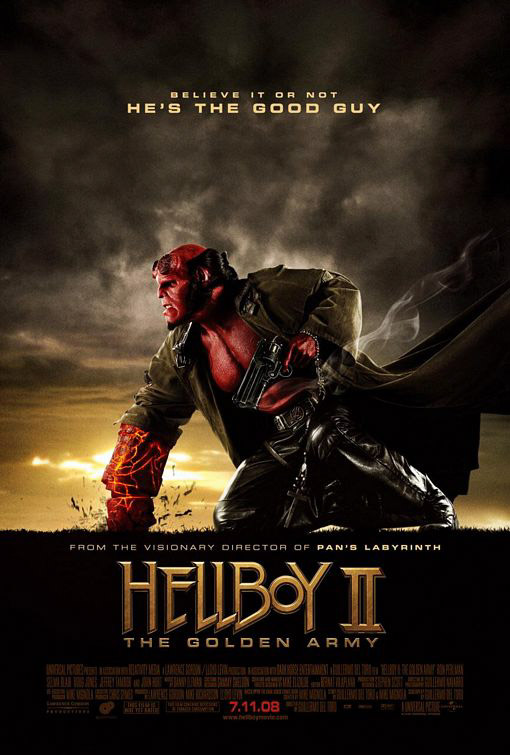
Hellboy (2004) and Hellboy II: The Golden Army (2007)

Hellboy (2004)

Director: Guillermo del Toro

Flawed, but singular and fun.

Hellboy is a curious entry into the world of film adaptations of comic book superheroes. Noted horror/fantasy/science-fiction director Guillermo del Toro went against the then-forthcoming grain of comic book movies when he opted to adapt the little-known cult comic, Hellboy, created and drawn by Mike Mignola. It ended up being a strong pairing of creative forces.

Hellboy quickly introduces the title character as a baby demon pulled into our world at the end of World War II. He was meant to be one of several diabolical, Lovecraftian monsters drawn down by the mad monk Rasputin in order to wreak havoc on Earth. Rasputin's plot is initially foiled, but not before the young demon is found by a platoon of U.S. troops. He is dubbed "Hellboy" and taken under the wing of  Professor Bloom, an expert on the occult and attache to the Allied platoon who finds Hellboy. Over the next several decades, Hellboy (Ron Perlman) is raised by Bloom into a massive, red-skinned, long-horned, amazingly strong force against supernatural attacks on mankind.

The movie still feels unique, even amidst the modern deluge of superhero, fantasy, and science fiction films. While it certainly hits all of the familiar marks of those genres - a threat to the world; dazzling superpowers; large-scale battles - Hellboy does it in its own ways. The "superteam" whom Hellboy works with is made up of oddities and outcasts, but very sympathetic ones. There are plenty of amusing quirks in the film: Hellboy's love of cats and beer; his often misplaced confidence; the strange and damaged super beings who comprise Hellboy's team. These all make it feel rather different from nearly all other action fantasy movies. Also, being a Guillermo del Toro movie, the horror elements are done very well, though they are softened with much more levity than his graver films like Pan's Labyrinth or The Devil's Backbone.

Hellboy's main weakness is that it doesn't completely flesh out all of its elements. The relationships between Hellboy and his team have some fun and interesting dynamics, but their history is never explored enough to become truly gripping. The Rasputin character is interesting in his potential power, but he is little more than a one-dimensional bad guy looking to rule the world. The brilliant Ron Perlman does as much as possible with the script, but the gags and one-liners can be hit-or-miss. These are a few of the areas of potential which went untapped in the film.

This is still a fun movie, and definitely one which fans of superhero flicks should watch or regularly revisit. It's a great alternative to the Marvel Cinematic Universe (which I love) and its competitors.


Hellboy II: The Golden Army (2008)

Director: Guillermo del Toro

Arguably an improvement on the original in several ways, despite exhibiting some of the same weaknesses. In short, it's another fun chapter in the off-beat superhero series.

All of the strengths of the first film remain intact here. The title monster hunter is still as fun and snarky as ever, and his teammates are still quirky misfits that wouldn't be found in other blockbuster superhero movies (except maybe Guardians of the Galaxy). The visual effects are strong, and del Toro still opts for costumes and make-up over CGI whenever possible, a choice which I hold in very high regard.

The leg up that this sequel has is that the villain has more depth that the first film (or most other action and adventure films). The back story here is that many millenia prior, the world was ruled by a race of elves, which had built an army of hulking mechanical warriors - the titular "Golden Army," which was reputed to be unstoppable in battle. Despite commanding this force, the king of the elves was betrayed, and the key to the army was lost to time. That is until our story begins, when the exiled elf Prince Nuada decides to track down the key, use it to reclaim the Golden Army, and reclaim dominance over Earth. Nuada actually evokes more sympathy than most villains, which adds a bit of richness far too often lacking in such movies (I'm looking at you, Marvel Cinematic Universe).

The playful sense of wonder is on full display here. As Hellboy and his crew track Nuada's whereabouts and uncover his plans, we get plenty of great set pieces, odd monsters both large and small, and an ever-deepening mythology which never takes itself overly serious. While the relationship between Hellboy and his teammate Liz often has a screwball feel which I can do without, this is still a great fantasy action movie that's well worth watching every year or two.

As of writing this, we are now eight years into the "Hellboy 3" rumor cycle. I, for one, would gladly go and watch another of these films. While the MCU's Guardians of the Galaxy was widely lauded for being a fun, anti-establishment departure from its MCU brethren, people seem to forget that many of those charming elements in Guardians had already been done by del Toro in his Hellboy movies ten years prior. We could use a few more pure popcorn movies that are high on fun while lying a tad outside of the box. Another Hellboy would give it to us.

Tuesday, September 16, 2014

Retro Trio: Pacific Rim (2013), 13 Assassins (2010), Dark City (1998)

Pacific Rim (2013)

Director: Guillermo del Toro

This was my second viewing of this one, and I feel the same now as when I saw it on the big screen a year ago. It's certainly fun, but far from a masterpiece.

Yes, it's giant robots fighting against giant monsters, referred to as jaegers and kaiju, respectively. If you need to know more than that, then you probably won't be into this movie.

I do have to say that they do come up with a decent enough story for why we are watching a robot/monster slugfest. It's not exactly novel, but it doesn't try to get too clever for its own good, while not insulting your intelligence. Also, the notion of needing at least two "pilots" to handle the neural requirements to command the jaegers, leads to a bit more genuine empathy than you might expect.

Del Toro made sure that the fights looked at felt just as
titanic as they needed to be. Mindless? Yes. Fun? Hell yes!!
The fights are pretty awesome. They lose quite a bit on a small screen, it must be admitted, but they're still fun to watch, if you're not bored by that sort of thing, like my wife often is (she was fast asleep while I was happily watching Gipsy Danger body slam a Gamorrah lookalike into a Chinese skyscraper). Waiting to see just what type of bizarre powers the kaiju possess, or what kung-fu type moved the jaeger pilots will employ is plenty of fun. And there are a few noble deaths given up for admiration. The a deep-sea slugfest at the end is more than satisfying.

The weaknesses to me are few, but too obvious to ignore. The first is that the dialogue is inconsistent. There are some decent lines, including virtually all of the ones delivered by Idris Elba. However, there are plenty of cheesy duds that made me wince. When the protagonist Raleigh Beckett urges his neural partner Mako, "Let's do this! Together!!", it sounded way too much like the awful, hackneyed dialogue one might hear in a children's anime program. The other weakness to me is the romance between Raleigh and Mako. Totally unnecessary. The shame is that, for nearly all of the film, they don't fall down the Hollywood trap of cramming a romance story into an out-and-out action movie. Then, at the end, we get the cliched kiss-cut-credits sequence. I would have admired the film a bit more if they had simply kept Raleigh and Mako's relationship one of friends and colleagues.

A fun movie, nonetheless. Watch it on blu-ray, on a large screen, with a good sound system, if possible.

13 Assassins (2010)

Director: Takashi Miike

Great samurai flick. I don't watch a ton of Japanese or samurai movies, but I absolutely love them when they're done well, like 13 Assassins.

It probably helped that, just by coincidence, I had finished reading Hagakure a few weeks prior. This 18th century collection gathers the thoughts of a true feudal samurai, and it provides a fair amount of insight into the ideals of that position in Japanese social history. 13 Assassins incorporates several of the deepest sentiments and values of the samurai, both the admirable and the baffling. The primary belief is the ultimate quest for an honorable death. Essentially, a true samurai should never fear death. In fact, a true samurai should embrace the fact that he will die, and he should simply prepare and wait for the opportunity to give his life in the service of his feudal lord. It may seem like an oddly suicidal world view to most of us Westerners, but I've always been intrigued by the sense of honorable purpose conveyed by such an approach to life and death. 13 Assassins uses this idea to motivate the titular group.

But the movie is far from merely being a somber existential meditation. It starts off not unlike a Seven Samurai "let's get the band together" scenario. A middle-aged samurai, Shinzaemon, is tasked with the mission of killing the psychotic, sadistic, and homicidal Lord Matsudaira before he ascends to an esteemed place at the side of the shogun. So Shinzaemon, played with masterful gravitas and humanity by Koji Yakusho, rounds up whomever he can find to attempt what amounts to a suicide mission. The dozen fellows who join the band do so for various reasons, but they all add something to the group.

Do not get on the wrong side of this haggard-looking group.
They're just itching to give their skills and lives up for a
noble purpose.
The assault on Matsudaira is akin to the final 90 minutes of Seven Samurai, but condensed and thrown into a blood-soaked typhoon. In short, it's amazing. There is a slow-build throughout the movie, in terms of the duels and stand-offs. There are some outstanding showdowns, with steely-eyed swordsman squaring off. During the final half hour, though, it's a blizzard of violence, as Shinzaemon's band uses every scrap of cunning and trickery, as well as their considerable individual fighting skills to mow down their 200 opponents. The direction is outstanding, giving a phenomenal sense of place, purpose, and tension to all of the action.

True to the spirit outlined in Hagakure, the 13 "assassins" charge towards their noble deaths, and it's a phenomenal show.

Dark City (1998)

Director: Alex Proyas

As the title suggests, this is a dark, twisted science fiction mystery tale that I found to be excellent.

Dark City contains many shades of other, earlier artists and works: Franz Kafka, Philip K. Dick, noir in its many forms, and Clive Barker's Hellraiser are some of the most immediate that come to mind. The blending of them, though, is unique and highly engaging.

I'll refrain from writing about the plot, as the slow revelation throughout the movie is a large part of its appeal. All a first-time viewer needs to know is that the protagonist, John Murdoch, awakes in a motel bathtub, with no memories of who he is or how he got there. He very quickly finds himself pursued by shadowy, cloaked figures who possess terrifying supernatural powers. Murdoch, in constant flight, attempts to figure out who and where he is, but every answer raises many more questions about the nature of the reality that he is experiencing.

The story is so creative, and its execution is so brilliant, that I'm simply amazed that this movie isn't better known. My guess is that some of the themes and visuals were a little too bizarre or macabre, and the aesthetic - a pervasive noir darkness - was a bit off-putting to people who didn't know what to make of it. In addition, the film doesn't draw the clearest lines between good and evil, which can often disappoint and confound many viewers.

Another potential source of frustration for many viewers is likely the fact that there are certain larger questions that are not clearly answered. Without giving anything away, I can say that we are never given the grand answer to just how the entire scenario of the movie began. But this is completely fine to me. Ultimately, the way it began is immaterial, and this unanswered question allows us viewers the opportunity to engage in some imaginative speculation, based on the many details offered in the film's look and narrative.

Whatever the reasons for its lack of commercial success, it's a great science fiction movie that has rightfully built up the wider praise that it should have received from the outset. 

Sunday, September 7, 2014

Retro Trio: The Most Dangerous Man in America (2008); The Triplets of Belleville (2003); Cronos (1995)

The Most Dangerous Man in America: Daniel Ellsberg and the Pentagon Papers (2009)

Director: Judith Ehrlich & Rick Goldsmith

I can't believe I had never heard of Daniel Ellsberg.

Maybe in the mid-1970s, his story was as huge as this film made it out to be. I'm not sure since I was hardly a twinkle in my pop's eye at the time. Whatever the case, this documentary lays out a fascinating tale of personal, internal conflict that has ramifications that reach the highest magnitude.

The original TIME magazine cover that
contained one of the biggest stories
of the 1970s.
The short version is this: Ellsberg was a brilliant strategist and former Vietnam vet who worked for the Pentagon for a number of years. He basically supported the presidential regimes under which he had worked, somewhat blindly faithful that he was doing the right thing. Then, he got the keys to the secret documents. Once he found out exactly what past and current presidents had known and still knew, he started to doubt everything he had previously believed.

Ellsberg's personal struggles are engaging enough on their own. When they are told within the context of a United States in some serious turmoil, they take on much grander significance. This documentary, though now six years old, has timeless themes. By looking at exactly when a person should start to take personal responsibility for wrongdoing, even if it may be a small part of a wrong, this documentary is just what the genre is all about.


The Triplets of Belleville (2003)

Original French Title: Les triplettes de Belleville

Director: Sylvain Chomait

It's weird and I loved it.

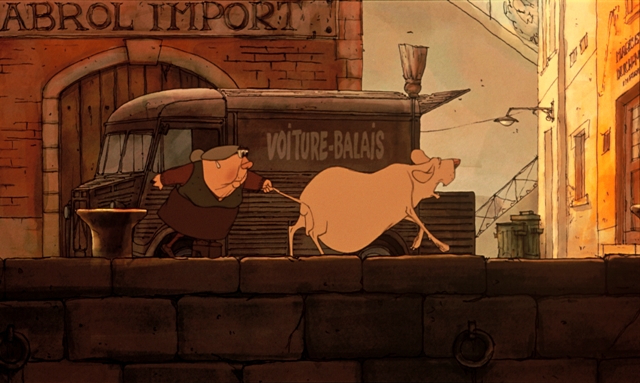
All you have to do is look a still frame from the movie to realize that this is not your typical animated film. The visual style is very quirky, and even jarring at times. Once you start watching, you realize that the film itself is just as idiosyncratic and skewed. The oddity that runs the course of the film is certainly amusing enough, but I'm not one who enjoys oddity for its own sake.

The grandmother and the dog, hot on the trail of their
beloved cyclist grandson. Two of the most endearing
characters you're likely to ever see in a film.
What I enjoyed so much about this movie is how the oddity adds an exotic spice to what is, at its most basic, a traditional tale of love, loss, and recapture. It's the details, though, that are hilariously strange. And there are countless little details to absorb. An old Portuguese woman living in France raises her grandson to be a competitive cyclist. He competes in the Tour de France, but when he falls far behind the leaders, some extremely strange things begin to take place. His supremely dedicated and stubborn grandmother winds up dragging their obese dog along on an odyssey to find the boy, running into no end of bizarre characters along the way.

The best thing? There is no real dialogue to speak of for the length of the 89-minute film. Sure, there are sound effects, music, and some grumbles and gutteral noises made by the characters. But mostly, it is all visual storytelling and humor, from start to finish. This is something that is difficult enough to do for five or ten minutes. To do it for a full, feature-length movie is the very reason the medium exists.

For an animated movie, I doubt that very young children would like all of it, though many would enjoy some of the sillier moments, especially with the dog. Anyone else who has an appreciation for the slightly peculiar and isn't too proud to watch a cartoon as an adult should give this one a watch. It's undoubtedly one of the most unique animated movies you will ever see.

Cronos (1993)

Director: Guillermo del Toro

I'm not exactly a del Toro "fan," but I've certainly enjoyed several of his movies. I really enjoyed the Hellboy films, and I thought Pan's Labyrinth was captivating. Pacific Rim was fun, even if I didn't geek out over it like many people did. I even thought that his earlier film, The Devil's Backbone, was a really novel story that showed some excellent technical skill and narrative creativity.

The kindly Jesus Gris inspects the cronos device, sending
him down a dark and tragic path along which his
granddaughter is courageous enough to follow him.
Going back and watching Cronos, del Toro's very first feature film, was mildly interesting. It's a vampire story unlike any that I've come across. An old antique dealer, Jesus Gris, comes across a statue that encases an intricately-decorated gold scarab. In examining it, the device activates several blade-like appendages which cut into and draw blood from Gris. Soon, Gris learns that the device, known as the "cronos device," was the work of an alchemist in the 16th century. The cronos contains some form of vampiric insect, which not only sustains itself with human blood, but conveys the same immortality upon its host. Thus, Gris begins to show symptoms of vampirism. This is ghastly enough, but also seeking the cronos are an uncle/nephew duo, the former of whom is seeking a cure from a terminal illness.

As with several of his films, del Toro inserts a young child into a place of prominence, which adds an atypical perspective on a horrific set of circumstances. In this case, it is Jesus Gris's granddaughter, whose love for her transforming grandfather becomes his only link to his mortal life. This is the real novelty of the film. Also impressive is the prowess of the cinematography, given that the budget of the film was clearly limited.

Cronos is not a great movie, but it's a decent enough one that gave several strong indications that its creator would be capable of far more when given more resources.