Showing posts with label Jean Renoir. Show all posts

Monday, April 20, 2020

Before I Die #639: La Chienne (1931)

Director: Jean Renoir

A good, classic French movie that didn't really grab me until the third act.

La Chienne - English translation, "The Bitch," - takes place in 1930s Paris and mostly follows Maurice LeGrand, a rather quiet, reserved, and sensitive sad sack who works as a clerk for a hosiery company. He is married to a WWI widow, a battle ax of a woman who despises him, and he finds solace in doing humble paintings when he can. Coming home from a dinner with work colleagues one night, he runs across Lucienne and Andre in a fight. Lucienne, or "Lulu," is a rather dim-witted young woman who is constantly extorted and abused by the fast-talking pimp Andre, or "Dede." Maurice rescues Lulu in a rather timid way, and he strikes up a romance with her. Dede, ever the opportunist, convinces the hopelessly dependent Lulu to help him extort Maurice for everything he has.

The movie is not an easy one to watch, frankly. As my summary probably suggests, it features a trio of none-too-admirable characters at its center. And honestly, it is disheartening to watch the spineless Maurice get bilked by the shallow and dumb Lulu, who in turn is abused and exploited by the morally bankrupt Dede. There are very few redeemable characteristics to be found in the movie, even with supporting characters like Maurice's wife, who is a vicious person with nothing but unfounded contempt for her second husband.

So why do I say it's a good movie? Well, it all came down to the third act for me. It was at this point that the plot took an unforeseen turn that, while rather shocking, still felt organic rather than contrived. Not only that, but it turns on their heads several notions about the characters and the viewers' judgments of them. It's not that you completely rethink all of them, but you certainly have to think hard about whether there is any justice in the ways that their three lives turn out by movie's end. It put me in mind of the classic American noir novel, The Postman Always Rings Twice. That novel I found to be rather dull until the final chapters, in which things become wondrously existential and find a depth that one couldn't see coming for most of the story. La Chienne produces a similar effect, and this film came out several years before James M. Cain's hallmark novel.

There is also, of course, the pure cinema of the movie. I've now seen a few of Jean Renoir's films, and the man always showed a keen eye for the visual (not surprising, considering that his father was world-renowned painter Auguste Renoir). While La Chienne doesn't employ any especially dazzling technique, such as we see in Renoir's Beauty and the Beast or his Orphic Trilogy, there are more than a few brilliant-if-subtle frame compositions and angles which enhance the mood and narrative. I often find such things easier to discern in black and white films, so this was a treat for me.

It took the final thirty minutes for me to see it, but it's clear why this one is considered a classic. 

Saturday, December 11, 2010

Film #42: Pather Panchali (1955)


* Pather Panchali is the 1st of a trilogy known as “The Apu Trilogy”. The 2nd and 3rd films, Aparajito & The World of Apu will be reviewed later in the list, but are considered a part of the same “film” by the reviewers at TIME who compiled the list that I'm working from.

Title for We English-Speaking Types: “Song of the Little Road”

Director: Satyajit Ray

Initial Release Country: India

Times Previously Seen: once (about 10 years ago)

Teaser Summary (Plot synopsis in 20 words or fewer. No spoilers)

Young Indian boy is born into poverty, lives with his sister, mother and oft-absent father.

Uncut Summary (The full plot, spoilers included. Fair warning)

In the 1940s (?) Bengal, India, the child Apu is born into a poor family. His father is a priest and poet who often struggles greatly to find work and pay for his family's needs. Apu's mother is a woman anguished by her own poverty, but is steadfast is trying to do right by her husband and children. Apu's sister, Durga, is roughly five years his senior, and is kindhearted, though she is mischievous enough to occasionally steal fruits from her wealthier aunt and cousins' nearby orchards. Also living with the family is their extremely elderly great aunt, who does little more than sit and make the occasional observation.

When Apu reaches the age of six, he is sent to school, a place where he finds the teacher rather frightening. By now, he has developed a very typical brother-sister relationship with Durga – the two annoy each other plenty, but genuinely love and protect each other from any possible harm, whether it be their scowling aunt, the absence of their wandering father, their sometimes angered mother, or the more abstract shame of being obviously poor.

Apu and Durga share a typical sibling moment.

One afternoon, with their father off in a large city to find work in either a religious or artistic capacity, a monsoon tears into the forest where Apu and his family live. Apu and Durga are stuck outside of their home, and Durga huddles close to her little brother to protect him from the relentless rains. After the storm passes, Durga takes horribly ill and dies within a few days. Apu's father returns the next day to discover the tragedy and collapses with his wife in grief.

In the wake of their daughter's death, Apu's parents decide to move the family away from their ancestral home and to the massive city of Benares, where they home to find more work, a better life, and leave their tragedies behind them. As a wagon takes the family away, Apu looks back on the only place he has known for his six years on earth.

Apu dons a hand-made prince's crown, perhaps suggesting a desire for greater things.

Take 1: My Gut Reaction (Done after this most recent viewing, before any research on the film)

Entrancing movie, if you're in just the right mood for it. If you're not, you're bound to find it slow, boring and may have trouble finding the point of it. I was in the mood, so count me in the former group.

Of the 42 films I've watched for this blog, Pather Panchali is easily the most humanist and naturalistic of the lot, and I suspect it may end up holding that title throughout the list. The story is the furthest thing possible from high drama that you can get. It's all about communicating all of the most basic, shared human emotions. The vehicle for this is the six year old boy Apu, a cute-as-can-be kid whose happiness, fear, love, disappointment, and shame shine as clear as day in his massive eyes.

This is the link to a great youtube clip that shows the great relationship between Apu and Durga. It's actually enhanced by the lack of English subtitles, as the dynamics, facial expressions, gestures and music tell the tale as well as any dialogue could.

The trick is that, on the surface, this story may seem as foreign as humanly possible. Not many of us in the Western Hemisphere would have an inkling of how a family in India lives, let alone a dirt-poor family in a small village in 1940s India. Yet, it only takes about 10 minutes of film to completely see so much of the universally human qualities being displayed in the tale Apu and his family. Even more than the stylistically similar Tokyo Story, Pather Panchali gives the feeling of watching a documentary rather than a piece of fiction.

This is not to say that the movie is solely a grim or depressing affair. Generously sprinkled throughout the tale of Apu's boyhood are many moments of good humor and pleasantness, those essential assets of survival for anyone in arduous conditions. His ancient great aunt makes a few good cracks and her constant threats to leave become rather amusing. The little looks of mocking and impish glee that Apu and Durga share between each other are bound to make anyone with a soul smile despite themselves. These lighthearted elements make it all the more tragic when Durga dies suddenly later in the film. These are no longer carefully crafted characters, but very real people whose pain is evident and evokes real emotion.

When I think about the acting, my educational background in anthropology kicks in a bit, and I try to think in term of cultural relativity. While I don't know what the standards are for Indian actors, the acting in Pather Panchali seems very solid to me. However, it's impossible to compare them to performances like Marlon Brando or Humphrey Bogart. Playing Terry Malloy or Rick Blaine is a different animal altogether, but the actors in Satyajit Ray's humanist drama do exactly what they are supposed to – act like completely real people. It's more subtle and perhaps not quite as demanding as the western tradition of drama, but it works marvelously for this movie.

The technical merits of the movie are fantastic. From the very beginning, as we follow a 7-year old Durga running through the forest, the soundtrack sitar playfully accompanies her traipsing along. This same instrument appropriately picks in during several other moments of joy and happiness in the film, and it's just one of several sound and camera elements that enhance the various moods experienced by the characters. The filming is done so that I felt very much like I had a excellent sense of Apu's little part of the Bengali forest and everything in it. It's very much the same feeling I get when watching Kurosawa's Seven Samurai – by the end of that movie, I feel like I know that little Japanese village, front to back. Pather Panchali has the same absorbing effect.

This isn't a movie for all comers. Like films that I've reviewed recently (Tokyo Story, Ikiru, Umberto D.), it's one that everyone should probably watch at least once, though one that I can hardly guarantee will be “enjoyed”. It is now clear that the 1950s was the beginning of the very real transition of films from mere fantastic, melodramatic storytelling medium to one of very somber, humanist tales. Up until this point, such things had been the purview of literature. No longer. Films like those aforementioned were clearly changing films as people knew them.

Entertaining? Perhaps not. Revolutionary? Definitely.

Take 2: Why Film Geeks Love This Movie (Done after some further research)

Being the first of a coherent trilogy, isolated research on Pather Panchali is a bit tricky. As such, I'll keep this section brief and do a more thorough look at all three films after watching them all.

One of the most remarkable things about Pather Panchali is that it was Satyajit Ray's first film, was done on a budget of approximately $3000 U.S., and that very few of the actors or production crew had any kind of experience in cinema. This undoubtedly lent the air of needed verisimilitude. For such a crew to create such a landmark film is indeed a rarity that speaks to Ray's unique vision.

However, the vision was not without its powerful influences. Probably the two most notable are the French director Jean Renoir and the then-blooming style of Italian neorealism. Apparently, Jean Renoir went to India to film The River, and was put into contact with Ray, who was then working as an illustrator and general film enthusiast. When Ray discussed his ideas for adapting the novel Pather Panchali, Renoir offered plenty of encouragement. After spending several months in London, absorbing every movie he could get his hands on, Ray returned to India with the mission of making his movie.

After watching such films as The Bicycle Thieves, the neorealist film by Vittorio de Sica and forerunner of other movies like Umberto D., Ray knew that this was the style that would best suit the tale of the young Apu in his impoverished Bengali village. When one sees both films, the similarities are as clear as day.

Critical reception of Pather Panchali was mostly glowing, though this was not universal. While many saw the movie as an incredibly powerful document of human life in a previously little-known segment of the world, others found it difficult to stomach. French film titan Francois Truffaut claimed to never want to watch “peasants eating with their hands,” and some in the Indian government thought the film was “exporting poverty”. Still, the detractors were outnumbered by those who found endless lyricism and merit in the movie.

A final, less important note is that the snappy sitar soundtrack was provided by none other than the now internationally famous Ravi Shankar (just how many sitar players can you name?), a then little-known musician who was just starting to carve out his career. This was just one of the many little things that fell into just the right place to make this singular movie.

Here's another link to the final moments of the movie. Be warned that it contains serious spoilers for anyone interested in watching the film and maintaining the power of the unknown. Otherwise, it's a good representation of the things that the movie conveyed.

Again, there is obviously more to the tale of Apu that is told in the second and third installments of the series, and a more complete run-down of the analysis will accompany my reviews of those movies. For now, though...

That's a wrap. 42 shows down, 63 to go.

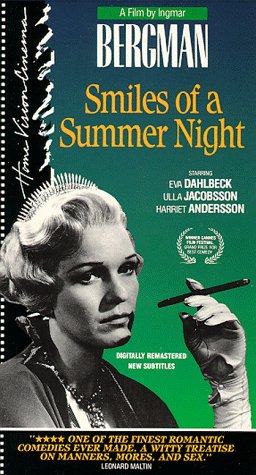
Coming Soon: Smiles of a Summer Night (1955)


A relatively early film by the insanely prolific Swedish film icon, Ingmar Bergman. I've seen quite a few of Bergman's other film, which can be challenging, to say the least. This one, by the looks of the poster however, may be of lighter fair. We shall see.

Please be sure to pick up all empties on the way out.

Thursday, March 4, 2010

Film #14: Le Crime de Monsieur Lange (1936)


Title That I Can Understand: The Crime of Mister Lange

Director: Jean Renoir

Release Country: France

Times Previously Seen: none

The Story (a summary of the plot; spoilers and all. Fair warning):

In Paris, France, Amedee Lange, a kindly, slightly naive employee for a small publishing company, toils nightly over a series of American western stories featuring a character named Arizona Jim, though the owner of the company simply laughs off any notion of actually publishing them. This owner, one Batala, is a complete scoundrel in a never-ending verbal dance to avoid facing his creditors and past lovers. On the verge of being sued, he gathers the companies funds, packs up and runs, leaving his company to deal with the disaster in his wake. Shortly after Batala hops a train out of town, we hear on the radio that the train has crashed, killing all aboard.

After the publishing company hears the news and panics for a short while, the remaining writers and artists, assisted by Batala's far more humane son, create their own co-operative and decide to publish the Arizona Jim tales. The stories become incredibly successful, and the co-operative find themselves in a new-found state of financial and social well-being, with even the shy Amedee finding love with Valentine, a beautiful and kind-hearted laundress who works nearby.

Just when things are at their height, Batala re-emerges. He had avoided death on the train and slinks back into the publishing office, threatening to reassert control over everything, take all that the co-operative has created, and perhaps even fire everyone out of spite. Upon revealing this dastardly plan to Amedee, the newly successful writer, refusing to allow the wanton destruction of so many people's lives, kills Batala and flees. At the border of France, Amedee and Valentine tell their tale to some local fishermen who have sympathy and help them flee across the border, presumably to safety.

Take 1: My Gut Reaction (done after 1 viewing & before any research):

Excellent movie, and this is saying something. I was exhausted when I started watching this, and the white subtitles were sometimes washed out by the white on the screen. Still, I was happy to fight through my fatigue and the visual barrier and see this film through to the end.

The story is told in classic flashback format. We actually open at an inn on the French border, and Valentine tells the whole tale to a bunch of locals. It works really well, as we immediately learn that this quiet and unassuming guy, Amedee, has killed someone. Great hook, right? It worked for me.

In a tight 80 minutes, you get a great feel for the setting, the characters and all the relevant plot points. It may be a touch rushed at times, but not distractingly so. I quickly developed sympathy for characters like Amedee, Valentine and others, while it took all of two minutes for the bile to rise in my throat at the sight of Batala. The publishing company owner, among a few other ancillary characters, may be a tad 2-dimensional, but he's certainly believable enough as a shifty, sleazy, if semi-charismatic, scumbag. It's another movie like Baby Face where a lot goes down in a concisely-told tale. I presume that this speaks to the director's skill.

The story itself is an interesting with one very deep question at its heart: Would you kill an inveterate leech of a human being to preserve the happiness of dozens of good people? It's one thing to ponder this hypothetical question on your own; it's another to see it play out amongst very believable, if fictional, characters. The murder doesn't come until close to the end. The rest is build-up and serves to create the power of the film.

Here's a clip from the end of the film. The subtitles are in Spanish, but just know that at this point, Batala, bastard extraordinaire, has returned and is explaining his plan to rob and gut the cooperative. Just watch Amedee's face towards the end - you can see the gears turning in his head, doing the math and having it all equal his final decision to murder:


Some may point out that none of the "good" characters is particularly strong. Amedee, the protagonist, is a bit of wimp in some ways, despite his good heart. Valentine is compassionate, but is overcoming past mistakes. The other characters' flaws are more glaring, but I think all of these add the humanistic element to the movie. By the time Amedee is faced with the choice to kill Batala, you completely realize what's at stake - the hard-earned joy of many very real people.

The acting may not be the best I've seen of the early films, but it's strong. A few of the simpler characters don't demand much range, so it's passable. The key roles of Amedee, Batala, and Valentine are played very well by Renee Lefevre, Florentine, and Jules Berry, respectively. This is all that matters.

I'd recommend this to anyone who likes old films and doesn't mind reading subtitles. The only drawback is that, right now, this one's a bit tough to find. It's not available on Netflix, so I had to order a VHS copy and pay $20.00 for it. Maybe it'll come out on DVD in the near-future, or you can find a copy at a video shop specializing in foreign and independent movies. If so, give it a shot if you want to dig into the past of solid cinema.

Take 2: Why Film Geeks Love It (done after some research on the film):

The handful of modern-day reviews of The Crime of Monsieur Lange seem to agree - it may not be absolutely perfect, but it's very unique in its mastery of telling an engaging, thoughtful tale that marries social commentary with genuine compassion, without either one becoming overbearing. Here's the short review by a fellow at TIME.

Apparently, the whole story of the cooperative springs from Jean Renoir's early affiliations with the far left movements in 1930s France. I suppose we're meant to see Batala as representing the thoroughly corrupt heads of industry. It may be a bit of a caricature, but it still works. The critiques I've read point this out as well as how Renoir didn't allow these elements to overwhelm the movie, raising it well above mere propaganda. This critic at Rotten Tomatoes puts it well.

The other lasting element is, as I had noticed, the very human characters. In later films of the French nouveau era that I've seen, like Breathless and Cleo 9 to 5, I feel like these "humanistic flaws" would become so commonplace and numerous that they led to characters who evoked no emotion from me, whatsoever. Decades before these, though, Renoir had the balance just right.

That's a wrap. 14 shows down. 91 to go.

Coming Soon: The Awful Truth (1937):

I've never seen this one, so my march through the unknown continues. Cary Grant's usually awesome, but this one is dubbed a "screwball comedy," which is a genre that I usually can't stand. Maybe this one will surprise me.
Please be sure to pick up all empties on the way out.