Showing posts with label Will Ferrell. Show all posts

Thursday, April 19, 2018

Retro Trio: Talladega Nights (2006); The Conjuring 2 (2016); The Ninth Gate (1999)

Talladega Nights: The Ballad of Ricky Bobby (2006)

Director: Adam McKay

My second viewing of this Will Ferrell farce, the first one being shortly after its release 12 years ago. Still consistently funny, though a movie that relies on its cast more than any especially clever script.

To quickly recap, Will Ferrell plays Ricky Bobby, a NASCAR driver born with a desire to "drive fast" and eventually gets his shot on the big stage. He quickly rises to the top of the sport, but almost as quickly becomes immensely arrogant, seeing his success on the racetrack as validating his and his family's boorish behavior. Ricky's world is turned upside-down when he is first defeated at the hands of the gay, French Formula One driver Jean Girard (Sacha Baron Cohen), and the subsequent defeat sees his family and best friend abandon him. Ricky then must rediscover his shattered confidence and put his life back together with the help of his loving mother (Jane Lynch) and his estranged and ever-irresponsible father (Gary Cole).

What can one say about Talladega Nights other than it's certainly a "Will Ferrell" movie. Ferrell has always been a guy who can make me laugh with consistency, even if he's never been an intellectual or overly clever comedian. Virtually every memorable role and character has been the same for him - the obliviously over-confident boor. Thing is, he is so freakishly good at playing this buffoonish role in spot-on deadpan, that he's bound to make nearly anyone laugh at least a few times in every movie. Talladega Nights is no different.

What helps this movie rise above lesser Ferrell fare like Get Hard or Daddy's Home is the comedic talent of the supporting cast. Time-tested comedy pros like John C. Reilly, Jane Lynch, and Sacha Baron Cohen unsurprisingly hit their marks well. But even lesser-known comedic quantities like trophy-wife-playing Leslie Bibb do nice work here. But arguably the stand-out minor character is legendary comedic character-actor Gary Cole, who plays Ricky's transient, rebel-without-a-clue father, Reese Bobby. Many will recognize him as the droning boss Lumbergh from the classic Mike Judge movie Office Space, or more recently as the hilariously dry political analyst Kent Davidson on the HBO series Veep. But here, Cole gets to show off a more dynamic aspect of his comedy game, playing the brash, loud-mouthed father who sparks his son's love of driving as well as his supreme arrogance.

It helped that I watched this movie with my wife, who hadn't seen it. Seeing a goofy comedy like this is always more enjoyable with others, even if it's hardly what I would call an essential classic. Within the Will Ferrell comedy canon, though, I have it up with Blades of Glory as one of his two or three best.


The Conjuring 2 (2016)

Director: James Wan

A step down from the original, though a high-quality version of a mostly by-the-numbers horror flick.

The Conjuring told the based-on-true-events story of a haunting which called on Ed and Lorraine Warren to assist a family with a truly haunted house. After recovering from that harrowing experience, the couple is now asked to help a poor family in London England with strange phenomena in their run-down flat. There, a single mother's children are experiencing moving objects and terrifying visions. Most notably, the youngest girl Madison is seeing and perhaps sometimes being controlled by the spirit of the old man who previously lived in the home.

This sequel was not nearly as satisfying to me as the original. It sticks to the same formula in most ways - use tried-and-true classic haunted house tropes: creaky doors, things jumping out of shadows, eerie sounds and whispers in the night, and so on, and do them well. Director James Wan (who also oversaw the original) is an undisputed expert in this realm, to be sure. The problem is that they lose their effect when one has seen the original movie not long before (I saw it about two years ago). Yes, the jump scares are very effective, but I've always found such a tactic as being ultimately shallow. Fortunately, there are some visual sequences that are more original and nerve-tingling, even before the inevitable jump-scare, such as Lorraine Warren's daydream at home involving "The Nun" (I won't ruin it for those who haven't seen it) and a few others.

I think what stood out to me as being particularly inferior to the original were the non-horror elements. The dialogue was notably bad at times, either from being overly sappy or simply overwrought. While the original movie didn't have stand-out dialogue, it at least wasn't distracting in any way. The sequel, unfortunately, made some missteps by trying to get sentimental or explore more human emotional territory. When highly reliable actors like Vera Farmiga and Patrick Wilson are having trouble selling the lines, then you know the writing is a bit dubious.

So I obviously did not like The Conjuring 2 as much as the original. Still, it was loads better than the next movie I watched...

The Ninth Gate (1999)

Director: Roman Polanski

Disappointing, even though I pretty much knew to keep my expectations tempered.

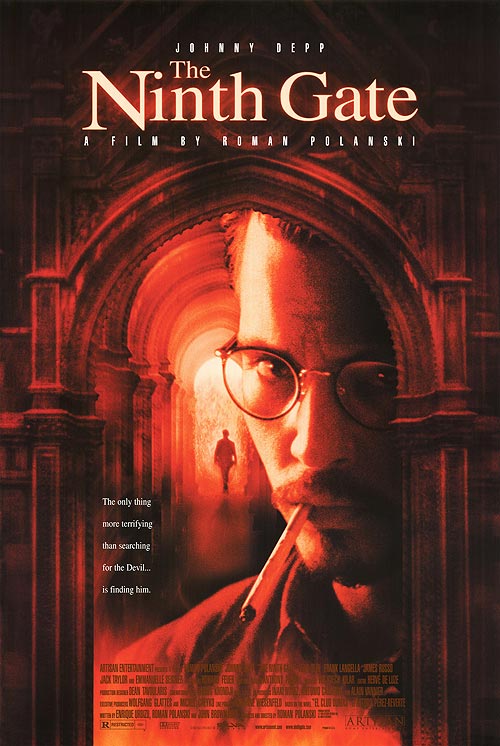
All I knew about this movie was that it was about a rare book dealer who is sent to track down an ultra-rare volume reputed to be of particularly demonic nature. As a guy who loves books, used to work in book stores and collect books, and enjoys a good Biblical demon story, I thought there would be enough here to really enjoy. Not quite.

The story follows Dean Corso (Johnny Depp), a book dealer of highly dubious morals who is hired to track down a pair of books supposedly written by Satan himself. The man who hires him, Boris Balkan (Frank Lingella), has one copy of the volume and he wants it authenticated along with the other two. Corso infers that Balkan has been attempting to use the books to literally raise the devil and acquire unspeakable power in the process. Corso goes to Europe, where the other two copies are held. As he gets closer to the books and their owners, however, Corso becomes a person of interest for a few mysterious individuals. When people start to die around Corso and the books, things grow ever-more sinister. Everything culminates when Balkan ends up with the relevant information from the three texts and enacts a Satanic ritual, only to fail horribly and burn himself alive. Corso, who witnesses this first-hand, is then granted his own chance to pass through the titular "ninth gate," and into who knows what sort of demonic powers.

The movie has some solid ideas going for it. Unfortunately, I'm not sure what accomplished director Roman Polanski was thinking as he made this movie. I don't know if there was studio interference here, or if it was just a bad misfire in terms of vision (it happens to the best of them), but the movie never seems to get anything completely right. There are several plot turns which at first are intriguing but then fall flat due to either being unimaginative or simply lacking enough detail to be compelling. Characters act in illogical or wildly inconsistent ways. I often had the feeling that Polanski was trying to be too subtle, leaving the audience to figure something out but not giving us nearly enough clues to do so. What we are left with is a mess of overly vague suggestions that never coalesce into a satisfying narrative.

The acting is just as spotty as the narrative. The veterans like Depp, Langella, and even Lena Olin are fine. They do their typically-solid jobs here. But more than a few secondary characters were downright awful, most obviously "The Girl," played by Emmanuelle Seigner. I don't know any of Seigner's other work, but it looks like she has a solid resume in film and TV. That said, it was simply hard to watch her in this movie. I can only guess at the possible reasons; whatever it was, though, it resulted in line deliveries that were alternately stiff and oddly-stressed. There were also a few other bizarrely wooden actors in lesser parts, which rang of Polanski hiring them for their stunning good looks rather than any trace of acting ability.

This movie is a shame, really. It had the makings of something much scarier and memorable, rather than the frustrating mess that it was. 

Friday, February 23, 2018

Retro-Trio: Hellraiser (1987); Semi-Pro (2008); Flesh + Blood (1985)

Hellraiser (1987)

Director: Clive Barker

Sometimes you feel the urge to go back and watch a highly influential movie you hadn't seen in decades, even if you're fairly sure that it won't hold up well. Such was the case when, a few nights back, I noticed that Hellraiser was available on one of my streaming services. It was late, and I was in the mood for something twisted and dark, so I went for it.

Watching this movie now, 31 years after its original release and probably a good 25 years after I'd last seen it, the strengths and weaknesses are exactly what lay in my memory, even though most of the details had been lost in the interim.

For those who don't know the tale, it is a wildly horrific tale of Julia and the family into which she married. The rather cold, reserved Julia moves into the old, previously abandoned family house of her husband, Larry, and her step-daughter Kirsty. When first seeing the place, they realize that Larry's mysterious loner brother, Frank, had been squatting in the home not long before their arrival, though Frank is nowhere to be found at the time. Seeing his belongings sparks Julia's memories of having an extended, passionate affair with the darkly hedonistic Frank, and Julia even begins to dream about being with Frank again. A few days later, Larry cuts his hand in the home, and the blood trickles into the floorboards of the dank, upper-most room in the house. Slowly, the blood is absorbed and revives some sort of horrific, flayed human, whom Julia discovers to her horror. This creature quickly explains to Julia that he is, indeed, Frank, and that he had transported himself, via a strange black and gold magic box, into a realm of dark sadomasochism ruled by terrifying, demoniac creatures called Cenobites. Frank convinces Julia to lure more victims into his upper floor lair, where she should kill him and allow their blood to revitalize Frank into human form before the Cenobites discover him missing and pull him back into their twisted, torturous realm.

In its day, Hellraiser was one of the most creative, disturbing, and truly horrifying films made in quite some time. Sure, there had been more graphic horror movies. And there had been eerier tales told on film. But Clive Barker's feature film debut was its own stunning blend of modern gothic horror and graphic bloodletting, wrapped in a supernatural tale that hinted at its own almost Lovecraftian-level mythos. The mere conception and look of the Cenobites, tortured and disfigured creatures cloaked in black leather and adorned with various sharp, cutting instruments, was enough to give most of us nightmares. When this was added to the quality special effects that brought the nightmares to life, you had something that made a major impression, grotesque it is may have been. In watching it now, 30 years after its release, I can say that most of the visual effects, especially the costumes and basic set designs, hold up. And the pure horror elements of the story are just as disturbing now as they were then.

The effects in the movie are great, most notably on the
slowly-regenerating Frank. It calls to mind of the stellar
makeup work from Cronenberg's
The Fly.
Unfortunately, like most of even the best horror films, the non-horror aspects of the movie are fairly weak. The backstory of Frank and Julia's affair is quite shallow, with Frank being a one-dimensional "bad boy" who literally shows up in a leather jacket on Julia's doorstep, dripping with rain, and giving her the bedroom eyes right from the jump. There is zero subtlety in their lust-filled affairs, and it seems a bit odd that Julia becomes so wildly obsessed with him that she is quite literally prepared to become a serial killer just to revive him - a man who long since abandoned her to go chasing other women and satisfaction of his own carnal lusts through any means he could find. I suppose one could argue that such can be the power of lust, especially lust repressed under a cold veneer such as the one that Julia usually exudes, but this is a bit of a stretch.

The acting is rather inconsistent, too, with a few screen veterans like Andrew Robinson and Clare Higgins doing just fine, but most other cast members appear rather amateurish. It doesn't do any of them any favors that the dialogue is uncomfortably bad, aside from the few memorable catchphrases that Barker puts in the mouths of the Cenobites - "We have such sights to show you," and "We'll tear you soul apart!" delivered in actor Doug Bradley's powerful, domineering voice still resonate as some of the most memorable lines in the history of horror films. But when it comes to the more casual dialogue between the horror scenes, the attempts at humor fall completely flat and any attempt to build any compassion for the characters never materializes.

I recall having seen the immediate sequel, 1988's Hellbound: Hellraiser II, but I've never bothered with any of the seven feature-length follow-ups (several of which were straight-to-video). I can appreciate dark horror, and the more imaginative concepts which Clive Barker created those decades ago are still somewhat compelling, but there was never enough for me to go beyond those first two movies. Real horror aficionados have likely already seen these films, probably multiple times, so it is hard to recommend it to any new viewers. Only if you are a horror fan who is a bit young and never gone back to see this one would I suggest you give it a go - despite its clear flaws, it really is one of the most influential horror movies of all time, with its fingerprints still being seen in horror movies made today.


Semi-Pro (2008)

Director: Kent Alterman

It's a Will Ferrell comedy, alright.

I like Will Ferrell. He's always been good for pretty solid, consistent laughs. I have not, however, ever become a full devotee of the comedian with seemingly boundless energy. As funny as he can be, he rather quickly became a one-note comic act in my view. This is why I've never run out to catch him movies in theaters, often waiting years after their release to watch them; sometimes never bothering to watch them at all. Watching the now decade-old Semi-Pro did nothing to change my feeling about Ferrell, either positively or negatively.

The story takes for its setting the rather low-hanging comedic fruit of the disco era in 1976. Ferrell plays Jackie Moon, a one-hit music wonder who used his lone hit song's earnings to purchase the Flint Tropics - a professional basketball team in the struggling American Basketball Association (ABA). The Tropics are the worst team in the floundering ABA, only keeping their nose above water thanks to Moon's over-the-top promotional antics, including sensational halftime shows and performances. When word comes down that the ABA is going to be contracted and absorbed into the far larger and more successful NBA, the desperate Moon makes a deal to see that his team is one of the four who will make the jump into the big league. The deal requires him to get his squad to climb out of the cellar and attain 4th place in the ABA standings by season's end, no mean feat for the disogranized and talent-bereft Tropics. Hope does emerge when aging former NBA player Ed Monix (Woody Harrelson) is able to lend his veteran knowledge and help coach up talented but selfish young NBA-hopeful Clarence (Andre Benjamin).

While Ferrell's Jackie Moon character isn't exactly like Ron Burgundy in Anchorman or Ricky Bobby in Talladega Nights, Moon does bear the hallmark idiocy, self-absorption, and overconfidence of virtually every character Ferrell has ever played on TV or the big screen. Of course, there is a reason for the typecast - Ferrell is exceptionally good at the role. Despite myself, I can't help but laugh at his line deliveries, facial expressions, and overall body language when playing such over-the-top buffoons. Since Ferrell's shtick alone can become a bit tiresome at times, it helps that there's ample comedy talent around him. Will Arnett is a standout, as the whiskey-swilling, chain-smoking color commentator for Tropics' broadcasts, but there are several others who round out the proceedings well. Woody Harrelson's comedic gifts are mostly underutilized, as he plays the mature role in the film, but he does have a few moments.

As with every other Ferrell-starring film, not every gag hits, and there are probably ten to fifteen minutes of ad-libbed nattering that should have been edited out, but the movie provides frequent enough laughs to justify its purpose. It's a dumb comedy meant to provide some gut laughs. It does that just fine.


Flesh + Blood (1985)

Director: Paul Verhoeven

A rather good, gritty medieval flick with a B-movie attitude by a director who knows how to do entertaining sex and violence.

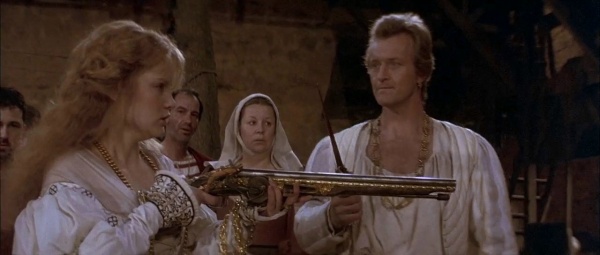
I picked this one up after seeing it pop up on more than one "underrated film" list. Despite being a true 1980s kid, I had never even heard of it. Now that I've seen it, I understand why. The movie follows a renegade band of mercenaries led by Martin (Rutger Hauer), a highly skilled and dangerously cunning fighter. Martin and his band are first used and then cheated by a regional lord in order to get his castle back from invaders. As revenge, Martin's unruly band stages an attack on a group of the lord's closest associates, including his son Steven (Tom Burlison) and Steven's bride-to-be, Agnes (Jennifer Jason Leigh). Martin's band of marauders steal the goods, only to later discover that Agnes has been hidden away in one of the wagons. She is promptly raped by Martin, although in a way whereby Agnes either does, or at least acts like she does, enjoy being violated by the strapping bandit leader. From this point, Agnes's action become rather difficult to decipher for everyone involved. She is taken with the band to a small nearby castle, where Martin's crew kills the defenders and takes over. Agnes seems to become Martin's willing woman, although when Steven and the regional lord's soldiers lay siege to the castle, Agnes continues to change her allegiances back and forth between Steven and Martin. By tale's end, Martin narrowly escapes his entire band's being wiped out by the plague, and Agnes leaves with Steven. Agnes actually sees Martin escaping, but remains silent rather than alerting Steven's men to the dangerous bandit's survival.

This is a 1980s medieval sword-swinger unlike any other I've ever seen, especially from that era. I always enjoyed the setting and characters in those romantic "Arthurian" type tales, and even plenty of the fantasy tales that were inspired by that sort of setting. Excalibur is still great, and movies like Ladyhawke and Willow always had an appeal for me. Those movies were, though, relatively PG-rated. Flesh + Blood, on the other hand, gets its hands really dirty. The murder and sex are right in your face, and Martin's rape of Agnes is downright disturbing on an original Straw Dogs level. This movie is very much about depicting a band of depraved and bloodthirsty cutthroats in all their viciousness, and it works quite well. They truly are despicable characters.

Martin is more than ready to let Agnes handle his, uh, rifle.
The previously-sheltered Agnes takes to the sex and violence
with disturbing alacrity.
The story of Agnes is also a strangely novel one. There is a bold ambiguity to her motivations, as she plays Martin and Steven off of one another, almost like a cat playing with two mice. Of course, this cat is posing as a harmless kitten, but there is a strange empowerment to her character at times. And the way that the theme of violence is handled puts me in mind of the David Cronenberg masterpiece A History of Violence, in which violence is depicted both as a repugnant aspect of human nature as well as a source of animal magnetism to others. Rutger Hauer's swaggering, bare-chested alpha male Martin is the polar opposite of the learned and thoughtful but also bold and clever Steven. The basic tale of a woman torn between "brawn" and "brains" was not a new one by a long shot, but this movie tackled the subject in a grittier way than any other I know of.

I doubt I'll ever need to see this movie again, but I was glad to have finally gone back and given it a shot. It's not for everyone, as it is a hard-R-rated movie, without a doubt. But it more than held my attention for its manageable running time, and it shed even more light on what an exciting, if uneven, resume Paul Verhoeven has put together over the decades.

Monday, December 21, 2015

Retro Trio: Massacre Gun (1967); The Happiness of the Katakuris (2001); Blades of Glory (2007)

Massacre Gun (1967)

Original Japanese Title: Minaogoroshi no kenjuu

Director: Yasuharu Yasebe

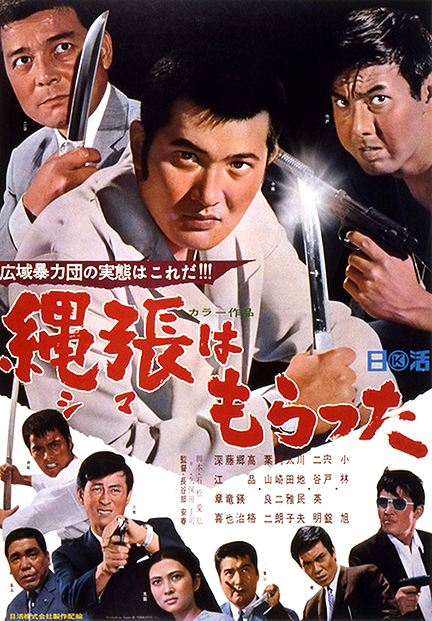
At a glance, Massacre Gun has all of the sheen and polish of the slickest, finest noir crime films. Unfortunately, there is very little beneath the stylish exterior.

The movie follows Ryuuichi (Joo Shishido), a highly trusted lieutenant in the yakuza - the organized crime cadre in Japan. Ryuuichi is loyal enough that he even kills a young woman whom he has been leading on, at the orders of his bosses. This stuns his two younger brothers - Eiji, who is an aspiring yakuza, and Saburo, an up-and-coming boxer. When Ryuuichi decides to leave the life of a yakuza, his bosses begin to apply pressure on him to stay. Things soon escalate from minor skirmishes into all-out warfare between the brothers and Ryuuichi's former employers.

The basic story certainly has the makings of a decent crime tale. The execution, however, is often poor. The characters often act foolishly or completely predictably. It is thoroughly clear from the first 5 minutes that Ryuuichi is the "calm, quiet, thoughtful loner" - an archetype loved by many tough-guy movie fans, including Japanese cinema-goers. The only remote twists are when he decides to turn against his bosses, and when he decides to go completely "massacre gun" on them after they go too far. Aside from these, the plot and characters are fairly paint-by-number. Eiji is the typical hot-head, and Saburo is the kind-hearted prospective boxer who "coulda been a contender" if not for the interference of the mafia (On the Waterfront, anyone?). The mob against which the brothers fight is composed of completely one-dimensional, cardboard cutout gangsters, complete with cliche one-liners and hard stares. Whenever the movie attempts to do something original, it was a bit ill-conceived, such as when the brothers intimidate an opponent by dropping bowling balls on his foot - a foot which, inexplicably, the guy never tries to move. The movie has more than a few such scenes in which the aesthetic was more important than any attempt at organic plot progression. Once you've seen a Scorsese-directed mob torture scene, pretenders are embarrassingly weak-willed.

Perhaps the movie would have been more compelling had the dialogue been more original or the acting been more subtle. Neither was. I can't recall a single line of dialogue which stood out or wasn't predictable. Similarly, the acting was typically exaggerated for many Japanese films, whereby far too many of the actors are trying to deliver their lines with their entire bodies, all of the time.

Massacre Gun is a curious entry into the noir film canon. If you're looking for something of the depth or artistry of classics like Double Indemnity, Out of the Past, or even more mob-centric movies like The Killers, you're bound to be disappointed. If, on the other hand, you simply enjoy the look and general style of hard-boiled crime films, then this one is worth a viewing.


The Happiness of the Katakuris (2001)

Original Japanese Title: Katakuri-ke no koofuku

Director: Takashi Miike

A very strange one that amuses, in its way.

From what I've heard, this movie released with a decent amount of buzz back in 2001. It was being called "an instant cult classic," and similar. Had I known of this hype around the movie, I probably would have been disappointed by it. Fortunately, I knew very little, so I was able to enjoy it for what it was and not what others were telling me it was supposed to be.

The movie follows the Katakuri family, a sextet of Japanese spanning four generations, as they attempt to get their new bed and breakfast to make a profit. The problem is that the B&B is isolated from any kind of attractions and main roads. Making matters far worse is that once a few travellers do show up to stay, they all seem to die horrible deaths, including suicide, heart attack, and asphyxiation under a sumo wrestler, to name a few. Amid all of the death and fretting over economic viability, the Katakuris experience the typical dramas of a sitcom family. The father and mother work hard to support the family. Their son is a typically-disaffected young man, and their daughter is a dreamy, flighty romantic.

Frequently, the Katakuris sing. In a bizarre homage to The Sound of Music, the characters will often break into song and dance numbers about their emotional plights or the grim circumstances of macabre deaths around them.

You can imagine that this all makes for a very peculiar movie. When you add in the fact that the movie periodically shifts into claymation for no discernible reason, then you have a truly unique viewing experience. It's not exactly a great one, but it is unique. My wife and I definitely got a good amount of laughs from the movie, though we were in agreement that this was likely because we had no expectations going in. The movie was clearly filmed on a very low budget, and director Takashi Miike, who directed the brilliant 13 Assassins and about a million other movies of varying quality in the last 25 years, was throwing all kinds of things against the wall in this one. Some of them stick, while others simply slide down the wall and end up in a sloppy puddle on the ground.


Blades of Glory (2007)

Directors: Josh Gordon & Will Speck

This is a Will Ferrell movie that delivers the laughs more consistently than many of his others.

The world of figure skating had long been ripe for parody. In 2007, Blades of Glory got it very right. The two leads, Will Ferrell and Jon Hader, play Chazz Michael Michaels and Jimmy McElroy, two parodies on ice. Michaels is the oversexed "bad boy" of skating, while McElroy is the polished, effeminate, squeaky-clean pretty boy. The two are bitter rivals who are thrust together as a pair after being banned from the sport for fighting on the ice. It's a set up that easily could have fallen completely flat, if not for solid comedy writing and great acting.

I generally like Will Ferrell, though many of his hit movies are mediocre at best. Talladega NightsGet Hard, and Anchorman are a few examples of his movies that provided me with just enough laughs to justify watching them once, but I've never felt the urge to go back to them. Blades of Glory, however, holds up well, even after seeing it three times. The lines are great, and the gags hit far more often than most parodies. When it's not Ferrell's hilarious over-confidence, it's Craig T. Nelson's showing of a decapitation during a pairs skating performance in North Korea. Or Rob Corddry's cameo as the over-serious manager of a second-rate kids show on ice. Since the movie doesn't solely rely on Ferrell's comedic magnetism, its humor can hit you from different directions.

This is a goofy comedy that I'll return to every year or so and thoroughly enjoy, as ridiculous as it is and should be. 

Sunday, November 29, 2015

New(ish) Releases: Inherent Vice (2014); What We Do in the Shadows (2015); Get Hard (2015)

Inherent Vice (2014)

Director: Paul Thomas Anderson

The Big Lebowski meets Fear and Loathing in Las Vegas. As you may imagine, this works brilliantly at times but is a hazy mess at others.

Inherent Vice bears many hallmarks of the noir film genre: A male detective protagonist. A (quasi) femme fatale. An array of strange and suspicious characters. A nefarious plot which grows complex enough to baffle nearly any viewer. The story was clearly taking from the pages of the earliest noir novelists like Chandler and Hammett, as well as the classic noir film directors such as Raoul Walsh and Billy Wilder.

Where Inherent Vice would seemingly take a different slant on the noir genre is how it makes the private investigator protagonist a semi-burned out stoner, Larry "Doc" Sportello (Joaquin Phoenix). That is, it would be a different slant if the Coen brothers hadn't already done it nearly 20 years ago in The Big Lebowski. Granted, there is far less comedy and far more grasping for some sort of vague profundity in Inherent Vice. Still, it is impossible to watch the parade of comically bizarre and eminently "Los Angeles" characters and not think of the dozens of oddballs whom The Dude encounters while trying to track down Bunny Lebowski. The Dude had Walter, Jackie Treehorn, Maude Lebowski, the German nihilists, and plenty of others. Doc has Michael Wolfmann (Eric Roberts, in a solid performance), Detective "Bigfoot" Bjornsen (Josh Brolin, the same), Jade the hooker, Dr. Blatnoyd, D.D.S., the Nazi skinhead bikers, and plenty of others. Vice is clearly the spiritual successor of The Big Lebowski's tale of "a strange dude among far stranger and scarier people." It does make for a rather fun, trippy, 20th century American odyssey.

I have not read Thomas Pynchon's source novel, though I must assume that it provides the film adaptation's inconsistent, incoherent voice-over narration. Amidst what is sometimes very straightforward slapstick or gumshoe storytelling, the thoughts and observations of the nebulous character Sortilege often seem out of place and pretentious, if not downright ridiculous. The main characters also suffer from this same strange inability to completely flesh themselves out, whether through their actions or dialogue. It is simply quite difficult to get any firm grasp on who or what each person is supposed to be. When you mix in the sometimes-frantic tone, which I associate with Terry Gilliam's wildly uneven adaptation of Hunter S. Thompson's Fear and Loathing in Las Vegas, then there tends to be just a little too much emulation of earlier iconic pieces of work. Honestly, Inherent Vice even has Benicio del Toro in a cameo playing a fast-talking, unhinged lawyer, just like in Fear and Loathing.

All of this said, I will likely watch this movie again in the future, probably after reading Pynchon's novel. The performances are certainly commendable, even hypnotic at times. The movie seems strongest when at its most comical, even if this is also when it wanders too deeply into the territory of being a Lebowski clone. The story also includes enough of the noir hallmark twists and turns to provide amusing mental exercise in simply keeping up with everything. Some of the work pays off, while some left me wondering at the exact purposes of certain parts of the film.

Inherent Vice is another film in the Paul Thomas Anderson catalogue which shows the director's eye for visuals and dedication to crafting something engaging. This recent effort, though, is arguably his least accessible film to date. Those who like a clear, straightforward narrative and tone will probably find this 140-plus minute movie frustrating. Even those who appreciate elements of the film will likely find their patience tried more than a few times.

What We Do in the Shadows (2015)

Directors: Jemaine Clement and Taika Waititi

Maybe not quite an instant classic in the Spinal Tap class, but this is a great mockumentary.

Mimicking the tone of "days in the lives of" documentaries, What We Do in the Shadows follows four flatmates in New Zealand who happen to be vampires, ranging in age from around 150 to over 8,000 years old. Though having all of the powers glamorized through popular fiction, the four undead roomies are not immune to many nuisances similar to those experienced by the living, though their problems have very peculiar twists. They bicker about who has to clean the dishes, but they do it while floating in the air and hissing at each other. They try to keep the carpets clean, but mostly from their accidentally hitting a victim's artery and spraying blood all over the apartment. Since they can't cast a reflection in a mirror, they have to draw rough sketches of each other in order to know what they look like. And on it goes.

The movie is hilarious in a variety of ways. Some of the gags and lines are immediately and gut-bustingly funny. Others are far more wry, but they are likely to stay with you and grow funnier the more you think about them. One example is how the vampires, in their attempts to go clubbing, are constantly frustrated by the fact that they must, in keeping with well-known vampire lore, be invited inside. Watching the main trio of powerful creatures get turned away from club after club grew funnier the more I replayed it in my mind. This was just one of dozens of similar gags.

The cast is all but perfect. True to the humor seen in director/star Jemaine Clement's HBO series The Flight of the Conchords, everything is done in complete deadpan. The actors were, to a person, spot on in their absurd matter-of-fact approach to being vampires, meeting vampires, or even being eaten by vampires. A particular standout is co-director Taika Waititi, who plays Viago, the single most amusing and memorable character in the film. Viago was born in 18th century Austria, and is a hilariously chipper "dandy," as his roommate and fellow vampire Vladimir calls him. Waititi plays this undead creature of the night with such hilarious cheerfulness that his performance alone is worth your time.

I have a feeling that this movie will only grow funnier upon repeat viewings, as do the very best mockumentaries.


Get Hard (2015)

Director: Etan Cohen

Enjoying this movie requires two simple things: Be a fan of either Will Ferrell or Kevin Hart, and check your brain in before you watch it. I am, and I did, and I had just enough fun to justify spending 100 minutes with this comedy.

The  movie has problems, to be sure. The script and tone smack of disorganization and overreliance on improv by the highly energetic co-stars. The attempts to use race and racial stereo-typing as sources of humor sometimes fall flat at best, and horribly offensive at worst. Many of the scenarios are far too ridiculous to hold up to even the slightest bit of scrutiny. All the same, it provided just enough of the stupid humor that I was looking for that night.

My main concern going in was that I would find the hyper-active Kevin Hart extremely annoying. Blessedly, he's the far straighter character, resulting in his toning down his energy level enough to remain funny without getting too clownish. Ferrell is the far more ridiculous character here, which has always been his comfort zone. Between his occasionally manic outbursts and deadpan absurdity, he can carry many would-be dud scenes. Granted, there are several scenes so ill-conceived that neither Ferrell nor Hart could breath humor into them.  All the same, I got a good solid laugh every 5 or 10 minutes, which is all I really look for in a movie that clocks a 29% positive rating on Rotten Tomatoes.

The most frustrating thing about movies like Get Hard is that they have far more potential. In the opening scenes, it seems as if we are in for a well-done satire on wealth, privilege, and racial stereotyping. Around 15 minutes in, though, the satire fades and an oddly serious tone takes over. The remaining hour or so continue to zig-zag between complete zaniness and half-baked or misguided attempts at social commentary. If the movie had had a clearer vision of itself and more imagination and courage with the script, it could have been far better. As it was, it ends up in the same barrel as Talladega Nights - an intermittently funny flick that I'll never watch again. 

Saturday, February 13, 2010

Film #10: It's A Gift (1934)


Director: Norman Z. McLeod

Release Country: United States

Times Previously Seen: none

The Story:

Harold Bissonette (pronounces "Bis-oh-nay"), a mumbling, bumbling goofball of a man inherits some cash and seemingly wastes it by buying his lifelong dream: an orange orchard. Much to his wife's dismay, he sells their grocery store in New Jersey, packs up the family and heads to California. Upon arrival, they discover that the hoped-for splendor of an orchard is a complete dust bowl. Just when it all seems to be lost, Bissonette is offered a true orchard and tons of cash for the property, so that some prospectors can build a grandstand for a race track. All's well that ends well.

Take 1: My Gut Reaction (done after one viewing & before any research):

I enjoyed the movie for giving me a few really good laughs, but overall I don't love it.

I love W.C. Fields for probably the same reason that everybody has loved and still does love him - he's a character. He never had the wit of Groucho Marx, the pure physical abilities of Charlie Chaplin or Buster Keaton, and he was never in movies that told interesting tales. Still, there was no one at all like him: a half-clueless, drunken clown who spent half of his movies insulting those around him under his breath, while refusing to notice his own total ineptitude.

It's a Gift is pretty forgettable, story-wise. As with the other Fields films I've seen, the plot serves purely as a vehicle for Fields to do his thing - getting verbally and physically abused for his buffoonery and staring back at the world from between those narrow slits of eyes as if to say, "All of you are mad. Leave me out of all this."

When I try to pin down what it is that makes Fields so damn funny, I think of the reason my Dad gave me years ago: it's the under-the-breath comments. Dad's right. It's that and, like Buster Keaton, the downright refusal to so much as crack a smile.

One of the earliest scenes of Field's goofy interactions with his family. A still photo does him small justice - you've got to see him in action to witness his genius physical comedy.

The way he gets continually badgered by the people and world around him is all just the foil for his responses. In truth, a lot of the scenarios do become quite tiresome and annoying. In a handful of them, there's a good payoff, with Fields delivering a really snarky line. Other times, they fall flat.

Basically, Fields was something like the Will Farrell of his day. Not that they play the same character - but both men continually play singular characters of their own design. Farrell is always a semi-clueless, hyperactive gorilla; Fields was always a semi-clueless, lazy tippler. Neither man made a career of being in thoughtfully plotted films, but I laugh at them, all the same. Maybe not at all of their jokes, but enough to keep me coming back.

Take 2; or, Why Film Geeks Love This Movie (done after some research):

There's not much research to be done on this one. TIME Magazine didn't even do an original review for it back in 1934. The one thing that critics of past and present point to is what strikes everyone about W.C. Fields films, and that's W.C. Fields. It's funny to notice that no analysis of the film gives more than a line or two about the story, or anything else, aside from Fields. This is as it should be. All reviewers point to Fields' singularly misanthropic, yet lovable and engaging, character. It's a Gift, by most accounts, had the greatest number of solid gags in it. It's put quite well in the one paragraph here on the TIME website.

The other things worth mentioning are (surprise, surprise) about Fields himself. Born William Claude Dukenfield (quite a handle, that), the young Fields would become a world-class juggler and vaudevillian. By all accounts, he never drank as a young man, so that he could maintain the dexterity needed for his craft. However, the other performers drank like fish. Fields enjoyed their company, so had booze on hand for them. Eventually, he took to the sauce as well. Like it was his job. It's interesting to me that a highly social, phenomenally agile performer would make his name playing a hilarious, person-hating sot. Oh, the irony.

A scene from the end, just before Fields delivers one of his most famous (and often ripped-off) lines:
Bosterly: You're drunk!
Bissonette (Fields): And you're crazy. But I'll be sober tomorrow and you'll be crazy the rest of your life.

That's a wrap. 10 shows down. 95 to go.


That's right- the sequel to the original. I just reread the Mary Shelley novel to boot, so I'll have some more literate thoughts to add to this one. Cinephiles & bibliophiles unite!!
Please pick up all empties on the way towards the exits.