Showing posts with label Raoul Walsh. Show all posts

Thursday, March 24, 2016

Gangster Flick 3-Pack: The Killing (1956); High Sierra (1941); Mesrine (2008)

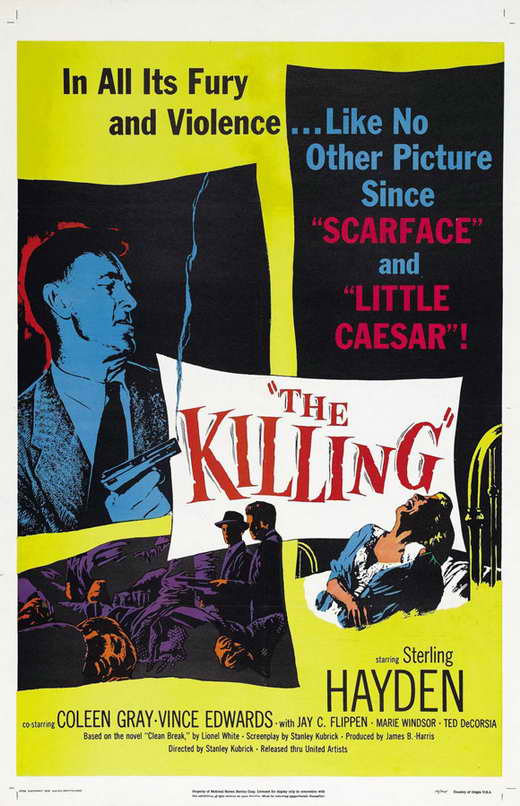
The Killing (1956)

Director: Stanley Kubrick

An uneven but fairly compelling early work from a film master, and a rather uniquely dark caper movie.

The title of the movie refers to the slang term of making a large amount of money in a short time, as well as the more literal reference to murder. Both meanings are appropriate for this film. The Killing is a caper tale centered on a group who plan to rob a horse track of two million dollars. The head of the group, Johnny Clay (Sterling Hayden), is the only professional thief in the group. The others are racetrack employees who, for various reasons, are looking to make a lot of money quickly. Clay plots out a very thorough and meticulous plan which requires expert timing. Once the plan starts to unfold, various hiccups begin to make things even harder than they already were, with Clay doing everything he can to execute his big score.

The movie takes a hard look at the brutal and dark consequences of crime, as do all of the very best noir  movies. All but one or two of the most minor members of the thieving crew are shown to be rather selfish, callous men whose greed or general weakness leads them into ever-more-foolish decisions. Unlike lesser crime films, The Killing does nothing to glamorize the thieves or their unsavory deeds. There is the compelling nature of the plan and its execution, as with all good caper movies, but this hardly overshadows the crew's dark motivations.

The primary distraction in this movie is the dialogue. Many of the characters are constantly spouting off tough guy lines in a rushed manner that spoke to some weak acting and uninspired scripting. This was especially disappointing considering that legendary crime fiction writer Jim Thompson wrote the script. Despite this, had I been watching this movie with someone else, we almost certainly would have been having plenty of good laughs at the abundance of silly, forced lines.

A lesser but rather obvious merit of the movie is the cinematography. This might not come as a major surprise, given that Stanley Kubrick directed this movie. Still, The Killing was his first major, full-length feature film. The then-only-28-year-old Kubrick was already showing his uncanny eye for striking camera angles, lighting, and using visual grammar to tell stories. This alone makes it worth seeing, as it is a very early but major step along a genius's path towards film mastery.
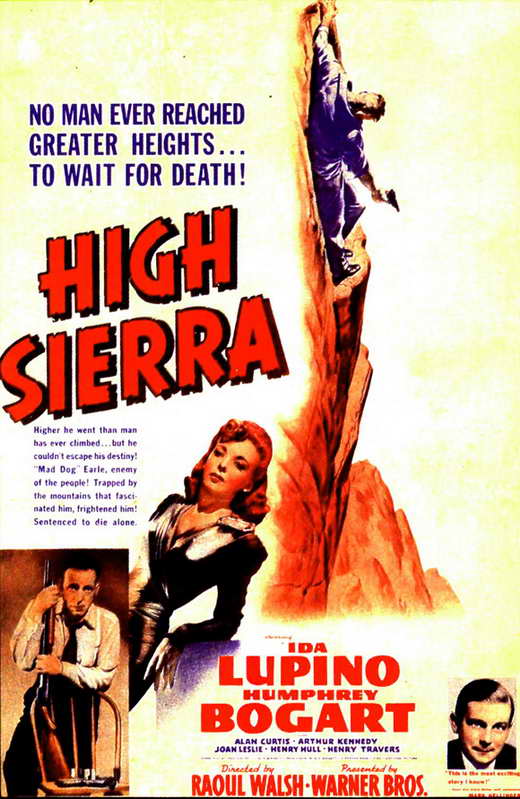

High Sierra (1941)

Director: Raoul Walsh

A compelling basic story buried within some painfully dated dialogue and acting.

I love Humphrey Bogart. While I haven't seen the majority of the many films he was in, I have seen around a half dozen of his best-known and best-loved movies. From these, it's easy to see why he became and still is a movie legend. With this in mind, I was excited to watch one of his relatively early starring roles in a crime movie. I have to admit some disappointment, however.

The story is actually the stuff of very strong noir. Bogart plays Roy Earle, a bank robber who has just been released from prison and is already setting up his next major score. The hard-boiled Earle came from a small town in Indiana, and he seems to have a tiny soft spot for small-town folks. This is clear when he comes across a farming family making its way out to California, whom he helps in several ways. Outside of his tender spot for such people, Earle is a rather severe man who does not suffer fools lightly, and will not hesitate to use violence if he feels the need.

One part of the story revolves around Earle's current big score - a jewelry heist arranged through an old associate of his. His partners in the caper are a couple of young, hot-blooded hoods who Earle dislikes but tolerates. The other part of the tale relates to Earle's relationships with two women; one is a young member of the farming family, and the other is a weary and jaded former dance girl. Seeing Earle try to juggle all of these aspects of his life is the real meat of the movie, and the story takes some turns which are intriguing in their unpredictability. I admire how the movie steered clear of a nice, pat, Hollywood ending.

Unfortunately, I had to work rather hard to maintain my appreciation. Even more than the above-reviewed The Killing, the dialogue and much of the acting in High Sierra have aged horribly. While there are some memorable lines, far too much comes right from the cheap, pulp "dime store hood" handbook. Bogart was a great enough actor that he could sell some of the dialogue better than his supporting cast, but even Bogie could only do so much. Also, the storyline involving the farming family is fraught with completely inorganic and illogical jumps. I feel that this movie served as an earlier, less balanced attempt at what director Raoul Walsh would do far better eight years later with the classic White Heat. I'll watch that latter picture again any time. High Sierra, however, is not one I'll ever return to.

Mesrine (2008)

Director: Jean-Francois Richet

Absolutely brilliant, if grim, biopic of a larger-than-life arch criminal.

Mesrine is the story of real-life French criminal Jacque Mesrine (pronounced "may-reen"), one of the most irrepressible, vicious, and public felons in the 20th century. Mesrine took to crime fairly early in the 1960s, after a stint in the French Army. He quickly became a noted burglar, bank robber, and violent thug with an appetite for women and high living. Though he made attempts at leading a "straight" life, they were few and relatively short-lived. For nearly all of his adult life, Mesrine was committing serious and violent crimes, eluding capture, being captured, or escaping from prison. A fair number of his exploits played out in the public eye, thanks to an image he created of himself which appealed to certain sects of the French masses.

Prior to watching this 2-film epic, I had no idea who Mesrine was, but I was fascinated. The movie urged me to look up some facts about the man, and it would seem that the film does not embellish his wild life. His story is told with a vibrance and energy found in some of the best gangster movies, such as Goodfellas or Bonnie and Clyde. The main difference with Mesrine, though, is that there is even less whitewashing of the man's most despicable actions. While it's made clear that Mesrine possessed good looks and charisma enough to seduce women, fellow criminals, and the French public at large, it doesn't balk at showing that he was also a brutal murderer who would torture or even kill anyone who offended his massive ego. The actions which play out on screen can be terrible, but I still found them compelling, given what an outsized persona Mesrine fashioned for himself.

A classic knee-capping, true to the violent nature of the title
character. It's so brutal that you might fail to notice just how
masterful the colors and  lighting of the scene are. This is
typical in these two movies.
The technical aspects of the movie are impressive. The set design and cinematography are first-rate, casting the ugly but oft-exciting world of Jacque Mesrine's life into a palatable light. The acting is also exceptional, with Vincent Cassel turning in a phenomenal performance in the title role. Some of the transitions between time periods can feel a bit rushed, which is surprising for a movie released in two parts and adding up to over four hours. This may just be a function of the sheer quantity of curious activities in which Mesrine invovled himself. The creators could probably have justified adding a tad more to it and making it a mini-series or a trilogy, if they thought anyone could stomach another hour or two of a rather detestable figure like Mesrine.

Mesrine is one of the darker, harder-hitting gangster movies one is likely to see. For those who enjoy well-executed dramatizations of very real and very frightening criminals, though, this movie is difficult to top. 

Sunday, June 27, 2010

Film #33: White Heat (1949)


Director: Raoul Walsh

Initial Release Country: United States

Times Previously Seen: once (about 8 years ago)

Teaser Summary (no spoilers):

Homicidal psychopath criminal grits teeth, kills cops, weasels, and dirty dames. Loves his mother, though.

Uncut Summary (the whole shebang, spoilers included. Fair warning):

Cody Jarrett (James Cagney) and his crew of thieves are bad dudes. In pulling a train robbery, Cody kills a few conductors before taking off with a stack of U.S. Treasury bonds. In the action, one of his crew has his face scorched by scalding steam.

Back at their hide-out, Cody and the crew meet up with Cody's mother and wife, both of whom are more than complicit in his illegal activities. In fact, his mother urges such action so that her son can carve out a path for himself and one day be “on top of the world.” Cody has to watch his back, though, since crew member “Big Ed,” his number two, has serious designs on usurping Cody's gang and his woman, the beautiful and high-maintenance Verna (Virginia Mayo).

While gathering up and preparing to hit the road, Cody suffers from a massive, crippling headache, a chronic condition that leaves him physically prone. He recovers with some soothing from his beloved mother and gathers the gang to head out, leaving behind their severely burned accomplice.

Left to right: Verna, Ma Jarrett, and Cody take a break from homicide & robbery for a quiet moment at the drive-in.

At police headquarters, FBI Agent Philip Edwards ponders how to find Cody. A series of clues lead him to where Cody is hiding with Verna and his mother. After a brief car pursuit, they get somewhat cornered in a drive-in theater. Cody tells Verna and his ma about his back-up plan in case of such a pinch: to turn himself in and admit to another, far lesser crime. This way, he will only do two years time, get released, and take control of the gang again.

After Cody turns himself in, Agent Edwards grills Ma and Verna Jarrett, but both are too smart to implicate themselves. Edwards seems a bit stuck, but he has another plan. He sends in fellow agent Hank Fallon to pose as a convict who will room with Cody in prison, hoping to gain enough confidence to learn where Cody has hidden the loot from the train robbery.

In prison, Fallon takes on the identity of Vincent Pardo, a fictitious con. While in, he eventually wins the excessively cagey and paranoid Jarrett's hard-fought trust. Just when it looks like they have a plan to “escape” together, everything goes to hell. From the convict grapevine, Jarrett learns that Big Ed, making his big move, has killed Ma Jarrett. Cody goes ballistic, punching out several jailers and getting sent to a solitary psych ward cell.

In the clink, Cody gives under-cover agent Fallon what-for.

Cody is far from done, though. He soon collects himself and stages a daring escape, capturing the prison doctor, killing a few guards, and lighting out with Fallon/Pardo and a few of his loyal crew on the inside. Cody Jarrett is once again on the loose.

First order of business is vengeance. Cody tracks down Big Ed and Verna at a hideout house. He catches Verna first, who lies through her teeth to avoid Cody's murderous rage. While she was the one to actually pull the trigger on Ma Jarrett, she pins it on Ed. Cody barely accepts the lie and goes after Ed, who he quickly dispatches with a few slugs to the back. The Jarrett Gang is now back in business again, with Fallon/Pardo now a full member of the crew.

The gang plans a massive score to knock off the payroll at a chemical plant. The plan is to use an empty gasoline truck and a Trojan Horse strategy. Unbeknownst to the rest of the crew, though, Fallon/Pardo has tipped off his fellow officers. Once the gang breaks into the plant and begins the heist, tons of cops show up to put an end to the robbery.

Inside the plant, Cody learns of Fallon's true identity and his impending capture. He finally loses whatever sanity he has left and goes on a killing rampage, though Fallon manages to escape in the chaos. Cody manages to scale one of the massive chemical towers and continues to fire upon the police. He finally makes it to the top, fires a few rounds into the container and screams, “Finally made it, Ma! Top of the world!!”

The container explodes into a massive mushroom cloud, taking Cody's psychosis and rage with it.

Take 1: My Gut Reaction (done after this most recent viewing, before any further research):

This movie is damn fun to watch. It's not high art, and it doesn't require any kind of background to enjoy, if one doesn't mind a high-octane shoot-em-up with a bit more depth than your average cops and robbers flick.

White Heat is noirish, though certainly not pure film noir. Many of the key noir elements are there: bad people doing bad things, a beautiful and dangerous woman in the mix, backstabbing, and a protagonist up to his neck in dastardly deeds. Yet, there is nothing admirable, enviable, or even very empathetic about Cody Jarrett, unlike other noir protagonists like Jeff Markham in Out of the Past or Walter Neff in Double Indemnity. Cody Jarrett is a pure psychopath: murderous, cunning, and driven.

James Cagney was the perfect guy for such a whack-job. Cagney may have been about 5-foot-nothing, but he exuded more toughness and lethal tension than nearly anyone I've seen in film. With his pug face, ever-present sneer, and cold, narrow eyes, it's not hard to see how he could play such a wild man so well. And yet, as scary as he is when in one of his psychotic rages, he was even more frightening when he would calmly look another character in the eye, and bold-facedly tell them that he was going to kill them. Said character was then no less that looking Death straight in that little squinched-up face.

I have to say that the dialogue is really amusing, as I'm sure it was meant to be, to an extent. Cagney delivering lines like, “If that radio's dead, it'll have company.” Or even the exchange when the worm-like con who tries unsuccessfully to kill Cody pleads, “You wouldn't kill me in cold blood, would you Cody?!” and Jarrett responds, “Nah, I'll let you warm up a while!” Pure gold, and there are plenty more like them.

Here's the clip of the prison escape, including one of the aforementioned "tough-guy" lines:


That Cody's crackers, I tells ya!

Still, while White Heat is essentially a cops-and-robbers movie on the surface, there's more to it than that. By adding in Cody's severe Oedipus complex, several layers are added to the tale. It becomes clear early on that Cody only really cares about two things: his mother and her edict that her son get to the top and stay there. The fact that “the top” is a twisted version of success built on thievery and murder is almost incidental.

And here lies the really interesting poser for me. When I think about Cody Jarrett and his ultimate goal, I almost can't help but see some warped version of the American dream at work. In a country in which individual accomplishment is prized above nearly all else, Cody Jarrett is a dark, mutilated, near-success story that ends in tragedy. Through the dialogue and story, we see that he only wants to appease his mother and do something grand with his life. His brand of slash-and-burn determination is not far from what one would have found in Nelson Rockefeller or J.P. Morgan. With this in mind, I almost liken Cody Jarrett to the Daniel Plainview character in Paul Thomas Anderson's epic There Will Be Blood. All of these men, both real and fictional, sought to define themselves by the money they made, by hook or by crook, and Cody Jarrett is no exception.

The non-noir elements in White Heat neither enhance nor take away from the film. There's a fair bit of over-the-shoulder exposition on the methods that law enforcement uses to track down the Jarrett gang. I suppose that this was interesting back in '49 the way that forensic cop shows can be interesting now – it's the basic human curiosity about methodology. Still, they are very dated in this film.

In that same vein, it's a bit of a shame that the movie quite obviously had to follow the “Hollywood” script. Sure, plenty of people get offed, but they're all extras. Even when it seems Fallon is a dead duck and is about to die a semi-noble death, the Hayes Code movie gods intervene and save his hide. Not that it's an altogether bad thing, but the movie lost a slight amount of punch to me by not having the insanity have more dire consequences for the more empathetic "good" characters.

These little things aside, I really liked White Heat, and would certainly watch it again. It's also one of those movies that you can judge for yourself by just watching the first five minutes. You get plenty of the action, depth, dialogue, and acting that make it a great one, and all before you can really relax in your easy chair.

Take 2: Why Film Geeks Love this Movie (done after some further research):

While reviewer after reviewer seems to hail White Heat as an undisputed classic, there's not a wealth of exposition on the film. It's one of the those movies that, like certain other classics, can be boiled down to a few key elements. With a Charlie Chaplin movie, for example, it's always the physical gags and comical situations. With White Heat, it's really two things: the amped up violence and James Cagney.

This film was really a grand return for Cagney. He had long before established his place as the face of cinema gangsterism. His sneering, pugnacious characters made films like Angels With Dirty Faces and Public Enemy. At the end of the 30s, however, he left Warner Brothers studios, turned away from the criminal roles and expanded his horizons, doing such films as the patriotic, light-hearted Yankee Doodle Dandy and others.

About eight years later, though, Warner offered him a deal he couldn't refuse; he went back and signed a contract loaded with residuals and, more importantly, a great deal of creative control. Cagney made the most of it, evidenced greatly in White Heat. Apparently, the true-crime inspirations were Cagney's suggestions, and the final rendition of Cody Jarrett was almost wholly Cagney's brainchild. Cagney reportedly wanted to make Cody a completely psychotic amalgam of all of his past gangster roles. Well, he did just that, and it worked like gangbusters.

One good story comes from the fact that Cagney did a fair bit of improvising on the set: during the famous scene in the prison mess hall, when Cody learns that his mother has been killed, Cagney's over-the-top berserk tirade actually scared the bejesus out of all of the extras, none of whom knew what was going to occur in the scene.

Here it is. It's amazing that Cagney didn't severely hurt himself while flailing around:


Much is made of the bizarre Oedipus complex that Cody has. Many critics point out that Raoul Walsh was so skilled that he managed to have a scene in which a distraught Cody actually sits on his mother's lap and allows her to sooth him, much like an eight-year old boy whose turtle just died. I have to concur since I remember the scene, but thought absolutely nothing of it since, by this time, Cody Jarrett's psychological deficiencies were so well fleshed-out that it seemed completely normal for him.

White Heat. It may not be high art, and it may not have been a grand leap forward for cinematic storytelling, but it sure is one helluva ride and a prime performance by an actor the likes of which Hollywood may never see again.

That's a wrap. 33 shows down. 72 to go.

Coming Soon: In A Lonely Place (1950):

Another Bogie movie! On top of that, I've never seen it, and know almost nothing about it. If you read my Casablanca review, you know how I feel about Bogart. Come back and see how I think this later addition to his resume stacks up.

Please be sure to pick up all empties on the way out.