Showing posts with label Unforgiven. Show all posts

Friday, May 25, 2018

Idiot Boxing, HBO shows: Barry, season 1 (2018); Silicon Valley, season 5 (2018)

Barry, season 1 (2018)

An excellent dark comedy from the mind of Bill Hader and Alex Berg.

The show follows the eponymous Barry Berkman (Hader), a former marine-turned-hitman who lives in Cleveland and shows signs of detached depression. This begins to change when Barry is sent to Hollywood on a job, where he inadvertently finds himself catching the acting bug after seeing a run-of-the-mill acting class in progress. The maladjusted Barry begins to try and dip his toes in the waters of the self-obsessed and artificial world of aspiring actors, all while trying to divest himself from his excessively violent occupation.

Hader as Barry (left) and Henry Winkler as his dramatic
acting teacher, Gene Cousineau. Unlike Gene and his
oblivious classmates, Barry comes by his haunted look and
demeanor all too honestly.
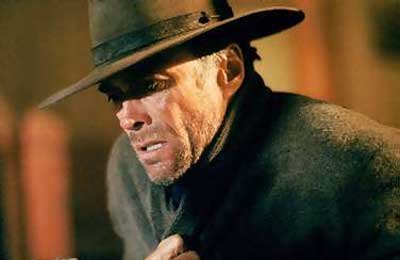
In a recent interview, show star and co-creator Bill Hader said that he and fellow creator Alex Berg pitched the Barry character to HBO as "Clint Eastwood's character in Unforgiven, but in a community theater acting class." And that's a pretty good description of what you get here. Like Eastwood's Will Munney character in that Western classic, Barry is a truly tortured man will a preternatural skill for assassination. Seeing such a dark and disturbed man in the middle of an acting class is bound to go one of two ways: be a completely awkward and potentially offensive disaster, or make for genius black comedy. Barry is clearly the latter.

There are a few reasons that black comedies are rare. One is that, while well-done dark comedies have dedicated fans, they simply don't appeal to a mass audience. Hence, there simply isn't a great profit motive out there for major TV networks and movie studios to support them. The greater reason, though, is that they are extremely difficult to pull off. Dark subject matter like violent death, murder, and depression don't typically mesh well with humor. And yet, when handled correctly, it really makes its mark. Movies like Dr. Strangelove or Fargo show that one can laugh at the most horrific circumstances if the story is told with the correct tone and approach. Barry follows in the footsteps of those other great films and gives us a sometimes disturbing look at what amounts to a severely - possibly irredeemably - damaged, murderous human being. And it can be hilarious.

In short, the most imposing darkness is seeded deep within Barry - a former marine who seems to have never been good at anything but killing. And he's frighteningly good at it. Other dark elements are to be found in the words and actions of some of his associates - his main contact Fuches (Stephen Root), the Chechnyan gangsters he works with, and a few others. The comedy springs mostly from two places. One is the contrast between the ridiculously out-of-touch and self-involved actors in the acting class Barry finds himself enamored of and his own all-too authentic pain and mental distress. Another is from the oft-hapless Chechnyans and their bumbling through the process of trying to make their mark on the criminal underworld of Hollywood. Not every character or situation is as funny as I think it was meant to be, but there are plenty of great laughs to be had, along with a handful of truly disturbing murders.

The cast is great, with special mention needed for Henry Winkler. The man who is probably still best-known as "The Fonz" from Happy Days in the 1970s once again shows his pure comedic chops here as Gene Cousineau, the acting instructor with hilariously outsized confidence. Thanks to great writing and Winkler's brilliant performance, Cousineau quickly becomes one of those characters who threaten to steal nearly every scene they're in, and Winkler usually does. All of the other parts are played well, too, though I did find the character NoHo Hank overly silly most of the time.

I'm not sure just how long the writers will be able to spin this tale out, but there's definitely still enough material for another short season (this one was a mere eight episodes). It has already been renewed, and I'm happy to know it.


Silicon Valley, season 5 (2018)

Still one of the best comedies on TV.

And then there were four. Though Erlich Bachman's absence
may be conspicuous in the first episode or two, I found that
the bombastic character was hardly missed. The rest of the
crew, plus Monica Hall, easily picked up any slack.
Season 5 of the show picks up with Richard Hendricks (Thomas Middleditch) and his Pied Piper crew trying to get their "New Internet," or "Pipernet," truly off the ground after their near-disastrous program leak at the end of season four. The fledgling company's issue now is how to find enough up-and-coming online companies to get the necessary usage to kick-start the entire thing. It all involves a high level of salesmanship and hobnobbing - two things that are far from the painfully awkward Richard's forte. As with previous seasons, the main Pied Piper crew of Richard, Dinesh, Gilfoyle, and Jarod have to navigate through and around the predatory environment of Silicon Valley and its vicious raiders. The carrot dangling is that the New Internet, if it can get far enough off the ground to achieve a certain exit velocity, could potentially dwarf any online revolution that the world has ever seen. And that potential prize attracts a lot of envious and thoroughly unscrupulous eyes.

The general arc of this season follows a path similar to previous ones: the guys have a grand idea that they're trying to get off the ground, they meet various difficulties along the way, and they triumph in some fashion. But also in keeping with tradition, Pied Piper's triumph is often in a fashion that none of its members quite expect, and it often opens up new issues that they hadn't yet anticipated. It's a time-tested formula that show creators Mike Judge and Alex Berg have perfected. Even though it's nothing especially novel, the journey is well worth it, thanks mostly to the characters.

This season is right on par with any previous ones, despite being only eight episodes (all previous seasons have been ten). I also didn't miss, for a moment, T.J. Miller as Erlich Bachman, who was written off the show for well-publicized issues with the show-runners. For my part, I often found the Erlich character more of a nuisance, although he did provide some solid laughs thanks to Miller's spot-on performance as the insanely overconfident braggart. But he was always used best very sparingly. Now that he is completely gone (the character is lazing in a never-ending opium stupor somewhere in Tibet). The rest of the cast more than picks up the slack. Kumail Nanjiani ratchets up the desperation as Dinesh, madly looking for any opportunity to show off the slightest bit of success, while his in-office arch-nemesis Gilfoyle (Martin Starr) continues to stoically and relentlessly egg him on. The seventh episode of the season is actually one of the greatest "Gilfoyle" episodes ever, as he fires off multiple fantastic digs and observations. And as usual, Zach Woods kills it as Donald 'Jared' Dunn, the soft-spoken but oddly intense Chief Operating Officer with a wild past. It was also nice to see a return of the Monica Hall character by season's end - a more prominent character in the first couple of seasons but who had faded in seasons three and four.

The only way one could say that this show is slowing down is merely in the 20% reduction in episodes. Aside from that, the series is an astounding five-for-five, with not a single season being anything less than great. Season six can't get here soon enough. 

Sunday, December 2, 2012

Film # 91: Unforgiven (1992)


Director: Clint Eastwood

Initial Release Country: United States

Times Previously Seen: around five or six

Rapid-Fire Summary

In the small town of Big Whiskey, Montana, in 1881, a cowhand becomes enraged at a prostitute named Delilah over a minor insult and slashes her face. Despite calls from Delilah’s fellow prostitutes that the cowhand and his companion be hanged, the sheriff, “Little Bill” (Gene Hackman) merely demands that the two boys pay the proprietor of the saloon/cathouse in the form of horses. The furious prostitutes then secretly pool their money and start spreading word of a bounty for anyone who kills the two cowboys.

To the south, in Kansas, a brash young man calling himself “The Schofield Kid” finds the middle-aged farmer William Munny and asks him to partner up to kill the cowboys for the bounty. The Kid has heard from that Munny was once a fearless and vicious killer who would make a perfect partner for such a dark deed. Munny, now a widower who has forsworn his previously murderous life and with two young children to support, at first refuses The Kid. With his farm failing, though, he changes his mind. He convinces one of his old partners, Ned (Morgan Freeman), to join him on this final killing in order to have a new start for his children.

Will Munny, a brutal killer in the past, now struggles on his farm with his two your children.

Back in Big Whiskey, Little Bill has now heard of the bounty put out and brutally beats and casts out the first bounty hunter who drifts into town to inquire after it – the noted gunman “English” Bob (Richard Harris). When the Kid, Will, and Ned come into town some days after, Will is himself beaten by Little Bill, while Ned and The Kid escape. The three rally themselves and set out after the first of the two cowboys, undeterred by Little Bill’s edict against assassins. When they find the cowboy, however, Ned is unable to bring himself to kill him. Will instead takes Ned’s rifle and shoots the cowboy dead. Ned, realizing that he no longer has what it takes to kill a man, parts ways with Will and The Kid, with Will promising to bring Ned his share of the bounty after the job is finished.

Will and The Kid then find the second cowboy, who actually cut up Delilah, holed up at the ranch he works on. The Kid kills the cowboy and the two make a narrow escape. When Will and The Kid return to just outside of Big Whiskey to collect the bounty, however, they discover that Ned has been captured, tortured, and killed. Suddenly overcome by a dark cloud of vengeance, Will plies himself with alcohol and rides into town alone. Calmly walking into the saloon where Ned’s corpse is prominently displayed outside, Will coldly kills six men, including the saloon owner, four deputies, and Little Bill himself. Though plenty of the townspeople are still alive to stop Will from leaving, they are all too terrified of the killer to even make the attempt.

Will, in Skinny's saloon as he slays all those he feels are responsible for Ned's death. During these moments, all traces of the quiet, tortured farmer have been burned away.

We are told in the end that Will returned to his farm and used his bounty money to move himself and his children away, possible to California where he “prospered in dry goods.”

My Take on the Film (Done after this most recent viewing):

Unforgiven is, in my mind, the greatest Western film. There are others that are more exciting and entertaining, but this one has by far the most depth and arguably the greatest acting.

Clint Eastwood’s masterpiece probably couldn’t have been made much earlier than it was. Being a deconstruction of the mythical West and Western stories, it required all of the popular lore that preceded it, both in literature and film. Eastwood set out tell a story that took a dark and realistic look into the souls of truly dangerous men in the old West, and he did it with expert precision.

At the heart of the film are all of the popular notions of the “Wild West” gunslinger. The mythology around that time and place has been the inspiration for countless tales of adventure for well over a century. The archetypal “deadly guman” has long been one of the most attractive characters in U.S. narrative. Unforgiven gives voice to this attraction through the character Beauchamp, a bumbling fiction writer who at first is following around English Bob as his biographer. His stories of Bob cast him as a noble warrior whose skills with a pistol make him a modern-day knight. Once Bob is thrashed and imprisoned by Little Bill, however, the myth starts to fall apart.

English Bob, left, and his biographer, Beauchamp. It is initially through these two characters that the myths of honorable gunfighters are taken apart.

It is during the scenes between Little Bill and Beauchamp, with English Bob watching from his cell, that we start to get at the reality of killers. With his first-hand knowledge of Bob, Little Bill tears apart Beauchamp’s notions of his idol. We soon see that Bob, though a truly dangerous gunman, is actually a vicious murderer unworthy of any admiration.

But the deconstruction of English Bob is only a prelude. It is with the tale of Will Munny that the truly disturbing truths about gunfighters emerge. With incredible pacing, Munny’s regression from penitent farmer back to unrepentant killer is as captivating as it is terrifying. For most of the film, Munny’s murderous past is merely hinted at, through stories told by other characters such as The Schofield Kid and even Will’s riding partner, Ned. As each bloody story is revealed, Munny tries to assure Ned and himself that he, “ain’t like that no more.” Watching him cling to the new self into which his dead wife molded him is like watching a time bomb trying to diffuse itself.

During his arrival at Bog Whiskey, Munny is still tortured and ill. It's almost as if his modern, peaceful self is slowly coming apart under the burden of trying to keep his homicidal nature at bay.

Any doubt about Munny is removed about halfway through the film, upon the death of the first cowboy. When Ned is unable to pull the trigger, Munny reverts to form. Without blinking, he takes the rifle from Ned’s uncertain hands, takes aim, and kills the young man. It is now clear that, while Ned truly has left his homicidal past behind him, Munny still possesses a true murderer's instinct. As if the contrast between Ned and Munny isn’t enough, is becomes all the more clear when Munny allow The Kid, eager for a kill, to execute the second cowboy later. After the deed is done, The Kid shakily admits that, contrary to his prior boasting, it was his first kill. The Kid is all too aware of the difference between himself and Munny, stating, “I ain’t like you Will.” Will’s response is right at the heart of the film – “It’s a hell of a thing, killin’ a man. You take away everything he’s got and everything he’s ever gonna have.” The Kid then swears off guns and killing for the rest of his life.

It is then, in the final ten minutes of the movie, that we see the true horror of William Munny. After he is told of Ned’s death, a terrifying transformation takes place. For most of the story, Will has been the picture of anguished restraint. He has refused to take a drop of alcohol and has only killed the two cowboys condemned by the bounty. However, when he learns that his friend has been tortured, killed, and put on display, his previous decade of temperance thoroughly vanishes. A cold fire alights in his eyes, his teeth clench, and he grabs a whiskey bottle and methodically starts to drink. By the time he enters the saloon at nightfall, he is Vengeance personified. In front of the group of puzzled and uncertain deputies and other town residents, he brutally shoots the saloon owner, Skinny. Even then, the deputies are clearly too frightened to try and bring down Munny. Even when they do gather their wits and try to square off against him, Munny is too calm under fire to be brought down. By doing little more than keeping his composure, he proceeds to shoot the five men remaining with weapons in their hands. The writer Beauchamp, who has been cowering in a corner and witnesses everything, then tries to question Munny on his “strategy.” Munny debunks any notion of skill or strategy by simple saying, “I was lucky…I’ve always been lucky when it comes to killin’ folks.” With this line, there is nothing left to be lauded in Munny’s actions, not even any kind of “skill.” Like English Bob, he is a mass murderer, though an uncommonly effective one.

Munny's execution of Little Bill. It may be one of the coldest, most haunting killings in all of film. 

Following the rapid departure of Beauchamp, Munny then steps up to Little Bill, who has been wounded but is not dead. Little Bill looks up at Will Munny, and instead of begging or pleading, simply says, “I don’t deserve to die like this.” Munny stares him in the face and delivers perhaps the most haunting line of the film when he proclaims, “Deserve’s got nothin’ to do with it.” At this moment, Munny is no longer even a spirit of vengeance. He is death itself. Unfeeling. Unthinking. Uncaring of right or wrong.

Those final lines, and others like them in the film, are what set Unforgiven apart. The only other Western I know of that even came close to taking such a hard look at the makeup of the Western gunfighter was The Searchers, with John Wayne. However, The Searchers still had a solid dose of romantic hokum blended into it, and it’s not nearly as even in execution as Unforgiven. Clint Eastwood directed this movie as well as anything he’s ever done, encompassing all of the things that make Western films great, while adding unprecedented philosophical depth.

The story and characters are undoubtedly what make the movie great, but I’d be remiss if I didn’t at least briefly mention its other merits. The cinematography is incredible, with all of the gorgeous wide-angle shots that you could hope for in a sweeping Western. Even more is the acting. Clint Eastwood does a fine enough job, and it helped that the character Will Munny didn’t call for any spectacular range of emotions (not Eastwood’s forte). The standout performances are Morgan Freeman and Gene Hackman, the latter of whom justifiably raked in a ton of awards for his turn as Little Bill. But even the smaller roles are all played perfectly, from Richard Harris as English Bob right down to the lowly prostitutes and townspeople.

Little Bill, in front of the townspeople of Big Whiskey. Just as important to the tone of the movie, the smaller roles all convey very realistic reactions to violence and death - rage, frustration, and fear.

When I think about Unforgiven as a whole, one thing I often come back to is the notion of freedom. For fans of Western tales, it is often the sense of freedom that is most appealing. The wide-open spaces of the old West have always been thought of as places where a person is free from the restrictions and expectations of “civilized” society. We often assume that this is essentially a positive thing, as it allows a person to be whoever they want to be or discover who they really are. This is a beautiful idea, if you assume that the person you really are is one to be loved and admired. But what if who you really are is someone as terrifying as William Munny? What if, in spite of your every effort to escape it in the quiet, isolated, wind-swept plains of Kansas, you are something that frightens yourself to your very soul? I don’t know if this is one of the intended themes of the film, but it is one that stays with me.

Additional Note: I came across the news that there is currently under production a remake of Unforgiven, set in feudal Japan and starring Ken Watanabe as the "Will Munny" character. Normally, I would be disgusted at the thought of a remake of Unforgiven; however, I can see the potential for a samurai setting to be very successful. I hope they can pull it off.

That’s a wrap. 91 shows down, 14 to go.

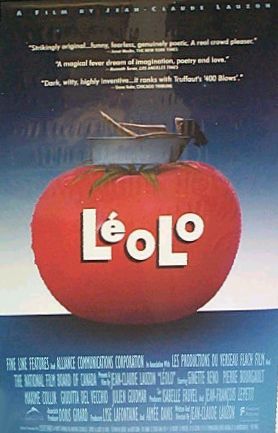
Coming Soon: Leolo (1992)


Don’t know anything about this one, but I’m guessing it doesn’t involve Clint Eastwood, ruminations on murder, or and Englishman getting his ass whipped. You never know, though…

Please be sure to pick up all empties on the way out.

Wednesday, January 5, 2011

Film #45:The Searchers (1956)


Director: John Ford

Initial Release Country: United States

Times Previously Seen: once (about 12 years ago)

Teaser Summary (no spoilers)

Cantankerous Indian fighter tracks down a pack of Comanche who have kidnapped his niece.

Uncut Summary (A full plot synopsis, spoilers included. Fair warning.)

Texas, 1868. Hardened Indian fighter and former Confederate soldier Ethan Edwards (John Wayne) returns to his brother Aaron's ranch after several years of wandering the plains. He hopes to settle down close to Aaron's family: his wife and their 10 and 16-years old daughters, Lucy and Debbie. He also finds their adopted nephew, the handsome, energetic, 1/8 part Indian, Martin Pawley (Jeffrey Hunter). Ethan gives Martin nothing more than suspicious glances and the proverbial cold shoulder.

The next morning, several Texas Rangers arrive at the ranch to deputize Aaron and Martin into a posse. They are responding to a report of Comanche raiders nearby. The two men agree to go, as does Ethan. After several hours' ride, they find that the Comanche have merely killed several cattle as a diversionary tactic. Ethan realizes that this was to draw the fighting men away from the two nearby ranches so that they could conduct what Ethan calls a “murder raid.” When they return to the ranch early the next morning, they find Aaron and his wife brutally murdered and Lucy and Debbie gone, taken by the Comanche war chief known as “Scar”.

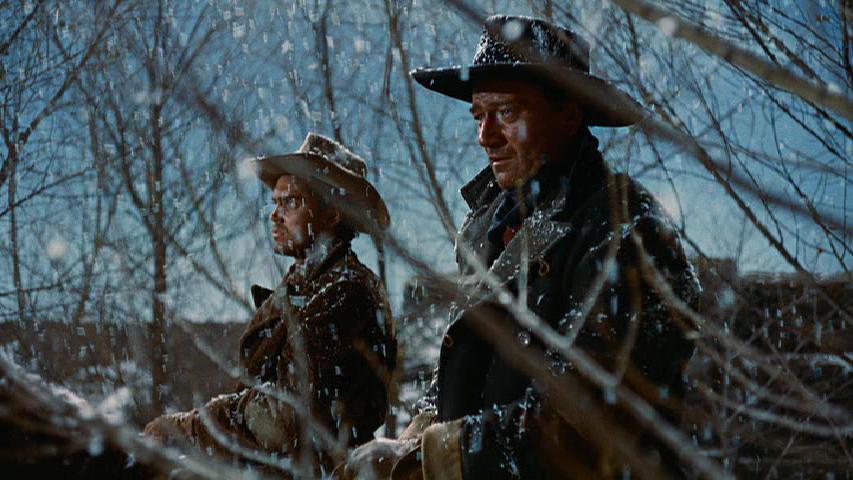
Martin Pawley is only just beginning his long, long journey with the angriest, nastiest Indian hater this side of Pecos.

Ethan and Martin accompany the remaining Rangers and begin tracking the Comanche raiders. Upon finding a dead Comanche buried, Ethan ruthlessly shoots out the dead man's eyes, so as to rob his spirit of the ability to find the afterlife. The Rangers and Martin are shocked at Ethan's apparent and deep racial hatred.

After continuing for a while longer, the search party is attacked by several dozen Indians. They manage to escape and fight them off, but Ethan once again turns brutal. Even when the attackers turn to flee, he continues firing his rifle into their backs. The Rangers decide to take one of their wounded comrades into town, and Ethan, Martin and the young Brad Jorgenson, Lucy Edwards' boyfriend, continue the pursuit.

Eventually, as the trio prepare to camp for the night, Brad sees Scar's war party and a person he believes is Lucy, since he recognizes her dress. Ethan then reveals that he had just earlier that day found Lucy's corpse in a narrow canyon, which he hadn't revealed so as not to upset Brad. In a rage, Brad blindly storms into Scar's camp and is promptly gunned down.

Ethan a Martin take a brief respite at the Jorgenson's home, where Martin is reunited with Laurie, who loves Martin. She wants Martin to stay with them, but he decides to accompany Ethan on his pursuit of Scar and Debbie. By now, Martin deeply suspects that Ethan may see Debbie as no longer “white”, but rather a Comanche, and therefore kill her with the same murderous contempt he has for other Indians.

Over the next several years, Ethan and the stalwart Martin scan the southwest from northern Texas into New Mexico. They travel through the changing seasons, Martin accidentally purchases and Indian wife, whom he banishes, and the two men even come across a group of white women who had been rescued from Comanche servitude. All are deranged, but none is Debbie.


The first of several winters sets in as the search for Debbie continues...

In New Mexico, the pair finally track down Scar's camp, thanks to a local Mexican man. Though Scar knows who they are and what they are after, decorum forces him to invite them into his tepee to trade. Inside, they finally find Debbie (Natalie Wood), now fifteen years old and one of Scar's wives or servants. Ethan and Martin barely refrain from reacting, but they leave in short order and regroup nearby, out of sight of Scar's camp.

As they talk over their next move, Debbie rushes over a hill to them. Martin runs to greet her, but Debbie warns them to run away, explaining that the Comanche are her people now and that Scar means to kill them both. On hearing this, Ethan pulls his gun to kill Debbie, only to be blocked by Martin. Scar's war party interrupts the standoff and the men have to hop their horses and flee. They escape once again, but not before Ethan takes a poison arrow to the shoulder. They race back to the Jorgenson's ranch in Texas.

At the Jorgenson's, Ethan and Martin arrive just as Laurie is about to marry local mailman and suitor, Charlie McCory. Despite having been away for five years, Martin is livid and gets into a fistfight with Charlie over Laurie. Once the dust settles, Charlie calls the wedding off and the Rangers who are in attendance prepare to take Ethan and Martin under arrest for a misunderstood murder and not-so-misunderstood string of robberies from Ethan's post Civil War years. Just then, a Union cavalryman arrives to report that they have found Scar's war band on the outskirts of the ranch. All men present saddle up and set out.

Debbie, now absorbed into the Comanche culture. Does The Duke kill her or rescue her?

When the Rangers get to the camp, Ethan wants to charge into the camp, not caring if it means that Scar will likely kill Debbie on the spot. Martin convinces Ethan and the Rangers to let him try to rescue Debbie before they and the cavalry assault the camp. He does so, quietly creeping in, waking Debbie, convincing her to leave with him, and even killing Scar. Just then, the cavalry storms in, killing or dispersing every Comanche in sight.

In the chaos, Debbie gets away from Martin, sees Ethan and runs away. Ethan knocks aside the pleading Martin and chases Debbie. He catches up to her in a nearby cave, where she falls to the ground. He picks her up and, instead of murdering her, he cradles her in his arms, saying “Let's go home, Debbie.”

They return to the Jorgenson house, in which everyone goes inside after a joyous reunion. Everyone, that is, except for Ethan, who walks off of the porch and back onto the plains, the door closing behind him.

Take 1:My Gut Reaction (Done after this most recent viewing, before any further research)

I count a handful of Westerns among my absolute favorite movies of all time, regardless of genre. The Searchers is not one of them. Far from it, in fact.

There are a couple of elements that I think explain why this movie is placed within the pantheon of “Wild West Masterpieces”, but there's really only one that I think explains why its given loftier status than any of John Wayne's other 5,672 western movies (well, it sure seems like there are that many, anyway), and it's that one that gave me the only thing to sink my teeth into.

So what was the one thing? Simple. Ethan Edwards. The character is so truly dark that he's fascinating. In a depressing way, he represents exactly everything that invites scorn upon Americans from basically everyone else: he's bigoted, arrogant, surly, aggressive, bullying and cold. But more importantly is that he's pragmatic and, above all, capable. All of those former adjectives wouldn't matter a whit if it were an ineffectual weakling who possessed them. Ethan Edwards, however, is a homicidal racist who not only wants to kill every Indian he sees, but also can kill every Indian he sees. The Searchers at least acknowledges this by having all other characters sense it and distance themselves from Ethan, even when he's a military compatriot or even blood kin. The final shot of the movie really says it all, which is certainly why it ranks as one of the most memorable closing scenes in history.

Here's one of the earliest examples of Ethan's bone-deep hatred of the Comanche. The video quality is horrid, but that's not really where the strength of this scene comes from. Start it at 6:00:


This brings up the other clear merit of the film – the cinematography. To anyone who has seen any of John Ford's movies, this should come as no surprise. Within the medium of the sweeping epic western, the man was a master of setting, costumes, and shot framing. The high def DVD that I watched the film on, remastered in 2007, truly highlights the vibrancy that visually set apart such Technicolor works in the same way as Meet Me in St. Louis and Singin' In the Rain. After watching almost exclusively black and white films of late, The Searchers simply glows.

Here's the opening scene. While the true power of it is mostly lost on a tiny youtube screen, I think you can get the point:


This, though, is not an entirely good thing to me, and this leads me to the reasons I don't particularly like this movie. As of today, my favorite westerns are The Wild Bunch; The Good, The Bad, and The Ugly (Film #63 on this list); The Outlaw Josey Wales; and Unforgiven (Film #91). If you've seen these movies, you can understand the common thread, and no, it's actually not merely Clint Eastwood. The shared element is that each one was a well-balanced blend of the real old west and the mythical old west, though each of these three films weighs one vision more heavily than the other. The Searchers gets the balance completely wrong, in my view. This despite Ethan Edwards being a prototype for the apocalyptic Will Munney in Unforgiven.

A lot of the film comes off as just another hokey, Hollywood western. Any dialogue not by Ethan is ridiculously corny, the comedy is sophomoric at best, and nearly all characters aside from Ethan are complete cookie cutters straight from the “Mass Appeal Western Cookbook”. The only positive about any of this is that it makes Ethan's callous, primitive worldview and his blood lust stand out in even starker contrast. Amidst the dullard jocularity and melodrama around him, Edwards seems even more of an emotional abyss. Still, this doesn't make all of these elements palatable to me. It became roughest for me at the end with the wedding scene, in which the most annoyingly buffoonish character of the bunch, Charlie McCory, is given his moments of “comic” relief. Maybe his dim-witted mannerisms were good fun fifty years ago, but by today's standards, they are on the same level as a pie in the face.

The other major problem with this movie is the pacing. The tale, stretching over five years, gets pulled forward in bizarre and dizzying fits and starts, with sparing clues as to the passage of time, aside from some clumsy or obvious bit of dialogue, and two very brief moments when the men are in winter snow. I assume that John Ford's intent was to convey the arduousness and length of the pursuit, but it may as well have been telling a real time story: the movie is two hours long, and it almost seems as if that's exactly how long Ethan and Martin take to find Debbie. No more, no less. The two men and Scar don't age in any visible way, Martin continues to be childishly naïve and impulsive, and Ethan's last-minute change of heart doesn't seem to have any visible cause. It all comes off as rather contrived.

So this brings me back to the same question I ask when one of the film's on the TIME list does not impress me: Why is it considered a classic?

My best guess is that the character of Ethan Edwards was such a dark departure for John Wayne, and it stood out so clearly amidst the otherwise safe, harmless backdrop and characters, that it is seen as having unprecedented depth. True that it has more depth than the Roy Rogers version of the wild west, but I still think that it's been far outpaced in the intervening decades. I'll take Sergio Leone over John Ford any day of the week and twice on Sunday. (Sunday is spaghetti western day!) I like my westerns will wall-to-tobacco-stained-wall roughnecks, and if a film is going to be a dark character study, the director needs to go all the way. While Ford went further than anyone else had back in 1956, artistic evolution has dimmed its power, in my view.

Take 2: Why Film Geeks Love This Movie (done after some further research)

OK, so maybe I was a bit harsh. Not much, though.

After listening to some commentary by several directors, including one of my favorites, Martin Scorsese, I'm willing to cut this movie a little more slack. There were clearly a few elements that I didn't fully perceive or realize upon this most recent viewing, but I believe I had good cause.

Probably the main thing that I should give more credit for is the way that the theme of religion runs through the picture. While John Ford's films have accurately been described as “Catholic”, The Searchers gives us a thoroughly un-Catholic protagonist. Through Edwards' interactions with the Ranger/preacher Clayton, and his expositions on Indians, we see him to be all but an atheist.

Something else that deserves a little more credit is the camerawork. While I did laud this in my Take 1, I was made aware of more than the majestic shots of Monument Valley. John Ford was actually a highly skilled visual storyteller, as evidenced throughout The Searchers. Many thoughts, emotions, and dynamics are conveyed through facial expressions and body language. This is something that far too many films are missing these days.

Many point to the similarity between the Ethan Allen and Scar characters. True that one could see them as the same man, separated by their racial backgrounds; however, I think it goes a little too far when some assert that this serves as proof that The Searchers portrayed Native Americans in a more positive, sympathetic light. The movie seems to have made a few strides past previous ones, but they are very small strides. Of course, such a thing was not to be very well done in commercial movies for at least ten years, and only truly shone through in the massively successful films like Dances With Wolves or Last of the Mohicans.

As far as critics go, I have to agree with a lot of this original TIME magazine review from back in 1956. That review, however, smacks of a writer who had had enough of John Ford/John Wayne films. The reviewer admits to the clear merits, but clearly felt the same way that I did about the pacing. Glad I wasn't the only one.

It is only proper that I end with the final scene of the movie, one that is often regarded as one of the greatest in film history. I have to say, I may not love the movie, but I can see people's point:


That's a wrap. 45 shows down, 60 to go.

Coming Soon: Aparajito (1957)


Part 2 of the Apu Trilogy. Last we saw the cute little Bengali bugger, he was on the back of a horse cart with his dejected mother and father, heading for Benares. I'll have a look in on the lad and see how things work out for him.

Please be sure to pick up all empties on the way out.