Showing posts with label Morgan Freeman. Show all posts

Tuesday, April 26, 2016

Retro Trio: The Dark Knight Trilogy (2005-2012)

Director: Christopher Nolan

Once in while, I'm in a mood to watch a movie which will give me a balance of not challenging me with anything new but still being rich enough to avoid dullness. Often, a good action or adventure movie I've seen before does the trick for me in these situations, so when just such a mood recently struck me, I fired up director Christopher Nolan's Dark Knight Trilogy. Over a few nights, I re-watched Batman Begins, The Dark Knight, and The Dark Knight Rises.

I think this trilogy is an impressive accomplishment. I own all three, and I enjoy returning to them every few years. This will not change, though there are certain gripes which I have developed regarding a few aspects of the series, as much out of over-familiarity as anything else. Let's get those out of the way:

One thing that irked me is that Bruce Wayne's scientific and detecting genius is almost completely absent. In fact, it is virtually spat upon. Since his very inception in Detective Comics in 1940, Bruce Wayne/Batman was noted for his intellect. He was virtually a Sherlock Holmes. Still, in Batman Begins, after Bruce Wayne is gassed with Scarecrow's hallucinogenic toxin, he awakes to have Lucius Fox rattle off the advanced chemical processes he needed to perform in order to produce an antidote. In response, Wayne simply states, "Is that supposed to mean anything to me?" Wayne's utter inability to comprehend Fox's chemistry jargon has always struck me as a severe oversight in terms of one of Batman's greatest strengths - that he is supposed to be phenomenally brilliant, especially with the forensic sciences, including biochemistry. Almost never in the entire trilogy is his scientific intelligence exhibited. The real shame is that it wouldn't have taken much effort to include it. My guess is that Christopher Nolan was so very focused on Bryce Wayne's tortured psyche that he ignored his considerable intellect, despite the fact that it could have been another avenue along which to explore his obsessive personality.

There's absolutely no way that the Joker (right) could have
been sure that his fellow crew member wasn't going to just
blow him away before his full plan unfolded. Just lucky,
I guess. This happens quite a bit. 
Another general area which exhibits cracks is in the little details and transitions from one plot point to the next. All of Christopher Nolan's movie's virtually crackle with great energy and pace, so that the eyes and mind are stimulated through the entire picture. However, when one watches his movies a second or third time, certain unanswerable questions arise. This was true with Memento, Interstellar, and every movie in between. In the Dark Knight trilogy, they are sprinkled around in plenty of places. In The Dark Knight, during the Joker's interrogation scene, how did the villain know that he would be able to break out at exactly the right time to call and set off his bombs while Wayne raced to save Rachel and Dent? In The Dark Knight Rises, how on Earth does even Batman recover from a broken back and return to peak fighting condition in a few short months? Though none of them ever torpedoes the overall stories, a few of these nagging little problems can be found in each film.

One of my lesser issues is that the dialogue can, depending on the mood I am in, feel overly polished. While there are plenty of thoughtful and brilliant lines (as I'll explore later), I sometimes cannot help but smirk at how nearly every character has a slick, clever line right on the tip of his or her tongue, at virtually every turn. Again, this is a minor issue, as many of the lines are great, but it does rob the characters of a certain level of authenticity.

And oh yes, Christian Bale's and Tom Hardy's respective Batman and Bane voices were strange and distracting choices. But they don't bother me nearly as much as they clearly bothered a lot of people. On to why I continue to return to these movies...

The Dark Knight trilogy did for superhero movies what Alan Moore and Frank Miller did for popular superhero comics two decades earlier: they brought a sense of maturity, depth, atmosphere, and intellect which simply had not been there before. Even some of the really enjoyable superhero movies from before Nolan's Dark Knight trilogy, like Tim Burton's Batman and Bryan Singer's first two X-Men movies, still bore hallmarks of PG-rated "bubble gum" comic books. Sure, there was a touch of psychological depth in them, but they still remained primarily plot-driven stories which relied a bit more on colorful visuals than on probing character study. With his Batman trilogy, Nolan decided to take a very close look at Frank Miller's work with Batman in the 1980s, when the writer and artist dug into the damaged and arguably unhinged mind of "the world's greatest detective." Nolan combined this with the question, "What if a real billionaire truly went sort of nuts and decided to take justice into his own hands by pummeling criminals?" Nolan decided to set this story in a world which asked us to suspend our disbelief far less than any previous superhero movie, especially in terms of the powers and abilities of the primary characters. This was very different territory for the movies, and I've greatly appreciated it. Admittedly, things get a bit sillier in the final installment, but it doesn't spoil Nolan's overall realistic take on costumed vigilantes.

Though not a primary character, Lucius Fox was one of the
most consistently entertaining through the trilogy. Morgan
Freeman was the perfect choice to play the sly tech genius.
I also feel that any viewer, even those who have major issues with this series, must admit that there is some rather strong writing throughout the trilogy. Yes, I also get a tad annoyed that so many characters speak in slick, unrealistically clever and didactic epigrams. But there are some truly great lines, all the same. When Jim Gordon, at the end of Batman Begins, says, "I never thanked you", Batman's response "And you'll never have to" is solid gold. In The Dark Knight, virtually every exchange involving the Joker has hypnotic gravitas. I particularly enjoy The Joker's exposition to a burned Harvey Dent on the connection between chaos and the blindness of justice. There are plenty of others, and even minor characters like Lucius Fox and Alfred have some great one-liners, further enhanced by the impeccable deliveries of world-class actors Morgan Freeman and Michael Caine. Even after seeing these movies multiple times, I still derive no small pleasure from the dialogue.

On a purely aesthetic level, the movies look fantastic. Nolan always showed a keen eye for pleasing visuals, even back to his first color pictures Memento and The Prestige, there is often a brilliant color palate and expertly-arranged sets that are wonderfully pleasing to take in. The trilogy is no exception, exhibiting the "Blade Runner" feel that Nolan wanted for Gotham City just as well as the expansive long shots in the Himalayas or Hong Kong. And working within those scnes are some outstanding actors. Certainly some actors and performances are better than others, but I have a very hard time saying that anyone in the Dark Knight trilogy (or any Nolan movie) turned in a bad performance. Even Katie Holmes was tolerable, and that was about as bad as it got for the entire series.

While the trilogy has its detractors and those who might even argue against some of the above-mentioned aspects which I enjoy, I'm a fan. 

Saturday, November 22, 2014

Gangster Flick 3-Pack: Lucky Number Slevin (2006); Gloria (1980); Point Blank (1967)

Lucky Number Slevin (2006)

Director: Paul McGuigan

A fun, stylish, rapid-fire gangster movie that carves out its own niche.

There are a ton of influences at work in Lucky Number Slevin, which can be a dangerous thing in the wrong hands. Fortunately, director Paul McGuigan juggles and balances them all impressively well. While the result may not be an all-time classic, it is still a tight, fun viewing experience.

Without giving too much away, the basic story set up is that a young man named Slevin arrives in New York City to stay with a friend named Nick Fisher. All too soon, Slevin is whisked away by men who think he is Fisher, and Slevin is quickly embroiled in a bizarre gang cold war between two powerful yet reclusive crime lords known as "The Boss" and "The Rabbi," performed with playful menace by Morgan Freeman and Ben Kingsley, respectively.

It might be easy to write this movie off as one of the countless Tarantino Pulp Fiction clones, but this would be a slight injuctice. While the nonlinear narrative and rapid-fire dialogue might suggest that earlier modern crime classic, Slevin is much more in the style of The Boondock Saints. It leaves behind the endless pop culture references and isn't nearly as gritty as a Tarantino picture, but is rather more visually polished and overtly fun. The script has more in common with film noir, with its staccato back-and-forth sarcasm.

Odd scenes like this one are the norm. Some are trying a
little too hard to be quirky, but others are effective enough.
Much of the amusement of the movie comes from the disorientation of the tale. The lead character, Slevin (Josh Hartnett), is often whisked around by and between oddball gangsters, a la Roger Thornhill in North by Northwest (which is openly referenced in Slevin). Slevin's wise-ass reactions to his surroundings and circumstances, along with their inevitable consequences, are often hilarious. And then there's the fun as the viewer of simply trying to piece together all of the seemingly disparate puzzle pieces, not unlike when one first watches The Usual Suspects. Of course, as is usually the case with such breakneck-paced films, the speed masks plot holes that are really only noticed when one has time to look back along the path. Still, it doesn't detract from the immediate experience, as the movie clearly doesn't take itself too seriously.

An interesting observation was how this movie might have the single longest "reveal" of any film I've ever seen. For the first 90 minutes or so, the story hustles along and teases a far more complex and sinister motive behind all of the actions. This motive is explained at the end but takes (no joke) twenty minutes to fully reveal all of the mysteries. This seems ridiculous because it is ridiculous, but the details are engaging enough to prevent boredom.

Gloria (1980)

Director: John Cassavetes

I'm not altogether sure why this movie gets so much acclaim. For my part, I just couldn't see it.

The movie tells the story of the eponymous Gloria, who finds herself protecting a 6-year old boy whose family has been murdered as part of a massive mafia hit. Gloria, though, is no ordinary neighbor. She happens to have been the mistress to the mafia overlord behind the massacre, although she has left that life behind her. As Gloria escorts and protects her charge, Phil, she wrestles with just how far she's willing to go to save him.

That basic premise is not a bad one at all, and it's one that was used in Luc Besson's 1994 film Leon: The Professional. To me, the latter film did a far better job of it, though. Gloria is a good idea completely mucked up by incoherent emotional tone, vague plot points, unimaginative mafia characters, and outright terrible acting and dialogue by child actor John Adames. This last one was the most intolerable for me, as Phil is in the vast majority of scenes, and it is his relationship with Gloria that is meant to be the lifeblood of the film. Alas, the script for Phil often comes off as unnatural, as if written by an adult with a point to make rather than as words of an actual child.

The setting is another bone of contention for me. Perhaps I simply wasn't in the right mood, but the film depicts the same New York City that we usually see in films from the late 70's - the grungy, grimy, scum-laden concrete jungle that seems to ooze depravity and hide menace around every corner. I'm not saying that this can't be effective, but it became tiresome and simply a chore to watch after about an hour.

I was expecting quite a bit more from this one, but hey, they can't all be winners.

Point Blank (1967)

Director: John Boorman

Not a bad movie, though not quite as strong as I was hoping for.

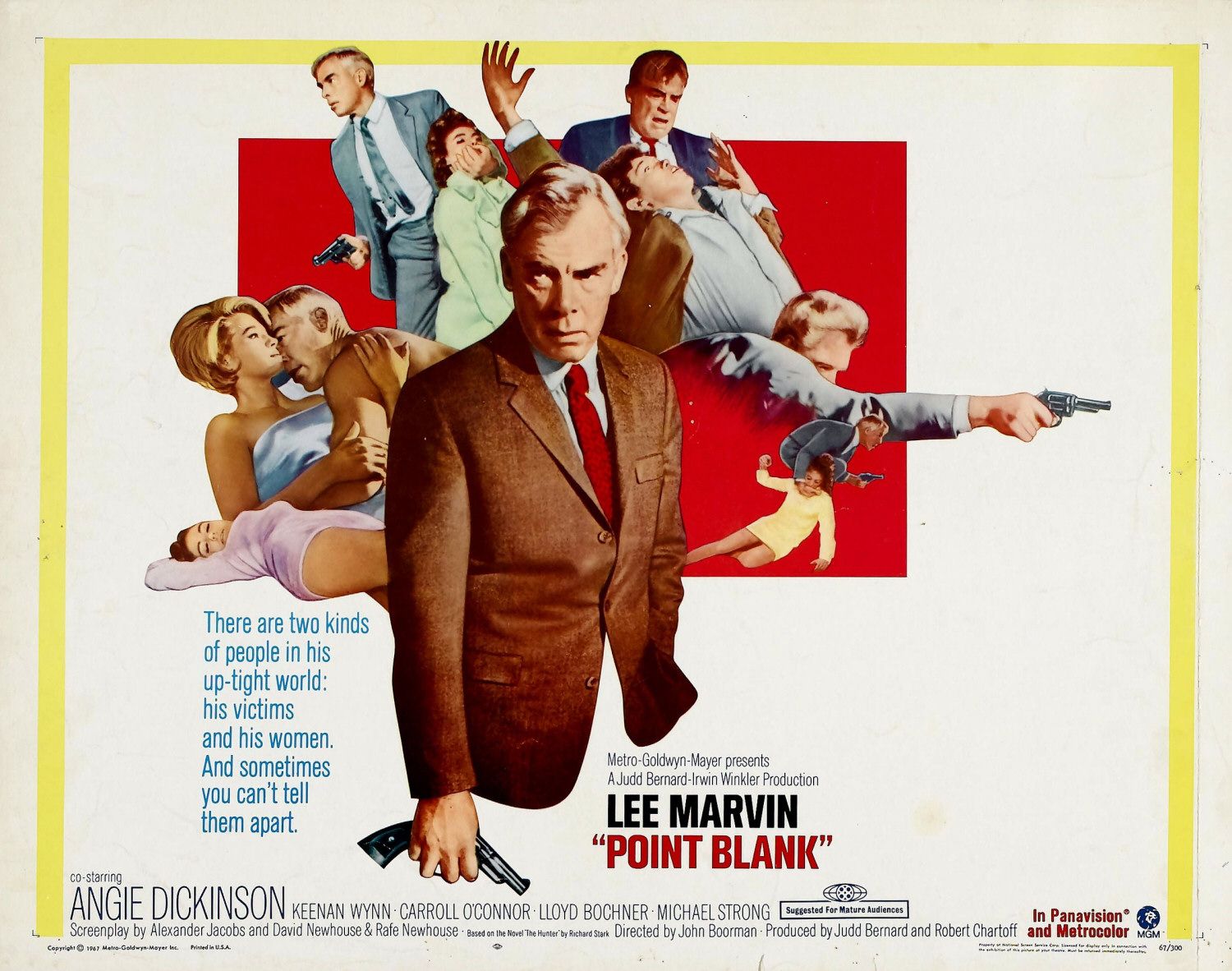
If you're like me, you pick up this movie because you want to see Lee Marvin (who I once saw referred to as "the toughest-looking son of a bitch who ever was born") wreck some serious shop. Well, you pretty much get that with Point Blank. The big drawback, though, is the aesthetic and settings within which he has to do it.

Marvin plays Walker (who, in classic tough guy fashion, adamantly never reveals his first name), who is out for revenge against a former friend who has double crossed him, shot him, and left him for dead in order to pay back a crime syndicate known as "The Organization." Well, Walker survives and comes back two years later to track down his betrayer between San Francisco and Los Angeles. He starts to target anyone who knows anything about his former friend, Reese (John Vernon), and he essentially kills his way up the criminal food chain to get to him.

Watching Walker go to work is fairly satisfying, though it's a story that's been done better in movies like Get Carter (the original 1971 version), A History of Violence, and others. Sure, the bad guys are scuzzy enough, but Walker doesn't ever have to display overly exceptional wits or physical prowess. He's smart enough to see various double-crosses before they get to him, but his skills are more often implied rather than actually displayed.

If you think these outfits are terrible, they're actually some
of the tamer ones that you'll see in the movie. And the
seediness of this still frame also indicates a pervasive tone.
What weakens the movie and has caused it to fade so much over the years are the look and feel of the film. Filmed in 1967, it hurls every groovy, mod-tastic piece of dated music and fashion that it can manage at you. There are hinky jazz clubs, a bombastic musical score and sound effects, and costumes that might as well smack you in the mouth. These may all have been chic and cool when the movie was released, but they were undoubtedly rather comical a mere decade later. Forty-five years later, they have become an obnoxious distraction.

It also didn't help that, aside from Lee Marvin playing Walker, there aren't any other compelling characters. Reese and everyone in the organization is a one-dimensional egoist who first tries to placate Walker before trying to stab him in the back. Even Angie Dickinson, who is pleasant enough to look at, plays a character who is arguably the work of a obliviously misogynistic mind. Perhaps thinking they were creating a woman of "depth," they have her swing between raging at Walker, punching and cursing him, and then jumping into bed with him. In between these weird bouts, she plays it cool as a cucumber, though we never have any clear idea how or why the transitions are made. What we're left with is a woman who can only be described as a traumatized schizoid. Either that or just poorly conceived and written.

Fortunately, the film is only 93 minutes long, and it's fairly streamlined. There are a few throwaway scenes, but not many. The story clicks along fine, with Walker moving from one punching bag to the next, doling out underworld justice. I've no need to watch it again, but it was fine one-shot viewing. 

Sunday, December 2, 2012

Film # 91: Unforgiven (1992)


Director: Clint Eastwood

Initial Release Country: United States

Times Previously Seen: around five or six

Rapid-Fire Summary

In the small town of Big Whiskey, Montana, in 1881, a cowhand becomes enraged at a prostitute named Delilah over a minor insult and slashes her face. Despite calls from Delilah’s fellow prostitutes that the cowhand and his companion be hanged, the sheriff, “Little Bill” (Gene Hackman) merely demands that the two boys pay the proprietor of the saloon/cathouse in the form of horses. The furious prostitutes then secretly pool their money and start spreading word of a bounty for anyone who kills the two cowboys.

To the south, in Kansas, a brash young man calling himself “The Schofield Kid” finds the middle-aged farmer William Munny and asks him to partner up to kill the cowboys for the bounty. The Kid has heard from that Munny was once a fearless and vicious killer who would make a perfect partner for such a dark deed. Munny, now a widower who has forsworn his previously murderous life and with two young children to support, at first refuses The Kid. With his farm failing, though, he changes his mind. He convinces one of his old partners, Ned (Morgan Freeman), to join him on this final killing in order to have a new start for his children.

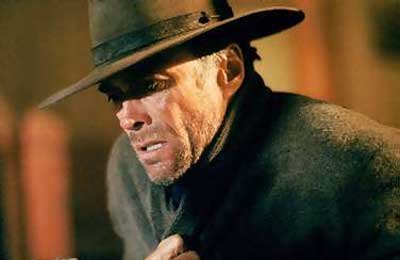
Will Munny, a brutal killer in the past, now struggles on his farm with his two your children.

Back in Big Whiskey, Little Bill has now heard of the bounty put out and brutally beats and casts out the first bounty hunter who drifts into town to inquire after it – the noted gunman “English” Bob (Richard Harris). When the Kid, Will, and Ned come into town some days after, Will is himself beaten by Little Bill, while Ned and The Kid escape. The three rally themselves and set out after the first of the two cowboys, undeterred by Little Bill’s edict against assassins. When they find the cowboy, however, Ned is unable to bring himself to kill him. Will instead takes Ned’s rifle and shoots the cowboy dead. Ned, realizing that he no longer has what it takes to kill a man, parts ways with Will and The Kid, with Will promising to bring Ned his share of the bounty after the job is finished.

Will and The Kid then find the second cowboy, who actually cut up Delilah, holed up at the ranch he works on. The Kid kills the cowboy and the two make a narrow escape. When Will and The Kid return to just outside of Big Whiskey to collect the bounty, however, they discover that Ned has been captured, tortured, and killed. Suddenly overcome by a dark cloud of vengeance, Will plies himself with alcohol and rides into town alone. Calmly walking into the saloon where Ned’s corpse is prominently displayed outside, Will coldly kills six men, including the saloon owner, four deputies, and Little Bill himself. Though plenty of the townspeople are still alive to stop Will from leaving, they are all too terrified of the killer to even make the attempt.

Will, in Skinny's saloon as he slays all those he feels are responsible for Ned's death. During these moments, all traces of the quiet, tortured farmer have been burned away.

We are told in the end that Will returned to his farm and used his bounty money to move himself and his children away, possible to California where he “prospered in dry goods.”

My Take on the Film (Done after this most recent viewing):

Unforgiven is, in my mind, the greatest Western film. There are others that are more exciting and entertaining, but this one has by far the most depth and arguably the greatest acting.

Clint Eastwood’s masterpiece probably couldn’t have been made much earlier than it was. Being a deconstruction of the mythical West and Western stories, it required all of the popular lore that preceded it, both in literature and film. Eastwood set out tell a story that took a dark and realistic look into the souls of truly dangerous men in the old West, and he did it with expert precision.

At the heart of the film are all of the popular notions of the “Wild West” gunslinger. The mythology around that time and place has been the inspiration for countless tales of adventure for well over a century. The archetypal “deadly guman” has long been one of the most attractive characters in U.S. narrative. Unforgiven gives voice to this attraction through the character Beauchamp, a bumbling fiction writer who at first is following around English Bob as his biographer. His stories of Bob cast him as a noble warrior whose skills with a pistol make him a modern-day knight. Once Bob is thrashed and imprisoned by Little Bill, however, the myth starts to fall apart.

English Bob, left, and his biographer, Beauchamp. It is initially through these two characters that the myths of honorable gunfighters are taken apart.

It is during the scenes between Little Bill and Beauchamp, with English Bob watching from his cell, that we start to get at the reality of killers. With his first-hand knowledge of Bob, Little Bill tears apart Beauchamp’s notions of his idol. We soon see that Bob, though a truly dangerous gunman, is actually a vicious murderer unworthy of any admiration.

But the deconstruction of English Bob is only a prelude. It is with the tale of Will Munny that the truly disturbing truths about gunfighters emerge. With incredible pacing, Munny’s regression from penitent farmer back to unrepentant killer is as captivating as it is terrifying. For most of the film, Munny’s murderous past is merely hinted at, through stories told by other characters such as The Schofield Kid and even Will’s riding partner, Ned. As each bloody story is revealed, Munny tries to assure Ned and himself that he, “ain’t like that no more.” Watching him cling to the new self into which his dead wife molded him is like watching a time bomb trying to diffuse itself.

During his arrival at Bog Whiskey, Munny is still tortured and ill. It's almost as if his modern, peaceful self is slowly coming apart under the burden of trying to keep his homicidal nature at bay.

Any doubt about Munny is removed about halfway through the film, upon the death of the first cowboy. When Ned is unable to pull the trigger, Munny reverts to form. Without blinking, he takes the rifle from Ned’s uncertain hands, takes aim, and kills the young man. It is now clear that, while Ned truly has left his homicidal past behind him, Munny still possesses a true murderer's instinct. As if the contrast between Ned and Munny isn’t enough, is becomes all the more clear when Munny allow The Kid, eager for a kill, to execute the second cowboy later. After the deed is done, The Kid shakily admits that, contrary to his prior boasting, it was his first kill. The Kid is all too aware of the difference between himself and Munny, stating, “I ain’t like you Will.” Will’s response is right at the heart of the film – “It’s a hell of a thing, killin’ a man. You take away everything he’s got and everything he’s ever gonna have.” The Kid then swears off guns and killing for the rest of his life.

It is then, in the final ten minutes of the movie, that we see the true horror of William Munny. After he is told of Ned’s death, a terrifying transformation takes place. For most of the story, Will has been the picture of anguished restraint. He has refused to take a drop of alcohol and has only killed the two cowboys condemned by the bounty. However, when he learns that his friend has been tortured, killed, and put on display, his previous decade of temperance thoroughly vanishes. A cold fire alights in his eyes, his teeth clench, and he grabs a whiskey bottle and methodically starts to drink. By the time he enters the saloon at nightfall, he is Vengeance personified. In front of the group of puzzled and uncertain deputies and other town residents, he brutally shoots the saloon owner, Skinny. Even then, the deputies are clearly too frightened to try and bring down Munny. Even when they do gather their wits and try to square off against him, Munny is too calm under fire to be brought down. By doing little more than keeping his composure, he proceeds to shoot the five men remaining with weapons in their hands. The writer Beauchamp, who has been cowering in a corner and witnesses everything, then tries to question Munny on his “strategy.” Munny debunks any notion of skill or strategy by simple saying, “I was lucky…I’ve always been lucky when it comes to killin’ folks.” With this line, there is nothing left to be lauded in Munny’s actions, not even any kind of “skill.” Like English Bob, he is a mass murderer, though an uncommonly effective one.

Munny's execution of Little Bill. It may be one of the coldest, most haunting killings in all of film. 

Following the rapid departure of Beauchamp, Munny then steps up to Little Bill, who has been wounded but is not dead. Little Bill looks up at Will Munny, and instead of begging or pleading, simply says, “I don’t deserve to die like this.” Munny stares him in the face and delivers perhaps the most haunting line of the film when he proclaims, “Deserve’s got nothin’ to do with it.” At this moment, Munny is no longer even a spirit of vengeance. He is death itself. Unfeeling. Unthinking. Uncaring of right or wrong.

Those final lines, and others like them in the film, are what set Unforgiven apart. The only other Western I know of that even came close to taking such a hard look at the makeup of the Western gunfighter was The Searchers, with John Wayne. However, The Searchers still had a solid dose of romantic hokum blended into it, and it’s not nearly as even in execution as Unforgiven. Clint Eastwood directed this movie as well as anything he’s ever done, encompassing all of the things that make Western films great, while adding unprecedented philosophical depth.

The story and characters are undoubtedly what make the movie great, but I’d be remiss if I didn’t at least briefly mention its other merits. The cinematography is incredible, with all of the gorgeous wide-angle shots that you could hope for in a sweeping Western. Even more is the acting. Clint Eastwood does a fine enough job, and it helped that the character Will Munny didn’t call for any spectacular range of emotions (not Eastwood’s forte). The standout performances are Morgan Freeman and Gene Hackman, the latter of whom justifiably raked in a ton of awards for his turn as Little Bill. But even the smaller roles are all played perfectly, from Richard Harris as English Bob right down to the lowly prostitutes and townspeople.

Little Bill, in front of the townspeople of Big Whiskey. Just as important to the tone of the movie, the smaller roles all convey very realistic reactions to violence and death - rage, frustration, and fear.

When I think about Unforgiven as a whole, one thing I often come back to is the notion of freedom. For fans of Western tales, it is often the sense of freedom that is most appealing. The wide-open spaces of the old West have always been thought of as places where a person is free from the restrictions and expectations of “civilized” society. We often assume that this is essentially a positive thing, as it allows a person to be whoever they want to be or discover who they really are. This is a beautiful idea, if you assume that the person you really are is one to be loved and admired. But what if who you really are is someone as terrifying as William Munny? What if, in spite of your every effort to escape it in the quiet, isolated, wind-swept plains of Kansas, you are something that frightens yourself to your very soul? I don’t know if this is one of the intended themes of the film, but it is one that stays with me.

Additional Note: I came across the news that there is currently under production a remake of Unforgiven, set in feudal Japan and starring Ken Watanabe as the "Will Munny" character. Normally, I would be disgusted at the thought of a remake of Unforgiven; however, I can see the potential for a samurai setting to be very successful. I hope they can pull it off.

That’s a wrap. 91 shows down, 14 to go.

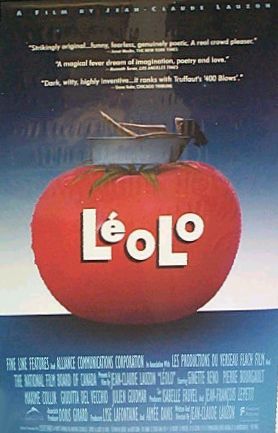
Coming Soon: Leolo (1992)


Don’t know anything about this one, but I’m guessing it doesn’t involve Clint Eastwood, ruminations on murder, or and Englishman getting his ass whipped. You never know, though…

Please be sure to pick up all empties on the way out.