Showing posts with label Viggo Mortensen. Show all posts

Sunday, March 3, 2019

Newish Releases: Mandy (2018); Green Book (2018)

Mandy (2018)

Director: Panos Cosmatos

Whoa. Someone actually managed to cast the off-the-rails, 2010s Nicolas Cage in the perfect film for where he seems to be, career-wise. Mandy is a trippy, wild, phantasmagoric take on 1970s grindhouse cinema, with a slick 1980s shine on it. And I was riveted.

Oddly, it was a bit tough to track down this movie. After hearing significant buzz about it back in September or so, I searched and searched for a theater showing it in the Philadelphia area, to no avail. And so it came and went on the big screen. Then, I had to wait several months before it was available to rent through streaming services, and then only through Microsoft. But when I did fire it up...

I got a tale of Red (Nicolas Cage), a lumberjack who lives with his artist wife Mandy (Andrea Riseborough) in a secluded cabin in the woods. Mandy is an artist and a fan of fantasy novels, and the two have a deep and genuine love for each other. Their bliss is horrifically shattered when a small cult, lead by Jeremiah Sand, kidnaps Mandy to satisfy Sand's self-indulgent, messianic desires. Things go horribly wrong, and Red is sent on a mission of revenge. To gain his vengeance, he cuts a bloody swath through demonic bikers and drugged-out cultists.

This movie is balls-to-the-wall, gonzo crazy and trippy. But it's done with such an amazing sense of cinematic excellence that I was absolutely entranced. In some ways, it can remind one of the hallucinogenic grandeur of the cult classic El Topo, although Mandy has a clearer overall plot. What it shares with that earlier Jodorowsky film is a keen sense of framing, color, and setting. There is a simplistic clarity to the basic story elements which could have had a broad appeal, but the brutal nature of the events depicted puts the emotional tone more in the realm of 1970s grindhouse films, which featured horribly twisted people doing horribly twisted things to each other. Mandy bears more than a few of the hallmarks of those down-and-dirty flicks.

What elevates this movie beyond those filthy '70s shows, which I've never much gotten into, is that director Panos Cosmatos uses cinematic techniques to brilliantly illustrate a man completely and fantastically losing his mind in the most violent of manners. It is set up early in the movie that Red is a recovering addict. Then, there is a point where he falls off the wagon about as hard as a person can, and from that point, we begin to witness what might be an ever-more surreal fevered revenge fantasy. This is all brought home with brilliantly distinct costumes, set pieces, props, and masterful lighting. It's an amazing experience to drink in, if a rather disturbing one.

Obviously, this movie is not for everyone. It is packed with horrifically warped people doing disgusting and grizzly things to others. But if you're like me, and can see the movie as a creative, if violent, flight of fancy, then you may just be as transfixed by this flick as I was.


Green Book (2018)

Director: Peter Farrelly

Note: I saw this movie before its now-controversial selection as the Academy Awards' "Best Picture" winner.

Well-crafted and executed story based on real events from the early 1960s. Though it can be a bit on the nose at times, the overall themes, acting, and craft make this a solid film. Not necessarily an all-time, Oscar-worthy film, but a very solid one, nonetheless.

Based on a true story, the film follows Tony "Lip" Vallelonga (Viggo Mortensen), an Italian-American New Yorker and street-wise bouncer who, when he can't work an angle with his mouth, will effectively work it with his fists. In 1963, Tony Lip accepts a high-paying job driving and protecting Dr. Don Shirley on a music tour through the deep south. Shirley (Mahershala Ali) is African-American, and is a supremely well-educated, intelligent, and cultured genius of music, and his trio is among the most well-regarded in the world. As the racist Tony and aloof Dr. Don spend nearly every waking hour together during the tour, they learn to see things from each others' very different perspective.

At this point, this movie has received probably more criticism that it's deserved. Yes, it is yet another "race relation" film told mostly from the perspective of a white person. And yes, it can sometimes be a bit obvious and even clumsy with its "messages." But there is plenty about this movie that is very well done, and even admirable.

What I appreciated most about the movie is that it utilizes a few new elements and infuses them into the rather well-worn tale of "white person learns to empathize with black people." Unlike most of such tales from the past, Green Book features an uneducated, blue-collar white character having to work with a black person who is vastly more worldly than he will ever be. Dr. Don is immensely poised, articulate, sophisticated, and wealthy in ways that Tony Lip could hardly dream of. The mostly unapologetically racist Tony soon sees Dr. Don's gifts, and he develops more than a little empathy for a man whose gifts and whose struggles as an African-American in the U.S. become clearer as the two men spend so much time on the road together.

The reserved, ultra-intelligent, and sometimes flamboyant
Doctor Don Shirley. It isn't difficult to imagine a better, bolder
film being made more from the perspective lofty musical savant. 
But what, one might wonder, could Dr. Don learn from a New York ruffian-for-hire? Well, this is where the movie starts to get a tad choppy in its themes. While there is some fairly authentic-seeming lessons that a street guy like Tony imparts upon Don, such as introducing him to popular Motown and rhythm and blues music of the early 1960s, there are other nuggets that are almost painful to see. Probably the most cringe-worthy is Tony force-feeding the more aristocratic Don his first ever taste of fried chicken. Having a white man "teach" a black man "the joys of fried chicken" is one of those things that probably looked funnier and more effective on paper than it did on film. There are a few moments such as this, though they are fortunately low in number. And in the end, the film is not one where the two characters have such grand revelations that their entire lives are changes. Ultimately, they change in relatively small but important ways, while remaining themselves for the most part.

A great strength of the movie is is the performances of the two leads, Viggo Mortensen and Mahershala Ali. The two men play their extremely opposite roles to perfection, lending more than a little authenticity to the proceedings. They're both such excellent actors that they can sell the comedy just as well as the drama, which elevates the film appreciably.

Both my wife and I had a similar thought about this movie - that it would have been more effective and enlightening to see the tale much more from Doctor Don's perspective than from Tony's. Though we do get a few scenes in which the brilliant musician struggles with being so very isolated, the bulk of the movie's scenes include the more accessibly appealing ruffian Tony. Focusing on the more elusive and mysterious doctor would have challenged us viewers more, but would have offered us something more novel. 

Sunday, June 18, 2017

New(ish) Releases: Captain Fantastic (2016); Elle (2016)

Ben, leading his kids into a misguided adventure. As admirable
as much of Ben's philosophies and teachings are, the flaws
become more apparent as the movie progresses.
Captain Fantastic (2016)

Director: Matt Ross

Highly interesting and rather unique tale which allows the extremely versatile Viggo Mortensen to shine brightly.

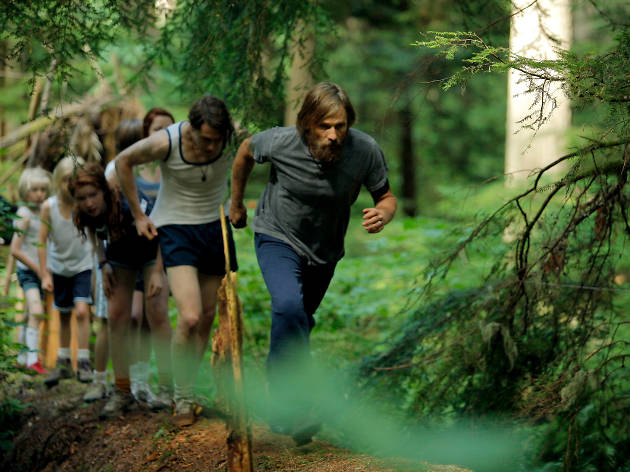
Mortensen plays Ben, an ideologue of such extreme dedication that he has been raising his five children completely off the grid for nearly two decades. In the woods of the American Northwest, he leads his children go through regular training in order to sharpen their physical, mental, and spiritual health. They exercise vigorously, read classical and modern literature, engage in thoughtful and highly intellectual debates, and they exhibit the kind of empathy and concern that Ben sees ignored far too often by commercial America. At a glance, the family seems in many ways like a miniature example of the perfect commune. Much of this is thrown in disarray, however, when they learn that Ben's wife, the mother of the five children, has died. The circumstances around the death are not immediately clear, but it forces Ben and the kids to leave the forest and make a road trip back into the "real" world of modern conveniences and excess. As they re-enter this world, we start to see certain cracks in what at first seemed like a perfect little universe of Ben's and his wife's creation. This becomes especially apparent when Ben and the kids come into contact with Ben's in-laws, who have always found Ben to be a deranged and even abusive influence on their daughter and grandchildren.

Ben leads his kids during their rigorous, daily physical
training. In addition to working their bodies, he also works
their minds by having them read tons of high-end literature
and play instruments of their choosing.
This movie was surprisingly thoughtful and balanced, which is impressive given that it deals with a subject that can very easily get romanticized and be presented in extremely biased ways. The idea of raising one's children free of the avaricious nature of consumerism and any perceived problems of organized religion is noble, and one that more than a few people have attempted or fantasized over for decades. Could someone actually do such a thing, with the right attitude, work ethic, and genuine care for the children they are raising? Captain Fantastic initially paints an attractive portrait of someone's success in this arena. Simply seeing how it might be done is fairly compelling on its own, and the skills Ben's children exhibit are impressive, often because they raise very relevant questions about the current education system in the U.S. and people's attitudes towards what constitutes life's necessary lessons. How does one raise not just a knowledgeable person, but one who can think critically about how to be a "good" person?

While the educative themes explored in the movie are certainly thought-provoking, the dramatic element is also what provides us with the complexity that enhances the film. Once Ben and his children have to interact with mainstream society, we eventually see that his utopian vision for his children is in some ways unrealistic and in other ways downright negligent. Fortunately, by the end of the movie, we are not left with easy answers as to whether Ben's ways are completely correct or incorrect. Rather, we are left with a portrait of an extremely unique man and his children - one which can inspire in many ways but is clearly not meant as a manifesto for those tempted to run off and raise their kids away from the rest of humanity.

It's also worth mentioning just how excellent the acting is. There are many familiar faces in the film, but the primary actors - Viggo Mortensen and the five younger actors who play the children - are exceptional. Mortensen even got an Oscar nomination for Best Actor, which was completely deserved. He and the other performers did a great job in bringing this provocative, funny, and touching story to life. I highly recommend it.


Michele arms herself against future attacks. While she is clearly
a victim in several ways in this story, hers is a very complex
and often disturbing psychology. This despite her often calm
veneer as a successful, professional woman.
Elle (2016)

Director: Paul Verhoeven

Think of this as one of Pedro Almodovar's uncomfortable, controversial movies, but without the vibrant colors. Or much of the dark humor.

The story begins with a most awful act - a brutal rape of Michele LeBlanc (Isabelle Huppert) in the victim's home. Her assailant briskly leaves after this heinous violation, leaving Michele to pick up the pieces. Strangely, she does not call the police, but rather simply cleans up the broken glasses in the house, takes a shower, and goes to bed. She then continues the morning, going through her typical routine. Over the succeeding days, Michele's initial veneer of indifference shows signs of wearing down: she starts doing some simple detective work in order to try and learn the identity of her assailant. Along the way, we learn that Michele's father was a mass murderer who killed over 20 people when Michele was only 10 years old. He is also due for a parole hearing soon. All the while, lines between sex and violence become more and more blurred, especially once Michele discovers the true identity of her rapist.

Elle is a very well-done, calculating, and bold film very unlike any other movies I'd seen from director Paul Verhoeven, which include Robocop and Starship Troopers (he also directed Showgirls and few other glossy, campy good times). This film, though, is more akin to something I would expect from the aforementioned Almodovar, Stanley Kubrick, or perhaps even Lars Von Trier. Michele is, quite simply, not a terribly likable protagonist. For reasons that are not completely her fault, it is often painful to see her interact with her son, employees, mother, and even her lovers and closest friends. She is obviously smart and sophisticated, but she is also often distant, aloof, and calculating. While she is clearly the victim of the rape, her reaction to it is at first baffling. As the story progresses and we learn more about the horrors in Michele's background, her responses become a bit more understandable, but no less upsetting and disturbing. In short, she is complicated, which makes for an engaging tale.

The acting is incredible. Isabelle Huppert was rightly nominated for a Best Actress Oscar, as she displays the nuance that the character demands. She is clearly the show, and worth the price of admission. All of the other technical aspects of the movie are spot-on, with intense, almost crime-procedural segments broken up by slower, more thoughtful and sometimes more sinister scenes during which a viewer can find themselves getting pulled into the dark labyrinth of the mind of Elle and some of those around her.

As well-made as the film is, it is hardly one that I need to watch again. While it clearly tells the story it sets out to tell with excellence, it is a very disturbing one that I am not altogether comfortable subjecting myself to more than once. People who prefer more straightforward, black-and-white stories, where it is clear who the heroes and villains are will most likely not appreciate Elle. However, people who enjoy narrative and emotional complexity, and are not put off by highly uncomfortable situations, would do well to give this movie a shot. 

Thursday, April 27, 2017

Retro Trio: Eastern Promises (2007); Repo Man (1984); They Live (1988)

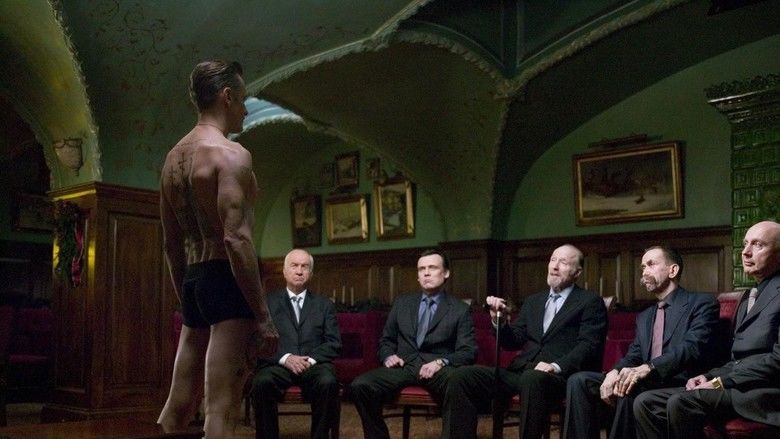
So you think you've had a stressful promotion interview or
two in your day? They're nothing compared to what Nikolai
goes through in the ultra-ruthless world of the Russian mob.
Eastern Promises (2007)

Director: David Cronenberg

First time I had watched this one since it was out in theaters. Still a really tight, harrowing piece of crime cinema, though not one that offers viewers any convenient answers about the problems of deep-seeded and systemic criminality and violence.

The story takes place in London, where local nurse Anna (Naomi Watts) has to assist in an emergency birth of a child born by an abused 15-year old girl from Russia.The mother dies giving birth, but she leaves behind a diary in which she details the horrors of her life in London. Being the child of Russian immigrants, Anna takes the diary to her mother and uncle. As Anna learns more about the men who were responsible for the girl's death, she becomes partially involved in a vicious power struggle within a local sect of the Russian mafia. The man with whom she has the most contact is Nikolai (Viggo Mortensen), a chauffeur to the local mob leader's son Kirill (Vincent Cassel). Nikolai is a quiet but intense and intimidating presence who seems to have far more knowledge and ability than he lets on as a mere driver and sometimes-assistant in the mob's criminal dealings. By interacting with Nikolai and his bosses, Anna unwittingly and rather quickly finds the lives of herself, the newborn baby, and her relatives are all in serious danger.

Eastern Promises was David Cronenberg's next film after 2005's  A History of Violence, and the two make for excellent companion pieces. Aside from both starring Viggo Mortensen, both are skilled, unflinching looks at the nature of violence and how it can manifest itself in individuals and cultures. The differences between the two lie mostly in the type of general story and the particular focus of each. The former film looked at one man's deeply buried violent past and nature, while the latter examines a type of violence that runs throughout an entire cultural group and is deeply enough embedded to be woven into other, more accepted traditions and rituals.

In terms of narrative, Eastern Promises uses suspense as a major device, with the lives of Anna, the newborn baby, and Anna's family all at stake as the Russian mob slowly closes in. There is also the element of mystery thrown in, as the Nikolai character is slowly revealed to be more than a stoic, detached chauffeur. These alone make the movie strong enough. Added to all of this, though, is the same bold and brutal depiction of violence which Cronenberg employed in A History of Violence. While I wouldn't say the movie is oozing violence, there are a handful of scenes that are violent, some of them extremely so. And Cronenberg strips away any pretense at glamorizing the brutality. This is an approach which I appreciate in movies such as this, as it drives home the point that nothing that these people are doing should in any way be seen as anything but horrendous. Cinematically, it also adds to the tension of the movie, as we understand the threat that characters like Anna are under.

This movie is one of many that has made me a tremendous fan of Viggo Mortensen, who does a brilliant job here. He and Cronenberg seem to make excellent collaborators, and I hope they can find another story strong enough to pair themselves up again in the future.


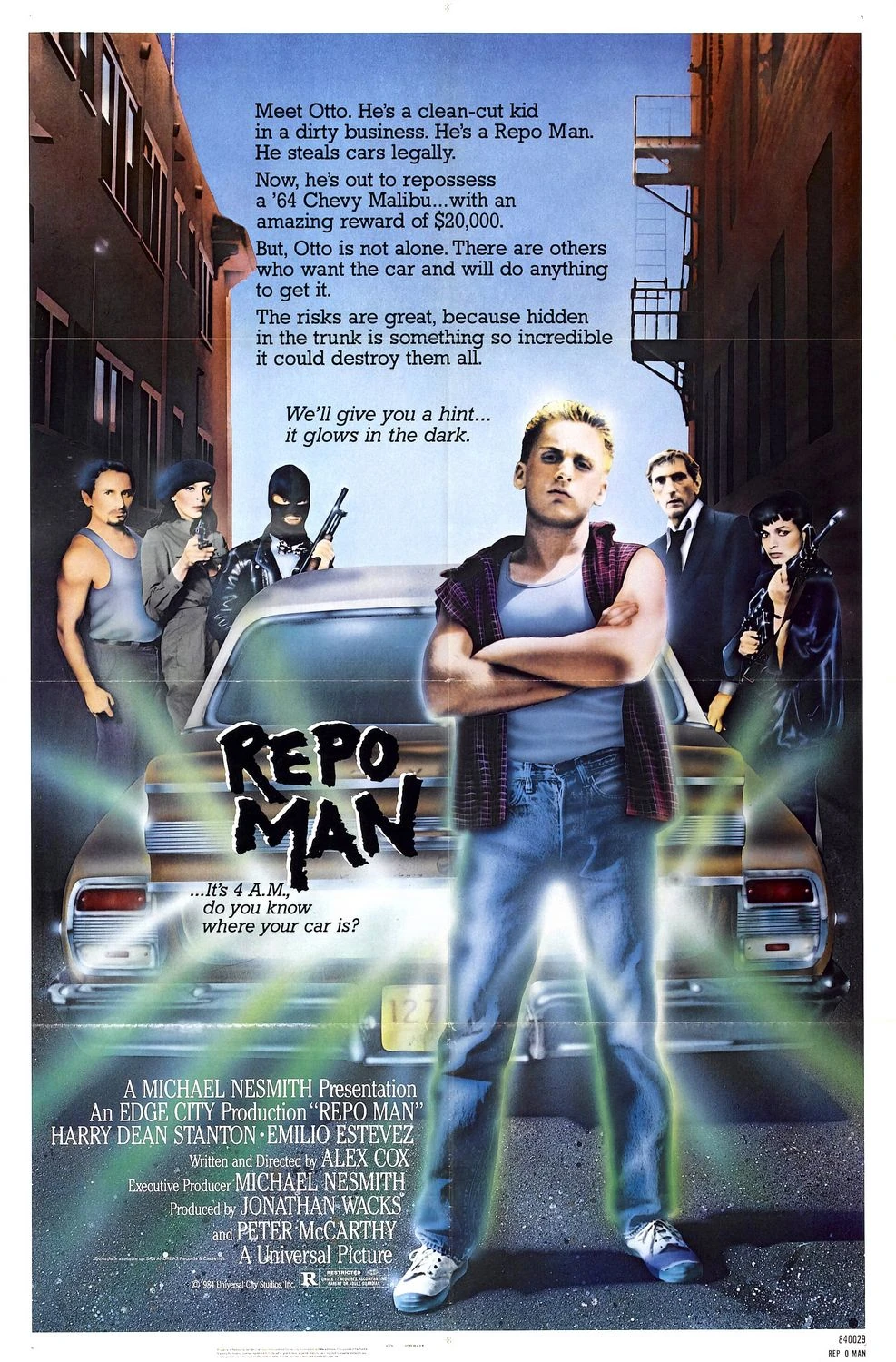
One of the most verbose movie
posters I've ever seen. Ironic, given
how Otto is not exactly a young man
of letters, shall we say.
Repo Man (1984)

Director: Alex Cox

I didn't first see this movie until around 2005, and I enjoyed it. This second viewing confirmed my enjoyment, and it confirmed to me why this movie is still a cult classic.

Emilio Estevez plays Otto, an 18-year old punk rocker who is disgusted by his dull suburban life. He quits his job at a supermarket and is soon taken into the car repossession business by Bud (Harry Dean Stanton), a veteran of the trade. Otto's fellow repo men are all social misfits of one form or another, each with his own bizarre code of independence and rebellion. Otto eventually gets mixed up with a strange maelstrom of activity surrounding a Chevy Malibu housing a radioactive alien in its trunk. Mysterious secret operatives are involved, and Otto's fellow repo men get involved in the bizarre pursuit.

The movie is an oddity that could only have come from the middle of the Reagan-era United States, made all the more odd by the fact that it still holds up as a great cult movie, even in 2017. English writer and director Alex Cox (it's always foreigners who nail the American tale in movies) crafted an oft-times hilarious take on American rebellion in the face of and encroaching popular culture of conformity. Otto is a straight up punk-rocker - a kid who has no idea what he wants but knows that he hates nearly everything about his life and the world around him. When he meets a gaggle of curmudgeonly rebels in the repossession business, their interactions are downright hilarious at times. While all of the repo men are great characters, legend Harry Dean Stanton takes the cake as Bud. Bud is a true, died-in-the-wool libertarian who thinks any real American can and should pull themselves up by their bootstraps, put life in a headlock, and give the middle finger to anyone who thinks otherwise. One of his many gems is his response to Otto pointing out that Russians don't pay for anything: "All free? Free my ass," replies Bud, "What are you, a fuckin' commie? Huh?...Well, you better not be. I don't want no commies in my car...No Christians, either." Kind of says it all, right there, really.

Sure, the story, characters, dialogue, and acting can sometimes be a little frayed around the edges, but those don't overpower the gonzo, in-your-face fun of this movie. With it's rebel attitude and d.i.y. approach to characters and dialogue, it conveys a punk rock perspective that is rarely matched. Interestingly enough, the actual cinematography is high quality, which makes the movie generally pleasing to take in. While it's not a movie I need to watch over and over, it's a great little work of its time that holds up rather well.


They Live (1988)

Director: John Carpenter

Talk about a great premise, with some great moments, dragged down by some questionable elements and a limited budget.

In They Live, Carpenter adapted the Ray Nelson short story "Three O'Clock in the Morning" into a solid cult movie. The tale follows Nada ("Rowdy" Roddy Piper), an out-of-work drifter who comes across a secret resistance movement fighting against an unseen cabal of aliens who use subliminal messaging to keep humanity locked in a state of consumption and laze. Once Nada accidentally gets a hold of specially-made sunglasses which allow him to see the ghoulish aliens, he has to flee and attempt to convince people to join him in resisting their plot.

Like a few other Carpenter movies, They Live is a perfect example of a mediocre movie that would have made a fantastic TV episode of The Twilight Zone. Perhaps with a better budget and a stronger script, it could have been a great 90-minute movie. As it was, though, some sharp editing could have pared it down to a brilliant 50-minute show. There is some great commentary on rampant consumerism driven by economic elites, which is as relevant now as it was at the height of Reagan-era excess. And the science-fiction devices work fairly well, with even the clearly-underbudgeted makeup effects creating the necessary creepiness. And the movie does provide us with a couple of classic one-liners, including the gem "I've come to kick ass and chew bubblegum...and I'm all out of bubblegum."

What keeps the movie from being all it could have been comes down to two things, really. One is several sluggish, filler-type sequences that gobble up far more screen time than necessary. Most egregious is the back alley fistfight between Nada and Frank (played by the ever-solid Keith David). The pro wrestling-style brawl goes on for over five minutes, but it feels like three or four times that. Add in that it is far from essential to the primary plot, and you get a nasty speed bump in the middle of what is occasionally a well-paced movie. The second issue is that the script simply isn't terribly creative or tight. The brilliant premise and basic framework aside, there just aren't many verbal exchanges or expositions that are terribly compelling or memorable. Equally dubious are some of the threads that are meant to tie the story together, which can be frayed in more than one part of the film.

They Live is a fun little slice of 1980s dystopian social commentary, to be sure. It's not much of a time commitment at right around 90 minutes, so it's worth checking out for anyone who enjoys a clever sci-fi premise, even if the technical merits of the movie are lacking in several aspects. 

Sunday, August 23, 2015

Gangster Flick 3-Pack: A History of Violence (2005); Underworld, U.S.A. (1960); Sonatine (1994)

A History of Violence (2005)

Director: David Cronenberg

A phenomenal movie that pulls off the unique feat of thematic, effective self-criticism.

The two homicidal maniacs on left have no idea what's lurking under the
humdrum exterior of Nick Stall. The peeling back of that exterior is an
exercise in intelligent, chilling filmmaking.
The basic story seems to be a straightforward tale of bad guys getting their comeuppance after messing with the wrong man. Tom Stall (Viggo Mortenson) lives in a sleepy little Indiana town, where he runs a quaint diner and has a loving relationship with his wife, teenage son, and young daughter. When a pair of homicidal thieves attempts to rob Stall's diner and rape one of the employees, Stall kills the invaders with astounding efficacy. This tale of the small-town hero draws the attention of the national press. Soon after, a trio of extremely grim men arrive and approach Stall, claiming that Tom is really a man named "Crazy" Joey Cusack, a former wildman thug associated with an organized crime syndicate in Philadelphia. Stall must begin going to more and more extreme measures to protect his life and family.

While this may all seem like a familiar story of satisfying, righteous justice, trust me that it is far more. Early in the movie, it becomes clear that the story, guided by David Cronenberg's brilliant direction, is displaying the deeper, scarier nature of violence, its effects on humans, and its place in society. Tom's teenage son, Jack, is the victim of bullying at school. Jack follows his father's noble guidance by not fighting back and defusing many situations with his wit and humor. After he sees the praise his father receives for killing the two would-be murderers in his diner, though, Jack abandons his passive approach and pummels his tormentor at school. We viewers gain that base level of satisfaction at seeing this; however, when Jack's father later tells him that this is not the way to solve problems, we feel conflicted again. Certainly, non-violence is the lofty and ideal way to answer aggression, but we can't deny the primal thrill of physically punishing those who threaten us. This is just one of several very mature and intelligent themes and scenes in the film that add unprecedented depth to what could have been a more run-of-the-mill precursor to Taken.

The story carries the movie well enough, but Cronenberg's direction enhances it every step of the way. This is one of the most efficient movies you are ever likely to see. In an exceptionally tight 95 minutes, there are moments of brooding tension that bridge the violent action. It all has an almost hypnotic rhythm which carries you through, with virtually no wasted shots, scenes, or lines.

An easy technique to overlook is one that I particularly love about Cronenberg - his approach to film violence. When he portrays violence on screen, Cronenberg never glamorizes. There are no slow-motion shots. No triumphant music scores. No one-liners. Killing and maiming are horrible, brutal acts, and this is exactly how Cronenberg gives them to us. In A History of Violence, the deaths are ugly, gut-wrenching affairs, even when they are happening to villains who may have had it coming. This is a point for which I admire Cronenberg - the point that one should never get comfortable watching realistic violence.

I thoroughly enjoyed this rewatch (my fourth viewing, I believe), and I'll continue going back to this movie every few years in the foreseeable future.

Underworld, U.S.A. (1960)

Director: Samuel Fuller

Not the most polished film you'll ever see, but one loaded with admirable energy and conviction.

I've seen a handful of Samuel Fuller films - The Steel Helmet, Shock Corridor, and The Naked Kiss. I find them all to be the product of a man with a bold approach to the types of stories that he told in film, though without the resources that would make the film more widely appealing. Underworld, U.S.A. falls right into the same category.

You probably wouldn't trust a guy who looks like him, but
watching Devlin exact a brutal vendetta against a bunch of
repugnant criminals is crime movie gold.
The story is that of Tolly Devlin - a street thug who sees his low-rent criminal father killed by a quartet of goons associated with local organized crime. Devlin swears revenge. Over the next decade, he becomes an expert safe-cracker. Eventually, he sees his chance to exact vengeance on his father's killers, though it will be no small task. Three of the four men are extremely powerful lieutenants in a massive crime syndicate. This doesn't deter Devlin, though, as his sense of purpose brooks no flinching at the task he set himself from the moment he saw his father murdered.

The tale is a solid revenge story, though it doesn't take the path that you may predict. Fuller, who wrote the script, gave us something that I can't recall seeing in other crime/revenge stories. While the overall arc follows typical lines, the path that Devlin takes is novel enough to keep things interesting. He cozies up to unexpected figures, including a prostitute, a police lieutenant, and even the ruthless murderers whom he hopes to assassinate. He is a true rogue whose only allegiance is to his own vendetta, and such characters are almost always intriguing.

The movie has a certain raw feel to it, as do all Fuller movies which I've seen. He was willing to go places, in terms of human vice and violence, that kept him from mainstream success. His treatment of these things was never gratuitous, though. In Underworld, we see an innocent young girl ruthlessly run down by a hitman. Such an act is shown not for mere shock value, but rather to exemplify the hitman's utter lack of empathy or compassion. The movie has several other hard-hitting scenes, and they set Fuller movies apart from their contemporaries.

Even when in the middle of a lethal firefight, Aniki (far right) shows a
disturbing amount of impassiveness. It eventually becomes clear that this is
not done merely to make him seem "cool."
Sonatine (1994)

Director: Takeshi Kitano

A quirky, enigmatic film with a powerful final punch.

Anyone who has seen a Kitano film knows that he has an unusual style. Sonatine is no different. It follows Japanese yakuza strongman Aniki Murakawa (Takeshi Kitano, who also directed). Though very powerful and successful on his turf in Tokyo, Aniki gets orders from a superior to take a small contingent of soldiers to Okinawa, where they need to settle a turf war between locals. Once there, Aniki and his mostly inexperienced crew find things becoming unexpectedly complicated. Several men on both sides are killed, and Aniki and his remaining soldiers retreat to a secluded house on the beach. While there, the men while away the time by drinking and clowning around. Aniki has some fun with them, but he also begins to quietly ponder the meaning of his life of crime.

I must admit that I found the movie somewhat difficult to follow. This is partially because of the number of characters involved, each being part of one of four or more factions in the disputes. (And no, it's not because I think all Japanese guys look the same - I spent two years living and working in Japan, and I never confused people). A larger reason, though, is that the plot is vague. This is by design, as Aniki's confusion over the killings around him is what spurs his existential crisis. For all the value Aniki and his men give to killing their opponents, they might as well all be the same. Adding to my confusion was the quirky detachment that nearly all of the characters exhibit. I'm all for using deadpan as a device, and it is sometimes effective in Sonatine, but it was amazing how it obfuscated people's intentions and motivations much of the time.

Though I discovered afterwards that I had clearly missed and misunderstood certain plot points in the movie, this did not make the ending any less powerful. The closing sequences expose Aniki's deepest, darkest feelings in ways that I had never seen. These alone set this movie apart from any other gangster film that I have seen thus far.

Those unfamiliar with modern Japanese cinema might find the tone and performances off-putting in their stoicism or strangeness. However, if you are willing to put in some work and make it to the end, there is a rather profound payoff waiting. 

Friday, September 20, 2013

Film #103: Lord of the Rings: The Two Towers (2002)


Director: Peter Jackson

Original Release Country: United States

Times Previously Seen: six or seven

*Note: The Lord of the Rings (LotR) trilogy was considered a single film by the list compilers at TIME, but I am reviewing each film separately. Here was my review for the first installment, The Fellowship of the Ring.

Legolas Quick-Draw-and-Fire Summary:

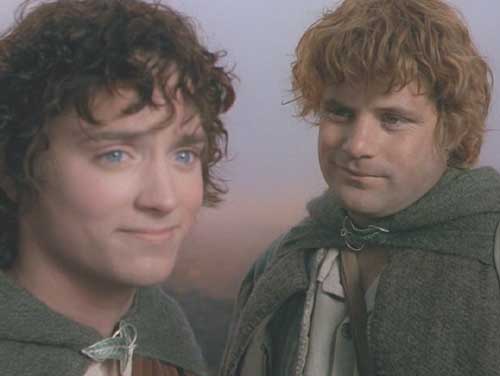
The eight remaining fellows of the fellowship of the ring are scattered about the lands. Many a fight ensues, while Sam and Frodo make more puppy-dog eyes at each other.

Extended Summary (with spoilers. Lots of them.)

*If you’d really like to dork out, you can check out this even-more detailed summary at imdb.

Sam and Frodo, having left behind the rest of the fellowship, continue to make their way towards Mordor. As they make the arduous trek across the craggy, sheer cliffs, they are attacked by Gollum, the previous owner of the Ring of Power. Gollum is monomaniacally obsessed with repossessing the ring. Sam and Frodo manage to capture and subdue Gollum, forcing the wretched creature to guide them safely to Mordor.

Far away, on the open plains of Rohan, Merry and Pippin are being carted along by the band of Uruk-hai that captured them. This band of vicious creatures are eventually joined by an equally repulsive force of orcs. The entire group is being hunted and hounded by Aragorn, Legolas, and Gimli, who are relentlessly chasing after their hobbit companions. However, before the trio can catch up to the Uruk-hai, the band of monsters are set upon by the Roherrim – a force of horse lords led by their Prince Eomir, who has been banished from his own lands by a possessed King Theodrin. Despite this, the Roherrim kill all of the Uruk-hai and orcs. Merry and Pippin manage to escape the carnage, fleeing into the nearby Fangorn Forest.


Legolas, Gimli (obscured by horse head), and Aragorn are met by a wary Eomir and his Rohirrim.

In the Forest, Merry and Pippin are saved by a massive, animated tree – a creature known as an “Ent.” This ent, which gives his name as Treebeard, brings the hobbits to a man he refers to as “the White Wizard.” Though the hobbits at first assume that Treebeard is referring to the now-evil Saruman, it is actually a reincarnated Gandalf. We come to find out that Gandalf, after defeating the Balrog beneath the Mines of Moria, was resurrected and brought back to Middle Earth in order to assume the role vacated by the twisted Saruman – that of “The White Wizard.” Eventually, Aragorn, Legolas, and Gimli find all three of their old friends in Fangorn, and the six are happily reunited. The reunion, however, is short, as Merry and Pippin are taken with Treebeard to a muster of other Ents, while the other four make their way to Edoras, the capital of Rohan.

Meanwhile, Sam, Frodo, and Gollum have traversed the Dead Marshes outside of Mordor’s Black Gate, though not without some serious risk. As the trio arrive at the gate, it becomes clear that entering Mordor this way is virtual suicide. Gollum convinces them that there is another way in, though it will take some time to reach it. Though Sam is highly skeptical of the skulking Gollum, Frodo puts his trust in the shifty guide, and the three begin their retreat from the Black Gate.

Back in Edoras, Gandalf and company arrive to find King Theodin in a vicious mental trap laid by his own “advisor,” Wormtongue, and maintained by the sorcerer Saruman. The newly empowered Gandalf exorcises Theodin, restoring his mind and youth; then, the wizard leaves in order to find Prince Eomir and the Roherrim. Gimli, Legolas, and Aragorn stay behind to assist Theodin, as his lands are being overrun by Saruman’s ever-growing hordes of bloodthirsty creatures and feral human tribes. Theodin decides to gather all of the people in his city and bring them all to Helm’s Deep, a massive fortress built into a mountain. From there, he hopes to repel and crush any oncoming army. En route to Helm’s Deep, the caravan is set upon by a group of vicious, lupine wargs. The humans fend them off, but they seemingly lose Aragorn in the defense, the ranger having been sent over a cliff while fighting one of the warg riders.


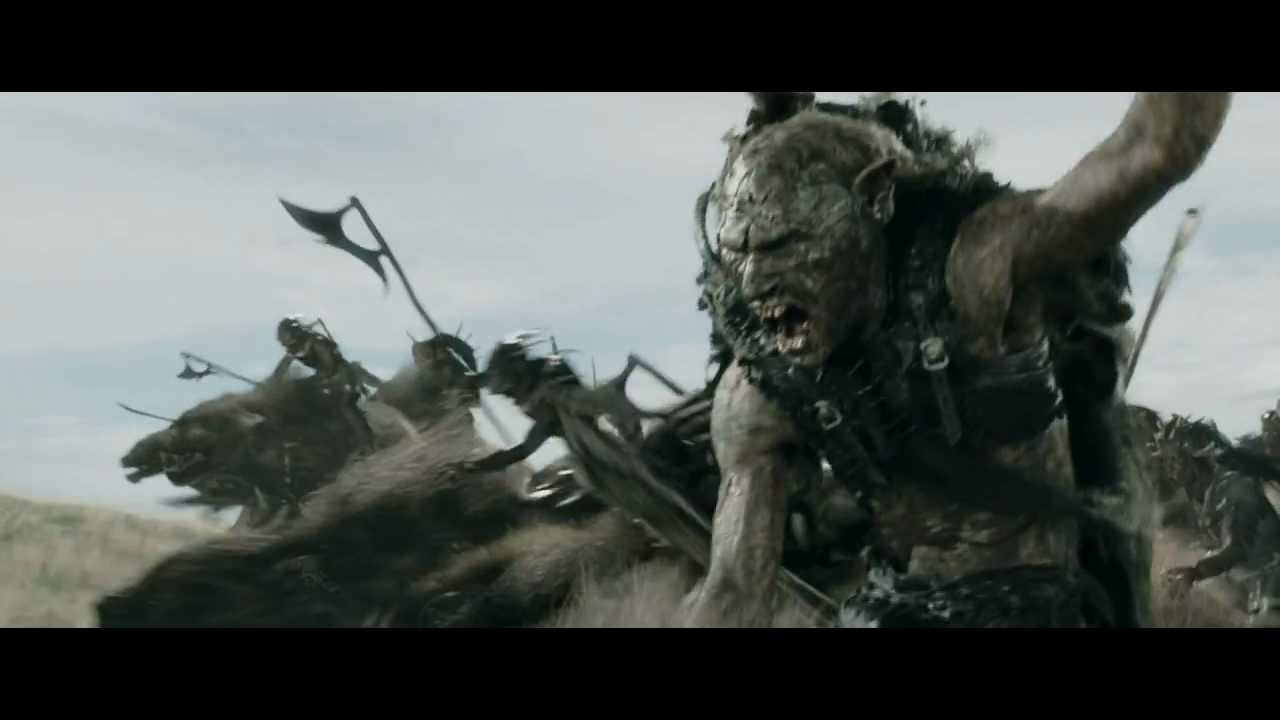
The vicious wargs and their riders. Our heroes have to fend off a whole mess of these nasty critters, en route to the safety of Helm's Deep.

Far off, within the borders of Gondor, Sam, Frodo, and Gollum continue to make their way towards Gollum’s alternate path into Mordor. However, they are taken by a band of humans led by Faromir, a young Prince of the region. Sam and Frodo are taken captive as assumed spies, but the cunning Gollum eludes capture.

Back in Helm’s Deep, King Theodin readies the small group of humans remaining for their grand defense. Though the Deep is an amazing defensive structure, their number of actual warriors is very few. Their hopes are bolstered, however, when first Aragorn turns up very much alive, and then even more when a force of elven archers arrives.

In Gondor, Faromir begins to interrogate Sam and Frodo about their purpose in his lands. He also manages to capture Gollum. Faromir eventually learns from Gollum that Frodo carries the Ring of Power, and Sam and Frodo learn that Faromir is the younger brother of Boromir, their fallen comrade from the fellowship of the ring.  Despite the hobbits’ warning to Faromir not to try and take or use the ring, the young prince decides to take them all to his father at Minas Tirith, the capitol of Gondor.

At Helm’s Deep, night has grown completely dark, and Saruman’s massive army has arrived at the gates. The battle ensues. After hours of bloody fighting, the humans and elves have exacted a mighty toll on the numbers of the attacking hordes. Still, the sheer numbers of the monsters is near to overwhelming them all. Just when Theodrin’s forces are down to their final few, the dawn breaks, and reinforcements arrive. In the east, Gandalf, Eomir, and the Roherriam charge into the flank of Saruman’s remaining army, routing them all and saving the remaining human forces nestled within Helm’s Deep.


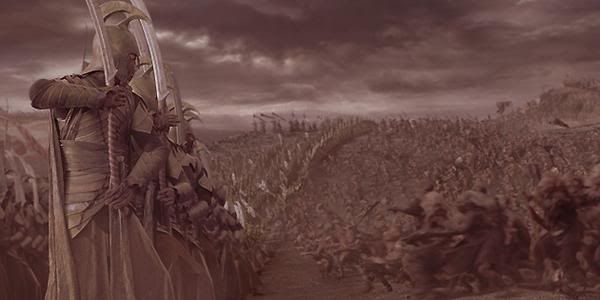
It's all-out siege warfare when Saruman's army attacks Helm's Deep.

All the while, Merry and Pippin have been waiting for the excruciatingly deliberate Ents to decide whether to involve themselves in the war. Though the tree creatures decide that they will not fight, they change their minds after Treebeard sees how Saruman has razed huge swaths of forest surrounding his tower. An army of ents storms and overtakes the tower, wiping out the monstrous forces within and trapping Saruman in his own lair.

Within Gondor, Faromir and his captives arrive in Osgiliath, a blasted city close to Minas Tirith. Their entire party is assaulted by forces from nearby Mordor, including a Ring Wraith riding a vicious black dragon. Frodo barely escapes the Wraith, and Faromir finally decides to allow Frodo, Sam, and Gollum to continue their way into Mordor. The Gondorian prince does, however, warn then that the path that Gollum is taking them to is fraught with horrible dangers.

The road, it seems, is only going to get harder…

My Take on the Film (Done after this most recent viewing)

While my recent re-watching of Fellowship of the Ring found me a little more restless than I had ever been when watching it before, I did not find the same problem with The Two Towers. Though I might not be quite as enchanted by it as I was ten, five, or even three years ago, I still really enjoy it.

Compared to Fellowship, there’s simply more meat to it. Yes, there are some of the lighter, more melodramatic moments, especially in the extended edition (which is the one that I watched this time). The teased romance between Aragorn and Eowhin, the antics of Merry and Pippin, and the wistful recollections and musings of Aragorn and Arwen, are all little moments that become a bit stale once you’ve seen them as many times as I have. They’re not bad, but they provoke some watch-gazing for me.

The real draw of The Two Towers is the action. While Fellowship certainly has a few good action scenes and small-scale battles, the second chapter steps it all up in a serious way. The smaller skirmishes with the wargs, orcs, and Uruk-hai are cool enough. But they all pale in comparison to the battle of Helm’s Deep. At this point in the story, Peter Jackson began to throw it all out there. In scenes that would do Braveheart proud, the fighting intensity and action are simply a blast to watch. The entire battle takes up over 30 minutes of the film, but it has never, any of the times that I’ve watched it, felt overly long to me. There are simply so many eye-catching things happening in nearly every shot that the entire Helm’s Deep sequence demands multiple viewings. Of course, if you simply can’t stand battle scenes, then you’re out of luck. For the rest of us, it’s unadulterated popcorn entertainment.


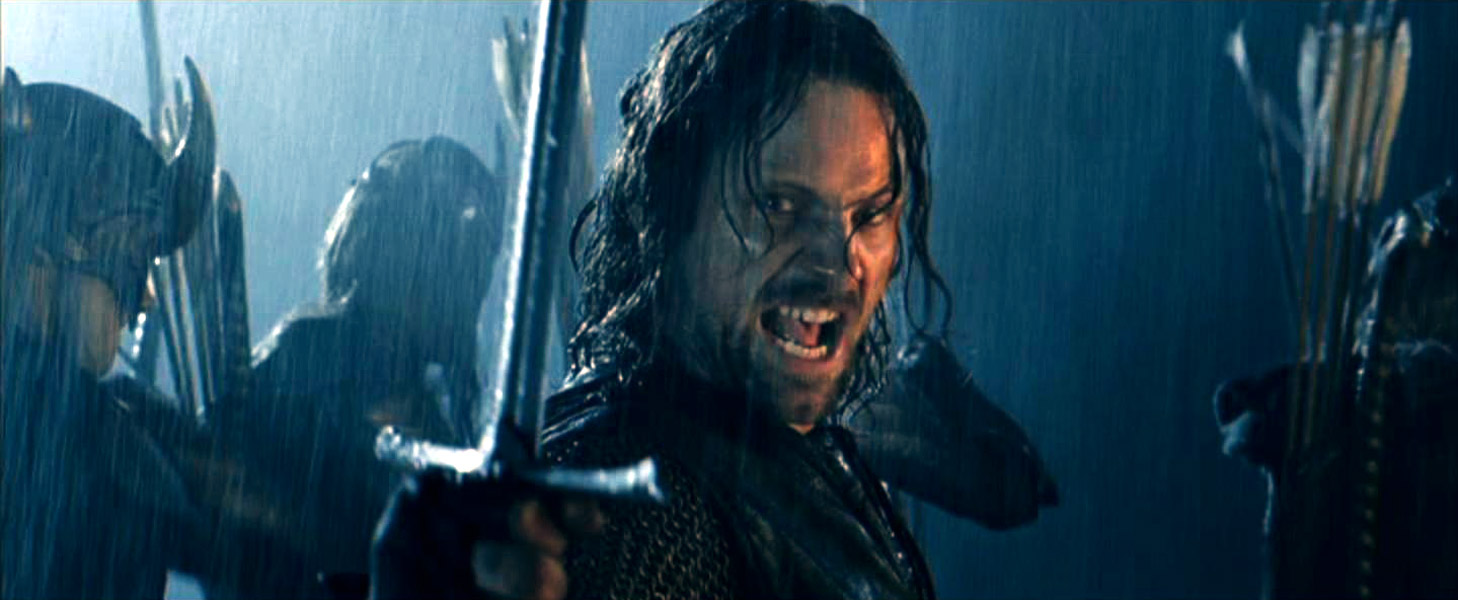
The battle of Helm's Deep is so rousing and entertaining, that I'm usually ready to pick up a sword, put on a snarl, and charge into the fray, right behind ol' Aragorn here.

Nearly all of the same strengths of the first film carry over into this second. The acting and casting remain incredibly strong, and there are some nice additions. The characters Arwin and Faromir have some intriguing depth and back stories. The Ents seem to be a bit divisive – some viewers really love them, while others find them boring as, well, watching a tree grow. I’ve always thought they were fine, and I especially love their attack on Saruman’s tower.

My overall sense of The Two Towers is that of expansion. While Fellowship introduced us to the main characters and kept things relatively tight in terms of the players, the second story starts to give us much larger groups, new lands and peoples, and a much greater sense of the entire land that the Dark Lord Sauron seeks to dominate. To me, Peter Jackson pulled off a rather amazing feat in that, though many readers of the source novel will say that The Two Towers is the least interesting of the three parts, the film version is no such weak link. It builds perfectly into the third and final chapter when, as Gandalf puts it at the end of this chapter, “The Battle for Middle Earth begins.”

That’s a wrap. 103 shows down; 2 to go.

Coming Soon: Finding Nemo (2003):


“Whaddaya mean I’m funny?! Funny how?! Like a clownfish??!!”

(Seriously. Just say that to yourself in Joe Pesci’s voice. It’s hilarious.)

Please be sure to pick up all empties on the way out.

Sunday, August 4, 2013

FIlm #100: Lord of the Rings: The Fellowship of the Ring (2001)


*The Fellowship of the Rings is the first part of the Lord of the Rings trilogy. The list-compilers at TIME magazine consider them all “one film,” but I will review each one separately.

Director: Peter Jackson

Initial Release Country: United States

Times Previously Seen: at least eight

Rapid-Fire Summary (No spoilers)

Tiny, cheery little fellow ends up with the most powerful and evil trinket in the land. A few other tiny, cheery little fellows and a few larger fellows join up to help him bring the trinket to a raging volcano and destroy it. Some silliness and swordplay carry them through.

Extended Summary (Spoilers included. Fair Warning)

*As many of you know, a truly geeked-out Tolkien and/or LoTR film fan could write a 200-page summary of this film. I’m not, and I won’t. However, if you want something more detailed, you can check out this synopsis at imdb. And if you want something MUCH more detailed, just read the novels.

In the mythical world of Middle Earth, a variety of beings dwell. In a setting that resembles the Middle Ages of our world, humans share Middle Earth with other races, including elves, dwarfs, orcs, goblins, and many others. One of the more peaceful and communal races is that of the hobbits – smallish beings that resemble humans, though around half the size and bearing hairy feet and slightly pointed ears.

One evening, in Hobbiton, the elderly hobbit Bilbo Baggins pulls an incredible vanishing act in front of a full crowd on his 111th birthday. To pull off this feat, he uses a ring of invisibility that he had obtained many decades prior in a game of riddles from a wretched creature that called itself Gollum. In addition to the other witnesses to Frodo’s disappearance are his nephew Frodo and their human wizard friend, Gandalf. What Gandalf knows that Frodo doesn’t is that Bilbo had planned this disappearance, in order to leave behind the daily headaches caused by his relatives in Hobbiton. Bilbo leaves behind the ring of invisibility, which Gandalf carefully passes along to Frodo. Gandalf, however, suspects something more sinister about the ring.

Bilbo and Gandalf share a smoke before Bilbo's grand vanishing act in the shire of Hobbiton.

After much travel and research, Gandalf returns to Hobbiton and tells Frodo that the ring is, in fact, the lost “One True Ring” of Sauron, “The Dark Lord” from ages past. The ring is a physical manifestation of Sauron’s evil soul and his will to dominate, and it corrupts all those who come into contact with it. Hobbits, though, seem to have a much stronger resistance to the ring’s corrupting powers than nearly all other races. Gandalf has also discovered that Sauron has been gradually reforming and building a massive army in the blasted lands of Mordor. The Dark Lord has also learned that his ring of power is in the hands of a hobbit called “Baggins.” Because of all of these things, Gandalf forces Frodo and his friend, Samwise (Sam), to leave the shire and get to the nearby town of Bree, where he will meet them after he consults with the head of his wizarding order, Saruman the White.

When he meets with Saruman, Gandalf soon discovers that his elder and superior has already been turned by the powerful will of Sauron. Saruman captures Gandalf for a time, but Gandalf eventually escapes. Meanwhile, Frodo and Sam, who have been joined on their journey by fellow hobbits Merry and Pippin, reach Bree, only to find that Gandalf is not yet there. After some trouble nearly erupts, the hobbits are befriended by a man called “Strider,” a ranger who seems to have their interests at heart. He saves them from the “ring wraiths,” powerful minions of Sauron whose only goal is to retrieve his ring of power.

The hobbits and Strider spend several days evading the ring wraiths, and they eventually reach the elven city Rivendell, where they reunite with Gandalf. After a counsel between representatives of the races of elves, dwarfs, and humans, it is decided that the ring must be taken to and destroyed in the only place where it is possible – Mount Doom in the middle of Mordor, where the ring was originally forged millenia earlier. Frodo elects to bear the ring, and eight others accompany him: his three fellow hobbits, Gandalf, Strider (whose real identity we learn is Aragorn – the heir to the throne of humans), the human nobleman Boromir, the dwarf Gimli, and the elf Legolas. The fellowship of the ring is formed.

The nine members of the fellowship of the ring in Rivendell, before they embark on their treacherous (and for some, fatal) journey to Mordor.

The fellowship fight through and past many dangers in an attempt to reach Mordor. They are harried by crows, pursued by orcs, and turned back by massive snowstorms created by Saruman. With no other options, they take Gimli’s suggestion to go under the mountains, through his cousin Bali’s cave city, The Mines of Moria. However, upon entering Moria, they find nothing but dwarf corpses. Moria has been overrun by goblins. The fellowship forges ahead, cautiously, but after a few days they are attacked. After fending off several dozen goblins and a cave troll, the must flee when a powerful fire demon appears. Gandalf stands against the creature, allowing his companions to escape; however, the kindly wizard is pulled down into a seemingly bottomless chasm with the beast.

Once free of Moria and after a brief respite in a wooded elvish city, the eight companions move on. Eventually, though, Frodo begins to realize that he will have to continue the journey alone, as the ring’s power threatens to overcome and twist each of his companions. To confirm his suspicions, Boromir attempts to take the ring from Frodo. Frodo flees him just as the fellowship is attacked by a band of orcs. The companions turn back the orcs, but not before Boromir is killed and Merry and Pippin are taken prisoner (Saruman has commanded his orcs to take any hobbits prisoner, so that he can find the ring of power).

The fellowship of the ring, once composed of nine companions with common purpose, is now broken. However, they are not defeated. Sam willfully joins Frodo on his quest to bring the ring to Mount Doom and destroy it. Now parted from the ring bearer and his closest friend, Aragorn rallies Gimli and Legolas, as they agree to stalk the orcs who have Merry and Pippin and free their little companions.

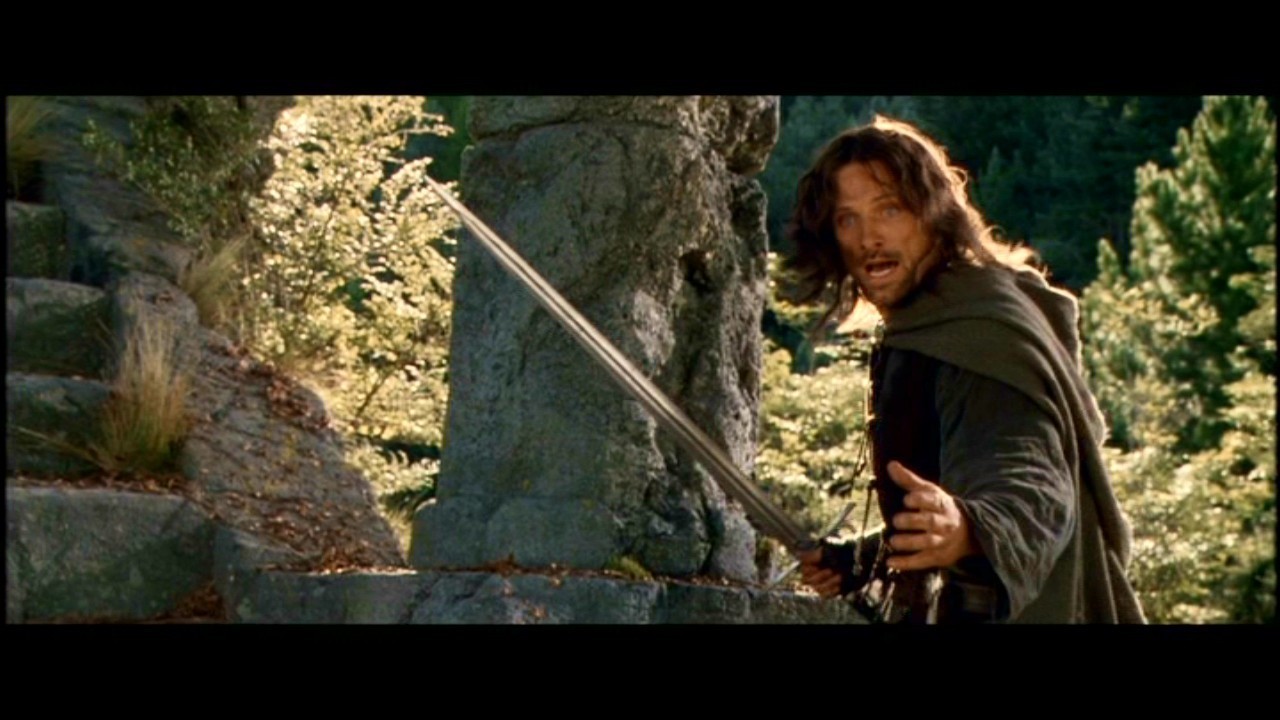
Aragorn, imploring Frodo to flee on his own and leave the fellowship behind. Aragorn then goes on to display his swordsmanship by mowing down waves of orcs.

My Take on the Film (Done after this most recent viewing)

To my slight sadness, the Fellowship of the Ring has lost a bit of its magic for me in the past few years. It’s still a great film, and I can’t see anyone ever attempting to adapt Tolkien’s seminal work onto the big screen again, so successful was Jackson. Still, this recent viewing didn’t hold my attention the way that it had before.

A little history: I LOVED these movies when they came out. When Fellowship hit the theaters, I saw it three times. When it was released on DVD, I watched it another two or three times. When they released the extended DVD version (which brought the film’s length to nearly three-and-a-half hours), I bought it right away and watched it three more times. About four years ago, my local theater did a marathon of the full trilogy, extended editions (nearly 11 hours of film in one day), and I went to it and enjoyed them all, immensely.

So why has my adoration for the movie faded? I can’t say that I’m completely sure. It could be that I just wasn’t in the right mood to watch it upon this recent viewing. I also suspect that, by viewing the 200-minute-long extended edition, I asked too much of myself at that particular time. However, I have other suspicions…

Upon this umpteenth viewing, I experienced some of the same dazed, stupefied disconnection as ol' Boromir here. Mainly, it was during the the sappier Frodo/Sam exchanges.

Once you’ve seen the films a few times, or maybe if you’re really familiar with the books, you may have less patience for the slower moments of the film. And Fellowship does have plenty of what could be called “slow moments.” This is not to be confused with “unnecessary scenes,” as all of the quieter moments do have their purposes: they add depth to certain characters, they reveal relationships or lore about the very rich world of Middle Earth, or they allow the viewer to take in the visual majesty that the film presents. Still, for some reason, these things weren’t enough to keep hold on my attention like they had in the past.

Lest I get too deeply into what I was not as enamored of, I need to spend time on the many positives of this movie. Now, one needs to be aware that this is the ultimate “fantasy” film, based on the “fantasy” story that basically birthed a massive genre of novels, films, cartoons, role-playing games, and so forth. If you haven’t seen these films and you have no interest in medieval-setting mythical tales, then don’t bother. I understand that some people find such things silly and pointless, and those people should stay well away from this film trilogy. I, on the other hand, love this kind of stuff, and Peter Jackson constructed what will probably remain the greatest fantasy film(s) for many, many decades.

Tackling J.R.R. Tolkien’s incredibly rich world of Middle Earth had been attempted before, but only in cartoons. For the many decades that followed the book’s release, there was simply no way that any movie could capture the imagination the way that the books always had. Finally, though, by the late 1990s, the financial and technological means existed for bringing Tolkien’s Middle Earth to live-action life. And right from the first scenes of this first installment, it was clear that Jackson was the man for the job. The prologue in Fellowship, which depicts the background tale of the Dark Lord Sauron’s One Ring of Power and his defeat at the hands of elves and humans, is packed with the visual magic and rousing action that define the film series.

The first, historic battle scene is relatively short, but conveys all of the grandeur and intensity that is intended. After this, though, it takes quite a while for the film to get back to these breathtaking, blood-pumping melees. 

The attention and respect that Jackson constantly pays to the source material is very impressive. Of course, hardcore Tolkien fanatics will nitpick at plenty of little things – “No, Boromir didn’t inherit that sword from that person…,” or “No, it wasn’t Pippin who stole the carrots, it was Merry...” and blah, blah, blah. Those who get caught up in such minor details completely miss the point – Jackson was brilliant at staying as true as he could to the novels while putting together a very entertaining film. The story conveys every bit of wonder and richness embedded within Middle Earth, and the tale of Frodo and the ring are given the epic treatment that they require.

The story itself is the classic, age-old story of a quest undertaken in order to prevent evil forces from dominating the lands. The fellowship formed by the four races certainly presents a compelling mix of mythical history, characters, and archetypes. The various races represent simplicity, power, honor, grace, courage, stodginess, and many other characteristics, in different turns. The ultimate presence of magic, represented by Gandalf and Saruman, adds the mystic and mysterious aspects of the story. To people like me, it can be truly enchanting.

Of course, all of the things explained in the previous paragraph were present in the books. What Jackson did was successfully translate them onto the big screen. Using his native country of New Zealand was a convenient and perfect choice. The small island country’s rolling, verdant hills; craggy, snow-capped peaks; and lush forests provide all of the scenery that Tolkien’s Middle Earth contained. Even someone who has no interest in the story of little hobbits, dwarfs, and elves can watch many of the sweeping shots over the landscape and marvel at it.

Jackson also put New Line Cinema’s massive budget to good work as well, with the end result being phenomenal costumes and visuals. The set pieces are great, and they build up the world all the more. Perhaps my favorite decision of his was to use human actors as much as possible. While there are clearly moments when CGI was used (particularly to create some of the especially enormous buildings, statues, or armies), Jackson opted to use make-up and creature effects as often as he could. Hence, you have many of the orcs, goblins, and other nefarious beings being played by human actors. The effects is that they all seem much more tangible and horrifying. I guess this latter adjective should come as no surprise, seeing as how Jackson got his cinematic start doing extremely graphic and effects-heavy horror films like Dead Alive.

Even when scenes involved dozens of individuals, Jackson didn't cop out with computer graphics - the use of real actors done over in top-notch make up and costumes was an invaluable asset to the film series.

The cast is excellent. From the impish and humble hobbits to the gruff and belligerent dwarves, all of the players nailed their parts right from the start in this first installment of the trilogy. The standouts to me are Ian McKellan as the kindly, paternal Gandalf the Grey and Viggo Mortensen as the mysterious, internally conflicted Strider/Aragorn. Some people might find the dialogue and deliveries to be overly theatrical and dramatic, but I’ve always felt that it fit the setting well. We’re dealing with imaginary myths here, so the speech and deliveries should be delivered with a polished and almost aristocratic air. It all fits perfectly well in this film series.

This does, however, bring me to something that I now find a bit tedious in Fellowship – the relationship between Frodo and Sam. I do understand perfectly well that this relationship is the true heart of the story. The fraternal bond between the two friends is the very type of goodness that is supposed to carry us through dark times, and it is this notion that creates the connection between us the viewers and these completely imaginary characters. Still, once you’ve seen the film a few times (or a half dozen times, like myself and other nerds), the moments that Sam and Frodo share start to drag. Granted, it isn’t a massive focus in Fellowship, but it’s already starting to wear on my attention. Instead of enjoying the moments between the two hobbit pals, I find myself anticipating other scenes. Namely, the action sequences.

Just a small, early sample of what will be many, many, MANY doe-eyed gazes between Sam and Frodo. It doesn't get terribly annoying until the third film, but it begins in the first film.

In Fellowship, we get several fantastic action sequences, and these serve as great hints of what is to come in the subsequent films. The opening prologue features a rousing depiction of the historic defeat of Sauron at the hands of Isildur. Other fight and battle scenes are equally entertaining, though they take a while to arrive at. The standouts are the trek through the Mines of Moria, including Gandalf’s facing off against the towering Balrog, and the battle in the woods between the fellowship and a patrol of orcs. For a man who had never directed extended action scenes in any of his previous major films (maybe you could include The Frighteners), Jackson proved himself quite astute at directing these scenes. Of course, he would continue to outdo himself in each of the sequels, with battles becoming grander and more spectacular.

*I will be reviewing the other two films in the Lord of the Rings trilogy in the next few weeks, after watching the few other films remaining on the TIME list.

That’s a wrap (sort of). 100 shows down; 5 to go.

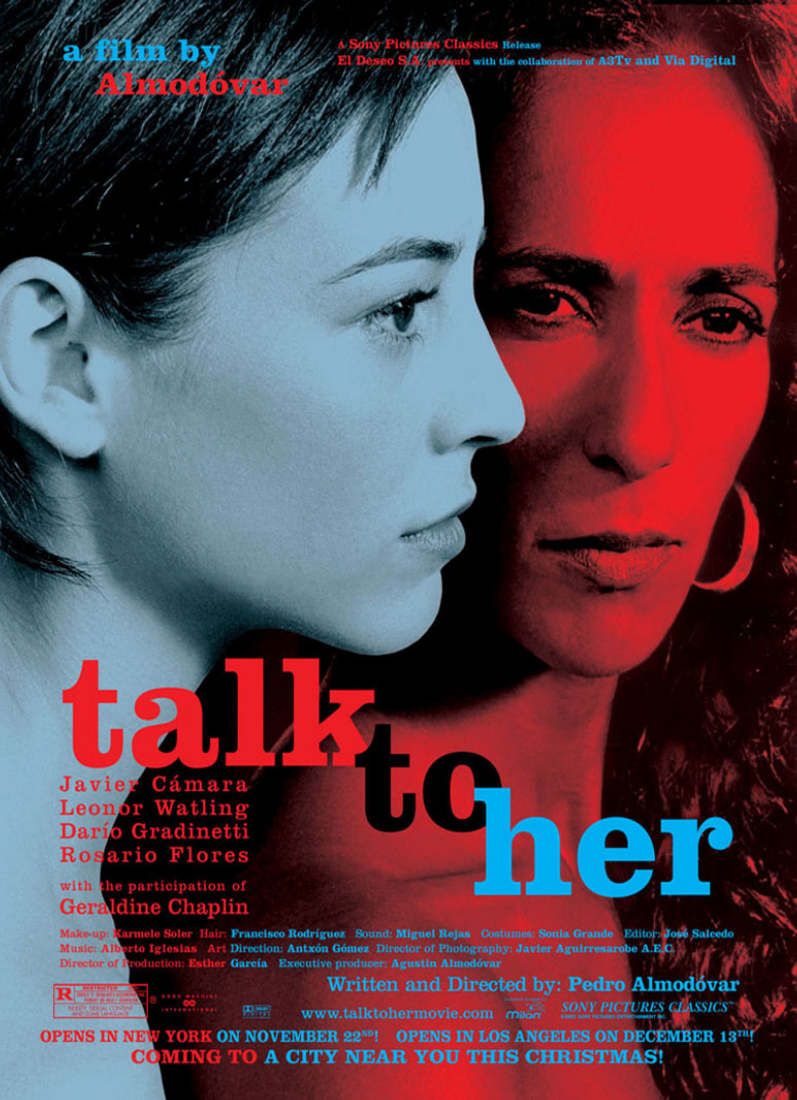
Coming Soon: Talk to Her (2002):


My hunch is that this is a thoughtful, artful drama that has nothing to do with elves and dwarfs cracking wise and killing monsters. It should be an interesting change of pace.