Showing posts with label David Cronenberg. Show all posts

Thursday, April 27, 2017

Retro Trio: Eastern Promises (2007); Repo Man (1984); They Live (1988)

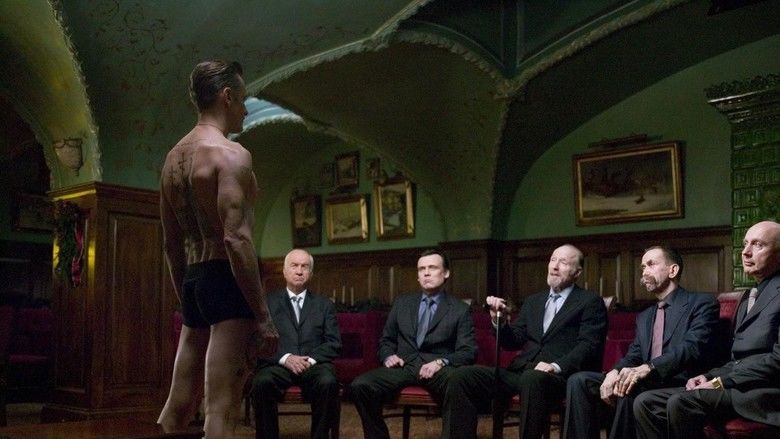
So you think you've had a stressful promotion interview or
two in your day? They're nothing compared to what Nikolai
goes through in the ultra-ruthless world of the Russian mob.
Eastern Promises (2007)

Director: David Cronenberg

First time I had watched this one since it was out in theaters. Still a really tight, harrowing piece of crime cinema, though not one that offers viewers any convenient answers about the problems of deep-seeded and systemic criminality and violence.

The story takes place in London, where local nurse Anna (Naomi Watts) has to assist in an emergency birth of a child born by an abused 15-year old girl from Russia.The mother dies giving birth, but she leaves behind a diary in which she details the horrors of her life in London. Being the child of Russian immigrants, Anna takes the diary to her mother and uncle. As Anna learns more about the men who were responsible for the girl's death, she becomes partially involved in a vicious power struggle within a local sect of the Russian mafia. The man with whom she has the most contact is Nikolai (Viggo Mortensen), a chauffeur to the local mob leader's son Kirill (Vincent Cassel). Nikolai is a quiet but intense and intimidating presence who seems to have far more knowledge and ability than he lets on as a mere driver and sometimes-assistant in the mob's criminal dealings. By interacting with Nikolai and his bosses, Anna unwittingly and rather quickly finds the lives of herself, the newborn baby, and her relatives are all in serious danger.

Eastern Promises was David Cronenberg's next film after 2005's  A History of Violence, and the two make for excellent companion pieces. Aside from both starring Viggo Mortensen, both are skilled, unflinching looks at the nature of violence and how it can manifest itself in individuals and cultures. The differences between the two lie mostly in the type of general story and the particular focus of each. The former film looked at one man's deeply buried violent past and nature, while the latter examines a type of violence that runs throughout an entire cultural group and is deeply enough embedded to be woven into other, more accepted traditions and rituals.

In terms of narrative, Eastern Promises uses suspense as a major device, with the lives of Anna, the newborn baby, and Anna's family all at stake as the Russian mob slowly closes in. There is also the element of mystery thrown in, as the Nikolai character is slowly revealed to be more than a stoic, detached chauffeur. These alone make the movie strong enough. Added to all of this, though, is the same bold and brutal depiction of violence which Cronenberg employed in A History of Violence. While I wouldn't say the movie is oozing violence, there are a handful of scenes that are violent, some of them extremely so. And Cronenberg strips away any pretense at glamorizing the brutality. This is an approach which I appreciate in movies such as this, as it drives home the point that nothing that these people are doing should in any way be seen as anything but horrendous. Cinematically, it also adds to the tension of the movie, as we understand the threat that characters like Anna are under.

This movie is one of many that has made me a tremendous fan of Viggo Mortensen, who does a brilliant job here. He and Cronenberg seem to make excellent collaborators, and I hope they can find another story strong enough to pair themselves up again in the future.
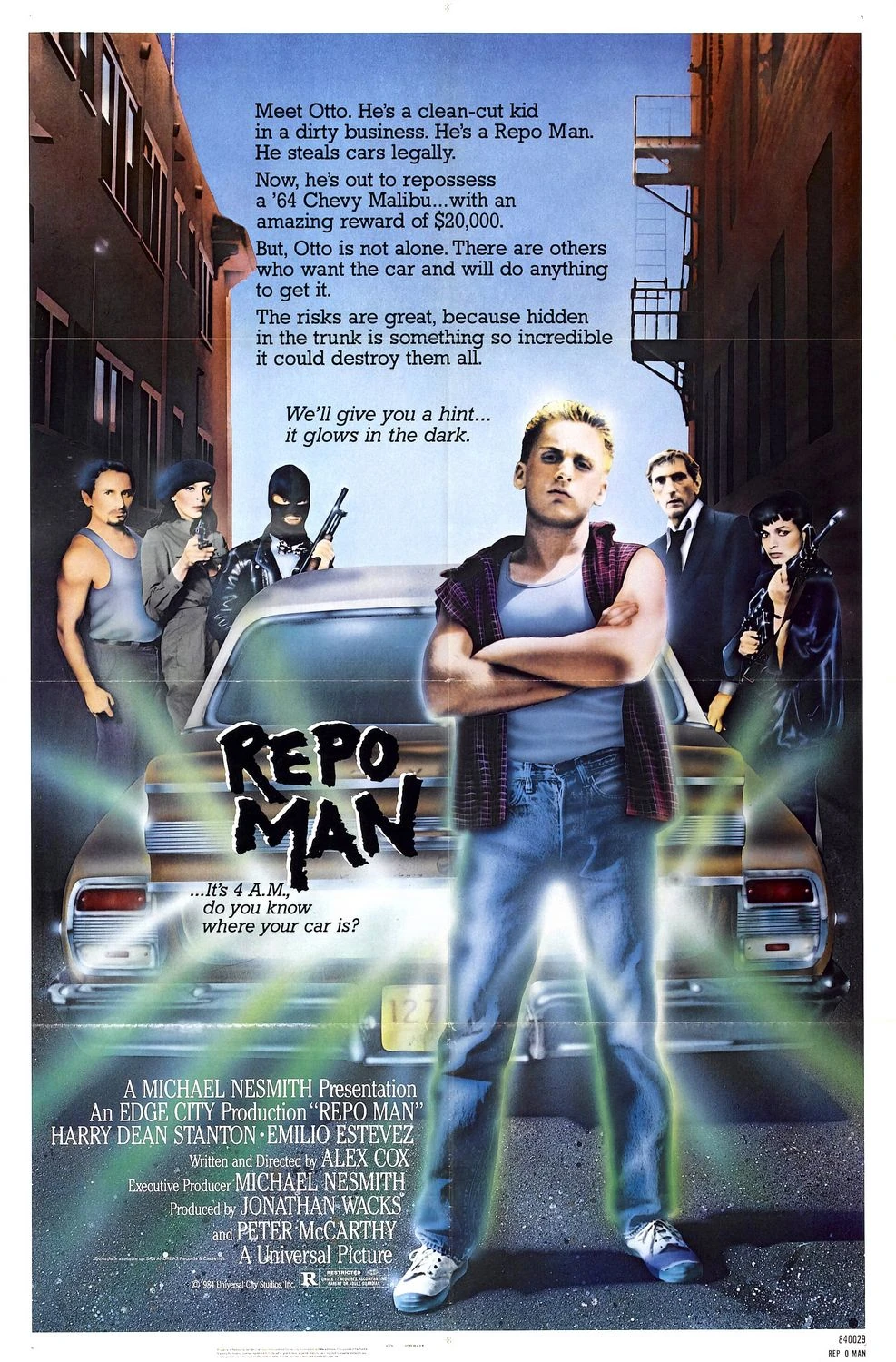

One of the most verbose movie
posters I've ever seen. Ironic, given
how Otto is not exactly a young man
of letters, shall we say.
Repo Man (1984)

Director: Alex Cox

I didn't first see this movie until around 2005, and I enjoyed it. This second viewing confirmed my enjoyment, and it confirmed to me why this movie is still a cult classic.

Emilio Estevez plays Otto, an 18-year old punk rocker who is disgusted by his dull suburban life. He quits his job at a supermarket and is soon taken into the car repossession business by Bud (Harry Dean Stanton), a veteran of the trade. Otto's fellow repo men are all social misfits of one form or another, each with his own bizarre code of independence and rebellion. Otto eventually gets mixed up with a strange maelstrom of activity surrounding a Chevy Malibu housing a radioactive alien in its trunk. Mysterious secret operatives are involved, and Otto's fellow repo men get involved in the bizarre pursuit.

The movie is an oddity that could only have come from the middle of the Reagan-era United States, made all the more odd by the fact that it still holds up as a great cult movie, even in 2017. English writer and director Alex Cox (it's always foreigners who nail the American tale in movies) crafted an oft-times hilarious take on American rebellion in the face of and encroaching popular culture of conformity. Otto is a straight up punk-rocker - a kid who has no idea what he wants but knows that he hates nearly everything about his life and the world around him. When he meets a gaggle of curmudgeonly rebels in the repossession business, their interactions are downright hilarious at times. While all of the repo men are great characters, legend Harry Dean Stanton takes the cake as Bud. Bud is a true, died-in-the-wool libertarian who thinks any real American can and should pull themselves up by their bootstraps, put life in a headlock, and give the middle finger to anyone who thinks otherwise. One of his many gems is his response to Otto pointing out that Russians don't pay for anything: "All free? Free my ass," replies Bud, "What are you, a fuckin' commie? Huh?...Well, you better not be. I don't want no commies in my car...No Christians, either." Kind of says it all, right there, really.

Sure, the story, characters, dialogue, and acting can sometimes be a little frayed around the edges, but those don't overpower the gonzo, in-your-face fun of this movie. With it's rebel attitude and d.i.y. approach to characters and dialogue, it conveys a punk rock perspective that is rarely matched. Interestingly enough, the actual cinematography is high quality, which makes the movie generally pleasing to take in. While it's not a movie I need to watch over and over, it's a great little work of its time that holds up rather well.

They Live (1988)

Director: John Carpenter

Talk about a great premise, with some great moments, dragged down by some questionable elements and a limited budget.

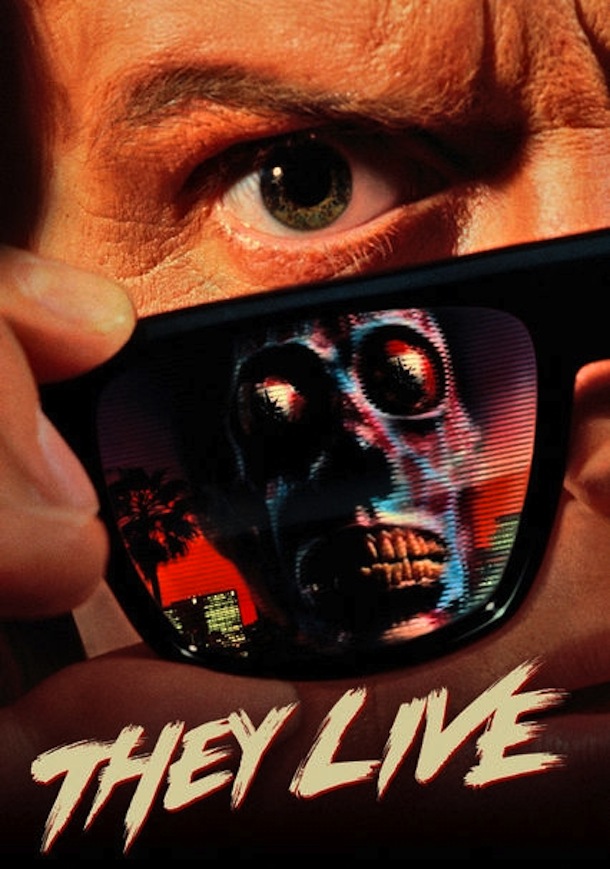
In They Live, Carpenter adapted the Ray Nelson short story "Three O'Clock in the Morning" into a solid cult movie. The tale follows Nada ("Rowdy" Roddy Piper), an out-of-work drifter who comes across a secret resistance movement fighting against an unseen cabal of aliens who use subliminal messaging to keep humanity locked in a state of consumption and laze. Once Nada accidentally gets a hold of specially-made sunglasses which allow him to see the ghoulish aliens, he has to flee and attempt to convince people to join him in resisting their plot.

Like a few other Carpenter movies, They Live is a perfect example of a mediocre movie that would have made a fantastic TV episode of The Twilight Zone. Perhaps with a better budget and a stronger script, it could have been a great 90-minute movie. As it was, though, some sharp editing could have pared it down to a brilliant 50-minute show. There is some great commentary on rampant consumerism driven by economic elites, which is as relevant now as it was at the height of Reagan-era excess. And the science-fiction devices work fairly well, with even the clearly-underbudgeted makeup effects creating the necessary creepiness. And the movie does provide us with a couple of classic one-liners, including the gem "I've come to kick ass and chew bubblegum...and I'm all out of bubblegum."

What keeps the movie from being all it could have been comes down to two things, really. One is several sluggish, filler-type sequences that gobble up far more screen time than necessary. Most egregious is the back alley fistfight between Nada and Frank (played by the ever-solid Keith David). The pro wrestling-style brawl goes on for over five minutes, but it feels like three or four times that. Add in that it is far from essential to the primary plot, and you get a nasty speed bump in the middle of what is occasionally a well-paced movie. The second issue is that the script simply isn't terribly creative or tight. The brilliant premise and basic framework aside, there just aren't many verbal exchanges or expositions that are terribly compelling or memorable. Equally dubious are some of the threads that are meant to tie the story together, which can be frayed in more than one part of the film.

They Live is a fun little slice of 1980s dystopian social commentary, to be sure. It's not much of a time commitment at right around 90 minutes, so it's worth checking out for anyone who enjoys a clever sci-fi premise, even if the technical merits of the movie are lacking in several aspects. 

Sunday, August 23, 2015

Gangster Flick 3-Pack: A History of Violence (2005); Underworld, U.S.A. (1960); Sonatine (1994)

A History of Violence (2005)

Director: David Cronenberg

A phenomenal movie that pulls off the unique feat of thematic, effective self-criticism.

The two homicidal maniacs on left have no idea what's lurking under the
humdrum exterior of Nick Stall. The peeling back of that exterior is an
exercise in intelligent, chilling filmmaking.
The basic story seems to be a straightforward tale of bad guys getting their comeuppance after messing with the wrong man. Tom Stall (Viggo Mortenson) lives in a sleepy little Indiana town, where he runs a quaint diner and has a loving relationship with his wife, teenage son, and young daughter. When a pair of homicidal thieves attempts to rob Stall's diner and rape one of the employees, Stall kills the invaders with astounding efficacy. This tale of the small-town hero draws the attention of the national press. Soon after, a trio of extremely grim men arrive and approach Stall, claiming that Tom is really a man named "Crazy" Joey Cusack, a former wildman thug associated with an organized crime syndicate in Philadelphia. Stall must begin going to more and more extreme measures to protect his life and family.

While this may all seem like a familiar story of satisfying, righteous justice, trust me that it is far more. Early in the movie, it becomes clear that the story, guided by David Cronenberg's brilliant direction, is displaying the deeper, scarier nature of violence, its effects on humans, and its place in society. Tom's teenage son, Jack, is the victim of bullying at school. Jack follows his father's noble guidance by not fighting back and defusing many situations with his wit and humor. After he sees the praise his father receives for killing the two would-be murderers in his diner, though, Jack abandons his passive approach and pummels his tormentor at school. We viewers gain that base level of satisfaction at seeing this; however, when Jack's father later tells him that this is not the way to solve problems, we feel conflicted again. Certainly, non-violence is the lofty and ideal way to answer aggression, but we can't deny the primal thrill of physically punishing those who threaten us. This is just one of several very mature and intelligent themes and scenes in the film that add unprecedented depth to what could have been a more run-of-the-mill precursor to Taken.

The story carries the movie well enough, but Cronenberg's direction enhances it every step of the way. This is one of the most efficient movies you are ever likely to see. In an exceptionally tight 95 minutes, there are moments of brooding tension that bridge the violent action. It all has an almost hypnotic rhythm which carries you through, with virtually no wasted shots, scenes, or lines.

An easy technique to overlook is one that I particularly love about Cronenberg - his approach to film violence. When he portrays violence on screen, Cronenberg never glamorizes. There are no slow-motion shots. No triumphant music scores. No one-liners. Killing and maiming are horrible, brutal acts, and this is exactly how Cronenberg gives them to us. In A History of Violence, the deaths are ugly, gut-wrenching affairs, even when they are happening to villains who may have had it coming. This is a point for which I admire Cronenberg - the point that one should never get comfortable watching realistic violence.

I thoroughly enjoyed this rewatch (my fourth viewing, I believe), and I'll continue going back to this movie every few years in the foreseeable future.

Underworld, U.S.A. (1960)

Director: Samuel Fuller

Not the most polished film you'll ever see, but one loaded with admirable energy and conviction.

I've seen a handful of Samuel Fuller films - The Steel Helmet, Shock Corridor, and The Naked Kiss. I find them all to be the product of a man with a bold approach to the types of stories that he told in film, though without the resources that would make the film more widely appealing. Underworld, U.S.A. falls right into the same category.

You probably wouldn't trust a guy who looks like him, but
watching Devlin exact a brutal vendetta against a bunch of
repugnant criminals is crime movie gold.
The story is that of Tolly Devlin - a street thug who sees his low-rent criminal father killed by a quartet of goons associated with local organized crime. Devlin swears revenge. Over the next decade, he becomes an expert safe-cracker. Eventually, he sees his chance to exact vengeance on his father's killers, though it will be no small task. Three of the four men are extremely powerful lieutenants in a massive crime syndicate. This doesn't deter Devlin, though, as his sense of purpose brooks no flinching at the task he set himself from the moment he saw his father murdered.

The tale is a solid revenge story, though it doesn't take the path that you may predict. Fuller, who wrote the script, gave us something that I can't recall seeing in other crime/revenge stories. While the overall arc follows typical lines, the path that Devlin takes is novel enough to keep things interesting. He cozies up to unexpected figures, including a prostitute, a police lieutenant, and even the ruthless murderers whom he hopes to assassinate. He is a true rogue whose only allegiance is to his own vendetta, and such characters are almost always intriguing.

The movie has a certain raw feel to it, as do all Fuller movies which I've seen. He was willing to go places, in terms of human vice and violence, that kept him from mainstream success. His treatment of these things was never gratuitous, though. In Underworld, we see an innocent young girl ruthlessly run down by a hitman. Such an act is shown not for mere shock value, but rather to exemplify the hitman's utter lack of empathy or compassion. The movie has several other hard-hitting scenes, and they set Fuller movies apart from their contemporaries.

Even when in the middle of a lethal firefight, Aniki (far right) shows a
disturbing amount of impassiveness. It eventually becomes clear that this is
not done merely to make him seem "cool."
Sonatine (1994)

Director: Takeshi Kitano

A quirky, enigmatic film with a powerful final punch.

Anyone who has seen a Kitano film knows that he has an unusual style. Sonatine is no different. It follows Japanese yakuza strongman Aniki Murakawa (Takeshi Kitano, who also directed). Though very powerful and successful on his turf in Tokyo, Aniki gets orders from a superior to take a small contingent of soldiers to Okinawa, where they need to settle a turf war between locals. Once there, Aniki and his mostly inexperienced crew find things becoming unexpectedly complicated. Several men on both sides are killed, and Aniki and his remaining soldiers retreat to a secluded house on the beach. While there, the men while away the time by drinking and clowning around. Aniki has some fun with them, but he also begins to quietly ponder the meaning of his life of crime.

I must admit that I found the movie somewhat difficult to follow. This is partially because of the number of characters involved, each being part of one of four or more factions in the disputes. (And no, it's not because I think all Japanese guys look the same - I spent two years living and working in Japan, and I never confused people). A larger reason, though, is that the plot is vague. This is by design, as Aniki's confusion over the killings around him is what spurs his existential crisis. For all the value Aniki and his men give to killing their opponents, they might as well all be the same. Adding to my confusion was the quirky detachment that nearly all of the characters exhibit. I'm all for using deadpan as a device, and it is sometimes effective in Sonatine, but it was amazing how it obfuscated people's intentions and motivations much of the time.

Though I discovered afterwards that I had clearly missed and misunderstood certain plot points in the movie, this did not make the ending any less powerful. The closing sequences expose Aniki's deepest, darkest feelings in ways that I had never seen. These alone set this movie apart from any other gangster film that I have seen thus far.

Those unfamiliar with modern Japanese cinema might find the tone and performances off-putting in their stoicism or strangeness. However, if you are willing to put in some work and make it to the end, there is a rather profound payoff waiting. 

Monday, November 17, 2014

Before I Die # 524: Tetsuo: The Ironman (1989)

If this movie poster seems bleak, horrific,
and claustrophobic, then you've got some
inkling as to the tone of the feature.
Director: Shin'ya Tsukamoto

Whoa. If you plan to watch Tetsuo, then you had better be mentally prepared. It is one trippy, disturbing piece of work, which wears its influences right on its sleeve.

The story, at its most basic, is that a young businessman in Japan suddenly finds different parts of his body turning into machinery. The process is slow at first, but then rages in fits and starts, so that the man soon begins to look like a moving, humanoid sculpture assembled out of scrap yard leavings.

Now, take that idea and imagine that the tale is directed by David Lynch in his most Eraserhead state of mind. Add in several dashes of David Cronenberg's grisly transformation horrors like The Fly and Videodrome, and blend in the psychological torture element of guilt over accidental murder as seen in the harrowing film The Machinist. Put all of those uncomfortable movies together, and you get Tetsuo.

If you're unfamiliar with the movies cited, you just need to know that the movie is stunningly brutal. And yet, its merits are there, for those who care to get past the grainy black and white filming, shocking imagery, and the breakneck editing. The result is that one feels claustrophobic and completely pinned down by the relentless onslaught of the machinery and technology that literally consumes the main characters. And this is clearly what director Shin'ya Tsukamoto was aiming to accomplish. For that, it is easy to see why this film is lauded in many circles.

The movie is taxing to watch. No particular shot lasts for more than four or five seconds before it jumps to another frenetic image, many of which utilize some very well-done stop-motion animation or skewed framing or constricted perspective. Fortunately, I was in the right head space to keep up with it, and the movie is a mere 64 minutes long. Any more than that, and I don't know that my brain would have been able to maintain pace.

File this one under the label of "interesting, experimental films that are good to watch once." If you're looking for a graphic, deeply frightening and challenging visual experience, Tetsuo will satisfy the urge. Just know what you're in for.

Sunday, August 26, 2012

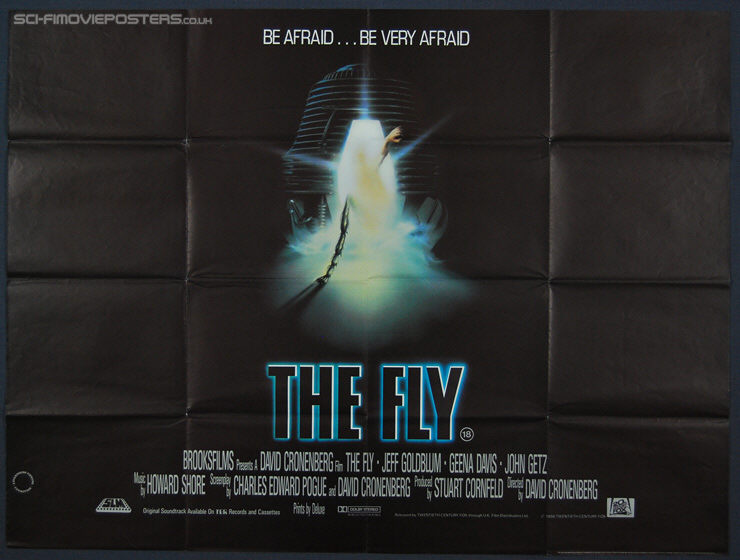
Film #84: The Fly (1986)


Director: David Cronenberg

Initial Release Country: United States

Times Previously Seen: around 5 or 6 (last time probably 20 years ago)

Rapid-Fire Summary:

At a science convention, an eager young journalist, Veronica Quaife (Geena Davis) meets an eccentric and enthusiastic man named Seth Brundle (Jeff Goldblum). Brundle swears to Veronica that he is sitting on the invention that will change human history. Though skeptical at first, Veronica is curious enough to follow Brundle to his warehouse laboratory and finds that he has created telepods – mechanical devices that can transport matter instantaneously from one location to another. The only problem is that it can only work on inorganic objects. Brundle proclaims, though, that he will work this out soon enough.

Over the next few weeks and months, Veronica chronicles Brundle's attempts to solve the “organic matter” problem, and begins a romantic relationship with the quirky yet charming genius. He eventually figures out how to transport organic matter, though he waits before attempting it on a human. One night, however, in a drunken fit of daring, Brundle steps into the pod and successfully transports himself. What he doesn't know, though, is that a housefly has flown into the pod at the same time, and that they have both been fused on a genetic level.

As the next few days and weeks unfold, Brundle begins to undergo and gradual yet steady transformation. At first, he shows phenomenal strength and energy levels. Eventually, though his skin starts to change and he begins to exhibit territorial and violent tendencies. Brundle discovers the truth about how he and the fly are now becoming some sort of mutated hybrid of each other, and tries to discover some way to stop it. His efforts fail, however, and he continues his horrifying metamorphosis.

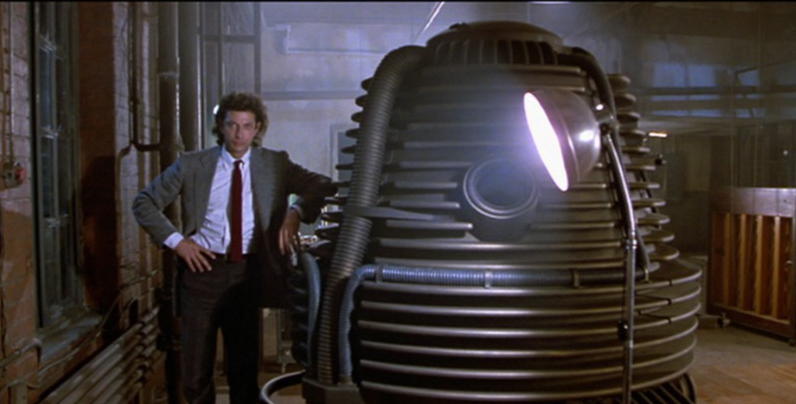
Dr. Seth Brundle, next to his greatest invention, and the very thing that will spell his grisly doom.

Making matters even more terrifying is the fact that Veronica discovers that she is pregnant with Seth's baby. While she had previously been attempting to help Seth find a cure, she has had to flee from his increasingly brutal and warped nature. When she goes to have an abortion of their child, Seth abducts her from the hospital and brings her to his lab. The now-barely recognizable Brundle hopes to enact a mad plan by which he will transport and fuse himself, Veronica, and their unborn child into one creature. Brundle almost succeeds, if not for Veronica's past lover and current editor, who fends off Brundle long enough for Veronica to escape.

In the end, a mishap with the telepods leaves the Brundle/fly creature fused with part of the pod. The creature claws its way to Veronica and begs for the mercy of death, which Veronica grants by shooting it.

My Take (Done after this most recent viewing):

This movie still packs every bit of punch that it had 26 years ago.

The Fly is as horrifying as it is compelling. I'm not any kind of horror film buff, but I'll take one in every once in a while. From what I have seen in the decades since David Cronenberg's science-fiction horror show, I can't think of another film that is as powerfully hypnotic and terrifying.

As stated at the end of my last review, I remember watching this movie many times when it was available on VHS, back when I was 12 and 13 years old. I was certainly freaked out by it back then, and I'm pretty sure that I'll have a few nightmares after this most recent viewing as well. As a kid, I was enthralled by the special effects that transformed Jeff Goldblum into the titular creature. These were, of course, the very things that brought The Fly to popular consciousness back in 1986. To this day, they hold up amazingly well, and they illicit the same visceral reaction now that they always have and always will.

This montage shows the stomach-turning devolution of Dr. Brundle. Watching it unfold throughout the film is part of the macabre magnetism.

The visuals, though, tell only a part of what makes this movie so powerful. Primarily, it is that, right up to the end, you care about the people involved. This includes, surprisingly, the monster that Dr. Brundle becomes. In the early going, we quickly see that he is quirky, brilliant, and oddly charismatic. The love that develops between him and Veronica feels very genuine. This is what makes his slow and terrible transformation and destruction so tragic.

The character of Veronica amplifies this even more. Through the entire macabre affair, she tries to help Brundle, even towards the end, when virtually nothing of the man that she loves is left. Arguably the most powerful scene is the final one. As the Brundle creature emerges from the telepod, now an utterly grotesque fusion of the man, the fly, and hulking parts of an inanimate telepod, the tale does not go the traditional horror movie route. In nearly all horror films, the monster makes a final lunge at the fleeing humans, only to be killed in self defense. In The Fly, instead, the monster crawls up to Veronica and makes a final plea for the release of death by gently drawing the shotgun to its own head. This shows that there is some final shred of humanity, if only in the form of self-pity, left inside of it. It is a pathetic emotion, but one that inspires just enough compassion to give the tale its final cruel and tragic twist.

A less obvious theme in the film is that of primal, animal attraction. In the beginning stages of Brundle's transformation, when he still appears to be human, he shows phenomenally enhanced strength and drive. One just has to look at the faces of Veronica and Tawny during these stages to see how attracted they are to his seeming virility, while at the same time being slightly afraid. These are two very basic, very tightly interwoven compulsions in humans, whether we want to admit it or not. It is also these same two aspects that Cronenberg explored more overtly in A History of Violence.

Through most of the movie, including most of his repulsive metamorphosis, Goldblum makes Seth Brundle a far more sympathetic character than you might expect.

The storytelling is incredibly tight. Even though there were plenty of the quieter, more interpersonal scenes that I had forgotten from my childhood viewings, the movie never slows down. Right from the opening scenes, we get caught up in the wonder of discovery and the potential for what Dr. Brundle has created. We then get the thrill of watching him improve and develop his invention so that it can transport organic matter. Once he teleports himself, not knowing that the fly has been fused with him, it's almost impossible to stop watching. Especially if you haven't seen the movie before, waiting to find out just how far Brundle's physical appearance will deteriorate is a bizarre magnet, pulling us along.

The performances certainly enhance, if not necessarily make, the movie. Geena Davis does a fine job expressing the compassion, disgust, and revulsion that the part requires. More than her, though, is Jeff Goldblum. Once you see this movie, it is no mystery as to why he has been typecast as “the creepy yet charismatic scientist” in no less than a half dozen films. In The Fly, Goldblum exhibited probably the widest range of his acting life, going from the shy, witty, brilliant innovator to the brute creature, while retaining an oddly charming gallows humor through nearly the entire gut-wrenching affair. It was a feat that few actors could have pulled off.

The Fly is one of those films that is powerful in so many different ways that I can see why it is considered “great”. That being said, it is disturbing and grotesque enough that I can't see myself watching it again for at least a very long time. Fortunately, though, it is a film that imprints itself so strongly in one's mind, that watching it twice in a short time is an effort in redundancy.

That's a wrap. 84 shows down. 21 to go.

Coming Soon: The Singing Detective (1986):


This promises to be a more light-hearted affair than the last made-for-TV film series that I watched, Berlin Alexanderplatz. I really don't know anything about it, though. This is often a very good thing, and I'll find out soon enough.

Please be sure to pick up all empties on the way out.

Tuesday, November 1, 2011

Film #65: Bonnie and Clyde (1967)


Director: Arthur Penn

Initial Release Country: United States

Times Previously Seen: once (about 10 years ago)

Teaser Summary (No spoilers)

Restless Texas redneck lovers go on a bank-robbing spree during the Great Depression. “Laws”, emotional highs and lows dog their heels.

Extended Summary (More complete plot synopsis, including spoilers. Fair warning.)

Rural Texas, 1931. The 21-year old Bonnie Parker (Faye Dunaway) is agitated by her dead-end life as a waitress living with her mother in a small town. She spies a handsome, dapper young man outside of her house, casing her mother's car, seemingly to rob it. After running out to stop him, the two strike up a conversation during which the man, Clyde Barrow (Warren Beatty), readily admits that he has recently been released from prison for an attempted robbery. Bonnie is skeptical to the point of egging Clyde into robbing a nearby grocery store. When Clyde does just that, Bonnie, rather than flee the armed robber, readily hops into a stolen car with him and drives out of town.

When the pair stop just outside of town, Bonnie is so overcome with excitement that she throws herself at Clyde. Surprisingly, Clyde roughly rebuffs her, claiming that he “ain't no loverboy”. Despite this odd reaction to the beautiful and willing Bonnie's advances, the two see that they have a unique connection with each other. Both are seeking to make names for themselves by breaking away from societies' rules. Clyde plans to rob his way to fortune and fame, and Bonnie is all too happy to join him.


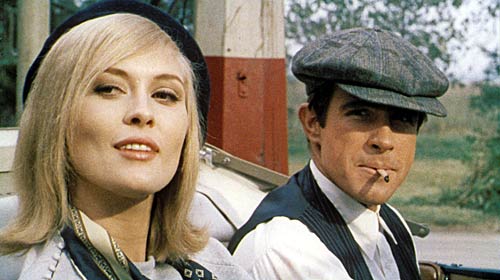
The pair of fugitives size up the next member of their little gang.

The two make a failed attempt to rob a bank that has recently gone out of business, but they soon start to find more success. After picking up a strange and disenfranchised young gas station attendant, C.W. Moss, as their getaway driver, they manage a successful bank robbery. However, Clyde shoots and kills a man during their semi-bungled escape.

Once in a safe hotel room, Clyde offers Bonnie a chance for escape. Realizing that he will now be wanted for murder, he urges Bonnie to return home and avoid any potential capital punishment. Bonnie refuses to leave Clyde, thus reaffirming their bond to one another. The two attempt to consummate their love, but Clyde's impotence prevents it yet again.

The trio of fugitives soon meets up with Clyde's older brother, Buck (Gene Hackman), a fellow ex-con, and Buck's wife, the reserved and rather dim-witted Blanche. The fun-loving and simpler Buck readily joins his younger brother's crime spree, Blanche in tow. Clyde welcomes the company of his brother, but Bonnie soon becomes highly agitated at Buck and Blanche's utter lack of sophistication. While Bonnie has some spark of creativity, even writing poetry, Buck, Blanche and C.W. seem to find the game of checkers the height of mental gymnastics. The tensions begin early and grow steadily.

The gang of 5 continue robbing banks throughout Texas, Kansas, Oklahoma, and other nearby states, hopping borders in order to avoid capture. They avoid some early attempts at capture as they perfect their thievery. They efficiently loot multiple banks, but never take any money from the more humble farmers and locals. Their legend and fame grows rapidly, as newspapers regularly report the deeds, as well as falsely attributing several robberies to the gang.

The gang grows more confident and skilled in their robberies.

Eventually, the law begins to close in. After C.W. Allows himself to be seen in a little town, the police raid the gang's hotel room. After a furious and bloody shootout, the gang escapes, but not without serious injuries. Buck sustains a horrible head wound, Blanche suffers eye damage, and Clyde is shot in the arm. After camping outside to recover slightly, the gang is once again tracked down and attacked. Bonnie, Clyde, and C.W. Manage to get away, though Bonnie is also wounded in the arm. Buck and Blanche are not so lucky. Buck is shot again and soon dies. Blanche, now completely blind, is taken away by the police.

The injured Bonnie and Clyde are driven to safety by C.W., receiving a little support along the way from impoverished Dust Bowlers who are awestruck by the celebrity thieves. C.W. takes the pair to his father's tiny farm, and the man seems to welcome them. This ostensible kindness is merely a front, though. As Bonnie and Clyde recuperate, C.W.'s father privately berates his son for a fool and eventually informs the Texas Rangers about the two fugitives.

In a simple set-up while Bonnie and Clyde return from buying groceries in town, C.W.'s father pretends at having car trouble. The pair pull over to assist, but do not sense the trap. Before either Bonnie or Clyde can react, let alone surrender, a score of Rangers and lawmen open fire upon them from behind the nearby bushes, riddling the couple and their car with dozens of bullets. The mutilated corpses of Bonnie Parker and Clyde Barrow fall limp onto the ground, ending their renowned spree.

Take 1: My Gut Reaction (Done after this most recent viewing, before any research on the movie.)

Really good movie that holds up exceptionally well.

Bonnie and Clyde may not seem so special to modern, first-time viewer, but with a little awareness of the context, it's not hard to see why it is considered so very influential. Based on my film-watching experience, it created a unique blend of tried-and-true standard film-making conventions with a dash of the novel, leading to entire shifts in the way that crime stories have been told in film.

The story itself is intriguing enough, being based in reality. I personally don't know much about the real Bonnie and Clyde, but I'm eager to do the research for the Part 2. I have to assume that the screenwriters took certain liberties with the dialogue, and even some of the action. What little I do know, however, tells me that the singular personalities and passion of the titular pair of thieves is not a mere fantasy. The bizarre quirks of the two – Bonnie's predilections towards intellectualism and Clyde's sexual impotence, to name the most obvious – give the story a very compelling eccentricity that is lacking in most crime films.

Of course, such unique characters can only be given life by solid acting, and Faye Dunaway and Warren Beatty do phenomenally well. While Beatty's Texas accent is a bit inconsistent at times (maybe I can say that only because it's my home state), this is a minor gripe. In all other things, the two actors nail the charm, passion, foolishness, pretentiousness, and rebelliousness that make for intriguing and rounded characters. Being able to pull off such a range of traits can't be easy, but Dunaway and Beatty do just that.

The supporting cast is also quite solid. A young Gene Hackman stands out wonderfully as the loud-mouthed yokel, Buck, and his wife is played to pitch-perfect annoyance by Estelle Parsons. It doesn't take long to see why the more reflective Bonnie takes an instant dislike to the shrieking, mulish Blanche. Even the minor roles by Michael J. Pollard and Gene Wilder (!) make great accents to the film.

The performances and story are certainly strong, but no stronger than quite a few other good crime movies. What sets this one above the rest, I feel, is the direction. Bonnie and Clyde is one of those rare films that wastes nary a second. Every scene, every word, every glance between characters means something and adds to the tale. From the opening shots of a bored Bonnie Parker, pining away in her room, to the final shots of hers and Clyde's lifeless bodies on the ground, this movie is about as tight as they come. There are certainly quiet moments, as well, but even they invite the viewer to pay close attention, as body language and eye movements are telling stories that words aren't. One needs only see a few of Bonnie's eye rolls to see my point.

The quarters get tighter, and Bonnie's patience with her goober gang-mates runs thinner.

Even beyond all of this is the overall story arc and the tone. Bonnie and Clyde might have been the first movie to tell the tale of two criminals in a way that endears them to the audience, and then shoves their bloodied corpses right in your face. The first half of the movie is far heavier on comedy, a lot of which holds up really well, 45 years later. It feels like you're on a fun little escapade with a few young renegades. However, there are allusions of what is to come. After one bank robbery, a farmer whose money Clyde purposefully did not steal, says to a reporter, “That Clyde Barrow done alright by me. I'll be bringin' the Missus to their funeral.” This and other signs remind the viewer of just how this will all end.

Once the “laws”, as Clyde and Buck call them, begin to close in, the humor begins to fade and deadly seriousness takes over. There's a sequence in the film when, at Bonnie's behest, they go out to see her mother and family in a remote rock quarry. The scenes are shot in a washed-out, sepia tone that lends a hazy heaviness to this part of the story. This is totally appropriate, as Bonnie mother senses her daughter's imminent demise and detaches herself with a final, matter-of-fact goodbye.

When the end finally comes, director Arthur Penn puts his ultimate stamp on violent film-making. With a death scene that would be emulated within a scant few years in films such as The Godfather and others, Bonnie and Clyde are mowed down in quick, brutal fashion. In such scenes in earlier films, I can't recall them ever being so shockingly realistic. The likable duo are machine-gunned to death with a scant few seconds. There is no slow-motion or music score to add any semblance of romance or glory to it. There are no death throes or final words from either of the two lovers. One moment they are smiling and alive; the next they are simply no more.

This single frame gives a good sense of just how brutal the finale is. It's lightning-quick and ultimate.

It is the elements in this final scene that set a standard for film violence that many directors misunderstand and misuse today. Someone like Michael Bay seems to think that the violence itself is the artistry and the draw of such things. However, he glamorizes and ultimately anesthetizes people to it through cinematic slight-of-hand. David Cronenberg, on the other hand, follows the Arthur Penn model, in his way. If you watch the death scenes in his recent films A History of Violence or Eastern Promises, you see that these scenes, while few in number, are brutally graphic and shockingly quick. I heard him explain in an interview that this is because he wants the audience to know that violence is not to be polished up for easier consumption, even in a tale of fiction. I think Arthur Penn had this figured out long before his imitators.

Bonnie and Clyde is a revolutionary film, though probably not so obviously a one as other films. It wasn't until I watched it, slept on it, and thought about it for a day that I realize this. I would recommend it virtually anyone who is not completely turned off by rather graphic violence, as the latter half of the film features plenty of it. This aside, it has something for nearly any attentive film-watcher.

Take 2; Or, Why Film Geeks Love This Movie (Done after further research on the film.)

There's almost no end of material that one can lose oneself into when it comes to the Bonnie and Clyde film. Let's start with the real history:

Volumes have been written, so in the interest of time, I went to that oh-so-reliable reference source, wikipedia (hey, I'm running a blog for fun here, not writing a dissertation!). It becomes quite clear that Arthur Penn's movie, as is usually the case with movies, plays extremely fast and loose with the facts. Sure, some of the locales and people's names are correct, and even a few of the general actions are true to fact. Still, a large portion of the true story was molded, shaved, and fashioned into something very different. And this, of course, was the only way that it would work.

The reality of Bonnie Parker and Clyde Barrow is, of course, far less sexy and far more tragic than a Hollywood movie can convey. While true that the two were renegades and had no small affection for each other, the film conveniently leaves out just how many civilians they murdered. Or about Barrow's very troubled younger days, being raped in prison at age 16, essentially channeling his rage to become the personification of the philosophy “Get rich or die trying.” If you read a brief description of Bonnie and Clyde's exploits throughout the Dust Bowl, you become less sympathetic than you probably would be for Beatty's and Dunaway's more affable duo.

The real deal Bonnie and Clyde, goofing around with a shotgun. Unlike the film, in which the duo are unarmed when killed, the originals were loaded for bear and had already taken the lives of multiple civilians and lawmen, alike.

Of course, Arthur Penn's film makes no claims at being a documentary, and so we can view it in a very different way.

Apparently, the going was very rough for the production of the film. A few very talented people were interested, but Warren Beatty landed the production rights. After the film was made, the studio and test audiences apparently hated it, so much so that the studio was planning to only release it in Texas drive-ins. The story goes that Beatty literally begged the studio, on hands and knees, to give it a real chance. They did, to initially lukewarm and even poor reviews. When it was released, the original TIME reviewer called it “sheer, tasteless aimlessness”.

After several months hovering in obscurity, people eventually came around. Once again, Roger Ebert, having only been at the professional film critic gig for less than 6 months, was ahead of the curve. In this more modern 1998 review, he outlines the story of the film with far more detail. He also points out some of the more interesting tones and themes in it, some of which I mentioned in my own “Take 1” above.

In short, the novelty of the movie has resonated right through the succeeding decades, into out very own. For those of us who have grown up with Thelma & Louis or Natural Born Killers as part of the mainstream movie landscape, Bonnie and Clyde may seem rather tame. One only has to realize, however, that this movie was the granddaddy of them. As with Citizen Kane, in inspiring so many imitators in terms of techniques and styles, it's almost hard to see Bonnie and Clyde for just how embedded its innovations are in so many movies that have followed.

I suppose what brought some of it home to me was reading about how many of the early 1967 audiences were shocked, bordering on disgusted. Bonnie and Clyde was seen by many as more violent and sexual than any movie had a right to be.

And you know what? The kids loved it.

Even now, in 2011, some of the scenes have a somewhat uncomfortable promiscuity to them, but maybe that's just that 1960's, grainy look that the film has. Whatever the characters are doing, it always seems to be more illicit when it was filmed in the 1960s and 1970s. Whatever the case, younger viewers were right on board with the maverick tones of sex and violence flying right in the face of the moral majority.

All of this just scratches the surface of the myth-versus-reality angle, the story of the film angle, and any of a number of others. All I really need to do is reiterate that, if you haven't seen this movie, you really should give it a shot. If you do, and you really watch what's being said and done, it's easy to see it for the a truly revolutionary work.

That's a wrap! 65 shows down. 40 to go.

Coming Soon: Once Upon a Time in the West (1968)


As much as I love Sergio Leone and his movies, I was surprised that they put a second Western of his on the list, already giving The Good, The Bad, and The Ugly a slot. Whatever the reason, I certainly don't mind setting aside about three hours to watch more long shots, extended close-ups, and bizzaro sound effects, as scuzzy buckaroos try to out-shoot and out-stare each other.

Please be sure to pick up all empties on the way out.