Showing posts with label Walter Matthau. Show all posts

Monday, November 23, 2015

Gangster Flick 3-Pack: Mafioso (1962); Al Capone (1959); Charley Varrick (1973)

Mafioso (1962)

Director: Laberto Lattuada

A slow, frightening burn of a mafia movie. This was one of the more unique and unnerving gangster movies I've yet seen.

Mafioso takes some time to get to the "mafia" elements. For much of the film, we follow Antonio Badalamenti, a native Sicilian who has long since left his home island and become a successful manager in a Milanese industrial factory. He has a beautiful wife and two charming little daughters, whom he is bringing home for a 2-week vacation during which they will meet his family for the first time. Antonio has also been given a peculiar little task by his superior at the factory - to deliver a "very valuable" small package to Don Vincenzo, an extremely prominent man in Antonio's hometown. Antonio's manager says that he and his "friends" in New Jersey, U.S.A., have some business with Vincenzo, though the details are not explained to Antonio. The fastidious and ever-pleasant Antonio agrees without hesitation.

Upon arriving in Sicily, Antonio quickly embraces his old roots. His large and traditional family welcomes him warmly into their home, though Antonio's cosmopolitan wife has difficulty adjusting to the earthy and standoffish demeanor of her husband's mother and aunts. Antonio begins to reconnect and catch up with his old friends, who refer to him by his old nickname "Nino." It soon becomes clear that the entire town is still dominated by Don Vincenzo, the patriarchal mafia leader who commands respect and admiration of nearly everyone in town. There are hints at possible dissenters, though we are led to believe that such malcontents have been dispatched. Despite this air of death, Antonio pays his obligatory respects and delivers his manager's package to the Don.

Then Antonio's world goes completely sideways.

Just as his wife seems to be acclimating and Antonio begins to fully relax, he is pulled into the mafia world which he had left behind long before. Being an "outsider" and a preternaturally good shot, Antonio is pegged to exact an assassination. The otherwise kindly factory manager is all but kidnapped and forced to embark on a strange and dizzying journey to New York City, where he is expected to execute a rival Don.

Mafioso is undoubtedly one of the strangest and most intriguing gangster movies I've ever seen. The senses of place are so well established that we can easily grasp the anxiety, confusion, and terror that Antonio falls into. Our introduction to Antonio is in Milan, where his satisfied clockwork attention to detail speaks of a man right at home in the bustling modern city. Once in Sicily, though, we soon see the culture from which he comes. His town and family follow modes that are fastly fixed in traditions hundreds of years old, from the burka-like robes that the older women wear to the vicious culture of murder and vendetta which the men fully embrace and accept as a fact of life. When Antonio is made an assassin against his will and whisked away to New York City, we get the sense that he has fallen down some horrible rabbit hole where he must act out the very worst things which he had sought to escape in going to Milan.

This movie has stayed with me since watching it a few days before writing this. It is a frightening prospect to consider that one's childhood environment can reach out and warp a person into becoming a monster, and this is what Mafioso presents to us. It can be slow in the telling, as the buildup is very gradual, but this lends it even more power. It is not at all difficult to see why this is considered one of the great gangster movies.

Movie pairing: I couldn't help but think that the modern Sicilian mafia movie Gomorrah makes for a great follow-up viewing for Mafioso. Like the latter, the former explores just how organized crime can impact average people who may have or may want nothing to do with the nefarious crime organization.

Al Capone (1959)

Director: Richard Wilson

A solid film which is even more fascinating when taken in the historical context of gangster movies which came before and after it.

As you can guess, Al Capone offers the tale of the infamous Chicago gangster's violent and ruthless rise to power in the Depression Era. It starts from his arrival in Chicago, following his departure from his native New York City under shady circumstances. Capone (Rod Steiger) becomes a bouncer at a bar run by friend and fellow criminal Johnny Torrio. Through Torrio's connections to Chicago's organized crime syndicates, the ruthless and vicious Capone quickly rises to the head of the local families. He readily employs any method to obtain and maintain power, including murder, extortion, election fixing, and legal manipulation. Law enforcement does catch up to Capone by the mid-1930s, though, after he has spent nearly a decade lording over much of Chicago. His many legal transgression land him in Alcatraz Prison for several years.

The historical points covered in the film are familiar to most Americans with any interest in this iconically notorious criminal. What Al Capone offered was a less glamorous portrait of the title villain than many previous biopics had offered. In fact, star Rod Steiger had refused the first three scripts sent to him since he felt they showed Capone in overly glamorous tones. What the 1959 version gives us is a snarling, pugnacious, and murderous thug who happened to be in the right place at the right time, and who had enough low cunning to satisfy his unrelenting greed. This was a rare depiction of a man who had often been exhibited without his more repellent characteristics.

The fascinating aspect of this movie was how, technique-wise, it so clearly had a foot in both the past and future, with 1959 being the fulcrum. Rod Steiger's performance is the most obvious. While his raging, manic rants evoked images of more overblown acting techniques from the earlier half of the 20th century, the dialogue sometimes had a more disturbing and modern authenticity. The quieter, creepier moments also had a realism which is far eerier than nearly any movie that came before it. The sliminess with which Capone oozes his way into the life of his future wife has a naturalistic look which is unnerving.

This is a great gangster movie to watch in the middle of several of it's predecessors and successors. One can clearly see how it acted as a sort of bridge between earlier films like Key Largo or White Heat, and later films like Bonnie and Clyde or Dillinger.

Charley Varrick (1973)

Director: Don Seigel

Interesting in its grittiness and tension, but a crime movie lacking soul.

Walter Matthau plays the titular thief, a very clever and calculating bank robber who pulls a daring heist with his wife and three other professional larcenists. Things don't go quite as planned, though, in several ways. During the robbery, Varrick's wife and two other members of the five-person crew are killed by police. Once Varrick and the lone other survivor, the hot-headed Harman, execute the rest of their careful getaway, they discover that the amount of cash taken far exceeds their expectations. While the impetuous Harman thinks little of this beyond imagining just how he'll spend his six figures in stolen loot, the wiser Varrick knows that such a large sum will be sorely missed. The two soon learn that Varrick is all-too correct, as the money belonged to the mafia, who has sent a ruthless hitman on their trail.

The crime elements of the story are actually quite good. In ways that foreshadow Cormac McCarthy's No Country for Old Men (as well as the Coen Brothers superb film adaptation), you have a cold-blooded and chillingly intelligent killer chasing down an equally crafty thief. Watching just how they circle and re-circle one another makes for fairly compelling viewing. For me, though, this is where my interest stopped.

The characters simply didn't evoke any kind of empathy, sympathy, or any other emotion which made me care for them one way or the other. Walter Matthau has often played ornery but likable characters. Charley Varrick is not one of them. Varrick doesn't bat an eye as his wife and fellow bank robbers mercilessly gun down police officers. Varrick himself also shows little care for any of the other people whom he sells out or puts in harm's way. The only thing you're left to admire about him is that he is smarter than the other criminals around him and after him.

And then there's the misogyny. What gritty crime movie made between 1967 and 1978 would be complete without a funk jazz music score to accompany a woman getting slapped a few times before jumping into bed with her abuser? Between movies like Point Blank, Dirty Harry, and plenty of others including Charley Varrick, this bizarre sadomasochism was practically a matter of course. For my part, such scenes make me want to take a shower afterwards.

Charley Varrick is a decent enough movie to see one time, if you know how to take your '70s film crime with its requisite amount of sleaze and utter lack of amorality. I'll never need to bother again, though. 

Thursday, June 2, 2011

Film #57: Charade (1963)


Director: Stanley Dolan

Initial Release Country: United States

Times Previously Seen: once (about 2 years ago)

Teaser Summary (No spoilers)

Newly widowed, ever-chic waif is hounded by mean strangers over a mysterious fortune left by her enigmatic dead husband. Wears fantastic hats.

Extended Summary (Lengthier synopsis, including major spoilers. Fair warning)

Somewhere in France, a body is found beside a railroad track. The corpse was Charles Lampert, whose widow, Regina (Audrey Hepburn) at first knows nothing of her husband's death. Instead, she has been whiling away her time on a ski slope, complaining to a friend about how she knows virtually nothing of her husband, and will soon be asking for a divorce. While at the ski lodge, she has a brief flirtatious encounter with Peter Joshua (Cary Grant), a suave American seemingly on holiday as well.

Upon her return to Paris, Regina discovers that she and her husband's 5-star hotel suite has been completely gutted of all belongings. At police headquarters, she is informed that her husband has been found dead, but not before he had sold off he and his wife's belongings and attempted to flee the country for some unknown reason. The questions about Regina's deceased husband increase.

Regina Lampert, sporting the only sunglasses that could possibly be larger than her Japanese animated character eyes.

Back at her hotel room, Regina is soon met by Peter Joshua, who has looked her up and found her deep in thought. After hearing her story, he offers to help her in any way that he can. At Charles Lampert's funeral the next day, Regina witnesses more oddity: three distinctive men, known as Panthollow (James Coburn), Scobie (George Kennedy) and Gideon, one-by-one, approach the open coffin of the dead man and carefully check to see that he is dead. Regina merely watches in stunned amazement.

After the funeral, Regina is contacted by U.S. Treasury official Hamilton Bartholomew (Walter Matthau), who clarifies a few things, while adding new mysteries. He explains that Charles Lampert's real name was Charles Voss, and that he was part of a small U.S. military group that stole $250,000 that was meant for the French resistance during World War II. Voss/Lampert was part of the five-man conspiracy, which included the three strange men from Lampert's funeral, as well as a fifth man named Dyle. Voss/Lampert, after many years of waiting, snuck in and stole the money and was running off with it when he was killed. With Voss/Lampert dead for a certainty, the surviving conspirators are all after the money that they are sure he spirited away from them. The problem is that no one knows where the money is, but everyone thinks that Regina does. The only clues that Charles Voss/Lampert left behind are in a travel bag which seems to contain nothing out of the ordinary.

As if this winding tale weren't confounding enough, the confusion grows as Peter Joshua becomes more involved. At first, he is the helpful compatriot, Peter Joshua. However, he then seems to be in cahoots with the other three thieves, as they refer to him as Dyle. He later explains that he is not the original Dyle, who is presumed dead, but Dyle's brother, and he is seeking revenge on the other three treasure seekers. This, too, is another fabrication, as “Dyle” admits to a third identity – that of an international thief named Adam Canfield. All of these shifts and covers are slowly revealed to Regina through their interactions. Frustrating as it all is to her, she finds herself falling in love with this mystery man, as he repeatedly saves her from the other three fortune hunters.

The mystery man shows off his true professionalism by not laughing at that ridiculous excuse for a hat that Regina Lampert is wearing.

The serious problems start when more deaths occur. First is the massive Scobie, who is found drowned in The Mystery Man's tub. Shortly after, Gideon is discovered with his throat slashed in the same hotel's elevator. It would seem that the only suspects are the still-living Tex Panthollow or Regina's identity-shifting protector/rogue, The Mystery Man.

Just as all of this is transpiring, The Mystery Man presses Regina for any information that will still lead him to the $250,000 and save her from any further threats by Panthollow. She does recall a meeting place and time, which is in a nearby public park. When The Mystery Man arrives, he notices that Panthollow is already there. At first, neither of them understands the significance of the park. That is, until they both notice the massive swap meet of stamp collectors. Panthollow recalls that one of the items in Charles Voss/Lampert's travel bag was a letter affixed with three stamps. He also correctly assumes that these stamps must be the hiding place of the quarter million dollars. He races back to Regina's hotel room to get the stamps. The Mystery Man puts together the same pieces, finds Panthollow back in the room, but discovers that, while the letter and envelope are still there, the stamps have been torn off.

Back in the park, Regina sees the results of her own little maneuver. She had realized the value of the stamps and sent them to a friend for safe-keeping. Following a nearly disastrous sell-off of the stamps, she recovers them. We then learn that the three stamps are, indeed, worth an amazing $250,000.

Regina returns to her hotel room and is horrified to find Tex Panthollow's dead body in her room. His dead fingers have sketched out the name “Dyle” on the carpet. As Regina flees, The Mystery Man himself arrives and begins to give chase. Regina runs and manages to contact the Treasury Agent Bartholomew for help. All three people converge between the massive marble pillars of an outdoor plaza. Both Bartholomew and The Mystery Man are armed and ready to kill each other. It is only now that The Mystery Man realizes and explains to Regina that Bartholomew is actually the original Dyle; that he was never killed in the War, and that he has been posing as a Treasury agent and killing the other thieves in order to get at the money through Regina. While he denies it at first, Bartholomew eventually admits to the truth. He threatens Regina in an attempt to wrest the valuable stamps from her, but The Mystery Man gets to the real Dyle first, shooting him dead.

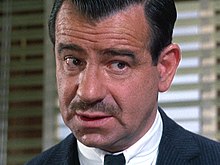
Hamlton Bartholomew, one of several characters who are not quite what they seem.

The following day, The Mystery Man and Regina go to the American Embassy to return the $250,000 that was originally theirs. The Mystery Man decides to remain in the hallway, claiming that, being a professional thief, it would hurt him too much to see so much money simply given away. This, however, is his final ruse. When Regina strolls into the office of Treasury Director Crookshanks, she discovers that he is, in fact, the man who has been so rapidly swapping names. This final identity is, however, genuine, and the two fall into each others' arms.

The Verdict

Charade is a decent enough movie, and it held my attention, but this was despite some really serious problems I have with it.

The good? One thing is the overall plot. As far as playful suspense movies go, the story in Charade clicks along really well. Like many of Alfred Hitchcock's stronger suspense movies, the viewer is intrigued enough to try and piece together the strange scenarios. However, every time you think you have a handle on it, one of the variables changes. This is typified by the nominal chameleon, Agent Crookshanks. Even though I wasn't completely in love with this movie, the time flew by pleasantly enough as I scrambled to keep to up with the plot.

Helping out the telling of the tale are some humorously 2-dimensional characters brought to life by some solid acting. While I have serious problems with some of the acting (I'll get to that in a moment), James Coburn and George Kennedy are enjoyable. Even better, I felt like Walter Matthau steals all of his scenes. His effortlessly dry humor is perfection.

Another undoubted strength is the visuals. As might be expected from a director who was behind such technicolor musical standards as Singin' In the Rain and many others, Charade's vibrancy is rather appealing. The shots are framed perfectly, and all actors and props are right in their places. Such compositions make the film exceptionally easy on the eyes.

One of the many shots in the film that could make a pretty decent postcard. Note the artful arrangement of colors.

All of these positives just barely outweighed the nuisances to me. First among these bugaboos is that there is a serious lack of cohesion in the speech and actions of the main characters. Both Regina Lampert and Crookshanks make odd swings between being silly and playful to being highly emotional. This leads to some rather strange scenes and annoying interactions. Most obvious to me is a rather weird scene in which Crookshanks, to bring a smile to Regina's face after a near-death experience, jumps into a shower fully clothed and pretends to wash. I think it was meant to be charmingly goofy, but it comes off as just bizarre.

The greater problem to me is a major bias of mine: Audrey Hepburn. I am simply not a fan of hers. Granted, the fact that the character she plays is a confusing hodge-podge of attitudes and emotions, and perhaps no actress could have pulled it off. Still, there has always been something about Hepburn's giant-eyed posing and aristocratic air that irks me. I realize that she was the “it” girl in her day and is still seen as a fashion icon, and I guess I understand why. All the same, the only movie in which I've been able to stomach her is My Fair Lady, and that only because she is verbally abused relentlessly by Rex Harrison. Her role in Charade managed only to annoy me with her odd shifts from comically apathetic widower to hopelessly fawning romantic or from clever, cool customer to skitish, hapless victim.

One of many scenes in which Audrey Hepburn over(re)acts. Seriously - it's just a friggin' match, lady.

Will I watch this movie again? Probably not. The riveting aspect of this movie was the suspense of the unknown. Even having watched the movie a few years ago, I had forgotten nearly all of the plot details. Now knowing them all, further viewings would only highlight the things that I don't like about the movie. I would still recommend that nearly anyone who enjoys films give it at least one go. Anyone who really likes Audrey Hepburn and/or Cary Grant will surely not be disappointed, as the former is at her most “adorably” elfish, and the latter is...well, he's Cary Grant.

That's a wrap. 57 shows down. 48 to go.

Coming Soon: Dr. Strangelove: Or, How I Learned to Stop Worrying and Love the Bomb (1964)


One of my favorite comedies of all time, by the otherwise dead serious directing great, Stanley Kubrick. If any film on this list has a chance to unseat Kind Hearts and Coronets as “darkest comedy”, this is the one...

Please be sure to pick up all empties on the way out.