Showing posts with label Barry Lyndon. Show all posts

Friday, April 13, 2012

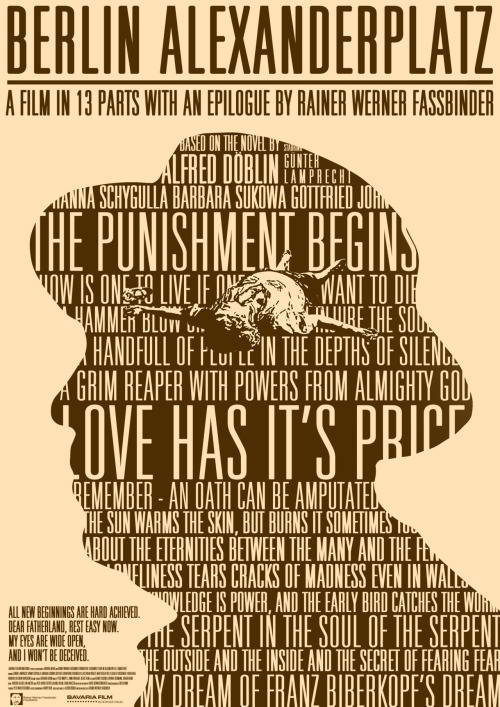
Film #78: Berlin Alexanderplatz (1980)


Director: Rainer Werner Fassbinder

Initial Release Country: Germany

Times Previously Seen: none

Teaser Summary (No spoilers)

Former thug gets out of jail, tries to go straight, fails miserably, goes crazy, embraces crime, goes crazy again, and then gets well. Sort of.

Extended Summary (Relatively more complete pot synopsis, including spoilers. Fair warning.)

* This film is reeeeaaaally long, so I’m giving you a very short version of the plot. If you’re really curious about the little details, check out this more complete synopsis at wikipedia.

Berlin, 1928. Germany is in the middle of a horrible economic depression. Franz Biberkopf (Günther Lamprecht) has just been released from prison, where he has spent the past four years for the involuntary manslaughter of his prostitute girlfriend. After an initial period of confusion about how to reintegrate himself into society, Franz decides to leave his criminal past behind him and live a straight life, free of illegal activities.

It doesn’t take long for Franz’s plan to fail. Despite trying to go straight by taking menial jobs selling newspapers and hawking various wares on the streets and going door-to-door, he starts to be taken advantage of. One business partner robs one of Franz’s clients, sending Franz into a manic depressive bout of heavy drinking, away from any friends or associates.

When Franz emerges from his bender, he finds one of his old criminal associates, the kindly Meck, who introduces him to the highly unsavory Reinholt. Franz begins a bizarre scam with Reinholt, who is a compulsive womanizer, to take Reinholt’s girlfriends off of his hands after he inevitably tires of them. Franz eventually ties of these strange deceptions, though he maintains his friendship with the warped Reinholt.

Franz Biberkopf, the man at the middle of this massive, swirling tale.

Franz then takes up with a local crime gang. He is initially taken on a night robbery, without his knowledge, and forced to be the lookout. Franz reluctantly goes along with it, but as the gang is driving away, a car begins to follow them, merely by chance. Reinholt becomes suspicious and soon pushes Franz out of the back of their vehicle. Franz has his arm run over by the following car. The arm is so badly damaged that it must be amputated.

Franz, now without his right arm, rejoins a pair of old friends to recuperate. One is a former prostitute who was under his control in his days as a pimp – Eva, who still has deep affection for Franz. The other his Eva’s lover, Herbert, who is also involved in various petty crimes. The two take in Franz and tend to him carefully, seeing Franz as a decent person who is prone to bad decisions, bad luck, and strange fits of emotion. Eva and Herbert even find a young woman to be Franz’s new lover – the prostitute whom Franz names Mieze. The two instantly fall in love with each other.

Franz and Mieze move in together and they continue to adore each other, though their relationship is not without difficulty. The one-armed Franz begins pulling robberies with the local gang again, and Mieze’s job as a prostitute leads Franz to become severely jealous at times. The worst is when Mieze admits to an unplanned affair with a client’s younger son, whom she claims to have fallen in love with. Franz goes into a rage and beats Mieze bloody, stopping just short of killing her. Despite the brutal attack, the two make up with each other shortly afterwards.

A few days later, Franz brings Mieze to their local bar to introduce her to Meck, Reinholt, and the rest of the gang. The compulsive Reinholt immediately blackmails Meck into setting up a meeting between him and Mieze. Meck does so, and he brings Mieze out to a forest retreat to meet with Reinholt, Mieze hoping to learn more about her beloved Franz from his friends. Instead, when Reinholt brings Mieze out to the woods, he tries to force himself on her repeatedly. Mieze teases some information about Franz out of Reinholt, including the fact that Reinholt was responsible for Franz losing his arm. This disgusts Mieze and she repels Reinholt. Reinholt, in a fit or rage, strangles Mieze to death and leaves her in the woods.

The utterly twisted Reinholt, attempting to seduce his "friend" Franz's girlfriend, Mieze.

Back in the city, Franz grows worried after not hearing from Mieze for several days. Meck, who had helped Reinholt bury Mieze’s body despite not knowing that Reinholt would kill her, decides to inform the police. When Mieze’s death is reported in the newspaper the next day, Franz breaks into a crazed laughter, deliriously happy that Mieze’s absence was due to her death and not due to a willful abandonment of Franz.

Franz goes into a complete daze. We start to see his tale from a bizarre perspective, including two angels following him and commenting on his confused state. Franz walks along in an odd dreamlike realm in which the dead are strewn about. Back in reality, Franz is taken to an asylum, and Reinholt is being held in prison under and mistaken identity. In the asylum, we see inside Franz’s tortured mind. He sees himself interacting with various characters from his life in the past year, both dead and alive. He shifts perspectives with many of them, and even faces off with the specter of Death. Franz seems to see himself as deserving of any punishment he receives, as he and others are butchered in an abattoir.

We snap back to reality, at a court hearing for Reinholt, who is on trial for Mieze’s murder. Franz testifies to Reinholt’s good character, which helps Reinholt receive a relatively lenient sentence of ten years in prison. Franz takes a job as an assistant gatekeeper at a car factory. He is attentive to his work, but seems utterly detached from anything happening in the word around him.

Take 1: My Gut Reaction (Done after the viewing, but before any further research.)

Looooooooooooong.

Berlin Alexanderplatz is fifteen and a half hours long. Fifteen. And a half. Hours.

I watched it over the course of about three weeks, and by the end, I was ready for it to be over. Perhaps I would have been better served to spread it out more, but hey, I have nearly 30 more of these reviews to do, and I want to get on with it.

It’s not really the length itself that it a little tough to take. Some people might be able to watch all of this show in a few days, but I would find it rather tough. However, this is not because it is bad in any way. It’s merely that the tone and look can be a tad monotonous.

That said, this is a haunting humanist story. This itself was a bit surprising, as I was expecting a more epic tale that connected one man’s journey into the Third Reich. I expected to see plenty of direct references to the rise of the Nazi party and their growing control of Germany. Such is not the case at all.

This may seem odd, by I couldn’t help but think of Henry Miller’s novel, Tropic of Cancer. That novel was a lightning rod for being so honest and frank about the human experience, including the most sensual (some thought indecent, at the time) elements. The difference is that Tropic of Cancer had a relatively rosier tone and outlook; Berlin Alexanderplatz takes a hard look at the mental degeneration of a man who has slipped right through the cracks of a failing society.

Franz partakes in one of his favorite vices to escape - binge drinking on a level that would would make even a German (maybe even an Irishman) blanch. [note: I'm of Irish descent, so don't get up in arms.]

Berlin Alexanderplatz tells the story of a man who is, in many ways, highly unsavory. And yet, it’s impossible to dismiss Franz Biberkopf as a purely despicable villain. Unlike the titular protagonist of Barry Lyndon, Franz actually has several admirable traits. With his close friends, he has incredible loyalty and enthusiasm. His emotions are on his sleeve for all to see, and he is generally a social creature. His vices are, at root, ones that most people who are honest with themselves can understand – booze and women. Franz is at his most despicable when he is in the throes of passion or rage, or when he is victim to his own mental instability. Not long into the massive film, you start to see him as pitiful as much as anything. This is not unlike another film character that I will be seeing soon on this blog – the very real Jake LaMotta as depicted in Raging Bull. Both can be destructive, though Biberkopf is easier to like.

Most of Franz Biberkopf’s tale is easy enough to follow, in basic terms. He gets out of prison, he tries to go straight, he fails, and he suffers several brutal losses. However, there is a reason that the director chose to use over fifteen hours to tell the story and not two. Franz is complicated, and some of his actions are plainly irrational. To make any sense of them, we need the time to see how his more reasonable friends react to him. This gives us a better compass to navigate with. When characters like Eva, Herbert, and Meck show up to help Franz, we viewers need them just as much as Franz does. When the narrative of Franz’s life loses direction, they give us some semblance of meaning.

During the course of watching this whole thing, I often found myself pondering just what such an environment would be like. I can only imagine what it is like to live in the middle of a true economic depression, and how this affects one’s life choices. It would be hard enough for a person of decent means, but I believe Berlin Alexanderplatz gives a very real and disturbing view of how such a depression affects the already downtrodden. Those at the bottom of the socioeconomic ladder begin to engage in strange, irrational, short-term gain behaviors. A lot of people will watch this film and find the actions in it too distasteful to stomach, and to be honest, I did at first, as well. However, once I thought about it some more, I couldn’t help but feel that there was a disturbing authenticity to the entire tale. The corrupt actions of the characters reflect the polluted environment they are in, as they do whatever they can to survive and find any sort of solace that they can.

Franz and Mieze, a criminal and a prostitute, find some measure of happiness together. Their relationship may seem perverted to some, but it makes far more sense within their constraints.

There are some rather strange elements to Franz’s tale, though. Some are ones that I found a bit perplexing. Throughout the show, we have a disembodied and unknown narrator offering commentary that sometimes includes observations about the characters, but also Biblical verse, song lyrics, and readings from philosophical treatises. The connections are sometimes clear, but other times simply baffling.

Related to this is the final Epilogue episode, which is right out of surrealist left field. The previous 14 hours of the show are quite straightforward, with only occasional lapses into the aforementioned narration. The final episode, though, goes right into the realm of mind-blowing oddity. At least, that’s how it seems at first. When I thought about what all of the stunning and wild images had to do with Franz, most of them became clear. It didn’t make them any less shocking, though.

Just one of the many dark, disturbing images that we see in the Epilogue. This shows the tattered, tortured state of Franz's mind after losing his beloved Mieze.

Aside from the story itself, the other elements of the film are not ones that I would call spectacular, though they are very strong. The acting is very solid, all around. Günther Lamprecht is outstanding as Franz. Considering the incredible range of emotions and attitudes that he needs to show, it’s remarkable how he pulls them all off naturally – he can be charming, funny, pathetic, crazed, manic, depressed, or meditative at nearly any moment. Among the rest of the cast, there are really no weak links.

The visuals are rather intriguing. There is a somewhat dreamy, soft glow to most of the shots. This also often leads to an unusual halo effect that reminds me of the look of Sergio Leone’s 1984 gangster epic, Once Upon a Time in America. Beyond that, the several scenes in the forests outside of Berlin, where Mieze is killed, look eerily like the woods used in Miller’s Crossing. Some of the scenes even seem to be set up the same way. I will have to check on whether the Coen Brothers in fact used this show as inspiration.

While the technical merits are all there, this show is really all about where this one singular character, Franz Biberkopf, fits into his own strange sub-society – a sub-society that exists in shadows that most of us don’t want to think about or acknowledge.

Take 2: Why Film Geeks Love This Movie (Done after some further research)

Researching this massive film is filled with peaks and valleys. I watched a documentary that got behind the scenes and had a few good interviews, but didn’t add much to my understanding. There is a lack of information in my normal go-to places for this sort of thing, as well.

Then, there is Peter Jelavich. Jelavich is a professor of European history, especially German historical culture. I watched an amazingly concise, 25-minute documentary in which the man clearly answered my every question about Berlin Alexanderplatz.

The novel, by Alfred Döblin, was a masterpiece of its day. Written in 1929, it was one of the very earliest “metropolitan” novels that effectively depicted life in a modern mega-city, such as Berlin. Jelavich likens it to the contemporary novel Manhattan Transfer, by John Dos Passos. I haven’t read that novel, but having read Dos Passos’ U.S.A. trilogy, I know exactly what he means. The narrative is an enormous, sometimes dizzying, literary montage of sights, sounds, and images as perceived by an individual living in those days.

A major theme of these works is the rise of mass media. In watching the movie, this was something that confounded me; I did not understand the narrator giving me little snippets of songs, advertisements, articles, political treatises, and so on. Now knowing the intent, it all makes perfect sense. All of these little phrases are the straggling pieces of information that Franz has inadvertently picked up simply by living in Berlin. On top of that, I realize how genius Döblin was, and just how much foresight he had. When I think about my own mental state, and how much information and little, random tidbits flow through my mind on a daily basis, it’s amazing to think that Döblin saw it all coming long before its impacts were fully realized.

The original cover for the novel. It conveys the life Franz Biberkopf, surrounded by an overwhelming amount of text and information.

The other significant thing that Jelavich confirmed for me is just how to take Biberkopf the character. He is, as I felt, meant to be seen as a sympathetic figure. He essentially has a good heart and wants to do the right things, but he is incapable of it. Sometimes this is due to the endless social pressures around him, and sometimes it is because of his own lack of abilities. Either way, you want to see him find some sort of happiness. This makes it more tragic when he fails.

Believe it or not, there was a film version done shortly after the novel, back in 1931. Despite having Döblin himself working as a writer, it was far shorter and had a much sunnier ending. When Fassbinder took on the project in 1979, he was already established as something of an eccentric genius of film. He was given a lot of latitude, and he had been an incredible fan of Alfred Döblin’s novel. Wanting to do it justice, he stayed very close to the source material. The only personal touches he added were some aural references to 1960s and ‘70s pop culture, drawing a parallel between the 1929 novel and his own world in the late 1970s.

There is also a 2007 essay here by Tom Tykwer, which seems very thorough and probing. However, it dives into elements and connections with German culture that fly right over my head, in most cases. For anyone who can get something out of it, though, check it out.

The reception of the film was fairly positive, especially among critics. As you can imagine, some viewers weren’t sure what to make of the gargantuan film. Many complained that the visuals were too dark, but this was really the only common gripe. Overall, people saw it for an amazing piece of work.

That’s a wrap. 78 shows down. 27 to go.

Coming Soon: Raging Bull (1980)


 This is one of my all-time favorites. I love several of Scorsese’s movies, but I think I put this one at the top of the list. Come back and see how I break down the sad but entrancing life of the very real Jake LaMotta.

Please be sure to pick up all empties on the way out.

Sunday, February 19, 2012

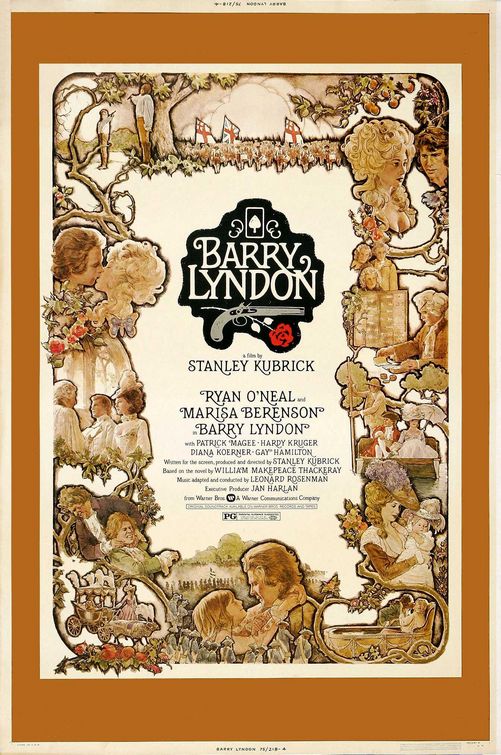
Film # 74: Barry Lyndon (1975)


Director: Stanley Kubrick

Initial Release Country: United States

Times Previously Seen: once (about 12 years ago)

*Weird, Egotistical Note: After now watching 74 shows from TIME’s “100 All-TIME Films” list, this is the first film released within my lifetime. Funny to think that, as viewers were seeing this movie for the very first time, I was wailing away in a crib on a military base in South Carolina.

Teaser Summary (No spoilers)

18th century Irish commoner spends lots of time on many rungs of the social ladder. Duels and massive decorative hats abound.

Extended Summary (Longer plot synopsis, including spoilers. Fair warning.)

What follows is a fairly complete summary. For a meticulously detailed synopsis, check out imdb’s version through this link.

Late 18th century Ireland. Redmond Barry (Ryan O’Neal) is a young lad whose father is killed in a duel. He soon falls in love with his cousin, Nora, who returns his affection readily. However, when Nora accepts a marriage proposal from a stately, if uppity, English officer, Barry becomes furious. He insults the officer to the point of demanding a duel. Barry shoots the officer, seemingly killing him. On the advice of his cousins and his second, an Irishman in the English army named Grogan, he flees his hometown for Dublin, hoping to escape the inevitable pursuit of the law.

Langdon getting held up as he flees from the English army.

On the way to Dublin, Barry is robbed of all but his clothing. Desperate for any kind of escape, he joins the British army and heads off to war. After a few brief skirmishes and witnessing the death of his lone friend, the rediscovered Grogan, Barry decides to desert his post. Using a stolen officer’s uniform and identification papers, Barry enters Prussian-controlled areas near Holland. His hope is to return to Ireland.

Instead, he is captured by a savvy Prussian officer, Captain Potzdorf (Harry Kruger), and forced to join the Prussian army. Barry spends several years with Prussian forces, among a regiment composed mostly of scoundrels and cold-blooded killers. From these, Barry learns the cold means of survival and the arts of deceit. In one particular battle, Barry saves Potzdorf. This act is rewarded with back-handed recognition, a reward, and some small measure of trust.

Barry is recruited by Potzdorf and the Prussian Minister of Police to keep tabs on a suspected spy, a gambler of Irish origin named the Chevalier de Balibari (Patrick Magee). Barry readily accepts; however, upon meeting the Chevalier, he becomes emotional in the company of a fellow countryman and betrays his true mission. The Chevalier takes him in and the two become co-conspirators. Barry helps the Chevalier cheat nobles in games of chance, at the same time feeding the Prussian government useless information about his new confidant.

Eventually, Barry and the Chevalier manage to concoct a ruse to escape from Prussia unscathed. They then spend several years traveling around Europe. The Chevalier continues to cheat wealthy aristocrats out of their money, and Barry assists by successfully dueling any reluctant debtors.

Barry plies his trade as a master duelist, a perfect profession for any amoral rogue with the necessary skills.

Barry eventually sets his sights higher – true wealth in the form of the English countess Lady Lyndon, whom he meets at a gambling table. Barry courts the married Lady, which infuriates her aged and decrepit husband. The Lord Lyndon is so enraged, in fact, that when he starts an argument with the calculating Barry, he dies of a heart attack. This leaves the way wide open for Barry to swoop in and marry the love-struck Lady Lyndon and assume his new title – Barry Lyndon.

Over the next several years, Barry’s married life on his wife’s English estate disintegrates. While his wife stays home and looks after her son from her first marriage, Sir Charles, and hers and Barry’s son, Bryan, Barry himself lives a life of opulent leisure. His excessive drinking and philandering does not go unnoticed by his step-son, Sir Charles. Though merely ten years old when his mother remarries, the boy quickly develops acute hated for his rogue of a stepfather. This hatred only grows stronger as time passes.

Within these years, Barry’s mother comes to live with them and she points out how Barry needs to attain his own title, thus decreasing his total reliance on his wife’s fortune. Following this advice, Barry begins to spend lavishly on art, parties, and greasing the social wheels for his ascendancy into “higher spheres” of social worth. Things seem to be moving in the right direction until, at a party on the Lyndon estate, Lord Charles bursts in and announces his utter hatred for his stepfather in front of the guests. The enraged Barry mercilessly attacks his step son and pummels him in front of their guests. Word soon spreads of Barry’s brutality, and his “friends” completely ostracize him.

Barry turns his attentions toward his natural son, Bryan. As opposed to his horrid treatment of Lord Charles, Barry showers Bryan with true love and affection. Unfortunately, Bryan suffers a terrible horse riding accident just before his ninth birthday and dies a few days after. Barry and Lady Lyndon are so distraught that Barry’s mother must take over the family’s finances. When she dismisses Lady Lyndon’s closest associate, the vicar Reverend Runt, word gets out to Lord Charles, who has been living away from his family’s estate after the beating received at the hands of his stepfather.

Barry in the center of the frame, Attempting to drown his sorrow over his son's death. Little does he know that things are about to get even worse...

Lord Charles, supported by some of his family’s close friends, seeks out Barry and challenges him to a duel. In a secluded barn, Lord Charles wins the right to the first shot, but misfires. Upon his chance to return fire and likely kill Lord Charles, Barry opts to fire his pistol into the ground. Lord Charles, instead of being satisfied, demands another shot. He takes it and hits his stepfather in the leg. Barry is taken to a nearby inn for treatment, while Lord Charles rushes back to his family estate and quickly reasserts control over the household.

Barry must suffer his leg being amputated. More than this, though, he is given an ultimatum from Lord Charles – leave England forever and accept a 500 guineas annuity from the Lyndon family, or stay and suffer arrest on the grounds of his massive debts. Barry leaves England, and we are told that he returned to continental Europe to return to the gambling profession, “without his previous success”.

Take 1: My Gut Reaction (Written after this recent viewing, before any research.)

A story about this viewing of Barry Lyndon:

My girlfriend and I sit down a few evenings ago to watch it. The film moves on at its’ leisurely pace and time clicks on. At roughly the 90-minute mark, the “Intermission” screen pops up. My girlfriend goes slightly slack, her eyes widen, her jaw drops, and she asks, “How long is this movie?!” With a semi-knowing grin, I turn and reply, “It’s three hours long. We’ve got 90 more minutes to go.” Eyes still wide, she shakes her disbelieving head. After hanging in for another 30 minutes or so, she gives up and goes to bed. I stay up and watch the full film, enjoying it right up until the end.

This little tale of our viewing I think sums up how nearly all people feel about Barry Lyndon – you either love it, or you see it as too long and dull to take. Clearly, I am in the former group.

I have to say that this is one of those movies that you have to know what you’re in for and be in just the right state of mind to watch. Barry Lyndon is slow. Extremely slow. Kubrick took the approach of relying far less on dialogue and far more on slow zooms of panoramic landscapes and interiors. If you prefer more kinetic action and emotional dialogue, the three-hour Barry Lyndon will be an effort in frustration. I, however, love watching the movie. The lush colors, attention to detail, and expansive wide-angle shots are like classic works of art slowly coming to life (emphasis on “slowly”). The beauty of the natural surroundings, castles, and costumes throws into contrast the dastardly deeds that people are committing throughout the film.

This is the very first shot of the film, both in filming terms and in dueling terms. The entire visual style and story theme are set up within this shot - breathtaking beauty wholly encompassing human destruction.

The story itself is epic in scale, and I’m a sucker for a good epic. Following the roughly twenty-year rise and fall of Langdon Barry is a spectacle, as it allows the viewer to traipse through the Europe of William Makepeace Thackeray (the author of the source novel). To be sure, there is some interpersonal exploration done, but the movie is mostly given to sweeping powers of the times - war and class distinction – and their effects on humanity.

One of the recurring themes in the film is the duel, and it is these scenes that are most striking and intense to me. While all of the duel scenes (three with pistols, one with swords) are incredibly hypnotizing, it is the final one between Barry and his stepson, Lord Charles Bullingdon, that is an absolute masterpiece. The measured ritual with which the scene plays out and the very visible terror on the face of Bullingdon are perfection. The scene plays out with agonizing deliberation, forcing you to get into the heads of those involved. Once you do this, it’s not difficult to imagine just how terrifying a prospect it must have been to stare at someone standing ten paces from you, and you stared into their eyes just before they killed you or vice versa. It’s a version of Sergio Leone’s extended western gunfights, though a far more chilling one.

Guiding us through Barry’s journeys is a bemused narrator. As a rule, I find narration in films to be something of a crutch, borrowed from the realm of literature. Films should be able to tell their stories through visuals and dialogue. However, there are a few films in which it can enhance, and Barry Lyndon is a mixed bag. At times, the narrator’s commentary is tinged with sly gallows humor that I can only guess was Thackeray’s and which adds some welcome levity. In other moments, it does indeed seem a cheap way out of conveying humor or emotion directly through the characters’ words or actions.

Barry, we are told by other character and the narrator, is a hot-blooded young man. You'd hardly know it from his face here, which is the same bland expression he wears through nearly the entire film.

This downplay (or lack of) emotional dialogue is probably one clear reason that people may not like this movie. There is an overall stillness to the movie, save perhaps a few scenes of warfare and brief fighting. Knowing that Kubrick was a meticulous perfectionist, I am quite sure that this was intentional, and this tranquility pervades even to the acting. Even during tense confrontations and emotional moments, everything is very placid. While this is soothing in most places, after about two-and-a-half hours, the characters almost seem devoid of any real feeling.

This sensation of dead calm would not be so obvious if not for the performance of the title character actor, Ryan O’Neal. Some of the film’s minor characters do actually show more spirit. In stark contrast, O’Neal’s facial expression almost never changes throughout the movie, which leaves the viewers to rely on the narrator and guesswork to glean Barry’s true desires. Perhaps we viewers are supposed to take this as an outward sign of Barry’s emotional detachment, but it really just comes off as flat and unengaging most of the time.

This brings up the other reason most people probably dislike this movie. The morning after I watched it, my girlfriend and I discussed it. As she considered how Barry is a mostly despicable character, she rightfully wondered, “What’s the point?” I imagine countless other viewers have asked the same question. When I ponder the answer, I always return to the epigram of the film:


With this final message, we are left to wonder perhaps not about the point of the movie, but rather about the point of all of the violence and pain depicted in the movie. Violence and pain that certainly was based on real actions of the times. In watching Redmond Barry get caught up in the materialism and territorial struggles of his age, I can’t help but think of a movie critic who suggested something very cogent about Stanley Kubrick’s films. Kubrick’s movies, while covering a vast spectrum of genres, including war, action, science fiction, horror, and drama, all had the same basic message underlying them: humans are not fallen angels, but rather ascendant apes. Barry Lyndon, like all of Kubrick’s other films, shows just how not just one person but an entire society can slip into barbarism. Even when the players are dressed in the finest of clothes, living in the plushest of mansions, and possessing the most stunning of lands, they are no less capable of the basest primitive cruelties.

A happy message, it is not. But it is certainly one worth pondering. Barry Lyndon gives you the chance to calmly mull it over while drinking in the cultural splendor of a bygone age. It’s not for everyone, but I’d recommend everyone at least watch the 90-minute first act and find out for themselves.

Take 2: Why Film Geeks Love This Movie (Done after a little further research.)

A few surprises on things that I’ve found (and not found) in reading up a little more in Barry Lyndon.

The movie was, as mentioned, based on a far lesser known novel my William Makepeace Thackeray, who is now far better known for Vanity Fair. Barry Lyndon, though, is often referred to as the first “anti-hero” English novel. Kubrick clearly kept this idea true to its roots. Kubrick also kept the setting and characters basically the same, though he took out a few family connections that were in the novel. One such is that the Chevalier de Balibari (as I probably should have figured, based on the name) is, in the book, actually an uncle of Barry’s who had fled Ireland. The novel’s tale goes that he was kicked off his land and dispossessed by the Lyndons themselves, into whose family Langdon marries much later. This is probably a more interesting plot connection, and I wonder why Kubrick left it out. Perhaps he felt it far too convenient, but who knows?

Another interesting departure from the novel is that the film ends significantly before the novel’s tale, with several notable differences. In the film, the story ends just after Barry is shot and loses his leg in the duel with Lord Charles, and he is forced to leave England, accepting his modest annuity. In the book, the duel does not exist, and Barry actually becomes a member of British parliament. He sends his step-son to the Americas to fight in the Revolutionary War, and is accused of trying to have his son killed. He is stripped of his title and forced out of the country. Eventually, he is jailed for debts and spends the final seventeen years of his life in prison, with only his elderly mother to attend him. Obviously, Kubrick couldn’t tell all of this story using the measured pace that he wanted, so he chucked it.

A fairly recent edition of Thackeray's original novel. Kubrick was faithful to most key elements, but made several notable changes.

Another interesting difference between novel and film is the tone. From what I’ve read on it, Thackeray’s novel is told in first person by Barry himself, with an overtly humorous tone. In it, Barry is an early example of the “unreliable narrator”, who seems oblivious to his own shortcomings. Kubrick eschewed this and achieved a much more objective look at the character and his world. This accounts for the very detached feeling of the movie.

When released, Barry Lyndon was something of a disappointment. While it did pull in seven Academy Award nominations (winning four in the technical categories of art direction, costumes, cinematography, and music) and received fair critical acclaim, it did not win over all critics or the public, especially those with high expectations of Stanley Kubrick. In his original review in 1975, Roger Ebert probably summed up a lot of the feeling of the day. He described it as having “the arrogance of genius” and lauds its many brilliant merits. He does, however, note of O’Neal’s performance that “Kubrick has directed Ryan O’Neal in the title role as if he were a still life. It's difficult to imagine such tumultuous events whirling around such a passive character.” This is really the only critical note I found of O’Neal’s flat-line turn as Barry.

In recent years, Barry Lyndon has gradually gained more attention as one of the greatest of films. More and more, critics seem to be willing to see its cold, calm tone not as an example of a bad decision on Kubrick’s part but rather a very unique and artistic way of observing and telling a human story. One can call it hopeless or dreary, and I can’t necessarily argue, but I have to say that I will always find it mesmerizing.

That’s a wrap 74 shows down. 31 to go.

Coming Soon: Taxi Driver (1976)


Oh, boy. Anyone who’s seen this movie knows that it contains every ounce of dark despair that the mid-1970s United States could muster. It’s also an incredible piece of film making, and the first of three Martin Scorsese movies on the list. Come on back in about a week or so to see what I make of my return to the sad tale of Travis Bickle.

Please be sure to pick up all empties on the way out.