This is the 553rd I've watched of the 1,162 films on the "Before You Die" list that I'm gradually working my way through... Original Korean Title: Bin-jip
Director: Ki-duk Kim
A captivating and wonderfully unique film, even if it is one with a somewhat whimsical resolution.
3-iron follows Tae-suk, a young drifter who breaks into people's homes while they are away on vacation. The incredibly crafty Tae-suk never steals more than a little bit of food and a bed for the night, and he always repays by thoroughly cleaning the dwelling and fixing any malfunctioning machinery they may have. This odd little ghost one day breaks into the home of a wealthy, bullying businessman, whose wife, Sun-hwa, Tae-suk finds beaten and alone. Tae-suk becomes taken with Sun-hwa to the point that he confronts her husband and beats him by pelting him with golf balls. Tae-suk and Sun-hwa leave together and become partners of sorts, continuing the pattern of using others' homes with the least amount of invasiveness possible. Serious problems do arise, though, once the couple eventually are captured by police.
Sun-hwa looks on as Tae-suk whiles away some time with his own strange form of golf practice. Their peculiar, meditative relationship is hypnotic.
This movie is far more artistic than a mere plot synopsis can convey. The most immediately amazing thing is that the protagonist Tae-suk does not utter a single word during the entire movie. Given that he is in nearly every scene, this is quite a feat, and it meant that director Ki-duk Kim had to rely on a lot of visual storytelling. He does this in a fashion that would impress every major director, right back to the silent film era. Through nothing more than careful direction and camerawork, the odd behavior of the wordless Tae-suk is given meaning that becomes deeper and more profound as the film spins on. By film's end, Tae-suk becomes a sort of transcendent, soulful evolution of the classic "Little Tramp" character of Chaplin's. I'm no great fan of Chaplin, but I found Tae-suk to have all of the charm are far more depth than the Tramp ever did.
The movie is probably not for those who do not enjoy "foreign movies," to use the stereotypical pejorative form of that phrase. 3-iron is slow, subtle, heartfelt, and admittedly a tad sentimental. Some viewers may just see the actions of Tae-suk and Sun-hwa too peculiar to find enchanting. As one who enjoys visual storytelling, I thoroughly enjoyed this rather singular tale.
That's 533 down. Only 609 films to go before I can die.
Marco (Dario Grandinetti), a journalist in Spain, tracks down
the noted female bullfighter Lydia (Rosario Flores) in order to do a story on
her. When he meets and explains that he hopes to do the story about her recent
breakup with a fellow matador, Lydia initially is upset. However, she changes
her opinion, does the story with Marco, and the two become lovers for a time.
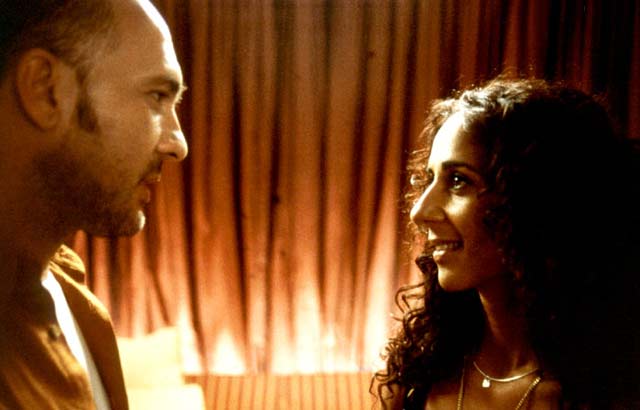
Lydia, the unlucky-in-love lady bullfighter who becomes romantic with the sensitive journalist, Marco.
Several months later, Lydia is horrifically injured by a bull
and is sent into a coma. While visiting her in the coma ward, Marco meets Benigno
(Javier Camara), a nurse who works in the coma ward with one specific patient –
Alicia. Marco eventually learns that Benigno’s relationship is far from a
simple nurse-patient one. Four years prior, just before Alicia became comatose,
Benigno had been living a solitary life with only his mother. He had noticed
Alicia in the dancing school across the street from his and his mother’s home,
and he one day approached and introduced himself to to her. Not knowing how
else to proceed, he even made an appointment with Lydia’s father, who is a
psychiatrist.
Before things could go any further, however, Alicia was the
victim of a car accident. Benigno, still smitten with the beautiful young dancer,
applies to be a nurse in the coma ward where she is admitted. Benigno’s skill
and sincerity in caring for Alicia impresses her father enough to hire Benigno
as one of two nurses who will attend his daughter at all times. As the four
years pass, Benigno continues to dedicate all of his love to Alicia, not only
caring for all of her physical needs but also constantly talking to her as if
she were perfectly conscious.
When Benigno meets Marco in the coma ward, he offers him some
friendly advice about caring for Lydia. However, Marco soon learns that Lydia’s
former lover has returned and that they had been back together for about a
month before Lydia’s accident. Understandably saddened, Marco leaves the
hospital. He runs into Benigno on his way out, and he learns an unsettling
secret. Benigno tells Marco that he is so in love with Alicia that he hopes to
marry her. Marco, thoroughly shocked, tries to explain how inappropriate
Benigno’s notion is, given that Alicia is essentially dead. Benigno, though,
seems undeterred.
Benigno "introduces" Alicia (left) to Marco and Lydia. The two men are both doomed to love women who are unable to return their deep feelings.
Soon at the hospital, things take a dark turn. It is
discovered that Alicia is pregnant. Based on the circumstances and the fact
that a fellow nurse had overheard Benigno’s plans to marry Alicia, Benigno is
put into prison on the assumption that he has raped her. While this is
occurring, Marco has been in Jordan for several months, writing a travel guide.
While Marcos is there, he reads in a newspaper that Lydia has died. When he
calls the hospital and asks for Benigno, he learns of the sordid story.
When he returns and visits Benigno in prison, it becomes
fairly clear to Marco that Benigno is guilty. Still, he remains friends with
the sensitive and horribly misguided nurse. Marco seems to empathize on some
level with Benigno’s desire to know whether Alicia’s child is born or not.
Marco even accepts Benigno’s offer to stay in his old apartment. While staying
there, in fact, he sees Alicia, recovered from her coma. He learns later that
she had given birth to a stillborn child, but then came out of her coma. When
Marco sees her, she is still on crutches, rehabbing her atrophied muscles.
Marco initially decides not to tell Benigno of Alicia’s
stunning recovery and the death of the child. This changes rapidly when Marco
receives a phone message from Benigno in which the hopeless man announces that
he will escape. Marco rushes to the hospital, only to find that Benigno has
indeed “escaped” – he has overdosed on pills and killed himself.
Not long after these tragic events, Marco runs across Alicia
at a dance performance. The two exchange a few words and glances, and there
seems to be some sort of spark between them.
My Take on the Film
Talk about getting dropped off a cliff.
Talk to Her had me fully engaged for over half its length,
and it was easy for me to see why this is considered a great film and why
Almodovar is considered a great director. Yet there is a point in this movie at
which all viewers will take one of two completely divergent emotional paths. I
took the path that led to confusion and alienation from the film.
The seemingly kind and altruistic Benigno - the character who will force you to ask yourself some very serious and disturbing questions.
So what is this crucial moment? We’ll get to that, but let me
cover what I really liked about the film, especially during the first hour or
so.
The most immediate is the cinematography. The sets and
costumes are wonderfully colorful, as is the general setting of Spain, the
bullfighting scenes being the ones that immediately come to mind. The shots are
wonderfully framed and things are edited in ways that make the visuals smooth
and inviting. There is a general warmth exuded from the pictures, even when the
characters are suffering through terrible bouts of loneliness or anguish.
The actual narrative itself is also masterfully composed.
Despite the depth of the several characters and just how much we are given
about them, nothing ever feels either rushed or stagnant. Every time a
mysterious element emerges, the story addresses it somewhere further into the
plot. This is always a welcome element in films, especially ones like this.
I’ve seen far too many films that raise serious questions about the characters or
plot that are never addressed, as if the director were either too lazy, too unimaginative,
or too pretentious to resolve potential conflicts. Not so with this film.
One of the many visually and emotionally warm moments in the movie. Marco, Lydia, and all of the other characters manage to stoke viewers' feelings for them.
There is also a lot of emotional food for thought in the
story. The running theme is finding and losing a person who you love, what it does
to a person, and how you can overcome the pain involved. Done mostly through
dialectic recollections and a few very brief visual flashbacks, we can sense
the pain felt by the different characters as they struggle over past lovers.
The acting is absolutely superior. Each and every person
nails their roles perfectly, even the rather difficult roles of Marco and
Benigno. The latter, especially, is a character who will surely test the
emotions of all viewers, and it had to be played in just a particular way.
Javier Camara pulled it off remarkably.
So, these all seem to be the stuff of a hands-down excellent
movie, right? Not so fast. Allow me to explain just when the train went off the
tracks for me.
About an hour or so into the film, we have a scene with Marco
and Benigno. Shortly after Marco learns that Lydia had been seeing her former
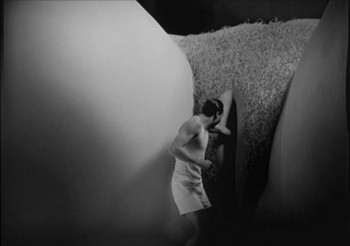
lover before her accident, Benigno tells him an odd tale of a silent film that
he had watched the night before. The film was about a man who had taken a
“slimming” potion concocted by his scientist girlfriend. The man shrinks down
to roughly six inches high, with no remedy in sight. One evening, while his
wife is in bed, he begins to caress her sexually. He then enters her through
her vagina, where he stays for the rest of his life.
To answer your question - Yes. This still photo depicts exactly what you think it does.
Now, that scene alone is going to make you ask some
questions. It might even lead you to turn off the movie, completely baffled
and/or disgusted. Though I was rather uncomfortable at the scene, I stuck with
the movie to see where it went.
And then we learn that Benigno has raped the girl in a coma.
Good night, everyone.
I continued to watch the entire film because we do not really
get full confirmation of the rape until close to the end, and by that time I
was emotionally checked out. And before anyone thinks that I simply didn’t “get
it,” I beg to differ. I do understand that Benigno represents some form of
victim of the ultimate unrequited love. He felt that he himself had “shrunken”
into nothingness like the man in the silent film, and he felt that the only way
to prove his own existence was to lose himself in Alicia. After spending four
years losing himself emotionally in her, he takes the most extreme next step
possible – he loses himself physically by planting his seed in her and then
killing himself.
I get all that, and I suppose that it does make for some
interesting intellectual discussion. I also assume that Almodovar is asking us
to realize that this is a film, and to see these all as fictional characters
through which we can use highly unnerving situations to raise poignant
questions. And despite knowing all of this, I simply can’t subdue my repugnance
at the notion, even fictional, of raping someone in a coma. Call me overly
sensitive, but that’s my ultimate impression.
Even after learning that Benigno has, in fact, raped Alicia, Marco continues to remain friends with the former nurse while he's in prison. I understand, intellectually, why this is. However, this was all just too much for me, morally.
For anyone who is thinking of watching the movie and has read
through this review, just try to have some idea of what you’re in for. It will
seem like a fairly standard drama most of the way, but you will be seriously
challenged at the mid-way point. I can see why it is considered a “great” film,
as its technical merits are irreproachable and it is unlike any film that I’ve
ever seen. But there’s no reason for me to ever watch it again.
That’s a wrap. 101 shows down; 4 to go.
Coming Soon: City of God (2002):
I watched this one about eight years ago and remember
thinking it was excellent. It’s been long enough now that I don’t really
remember much about it. It’s also appropriate, what with the protests going on
in Brazil right now. I’m looking forward to it. Please be sure to pick up all empties on the way out.
Title for Us English-Speaking Types: “Thirst” or “The Thirsty One”
Director: Guru Dutt
Initial Release Country: India
Times Previously Seen: none
Teaser Summary (No spoilers)Skilled but poor poet loses, laments, finds, loses, and finds love for women, if not humanity. Sings about it all.
Uncut Summary (The full plot synopsis, including spoilers. Fair warning.)
In 1952, India, the young poet Vijay (Guru Dutt) searches for love and work. He is clearly a very gifted poet who delivers his verses with an incredible singing voice. Yet, he is spurned everywhere he goes. While he would like to sing profound verses about lost love and the ills of society, publishers and audiences have no desire to listen.
Vijay, left, receives just one of many rejections of his poetry from a publisher.
At his family's meager home, his mother tries to offer him a charity dinner, but his two older brothers heap shame and guilt on him for not being a “working” member of the family. Vijay then discovers that one brother has sold some of his poetry as waste paper. Despite his loving mother's pleas to either stay or take her with him, Vijay departs home alone.
In a nearby market, Vijay discovers that his poetry was sold to a woman who read and was interested in the verses. Alas, the vendor does not know the woman. Later that day, by the river, Vijay hears a beautiful young woman singing words that he had penned. He follows her to her home, discovers that her name is Gulabo (Waheeda Rehman) and that she is a prostitute. Vijay is far less concerned about this than getting his poetry back, which he does.
Vijay shares a close moment with Gulabo.
Soon after, Vijay is reluctantly dragged to a college reunion by a former classmate. There, he sees his past lover, Meena (Mala Sinha), with whom he had a storybook romance until she left him, inexplicably. At the reunion, he recites some extemporaneous melancholy poetry, which falls on ears that are all deaf except for Meena's and a quiet dark-eyed figure, Mr. Ghosh. Upon leaving, Vijay is met by Ghosh, who is a publisher and offers him a job, though only as a menial worker. Vijay accepts.
At Mr. Ghosh's publishing company, it soon becomes clear that Ghosh, though realizing Vijay's dream of using his poetry to reach the public, has no interest in publishing the young man's work, calling it “trash”. Vijay overhears this, but swallows his pride and stays on the job. That evening, he goes to work at a party at Ghosh's home, where a gathering of prominent poets is taking place. Here, Vijay discovers that Ghosh's wife is none other than his lost love, Meena. He breaks out into another mournful piece of sung poetry, which captivates all of the other poets there. Afterwards, Vijay sees that Meena left him for the promise of material wealth with Ghosh. It becomes clear to Ghosh that there is something between Vijay and his wife, leading him to fire Vijay.
Through all of this, Vijay occasionally runs across the prostitute Gulabo, who has clearly fallen in love with Vijay through reading his poems. Vijay seems attracted to Gulabo's loving spirit, but is conflicted over how to behave towards her.
A few days after his firing, a broke and homeless Vijay is lost in thought on the banks of the Ganges when he sees his two brothers giving last rites to someone. Vijay discovers that it was his mother, who has died before he could make any final farewell. He retreats to the home of a vice-ridden fellow poet and promptly gets drunk. Intoxicated, he drifts through the brothel area of the city and sings a rousing verse about the social ills of his country. Yet again, however, no one is listening.
A drunken and despondent Vijay unleashes his poetry on an uncaring red light district.
Financially and spiritually at rock bottom, Vijay resigns himself to suicide. He heads towards some nearby train tracks, and even gives his jacket to an emaciated vagrant, who then quietly follows him to the train yard. Just as Vijay's about to throw himself in front of an oncoming locomotive, the vagrant gets his foot caught on a different track. Vijay goes back to pull him free, but fails. Vijay survives, but in a state of shock. In a case of mistaken identity, the country at large believes Vijay to have been killed by the train, thanks to the jacket that the vagrant had been wearing when run down.
Thinking her love to be dead, Gulabo goes to Ghosh to publish Vijay's surviving poems, not knowing Ghosh's feelings towards the young man. Instead, Gulabo finds Meena in the office, and quickly discerns that Meena was the inspiration for so many of Vijay's poems of lost love. Just as this discovery is made, Ghosh arrives. He gladly accepts Vijay's poems from Gulabo, realizing that he can reap enormous profits from the presumed-dead poet.
Ghosh's plan works all too well. Vijay's poetry is a nationwide publishing sensation, touching the dispossessed souls of the populace and raking in millions. However, a problem arises for Ghosh – Vijay awakens from his stupor in the hospital. He is initially put into a sanitarium for claiming to be the famous poet Vijay, and is kept there after Ghosh, a former colleague, and even his own brothers refuse to identify him. They realize that their gravy train will most likely only continue rolling as long as Vijay is “dead”.
Eventually, Vijay manages to escape with the help of his friend, local massage oil salesman and goofball, Abdul Sattar. It has now been a year since his “death”, and Vijay follows a throng to a memorial service in his honor. At the service, the ever-cunning Ghosh lambastes the audience for being the reason that Vijay committed suicide. Seeing the scene and infuriated by the greed, avarice, and materialism he sees at work, Vijay breaks into an impassioned verse railing against these social ills. All present are stunned, including Gulabo, who is the only one who is genuinely joyed to see that Vijay is alive.
After the public revelation that he is alive, Vijay's former detractors and enemies turn coat and try to ally themselves with him now that he is on the verge of becoming immensely wealthy by acting as the country's living voice. At what is meant to be a public recognition of his true identity, Vijay disavows his name and leaves the angry mob to tear each other apart, only further acting out the very corruption that Vijay no longer wants a part of.
That night, at her brothel, a saddened Gulabo slinks into deep feelings of loss. This changes when, much to her surprise, Vijay appears at the gate. In his eyes is a profound melancholy as he tells Gulabo that he is going to go away. When she asks to where, he simply replies that he will go until he does not need to go any farther. He asks Gulabo if she will go with him, to which she gives a wordless smile. The two walk, hand in hand, into the night.
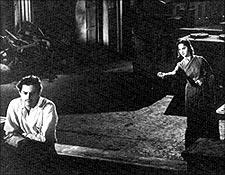
Vijay arrives at Gulabo's brothel to announce his departure from society.
Take 1: My Gut Reaction (Done after this first viewing, before any research)
It's now been about 24 hours since I watched Pyaasa, and I can't get it out of my head. This is a good thing.
After my girlfriend and I watched the movie, we were both rather quiet as we absorbed everything that had been thrown at us during the movie's two-and-a-half hours. As you can see from the mere length of my earlier synopsis, there are plenty of pivotal plot points, which make for a epic story. Add to this the Bollywood mode of adding music, and you now have an even larger piece of work. But it was neither the storyline nor the extended soundtrack that gives Pyaasa its weight. No. It's the tone and the themes.
Anyone who has read my reviews of the musicals Meet Me In St. Louisor Singin' In The Rainknows that the genre is probably my least favorite. While Pyaasa is clearly a musical, I found that I didn't mind the songs. Unlike so many Hollywood musicals, these Indian numbers were not invasive or written merely to be independent hit songs that were shoehorned into the picture (this is something that I found Meet Me In St. Louis particularly guilty of). Rather, the songs in Pyaasa are artistic expressions of the characters' feelings, and it is these very feelings that sets the movie even further above its musical brethren.
Nearly all musicals that I've seen are optimistic in tone. Sure, there may be a sad little tune thrown in here and there, but everything is generally upbeat. The songs in Pyaasa, however, have a beautifully melancholy attitude running through them all. Whether they're about unrequited love, frustration at a diseased society, or a resigned acceptance of both, there's a genuinely Romantic power to them that is absent from most musical soundtracks. In fact, the only other “sad” musical that I have seen is Lars Von Trier's uber-downer, Dancer In the Dark, but that film brought depressing to new lows despite how skillfully it was made. Pyaasa taps deeply into the ennui but it never dragged me so far down that I couldn't see a certain amount of beauty to it.
Here's a clip of one of the great songs. There are no subtitles, but the emotions are as clear as can be. This is from the class reunion at which Vijay sees his past love, Meena. I needn't explain just how he feels about her:
On top of all of this, the music is, on the whole, fantastic. While I don't really like when the singers send their voices soaring into the wavering, higher registers, the rest of the time the vocalists displayed amazing chops. All of the songs were either catchy or touching, depending on the requirements of the scene. A few songs may have gone on a tad too long, but many were quick hitters that popped up and then got out of the way of the story. I find that I really like the Indian styles with the sitar, accordion, and percussive instruments.
Another general strength is the overall story. Granted, the notion of a gifted and tortured artist being unappreciated and scorned by society is hardly new. Still, this movie imbues Vijay with thoughts and words that tap into the more universal plight of humanity. The vehicle of the love stories is a bit hackneyed, and even the “mistaken death” plot line is a rip-off of Sullivan's Travels, but the movie is effective in making the larger points.
As far as the other technical merits, they were a somewhat strange hodgepodge. Director and star Raja Dutt apes the visual and musical scoring style that had preceded him. Cinematography-wise, one can see many similarities with earlier Hollywood masterpieces like Citizen Kane and Casablanca. He does it very well, even if he wasn't exactly breaking new ground. The score is an odd scattering of popular melodies ranging from classical European to snappy American folk. The shifts were sometimes strange, bordering on comical, but they don't greatly diminish the overall film.
The acting is another point that is a mixed bag. The primary actors, especially star and director Raja Dutt, are excellent. However, most of the other parts are overdone in the throwback melodramatic styles of previous decades. It doesn't help that much of the dialogue is rather simplistic an stagey.
Would I watch this movie again? Perhaps. I have to say that the DVD version I watched appeared to be an older edition. This made for some questionable subtitles and a rather grainy look. If a reliable company like Criterion Collection were to give it a facelift and some updated translation, I would love to see it for the more polished aesthetics.
Pyaasa was a pleasant surprise, and one of the more singular films I've watched on the list yet. I can't say that it turned me into a Bollywood fan, but it has piqued my interest and given me some ideas and images that will stay with me for years to come.
Here's a clip of perhaps the most charged song in the movie. This is near the end, when Vijay sees the mob and his enemies figuratively feasting on his presumed corpse. He can take no more, and his song slowly builds to a fever pitch by the end:
Take 2: Why Film Geeks Love This Movie (Done after some further research)
Wow. Of the 47 films that I've watched for this blog thus far, Pyaasa wins the award for having the least amount information available. I'm sure this would be different if I could speak Hindi. I can't, so there's little to add to my own subjective views above.
There are a few interesting odds and ends, though. One is the all-too familiar tale of studio meddling. Raja Dutt wanted the ending to be Vijay walking off alone. The studio, certainly fearful that such an end would alienate a larger audience, demanded that Gulabo go with him. I have to say that, unlike the other movies in which such modifications were mandated, I was alright with this one. Maybe I was simply in a more romantic mood while watching it, but I was glad that my heart could hang its hat on something after Vijay's wholesale rejection of society.
On a minor, more amusing note is that the film crew wanted to film the red light district scene (maybe the most powerful and beautiful of the entire film) on location in Calcutta. They made it there, but were run off by a pack of local pimps. Among all of the problems that film makers have faced in history, I can't say that I've heard of such a thing.
Here is that famous scene in the brothel area. This is when Vijay is overwhelmed by the state of affairs in his beloved country:
That's a wrap. 47 shows down, 58 to go.
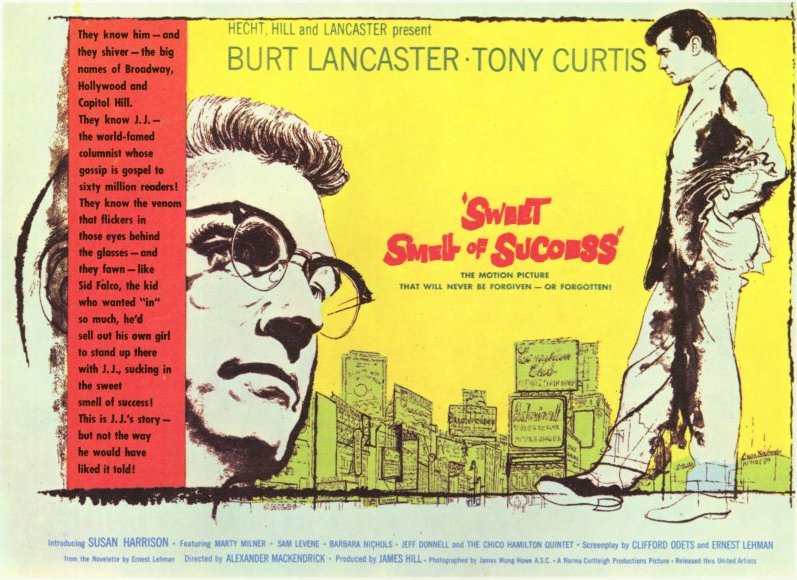
Coming Soon: The Sweet Smell of Success (1957) Watched this one about a year ago, and thought it was decent. I've always enjoyed Burt Lancaster, and he plays a real piece of work in this one.
Please be sure to pick up all empties on the way out.
In turn-of-the-century Sweden, the well established, 50-something lawyer Fredrik Egerman (Gunnar Bjornstrand) seems to possess several greatly desirable things: a prosperous law firm, a beautiful eighteen-year old wife, Anne (Ulla Jacobson), and an intelligent son, Henrik (Bjorn Bjelfvenstam) who is doing well at university.
Despite these ostensible blessings, some troubles are afoot. Anne, while quite vivacious and loving towards Fredrik, she seems to show at least a mild interest in her step-son, who is actually a few years older than her. Henrik himself is a tormented idealist who cannot find the balance between the lofty tenets of his chosen field of theology and his own earthly, carnal desires. He vacillates between quoting Martin Luther and fondling the pretty young house maid. Added to this is that Fredrik's former mistress, the stunning actress Desiree Armfeldt (Eva Dahlbeck) has returned to town to perform.
A very calm and collected Fredrik brings Anne to see Desiree's performance, not knowing that he had previously been muttering Desiree's name in his sleep. Having heard this and understood what it implies, Anne cannot bear to be at the play for more than five minutes before she begs to leave. Fredrik escorts her home, but returns to the theater to see Desiree.
At the theater, Fredrik confesses to Desiree that, though he has been married to Anne for two years, they have not consummated the marriage out of his sense of propriety. His love for her seems more paternal than matrimonial. Amidst some playful flirting, Desiree offers some comfort to her former lover in the form of advice. She then invites him back to her apartment.
At Desiree's apartment, the two continue their discussion of sex and love. Interrupting the talk is the arrival of Desiree's current lover, Count Carl Magnus Malcolm, who is the very picture of Victorian era masculine achievement. He is highly trained, deadly, aggressive, and unapologetically jealous. He and Fredrik have a stare-down in which Fredrik counters Malcolm's full frontal verbal assault with a more coy, passive-aggressive style. Fredrik leaves of his own accord, returning to his home.
The initial confrontation between Egerman (left) and the Count, with Desiree as part of the referee.
The next day, at Count Malcolm's estate, we see that his relationship with his own quite young and exceptionally beautiful wife, Charlotte, is far from ideal. She knows of his infidelity, is powerless to stop it, but is still in love with him, overbearing as he is. She decides to attempt a sabotage by visiting Anne Egerman and revealing Fredrik's late-night visit. All she accomplishes, however, is an affirmation that both of their husbands are being unfaithful to them with the same woman.
An interesting twist occurs when Desiree herself orchestrates a dinner for everyone at her mother's palatial estate. She invites the three Egermans and the two Malcolms, in the hopes of using her wiles to untangle everyone's knotted emotions. Through a plan executed in concert with Anne and Charlotte, Desiree accomplishes a few of her goals, if not exactly in the manner devised.
Most of the key players at the fateful dinner hosted by Desiree's aged but wizened mother.
After a bit of wine during dinner, the tormented young Henrik erupts in a passion and storms off to his room. The concerned Anne faints in his wake and is taken to her room, which neighbors Henrik's. As Henrik laments his fissured mind, he decides on suicide. After tying the rope around his neck and leaping from the high fireplace, however, he accidentally trips a trap mechanism which open a secret side door and sends the bed from the next room into it, and who should be in it but the slumbering Anne? Henrik sees it as fate and the two profess their love for one another. Early the next morning, the two elope while a devastated Fredrik watches from the shadows.
That evening, Charlotte looks to enact her part of Desiree's scheme. She lures Fredrik into a gazebo with the ostensible intention of seducing him. Desiree informs the Count of this, inevitably spurring the headstrong firebrand to charge into the gazebo. He banishes his wife from the gazebo and forces Fredrik to engage with him in a game of Russian roulette. Each man takes his shot, with Fredrik's second shot ringing out, apparently killing him. The shot was, however, merely a load of soot that the Count had used to replace an actual bullet. The Count claims that he would never put himself or his honor at risk for the sake of a “shyster”. Charlotte elicits a comforting promise of fidelity from her husband, and Desiree tends to Fredrik's mild injuries, the two seeming to accept their place with each other.
Take 1: My Gut Reaction (Done after one viewing, before any further research)
No mere plot synopsis can do this movie justice. It's truly comical and its value comes from far more than the storyline.
I've seen around ten of Bergman's 50-plus films, and some of them are a struggle, to say the least. While I enjoyed the more thoughtful, meditative fare like Wild Strawberries or The Seventh Seal, others like the gut-wrenching Cries and Whispers were like being forced to watch a gang of wolverines on cocaine tear each others' throats out. Not fun. With such a wide spectrum of moods and tones, I wasn't sure what to expect from a “comical farce” by the Swedish director. I needn't have worried so much.
With a style that blends the dry wit of Oscar Wilde with a refreshingly modern, earthy sense of humor, Ingmar Bergman constructed quite a film. I can only imagine how bold it seemed upon its release in 1955, but the mature approach to sex and love easily holds its own today. It takes a truly great storyteller to drive a plot using dialogue, and Bergman does it with seeming ease. By shifting the conversations between the various characters, we get a great number of thoughtful perspectives on love, lust and where the two overlap, if anywhere. The feelings conveyed are exceptionally meaty in terms of gravity and circumspection of the human condition.
“I hate him. I hate him. I hate him. Men are horrid, vain and conceited. And they have hair all over their bodies.”
Lest you think that the whole film is a pack of aristocrats prattling on about love, I need to emphasize the humor, which I think the above quote from Charlotte exemplifies nicely. It takes a little while to really warm up, but once it settles in, it's outstanding. I've already cited Wilde, and I can't help but think specifically of The Importance of Being Earnest; however, Smiles of a Summer Night is much more to my liking. This is because I find Wilde's wit, though razor sharp, to be so rooted in parodying British aristocratic mores that I usually lose interest. In Smiles of a Summer Night, Bergman makes far greater use of wry cynicism and sarcasm. The best examples among the many standouts are the brief tete-a-tetes between Fredrik and Count Malcolm. My only regret is that I don't speak Swedish, and therefore certainly lose some of the effect derived from tones and inflections that are lost in translation. Despite this, the writing more than effectively conveys the humor through the captions.
Here's a clip with the scene between Egerman and the Count. Jump to time 5:00 and give it 3 or 4 minutes of your time:
The characters are brilliantly conceived and translated into the tale. They all are very fully formed and feel thoroughly authentic. Probably the most interesting is Desiree, who seems to me to have a role very similar to the character of Garance in Children of Paradise – the rare female who is completely independent, and in being so, makes herself the object of nearly all men's desires. A key difference is that, while that latter French character is more of a two-dimensional representation of a greater, unattainable ideal of love, Desiree invites much more empathy and respect.
As with all other Bergman films, the technical merits are flawless. Whether you like or dislike a film of his, one cannot dispute that the man knew exactly how to frame his shots, cast his parts, and direct his actors. Smiles is merely a relatively early example of this. It may be in black and white, but the compositions of the settings and costumes is truly effective. While these things are far from the most important elements of the movie, they certainly enhance it for viewers who dig aesthetics.
I imagine that some would probably dub this movie a “chick flick”, and this moniker is probably not unwarranted. However, there is, amid the philosophical musings, plenty here for the thoughtful dude to sink his teeth into: lust, stare-downs, and even a game of Russian roulette. It all adds up to a movie that anyone who doesn't mind foreign films should enjoy. I would also give it a definite go-ahead to any fans of Jane Austen out there.
Take 2: Why Film Geeks Love This Movie (done after some further research)
It's late 1955. Ingmar Bergman is sitting on the toilet, newspaper unfurled on his naked knees. He sees a headline reading, “Swedish film nominated for Grand Prix at Cannes Film Festival.” He thinks to himself, “That's good. A Swedish film will finally get recognition. Good for those peers of mine, whoever they are.” It turned out that “they” was actually him. After making about seven films well-received in his native country, but not outside of it, his break had come, much to his surprise and delight.
Smiles was apparently Bergman's coming out to the international film viewing public. While this 1958 TIME magazine review didn't seem all too impressed, this was apparently a minority opinion. It was regarded as the first time the Swedish film master had blended all of his skills and used them to construct a “nearly perfect work”, as Pauline Kiel puts it in this 1961 essay. It was such a commercial and critical success that Bergman was henceforth given free rein to explore every dark and heady theme that he desired. And explore he did, via such films as The Seventh Seal and Persona.
In reading more on Ingmar Bergman in general, one realizes that, while his many films covered a variety of themes, one of his favorites was calling out pretension. In Smiles of a Summer Night, this is most easily seen through two characters whom I really did not cover in the summary or Take 1: the maid Petra and the coachman Frid. Especially at the end of the movie, after we've watched the ballet of emotions, ideal and carnal, amongst the bourgeoisie main characters, Petra and Frid's lustful frolicking seem far more honest, joyful, and pleasurable. Here it is:
Some critics point to the overwhelming number of epigrams throughout the movie, which is quite clear. The dialogue is ripe with one statement after another about what constitutes masculinity, femininity, love, lust, and so on. Still, I found them though-provoking and woven well into the overall story. With the fantastic balance provided by all of the other aspects of the movie, Smiles of a Summer Night is certainly one that I would watch again.
That's a wrap. 43 shows watched, 62 to go.
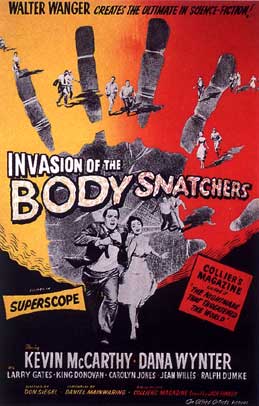
Coming Soon: Invasion of the Body Snatchers (1956)
In one of the more radical left turns to be made yet, I go from a turn-of-the-century Swedish farce about love to a McCarthy-era science fiction cult classic. Bring on the pod people!
Please be sure to pick up all empties on the way out.


.jpg)







.jpg)