Showing posts with label Bollywood. Show all posts

Saturday, September 22, 2012

Film #87: Nayakan (1987)


Director: Mani Ratnam

Initial Release Country: India

Times Previously Seen: none

Semi-Rapid-Fire Summary:

A young boy, Velu Naiker, in the Tamil region of India sees his union-leader father brutally shot by local government officials. Naiker flees to a massive slum in Bombay, where is taken in and fostered by a Muslim man who smuggles local goods and uses his profits to help those in poverty like himself.

When he becomes a young man, the clever and capable Naiker decides to help his foster father with a smuggling run. Naiker is successful, but his father is discovered and killed. Naiker takes revenge by finding the man responsible, a corrupt police official, and killing him in the middle of the slum. Naiker’s neighbors witness the act, but see him as a brave protector against the government, so they all support him rather than turn him in.

Over the next several years, Naiker continues to expand his smuggling empire, while also defending the poor in his foster neighborhood. His status grows into a man who is respected by other organized criminals, loved by his neighbors, and feared by the privileged elite. Naiker marries a former prostitute and has two children with her.

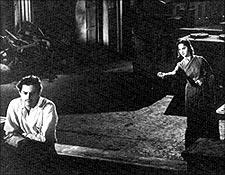
The young Naiker, complete with high-rise bouffant hairdo, ruminates in the presence of his future wife.

Nearing middle age, Naiker is stricken by tragedy when his wife is killed during an attempt on his life, as revenge by one of his criminal rivals. In retaliation, Naiker kills all of those responsible, further consolidating his power hold on the Bombay underworld.

More years pass, and Naiker’s two children are nearing their late teens. Despite his father’s desire that he have nothing to do with his criminal empire, Naiker’s son wants to involve himself in the organization. He takes it upon himself to set up an assassination of a potential witness against his father. The witness is killed, but Naiker’s son is also killed in the process. Naiker is grief-stricken, and his daughter leaves the family, so as to remove herself from the death surrounding them.

About another decade passes, and Naiker is now a patriarchal crime overlord. A new, young police commissioner launches an all-out war on Naiker, in an attempt to take him down. Unbeknownst to either Naiker or the officer, the officer’s wife is Naiker’s daughter. When Naiker is finally captured and brought to court, his daughter helps to negotiate a peace between them. Naiker actually escapes conviction, as he is far too beloved for anyone to testify against him. However, he is assassinated upon exiting the court by the deranged son of the corrupt policeman whom he had killed when he was a young man.

The aged Naiker, shortly before he is acquitted and then assassinated.

My Take on the Film:

Nayakan is billed as “India’s answer to The Godfather”, according to many summaries. If so, then it’s a rather weak answer, in my opinion.

Maybe I would have a different feeling about it if I weren’t so heavily steeped in the high-quality film making and masterful execution of The Godfather, Parts I and II. It is quite clear that, while having its own Indian influences and adaptations, Nayakan rather shamelessly takes more than a few elements from Mario Puzo and Francis Ford Coppolla’s classic movies. So many that it nearly crosses the line between “homage” and “rip-off”.

The Naiker character is a very thinly veiled Tamil version of Vito Corleone – a young man on the run from corruption who enters the criminal world out of survival, and whose intelligence, personal integrity, and character set him apart from other criminals. These kinds of stories are usually compelling, and maybe Nayakan’s would have been as well. Except for the fact that it really is Vito Corleone’s story – one that I’ve watched at least half a dozen times.

The young Velu Naiker, facing off against the corrupt cop who eventually kills his father, a la a young Vito Corleone in Sicily. This is just the first of many aspects that the movie apes from The Godfather films.

Granted, it’s not a wholesale rip-off. The tale of Velu Naiker involves social and political themes that are nowhere to be found in The Godfather story. Naiker represents a dark defender of the absolute poorest of the poor in Bombay. His refusal to buckle under the pressure of selfish and power-hungry authoritarians puts a different twist on the familiar story, and it makes him sympathetic in a way somewhat different from Vito Corleone. This is one of the few novel strengths of the picture.

Another way that Nayakan pales in comparison to The Godfather is character depth. Naiker himself is actually rather well fleshed-out, and is easily the most complex character in the movie. His wife and children also show some range. Virtually every other character, though, is at best two-dimensional. Aside from the Naiker family, nearly everyone else is either a sneering, leering, scuzzy criminal or simply not given enough time to show any depth beyond blind loyalty to their benefactor. This lack of time for development is at least partially due to another hallmark of Indian films – the music.

Ahh, the music. First of all, I am no fan of musicals, as I have chronicled in my reviews of Meet Me in Saint Louis and Singin’ in the Rain. At least in that latter film, though, the music was integrated into the movie in a logical way. Nayakan, just as literally every movie produced in India, has a handful of musical and dance numbers. A few of them fit into the story somewhat organically, and the theme song is actually really good (I might even download it on iTunes). Most of them, however, are shoe-horned into the tale in ways that are really bizarre and awkward. I’m sure that, to a viewer from Asia Minor, this does not seem in the least bit odd. For someone like me, though, it’s completely incoherent. It was a far cry from the mostly enjoyable melodies in the other Indian film I reviewed last year, Pyaasa.
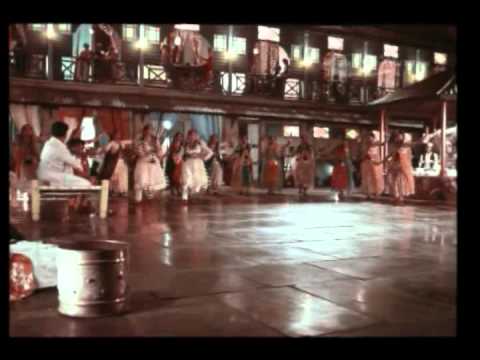
The setting of the first music and dance number of the film - the brothel where Velu meets his future wife. While there isn't a massive amount of musical numbers in the picture, most of them are oddly placed and break up the coherent tone of the film.

As far as the filming goes, there is actually a bit of merit. While this movie was made in 1987, it was clearly working on a budget of, I would guess, around $87. The visuals and sound effects have that cheap, grainy quality of the cheesiest of Kung-Fu Theater movies from the 1970s. Despite these limitations, there are actually some really well-framed and choreographed shots. Also, some of the long shots in Bombay are rather stunning, capturing the different regions of that massive, ancient city. For the most part, the cinematographers did a lot with very few resources.

A final problem I had with the movie is something that could not be controlled by the filmmakers – the subtitles. Nayakan is not an easy movie to get a hold of, and there has seemingly been no high-quality version of it produced for Western audiences. The subtitles were sometimes linguistically clunky and sometimes grammatically mangled. Also, multiple characters’ lines would pop up on the screen simultaneously, often before the second or third person would even speak. This added to the “Kung-Fu Theater Effect”. If a company like the Criterion Collection could get the rights to this movie, polish it up, and do the translation justice, it would help immensely.

Actor Kamal Hassan does a good job of bringing the necessary intensity and heart to the role of Velu Naiker. Unfortunately, it wasn't enough to overcome the elements that I didn't like about the movie.

Ultimately, I have no real idea exactly why the reviewers at TIME magazine put this movie on their “All-TIME 100 Movies” list. While there are some clear merits and strengths to it, Nayakan did not give me anything original. It recycled one of the most famous film stories, and did it with weaker visuals, far less character development, and shoddier execution. Will I ever watch it again? I think you know the answer to that question.

That’s a wrap. 87 shows down. 18 to go.

Coming Soon: The Decalogue (1989):


 This is another film “series”, consisting of ten one-hour movies by the famed director of the Red-White-Blue trilogy, Krzysztof Kieslowski. These will take me a while, but I’m going to do multiple posts on it, so stay tuned.

Please be sure to pick up all empties on the way out. 

Sunday, January 16, 2011

Film #47: Pyaasa (1957)


Title for Us English-Speaking Types:Thirst” or “The Thirsty One

Director: Guru Dutt

Initial Release Country: India

Times Previously Seen: none

Teaser Summary (No spoilers)Skilled but poor poet loses, laments, finds, loses, and finds love for women, if not humanity. Sings about it all.

Uncut Summary (The full plot synopsis, including spoilers. Fair warning.)
In 1952, India, the young poet Vijay (Guru Dutt) searches for love and work. He is clearly a very gifted poet who delivers his verses with an incredible singing voice. Yet, he is spurned everywhere he goes. While he would like to sing profound verses about lost love and the ills of society, publishers and audiences have no desire to listen.

Vijay, left, receives just one of many rejections of his poetry from a publisher.
At his family's meager home, his mother tries to offer him a charity dinner, but his two older brothers heap shame and guilt on him for not being a “working” member of the family. Vijay then discovers that one brother has sold some of his poetry as waste paper. Despite his loving mother's pleas to either stay or take her with him, Vijay departs home alone.

In a nearby market, Vijay discovers that his poetry was sold to a woman who read and was interested in the verses. Alas, the vendor does not know the woman. Later that day, by the river, Vijay hears a beautiful young woman singing words that he had penned. He follows her to her home, discovers that her name is Gulabo (Waheeda Rehman) and that she is a prostitute. Vijay is far less concerned about this than getting his poetry back, which he does.


Vijay shares a close moment with Gulabo.

Soon after, Vijay is reluctantly dragged to a college reunion by a former classmate. There, he sees his past lover, Meena (Mala Sinha), with whom he had a storybook romance until she left him, inexplicably. At the reunion, he recites some extemporaneous melancholy poetry, which falls on ears that are all deaf except for Meena's and a quiet dark-eyed figure, Mr. Ghosh. Upon leaving, Vijay is met by Ghosh, who is a publisher and offers him a job, though only as a menial worker. Vijay accepts.

At Mr. Ghosh's publishing company, it soon becomes clear that Ghosh, though realizing Vijay's dream of using his poetry to reach the public, has no interest in publishing the young man's work, calling it “trash”. Vijay overhears this, but swallows his pride and stays on the job. That evening, he goes to work at a party at Ghosh's home, where a gathering of prominent poets is taking place. Here, Vijay discovers that Ghosh's wife is none other than his lost love, Meena. He breaks out into another mournful piece of sung poetry, which captivates all of the other poets there. Afterwards, Vijay sees that Meena left him for the promise of material wealth with Ghosh. It becomes clear to Ghosh that there is something between Vijay and his wife, leading him to fire Vijay.

Through all of this, Vijay occasionally runs across the prostitute Gulabo, who has clearly fallen in love with Vijay through reading his poems. Vijay seems attracted to Gulabo's loving spirit, but is conflicted over how to behave towards her.

A few days after his firing, a broke and homeless Vijay is lost in thought on the banks of the Ganges when he sees his two brothers giving last rites to someone. Vijay discovers that it was his mother, who has died before he could make any final farewell. He retreats to the home of a vice-ridden fellow poet and promptly gets drunk. Intoxicated, he drifts through the brothel area of the city and sings a rousing verse about the social ills of his country. Yet again, however, no one is listening.

A drunken and despondent Vijay unleashes his poetry on an uncaring red light district.

Financially and spiritually at rock bottom, Vijay resigns himself to suicide. He heads towards some nearby train tracks, and even gives his jacket to an emaciated vagrant, who then quietly follows him to the train yard. Just as Vijay's about to throw himself in front of an oncoming locomotive, the vagrant gets his foot caught on a different track. Vijay goes back to pull him free, but fails. Vijay survives, but in a state of shock. In a case of mistaken identity, the country at large believes Vijay to have been killed by the train, thanks to the jacket that the vagrant had been wearing when run down.

Thinking her love to be dead, Gulabo goes to Ghosh to publish Vijay's surviving poems, not knowing Ghosh's feelings towards the young man. Instead, Gulabo finds Meena in the office, and quickly discerns that Meena was the inspiration for so many of Vijay's poems of lost love. Just as this discovery is made, Ghosh arrives. He gladly accepts Vijay's poems from Gulabo, realizing that he can reap enormous profits from the presumed-dead poet.

Ghosh's plan works all too well. Vijay's poetry is a nationwide publishing sensation, touching the dispossessed souls of the populace and raking in millions. However, a problem arises for Ghosh – Vijay awakens from his stupor in the hospital. He is initially put into a sanitarium for claiming to be the famous poet Vijay, and is kept there after Ghosh, a former colleague, and even his own brothers refuse to identify him. They realize that their gravy train will most likely only continue rolling as long as Vijay is “dead”.

Eventually, Vijay manages to escape with the help of his friend, local massage oil salesman and goofball, Abdul Sattar. It has now been a year since his “death”, and Vijay follows a throng to a memorial service in his honor. At the service, the ever-cunning Ghosh lambastes the audience for being the reason that Vijay committed suicide. Seeing the scene and infuriated by the greed, avarice, and materialism he sees at work, Vijay breaks into an impassioned verse railing against these social ills. All present are stunned, including Gulabo, who is the only one who is genuinely joyed to see that Vijay is alive.

After the public revelation that he is alive, Vijay's former detractors and enemies turn coat and try to ally themselves with him now that he is on the verge of becoming immensely wealthy by acting as the country's living voice. At what is meant to be a public recognition of his true identity, Vijay disavows his name and leaves the angry mob to tear each other apart, only further acting out the very corruption that Vijay no longer wants a part of.

That night, at her brothel, a saddened Gulabo slinks into deep feelings of loss. This changes when, much to her surprise, Vijay appears at the gate. In his eyes is a profound melancholy as he tells Gulabo that he is going to go away. When she asks to where, he simply replies that he will go until he does not need to go any farther. He asks Gulabo if she will go with him, to which she gives a wordless smile. The two walk, hand in hand, into the night.

Vijay arrives at Gulabo's brothel to announce his departure from society.

Take 1: My Gut Reaction (Done after this first viewing, before any research)

It's now been about 24 hours since I watched Pyaasa, and I can't get it out of my head. This is a good thing.

After my girlfriend and I watched the movie, we were both rather quiet as we absorbed everything that had been thrown at us during the movie's two-and-a-half hours. As you can see from the mere length of my earlier synopsis, there are plenty of pivotal plot points, which make for a epic story. Add to this the Bollywood mode of adding music, and you now have an even larger piece of work. But it was neither the storyline nor the extended soundtrack that gives Pyaasa its weight. No. It's the tone and the themes.

Anyone who has read my reviews of the musicals Meet Me In St. Louis or Singin' In The Rain knows that the genre is probably my least favorite. While Pyaasa is clearly a musical, I found that I didn't mind the songs. Unlike so many Hollywood musicals, these Indian numbers were not invasive or written merely to be independent hit songs that were shoehorned into the picture (this is something that I found Meet Me In St. Louis particularly guilty of). Rather, the songs in Pyaasa are artistic expressions of the characters' feelings, and it is these very feelings that sets the movie even further above its musical brethren.

Nearly all musicals that I've seen are optimistic in tone. Sure, there may be a sad little tune thrown in here and there, but everything is generally upbeat. The songs in Pyaasa, however, have a beautifully melancholy attitude running through them all. Whether they're about unrequited love, frustration at a diseased society, or a resigned acceptance of both, there's a genuinely Romantic power to them that is absent from most musical soundtracks. In fact, the only other “sad” musical that I have seen is Lars Von Trier's uber-downer, Dancer In the Dark, but that film brought depressing to new lows despite how skillfully it was made. Pyaasa taps deeply into the ennui but it never dragged me so far down that I couldn't see a certain amount of beauty to it.

Here's a clip of one of the great songs. There are no subtitles, but the emotions are as clear as can be. This is from the class reunion at which Vijay sees his past love, Meena. I needn't explain just how he feels about her:


On top of all of this, the music is, on the whole, fantastic. While I don't really like when the singers send their voices soaring into the wavering, higher registers, the rest of the time the vocalists displayed amazing chops. All of the songs were either catchy or touching, depending on the requirements of the scene. A few songs may have gone on a tad too long, but many were quick hitters that popped up and then got out of the way of the story. I find that I really like the Indian styles with the sitar, accordion, and percussive instruments.

Another general strength is the overall story. Granted, the notion of a gifted and tortured artist being unappreciated and scorned by society is hardly new. Still, this movie imbues Vijay with thoughts and words that tap into the more universal plight of humanity. The vehicle of the love stories is a bit hackneyed, and even the “mistaken death” plot line is a rip-off of Sullivan's Travels, but the movie is effective in making the larger points.

As far as the other technical merits, they were a somewhat strange hodgepodge. Director and star Raja Dutt apes the visual and musical scoring style that had preceded him. Cinematography-wise, one can see many similarities with earlier Hollywood masterpieces like Citizen Kane and Casablanca. He does it very well, even if he wasn't exactly breaking new ground. The score is an odd scattering of popular melodies ranging from classical European to snappy American folk. The shifts were sometimes strange, bordering on comical, but they don't greatly diminish the overall film.

The acting is another point that is a mixed bag. The primary actors, especially star and director Raja Dutt, are excellent. However, most of the other parts are overdone in the throwback melodramatic styles of previous decades. It doesn't help that much of the dialogue is rather simplistic an stagey.

Would I watch this movie again? Perhaps. I have to say that the DVD version I watched appeared to be an older edition. This made for some questionable subtitles and a rather grainy look. If a reliable company like Criterion Collection were to give it a facelift and some updated translation, I would love to see it for the more polished aesthetics.

Pyaasa was a pleasant surprise, and one of the more singular films I've watched on the list yet. I can't say that it turned me into a Bollywood fan, but it has piqued my interest and given me some ideas and images that will stay with me for years to come.

Here's a clip of perhaps the most charged song in the movie. This is near the end, when Vijay sees the mob and his enemies figuratively feasting on his presumed corpse. He can take no more, and his song slowly builds to a fever pitch by the end:


Take 2: Why Film Geeks Love This Movie (Done after some further research)

Wow. Of the 47 films that I've watched for this blog thus far, Pyaasa wins the award for having the least amount information available. I'm sure this would be different if I could speak Hindi. I can't, so there's little to add to my own subjective views above.

There are a few interesting odds and ends, though. One is the all-too familiar tale of studio meddling. Raja Dutt wanted the ending to be Vijay walking off alone. The studio, certainly fearful that such an end would alienate a larger audience, demanded that Gulabo go with him. I have to say that, unlike the other movies in which such modifications were mandated, I was alright with this one. Maybe I was simply in a more romantic mood while watching it, but I was glad that my heart could hang its hat on something after Vijay's wholesale rejection of society.

On a minor, more amusing note is that the film crew wanted to film the red light district scene (maybe the most powerful and beautiful of the entire film) on location in Calcutta. They made it there, but were run off by a pack of local pimps. Among all of the problems that film makers have faced in history, I can't say that I've heard of such a thing.

Here is that famous scene in the brothel area. This is when Vijay is overwhelmed by the state of affairs in his beloved country:


That's a wrap. 47 shows down, 58 to go.

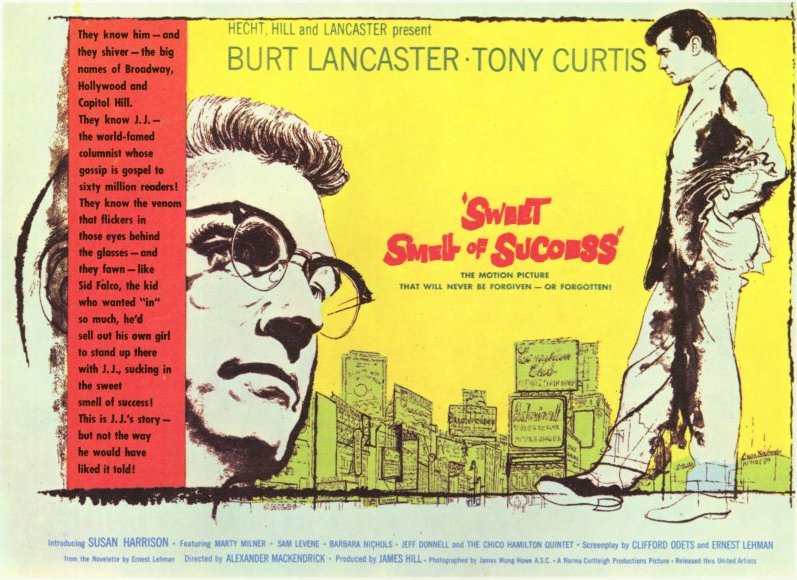
Coming Soon: The Sweet Smell of Success (1957)
Watched this one about a year ago, and thought it was decent. I've always enjoyed Burt Lancaster, and he plays a real piece of work in this one.

Please be sure to pick up all empties on the way out.