Director: Elia Kazan
Initial Release Country: United States
Times Previously Seen: once (about twelve years ago.)
Teaser Review (no spoilers)
Loopy, pretentious southern belle moves in with sister and her abusive, salt-of-the-earth, meat-head husband in New Orleans.
Uncut Summary (The full monty, spoilers included. Fair warning)
In a rough quarter of 1950s New Orleans, the young and beautiful Blanche Dubois (Vivien Leigh) steps off of a train. She finds her sister, Stella, at a nearby bowling alley with her husband, Stanley (Marlon Brando). Blanche is searching for refuge at Stella and Stanley's house since the last bit of the family estate, Belle Reeve, is now lost. Stella welcomes her sister to stay with her and her husband, though Blanche is far from forthcoming and Stella and Stanley's place is modest, to say the least: a tiny tenement shared by several other people.
At Stella and Stanley's, things become trickier. Upon hearing Blanche's tale of the sale of Belle Reeve, Stanley begins to show the man he is. The handsome and imposing but territorial man that he is realizes that anything sold to his sister-in-law is, according to Louisiana law, half his. He sees Blanche as an interloper, and perhaps even a con artist who will merely take up limited space in his apartment.
Initial Release Country: United States
Times Previously Seen: once (about twelve years ago.)
Teaser Review (no spoilers)
Loopy, pretentious southern belle moves in with sister and her abusive, salt-of-the-earth, meat-head husband in New Orleans.
Uncut Summary (The full monty, spoilers included. Fair warning)
In a rough quarter of 1950s New Orleans, the young and beautiful Blanche Dubois (Vivien Leigh) steps off of a train. She finds her sister, Stella, at a nearby bowling alley with her husband, Stanley (Marlon Brando). Blanche is searching for refuge at Stella and Stanley's house since the last bit of the family estate, Belle Reeve, is now lost. Stella welcomes her sister to stay with her and her husband, though Blanche is far from forthcoming and Stella and Stanley's place is modest, to say the least: a tiny tenement shared by several other people.
At Stella and Stanley's, things become trickier. Upon hearing Blanche's tale of the sale of Belle Reeve, Stanley begins to show the man he is. The handsome and imposing but territorial man that he is realizes that anything sold to his sister-in-law is, according to Louisiana law, half his. He sees Blanche as an interloper, and perhaps even a con artist who will merely take up limited space in his apartment.
 One of Blanche & Stanley's earliest confrontations.
Months wear on, Blanche stays, and things become gradually more tense. Stanley and Stella show themselves to have a textbook abuser/victim, co-dependent relationship. Blanche quite heavily puts on the airs of a southern sophisticate, though the job is a bit poor and neurotically desperate. The brutish Stanley grows ever more frustrated and begins to dig into Blanche's past. What he finds is that Blanche, far from being an innocent victim of encroachment, was at the heart of a scandal in her and Stella's hometown. She had an “inappropriate relationship” with a 17-year-old student and was relieved of her duties. In addition to this salacious story, Stanley also uncovers various rumors that Blanche had been a months-long resident in the nearby town of Auriol, where she “entertained” many different men until she was kicked out of her hotel.
Just before and as Stanley is uncovering these dark details of Blanche's past, his friend, Mitch (Karl Malden) falls deeply in love with Blanche, seeing her as a true southern gentlewoman. Mitch is a lonely man, getting on in years, and sees Blanche as an undreamed of chance at marital happiness with a beautiful woman. One evening, while out with Mitch, Blanche has a moment of clarity, drops her guard, and confesses to a traumatic experience from her past: As a teenage girl, she had inspired the love of a young man. However, the young man learned that he could not be with her and killed himself. This seemed to create a fracture in Blanche's mind. One that never fully healed in the subsequent years.
The psychological fissure continues to be pulled apart by the forces at play in New Orleans: Mitch's desperate desire for her hand in marriage, her sister's need to know just how she can help, and, most strongly, Stanley's scalding rage at her mere presence and demand that she move out. Everything comes to a head on the night that Stella goes into labor and is brought to the hospital. Left alone with the mentally fragile Blanche, Stanley unloads on her. He bullies her, both physically and mentally, culminating in rape, and she snaps. Stella returns to her apartment to find her sister in mental shambles.
In the end, Blanche is taken away by people from a mental institution, under the auspices of taking a cruise with a past gentleman caller. Unable to any longer tell fantasy from reality, Blanche eventually goes, uttering the well-known line, “I've always relied on the kindness of strangers.” Watching impassively all through the heart-rending affair is Stanley, all but counting the seconds down that he will get his tortured sister-in-law out of his life. Mitch is present and is disgusted with Stanley's insensitivity, but nowhere near as disgusted as Stella. She takes their baby to the upstairs neighbors, swears never to return to such a callous man, and closes the door behind her.
Take 1: My Gut Reaction (Done after this most recent viewing, before any further research)
This is a weird one for me. Great story, great acting, fantastic direction. In fact, I can only think of one thing that I didn't like. Unfortunately, that one thing will keep me from ever watching this movie or the play again. What was the one thing?
A heaveh suhhthuhhhn drawuhl, maaahh deeyuh.
You can chalk this one up to being a peccadillo of mine, since it really makes no great sense. There aren't really too many accents that get on my nerves. When you add in the fact that I was raised in Texas, you wouldn't think that a southern drawl would bother me very much. Yet, in Streetcar, Blanche DuBois's accent is (intentionally) so put on and heavy that I couldn't take it. It merely accentuates (yuk-yuk) how flimsy the veneer is that she's trying to keep up.
Here's how I know I lost my rationality watching this film: I was actually pulling for Stanley for the better part of the movie. I did come around at the end, and see him for the detestable gorilla that he is; however, for most of the film, I wanted him to burn down the paper palace that Blanche had tried to construct around herself. I'm not exactly sure if this development was Tennessee Williams' intent, but I was so agitated by Blanche's airs that I wanted them utterly annihilated, even if it was done to satiate a modern day Thug like Kowalski.
Here's the famous "Stella" scene, which all by itself conveys the nature of the abusive relationship and primal, animalistic lust that Stanley inspires:
I can only liken this bizarre accent hatred of mine to the way that we all dislike certain foods – you can't fully explain why you don't like it – you just don't like it. I suppose its a testament to the tale that I was pulled back from the brink of seeing Stanley as some kind of blue collar hero, and actually seeing him for the lout that he is. In this spirit, let me move past my displeasure at Blanche DuBois's over-the-top Louisiana lilt and take a look at the many strengths of the film.
The story, while crushingly depressing, is brilliant. Blanche is an immediate enigma who we are interested in learning more about, just as Stanley is. Hers is one of the finest examples of character development through slow reveal that I've ever seen. I went from seeing her as merely arrogant to hopelessly selfish to pathetically abused, and finally to sadly wasted. While she does make this transition within the tale itself, the gradual revelations about her past offer different facets and causes for her twisted attempts at gaining attention. When I realized that she has, essentially, been used up and crushed by an unknowable number of people in her past, I saw her as far more sympathetic.
Stanley is, of course, the force of nature that makes things move in this story. His relationship with Stella seemed to lay bare all of the details of abusive relationships that now seem shamefully cliched: verbal bullying and physical abuse followed by the woman leaving him, only to return when he feels remorse. The remorse is certainly authentic, but born of a sad realization that he has harmed the one person who seems to understand and love him. Things calm down for a while, and then the cycle begins again. In the middle of such a dysfunctional relationship, a mentally ill person like Blanche doesn't stand a chance.
The performances are, truly, extraordinary. While his mumbling, guttural linguistic style was starting to settle in for this role, Marlon Brando is frighteningly believable as the barbaric Stanley Kowalski. As in roles like The Wild One and On the Waterfront, he was a slick-looking head-turner. This makes it all the more powerful when you see him turn into a reprehensible animal.
Vivien Leigh is the other obvious standout. As hard as I found it to sit through the interminable front that she puts up as Blanche, her performance is of undeniably brilliant quality. In a sense, she's almost like the dark, battered version of her role as Scarlett O'Hara in Gone With the Wind (a film that I really can't stomach). The nuances of shifting from manipulative to pathetic are so skilled that the uniquely sad character of Blanche is wholly plausible. When I look at it objectively, I can't deny how incredible Leigh truly was.
The semi-sleeper is Karl Malden, who does a great job as Mitch, the kindly, if somewhat dim, man who falls for the broken Blanche. Even if I didn't really identify with him, I had to come down on his side as being deeply saddened by Blanche's ultimate fate and fully sickened by the actions of his once-pal Stanley.
A Streetcar Named Desire is, without a doubt, a great story, and one which Elia Kazan did a masterful job of adapting to the screen. I almost regret not being able to get past that one trivial aural bugaboo of mine so that I would be able to watch and appreciate its merits again. Alas, I can't.
Take 2: Why Film Geeks Love This Movie (Done after further research)
Not much that's terribly surprising about this film in the articles and reviews, though the adaptation process contains some familiar plot-lines.
Tennessee Williams' original play apparently was even more brutal, dark, and vague in terms of the character representations. In the film, it's rather clear that Stanley in meant to be seen as more of a villain, and Blanche more sympathetic, even if neither one of these characterizations is black or white. This is more pronounced by the “punishment” of Stanley in the film version, by way of Stella leaving him at the end. The play is far less clear-cut, with Stella actually seeking comfort in her brutish husband's arms.
According to articles, including the original TIME magazine article, Streetcar was one of the earliest movies to truly deal with “adult” themes. Or at least, deal with them as much as it could within the confines of the Production Code, which was still in evidence, even if its grip was beginning to loosen.
Within the original TIME review, it was interesting to see that the reviewer was not really impressed with Vivien Leigh's performance, thinking that she was outdone by the surrounding cast. I can't say that I agree, as I think that Leigh was excellent. Just couldn't get past that da-yuhmn ayk-se-yunt.
That's a wrap. 35 down. 70 to go.
Coming Soon (I hope): Umberto D. (1952)
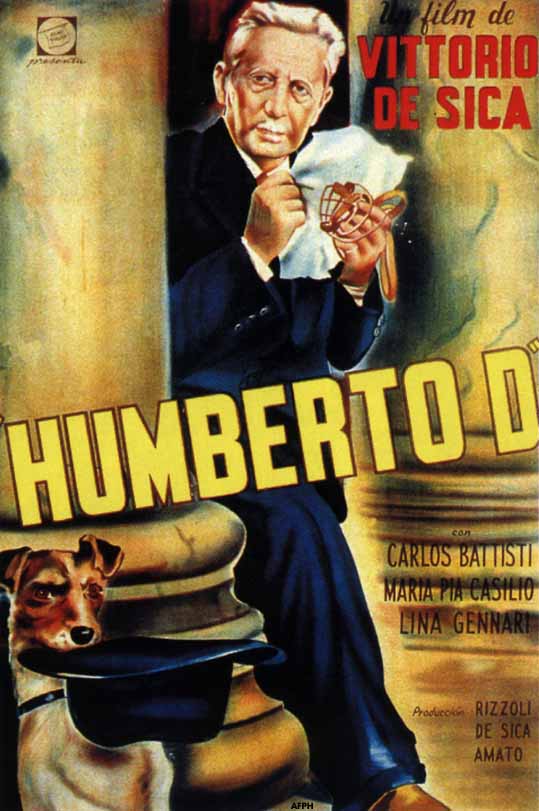
The list finally turns back to some foreign-language entries, though this is one I know nothing about. We shall see how it goes.
Please be sure to pick up all empties on the way out.