Showing posts with label screwball comedies. Show all posts

Saturday, January 29, 2011

Film # 49: Some Like It Hot (1959)


Director: Billy Wilder

Initial Release Country: United States

Times Previously Seen: once (about 9 years ago)

Teaser Summary (no spoilers)

Pair of jazz musicians dress in drag and travel with all-girl band to flee gangsters. Shenanigans abound.

Uncut Summary (Full plot synopsis, spoilers included. Fair warning.)

Chicago, 1929. Joe (Tony Curtis) and Jerry (Jack Lemmon) are a couple of jazz musicians who play in a hot speakeasy run by notorious gangster “Spats” Colombo. That night is payday, and the two are working out how to pay back all of their many debts. Just as they bask in the appreciation of simply having a steady job, the police raid the club off of a tip from a local rat, “Toothpick” Charlie. Joe and Jerry see it coming and get out, but the police manage to shut down the place.

The next day, Joe convinces Jerry to put all of their money on a horse. The horse loses, and gone is the fellows' remaining cash, leaving them broke and jobless. They head to a talent agency, to no avail, finding only the tantalizing job for a bass fiddle and sax, their instruments, but for an all-girls group heading to Florida. Instead, they take a small gig on the far side of town. Joe even connives his way to borrowing a secretary's car to get there.

Early that same evening, the boys stroll into the garage to pick up their loaner car. While waiting for the tank to be filled, though, a pack of mafiosos storms in, led by Spats Colombo himself. They have Toothpick Charlie cornered there and gun him down, along with a half dozen other unlucky saps. Joe and Jerry witness it all and are about to join the recently deceased, but they luck out and escape the garage.

On the run, they decide to pose as women and join the all-girls band that they had heard about earlier that day. They adopt the names Josephine and Daphne, don some wigs and dresses, grab their instruments, and show up at the train station. On the train, they meet all of the other girls in the band, including the sultry Sugar Kane (Marilyn Monroe), the group's bombshell singer and ukulele player. Joe and Jerry have to fight their male urges amongst the scantily-clad women, especially the voluptuous, naive and vulnerable Sugar.

"Josephine" and "Daphne" sashay their way down the platform.

Once in Florida, Joe and Jerry seem to be in the clear, but only to an extent. While Jerry is eager to ditch the masquerade, Joe reminds him that Spats is likely looking in every jazz club in the country for them. They decide to remain Josephine and Daphne for a while longer, though it's starting to pose its own unique problems: Jerry has already had to fend off a grabby, though very wealthy suitor – the playfully lecherous Osgood Fielding III.

This also gives Joe the chance to weasel his way into Sugar's arms. He uses what he knows of her search for a rich man “with glasses” and takes on his second persona: the heir of the Shell Oil Corporation. Under this guise, he finds Sugar on the beach and she falls for it, hook, line and sinker. The two part ways, but Sugar is clearly starstruck.

Back at the hotel, Jerry receives a call from Osgood, who invites “Daphne” to an intimate evening on his yacht. Joe convinces Jerry to let him use Osgood's yacht to woo Sugar under his “Shell Oil” millionaire persona. Jerry reluctantly agrees to this as well as keeping Osgood busy on shore for the evening.

That evening, Joe's devious plan works to perfection. Jerry keeps Osgood occupied with an evening of romantic dancing while Joe works a cunning game of reverse psychology on Sugar. After ferrying her out to Osgood's yacht and pawning it off as his own, he weaves a tall tale about the freak death of a past love and how he is no longer able to feel love for any woman. Sugar, taking up the challenge to re-ignite his passions, kisses Joe repeatedly and clearly falls in love with his fictitious persona.

Sugar and "Shell Oil Junior" get further acquainted.

Back at the hotel in the morning, Joe returns from his evening of deception and snuggling with Sugar to find his pal Jerry in a bizarre daze. After a marathon evening of lively dancing, Osgood has proposed to him, and Jerry seems to actually be considering marrying the goofy old sod and extorting alimony checks from him after the inevitable annulment. Joe manages to snap Jerry out of this odd and felonious notion.

At the same time downstairs at the same hotel, one Spats Colombo has arrived for a meeting of mafia dons, all under the heading of a gathering of “Italian Opera” aficionados and presided over by head boss Little Bonaparte. Bonaparte has a serious bone to pick with Spats, as Toothpick Charlie had been a friend of his.

In the lobby, Joe and Jerry stumble across Spats, fortunately in disguise, but think that they've been discovered. They immediately hustle back to their rooms and pack for a hasty getaway. However, while clambering down the banister outside their room, they are spotted by Spats and his crew. A chase ensues, but the boys manage to elude capture by ducking under a banquet table. Unfortunately, the banquet is for the “Italian Opera” mobsters, including Spats. The banquet turns into a bloodbath as Bonaparte has Spats and his crew brutally gunned down. Joe and Jerry a discovered by Bonaparte, but the police arrive, allowing Joe and Jerry to slip away once again.

In the lobby, Joe and Jerry hide and overhear some of Bonaparte's goons explaining that they have all of the roads and public transportation routes out of town covered, in order to intercept Joe and Jerry. They realize that they can take Osgood's yacht to escape, and Jerry channels “Daphne” to make Osgood amenable. Osgood agrees, and the only order of business is for Joe to break away from Sugar without breaking her heart. He decides to once again use Osgood by sending Sugar some flowers and a diamond bracelet that Osgood had intended for “Daphne”. This initially crushes Sugar, but she decides to pursue her Shell Oil man as he flees to the shore with Joe and Osgood. She joins them on the boat just as they depart for Osgood's yacht. Joe finally comes clean to Sugar, dropping all masks, but she hardly bats an eye and accepts Joe, wholeheartedly.

Jerry, still dressed as Daphne and riding next to an elated Osgood, tries to let him down easily. Osgood is not so easily rebuffed, forcing Jerry to finally remove his wig and confess that he is, actually, a man. The euphoric Osgood misses not a beat and delivers the most timeless line of the film, saying, “Nobody's perfect.”

The love-struck Osgood and his muse, "Daphne"

Take 1: My Gut Reaction (Done after this most recent viewing, before any research)

Eh. Inconsistently entertaining.

Some Like It Hot has some really funny moments peppered into an underwhelming barrage of flat gags. The movie is clearly meant as a silly, screwball affair. From my reviews of earlier classic screwball comedies such as The Awful Truth, His Girl Friday and The Lady Eve, it should be clear that the genre is probably my second least favorite, with musicals taking the top spot. Some Like It Hot, however, eliminates the elements that I always despised, namely the focus on the rich and sophisticated class. By having the two main boobs (not counting Marilyn Monroe's) be average Joes (Josephines?), the condescension found in most screwballs is blessedly absent. Joe and Jerry are semi-lovable, if deceitful, morons who stumble their way through the movie. Unlike the typical “Cary Grant” protagonists of earlier screwballs, I found them far more amusing than annoying.

The humor is so intentionally silly that you can't help but laugh at times. This is mostly due to some great script work and top-notch comedic acting. While I couldn't care less for the endless gender humor (e.g. the fellas tripping in high heels, Jack Lemmon adjusting his fake breasts, et al), the interactions between Tony Curtis and Marilyn Monroe are priceless. Once Curtis adopts his “Shell Oil” persona, complete with a dead-on Cary Grant affectation, there are plenty of great moments between him and the laughably gullible Sugar Kane.

Here's some of the primo stuff, when Curtis and Monroe are hitting on all cylinders as "Shell Oil Junior" is trying to cunningly lure the dim-witted Sugar Kane into amore:


A personal side-note and observation: watching Marilyn Monroe in this movie is an interesting exercise, as a modern viewer. She was excellent at playing what amounts to a bimbo who is, in her own character's word, “not too bright.” More interesting to me, though, are the more subtle moments when she would be recounting past failures in love at the hands of abusive men. There are moments when, between sips of bootleg hooch, her eyes would narrow and her pain seemed eerily genuine. Knowing how Monroe's life played out and ended, I wondered just how much “acting” she was doing at these moments.

As funny as some of those moments are, there are plenty of duds to me. Nearly all of the supposedly funny moments with Spats Colombo and his gorillas were anything but. I got the sense that they almost didn't go far enough with the parody. All of the characters in the movie are meant to be cartoonish, but this concept was not fully realized with the gangsters, especially with their dialogue. Instead of being slyly ridiculous, their lines were merely hackneyed. Had some of the other characters' dialogue not been so sharp and clever, I might not have noticed, but compared to Curtis, Monroe, and Lemmon's lines, the writing for the gangsters seems a bit lazy.

One thing that distracted me a bit was the utter shallowness of the characterization, typified most by a lack of consistency. During the first portion of the film, Joe seems to be the slick-talking shyster and Jerry the level-headed, uptight straight man. Without warning, though, Jerry becomes the libidinous and irresponsible clown of the pair. Then, the voice of reason shifts back to Jerry's lips for the last part of the story. I know better than to ask for much character depth from such a goofy comedy, but a little bit of consistency would have been nice.

The plot is hardly worth mentioning. It was clearly just a device for setting up scenarios that, for mainstream Hollywood of the time, were probably rather risque. Having a bunch of nubile women scamper around in their underwear and bathing suits was probably titillating enough; the added element of Curtis and Lemmon's overtly lusty observations and comments almost certainly blazed new trails for popular sexual comedy. It goes without saying that having Marilyn Monroe's undulating curves and generously displayed cleavage, highlighted through Billy Wilder's direction, clearly sent the sex-o-meter into the red. Alas, in this day and age of Farrelly brothers and Judd Apatow flicks, such old-school fare is a relative lightweight.

Some Like It Hot is yet another movie which, if you know a little about cinema history, poses no mystery as to its lasting place in the annals of film. Still, it's another “classic” that I feel has faded to degrees in recent decades.

Take 2: Why Film Geeks Love This Movie (Done after some further research)

Some Like It Hot seems impervious to wear, as far as critics are concerned. Even now, it is ranked by the American Film Institute as the 22nd greatest American movie of all time, and THE best American comedy of all time. (I respectfully disagree.)

There are no real surprises as to what critics have loved about the movie, which are the same things that I found enjoyable: the sharp, farcical scenarios and dialogue and the timeless sensuality of Marilyn Monroe. Something that does surprise me is how many critics, including this original reviewer back in 1959, cite Jack Lemmon as turning in the strongest performance, for which he was even nominated for several awards. Lemmon was excellent, no doubt, but Tony Curtis provided me with far more laughs.

As he often does, Roger Ebert points out an interesting aspect – Monroe's ability to be such a sex-pot while remaining so genuinely innocent. He recounts the well-known (among hard-core film buffs, anyway) tales of the troubles with Monroe, including her trouble with the lines and the domineering presence of then-husband Arthur Miller. There's also the curious tale of Tony Curtis saying that kissing Marilyn Monroe was “like kissing Hitler.” Check out his review here.

Speaking of Monroe, something was confirmed for me that I made no mention of above – that she did, in fact, perform all of her own singing. I have to agree with the reviews that I read that state that she did outstanding work with them. She may not have been any kind of world-class vocalist, but she was certainly skilled enough to “sell” the lyrics, as Ebert put it. As a person who nearly always dislikes musical numbers in movies, I had absolutely no problems with any of them in Some Like It Hot.

Here's my favorite number from the movie:


Another point of note is that, due to its blatant sexuality, Some Like It Hot is credited as being one of several contemporaneous films that began to break down the Hays Production Code, the ratings code that had been in place for over two decades. In fact, it received a rating of “Condemned” by the “National Legion of Decency” back in '59. I have to think that that piqued the public's curiosity to no end. Fortunately, such Protestant ideals of art and censorship would be mostly shattered in another five or six years' time.

Considering that it's hailed as arguably the greatest closing line of all time, I have no choice but to finish up with this:


That's a wrap. 49 shows down, 56 to go.

Coming Soon: The World of Apu (1959):

The final installment of the Apu Trilogy. The second was an understated delight, and I'm intrigued to see how Satyajit Ray completed his tale of the thoroughly human Bengali boy.

Please be sure to pick up all empties on the way out.

Monday, April 12, 2010

Film #22: The Lady Eve (1941)


Director: Preston Sturges

Initial Release Country: United States

Times Previously Seen: once (about a year ago)

20-Words-or-Fewer Plot Summary (no spoilers):

Wealthy ale heir is conned by lovely young grifter, who falls in love with him.

The Full Story (a complete summary, spoilers and all. Fair warning):

Charles Pike (Henry Fonda) a young ophiologist (that's snake scientist to we lay people) and heir to the vast fortunes of the Pike Ale company boards a cruise ship returning to the U.S. after a year-long research expedition in the Amazon. He is spotted and marked by Jean Harrington (Barbra Stanwyck) and her father, a pair of slick con artists. The savvy Jean uses her cunning and wiles to seduce Pike with the intention of suckering him out of some serious dough. In the process, however, she falls in love with him. She promises her father and herself to give up grifting and marry Charles, but before she can do so, Pike discovers their identities, dumps Jean and crushes her earnest desire to be with him.

The slick Harringtons on the left, with the mark, Pike, on the right.

Some months later, Jean, still seething from the rejection, sees a chance to get even with Pike. She poses as a young English aristocrat, Lady Eve Sidwich, and turns up at the Pike family mansion, once again conning Pike into believing that she's a different, though still infinitely charming, woman. Pike falls for her again and marries her. On the wedding night, just before the consummation, Jean tortures Pike with fictional tales of a wildly loose past with countless men. This time, it's Charles' turn to be crushed. He stops the train, mid-trip, and jumps off, swearing to never see his bride again.

Only after achieving her harsh revenge does Jean realize that she still loves Charles, and she seeks to make amends, still under the auspices of her assumed identity as Lady Eve. She is severely rebuffed by a still-disconsolate Charles, who then leaves for a new research journey into the jungles. On the ship, however, Jean tracks him down again, this time as herself. Charles sees her and, without realizing her past ruse as Lady Eve, instantly falls in love with her again. All is apparently forgiven and they fall into each other's arms.

Eve has truly captured her Adam, the one for whom she was made.

Take 1: My Gut Reaction (done after 1 viewing, before any research):

When I first watched this film a year ago, my lingering impression was of a decent, though not great, film. Upon this second viewing, I was conflicted for the first half. For 45 minutes, the film is so damn good that I almost wondered why I came away with such a lukewarm impression the first time. The characters are fantastic, Fonda and Stanwyck are absolutely perfect in their roles, the intrigue of the con game is totally engaging, and the script is razor sharp. Stanwyck renews my opinion that she may have been the sexiest woman in American film, which is only augmented by Fonda's stern, semi-naive portrayal of the bookish Pike. Everything that unfolds in the first episode of the film is flawless.

In this scene, Stanwyck does nothing more than run her fingers through Fonda's hair and whisper to him. She was so sensual, though, that this is one of the most alluring scenes I've ever seen in film.

Then, the second half.

After Pike leaves Jean emotionally high and dry, things got really tedious really quickly, and I can sum up every problem with one hyphenated word: Screw-fucking-ball.

Once the action goes to the Pike mansion, it all got to be way too much like the corniest bits of The Awful Truth, The Philadelphia Story, and their ilk. Virtually gone is the sophisticated plot and thoughtful dialogue, only to be replaced by a torrent of sophomoric sight gags. Within about 15 minutes, you get to watch the high-brow (read that with oozing sarcasm, please) jokes of: a couch tripped over by Pike, curtains ripped down by Pike, a roast beef platter spilled on Pike, coffee spilled on Pike, Pike fall over in a train, and Pike slip in the mud. If it had been a Three Stooges film, I would have been into it. Based on the first half of The Lady Eve, though, I felt like I had been demoted from a trigonometry to a finger painting class.

On top of that, the ending is a touch implausible. After Pike has dumped "Lady Eve" and sees Jean on the second cruise ship, his instantly re-kindled love is a bit confounding. He had initially dumped her as a deceptive gold-digger, and there's really nothing that's changed from this standpoint. Yet he gives himself right back to her, giving us all a happy ending that seems almost slapped together.

While the latter half left me unsatisfied, I still have to say that the first half is so strong that I'm willing to forgive the lamer follow-up. In fact, I was even able to deal with the weaker portions due to the performances of Fonda and Stanwyck. I cannot express enough how much I like Barbra Stanwyck. Before starting this blog, I only knew her from Double Indemnity (soon to be reviewed as film #25), and grew to appreciate her far more in Baby Face (film #9). I'm willing to admit that there were probably more stunningly beautiful actresses of the day, but I'm yet to see one who had the natural wits, power, and smoky sensuality that she portrayed with seeming effortlessness.

Check out this symbolic still of when she's seducing Pike under the guide of "The Lady Eve", especially how close her mouth is to Pike's:
Along with this, Stanwyck constantly draws attention to her mouth, whether it be with her words or movements. There's a scene on the ship deck in which she uses a rose to gently and playfully caress her own lips. It's entracing.

Fonda is a slightly different story. I've seen a handful of his better-known movies and I think he's great, though limited. Whether he was playing the quiet hero Tom Joad in The Grapes of Wrath or the cold-blooded murderer Frank in Once Upon a Time in the West, he had the strength one would ascribe to a gnarled oak tree. It's rigid and tough as hell, but in the end it's wooden. His character in The Lady Eve doesn't dispel this image that I have of him, but it's perfectly acceptable for the character. Charles Pike is meant to be a stiff bookworm who's uncomfortable around women, and Fonda was the perfect man to play him. The juxtaposition of Pike and Harrington was amazingly effective.

This is a film that, for me, represents a movie-watching experience that all movie-watchers experience at some point - the disappointment of a great extended first act followed by inferior second and third acts. I'd gladly re-watch the first half , but couldn't make any promises about sitting through the rest.

Take 2: Why Film Geeks Love This Movie (done after some further research):

No fantastic shocks in doing the research. Of note is that the original TIME magazine review, obviously impressed, indicates that neither critics nor fans were yet tired of the slapstick gags littering screwball films. I guess I just have to suppose that, had I been born in 1920, I would be far less bored by these elements.

One thing that I'm almost ashamed to have overlooked was the figurative nature of all of the physical humor. All of the the spills that Fonda takes throughout the story are meant to represent the mythical "fall" of Adam. This may add a certain amount of depth to the fumbling, but it doesn't make it any less tiresome to me.

Also of note is that director Preston Sturgess is a major footnote in film history. Most casual fans of classic films know at least a few old directors: D.W. Griffith, John Ford, and so on. Sturgess, though, is far less known, in the grand scheme. This apparently is because he was something of a comet - he banged out 9 extremely successful films within four years, most notably The Lady Eve and Sullivan's Travels. Nearly all of these screwball tales were darlings of moviegoers and critics alike, a feat that not many directors accomplish. I can only assume that his relative lack of enduring fame is due to the screwball genre having faded so much once films evolved in certain ways.

That's a wrap. 22 shows down. 83 to go.

Coming Soon: Citizen Kane (1941):


This is it! The one that many argue is the greatest American film of all time, and the film that kicks off what may very well be the best 1-2-3 sequence of the list: Citizen Kane, Casablanca, and Double Indemnity. Damn. On top of this, I absolutely love this movie and am greatly looking forward to watching it again, with my critic's hat on. Y'all come back now, y'hear?

Please be sure to pick up all empties on the way out.

Monday, March 29, 2010

Film #19: His Girl Friday (1940)


Director: Howard Hawks

Release Country: United States

Times Previously Seen: Once (about 5 years ago)

20-Words-or-Fewer Summary (no spoilers)

Machine gun-tongued divorcees & journalists reconnect through hot news story.

The Story (A full blow-by-blow, including spoilers. Fair warning):

Hildegard "Hildy" Johnson (Rosalind Russell), former star journalist, returns to her former newspaper, which is headed by her ex-husband, Walter Burns (Cary Grant). She has come to announce her retirement and fresh engagement to simple nice guy Bruce Baldwin (Ralph Bellamy). Hildy intends to move to Albany with Bruce, an insurance salesman, and become a full-time house wife. Walter, the fast-talking, take-no-prisoners editor of the city's largest paper, is taken aback and immediately pleads with Hildy to stay on the staff and even remarry him. She steadfastly refuses, instead proclaiming her desire to leave behind the high stress life of a beat reporter.

A major story interrupts everyone's plans. A skittish murderer is on death row and is the focal point of some serious local electioneering. Burns sees this as the chance to keep Hildy around, show her that her place is in journalism and as his wife. He uses every chance he can to embarrass Baldwin and guide Hildy towards the story. Eventually, Walter's machinations stoke Hildy's natural journalistic curiosity and she's on the case.


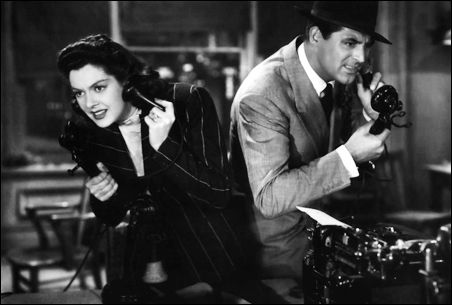
On the left, Walter Burns, master of the shit-eating grin.
Through a dizzying array of arrests, interviews, and lightning-quick dialogue exchanges, Hildy works out all of the kinks: the dead man walking is reprieved as insane, the corrupt local sheriff and mayor are revealed as frauds, and Hildy leaves Bruce to go back to her life with Walter.

Just like that.

Take 1: My Gut Reaction (done after one viewing & before any research):

If Cary Grant were alive, I would cold-cock him.

OK, maybe that's an exaggeration, but there were certainly plenty of moments in this film that I really felt this way. Not unlike his portrayal of Jerry Warriner in The Awful Truth, Grant's Walter Burns is so conniving and self-assured that one can't help but want to deck him. At least in His Girl Friday, he's not posing as a stand-up husband. He's pretty open about how he'll do damn near anything to get a story, including employing known felons as assistants and getting total innocents locked up to suit his professional and romantic aims. Had there not been a long period in the middle of the film when we don't see him, I may have been far more annoyed.

Like The Awful Truth, though, it wasn't necessarily Cary Grant that bugged me - it was the character. Walter Burns was written to be an amusing rogue, I suppose. I just found him bordering on contemptible.

One of the many rapid-fire dialogue scenes. It gets rather dizzying at times, and to me becomes a bit more style over substance/

Actually, a few decent laughs in there, but my fists were clenching during this stuff. For a more modern analogy, see explanation and video below.

Since His Girl Friday is by THE screwball comedy director, Howard Hawks, one shouldn't be surprised that it bears an almost hackish similarity to The Awful Truth, which is two years its senior. The romantic part of the story is almost a carbon copy of the earlier film, and the boobish fiance is even played by the same man, Ralph Bellamy. What made this one marginally more tolerable to me was that it wasn't solely about the privileged class. There are far more earthy characters in this film, which made it somewhat more engaging to me.

The crime story, while really just serving as a foil for the love story and verbal exchanges, is intriguing enough to keep things alive. While The Awful Truth had nothing more than the egocentric relationship of the Warriners, His Girl Friday has the inkling of a crime drama running through it. It's not a vast improvement, but an improvement nonetheless, in my view.

The dialogue. Good Lord. This is THE quintessential screwball film in terms of the ear-boggling dialogue that's like a ping-pong game played by two people on PCP. In one sense, it's fascinating since it's the first film I've seen from the list in which things are going so quickly that characters are talking over one another, and there's no way that a viewer can catch everything. The script is very sharp, but I felt like I was watching the film equivalent of an Yngwie Malmsteen guitar solo. Yeah, it's amazingly fast and takes immense skill and technique, yet it's often not very enjoyable, aesthetically.

Like a Malmsteen guitar solo, His Girl Friday is lightning quick, highly skilled, and often not very easy on the ears.

Big-haired, Swedish speed metal aside, I do need to mention the single biggest upgrade in this film from The Awful Truth - Rosalind Russell. She is so much more enjoyable than Irene Dunne that I can hardly describe it. Again, I believe that it came down to the character and the script to a great degree, but Russell exudes much more of an everywoman vibe that Dunne probably couldn't have done had you threatened to take away her diamonds and chiffon scarves.

This film, as much as it had in common with the spirit of The Awful Truth, was different in ways that made me further think about the screwball genre. While there is a slightly more universal appeal to it, there is still an almost mean-spirited ignorance about it. As a mentally imbalanced man's life hangs in the balance (pun intended - he's on his way to the gallows) and even escapes only to have the incompetent cops gun down a bunch of innocent civilians, Walter Burns still has plenty of time to make gags about it all. I'm not sure how I'm supposed to admire, pull for, or even laugh at the jokes of such a self-serving vulture, no matter how suave he may be. This would almost work if the film were meant as a full-on satire or farce, but it isn't. There are too many little moments of legitimate drama in relation to the condemned man for me to ignore, including his emotional girlfriend throwing herself out of a window in a suicide attempt. In my view, it's more upsetting than it is entertaining.

So there it is. Watching His Girl Friday was hardly the struggle that The Awful Truth was, but it's certainly not a film that I'll watch again. Like the latter film, though, lovers of old cinema and Cary Grant will certainly like it. I just couldn't ignore the little things that kept it from being either pure comedy or pure drama.

Take 2; or, Why Film Geeks Love This Movie (done after some further research):

After perusing a few original and modern reviews, it's clear that the dialogue is the pumping heart that keeps this movie alive in the annals of film history. The overlapping dialogue was apparently a major innovation back in '39, and the speed of the exchanges baffled and delighted people from the get-go. Here's the original TIME review upon the film's release.

I felt a little less hyper-critical when I saw Richard Schickel's 2005 review. I especially noted his almost throw-away use of the adjective "heartless" when describing the "hilarity". I guess he found it charming; I found it a tad off-putting.

A few interesting notes. Rosalind Russell was way down the line when it came to casting. Turning down the role were well-established actresses such as Katherine Hepburn (thank God), Irene Dunne (thank Allah), Claudette Colbert, and Ginger Rogers, among others. Russell was non-plussed about it, and secretly hired her own script writer to punch up her lines, which she felt were not as sharp or witty as Cary Grant's, so that she could insert them as "ad libs". Grant caught on and would greet her every morning with "What have you got today?" Man, that guy was either the smoothest cat on the planet or a 5-star asshole.

On final note is that in the original source play, Front Page, Rosalind Russell's character was a man. I suppose Hollywood wasn't yet ready to have a star-studded movie without a love story.

That's a wrap. 19 shows down. 86 to go.

Coming Soon: The Shop Around the Corner (1940):


This is the same director as Ninotchka, which wasn't a bad film, but not my favortie thus far on this little cinematic journey. And yes, by "James Stewart," the poster means "Jimmy Stewart." We'll see just how Mr. All-American does in this one.

Please be sure to pick up all empties on the way out.

Monday, March 8, 2010

Film #15: The Awful Truth (1937)


Director: Leo McCarey

Release Country: United States

Times Previously Seen: none

The Story (in which I painstakingly lay out the plot; spoilers and all. Fair warning):

Jerry Warriner returns from a supposed trip to Florida to find his wife, Lucy, not at home. When she returns with her dashing music instructor, she explains that they were delayed overnight due to a car breakdown and had to stay the night in an inn. Jerry becomes suspicious and begins to level his accusations. During the snide grilling, Lucy discovers that Jerry may not have actually been in Florida. She becomes suspicious. Things get heated and the two end up filing for divorce.
The divorce proceedings come off, and the couple have only to wait out a 90-day period before it is official. During this period, Lucy starts to get friendly with her new neighbor, Dan Leeson, a kindly, if simple, rancher from Oklahoma. Jerry, under the guise of apathy, openly sabotages the blooming romance by continually highlighting the vast differences between Lucy and Dan. The marriage is off.

With Lucy and Dan's relationship over, Jerry Warriner begins to see a different lady of his own high society sect. When Lucy discovers this, she goes for a little tete-a-tete and decides to torpedo Jerry's engagement in the same way he did hers. Her method is to pose as his drunken sister at a social event and insinuate that Jerry is equally incorrigible. That marriage is off.

After this second detonation of a budding marriage and some automobile trouble, Jerry and Lucy end up stuck in their old cabin in the woods. The two mull things over, and realize that they still do love each other. Just before the 90-day deadline on their divorce, they admit their love for one another and all is peachy keen once again.

Take 1: My Gut Reaction (done after 1 viewing & before any research on the film):

UUUUUUUUUUUGGGGGGGGGGHHHHHhhhhhhhhhhhhhhh... Man, do I HATE screwball comedies, and this movie is screwball to the absolute core. Thing is, there are virtually no technical flaws to be found in this movie, in my view. Directing? Great. Acting? Phenomenal. Set design? Costumes? Flawless. Dialogue? Sharp as can be. Characters? Ah-HA!!! And this is where I go off.

There is nothing specific to The Awful Truth that I dislike. My problem is with almost the entire genre of "screwball" films. And I've really, really tried. I have. Over the last decade or so, I've watched about a half dozen "classic" screwball films. In pondering them, I think I can pinpoint what separates the ones that I'm OK with versus the ones that make me feel like I wasted 90 minutes of my life. Here goes...

I like It Happened One Night and My Man Godfrey. I hate Bringing Up Baby, The Awful Truth, His Girl Friday, and The Philadelphia Story. What separates them? Well, one thing is that Bringing Up Baby and The Philadelphia Story star Katherine Hepburn, who I can't stand in any role (I'll delve into this in a future post, no doubt). On top of that, though, the latter listed films seem to lack any characters who I can relate to and sympathize with. It Happened One Night had an earthy wit to it, and My Man Godfrey had William Powell, who was the absolute man. Not to mention that these two films were grounded at least a little more in everyday problems. The rest are all about high society types looking for love, cracking wise, and having "madcap hijinks" all along the way.

Here's where The Awful Truth is at its screwiest:


It's a yuk-fest, alright. I'd rather watch my cat bathe himself.

What it comes down to is that I simply didn't care one bit. The two main characters, Lucy and Jerry, are filthy rich and totally self-absorbed. Sure, they're good-looking, clever and playful, but what's the point of the film? I think I understand the appeal - it's the same reason people watch reality shows like The Celebrity Apprentice, Celebrity Rehab, or Celebrity (name of reality show here) - people are fascinated with the rich and wealthy. People are even more fascinated when the rich and wealthy make asses of themselves. I'm not one who's drawn by such things, so perhaps this contributes to my apathy for these films.

I think that this is perfectly illustrated in The Awful Truth by the way that the character Dan Lesson is portrayed. He's an Oklahoma rancher who's obviously a well-meaning, kind person, but one who lacks the cosmopolitan sophistication of Jerry and Lucy. Well, the movie makes Dan out to be an utter buffoon fit for nothing more than Jerry to cunningly embarrass and condescend to. I just wanted to pat Dan on the back and tell him, "Look, ol' hoss, you don't want nothing to do with these backwards Yankees. Get on back to ranch, do what you do best, and leave these well-dressed a-holes to themselves."

So you don't think I'm trying to destroy this film, let me reiterate that the film does what it intends to with incredible skill. In fact, the only reason it was tolerable at all to me were the strong performances of Cary Grant and Irene Dunne, though Dunne's New England affectations annoyed me a bit. Those two knew how to balance the ridiculous with the calculated very well, though the ridiculosity (it's a word now) gets to be a bit much.

The awful truth is that I can't say that this is a bad movie at all - it would be insulting to the highly skilled people who created it. But I have to give a qualified recommendation only to people who liked the films that I mentioned before in the "I hate these screwball movies" roll call. Otherwise, stay away.

Take 2: Why Film Geeks Love It (done after some research on the film):

After reading the many gushing reviews of this film (here's the fellow at TIME magazine's feelings), I almost feel like a cretin for disliking it so much. I don't care, though. I still don't like it.

The reasons this film gets cited as so influential are several. One is that it really launched Cary Grant's career and forged the character that he would play in essentially every movie for the rest of his life - the smooth, easy-talking, quick-witted loverman. If you've seen any of Cary Grant's other movies (Hitchcock or otherwise), you'll see the first incarnation of whatever character he played in those films in The Awful Truth. He was so damn good at it right out of the box, there's no wonder he carved such a massive place in films with it.  

Here's a mildly amusing scene that illustrates pretty much everything that I like and loathe (mostly loathe) in the film:


I was also reminded that the basic tale of The Awful Truth is ripped right out of the pages of Shakespeare; Much Ado About Nothing, mostly. That old tale had Beatrice and Benedict, two head-strong types who loved each other but wouldn't admit it, go through all kinds of shenanigans before facing the facts of their feelings. Yes, I have read that play. Yes, I have seen the Kenneth Brannagh adaptation. Yes, I hated them all.

What can I say? This is obviously a type of film that I don't like. I've tried my damnedest to figure out why, and even to have a more open mind and just enjoy the comedy. I haven't been able to do it for most of these films, though. I will be getting another chance soon, however, as His Girl Friday and The Lady Eve are coming up soon on the list. We'll see if I've vented all of my vitriol on this subject before then.

That's a wrap (Thank the Lord). 15 down. 90 shows to go.

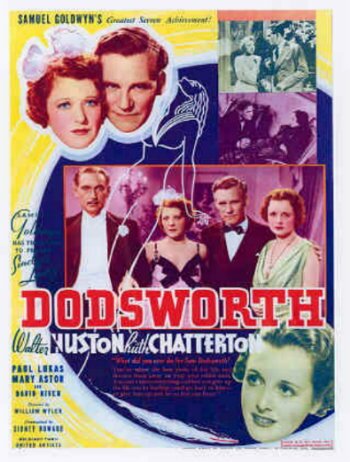
Coming Soon: Dodsworth (1936):

I've never heard of this one, and I have no idea what to expect. These are the moments when I am often pleasantly surprised and end up discovering some of my favorite movies.

Please be sure to pick up all empties on the way out...