Monday, March 31, 2014

Quick-Hitters of Recently-Seen Films

Here are a few flicks that I've watched in the last few weeks...


The Avengers (2012): This was maybe the fifth time I've watched this movie, and I still love it. It's a ton of fun, and it's really no mystery why it ended up as the third-highest grossing movie of all time.

For a non-comic aficionado, it's just a fast-paced, exciting action tale with fantastic characters, interesting personal dynamics, and excellent fights that range from great one-on-one punch-ups between superdudes (and a dudette)  and large-scale showdowns with hordes of aliens. In between the well-paced fisticuffs are Joss Whedon's slick dialogue, which I always enjoy. For the action/adventure genre, it's right up there with the all-time greats.

For a former comic fanboy such as myself, it's even more appealing. Joss Whedon channeled both his love of comic heroes and his abilities to use them in great stories, and he used them to produce what to me, along with The Dark Knight, is the strongest mainstream superhero film ever yet produced.

I'll never get tired of this one.


Iron Man 3 (2013): This second viewing of mine helped redeem this movie to me. A little bit.

When I saw it in the theater last year, I was disappointed. Upon a rewatch, I actually find it decent. It's not as good as the first one, and it's far better than the second. Decent.

The basic plot is solid. Guy Pierce's Killian character is much stronger and more engaging than either bad guy in Part 2. The humor is also in better shape in Part 3, as there are fewer outright goofy moments, and more elements that are organically fun. Ben Kingsley's is definitely a high point.

There are still weaknesses to it. There are certain plot points that simply don't hold water, and there are parts of the movie that drag a bit. Still, it's a solid entry into the Avengers' canon, and one that any person who's enjoyed most of the other films in the series should have fun with.


Down By Law (1986): I really like most of the Jim Jarmusch movies I've seen. Ghost Dog: The Way of the Samurai is good, solid, cool fun. I think Dead Man is an underrated excellent movie. So, I decided to go back and check out one of the director's earliest films.

It's great.

It's about three aimless miscreants - A pimp, a DJ, and an immigrant card sharp (played by John Lurie, Tom Waits, and Roberto Bernigni - yes, think about that cast for a second) - who end up in a tiny jail cell in New Orleans together. Most of the film follows their interactions in their cell, their subsequent escape and attempts to find freedom through the dangerous swamps of the bayou.

There is a little bit of character study, but mostly it's just hilarious. If you know the cast at all, you can imagine that, in the right circumstances, it could be magic. Well, it is. Highly recommended.

Friday, November 29, 2013

Thor: The Dark World (2013)


Director: Alan Taylor

Spoiler-Free Summary & Review:

Thor is back in Asgard, some time after the events in The Avengers. Thor is also spending time on the various other nine realms in order to pacify certain violent elements. As he dedicates his efforts to this, an ancient threat reemerges. The surviving members of the Dark Elves, a race that predates the creation of the universe, arise and are led by Malekith, who seeks to reacquire a substance known as “ether” – a purely evil substance that can inhabit and overrun nearly anything. The Dark Elves mount a massive assault on Asgard itself, laying waste to several parts of the main city and even claiming the life of one of Thor’s family. Thor enlists the aid of his traitorous brother, Loki, and the mortal friends whom he had made in the first Thor film. This group pursues Malekith and his collection of Dark Elves, in trying to prevent them from using the ether to cast the entire multiverse into utter darkness.

To give some context, I should be clear that I am a pretty big fan of this recent wave of “Avengers” Marvel films. Of the six “core” films in the ongoing series, I’ve enjoyed them all, to one degree or another, with the first Iron Man and The Avengers being the clear standouts. Though I didn’t think it was phenomenal, I did like the first Thor movie, also. So I was looking forward to this sequel.

Don't just stand there. Let's get to it. Strike a pose. There's nothing to it.Thor.

The movie does not start very well. For the first ten minutes, I was sure that I was in store for the weakest of the entire Avengers film catalog. However, it does pick up steam and gets moving well. I would caution any viewer to not expect an overly novel, intelligent, or tightly-plotted story. If you start thinking too much about it, there are certain holes that are never fully addressed. And the pacing of the film can seem a bit herky-jerky, especially in the early-going. The arrival of Thor, as he quashes a rebellion on one of the nine worlds, seems like an odd jump into the movie The Beastmaster, with a better budget. Hokey fantasy clichés and bad jokes abound for a few minutes. But this is about as bad as it gets.

Some critics are citing their displeasure with the confusing melding of Norse mythology and science-fiction elements in the movie. I actually have no problem with this, as I like the concept of Asgard being a world rooted in medieval structures but incorporating an advanced hybrid of magic and science (as Thor explains in the first film). Most of the movie takes place on Asgard and a few of the other worlds beyond Midgard (Earth), which is fun enough. Some might find the hypercolor world a bit too heavy on the visual effects, but it didn’t really bother me.

Hiddleston's Loki smile is as welcome in the film as it is smarmy.

I’m far from the first viewer to consider Tom Hiddleston’s performance as Loki as an overwhelming strength of the film. The guy is great as Norse mythology’s ultimate trickster. And Thor: The Dark World actually adds some depth to the character. No longer is he a pure villain, as portrayed in The Avengers. In this film, we actually see more of what he was at the beginning of the first Thor film – someone who actually has a sense of family connection. Yes, he’s still the cunning deceiver with the perfect mischievous grin. But we also get a character who can feel loss and suffering, which pushes the story beyond the cut-and-dried bad son/good son dynamic that it could have been. Hopefully, the Marvel movie writers see fit to work Loki into some of the future stories, and Tom Hiddleston is willing to take on the role a few more times.

So Thor: The Dark World is good, solid fun. No, it’s not going to blow you away with its intellectual depth or creativity, but it is good fun for any fan of this type of movie.

Coming Soon: Retro Film Review! The Commitments (1991)

Sunday, November 24, 2013

The Conjuring (2013)


Director: James Wan

Spoiler-Free Summary & Review:

The Conjuring tells the tale of the Perrron family, a married couple with their five daughters, who move into a horrifically haunted house in Rhode Island in the early 1970s. Once they being to realize that something is terribly amiss, as the malevolent spirits begin to terrorize them all, they call on the help of the Warrens – a husband/wife duo of paranormal experts. The Warrens work to determine the causes of the hauntings, in order to save the Perrons of the increasingly violent attacks.

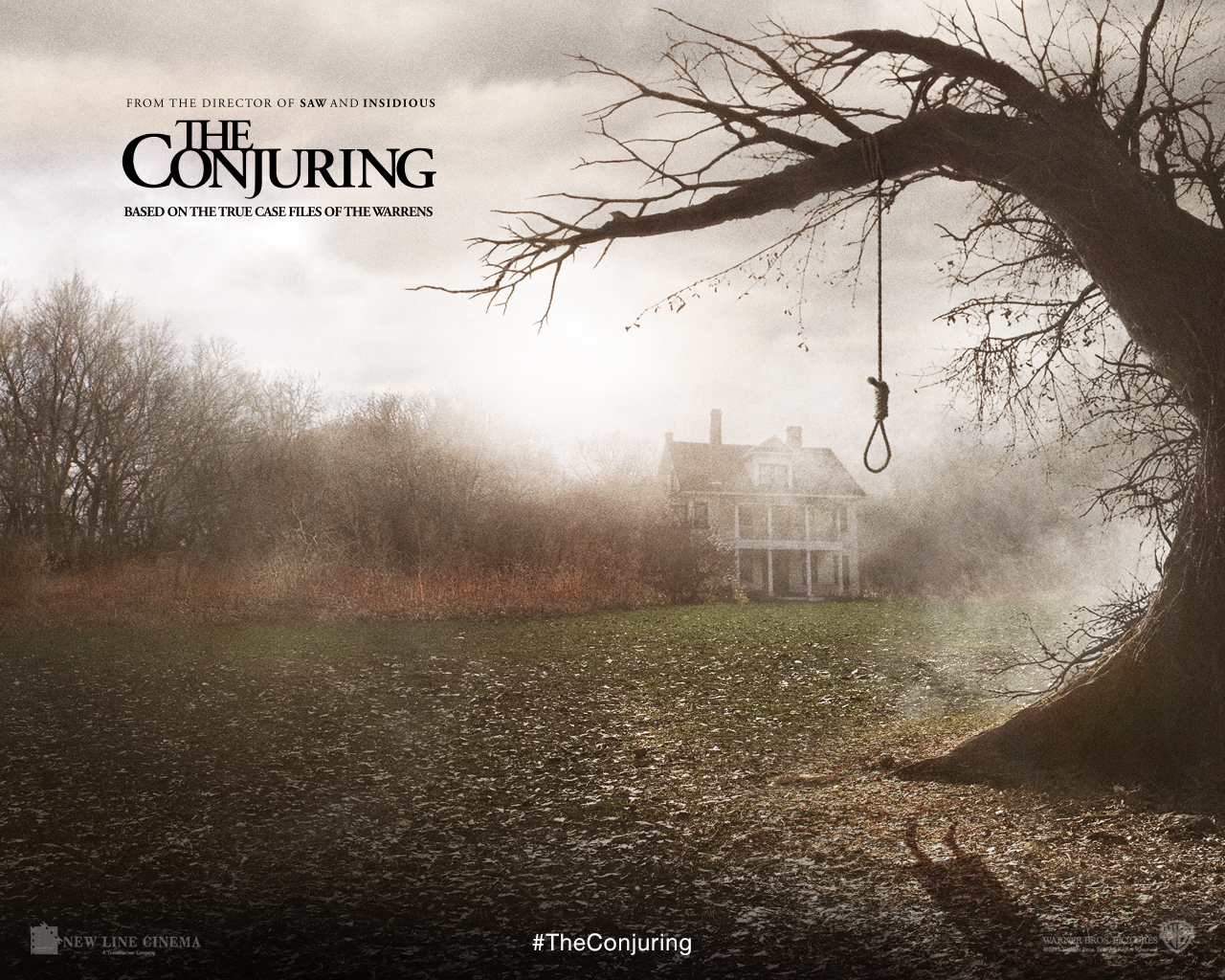
This movie is a great return to the look and feel of classic horror movies of the 1970s. Granted, there is no new ground being broken here. You’ve got your typical haunted house scenario, complete with spooky basements, creepy trees in the yard, and a house full of doors that need serious doses of WD-40. Despite the potentially tired story and plot, this movie does what it seeks out to, and it does it well. It doesn’t go overboard on the gore or graphic violence, but rather parcels out the moments of intensity to great effect.

Creepy dolls. Wild-haired old hags. Squeaky rocking chairs. This film breaks out all the classics.

The characters and acting are similar to the story – nothing original or revelatory, but very solid. The young Perron girls all perform perfectly well, as they need to. Probably the best performance is by Lili Taylor, who has to go from pleasant house-marm to bat-s#!t crazy, infanticidal wild woman. And she does it well.

If you like classic horror films, such as The Exorcist (it’s not that intense, though), then this one is for you. For full effect, do what I did – turn out the lights and watch it late at night, alone. It helps that my house is a slightly creaky, 85-year old number that makes a few eerie noises of its own. Perfect.


Coming Soon: Thor: The Dark World (2013)

Saturday, November 9, 2013

Gravity (2013)


Director: Alfonso Cuaron

Spoiler-Free Summary & Reaction:

Gravity tells the tale primarily of Doctor Ryan Stone (Sandra Bullock) as she attempts to avoid and escape an “all Hell breaks loose” scenario in Earth orbital space. Stone is a medical engineer working on installing an updated system to the Hubble Space Telescope. She is being assisted by veteran astronaut Matt Kowalski (George Clooney), who is on his final space mission. While working on the telescope, however, a massive disaster elsewhere in orbit sends massive amounts of debris hurtling towards the astronauts. As the debris slashes through their own equipment at devastating speeds, multiple times, Kowalski tries to help Ryan overcome her terror and personal fears to survive.

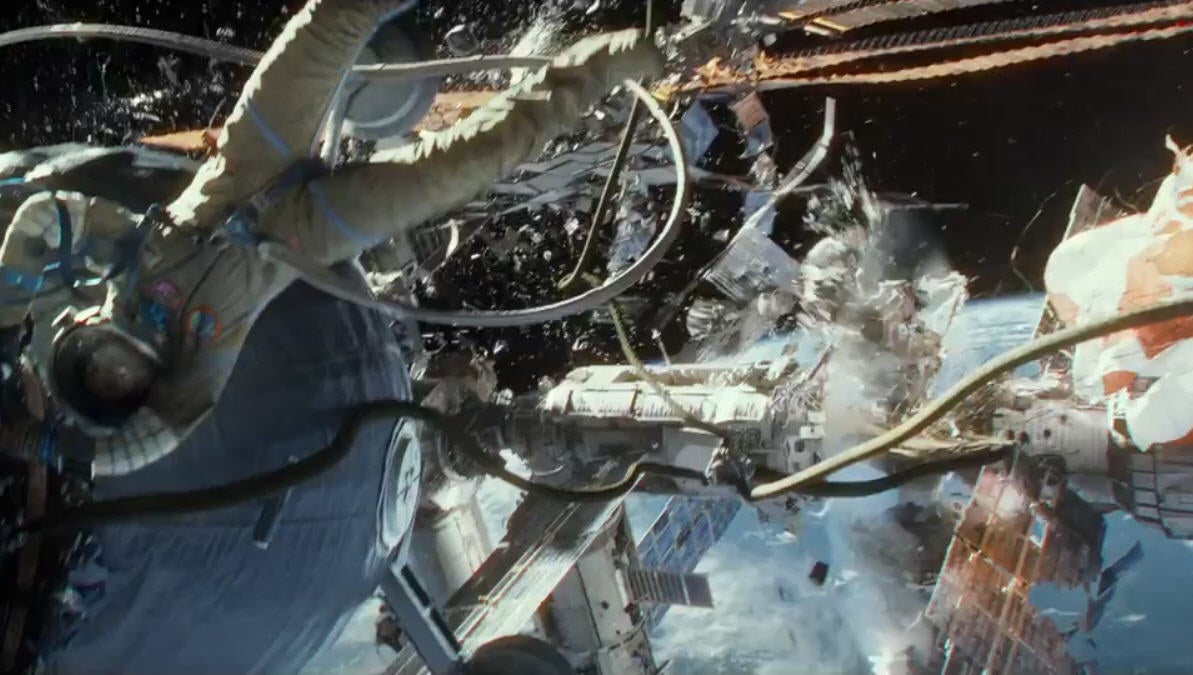
This movie is one that I absolutely recommend seeing on the big screen, with the bells and whistles of IMAX and 3D, if possible. I’m not much of a 3D fan, but this one is well worth it. (If you go in the near future, get to the theater early, so you can snatch up a good seat). The visuals are just as amazing as everything you’ve heard or read, and Cuaron and his crew obviously paid extremely close attention to detail in attempting to represent the experience of being in space to the 99.9999% of us humans who will never go. Sure, there’s plenty of action to keep the blood pumping, but there are also chillingly quiet moments that will stoke other phobias that you may not even know you had (agoraphobia being an obvious one).

Just one of the seemingly countless shots that will have your eyeballs rubbing their eyeballs.

While the visuals alone make the movie worth shelling out your $15 to $20, the plot is decent enough. No, it’s not groundbreaking or creative, but it provides a plausible premise for the film’s action. Of course, space seems the kind of place where it doesn’t take a lot for humans to get into some very serious trouble, and this is true for Gravity.

The weakest points of the film are the characters and dialogue. The actors do just fine, and Bullock may likely get an Academy nod for her performance as the terrified yet essentially tough Doctor Stone. To be honest, though, I found her character unbelievably sheepish during the first half or so of the movie. From what I know of the N.A.S.A. astronaut program, the men and women who actually make it into space are some of the most unflappable humans who have ever lived. Stone’s demeanor and reactions before and during crisis stretch plausibility at times.

Clooney does well playing, well, George Clooney. They almost could have just called him Danny Ocean or any of the other half dozen cool-as-a-cucumber charmers that he’s played so well over the years. And this is another element that stretches credibility a tad – I had a hard time imagining an astronaut, even a supposed veteran like Kowalski’s character, being so flippant and carefree about much of what transpires. I suppose that he offers the audience the chance to breathe a little bit, given the tension that runs throughout the film, but it’s all a little too smooth for my sensibilities.

The dialogue is probably the weakest part of the entire production. It’s often cheesy and clichéd, especially the messages about bucking up in tough situations. I honestly can barely remember many of the verbal exchanges between any of the characters. When dialogue is used sparingly in a film, as it is in Gravity, it’s preferable to me that it actually be more memorable.

Though flimsy characters and dialogue will often torpedo a film, such is not the case with Gravity. It’s still one hell of an achievement in film-making. This is undoubtedly one that will periodically be brought back to big screens for decades to come, giving people thrills. If you haven’t caught it yet, get out there.

A Few Recommendations of Other “Spacey” Films:

Here are a few other space movies that came to mind as I watched Gravity:

2001: A Space Odyssey (duh) – Stanley Kubrick did, in 1969 and with far more limited technological wizardry, what Cuaron updates and polishes in Gravity. He conveyed the sense of exploring space in visual ways that have blown away audiences ever since its release. Though the characters are mostly forgettable in 2001, the speculative theories about the ramifications of technology and the human desire to expand and explore give 2001 much more intellectual meat for us to sick our mental teeth into.

Almost as expansive as the cosmos themselves, 2001: A Space Odyssey encompasses far more than some of the more dramatic or adventure-oriented space films made.

Solaris (1971) – Russian director Andrei Tarkovsky’s answer to Kubrick’s 2001, Solaris is arguably every bit as transcendent, while adding far more personal humanity to a space exploration tale. While both films feature slick visuals, Solaris pulls viewers’ attention inside the human psyche in ways that the expansive 2001 does not.

The Right Stuff (1980) – Telling a dramatized version of the original United States space program’s earliest years, I’ve always felt that this film portrays astronauts as the always unshakable, often arrogant daredevils that they really were and are. An insanely all-star cast and solid film-making result in a great historical and dramatic epic.


For All Mankind (1989) – A great, concise documentary that compiles some of the best footage that N.A.S.A captured from the inaugural Moon landing, all set to a meditative Brian Eno musical score. A movie that gives you a sense of just how dramatic a feat it was for humans to, in fact, set foot on a different planet. 

That's a wrap. The next film I'll review is The Conjuring, from earlier this year. 

Please be sure to pick up all empties on the way out.

Sunday, November 3, 2013

Wrap Party!!!

The Grand Recap.

It’s been over three-and-a-half years since I started this labor of love. It’s involved, by my math, well over 400 hours of viewing, researching, and writing about the 105 films listed by the fellows at TIME magazine as “100 All-TIME Great Films.”

To give myself some kind of closure, I just wanted to go back over the entire list and, for my own edification, express just what I took from it all.

The reason I started this entire thing back in the cold winter of 2010 was that film have given me incalculable joy during my entire life. Of course, the more movies one sees, the more difficult it becomes to find ones that have the same impact as when you’re younger. When I came across the TIME list, it seemed like a nice mix of the familiar and the unknown. It was a perfect chance to revisit some classics and hopefully find some new favorites. This, indeed, happened, though it wasn’t without suffering through some films that I wouldn’t watch again if you offered me guilt-free night alone with Barbara Stanwyck (well, maybe not).

Without further ado, here are my final thoughts on the entire task, presented in a few groupings:

“Not Even if it’s in the Dusty, $0.99 Bargain Bin” Group


Sitting through some films can make you want to do something...drastic.

The films from the list that demanded the most steadfast determination on my part. The only reasons I didn’t push “Stop” and snap the DVDs in half was my promise to myself to watch them all, along with the potential for massive fines from Netflix:


Some of these films actually have a few redeeming qualities, like His Girl Friday and Leolo. On the whole, though, I found them frustrating and tiresome. Many say that all of these are stamped in the history of cinema; as far an I’m concerned, history can keep them.

“Best of the Decades”

My favorite film from each of the nine decades covered by the TIME list. Keep in mind that by "favorite," I don't necessarily think that these are the "best" films. They're just the one's that I enjoyed the most and would likely watch again (and again and again...):

1920s:   The Last Command (1928) – incredible silent film that tells a beautiful and epic story of lost honor and grandeur.

1930s:   Bride of Frankenstein (1935) – Maybe it’s just the current Halloween spirit in me, but this film is no end of fun. I don’t know if it’s the Alpha of campy horror films, but it certainly is one of the greatest.

1940s:   Casablanca (1942) – The 1940s were phenomenal, with some of the greatest films of all time being produced during that span. Casablanca, though, is still my favorite. Often, and understandably, called “the perfect film,” it’s difficult to imagine this one ever fading away.

1950s:   In a Lonely Place (1950) – Humphrey Bogart takes another one. In one of several great films from the list that I had never heard of before, Bogie is astounding as a dark, tortured screen writer who is suspected (with very good reason) of murder.


1960s:   The Good, The Bad, and the Ugly (1966) – This was a tough one, with Yojimbo (1961) being an awfully close second. Still, this Leone western is a seminal one in my education as a cinephile. It’s one a handful of movies that changed the way I watched and thought about the medium.

1970s:   The Godfather (1972) – I defy anyone to tell you that this isn’t one of the best films ever made. It may not be the most profound or novel, but like Casablanca, it executes the elements of film storytelling about as perfectly as possible. And I love a good gangster movie.

1980s:   Blade Runner (1982) (director's final cut version) – This one was neck-and-neck with Raging Bull, but the science-fiction geek in me won out by a hair. Still slick and hypnotic, even these three decades later, Ridley Scott’s altered vision of Philip K. Dick’s brilliant novel is a pillar of the genre. Its’ brilliance makes the glaring shortcomings of Scott’s recent Prometheus all the more baffling.

1990s:   Unforgiven (1992) – Within the decade in which I came to truly love films, Clint Eastwood’s masterpiece is still my favorite. One of the very few films that can shatter one’s cherished romantic notions about a genre, while enthralling you by revealing the darkest aspects of the human soul.

2000s:   The Lord of the Rings trilogy (2001 – 2003) – Yes, I’m going to cheat a little bit here by putting all three movies together. The pickings were slim for this decade anyway (the latest film was from 2003). Even people who couldn’t care less for the fantasy genre of storytelling would have to admit that this film series is an outstanding achievement in film. These movies are going to be imitated, probably in laughably poor form, for years to come (actually, they are right now, by Peter Jackson himself).

“Top O’ the World, Ma!!!” Award – My pick for my absolute favorite film from those reviewed. And the winner is…


Unforgiven (1992)

This was a tough pick to make, but I have to go with the tale of the spectral Will Munney. No other film conjures up such conflicting feelings in my red-blooded American male psyche. The more juvenile, macho part of me always gets a thrill from seeing just how efficient a killer the central character is. William Munney is, truly, a bad-ass. Conversely, the more mature, philosophical side of me is always quietly terrified of just why Munney kills people, and the cold brutality with which he does it. The dark abyss that lurks inside of him, taking the place of compassion, is the stuff of nightmares come to life.

Eastwood has starred in and directed quite a few excellent films, but this is the one that put his indelible mark on the history or film.

An Overlooked Director:

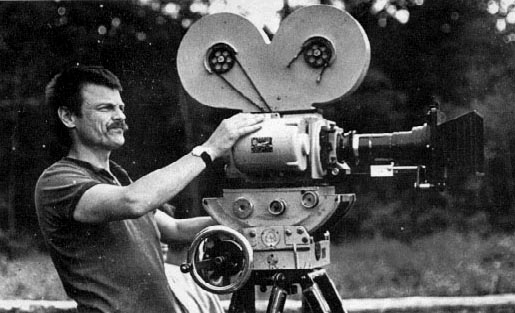
The Russian director asked for more meditation and patience from his viewers than most directors, but I've always found the exercise well worth it.

If anyone who loves movies really spent a lot of time thinking about it, they could probably come up with a dozen directors and a few hundred movies that could or should have been on the TIME list, in the places of the one’s chosen. For me, one stood out more than the others: Andrei Tarkovsky.

I haven’t seen all of Tarkovsky’s movies, but the ones I have seen I’ve found to be astounding. Andrei Rublev, Solaris (the original; not the respectable Steven Soderberg remake), and Stalker are amazing films. They are long, ponderous, and they make demands on the viewer, no doubt. But there is a beautifully hypnotic pacing to his movies that I love. He seemed to have a fantastic sense of how to use negative space and silence within an aural-visual medium to tell vastly different stories. If you’ve the patience for longer films that give you the space to immerse yourself in some philosophical quandaries, you should definitely try him out. Solaris is probably the most accessible of the ones I’ve seen, making it a good one to start with.

A shot from Solaris, sometimes referred to as Tarkofsky's answer to Kubrick's 2001: A Space Odyssey. Where the latter can come off as cold and purely cerebral, Solaris deals with deeper, more personal and emotional issues in the context of space exploration.

Final Thoughts and the Next Episodes:

It’s been fun, no doubt. This is not the end, though. I’ll now start doing reviews of whatever movies (and maybe the odd TV show seasons) I see, without the demands of a self-imposed list or anything. The reviews will be shorter and more to the point. I’ll divide them into only two segments: a “no-spoilers” general review and a “spoiler-addled” detailed review.

Coming Soon: Gravity (2013)


The recent critical and popular darling, as seen by me.

Please be sure to pick up all empties on the way out.

Saturday, October 12, 2013

Film #105: Lord of the Rings: The Return of the King (2003)


Director: Peter Jackson

Original Release Country: United States

Times Previously Seen: six or seven

*Note: The Lord of the Rings (LotR) trilogy was considered a single film by the list compilers at TIME, but I have reviewed each film separately. Here was my review for the first installment, The Fellowship of theRing; my review of The Two Towers is here.

Legolas Quick-Draw-and-Fire Summary

The hobbits are still little, but the stakes and fights are way, way, way bigger. “End of Middle Earth” bigger.

Extended Summary

*If you’d really like to dork out, you can check out thiseven-more detailed summary at imdb.

Following the defeat of Saruman’s army at Helm’s Deep, Gandalf, Aragorn, Gimli, Legolas, and King Theodrin make their way to the evil sorcerer’s tower, where the wizard is trapped and surrounded. The companions reunite with Merry and Pippin, who have been awaiting their friends. Aragorn and Theodrin attempt to convince Saruman to assist them by telling them of the Dark Lord Sauron’s plans, but the wizard is slain by a vengeful Wormtongue before he can provide any information. The group leaves the White Tower and heads back to Edoras.

Not far from Osgiliath, where Faramir freed them, Sam, Frodo, and Gollum continue their way towards Gollum’s promised “alternative path” to Mount Doom. Sam, overhearing Gollum telling himself about luring the hobbits into a trap, is convinced that the shifty creature is leading them to their deaths. Frodo, however, sees no choice but to trust their guide.

Frodo, Gollum, and Sam prepare for their incursion into Mordor. Of course, the scuzzy critter in the middle doesn't exactly help their cause.

Back in Edoras, Pippin makes the foolish decision to take hold of a “Seeing Stone” which they had discovered back at Saruman’s tower. The stone allows the user to peer into Sauron’s mind to an extent, but it also allows the Dark Lord to see back. Pippin is freed from the stone by Aragorn, and whisked away from Edoras by Gandalf, who knows that the hobbit’s location will now be known to Sauron. He decides that they must make towards Minas Tirith, where he can begin to muster the city’s defenses against the imminent attack which Pippin saw in Sauron’s mind.

When Pippin and Gandalf arrive in Minas Tirith, they find that the grand city’s steward, Denethor, is wracked with grief and despair due to learning of his favored son, Boromir’s, death. Denethor is too absorbed in his own self importance and pain to heed Gandalf’s pleas that he prepare the city for an oncoming attack from nearby Mordor. Gandalf and Pippin then take the initiative and slyly ignite the city’s beacon system.

When the beacon arrives far off in Edoras, King Theodrin subdues his displeasure at Gondor’s past lack of assistance to his own people and musters his men to head for Minas Tirith. His daughter, Eowhin, disguises herself as a male warrior and joins the hurried march.

Back in Mordor, Sam, Frodo, and Gollum have entered and lain eyes on the imposing Minas Morgul, the massive black fortress that is home to the Witch King Angmar, the most powerful of all of the ring wraiths. The hobbits and Gollum witness the pouring out of a massive army of Sauron’s forces, just before they begin to ascend a massive staircase up the side of a mountain – this is Gollum’s secret path into Mordor.

The hobbits and Gollum ascend the path around Minas Morgul, with a massive force of monsters marching below.

Back in Minas Tirith, Faramir, son of Denethor and brother of the departed Boromir, attempts to head off Sauron’s forces in Osgiliath, but he meets defeat after a pitched nighttime battle.

In the middle of the march to Minas Tirith, Aragorn and his companions begin to doubt their chances of victory. However, help arrives in the form of the elf king Elrond. Elrond gives him the newly re-forged sword of Aragorn’s ancestor king. The sword gives them new hope, but more will be needed. At Elrond’s urging, Aragorn makes into a nearby mountain pass which is haunted by an army of ghosts who had betrayed Aragorn’s ancestor two millennia earlier. Accompanied by Legolas and Gimli, Aragorn braves the spectral mountain, faces off with the ghostly leader of the traitors, and convinces them to follow him. Aragorn vows that, should the ghost army fight with him, he will release them from their cursed existence.

Back in Minas Tirith, the final battle has now begun. From their newly captured center at Osgiliath, Sauron’s forces attack The White City. The massive horde of all manner of creatures – including, orcs, trolls, Uruk-hai, goblins, and others – bombard the city’s defenses relentlessly. However, every time Sauron’s army seems to be on the verge of taking the city, help arrives. First, it is from King Theodrin, who leads his Rohirrim into the flank of the attacking army. For a while, the forces of good seem to be gaining the upper hand. However, the Witch King Angmar joins the fray and takes out Theodrin. Just when the tide of battle seems to be swinging back to Sauron’s side, Aragorn, Legolas, and Gimli attack from Osgiliath with their ghost army. With their forces bolstered, the defenders of Minas Tirith wipe out the attackers. Among the slain is the powerful Witch King, whom Eowhin herself has dispatched.

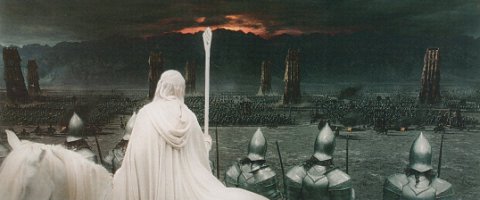
Gandalf looks on from Minas Tirith, the tremendous forces of the Witch King Angmar approaching to topple the glorious city.

Inside Mordor, Gollum finally makes his move. As Sam had feared, he leads Frodo into a deadly trap. Leading Frodo into a dark cave and then abandoning him, he leaves the hobbit to be attacked by Shelob – a massive carnivorous spider. Frodo is initially poisoned into paralysis by Shelob, but Sam comes to the rescue and fights off the vicious creature. Frodo is initially taken by some nearby orcs to a stronghold, but is freed once again when Sam capitalizes on infighting and manages to pull his friend away.

In Minas Tirith, the champions of the city take little time to celebrate. They realize that, despite their victory, Sauron has more forces that he can send after them. They also realize that, as long as the Ring of Power still exists, Sauron will never be defeated. Aragorn realizes that their only hope of true victory is to give Frodo enough time to reach Mount Doom and destroy the ring. To do so, Aragorn and the remaining forces of good decide to bring the fight to Sauron at Mordor. When they arrive at the Black Gate of Mordor, Aragorn, who has now fully accepted the mantel of “King,” goads Sauron’s forces into emerging from behind their walls. This pulls the attention of the Dark Lord away from inside Mordor.

Deep within Mordor, Sam and Frodo have been struggling their way towards Mount Doom. Frodo can barely walk, so weighed down is he by the power and burden of the ring. He and Sam are unsure of how to approach Mount Doom without being noticed by Sauron’s ever-searching massive eye. That is, until all of the forces make for the Black Gate to confront Aragorn’s army. The way is now clear for them.

At the Black Gates, Aragorn's army (center) are surrounded by Sauron's remaining hordes. This provides the distraction that Sam and Frodo need inside Mordor to dispatch the ring.

Sam physically carries Frodo up towards the entrance of Mount Doom, only to be waylaid by Gollum, who goes after the ring. Amid the scuffle, Frodo breaks free and enters Mount Doom. He at first makes as if to drop the ring into the pit of fire, thus destroying it, but at the last moment, he refuses. The ever-corrupting power of the ring has finally corrupted even Frodo, who puts the ring on and becomes invisible, which also alerts Sauron to the ring’s presence. Before Frodo can escape, though, Gollum reemerges and finds him, literally biting the ring off his finger. The two struggle over the ring, with it and Gollum eventually falling over the edge and into the pit of fire. Both Gollum and the ring are destroyed, and the Dark Lord Sauron is finally defeated.

The forces of good have finally and completely triumphed. Aragorn is officially recognized as the first true king of mankind in over two millennia, and Arwhen decides to forsake her elfish immortality and join him at his side. The remaining elves embark on their ships for “The Undying Lands,” taking the now very-aged Bilbo with them. Surprisingly, Frodo takes the elves invitation to join them in their journey away from Middle Earth. Frodo’s tribulations have left scars, physical and otherwise, that prevent him from ever living a normal life in Middle Earth again. And so, he bids his friends farewell and sails away.

In the end, Sam, Merry and Pippin all return to Hobbiton, where Sam re-assumes his life as a humble gardener, marries his sweetheart, and has a family.

My Take on the Film (Done after this most recent viewing)

Still the best film of the three, though one that has, like its predecessors, lost just a bit of its magic to me. The reasons are similar.

So much of LoTR: Return of the King is still an absolute blast to watch. So much so that I wished that I’d been able to see it on the big screen again, though I don’t know if my backside could have taken the endless sitting (the extended edition clocks it at nearly four hours).

True to its epic form, the entire third act of LoTR brings things to a massive and mostly satisfying conclusion. It probably would have been easy for any filmmaker to let a few plot threads dangle or try to inject too many of the countless minutiae from the source novels. Peter Jackson and his co-writers did no such thing, though. As massive as the plot and cast of characters are, it never feels too bloated, and virtually every scene and interaction either is central to the story or deepens our view of the battle for Middle Earth.

The inclusion of the Dead Men of Dunharrow may at first seem self-indulgent to Peter Jackson's horror whims, but it ties perfectly well into the larger plot. Not to mention it provides some of the most awesome scenes in the film, such as this one when they storm Osgiliath.

When taken with the first two installments, Return of the King completes the tale magnificently. Everything that is hinted at or brought up in the first two films finds its closure by the end. Aragorn’s place as the unwilling king; Theodrin’s ill will towards the Gondorians; Gandalf’s descent into death and rebirth as the new White Wizard; the hobbits’ noble attempts to be a part of something far greater than their humble selves; all of it comes together in the epic battle at Minas Tirith.

The fight at Minas Tirith is, as one would hope, the grandest of all in the series. As entertaining as the battle of Helm’s Deep is in The Two Towers, Minas Tirith cranks everything up to tremendous levels. From the initial assault, featuring wicked black dragons snatching defenders off the parapets and hurling them back into the city, to the nearly endless waves of monsters and beasts of war charging the forces of man, it’s simply eye-popping to behold. Again, it does lose something on anything smaller than the true big screen, but I still found myself captivated taking it all again for the umpteenth time.

Return of the King also adds in some new elements and players, which only enhance the film’s strengths. The inclusion of the ghastly Dead Men of Dunharrow is a great touch of the truly supernatural into the fantasy setting. Tapping into his horror roots, Jackson makes this ghoulish army as terrifying as it is awesome. There’s no small amount of satisfaction in seeing their spectral green forms wash over Sauron’s forces first at Osgiliath and then on the field of battle outside of Minas Tirith.

With all the fun that Return of the King provides, it still has lost a bit of luster, in similar fashion to, and for the same reasons that the previous two films have: Frodo and Sam’s part of the story. I completely understand that, actually, Frodo’s mission is by far the most crucial to the entire plot. And I understand that the relationship between him and Sam is the quiet heart and soul of the entire epic tale. Still, their trek through treacherous Mordor is painstakingly long, especially at the end. By the time Sam utters the words, “I can’t carry the ring for you, Mister Frodo, BUT I CAN CARRY YOU!!” I’m worn out with their love-fest.

Sam carries Frodo. The first time you see this scene, in the edited version of the film, it may carry an emotional punch. After that, though, it strikes as tiresome and sentimental.

On top of that is what may be the most dragged out, laborious ending in film history. I get it – this is an eight-hour-plus film trilogy (ten-plus if you watch the director’s cuts), so it’s going to take longer to provide closure for everything that has transpired. But really, it’s hard not to feel that the end of the story should be shortly after the victory at Minas Tirith, or at the very least, after Sam and Frodo finally destroy the ring. And yet, the movie keeps going for nearly thirty minutes AFTER that. The first or even second time I watched them, I didn’t notice it. But after you’ve seen the films several times, the ending can feel rather glacial.

The Lord of the Rings trilogy is still a monumental achievement in film. It’s bound to be many years, and even decades, before a film series translates the true spirit of fantasy storytelling with such outstanding visual effects, action, and adventure as Peter Jackson did. He’s trying to replicate it with The Hobbit as I write this, but even if the prequel tale’s three films are as good, they will still be in the shadow of their earlier, grander cinematic translations. I may not be as enamored of the series as I was for several years after their release, but they truly set a standard that I don’t see being matched for a very long time.

And that is, truly and completely, a wrap. 105 shows down. And that is all.

Coming Soon: Wrap Party!! - Where I do a recap of my last three-and-a-half years of working through this entire list and revisit my favorite and most despised films from the 105 that I watched. 


Please be sure to pick up all empties on the way out.

Sunday, September 29, 2013

Film #104: Finding Nemo (2003)


Initial Release Country: United States

Directors: Andrew Stanton, Lee Unkrich

Times Previously Seen: once (about ten years ago)

Quick-Fire Summary (No spoilers)

A father clown fish goes a helluva long way to find his lost son. A dippy blue tang and various other sea creatures help him out.

Extended Summary (Spoilers Included, if that even matters)

In the middle of the ocean, a clown fish named Marlin (voiced by James Brooks) just settles into his new anemone home with his wife and their innumerable eggs, which are waiting to hatch. Unfortunately, the home is attacked by a barracuda, killing Marlin’s wife and eating all of the eggs but one. From that lone egg emerges Marlin’s only living family member – Nemo.

Some time later, a young Nemo (Alexander Gould) prepares for his first day of school. Marlin is the epitome of an overprotective parent, but Nemo is itching for adventure. Once with his schoolmates, a variety of other youngsters representing all manner of ocean species, Nemo is goaded into venturing away from the pack, towards a distant boat. When out a bit too far, Nemo is captured by a human scuba diver, who then takes the young clown fish ashore in Sydney, Australia. There, Nemo is sold to a dentist and placed in an aquarium with a small collection of other fish, and he is forced to wait and be taken by the dentist’s klutzy niece.

Nemo (the little orange guy) with a few of his fellow fledgling ocean-dwellers.

Out in the ocean, Marlin overcomes his fear of the open ocean and goes in search of his son. In the beginning, he meets a kind but highly forgetful blue tang named Dory (Ellen Degeneris), who Marlin unwillingly allows to tag along and assist him. Over a very lengthy odyssey, the two little fish make their way past various dangers, including sharks, jellyfish, and other hazards, on their way towards the distant Sydney.

Back in the dentist’s office, Nemo befriends his fellow captives in the aquarium, who are led by Gill (Willem Dafoe), a fish with serious determination to escape back to open water. After a few failed and nearly fatal attempts by Nemo and his comrades to get out of the tank, they are eventually successful in getting Nemo into one of the dentist’s drainpipes, which Nemo follows out to the sea.

Out in the waters off the coast, Marlin and Dory get some final bits of assistance from a friendly pelican, Nigel (Geoffrey Rush), finally manage to get close enough to the dentist’s office to eventually find Nemo. The father and son are reunited, and they both have new-found respect for each other’s tenacity in the face of so many dangers. Marlin learns to let his son have adventures, and Nemo learns to respect his father’s hidden but proven courage.

Marlin and Dory. Dory's flightiness gets on Marlin's last nerve, but the nervous little clown fish eventually learns to love the well-intentioned, blue dope.

My Take on the Film

As with the best Pixar films (and most of them are excellent), Nemo gets everything right, and it’s still really fun to watch. That is, of course, as long as you’ve kept a little bit of your inner child alive.

Finding Nemo was the one that really gave Pixar its first sure-fire classic film. Sure, Toy Story 1 and 2 and Monsters, Inc. pre-dated Nemo, but Nemo put together the excellent storytelling and humor of those earlier efforts with the stunning visual majesty of the oceans, as rendered through computer graphics.

Finding Nemo, in the spirit of the original Walt Disney pictures like Snow White, Pinocchio and others, was not meant to be a “kids film.” Rather, it was clearly meant to appeal to as wide an audience as possible. This isn’t exactly an easy feat, as many parents will probably tell you. Often, such “family films” will be geared more for the younger kids than their older siblings or parents. As such, anyone over the age of ten will have to sit patiently through hokey gags, shallow action, clichéd morals that bash you over the head, or some combination of the three. Nemo avoids all of these pitfalls.

Nemo in the aquarium "prison." The other "inmates" all provide some of the best humor in the film, not least of whom is Gill (far left), voiced by Willem Dafoe.

The story does have a clear message which adults may or may not find mind-blowing. The warning against being overprotective isn’t exactly subtle, but at least it’s a message that remains universally relevant.

In terms of characters, I feel that I have a rather adult perspective on this movie. In truth, I don’t really find either of the two main characters – Marlon and Nemo – particularly novel or compelling. And though their dialogue can be funny at times, they are not what makes the film entertaining to me. In terms of characters, it’s all of the secondary and tertiary ones that steal the show, scene after scene. While I’m far from an Ellen Degeneris fan, her voicing of the memory-challenged Dory is actually pretty damn funny to me. Even funnier are critters like Gill, Nigel, the sharks, and plenty of others. Even the little voices given to the seagulls (“MINE!!MINE!!MINE!!MINE!!”) or the crabs (“Heeeey...heeeey...heeeey...”) are hilarious, if you’re into goofy humor like I am. The writers at Pixar and the voice actors must have had an absolute blast coming up with and executing their voice-overs of marine life.

The other grand appeal of Nemo is the visuals. As vibrant and smooth as their previous films had been, Nemo brought it to a whole new level. Their computer programmers managed to capture the color and fluidity of life under the ocean so beautifully that it was a pleasure to watch this film in high definition. On top of this, the writers and animators pull off a great amount of visual gags, many in the form of facial expressions on the fishes and other sea creatures. This should be no surprise to anyone familiar with Pixar’s brilliant short films, none of which ever have any dialogue.

The friendly seagull, Nigel (voiced by Geoffrey Rush), smacking into the dentist's office window. One of dozens of great visual gags that anyone with goofy sensibilities can appreciate.

While Finding Nemo is not my favorite Pixar film (for me, it’s The Incredibles), it’s not hard to see why it made the TIME 100 Great Films list. It set the absolute standard for computer-animated films that all others, even Pixar’s, have tried to match in the succeeding decade. It truly is a film that anyone, at any age, can watch and enjoy.

That’s a wrap. 104 shows down. One to go. (My god)

Coming Soon: Lord of the Rings: The Return of the King (2003):


And this grand journey of mine comes to an end, along with the grand journey of Frodo Baggins’s trek towards Mount Doom. Come on back to see how it all wraps up for me.

Please be sure to pick up all empties on the way out.