Showing posts sorted by relevance for query the crowd. Sort by date Show all posts

Friday, January 22, 2010

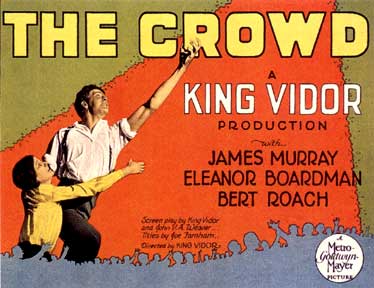
Film #5: The Crowd (1928)


Director: King Vidor (who wins the award for "Name That Belongs in a Star Wars Movie")

Release Country: United States

Times Previously Seen: none

The Story (in which I give away the plot and spoil the hell out of the movie for you. Fair warning):

In 1900, on the 4th of July, John "Johnny" Sims is born to a father who envisions his son doing something grand with his life. Fast forward 20 or so years. Johnny arrives in New York where he hopes to prove himself a success, as long as he's "given the opportunity." He grinds at a monotonous job, marries a nice gal, and has two children over the next 5 years, all the while toiling in the same career and persistently confident that his "ship will come in" any day. He goes through several ups and downs: some typical, like domestic feuds with his wife and in-laws; others much more tragic such as losing his young daughter to a traffic accident. After this horror, he quits his job, hops from one low-level gig to another, and nearly commits suicide. In the end, he finds a job as a juggling clown wearing a sandwich board and barely manages to save his marriage. His dreams of making it big are dashed, but he finds some sort of peace with his wife and remaining child. Swirling around it all is the titular "Crowd" of New York - the ever-bustling, ever-callous, never-still swarm of people that pump through the streets and buildings of the metropolis.

Take 1 (My opinion based on one viewing done before any research on the film):

Lame. Simple as that. If took five films to get there, but I've now seen one that I flat-out didn't like. I do need to mention that I had to watch this on a pretty shoddy VHS tape since it's not currently in-print. The picture quality is quite burned out, which leads to extremely bright spots and washes out a fair bit of the detail in many of the scenes. Still, this was hardly the problem. However, before I pummel the shit out of this movie, I'll take a look at the merits that I could see.

The obvious plus is the handful of interesting camera shots. As suggested by the synopsis on the tape jacket (one of those old-school, hefty plastic snap-case jobs that will end up buried in a landfill for at least 1,000 years), several shots were groundbreaking and iconic. There are three or four scenes with striking symmetry. One of them is when the 12-year old Johnny stands in a crowd at the bottom of a staircase leading into his home, preparing to ascend and learn that his father has died. We look down from the top landing and can get a sense of how distant and alone he is. Another, more famous one is our first look at Johnny's first job in New York. Here's a still shot:


Pretty exacting, eh? This scene and several more reminded me of the brilliant Coen brothers/Sam Raimi movie The Hudsucker Proxy (which I suspect drew very heavily from The Crowd), and which used many similar techniques to convey the sense of the cold machinery of big business. The problem, though, is that there's not nearly enough of it in The Crowd. Aside from these few admittedly impressive moments, nearly all of the rest of the camerawork was rather mundane to my eye. Had there been more shots like what you see above, I probably would have been more engaged. As it was, the extended montages of New York City traffic, the Coney Island amusement park, and Niagara Falls were yawners.

The other positive that stood out to me was that, compared to the other films I've watched from this era, The Crowd seems to be edgier and take on slightly risque topics: domestic fights, broken toilets, getting sauced on bootlegged hooch and picking up flapper "wrens", and the nervousness of a honeymoon evening. It lends a bit of verisimilitude to the story and the sense that Sims' story is that of your average fella. But again, it's the story of the average fella in the 1920s. For us 80-plus years later, the things that seem authentic are very different and amount to a slight disconnect. It's a bit hard for me to sympathize with a guy whose grand dream is winning $100.00 in an advertising contest. In the end, I couldn't say that I was overly wrapped up in whether Johnny was going to "make good" or not.

One final thing that brought me a touch of amusement was the dialogue on the title cards. Since the script was trying to convey the speech of the common New Yorker, we get some prime 20s-era slang. I had to chuckle at terms for people like, "old Bean," "you big egg," and admonitions when one of Johnny's co-workers tells him to "quit the high-hat"(a term used wonderfully by Jon Polito in Miller's Crossing).

On a final note, the overall story had a certain admirable appeal in that it served as a social commentary on hyper-urban culture. In this, the film does good work; however, to be truly effective, it really needed to be more tragic, a la the novel Sister Carrie by Theodore Dreiser or even the previous movie in this review, The Last Command. As it is, things end on a somewhat chipper note, with Johnny and his wife reconciling and moving forward with life. To me, this was a bit of a cop-out and amounts to the filmmakers trying to side-step alienating a popular audience.

Basically, this movie, though not overly long, was a struggle to get through. I don't really recommend it to anyone but hard-core film heads, critics and historians.

Take 2; or: "Why Film Geeks Love this Movie" (written after doing a bit of reading & research on the film.)

It would appear that, after reading a few critical analyses of the film, that the key words are "Everyman" and "camerawork." In a break from standard film topics, The Crowd was the first film to really tackle the plight of the average Joe trying to run with the rest of the pack. The fact that there is no "hero" or "villain" here seems to be one of the two major innovations here.

The second is, as mentioned, the filming. The use of tracking shots to illustrate how John Sims is either in or out of sync with the pulsing mob is still lauded by critics and filmmakers today. Apparently, the topic and style have been used in several other classics like the aforementioned Hudsucker Proxy and Billy Wilder's equally-heralded The Apartment.

Despite having these things pointed out to me and recognizing the merits, I'll never watch this one again. Well, maybe if someone paid me. A lot.

That's a wrap. 5 films down. 100 to go.

Coming Soon: Film #6 - The Man With a Camera (1929):

Based on the poster, I'll undoubtedly have to do stacks of acid before watching this movie in order to make heads or tails of what the hell is going on. Check back in a few to see if I can explain just what on God's green Earth this playbill is about.

Tuesday, January 19, 2010

Film #4: The Last Command (1928)


Note: This film not being in-print on DVD, I had to order a VHS version. I was able to catch a whiff of nostalgia as I pushed the tape into the decades-old player in my classroom. The whirring, clicking dinosaur sounded not unlike the first Terminator at the end of the film: nothing but a twisted torso and one robotic arm desperately scraping itself along the factory floor, lunging for Sarah Connor. Man, these old machines are great.

Times Previously Seen: none

Initial Release Country: United States

The Story (in which I flatly describe the plot and spoil the hell out of the movie for you):
A palsied, uncertain old man is hired as an extra in a Hollywood war movie, seemingly because he has the right look and merely claims to be a former general in the Russian Imperial army and cousin to the fallen Czar. We quickly learn through flashback that this man is not lying. In fact, he is former Grand Duke Sergeus Alexander, and the the director of the movie is a former Russian revolutionary who recognizes the old general and sees this as an opportunity to exact his revenge on the man who arrested him 10 years prior. It is also the director's last stab at the Russian aristocratic power of the past.

During the flashback, we see the general to have been a bit arrogant and blustering, but also deeply concerned about his troops and the welfare of Russia. He has loyalty to his cousin, the Czar, but does not blindly follow orders. He is a thoughtful man who develops a sincere caring for a beautiful young actress. The actress, a revolutionary herself, is captured and swayed into admiration for the general. Once the Bolshevik Revolution occurs, the young woman saves the general's life from a bloodthirsty mob, then herself falls victim to a tragic train crash. The general, torn apart professionally, spiritually and mentally, flees Russia.

Ten years later, in Hollywood, he is made to reenact his past role as general. In the middle of acting in the scene, the vivid memory of his past life is triggered, he slips into a delusional passion to defend his mother Russia and dies on the set.


A scene from the beginning of the film, depicting the distant, haunted gaze of Sergeus Alexander.


Take 1: My Gut Reaction (A review done before any kind of research on the movie):

This is a great film, silent or not. Sure, there are some elements and aesthetics that I can gripe about (and I will, further down), but this film is a masterpiece. So much so that, during the last 20 minutes or so, I wasn't even taking the notes that I normally take when doing these reviews. I was that gripped. The main character, Sergeus Alexander, is that rare thing in all stories, be they in films, TV, novels or theater: a complete human. So many stories are weakened by simplified caricatures of pre-determined archetypes: hero or villain; good or evil; powerful or weak, and rarely do the twain meet. The greatest characters, however, are people in full, warts and all. Sergeus is one of those characters.

In the beginning of the movie, you feel pity for this old, traumatized and feeble man as the other extras on the movie set taunt him, thinking his claims about his identity are nonsense. When we start to see his life as a general, we quickly resent him, his arrogant posture, his belittling of disrespectful officers, and his seeming callousness toward suspected revolutionaries. Then, we start to see more aspects of him: his tenderness towards the young actress, despite her attempt to assassinate him; his genuine concern for his soldiers' lives; and his deep love for the integrity of his home country. Once we get the sense of the complete man and understand how admirable he is, despite and because of his flaws, it's truly painful to see it all come crashing down around him. He loses his livelihood, his love, and his country, all in one fell swoop when the Empire falls. During the end scene, I was completely enthralled by the general's unbridled release of emotion - emotion that had been caged in by a decade of sorrow.

One of the first scenes in which the seemingly tyrannical general subtly reveals his more humane tenderness.

Something else that you can see in this clip is how the acting has evolved. Almost gone are the grandiose movements of earlier silent films. The actors behave and talk much more realistically, being on-par with modern thespians. Thanks to this, the 21st century viewer can more easily sense the emotions of the characters and empathize with them. As exhibit A, I suggest looking at the general's walk and face when he's retrieving his mistress/would-be assassin's cigarette, pondering whether he's about to die for his love of her; maybe even dutifully accepting it. The whole movie is filled with such moments. The capper is the look on Sergeus' face as his life is ripped from him. From contented to utterly haunted, his wide eyes are burned into my mind. Emil Jannings, who won the very first "Best Actor" Academy Award for the role, was truly amazing.

Alas, it was not a perfect viewing experience. A few minor things made me wince just a bit. One was the music score. Maybe the original, in-theater score was better, but this tape had the standard silent film organ music. I realize that this was the norm for the day, but here in 2010, it made me feel like I was watching an Icecapades extravaganza during an intermission at a minor league hockey game. For a moment, I thought the Hanson brothers were going to charge onto the screen and start throwing wicked hip checks.

Another, more prominent blemish is the gaps in the story. The flashback format works extremely well, but the ten-year time jump gives you no explanation as to how Alexander gets from crying in the Russian snow to subsistence living in a Hollywood boarding house. I realize that it's not the most crucial detail, but I wondered about it all the same.

The only other bugaboo was the titles. It has nothing to do with the acting or the other, more essential components of the movie, but a few of them were distractingly hokey. The prize-winner was when the general captures his revolutionary mistress and says, "You are now my prisoner of war. And my prisoner of love!" Ouch. Not even Sir Laurence Olivier could pull off that line.

But that's it for the downside. Fairly easily overlooked, and leaving me saying that this is easily the most enjoyable film I've watched from the list so far. In fact, I had initially planned to sell the tape after watching the film. Now, I plan to keep it and watch it at least once more. If you think you have the patience for a silent flick (it's just under 90 minutes), this one's a gem.

Take 2: A Few More Thoughts After Some Research (or, "Why Film Geeks Love This Movie"):

There's actually not a ton of analysis of this film out there, perhaps because the story, while packing emotional power, is rather straightforward. The one thing that the critics of the past and present point to is the acting. As mentioned, Emil Jannings garnered the very first Academy Awards for Best Actor in this one (amazingly, he was also nominated for The Way of All Flesh in the same year). Here's the original TIME Magazine review of The Last Command. I particularly like the description of Jannings as "clumsy-faced, blacksmith-muscled" and "think-fingered," while the writer praises him.

In addition to Jannings's brilliant acting is that of William Powell, who portrayed the general's nemesis as the Russian Bolshevik revolutionary-turned-Hollywood film director (it's far less ridiculous in the film than it reads - trust me). I know Powell from a few talkie films like The Thin Man and My Man Godfrey. While he's fantastic in those later films, I agree with critics who give him the nod - his subtle facial gestures and calm, steely gazes were just as effective in silent films. He lent yet another strong presence to an incredible movie.

That's a wrap. 4 films in the can. 101 to go.
Next Film: The Crowd (1928):
I guess this film was a smash-hit in China, based on the bilingual movie poster here. Like the previous two films, this one will be a totally new experience for me. Check back in a few days for the review.

Sunday, October 7, 2012

Film # 88, Part One: The Decalogue Parts I to III (1988)


Note: The Decalogue was initially released as a ten-part television series, with each episode being a story in and of itself, though there is some crossover. As such, I will be offering my review in 3 parts – one for the first three films, another for the middle four, and a third for the final three episodes.

Director: Krzysztof Kieslowski

Initial Release Country: Poland

Times Previously Seen: none

Part I Rapid Fire Summary:

A boy of around ten years old spends time with his father. The two share a love of mathematics, and the boy seems to show a special gift for computers, electronics, and the logical thinking that is the hallmark of scientific geniuses. The boy’s mother is away, in some unknown, faraway country, for an unspecified reason.

The father clearly loves his son, and the only area of tension seems to be that the boy’s aunt seems to be disappointed in the lack of religious faith in his life. His father is a man who has put his full faith in the laws of physics and mathematics, and he seems to quietly eschew any notion of a supernatural God figure.

Father and son bond over some breakfast. The two quietly share a lover for both each other and the seemingly incontrovertible laws of science.

One evening, as Christmas nears, the boy asks his father if he can go ice-skating. The two excitedly do some calculations on the father’s computer to determine if the weather conditions and width of the ice are safe. Their computations point to the situation being safe, and so the boy goes out with a few friends to skate at night.

The next afternoon, the father notices the occasional sirens of police cars and fire trucks passing by his apartment complex. Though not concerned at first, he begins to worry when his son does not return from a planned tutoring session. Hours pass and he eventually joins a crowd standing next to the nearby river. His horror slowly mounts as he realizes what may have happened. His worst fears are realized when he sees rescue teams fish his dead son’s body out of the river. The ice had broken, and his son had fallen in and frozen to death.

The father staggers to a nearby religious shrine and shoves down the altar, enraged that his son would be taken from him.

Part I, My Take on the Film

This episode is incredible. I can’t say that it’s in any way uplifting or “fun” to watch, but it is simply a brilliant piece of film.

The telling of this father/son tragedy is so well done that the heartbreak at the end is that much more gutting. Every interaction between the two feels completely organic, and every little glance, gesture, and smile carries so much weight that it’s amazing to think of how simple it all seems. “Seems” being the operative word. I have a feeling that, were it that simple, many more filmmakers would be able to do it.

When thinking about the theme of The Decalogue – the Ten Commandments of the Judeo-Christian faith – I have to assume that this film’s would be “thou shalt not believe in false idols,” with the “idol” being the supposed infallibility of mathematics. If so, it’s a very challenging theme, and one that doesn’t take the easy route. A cuddlier filmmaker would certainly have had the father learn a life lesson from his son’s death, and he would turn towards God. In this tale, however, the man’s atheism seems to turn to blind rage. I am reminded heavily of the final lines of the Graham Greene novel (adapted into a very good movie), The End of the Affair. In that, the atheist protagonist, much like the father in The Decalogue Part I, is all but forced to admit God’s existence and he utters the lines, “I hate you. I hate you as though you existed.”

It’s an amazingly powerful start to the series.

The quiet bonding moments between the father and son make the end of their story that much harder to watch unfold. 

Part II Rapid-Fire Summary

A middle-aged woman anxiously waits while her husband suffers from a debilitating and worsening disease. She happens to live in the same apartment complex as her husband’s attending doctor (also the same as the father and son from Part I), and she presses him for information about her husband’s condition. The doctor, in an oddly cold fashion, refuses to break hospital protocol and tell her anything. The doctor, a widower, lives alone and keeps to himself.

Eventually, the doctor does give the anguished woman a bit of information about her ailing husband. She presses him, however, for a more honest opinion. She explains that she is pregnant with another man’s child and is contemplating an abortion, should her husband live. The doctor advises her not to have the abortion, and he tells her that her husband will almost certainly die. She follows his advice and does not receive the abortion.

Miraculously, her husband recovers. She decides to stay with him and break off her relationship with the father of her child. However, it is unclear whether she actually tells him that the child is not his.

The anxious wife and the doctor. Their interactions are often fraught with emotional tension that only become clearer as they work through their own difficulties.

Part II, My Take on the Film

This episode is just as emotionally complex and powerful, though not as straightforward, as the first. One common element is the naturalism of the acting, characterization, and environment. Even though the situation is an extreme one, just as in Part I, the way that the characters deal with them and the way they are portrayed by the actors is wonderfully absorbing. While Part I’s subject of a child’s death was no picnic, Part II doesn’t exactly let its foot off the gas pedal, emotionally. It is clear by this point that filmmaker Krzysztof Kieslowski is not interested in mundane emotions, but rather the raw emotions that typical people deal with when something extraordinarily trying occurs. As with Part I, this one is not what I would call “enjoyable”, but it is a great piece of film that is very compelling.

Which of the ten commandments is the touch point? Much harder to say for this episode than for the previous one. It could be “thou shalt not commit adultery,” “thou shalt not covet thy neighbor’s wife,” or even “thou shalt not kill”. My guess is that it will become clearer after I watch the remaining eight parts, but pinpointing the specific commandment is already becoming academic. The power of the story is not from being able to identify which commandment is associated with it, but rather it is in the story and characters’ emotions.

Part III Rapid-Fire Summary

In an episode that is a bit less dour than the first two, it is Christmas Eve. A taxi driver is called away from his wife and children under a desperate ruse by a former lover. This former mistress of his claims that her husband has gone missing, and the taxi driver allows himself to pulled along on a wild goose chase for the entire night. After driving from one place to another, searching for his mistresses’ husband, she admits that it was all a lie in an attempt to rekindle their past romance. Her husband has, in truth, left her. The taxi driver does not give in to her overtures, and the two part somewhat amicably.

The former lovers' tale is one mostly shot at night, which fits the rather murky and shadowy emotions at play. Of the three first tales, this one's characters were the most difficult for me to get a good hold of.

Part III, My Take on the Film

This part did not carry the emotional impact of the first two, but it is still fairly interesting. Director Krzysztof Kieslowski is now showing that he refuses to spell out everything for the viewer at the beginnings of his stories. There often seem to be important plot elements missing in the first ten or fifteen minutes of each tale, but they are all answered by the end. Behavior that seems totally perplexing is always explained through further actions or dialogue. Such is the case with our taxi driver in this episode. Over the course of the 55-minute tale, the nature of the pair’s relationship is slowly revealed, adding new layers to the ways that we understand their interactions.

Of the three episodes so far, this one has been my least favorite. It’s not that the acting is any weaker or that the vision is any less clear than the first two. Mainly, it is that the woman in the story was difficult for me to take. Though ultimately harmless, she was clearly an emotional wreck, which always makes me cringe to watch. There is a feeling of some redemption at the end, as the taxi driver returns to his wife and family with his dignity intact, but watching him get there was not as engaging as watching the previous two stories in the series unfold.

In relation to the ten commandments, my guess is that the inspiration is either “thou shalt not commit adultery” or perhaps “thou shalt not covet thy neighbor’s wife”.

That is not a wrap. Still seven more episodes to watch and review, so come on back for my reviews of Parts IV through VII.

INTERMISSION

Sunday, March 28, 2010

Film #17: Olympiad (1938)


Director: Leni Riefenstal

Release Country: Germany

Times Previously Seen: none

The Story:

No story. This is a documentary of the 1936 Summer Olympics in Berlin. The production was directed by one of Hitler's favorite film makers, one who also did propaganda films for the Nazi party.

The film is divided into two parts: the first being the events that took place in and around the main arena: mostly track and field events. The second part covers the away-from-the-arena events, such as equestrian events, pentathlon, swimming and such.

Take 1: My Gut Reaction (Done after one viewing, before any research on the film):

This was a really enjoyable watch, and one that surprised me a bit. Knowing that Riefenstahl was a Nazi propaganda filmmaker, I fully expected this documentary to be ridiculously skewed and biased toward the German achievements at the Games. Such was most certainly not the case, to my delight. Rather than create a glorification of German superiority, the film focuses on the majesty and beauty of competition and the human physical form. Germany, having been the host country, had a large number of representatives, which means there are a lot of Deutchlanders in the film, but certainly to no greater ratios than you would see Americans during NBCs coverage of the games nowadays.

From the opening sequences, one gets the sense that this film goes beyond simply recording the events and results. There are slow pans along naked human forms, men and women alike, as they strike various athletic poses or engage in athletic activities. At first, the 6th grader still buried in my brain wanted to chuckle while saying "huh-huh. bare butts." Fortunately, this was short-lived and I was able to drink in the truly stunning symmetry and attraction of the human body at its peak. Certainly, there's a certain eroticism meant, but it goes far beyond this, into a very Platonic appreciation for visually attractive objects. From these forms, we get a few shots of Grecian ruins, which connect the 1936 Olympics to the traditions of the past, giving the viewer a real sense of the history behind everything. Here's the sweeping and majestic opening sequence:


Once the Games begin, a few unnerving things are shown. During the opening ceremonies (only 51 countries participated back then, by the way), each country's representatives were obliged to give the "Zieg Heil" salute to the Fuhrer, who was of course in attendance. Really eerie to see a bunch of Americans, French, and English doing that, a mere two years before all hell would break loose in Europe. When in Berlin,...

The events themselves were really interesting. Quite a bit has changed in 74 years, most notably the lack of universal techniques and equipment in sports. These days, thanks to the mountain of research done on such things, all athletes use essentially the same kinetics and the same uniforms. Back then, though, such was not the case. The variety of methods that the high-jumpers used (before the Fosbury Flop method became universal) equalled the number of jumpers. In terms of outfits, some runners went with fuller coverings, longer shorts and sleeved shirts; some were not afraid to go for what amounted to skin-tight hot pants. These days, we don't bat an eye at this, but it stood out back then.

Seeing the actual competitions was pretty engaging, for the most part. The definite highlight of the first part of the film was when they get to the men's 100 meter dash - the first appearance of one Jesse Owens at the Games. I had, of course, known the man and his accomplishments there, yet it was something else to see how this almost goofy-looking black kid absolutely destroyed the competition. Then, the stunned stillness of Adolf up in the stands made it even better. So much for that Aryan physical supremacy thing, eh? In addition to this, the film does not duck domination of events by countries other than Germany - a sweep by the Finns in the 10K run, the Japanese success in the high jump and pole vault, the U.S. taking over the long jump, and others are all given plenty of time. Here's a low-quality version of a somewhat nervous-looking Owens smoking the field (edited out was Hitler's petulent smacking of his knee):


Take that, you f***ing Nazis!!

The other thing it's easy to see early on is that Riefenstahl was not satisfied to simply keep the camera at a distance. Anyone who's watched sports footage from the 1930s, be it baseball, football, or (gag) soccer, you may remember that it was always a single camera, usually up in the cheap seats so that it could catch the entire field. Thanks to massive funding, Riefenstahl went far beyond this, positioning cameras all over the place and getting as close as humanly possible to the athletes while they were competing. You can see the sweat falling, the teeth gritted in concentration, and the pursed lips of the disappointed failures. I can only imagine how intense it must have seemed to viewers back then.

The second disc was even more interesting since it featured certain events that are off the beaten path or no longer exist in the Olympics. Of note was the pentathlon, which included horse-riding, pistol shooting, a 5K cross country run, swimming, and fencing. It was a series of very military activities, and the competitors were all soldiers who even competed in full dress uniform, at least for the equestrian and shooting events. Talk about something you simply wouldn't see these days. Even more eye-catching was a moment when, after the grueling 5K run, an American officer nearly collapses at the finish line, only to be caught and warmly seen to by a French officer on his left, and a Nazi German soldier on his right. Surreal in hindsight, to say the least.

The only gripe I can attempt to level at Olympia is that there is some manipulation of the editing for emotional impact. Many events are shown in isolation and there is always a swell of crowd noise during the more intense moments. After a while, you realize that it is not authentic, but dubbed in, much like the laugh track of lame TV sit-coms. It was meant for maximum dramatic effect, and it certainly doesn't kill the power that it has, but it does weaken it to be just a bit.

Olympia was a tremendous work in terms of sports filming and an absolute must-see for anyone interested in the history of sports, and aficionados of Olympic history would absolutely love it. Getting past the fact that it was a Nazi propagandist who did the work, which is not difficult, is the only small step required to appreciate the sheer artistry and innovation of the whole thing.

Take 2: or, Why Film Geeks Love This Movie (done after some further research):

Oh, those silly Nazis! They continued to screw things up for everyone, including incredibly talented German artists.

All joking aside, in reading up on Riefenstahl, it's not hard to see why her work got initially butchered by both editors and critics back in 1938. In the U.S., her initial 260-odd minute piece (the version I watched was a little over 210) was seriously hatcheted to erase any visuals of Hitler or even any German victories in the games, some of which are, admittedly, a bit bombastic. What the American public saw was a 92-minute version. Here's TIME magazine's 1948 (12 years later, mind you) review of it.

These days, however, as people far removed from the real threat of Nazis and with somewhat clearer vision, it's easy to see past what some mistook as propaganda. The fact is that Riefenstahl apparently only did one real propaganda film - and seemingly it was basically to pay the bills. Many essays and modern filmmakers strongly debate that there was any Nazi bias in Olympia at all. In fact, the film was not paid for by the Nazi party, but the I.O.C. Knowing this, I tend to agree with those who say there's very little evidence of a political agenda. How else does one explain the amount of time given to Owens' throwing a massive monkey wrench in Hitler's machine?

Above any debate is the technical artistry. Review after review points out how incredibly innovative the film was. It's still required viewing for many modern film students, as Riefenstahl invented many methods still at work today. The gents at TIME put it nicely.

On Riefenstahl herself, whole tomes could be written. Apparently, she was a phenomenal talent. Before film, she was a tremendously popular dancer in Germany. Injuries put a stop to that career, so she carved out her place in film history for a few decades. After WWII, she turned to photography and won even further acclaim. She went on to do documentary films in Africa and underwater films throughout the world. At the age of 100, she was directing a film in central Africa, was in a helicopter crash, and survived it. She did pass away a year later, but I'd say she managed to squeeze every ounce of life that a human can get in one body.

In finishing, here's a segment of the diving that I think showcases nearly all of Riefenstahl's mastery in using all that a camera could capture and relay to convey all that I wrote of up top:


That's a wrap. 17 shows down. 88 to go.

Coming (Very) Soon: Ninotchka (1939):


Oh, joy of joys...Greta Garbo again. I last saw her over a month ago in that overblown melodrama Camille. I've actually seen this one, and don't remember liking it too much. It's been a while, though, so I'll try to keep an open mind.

Please be sure to take all empties on the way out...

Sunday, August 4, 2013

FIlm #100: Lord of the Rings: The Fellowship of the Ring (2001)


*The Fellowship of the Rings is the first part of the Lord of the Rings trilogy. The list-compilers at TIME magazine consider them all “one film,” but I will review each one separately.

Director: Peter Jackson

Initial Release Country: United States

Times Previously Seen: at least eight

Rapid-Fire Summary (No spoilers)

Tiny, cheery little fellow ends up with the most powerful and evil trinket in the land. A few other tiny, cheery little fellows and a few larger fellows join up to help him bring the trinket to a raging volcano and destroy it. Some silliness and swordplay carry them through.

Extended Summary (Spoilers included. Fair Warning)

*As many of you know, a truly geeked-out Tolkien and/or LoTR film fan could write a 200-page summary of this film. I’m not, and I won’t. However, if you want something more detailed, you can check out this synopsis at imdb. And if you want something MUCH more detailed, just read the novels.

In the mythical world of Middle Earth, a variety of beings dwell. In a setting that resembles the Middle Ages of our world, humans share Middle Earth with other races, including elves, dwarfs, orcs, goblins, and many others. One of the more peaceful and communal races is that of the hobbits – smallish beings that resemble humans, though around half the size and bearing hairy feet and slightly pointed ears.

One evening, in Hobbiton, the elderly hobbit Bilbo Baggins pulls an incredible vanishing act in front of a full crowd on his 111th birthday. To pull off this feat, he uses a ring of invisibility that he had obtained many decades prior in a game of riddles from a wretched creature that called itself Gollum. In addition to the other witnesses to Frodo’s disappearance are his nephew Frodo and their human wizard friend, Gandalf. What Gandalf knows that Frodo doesn’t is that Bilbo had planned this disappearance, in order to leave behind the daily headaches caused by his relatives in Hobbiton. Bilbo leaves behind the ring of invisibility, which Gandalf carefully passes along to Frodo. Gandalf, however, suspects something more sinister about the ring.

Bilbo and Gandalf share a smoke before Bilbo's grand vanishing act in the shire of Hobbiton.

After much travel and research, Gandalf returns to Hobbiton and tells Frodo that the ring is, in fact, the lost “One True Ring” of Sauron, “The Dark Lord” from ages past. The ring is a physical manifestation of Sauron’s evil soul and his will to dominate, and it corrupts all those who come into contact with it. Hobbits, though, seem to have a much stronger resistance to the ring’s corrupting powers than nearly all other races. Gandalf has also discovered that Sauron has been gradually reforming and building a massive army in the blasted lands of Mordor. The Dark Lord has also learned that his ring of power is in the hands of a hobbit called “Baggins.” Because of all of these things, Gandalf forces Frodo and his friend, Samwise (Sam), to leave the shire and get to the nearby town of Bree, where he will meet them after he consults with the head of his wizarding order, Saruman the White.

When he meets with Saruman, Gandalf soon discovers that his elder and superior has already been turned by the powerful will of Sauron. Saruman captures Gandalf for a time, but Gandalf eventually escapes. Meanwhile, Frodo and Sam, who have been joined on their journey by fellow hobbits Merry and Pippin, reach Bree, only to find that Gandalf is not yet there. After some trouble nearly erupts, the hobbits are befriended by a man called “Strider,” a ranger who seems to have their interests at heart. He saves them from the “ring wraiths,” powerful minions of Sauron whose only goal is to retrieve his ring of power.

The hobbits and Strider spend several days evading the ring wraiths, and they eventually reach the elven city Rivendell, where they reunite with Gandalf. After a counsel between representatives of the races of elves, dwarfs, and humans, it is decided that the ring must be taken to and destroyed in the only place where it is possible – Mount Doom in the middle of Mordor, where the ring was originally forged millenia earlier. Frodo elects to bear the ring, and eight others accompany him: his three fellow hobbits, Gandalf, Strider (whose real identity we learn is Aragorn – the heir to the throne of humans), the human nobleman Boromir, the dwarf Gimli, and the elf Legolas. The fellowship of the ring is formed.

The nine members of the fellowship of the ring in Rivendell, before they embark on their treacherous (and for some, fatal) journey to Mordor.

The fellowship fight through and past many dangers in an attempt to reach Mordor. They are harried by crows, pursued by orcs, and turned back by massive snowstorms created by Saruman. With no other options, they take Gimli’s suggestion to go under the mountains, through his cousin Bali’s cave city, The Mines of Moria. However, upon entering Moria, they find nothing but dwarf corpses. Moria has been overrun by goblins. The fellowship forges ahead, cautiously, but after a few days they are attacked. After fending off several dozen goblins and a cave troll, the must flee when a powerful fire demon appears. Gandalf stands against the creature, allowing his companions to escape; however, the kindly wizard is pulled down into a seemingly bottomless chasm with the beast.

Once free of Moria and after a brief respite in a wooded elvish city, the eight companions move on. Eventually, though, Frodo begins to realize that he will have to continue the journey alone, as the ring’s power threatens to overcome and twist each of his companions. To confirm his suspicions, Boromir attempts to take the ring from Frodo. Frodo flees him just as the fellowship is attacked by a band of orcs. The companions turn back the orcs, but not before Boromir is killed and Merry and Pippin are taken prisoner (Saruman has commanded his orcs to take any hobbits prisoner, so that he can find the ring of power).

The fellowship of the ring, once composed of nine companions with common purpose, is now broken. However, they are not defeated. Sam willfully joins Frodo on his quest to bring the ring to Mount Doom and destroy it. Now parted from the ring bearer and his closest friend, Aragorn rallies Gimli and Legolas, as they agree to stalk the orcs who have Merry and Pippin and free their little companions.

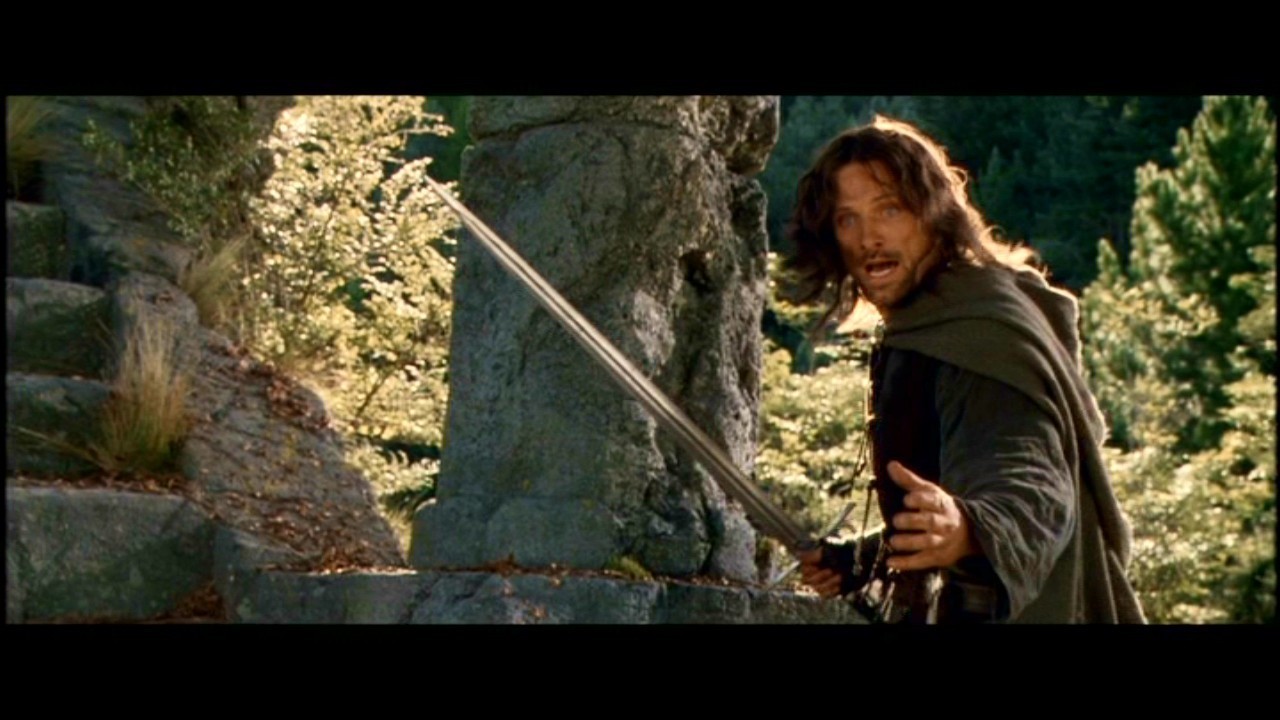
Aragorn, imploring Frodo to flee on his own and leave the fellowship behind. Aragorn then goes on to display his swordsmanship by mowing down waves of orcs.

My Take on the Film (Done after this most recent viewing)

To my slight sadness, the Fellowship of the Ring has lost a bit of its magic for me in the past few years. It’s still a great film, and I can’t see anyone ever attempting to adapt Tolkien’s seminal work onto the big screen again, so successful was Jackson. Still, this recent viewing didn’t hold my attention the way that it had before.

A little history: I LOVED these movies when they came out. When Fellowship hit the theaters, I saw it three times. When it was released on DVD, I watched it another two or three times. When they released the extended DVD version (which brought the film’s length to nearly three-and-a-half hours), I bought it right away and watched it three more times. About four years ago, my local theater did a marathon of the full trilogy, extended editions (nearly 11 hours of film in one day), and I went to it and enjoyed them all, immensely.

So why has my adoration for the movie faded? I can’t say that I’m completely sure. It could be that I just wasn’t in the right mood to watch it upon this recent viewing. I also suspect that, by viewing the 200-minute-long extended edition, I asked too much of myself at that particular time. However, I have other suspicions…

Upon this umpteenth viewing, I experienced some of the same dazed, stupefied disconnection as ol' Boromir here. Mainly, it was during the the sappier Frodo/Sam exchanges.

Once you’ve seen the films a few times, or maybe if you’re really familiar with the books, you may have less patience for the slower moments of the film. And Fellowship does have plenty of what could be called “slow moments.” This is not to be confused with “unnecessary scenes,” as all of the quieter moments do have their purposes: they add depth to certain characters, they reveal relationships or lore about the very rich world of Middle Earth, or they allow the viewer to take in the visual majesty that the film presents. Still, for some reason, these things weren’t enough to keep hold on my attention like they had in the past.

Lest I get too deeply into what I was not as enamored of, I need to spend time on the many positives of this movie. Now, one needs to be aware that this is the ultimate “fantasy” film, based on the “fantasy” story that basically birthed a massive genre of novels, films, cartoons, role-playing games, and so forth. If you haven’t seen these films and you have no interest in medieval-setting mythical tales, then don’t bother. I understand that some people find such things silly and pointless, and those people should stay well away from this film trilogy. I, on the other hand, love this kind of stuff, and Peter Jackson constructed what will probably remain the greatest fantasy film(s) for many, many decades.

Tackling J.R.R. Tolkien’s incredibly rich world of Middle Earth had been attempted before, but only in cartoons. For the many decades that followed the book’s release, there was simply no way that any movie could capture the imagination the way that the books always had. Finally, though, by the late 1990s, the financial and technological means existed for bringing Tolkien’s Middle Earth to live-action life. And right from the first scenes of this first installment, it was clear that Jackson was the man for the job. The prologue in Fellowship, which depicts the background tale of the Dark Lord Sauron’s One Ring of Power and his defeat at the hands of elves and humans, is packed with the visual magic and rousing action that define the film series.

The first, historic battle scene is relatively short, but conveys all of the grandeur and intensity that is intended. After this, though, it takes quite a while for the film to get back to these breathtaking, blood-pumping melees. 

The attention and respect that Jackson constantly pays to the source material is very impressive. Of course, hardcore Tolkien fanatics will nitpick at plenty of little things – “No, Boromir didn’t inherit that sword from that person…,” or “No, it wasn’t Pippin who stole the carrots, it was Merry...” and blah, blah, blah. Those who get caught up in such minor details completely miss the point – Jackson was brilliant at staying as true as he could to the novels while putting together a very entertaining film. The story conveys every bit of wonder and richness embedded within Middle Earth, and the tale of Frodo and the ring are given the epic treatment that they require.

The story itself is the classic, age-old story of a quest undertaken in order to prevent evil forces from dominating the lands. The fellowship formed by the four races certainly presents a compelling mix of mythical history, characters, and archetypes. The various races represent simplicity, power, honor, grace, courage, stodginess, and many other characteristics, in different turns. The ultimate presence of magic, represented by Gandalf and Saruman, adds the mystic and mysterious aspects of the story. To people like me, it can be truly enchanting.

Of course, all of the things explained in the previous paragraph were present in the books. What Jackson did was successfully translate them onto the big screen. Using his native country of New Zealand was a convenient and perfect choice. The small island country’s rolling, verdant hills; craggy, snow-capped peaks; and lush forests provide all of the scenery that Tolkien’s Middle Earth contained. Even someone who has no interest in the story of little hobbits, dwarfs, and elves can watch many of the sweeping shots over the landscape and marvel at it.

Jackson also put New Line Cinema’s massive budget to good work as well, with the end result being phenomenal costumes and visuals. The set pieces are great, and they build up the world all the more. Perhaps my favorite decision of his was to use human actors as much as possible. While there are clearly moments when CGI was used (particularly to create some of the especially enormous buildings, statues, or armies), Jackson opted to use make-up and creature effects as often as he could. Hence, you have many of the orcs, goblins, and other nefarious beings being played by human actors. The effects is that they all seem much more tangible and horrifying. I guess this latter adjective should come as no surprise, seeing as how Jackson got his cinematic start doing extremely graphic and effects-heavy horror films like Dead Alive.

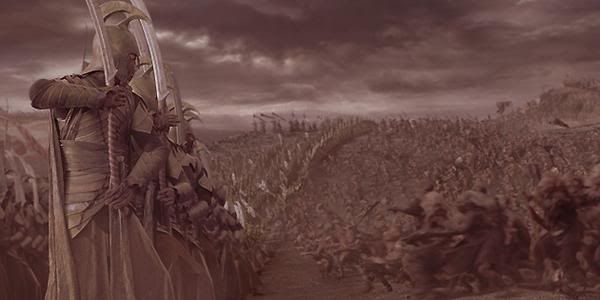
Even when scenes involved dozens of individuals, Jackson didn't cop out with computer graphics - the use of real actors done over in top-notch make up and costumes was an invaluable asset to the film series.

The cast is excellent. From the impish and humble hobbits to the gruff and belligerent dwarves, all of the players nailed their parts right from the start in this first installment of the trilogy. The standouts to me are Ian McKellan as the kindly, paternal Gandalf the Grey and Viggo Mortensen as the mysterious, internally conflicted Strider/Aragorn. Some people might find the dialogue and deliveries to be overly theatrical and dramatic, but I’ve always felt that it fit the setting well. We’re dealing with imaginary myths here, so the speech and deliveries should be delivered with a polished and almost aristocratic air. It all fits perfectly well in this film series.

This does, however, bring me to something that I now find a bit tedious in Fellowship – the relationship between Frodo and Sam. I do understand perfectly well that this relationship is the true heart of the story. The fraternal bond between the two friends is the very type of goodness that is supposed to carry us through dark times, and it is this notion that creates the connection between us the viewers and these completely imaginary characters. Still, once you’ve seen the film a few times (or a half dozen times, like myself and other nerds), the moments that Sam and Frodo share start to drag. Granted, it isn’t a massive focus in Fellowship, but it’s already starting to wear on my attention. Instead of enjoying the moments between the two hobbit pals, I find myself anticipating other scenes. Namely, the action sequences.

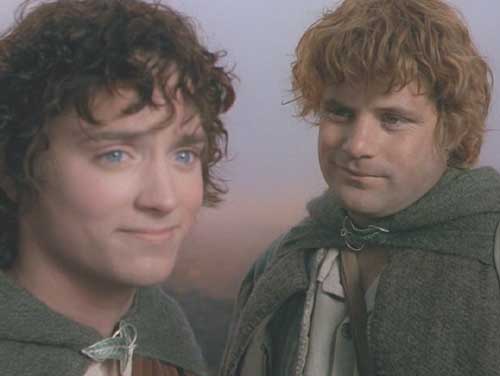
Just a small, early sample of what will be many, many, MANY doe-eyed gazes between Sam and Frodo. It doesn't get terribly annoying until the third film, but it begins in the first film.

In Fellowship, we get several fantastic action sequences, and these serve as great hints of what is to come in the subsequent films. The opening prologue features a rousing depiction of the historic defeat of Sauron at the hands of Isildur. Other fight and battle scenes are equally entertaining, though they take a while to arrive at. The standouts are the trek through the Mines of Moria, including Gandalf’s facing off against the towering Balrog, and the battle in the woods between the fellowship and a patrol of orcs. For a man who had never directed extended action scenes in any of his previous major films (maybe you could include The Frighteners), Jackson proved himself quite astute at directing these scenes. Of course, he would continue to outdo himself in each of the sequels, with battles becoming grander and more spectacular.

*I will be reviewing the other two films in the Lord of the Rings trilogy in the next few weeks, after watching the few other films remaining on the TIME list.

That’s a wrap (sort of). 100 shows down; 5 to go.

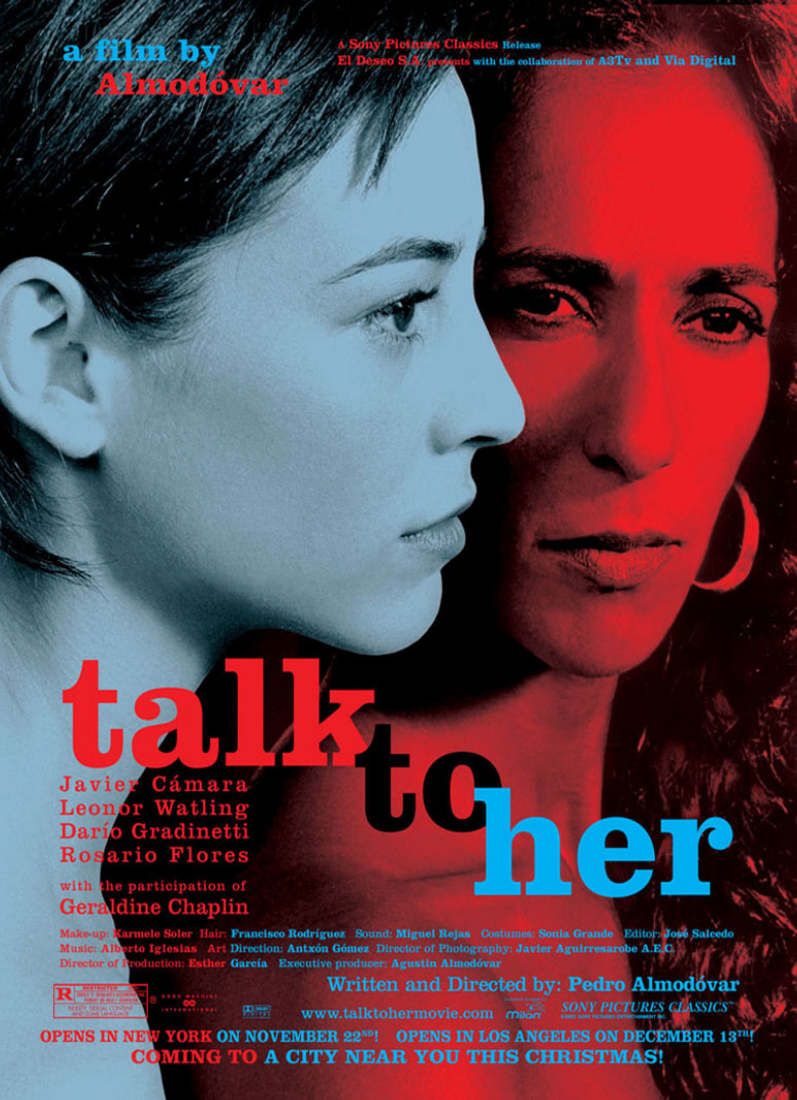
Coming Soon: Talk to Her (2002):


My hunch is that this is a thoughtful, artful drama that has nothing to do with elves and dwarfs cracking wise and killing monsters. It should be an interesting change of pace.

Saturday, March 14, 2020

Star Wars TV: The Mandalorian, season 1 (2019); The Clone Wars, seasons 1 through 3 (2008-20011)

The Mandalorian, season 1 (2019)

A highly entertaining show that, while having a few lulls, was a fun realization of oft-untapped potential in the massive Star Wars universe.

Like many, when I heard about The Mandalorian, it was the final nudge I needed to sign up for Disney's new streaming service, Disney+. It paid off, as both my wife and I enjoyed so much of what the show had to offer.

The show, helmed by Jon Favreau, takes place shortly after the events of Return of the Jedi, in which the Empire has been defeated by the Rebels, led by Luke Skywalker and his companions Leia, Han Solo, and others. Now that the Empire has dissolved, a certain amount of lawlessness has increased throughout the galaxy, opening up opportunities for some while making life more difficult for others. Operating in these tight and shadowy places is the titular Mandalorian, a bounty hunter whose name we don't know and is only referred to by the nickname "Mando," a call towards his cultural tribe. In the first episode, Mando takes on a sizeable bounty to acquire a mysterious person and return them to the client, who is apparently a former Imperial official. Once Mando finds the target, though, things grow exponentially more complicated.

The premise and set up of the show are brilliant, in that they offer so much of what any fan would want - fans of both Star Wars or just fun, lively television. The entire first season is a very manageable eight episodes, each ranging between 35 minutes to an hour, with most clocking in towards the shorter end. While the main story is Mando figuring out how to evade various pursuers, stemming from the initial bounty-gone-wrong in the first episode, several episodes in the middle are fairly stand-alone. On the whole, the series is solid, though one or two of those middle episodes are weaker than the others.

The show finished really strong, with plenty of crowd-pleasing moments that didn't devolve into pure Star Wars fan service. Though the show is very clearly set in the Star Wars universe, it tells its own tale, with its own characters, never relying on cameos by better-known characters from the movies. And this first season did a great job of taking any lose narrative threads left from the first two episoed and tying them all back together in the final two. The title role is done well, if not exactly requiring a great range of skills, especially since his head is covered the entire time. All the same, the writing is solid and the over-arcing story is compelling.

The final episode - the best of this first season - set up the already-confirmed follow-up season very nicely. I look forward to it with plenty of anticipation. Looks like creator, writer, and director Jon Favreau has another really solid hit on his hands.


The Clone Wars, seasons 1 through 3 (2008-2011)

A rather impressive TV series aimed at young adult fans of Star Wars that I had never bothered with until recently. It's clearly meant for a younger audience, but it also offers some decent narrative "glue" for some of us (much) older fans.

Being a Gen X person who grew up in the suburbs, I was as into Star Wars as any such kid of that demographic, and that remained the case well after my teen years. Then came the prequels, which were...underwhelming. Since then, I started to see the entire Star Wars behemoth for what it was - a fun, well-conceived and well-executed PG-rated fantasy tale aimed mostly at viewers between the ages of 5 and 15. But there has always remained that kid in me that has fun watching what the series has to offer, without ever going overboard about it. Hence, I never sought out The Clone Wars, which was a series kicked off with a feature film back in 2008 and telling tales between 2002's Attack of the Clones and 2005's Revenge of the Sith. These are the years during which Jedi Master Obi-Wan Kenobi, Knight Anakin Skywalker (still years before he was turned to the dark side), and Skywalker's apprentice Ahsoka Tano serve as peace-keepers during the long military struggle between the Galactic Republic and a faction of separatist systems headed by former Jedi master Count Dooku.

These first three seasons, while uneven, certainly have their moments. And by the third season, I was impressed at the depth a some of the themes, given that it is a show geared towards younger fans. Like many animated series from the 1980s and '90s, the show offers a mix of one-off, stand-alone episodes and some two- and three-episode story arcs. Typically, it is the arcs that are the strongest tales, and these are often where you find the strongest connections to the feature Star Wars films. The primary addition in terms of characters is Ahsoka Tano, a young apprentice under the tutelage of Anakin Skywalker. The dynamic between the two isn't terribly surprising, with Ahsoka being a tenacious, precicious, and headstrong apprentice, very much like Anakin was under the instruction of Obi-Wan Kenobi. It is the episodes which focus on those three - Tano, Skywalker, and Kenobi, which are the most reliably entertaining.

There are certainly other characters who merit attention and pique one's interest. New Jedi Masters like Kit Fisto (the names are hilarious, if you couldn't tell), Plo Koon, and others are fun. And new Sith apprentice Assage Ventress and bounty hunters like Cad Bane are also entertaining additions.

Of course, it's easy to be reminded when watching that this show's target audience is viewers between, say, 12 and 16. Especially through these first three seasons, very few characters are more than one-dimensional. The heroes are almost always heroic, and the villains are especially villainous. However, there are a few moments where the story shows a bit of nuance and depth, as do certain characters at times. The dialogue isn't going to impress anyone with a discerning ear, often locked into cliche and noted lines from the source movies, but it's passable if one accepts it as it is.

Since I started writing this, I've also worked my way through all of Season 4 and have started Season 5, and the improvements are notable. I'll be sharing my thoughts on those seasons soon. 

Monday, December 6, 2010

Film #41: On the Waterfront (1954)


Director: Elia Kazan

Initial Release Country: United States

Times Previously Seen: twice (last time = about 3 years ago)

Teaser Summary (no spoilers)

Slightly dense young dock worker takes on union-controlling mob on the Jersey shore; raises pigeons while being one.

Uncut Summary (The full plot, spoilers included. Fair warning)

On the shores of northern New Jersey, young former prizefighter and current longshoreman Terry Malloy (Marlon Brando) wants to keep his life simple. He just wants to keep his head down, not cause trouble, and continue getting cushy jobs at the dock through his brother's connections to dirty union boss, John Friendly (Lee J. Cobb). This is all upended when Terry semi-unwittingly takes part in the murder of Joey Doyle, a beloved young local who was about to turn state's evidence against the rampant corruption surrounding the docks.

Terry (middle) meets with the crooked & powerful John "Friendly" (left), while his brother listens in.

The local priest, Father Barry (Karl Malden) implores the workers to muster their courage and testify against the rotten dealings that they all know are wrong, but are too afraid to stand up against. Terry is among those who will not only refuse to testify, but feels obliged to back his crooked brother, Charlie “The Gent” (Rod Steiger), who is one of Friendly's lieutenants. Terry's method is the same as the other longshoremen – to be steadfastly “D and D” - “Deaf and Dumb”.

Terry sticks to these guns until he reunites with Joey Doyle's sister, Edie (Eva Marie Saint), who is home on a break from school and is now desperately trying to find someone who can uncover her brother's killers and put a stop to their brutality. Though rather callous at first, Terry's guilt mounts at seeing the anguish that Edie suffers. Urged by his conscience and Father Barry, Terry eventually confesses to Edie his part in her brother's murder. He then swears to a devastated Edie that he will testify against John Friendly and his crew of thugs.

Word of Terry's relationship with Edie reaches John Friendly, who gives Charlie “The Gent” an ultimatum: convince his brother not to testify or force him into permanent silence by killing him. Charlie meets Terry and tries to sell him on remaining quiet, but Terry refuses. Charlie comes within a trigger pull of killing his brother, but relents. The younger Terry then lets loose all of his pain and disappointment at how his older brother never looked out for him, chasing instead the short-term gains offered by mobsters like Johnny Friendly. A repentant Charlie allows Terry to escape, thus putting himself directly in the line of fire.

Later that same night, Terry meets with Edie, but is lured outside and nearly killed by some of Friendly's goons. They fail to kill Terry, but they leave him a clear message – Charlie's dead body hung up on a fence. Terry becomes enraged, finds a gun, and goes hunting for John Friendly at the local bar. Fortunately, Friendly is not there, forcing Terry to wait for him and giving Father Barry and Edie enough time to come and convince Terry not to try and kill Friendly. Instead, he agrees to bury Friendly in court, which is exactly what he does the following day. An enraged John Friendly erupts and swears that Terry will never work a shore on the eastern seaboard as long as he lives.

After testifying against Friendly, Terry's life becomes far from easy. Quite the contrary, he has now been labeled a rat and stool pigeon by most of the longshoremen who have for decades adhered to the gospel of “D and D”. With Terry's name being sullied seemingly beyond repair, Edie urges him to leave with her to some other part of the country. Terry refuses and heads down to the dock to receive his “rights” - a regular job.

At the shore, Terry stands in a crowd, though is clearly a pariah. While John Friendly may be under indictment and unable to openly muscle anybody at the dock, he still holds sway. Jobs are offered to every longshoreman but him. Terry stalks towards Friendly's headquarters just off of the main pier, in order to confront him. Terry pummels Friendly in a fistfight, only to be beaten unmercifully by Friendly's entourage of goons.

Father Barry & Edie try to get the battered Terry back on his feet.

All of the dockworkers are called back to their jobs. Now, however, they are greatly heartened by Terry's willingness to go toe to toe with John Friendly. They all refuse to work unless Terry is given a job first. Terry must overcome his physical pain and get on his feet. With extreme effort, he does so, and leads the dock workers to their day's work, now seemingly out from underneath the crushing thumb of John Friendly and his gang.

Take 1: My Gut Reaction (Done after this most recent viewing, before any research)

Great movie, though one that had a few blemishes that only five-plus decades reveal and that I didn't recall from past viewings. Basically, though, the things that irked me were either in the first half of the movie, or were easily overlooked. By the end, they were nearly forgotten.

Right away, the music bothers me. It's a score by the famous Leonard Bernstein, and I found it way too bombastic and intrusive. I realize that this is simply the way dramatic effect was achieved in a lot of films of the day, but I found it jarring at times. No sooner are the opening credits finished than an assault of typanies, cymbals, and strings are shattering any attempt at gradual tone-building. It's about as subtle as getting smacked with a mallet.

There is also a lingering silliness to some of the melodrama in the film, something that ties to the music and is, of course, par for the course in a 1950s movie. Really, though, the semi-hokey emotional outbursts and humor are relegated to the already two-dimensional supporting characters. The primary characters are blessedly free of the cliched.

Aside from these, On the Waterfront is outstanding to me. The tale itself is something that has been redone in lesser forms many times over (think The Insider and others), but stands out as being one of the best character development stories I can think of. Terry Malloy is such a well-conceived, plausible and fully formed character that I completely buy the stunning metamorphosis from self-interested layabout to righteously indignant revolutionary. The four characters that lead him on this journey are equally well-constructed: Friendly, Father Barry, Edie and Charlie. Each one, sympathetic or otherwise, is part of the stuff that transformations are made of, and each one awakens a different part of Terry that he didn't seem to know he had in him. Edie inspires compassion, Father Barry courage, Charlie disappointment, and Friendly wrath. It's a wonderfully composed positioning of characters that culminates in a truly satisfying story arc.

Here's the single most famous scene in the film. If you've seen the movie before, it's well worth another watch. If not, you may not want to spoil the impact by watching it by itself. Either way, you're witnessing film acting evolve right before your eyes:


Of course, even the most carefully crafted characters on paper can fall flat if not performed well. No such problem here. Marlon Brando is so incredible as Terry that it's hard to imagine anyone else doing the part. For an actor to be convincingly brutish, callow, remorseful, playful, charming, forlorn, and enraged in turns is an amazing feat. It's even more amazing when you compare this role to others that he played, notably A Streetcar Named Desire, in which his Kowalski was far less charming and much more of a true lout.

As mentioned, the supporting cast is equally strong, especially Karl Malden. Here again it helps to compare his role as the smoldering Father Barry with his role in Steetcar, in which he played a sad, lonely bachelor who invited little more than sympathy. The contrast is marked and impressive.

As he did with Streetcar, director Elia Kazan displays incredible skill in choice of cinematographers. The play of light and shadows throughout the movie give On the Waterfront just the right feel. The night scenes convey such a palpable sense of darkness and danger that a viewer understand that these Jersey docks are no place for outsiders, and it is not in one's best interest to go poking into its darkest corners. On the opposite side, the daylight scenes on the shores, either on the docks or especially when Terry is with Edie, offer those moments of hope and freedom that Terry aspires to, perhaps unconsciously at first, but with growing awareness as the story progresses.

Worth mentioning is something that might not seem as obvious but my girlfriend pointed out – the extras in the movie, even all those without a single line of dialogue, add a great aesthetic element to the whole film. In her words, she had, “never seen so many faces with so much character in one movie.” Too true. I have to think that most of those guys were the real deal: honest-to-God dockworkers whose back-breaking work and arduous lives were obvious in the lines and scars running across their weathered faces.

On the Waterfront has now spent over five decades among the pantheon of “greatest American movies” with good reason. This recent viewing of mine tells me that there's no reason that it shouldn't spend many more decades in exactly the same place.

Take 2: Why Film Geeks Love This Movie (Done after some further research)

Plenty of storylines emerge as one digs into the film just a bit further.

One is the political context. On the Waterfront was, as director Kazan openly admitted, his response to those who criticized his testimony to the House Un-American Committee two years before the release of Waterfront, in which he “named names” of associates with ties to the Communist Party. Many would never forgive Kazan for this, but he used the story of Terry Malloy to present his position in a sympathetic light. Whether one wants to see Kazan and Malloy's stories as analogous is up to the viewer.

The story of the movie was taken from very real occurrences on the Hoboken docks in the 1940s, particularly the latter part of the decade. It all came to a head when a whistle-blower named Anthony DiVincenzo dropped dime on the rampant corruption and was somewhat ostracized, the condition dramatized at the end of On the Waterfront.

I found it interesting that, despite being roundly lauded by nearly all critics and raking in 11 Oscar nomination and winning 8, the original TIME review is a bit lukewarm. However, even the harshest critiques I came across could not ignore the power of the acting and the masterful cinematography by Boris Kaufman. I find it also of note that more than a few critics, both past and present, point to Marlon Brando as ringing in the modern style of “realistic” acting. This is rather clear when you compare his performance to nearly any other actors' in his 1950s movies. Current day film critic royalty Roger Ebert covers a lot of ground on this and nearly everything else in the film in this essay.

Less important but equally curious trivia about the film: the extras in the movie were, as a viewer would expect, authentic dock workers; the men who played John Friendly's tough-guy bodyguards and goons were, in fact, former heavyweight boxers. The stunner piece of trivia to me was the original choice for the role of Terry Malloy: Frank Sinatra. That's right. The Jersey native Ol' Blue Eyes had been given the thumbs up, and the ball was rolling on getting him outfitted when Kazan and the studios decided to go for Brando, whose prestige and higher price tag would allow them to ask for a larger budget. The studio agreed and Sinatra was out. Imagine that – Mr. “New York, New York” himself in that same role. I guess it could have worked, but it's tough to picture.

Here's the grande finale, in which Terry delivers a beat-down, receives an even bigger beat-down, and then heroically recovers from said latter beat-down. As with the previous clip, you may not want to watch if you've never seen, and have intentions of watching, the movie:


So there it is. Just a few of the interesting footnotes on a film that any cinema fan needs to see. One can certainly debate the relevance of the political themes and the artistic credibility of using a movie to defend one's real-life political actions, but I don't see that one can question the clear merits of this movie. If you haven't seen it, it's more than just worth your time – it's all but required viewing.

That's a wrap. 41 shows down. 64 to go.

Coming Soon: Pather Panchali (1955)


And our first entry from India! I have seen this once, and it's widely considered one of, if not the, titan of Indian film. We'll see how it comes off.

Please be sure to pick up all empties on the way out.

Sunday, November 7, 2010

Film #37: Singin' In The Rain (1952)


Directors: Stanley Donen, Gene Kelly

Initial Release Country: United States

Times Previously Seen: once (about ten years ago)

Teaser Summary (no spoilers)

Cheeseball silent film star stumbles through transition to talkies while finding love and dancing, wearing a shit-eating grin.

Uncut Summary (The full story, including spoilers. Fair warning)

It's 1927 and silent film stars Don Lockwood (Gene Kelly) and Lina LaMont (Jean Hagen) are the toast of Hollywood. They are in the middle of a string of commercially successful, if formulaic romance/adventure movies. Despite their obvious film success, however, the two could not be more different in real life. Don is a happy-go-lucky man who, with his closest friend Cosmo (Donald O'Connor) has worked his way up through the entertainment world by building his singing and dancing chops in all manner of low-brow acts. Lina is a no-talent, dim-witted, high maintenance egomaniac who seems to believe herself a princess simply because she plays them in the movies.

Along comes the landmark film The Jazz Singer – the first talking picture. While most of Hollywood dismisses it as a novelty gimmick, the film's smash success sends all other studios scrambling to follow suit, including Don and Lina's. The transition could not be rougher. Though Don has some trouble, the biggest problem is Lina, whose pretty face is no longer enough. Her high, shrieking New York “city goil” accent cannot be tamed into anything listenable. Not even costly enunciation lessons can can break through her thick skull or provincial, nasal voice.

To the rescue comes Don's new love, Kathy Seldon (Debbie Reynolds), an adorable, spunky little entertainer whose remarkable dancing ability is only outdone by her incredible singing. Cosmo hatches the idea of using Kathy's voice as an unseen proxy for Lina. Since Lina's is the beautiful face that viewers know and love, they'll have her lip synch the dialogue and songs as Kathy sings them.

Cosmo, Kathy and Don rip through one of their many happy little tunes.

The plan works, and the latest Don Lockwood/Lina LaMont film is made. Once the movie is in the can and awaiting its premier, however, Lina starts to do the one thing that she probably shouldn't: think. Jealous of Don and Kathy's love and Kathy's genuine talent, Lina attempts to legally blackmail the movie studio into making Kathy her permanent voice. The studio head is furious, as he has plans to groom Kathy into their next big star. Flustered, all are left to stew on Lina's selfish machinations.

Everything comes to a head at the movie premier, where the film is shown to an audience who loves it. To roaring applause, Lina decides to really drive her plan home. She attempts to give a speech, but her true voice and condescending comments baffle the crowd. The uncertain viewers demand that she sing, “like in the picture.” Knowing that she has no hope of singing as well as Kathy, Don and Cosmo create the perfect set-up: they tell Lina to lip sync the words as Kathy sings the song just behind Lina and a dividing curtain. In the middle of the song, the curtain is raised, Lina is exposed as a fraud, Kathy's true talent is revealed, and all of the good guys live happily ever after.

Exit, stage right.

Take 1: My Gut Reaction (done after this most recent viewing, before any research)

This musical very often flirted with sliding into the same category as Meet Me In St. Louis, West Side Story, and The Sound of Music: musical films that I simply can't stand. It did, however, manage to fall just on the right side of the line separating amusing viewing from insufferable fluff.
I guess the key ingredient for me was the intentional cheese factor. There is a self-awareness that, while not perfect, was present enough to provide some timeless laughs. From the jump, you get Don Lockwood's shit-eating grin as he shows up at he and Lina's latest premier. While on the red carpet for the pre-show interview, he claims to have always used the word “dignity” as his motto. During this pompous speech, we're treated to a montage of ridiculous and demeaning jobs that he's taken in the past. The scenes are actually pretty funny, and the sarcasm underlying it works well.

This self-effacing tone keeps surfacing occasionally throughout the film, though in fits and starts at times. When its not there, Singin' In the Rain does become rather tiresome. The most obvious moment of this is a bizarre “advertising” sequence during the “Beautiful Girls” number, which seems to be nothing more than an excuse to show off an array of fashion models posing in various costumes. It was a rather bizarre waste of screen time.

It's really the great irony of the film to me: most of the humor is based on ridiculing the superficiality of popular silent films and its stars. And while it's funny to see how talkies exposed this superficiality in the film, the film Singin' In the Rain is, itself, a showcase of superficiality in many ways. You have to acknowledge that Kelly, O'Connor and Reynolds were phenomenally talented singers and dancers. Still, the movie is almost all about flash and show. Sure, it's not as shallow as bad silent films, in which you just needed a few few pretty faces and melodramatic physical acting, but it is still a pretty shallow exercise all the same. If not for the novelty and flash of technicolor cinematography to show off the hyper-colored costumes and sets, I have to wonder if this film would have been such a marvel in its day.

Here's a perfect example of the useless, harmless tone of the film, as seen in the well-known bit, "Good Mornin'":


Despite my skepticism at the depth of the movie, I have to admit to how incredible Kelly, O'Connor and Reynolds were. Even if several of the musical numbers were contrived and hokey, some of them were masterpieces of choreography. Granted, by the end I had pretty much had it with the songs and dances (the 15-minute long 20s number was a test) and just wanted the story, such as it was, resolved, but when I was still engaged in entertainment bits, they were a lot of fun to watch.

The real gem of the movie is the second-billed Donald O'Connor, who may not have had the tanned good looks or raw dancing power of Gene Kelly, but seemed to have more pure athleticism and better comedic timing that his better-known co-star. His “Make 'Em Laugh” routine may be one of the best I've ever seen, being heavily rooted in the physical comedy of Keaton, Chaplin, The Three Stooges, and everything in between.


Here's a link to the astoundingly energetic "Make 'Em Laugh" number.

Singin' In the Rain didn't hold up on this second viewing as well as I had hoped, but it wasn't nearly the exercise in patience that watching other musicals has been. It's a light, fun little movie that I'd recommend to someone who likes musicals in general, and doesn't need an enormous amount of plot depth.

Take 2: Why Film Geeks Love this Movie (done after some further research)

No shockers here, though a few interesting little tidbits after doing some digging.

Like other films that are on TIME's list (It's a Wonderful Life, Detour, and others), this “classic” was not hailed as such immediately. The critics in 1952 seemed to like it, but considered it a touch inferior to the previous year's Kelly dance offering, An American In Paris. Like the other films mentioned, it was only after several years on the shelf and a re-release in 1958 that the masses and critics gave the movie a more special place in their hearts and minds. At this point, it's often praised as the hands-down greatest American musical of all time. I personally don't see it as such, preferring Swing Time or even Cabaret, but I can't knock anyone for the more popular opinion.

Something I didn't realize is that not one of the songs was composed solely for this movie. They were all written years prior, for a number of other shows. This may account for the seeming disconnectedness as far as lyrics and tone go. Not that it mattered much. It's clear that musicals certainly don't need inter-song cohesion to be effective. Each song in Singin' In the Rain, if not my cup of tea, is certainly snappy or catchy.

One better-known tidbit is that during the iconic title song and dance routine, Gene Kelly was operating with a 103 degree fever. I know that when I'm in such a state, I can barely lift my arm to change the channel on my TV, let alone bound and vault around with the reckless abandon that Kelly did during that routine. Incredible. Click this link to see what he did while sick as a dog.

Another curious anecdote is about Debbie Reynolds. At the time of the film, she apparently was a gymnast rather than a trained dancer. Her lack of skills in the latter area enraged Gene Kelly into yelling at her at one point, after which she left the set to have a good cry under a piano on another set. Who should find her there but one Mr. Fred Astaire. Taking pity, Astaire decided to work with Reynolds to get her dancing up to snuff. After reading this story, I can't help but move ol' Fred a few notches further up the “hulluva guy” ladder.

So the research really does nothing to change my opinion of this movie. A good, solid musical that provided me with enough entertainment so that it wasn't a struggle to get through, which his saying something considering my general opinion of the genre.

That's a wrap. 37 down, 68 to go.

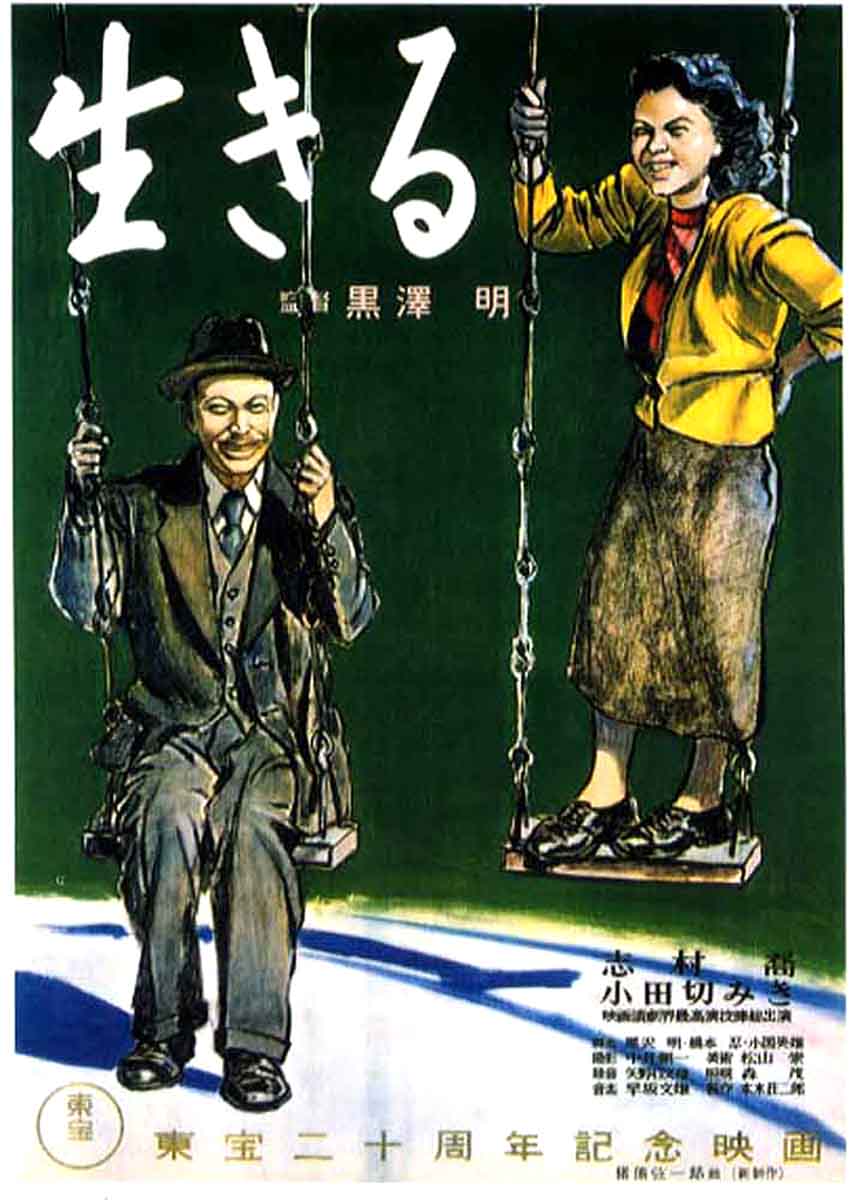
Coming Soon: Ikiru (1952):

Another film about a sad old man, this one in Japan. We'll see if this poor old bugger makes out better than Umberto D.

Please be sure to pick up all empties on the way out.