Tuesday, January 24, 2012

Film #71: La nui americaine (1973)


Title for us English-speaking types: Day for Night

Director: Francois Truffaut

Initial Release Country: France

Times Previously Seen: none

Teaser Summary (No spoilers)

A director deals with the endless technical and emotional chaos on the set of his current picture. 

Extended Summary (A more detailed plot synopsis, including spoilers. Fair warning.) 

France, 1973. Noted film director Ferraud (Francois Truffaut) is trying to get his current project up and running smoothly. Well, as smoothly as possible for a film. The financial backing is imposing stifling deadlines, the script is in constant flux, and the cast and crew have brought all of their emotional baggage with them. The film the Ferraud is attempting to make, May I Introduce Pamela, involves a young man bringing his new bride home to meet his parents, only to have her and his father fall in love and leave the rest of the family.

As emotional as this fictional tale might be, it pales in comparison to more immediate concerns of the cast and crew trying to bring the story to life. Ferraud must deal with almost no end of troubles. Each member of the cast either has gone through, is going through, or is trying to recover from some sort of depression or mental fatigue. The lead actress, Julie (Jacqueline Bisset) is returning from a hiatus to recover her mental health. The young actor Alexandre is an emotional juvenile whose neediness and jealousy knows almost no bounds. The elder supporting actress, Severine (Valentina Cortese), is in the full grip of alcoholism and struggles to so much as remember her lines. Add into this the little quirks and difficulties of the crew, from the script co-writer right down to the lowliest prop man, and Ferraud has his hands both full and tied.

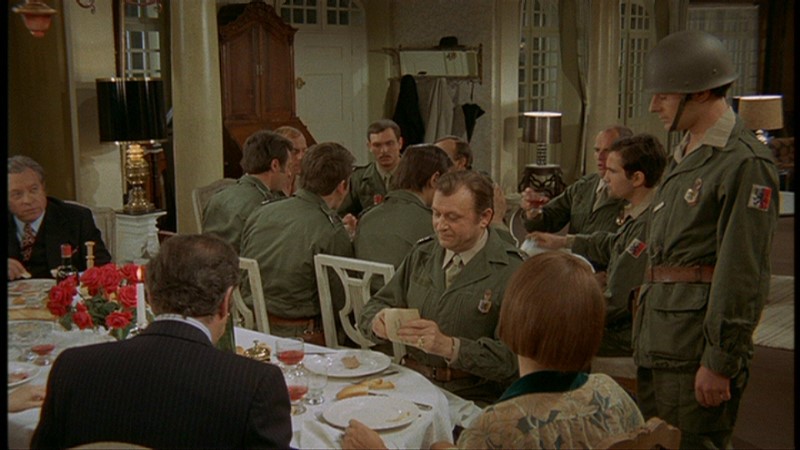
It takes an army. Virtually everyone in this shot either loves, hates, has slept with, and/or will sleep with someone else in this shot. Maybe multiple someones. 

The greatest tests come near the end of filming. First, Alexandre’s girlfriend, the older and more worldly Liliane, leaves him for a British stuntman. This leads to Alexandre sleeping with his co-star Julie, much to the chagrin of Julie’s real husband. Just as all of this gets sorted out, one of the other key actors, Alphonse, dies in a car accident. Despite the insanity and tragedy, Ferraud manages to see the film through to its end. As shooting wraps up, the cast and crew part ways, though many of them clearly expect to see each other on projects. As strange and chaotic as it seems to most, this is the life they choose.

Take 1: My Gut Reaction (Done after this first viewing, before any further research.) 

Day for Night is an enjoyable, extremely well-constructed film that I probably don’t need to watch again. In a style similar to some of Robert Altman’s more renowned movies (M.A.S.H., Nashville, and especially The Player), Francois Truffaut decides to give us a panoramic view of the insanity surrounding a film set. I suppose some people see the subject matter as being self-important and self-aggrandizing, but Day for Night certainly doesn’t come off that way. The interactions between the characters is far often far too playful to be mistaken for pretension on Truffaut's part.

Director Ferraud instructing Julie on exactly how to hold her hands. Day for Night is full of such minutiae of film-making. It's actually fascinating. 

There is no way that I can avoid comparing this movie to its chief forebear: Federico Fellini’s 8 ½ . If looking at a brief treatment, it may seem as if Truffaut pirated Fellini. Both films are about making a film, and both convey the maelstrom surrounding the endeavor. Fellini, though, focused much more on the fantastic inner mental workings of the director-as-artist. Truffaut’s Day for Night takes in the entire scope of the project, not giving too much time to any one person, only delving slightly into a few characters’ minds. The only other clear similarity is that both films expertly achieve what they wish.

As mentioned, there are some graver moments and themes in the movie, such as Severine’s waning ability and waxing alcoholism. But this is tempered by her generally amiable demeanor. There are also Julie’s recovery from depression and her affair with Alexandre, as well as Alphonse’s sudden and tragic death. These, as upsetting as they may be, are quickly resolved and the film, just as the crew in the film, moves on. We viewers are given little more than a few brief moments to feel any lingering pain before being swept away by the inertia of the film-making process and lifestyle. Truly, the show must go on.

Technically, the film is brilliant. While there are no special effects to speak of, the cinematography pulls off plenty of great little maneuvers to draw the eye. To add a layer, you are often getting to look behind the curtain of filming, as we see plenty of the wild and contorted techniques that the May I Introduce Pamela cameramen have to employ to achieve the desired shots. At times, it’s like watching gymnasts do magic tricks in the middle of their routines.

One of the many shots that's not only eye-catching but also pulls back the movie magic curtain a bit. 

On par with the visuals is the acting. Every person plays their part perfectly, from the highly emotional and quixotic actors to the earthier and more practical crew members. Even Truffaut, playing himself in spirit, if not in name, does admirably. The key is that virtually all of the characters are either intriguing, funny, tragic, or a compelling combination of all three. In this, Day for Night taps into the voyeurism that is at the core of the appeal of cinema. We want to watch what all of these people do with and to each other.

All of this being said, I doubt that I will ever watch the movie again. As much as I enjoyed it and can see its strengths, I simply don’t know what I could get out of a second viewing. Hardcore film experts and budding film-makers could probably milk it for endless inspiration and knowledge, but I’m neither. I’d recommend it to anyone who enjoys learning about the filming process and enjoys a healthy dose of oft-light drama and humor. It’s also a great little follow-up to the aforementioned 8 ½ .

Take 2: Why This Movie’s Considered “Great” (Done after a wee bit o’ research.) 

A very wee bit.

It would seem that this movie has gained its praise for the sheer love of film that it conveys. Roger Ebert revisited it in this 1997 review, and he expresses a lot of the enjoyable elements of it well. He points out how the film shows how all of those involved in the film industry, creators, actors and crew alike, are often inebriated on the culture of the filming process. The quirky, high-drama relationships that develop and then dissipate over the course of a few weeks of filming seem as a drug. I suppose it should be no surprise that film critics, almost all of whom must truly love the medium of film, would love such a movie. It taps into their own passions, so a playful, thoughtful, and entertaining movie on the subject is bound to be adored by the professional critics. Day for Night fits the bill.

After this little bit of digging, I feel that Day for Night is a touch overhyped. Compared to nearly all of the other movies on this list, including Truffaut’s own 400 Blows, Day for Night I feel is considered great more because of its subject matter rather than any standout novelty. I do think that viewers who are looking for something a little different and humorous would enjoy it, but perhaps shouldn’t expect the mind-blowing movie that you may expect from an “All-TIME 100 Film”. 

That’s a wrap. 71 shows down. 34 to go.

Coming Soon: Chinatown (1974):

The classic film noir genre gets brought up to date in this slick 1970's Roman Polanski classic. This film kicks off a great streak of 1970s movies in the coming weeks that are some of my absolute favorites. Come on back for my take on it.

 Please be sure to pick up all empties on the way out.

Sunday, January 8, 2012

Film #70: Aguirre, der zorn gottes (1972)


Title for us English-speaking types: Aguirre, The Wrath of God

Director: Werner Herzog

Initial Release Country: Germany

Times Previously Seen: once (about 8 year ago)

Teaser Summary (No spoilers)

Small crew of conquistadors & slaves search for El Dorado. One of them goes batty, much to the dismay of the rest.

Extended Summary (More complete plot synopsis, including spoilers. Fair warning.)

Peru, 1560. The conquistador Pizarro is in the middle of his search for El Dorado, the fabled “City of Gold”, which is rumored to be hidden deep within the Andes. However, with supplies running short, Pizarro decides to split his group, sending a scout group of forty farther down the river to find El Dorado. The leader of the group is the noble Don Pedro de Ursua, with Don Lope de Aguirre given second command. Joining them are a handful of other conquistadors, several Spanish soldiers, about a dozen indigenous slaves, Ursua’s wife, and Aguirre’s daughter.

The scout group heads downriver, but things soon go awry. One of the rafts is caught in an eddy, and most of the men aboard are mysteriously slaughtered overnight while the rest of the crew sits unaware on the opposite bank. Ursua wants to bring the dead men back to main camp for a Christian burial, but Aguirre circumvents this plan by having a crony sink the raft and dead men before anyone can retrieve them. Thus begins Aguirre’s usurpation of the group.

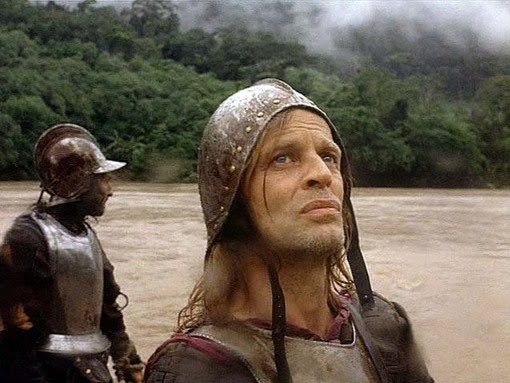
The buffoonish Don Guzman, unwittingly about to be "elected" as "Emperor of El Dorado".

Over the coming weeks, the expedition unravels. Aguirre heads a mutiny, puts Ursua in chains, and nominates the bloated Spanish noble Don Fernando Guzman as their new leader. Guzman, however, is merely a proxy for Aguirre’s ever-growing mania. Obsessed with obtaining glory and power, Aguirre and his reluctant followers draft a declaration of independence from Spain. The group dubs Don Guzman as “Emperor of El Dorado” and the Spaniards begin dreaming of laying claim to the untold hoards of gold somewhere in the mountains.

As the treasure-seekers continue, their numbers are gradually reduced. A few men are killed by cannibals, silently sniping them from the river banks with arrows. The river rises to a point that their rafts cannot reach the land. Their food dwindles, and their spirits wane. Don Guzman himself is eventually found dead on their raft. With their “Emperor” gone, the few remaining in the crew are at the mercy of Aguirre’s ever-deepening mania. He has Ursua hanged and demands that they press on towards El Dorado. When one of the Spanish soldiers plots to escape and return to Pizarro, Aguirre immediately has his head cut off.

The crew drifts on for several more weeks. Their food supplies become exhausted and they are gradually laid low by disease and delirium. Just at the point when the few survivors are in the final stages of starvation, they are attacked by the natives a final time. Arrows take down nearly all of them, including Aguirre’s daughter. Aguirre, now fully insane, imagines himself and his now-deceased daughter not only finding El Dorado, but building a world-sweeping empire together. He stands alone on the corpse-laden raft, stuck against the shore, as dozens of tiny monkeys swarm around him.

For a bafflingly exhaustive synopsis, check out imdb’s link here.

Now thoroughly lost in his own dementia of grandeur, Aguirre preaches to the only thing left living.

Take 1: My Gut Reaction (Done after this most recent viewing, before any research.)

Aguirre, Wrath of God is a really impressive film, though not in very obvious ways.

Since making this movie, director Werner Herzog has solidified his reputation as an adventurous, film-making wild man, whose prime theme is nature’s indelible power over humanity. Through his dramatic films and, more recently, his brilliant documentaries, he has explored Mother Nature’s inescapable impacts on humans. In the relatively early work, Aguirre, he explores how natural forces can crush even the most powerful, driven, and maniacal impulses of mankind. It’s fascinating and disturbing to watch.

Visually, Aguirre may initially seem a touch amateurish. When compared to similar films such as The Mission or Black Robe, the camerawork seems shaky. However, it’s merely a function of hand-held technique, and I actually enjoyed the documentary type feel that it lends the tale. I got the sense that this is probably about as accurately as someone could portray these events from several centuries ago, giving an “if you were there” feel to it all. By the end, the little jolts and wavering of the camera angles enhanced the mounting chaos surrounding the expedition.

The disintegration of the conquistadors makes for compelling, if depressing, cinema. The more level-headed and righteous Don Ursua is subdued with disturbing ease by the quietly ruthless Aguirre. Almost as warped is the compliance of the accompanying monk, Brother Carvajal, who readily admits early on that “the church has ever been on the side of the strong”. The remaining Spaniards, dreaming of gold and glory, are willing to overlook Aguirre’s obvious psychosis so that they may lay claim to the chimerical treasures said to lie farther down the river. One could look at all of this as allegory, which can be fun, but it’s plenty interesting enough in and of itself.

The rather un-Christan Brother Carvajal, one of the majority who choose to chase Aguirre's mad dreams for power and glory.

Most viewers, myself included, would have to admit that some of the supporting acting is a bit shoddy. Fortunately, it hardly matters, as the primary roles are done well. Of course, the title role of Aguirre himself is key, and Klaus Kinski is amazing. His frog-like, protruding eyes and wide mouth. The wildly off-kilter shoulders and strange gimp. These physical deformations belie the dementia-driven ambition that lies within the obsessed would-be conqueror. Often with little more than an intense stare, Kinski’s Aguirre wills nearly all those around him into doing his bloody bidding. It’s absolutely mesmerizing, and Kinski draws your eyes in virtually every scene.

Amid the intense and brutal exploits of the Spaniards are the eerily quiet moments of the western Amazonian rain forest. As the rafts float along the river, the latent power of the whole environment is palpable. As the film progresses and the crew is gradually laid low, it becomes clear that they never stood a chance. Their cannons and rifles may have given an advantage over some of the primitive cannibal tribes that they encounter, but ultimately the locals and the jungle wipe out the invaders. Perhaps most interesting is that, while the “conquerors” failed tragically in their quest to subdue the land and its people, the land and its people quash the interlopers with nary a bat of the eye. Aguirre and his crew’s grand ideals for power and immortality amount to little more than an insignificant nuisance, if even that, to their destroyers.

As you can tell, this is not exactly a popcorn movie. One probably should not expect to be “entertained” by it. At only a little over 90 minutes, though, it is not a massive time commitment, and there’s plenty of beautiful, natural imagery juxtaposed with the brutality. I would recommend that everyone watch it at least once, for it offers a great perspective on humanity’s place in the natural world. The themes in Aguirre, though expressed in a setting nearly five centuries old, are just as poignant today.

Take 2: Why Film Geeks Love this Movie (Done after some further research.)

How much fact? How much fiction? Anyone who watches a “historically based” movie has to wonder this. The answer in the case of Aguirre, The Wrath of God is a mix. Herzog did use a few historical accounts about a real expedition involving some of the men and women portrayed in the film. However, Herzog streamlined and refashioned them to keep the film tighter. The reality is actually more terrifying. The historical Aguirre did attempt to lead a revolt against Spain. Rather than meet his fate in the middle of a Peruvian river, though, he set up on an island off the coast of Venezuela. His vainglorious attempt to overthrow the Spanish crown ended with his men deserting him for pardons and Aguirre being captured, drawn and quartered, but not before he killed his own daughter.

As if the film rendition of the psychotic Don Lope de Aguirre weren't terrifying enough, the actual man was probably even more frightening.

Herzog’s modified film version is what any maverick film-maker seeks: a monumental piece of art made on a laughable budget. Herzog made this film on a measly $350,000, but he showed how vision and talent can overcome such financial limitations. While not released in the U.S. for several years after its unveiling, Aguirre was an instant critical success around the world. In the forty years since, its stature has only grown. Some of the most heavily and obviously influenced films to follow Herzog’s basic template are: Apocalypse Now, Predator, The Mission, and The New World. I’ve seen the first three, and though they are vastly different from one another, I love them all.

There are no real surprises when it comes to why this movie is so lauded. In this 1999 review, Roger Ebert does a nice job capsulizing the merits that virtually all other professional reviewers see in not only this movie, but many of Werner Herzog’s others.

Probably the most fascinating thing to learn about this movie is the borderline insanity of lead man Klaus Kinski. If you read the Ebert review referenced above, you get some of the tales. An even more complete list of Kinski’s Grade-A whack-job antics is here at wikipedia, including his shooting off an extra’s finger, and basically scaring the living hell out of everyone on the set. Herzog used this to the film’s advantage, allowing Kinski to have his volcanic temper tantrums, run out of energy, and then film the desired scene. The result is magic. By adding the odd limp to his stride, coupled with his own very real, smoldering anger, Kinski as Aguirre is a frightening sight to behold.

By the end, this is all that's left of the men's hopes of reaching the Lost City of Gold.

That’s a wrap. 70 shows down. 35 to go.

Coming Soon: Day for Night (1973):


Another film that I know nothing about, aside from what it says on the sleeve of the DVD. Come on back in about a week to see what I think about this French film.

Please be sure to pick up all empties on the way out.

Sunday, January 1, 2012

Film #69: Le charme discret de la bourgeoisie (1972)


Title for us English-Speaking Types: The Discreet Charm of the Bourgeoisie

Director: Luis Bunuel

Initial Release Country: France

Times Previously Seen: once (about 3 years ago)

Teaser Summary (No spoilers)

Sextet of middle-classers try to get some grub repeatedly. Fail repeatedly. Have weird dreams between each failure.

Extended Summary (Slightly longer plot synopsis. Spoilers included. Fair warning.)

Actually, my little caveat above is more pointless than normal. It's all but impossible to “spoil” this movie, given the story.

In early 1970s Paris, four middle-aged, middle-class people arrive at a pleasant home for an evening dinner, only to surprise the supposed hostess, who tells the four that their dinner date is for the following evening. This also explains why the hostess' husband is not there. The five improvise and head out to a nearby inn for some dinner. Their effort is thwarted, however, when they enter the inn to find a funeral service being given for the recently-deceased owner.

The next day, the three men, two of them French government officials and the other a diplomat from a South American country, meet in the diplomat's office. The three are involved in drug smuggling. The two Frenchmen's wives and single sister-in-law are clueless to their doings.

Just one of the many soon-to-be interrupted attempts at dinner. If you look closely, you can almost see the arrogance and entitlement radiating off of all six of the "friends".

Over the next several days, the sextet repeatedly attempt to have a meal or a drink together, only to be thwarted at every turn. Whether they are in pairs, trios, or larger groups, every time they are about to be served, something interferes. Some interruptions are mundane: the first evening's schedule mix-up, or a restaurant being out of basically everything. Others are far more bizarre, such as being interrupted by strangely forthcoming soldiers barging in and unburdening themselves with odd tales. Still others take the form of dreams begun but unfulfilled.

Most of the six people get lost briefly in a dream of theirs. Some include the embarrassment of being caught on a theater stage, having forgotten one's lines. Others have dreams about being in a duel, or being arrested with all of their friends for their illegal drug smuggling. Whatever the dream or interruption, not one of the person's tales, or even tales within tales, is completed.

One of the more violent dream sequences, with the Senechal gunning down a man who has offended his honor.

Interspersed throughout the menagerie of unfulfilled narratives are occasional looks at the entire group of six, walking along a desolate road in the middle of the country, with no clear goal in sight.

I would offer a link to a more detailed, complete plot synopsis, but finding one it rather difficult. Read into that what you will.

Take 1: My Gut Reaction (Done after this most recent viewing of the film, before any research.)

When American comedians make fun of “weird European movies”, The Discreet Charm of the Bourgeoisie is almost certainly what they have in mind. As you may be able to tell from my rather vague plot synopsis, this movie does not fit into any standard categories. There is no main story arc (aside from six people trying to get some food), and virtually no standard cohesion from one scene to the next. The mad hopping between dream sequences and quirky occurrences can be dizzying, and I think any viewer can be excused for uttering “Whaaahh...??” more than a few times while watching.

Did I like it? Actually, yeah. More or less.

I felt like I had a pretty good handle on what director Luis Bunuel was doing with this movie. I had seen it before, and I felt like I “got” the point. And then, after watching, my girlfriend articulated it far better than I could. She explained that she'd never seen a film that captured the “unfulfillment aspect” of dreams so well. Every single little story, of which there are no less than a dozen, leaves the viewer wanting, just as the characters in the movie are constantly left wanting. This is, for many people, much like their own dream experiences.

One of the more universal dream fears is revealed in the dinner-on-stage scene. The main players almost all flee due to self-consciousness or nervousness at having "forgotten their lines".

When dwelling on it, I can't help but compare it to a recent blockbuster film dealing with dreams, Inception. In that much more recent movie, the hyper-organized Christopher Nolan deals with the malleability of dreams, but keeps the story air tight, almost to the point of snapping the seams. In The Discreet Charm of the Bourgeoisie, Bunuel was clearly going for the true dream-like experience: the tighter you grasp for the meaning or a sense of closure, the more you're going to lose them. Once you figure this out, it's easier to sit back, stop wondering about the point, and enjoy the bizarre spectacle.

Lest you think the movie is just a cluster of peculiar scenes thrown against a wall, I need to clarify. There is a rather loose narrative that holds things together. The six middle-class main characters are rather self-absorbed and not exactly likable. For this reason, I didn't mind seeing them spun about and tormented by their own mildly warped circumstances or inner thoughts. It also brought to mind the wonderfully strange Flann O'Brien book, The Third Policeman. In it, a young thief and murderer is sent to hell, but doesn't know it. As things go from familiar to strange to absolutely torturous, he never realizes exactly where he is. Every time he comes close to getting a handle, the entire situation shifts, leaving him even more confused, frustrated, and dejected than before. Bunuel's film isn't as disturbing as all that, but the general feel is similar.

The film also keeps a nice level of humor throughout. The oddity of many of the situations is humorous, if in a wry way. More than this are the dead-pan performances of most of the cast. Weirdness is at its funniest when it's played straight, and the actors got it right on in this movie. This isn't a gut-busting, laugh-fest by any means. Still, I found plenty to smile and laugh at, from the attempts to eat plastic stage prop food in the “theater dream” scene, to the clever little evasions about exactly where the fictitious country “Miranda” really is, and even to the oddly open soldiers’ tellings of their private dreams. Added to it all is the acceptance of every other character of the quirkiness of all of these things.

The second of two wryly humorous scenes in which soldiers simply show up, interrupt, and tell bizarre tales about their own dreams of horror and death. A contrast with the pithy concerns of our egocentric sextet? Possibly.

This is yet another movie that you need to be in the right frame of mind to deal with. If you take each scene at a time and don’t attempt to judge the whole by the standards of most narrative films, you should find it enjoyable. I certainly did, though this isn’t a movie I see myself running back to anytime soon.

Take 2: Or, Why Film Geeks Love This Movie (Done after some further research on the movie):

In reading up on this film, I realize that my Take 1 missed mention of the obvious – the social commentary. This is not something that is difficult to miss in the film, though other commentators have done a far better job analyzing it than I could.

What gives The Discreet Charm of the Bourgeoisie an even greater helping of food for thought is what gave most, if not all, of Luis Bunuel’s movies the same: the revelation of hypocrisy. I’ve only seen a few of his other films, but the theme is clearly there. Politeness, manners, and fashion are a thin façade behind which lurk the basest animal desires and fears. Lust, humiliation, and death are all represented in this movie, filtered through the self-interested viewpoints and subconscious of the main characters’ dreams. These things might be presented as horrifying by many other directors, but Bunuel always had a different approach.

The Senechal, almost escaping notice and capture, reveals his own presence to the police by reaching out a taking a sandwich from the table. One example of some common visual humor blended into other moments of a dryer comic type.

In this review of the film, Roger Ebert does a nice job explaining some of the subtleties of Bunuel’s themes, and how he used humor to reveal the human psyche. The interesting thing to me is that Bunuel never really took a side in his commentaries on social classes. His works seemed to attempt to reveal the hypocrisies at work in all people. Some of these revelations are humorous, while some can be highly disturbing.

In this 1973 essay by Carlos Fuentes (done shortly after the release of Discreet Charm), a much broader and deeper look is taken into Bunuel’s life’s work up to that point. It’s an interesting read, in which Fuentes ties together not only the themes mentioned by Ebert, but also the visual techniques that Bunuel employed to convey his messages as an artist. It’s a good little read for anyone who has seen a handful or more of Bunuel’s films.

After this reviewing of the movie and a little bit of research, it is now no surprise to me why The Discreet Charm of the Bourgeoisie is on the TIME 100 list. It truly is a different species of film, and piece of art that may very well be a part of the artistic landscape for decades, if not centuries, to come. Like an abstract Picasso painting, you may not always “understand” every little thing about it, but it certainly does catch the eye and stimulate the mind.

That’s a wrap. 69 shows down. 36 to go.

Coming Soon: Aguirre, The Wrath of God (1973):


Another one that I watched a number of years ago, but probably didn’t appreciate very much. I’ve come to like Werner Herzog quite a bit, so I expect to get more out my second viewing of this early work of his.

Please be sure to pick up all empties on the way out.

Sunday, December 11, 2011

Film #68: The Godfather (1972)


Director: Francis Ford Coppola

Initial Release Country: United States

Times Previously Seen: 4 or 5 (last seen about 5 years ago)

*The critics who put together the TIME list counted The Godfather and its sequel, The Godfather II, as a single show (no Part III, for reasons obvious to anyone who has ever seen the final installment). I am reviewing them separately, however. Come back in a few weeks to see my review to Part II.

Teaser Summary (No spoilers)

Mafia family undergoes serious changes following World War II. Mafiosos get whacked in between various family functions.

Extended Summary (A more complete plot synopsis, spoilers included)

Brooklyn, New York. Late 1945. The young Michael Corleone (Al Pacino) has returned from fighting in World War II. He attends his sister's wedding – a massive affair with hundreds of people in attendance. He explains to his new girlfriend, Kay (Diane Keaton), that his family has deep criminal connections, as evidenced by the numbers of people lining up to ask his father, Vito Corleone (Marlon Brando) for various political and criminal favors. Michael readily admits to all of this, but assures Kay that he never has and never will have anything to do with that part of his family's business.

The Godfather, Don Vito Corleone, listens to one of the many requests put to him.

Soon after the wedding, Don Vito Corleone meets with his eldest son, Santino “Sonny” (James Caan) and his adopted son and the family's legal counselor, Tom Hagen (Robert Duvall). They discuss a newcomer to the New York area, a narcotics trafficker named Sollazzo, or “The Turk”. The Turk seeks Vito Corleone's protection through his many political connections, so that he can operate his drug business free of police interference. While Sonny and Tom try to convince their father Vito that this would be a lucrative connection to make, Vito decides to refuse. His reasoning is that narcotics is far more dangerous and far less socially acceptable than their standard rackets of gambling, liquor and prostitution. He respectfully tells The Turk as much during their brief meeting.

A few days after his meeting with The Turk, Vito Corleone is gunned down while shopping at a grocery. Vito lives, but is seriously injured. The assassination was arranged by The Turk, who seeks Corleone out of his way so that he and one of the smaller, less powerful rival crime families can move in on his political contacts and usurp the Corleone family's power. Vito, in the hospital and stable but unconscious, has another attempt on his life averted by his son, Michael, who happens to be there for a visit.

With his two attempts to eliminate Vito Corleone having failed, The Turk attempts to coax a truce, using the civilian Michael as the negotiator. Before the meeting, Michael convinces his brothers and family lieutenants that there can be no truce with The Turk, as his father is the lone obstacle to the newcomers' goals. Instead of arranging a deal with The Turk, Michael conceives a plan to assassinate both The Turk and his bodyguard, local police captain McCluskey. Much to the surprise of his brothers, Michael succeeds in killing both targets. However, he must flee the country due to the political and legal pressures.

In hiding from extradition and the other New York mafia families who supported The Turk, Michael spends several months in Sicily, around his father's home town of Corleone. He keeps quiet, but does fall in love and marries a local beauty, Appolonia. Back in New York, Sonny has taken over the Corleone family business while his father gradually recovers his strength. Sonny, however, is not the most level-headed of crime family leaders. His fiery temper allows him to be goaded into racing to his sisters, without his normal guards, on the pretext of protecting her from her abusive husband, Carlo. Sonny is gunned to death at an isolated toll booth. In Sicily, a similar attempt is made on Michael. This assassination attempt, though, goes horribly wrong and kills Appolonia instead.

Sonny getting ambushed and annihilated on the causeway. This causes, and paves the way for, Michael's rise in the family business.

In New York, Vito Corleone has recovered a certain amount of strength. With Sonny dead and Michael a constant revenge target, he calls a meeting of family heads. He calls for a truce from all sides, swearing that, as long as Michael’s safety is assured, he will use his political contacts to assist any family who wishes to delve into the illegal narcotics business. From the interactions at the meeting, the savvy Vito also determines that it was his rival Don Barzini who had supported the Turk and set up the initial assassination attempt on his own life, as well as Sonny's and Michael's.

Michael returns to New York and reunites with Kay. They get married and, over the course of a few years, have children. Meanwhile, with the help of his aging father Vito, Michael slowly becomes the head of his family's business, legal and illicit alike. Michael is quickly thrust into the role of full-fledged family head when, unexpectedly, Vito dies of a sudden heart attack.

At his father's funeral, new Don Michael quietly and ruthlessly calculates how to retain and increase his family's power. Other bosses, beware.

Michael then moves with blinding quickness to consolidate and secure his family's interests. In Las Vegas, where his doltish elder brother FredoBarzini, and even Moe Green in Vegas, are executed.

As his final moves, Michael coolly calls for the deaths of two men very close to his family. One is his brother-in-law, Carlo, who had a hand in Sonny's death. The other is his deceased father's long-time lieutenant, Tessio (Abe Vigoda), who was going to attempt to assassinate Michael himself. When these murders are completed, the Corleone family's control in firmly in Michael's hands. Kay, who has been willfully ignorant of Michael's actions, finally asks her husband if he had a hand in all of these brutal slayings, including their brother-in-law, Carlo. Michael coldly lies to Kay, who buys the lie and sees Michael's ascension to “Don Michael”, the new Godfather and head of the Corleone family.

Take 1: My Gut Reaction (Done after this most recent viewing)

An absolute titan of a movie, and one that I really never get tired of watching.

After you've seen The Godfather once, it's almost impossible to see it with fresh eyes. The movie has become so firmly ingrained in our popular culture that you would think it might become stale and tired. Yet it doesn't. This speaks volumes for how strong a film it is, and its strength comes from sources that go far beyond what a mere plot synopsis can convey.

The story of the Corleone family's crime involvement and its interpersonal dynamics are a great melding of Greek tragedy and the American Dream. This theme is as simple as it is attractive to many of us American viewers – riches and power can not save people from themselves. As powerful as the Corleone family is, the odd dysfunctions of any family remain. However, unlike most families', the falls are far greater and more spectacular when happening from such heights of ostentatious wealth. This runs through the Corleone family, but most obviously in Sonny, whose Herculean rage leads directly to his own brutal and bloody demise.

Looks like a nice family, right? Wrong. Just in this picture, you have: a hot-headed womanizer, a dangerously doltish stooge, a cold-blooded killer, and several willfully ignorant and complicit spouses. And I haven't even gotten to the adults in the photo.

Of course, The Godfather was far from the first gangster movie, or even the first mafia movie. It was, though, one of the first to bring this notion of family responsibility and honor to the fore. The first 30 or so minutes take place at a wedding – the most cordial and joyous of family events. While the guests are laughing, dancing and singing, however, sinister things are going on in the dark office of Vito Corleone. When not briefly outside with his guests, Don Vito makes deals with various supplicants, promising to use his power to give them what they want, provided that he can call on favors from them in the future. These quiet deals are what make the entire wealthy family machine run. Seeing the wedding take place right along side of it drives the point home.

The point of family cannot be overstated, and it is a great exercise to ponder its various meanings in the story of The Godfather. When watching this recent time, I began to realize just how, in the tale, we are seeing a more subtle transition within the Corleone family. Beyond the handing over of power from Vito to Michael, or the transition from New York to Las Vegas, is the ever-so-slight shift in the family/crime formula. Though we don't get Vito's back-story until the sequel film, we can understand that he is a man for whom family is paramount. The fact that his methods of supporting his family happen to be illegal is of minor consequence to him. We viewers don't have to agree with it, but we can understand and maybe even sympathize with him a little, for Vito does have a moral compass. His children, on the other hand, are a different breed. The hot-tempered Sonny, while a loving brother and son, is easily tempted by money and women. Michael seems to understand the value of family as a concept, but lacks the genuine emotion that was his father's most endearing trait. For Sonny and Michael, the family becomes a sham facade that supports their illegal and immoral activities. This inversion is fairly clear, but the elements that tip the scales are only matters of degree between generations of Corleones.

Michael gets advice from his father. Michael has the brains and wherewithal to do what needs to be done. However, he never does have or obtain the genuine love of people and family, which are his father's redeeming traits.

Of course, the higher-minded themes are only a part of a great movie. A compulsively watchable film needs great characters, as well, and The Godfather has them in spades. The Corleones themselves, Vito, Tom Hagen, Sonny, Fredo, Connie, Michael are fascinating enough, with odd dynamics throughout. But equally compelling are all of the minor characters. The Godfather has a solid two dozen memorable faces and characters, many of them with their own linguistic hooks and gestures that stay with you long after the film is over. A prime example is the bombastic and megalomaniacal film producer Jack Woltz. Woltz's self-satisfaction, pride, and epithet-riddled tirades are hilariously engaging.

Woltz also brings up another great element – the humor. The Godfather is loaded with drama and several brief, brutal, and graphic scenes of violence; these are fantastically tempered by the many moments of humor sprinkled throughout. Whether it's Woltz shifting from his condescension of Italians to the German-Irish Tom Hagen by calling him his “kraut-mick friend!”, or it's Appolonia's oblivious butchered English (“Mawnday, Toosday, Thursday, Wensday...”), or even the simple silliness of Vito Corleone scaring his grandson by sticking and orange peel in his mouth, there is a gamut of levity offered throughout. This is also another element that builds a sense of genuineness in all of the characters, and makes them far more than cardboard cutout cliched gangster characters.

The composition of the film is rightly regarded as the height of cinema. Francis Ford Coppola may have only outdone himself with The Godfather II, but only slightly if so. The classic look and feel of every environment and shot in The Godfather is iconic, which is why it has become such a standard for any film. I recall a former New York journalist who, in the 1990s, recounted the cultural effects of The Godfather. He said that it became the movie that every wannabe-wiseguy in the country watched, in order to learn how to “act like a genuine gangster.” It's not hard to see why – so many of the characters possess the ruthlessness, savvy, and style that any aimless young hood would aspire to.

This is exactly the icon that nearly every mafia hopeful and poser aspired to for decades after Coppola's movie. A good haircut, an expensive suit, and a leather chair from which to dispense life and death.

It is difficult to find faults with the movie, but a few things do show up to me. One is that there are a few jerky time jumps. In the second half of the film, around five or so years whisk by, with only a few nonchalant mentions by the characters. It is slightly dizzying. More than this though (and I may be in the minority on this) is that I have never been overwhelmed by Al Pacino in this movie. As great as he has been in other movies, I always find his turn as Michael Corleone as very flat. I understand that he is supposed to be the cold, calculating, and lethally capable heir to his father, and this part comes across just fine. The thing I have never bought is exactly what the naive and warm Kay sees in him. Perhaps this is something that is explored far more in the source novel by Mario Puzo, but it is never clear in the film.

These things aside, The Godfather is superb. Even a person who is not enamored of gangster movies should love watching such an epic tale of the inner working of a dynastic family like the Corleones. It expertly blends nearly every element of great cinematic storytelling into a movie that is uniquely American, yet universally appealing. If you have never seen it, you absolutely need to give it a try.

Take 2: Why Film Geeks Love This Movie (Done after some further research on the film.)

When it comes to such a universally-hailed film like The Godfather, there's not much someone like me can do to “explain” its status. Volume after volume has been written about it, and one doesn't have to look very far to find scores of interesting background and factoids on the movie. Here are just a few of my favorites:

The improvisation. I absolutely love learning what things have been concocted, extemporaneously, by the actors. I always assume that this is what marks the absolute greatest actors – the ability to add things into the movies from their guts, which become as memorable as anything. The Godfather has a few gems. One is James Caan's rapid-fire addition of the phrase “bada-bing!” when he's explaining to his “nice, college boy” kid brother just how he'll have to shoot Sollozzo and McCluskey in the face. All of us, even those from far outside of New York, are now well familiar with this little Italian-American-ism. Another is Brando's open-handed smack of Johnnie Fontaine, when he commands him to “act like a man!”. Apparently, actor Al Martino was too tight in the scene, and Brando decided to shake him up. It worked. You just have to look at Martino's face to see it. There are plenty of others, but these were a few of the standouts.

Rather than go on and on, I'll just recommend that any fan of this movie should seek out a few of these behind-the-scenes pieces. A really excellent one is the recently-published The Ultimate Book of Gangster Movies, written by George Anastasia and Glen Macnow. These two guys did a great job of assembling analyses and critiques of their “100 greatest gangster movies”, warts and all. The Godfather and its sequel (which top their list at numbers one and two) get plenty of pages. Another great source is the extra materials on the DVD collections. There are tons of tales of the near-castings and near-firings of Pacino and Coppola, and the countless things that Coppola would not compromise on with the studio, all for the better.

That does it for The Godfather, but I'll be watching Part II in several weeks, and doing a separate write-up for it.

That's a wrap. 68 shows down. 37 to go.

Coming Soon: The Discreet Charm of the Bourgeoisie (1972):


I've seen this Bunuel movie once before. Peculiar. Mind-boggling. Oddly humorous. These are a few of my impressions. Maybe I can glean a little more out of this second viewing.

Please be sure to pick up all empties on the way out.

Saturday, November 26, 2011

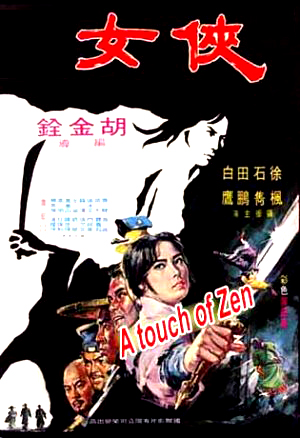
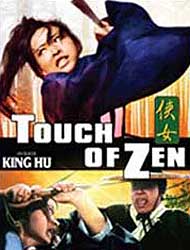
Film #67: Xia Nu (1971)


Title for us English-Types: The Dignified Lady, a.k.a. A Touch of Zen

Director: King Hu

Initial Release Country: Taiwan

Times Previously Seen: none

Teaser Summary (No spoilers)

Chinese scholar helps a young woman deal with corrupt government officials who pursue her. Many people brandish swords and jump really high.

Extended Summary (Slightly longer plot synopsis. Spoilers included.)

In a small village in Ming Dynasty China, a young man named Ku lives a humble life. He is an artist and a scholar who ekes out a living doing portraits and scribing. The only seeming worry is his mother, who constantly badgers him about his bachelorhood and apparent lack of ambition for more prominent work within the government.

Within a short span, several strangers appear in the town: Doctor Lu, the blind fortune-teller Shih, a government official named Ouyang, and the young woman Ying. The very private and rarely-seen Ying actually moves into the supposedly haunted fort next to Ku's ramshackle home, which is part of a larger dilapidated and disused castle.

Over the next several days, it becomes clear to Ku that each of the newcomers is hiding something beneath their simple public personas. After a few moments of mystery and suspense, Ku learns that Ying, whose real name is Yang, is the daughter of a former magistrate who was going to inform the emperor of massive corruption. The primary figure involved in the corruption is someone known as “Eunuch Wei”, who intercepted Yang's father and had him tortured to death. Yang flees with two trusted generals – Shih and Lu – until they find refuge in the monastery of fighting Buddhist monks and remain there for two years.

Back in the present, Ku and Yang share an evening in each other's arms. Shortly after, Ku helps Yang and her two general protectors to lure Eunuch Wei's forces into a trap. Using local superstition and his own mechanical contrivances, Ku entices hundreds of Wei's forces, led by corrupt local officials, into the “haunted” fort and methodically lays waste to them with various traps. His plan is executed brilliantly, but he finds that Yang has fled the morning after their night-time victory.


Yang, Ku, and the generals trek through the jungle. You can bet that bodies and blades will be soaring through the air, shortly.

Ku, over several months, tracks Yang back to the monastery where she previously was sheltered. Before he can ascend the monastery mountain and find her, though, a monk brings down a newborn child – the result of his single night with Yang. With the child is a note from Yang asking that she not be disturbed, for she seeks permanent solitude in the monastery. Ku, dejected, begins to take the child home.

Ku and his infant son do not get far when he is accosted by a small band of soldiers, headed by Hsu Hsen-Chen, the brutal and powerful leader of Eunuch Wei's forces. Before Hsu can take Ku, however, Yang and the monastery's master, Abbot Hui, intercede. The immensely powerful yet impassive Hui uses his remarkable martial skills to eventually subdue and dispatch the considerable might of Hsu, though not before receiving a mortal wound at his hands.

In the end, the wounded but living Ku and Yang look on as Abbot Hui struggles to ascend a nearby rock formation. Hui sits in a lotus pose and becomes one with Buddha.

Take 1: My Gut Reaction (Done after this one viewing, before any research on the movie.)

This movie is as good as I can imagine a kung-fu movie getting, which tells me that kung-fu movies just are not my thing.

A Touch of Zen has a ton going for it, which is good since it clocks in at over three full hours. There are plenty of compelling things that will enthrall a viewer, as they did me. The movie blends several strong components with a style that, though familiar, takes on a different feel due to the unique setting. However, after a certain point, the genre elements of the movie became rather dull.

The movie is divided into two parts, as most 180-plus-minute movies are, and the division is not just temporal. The very style of the movie changes drastically between the first and second parts. When dwelling on the first part of the movie, I can't help but think of the previous movie that I reviewed for this blog, Once Upon a Time In the West. Like that and other Leone films, A Touch of Zen begins with very deliberate, quiet pacing. It allows the viewer to passively drink in the scenery, the characters, and everything about the setting. I found this enjoyable since the director, King Hu (yes, that was his name – your sophomoric joke here), had a real eye for camera placement. I don't know if he was a student of Sergio Leone's films, but the parallels are hard to miss. Plenty of wide-angle shots cut with close-ups, featuring the vibrant faces and varying landscapes catch the eye throughout the film.


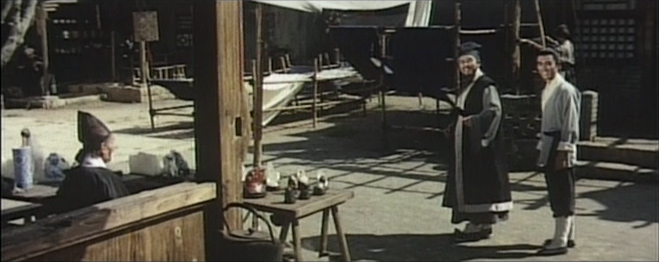
Many of these earlier scenes in the village create a great feel for the little place, not unlike Sergio Leone's Westerns.

Another great strength of the first half of the film is revelations about the various mysterious characters. It takes well over an hour to get the whole story of Uoyang, Ying and the generals, but until you do, the intrigue makes for great theater. I also found it great that a lot of the suspicions and enigmas are, initially, merely hinted at through looks and gestures rather than superfluous dialogue.

Hu definitely took a slow-burn approach to this, and I loved the way that it inched its way into the movie. It starts with a small attack between two people. To this point, there has been nothing outlandish in the film. Suddenly, in the midst of a fight, two fellows are deflecting daggers with their bare hands and leaping ten to twenty feet in the air off of tree branches. These initial dashes of the supernatural work well within the movie early on, and they lend an entertaining sense of adventure.

However, the second part of the film defines the phrase “too much of a good thing” to me. Whereas the first 90 minutes mostly comprise still moments punctuated by gradually-extended action sequences, the second half of the film is almost all action, with very few quieter moments. It's pretty neat to see a few people flying around like trapezists and dueling with swords for a bit, but after an hour, I found it tedious. I can certainly appreciate the acrobatic, choreographic, cinematic, and editing skill that all of these scenes took, but come on. Once the point is made that the characters are possessed of these Buddha-granted fighting powers of extraordinary magnitude, it morphs into pure stylization. And I can only handle so much style when there's no substance being added.


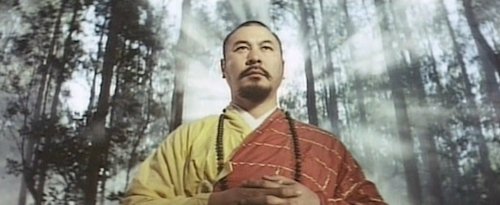
Abbot Hui, whose Enlightenment will kick your ass off.

A saving grace did come at the end for me. While roughly 45 minutes of the final hour of the film consists of extended fighting sequences, the finale is one of very interesting imagery. Abbot Hui, who was brilliantly played by the quietly imposing Roy Chiao, sitting in the lotus pose with the setting sun forming a halo behind him puts a wonderfully ambiguous and iconic stamp on the tale. Perhaps the implication is clearer to viewers more familiar with Buddhism, but a novitiate Westerner like myself is left to marvel and ponder exactly what this all means, especially in light of the fact the never-seen arch enemy, Eunuch Wei, is never conquered.

Despite this satisfying and metaphysical moment of closure, it takes a long time to get there. It also highlights one of the things that I wanted to see more of – the monks. Perhaps restraint was the best course here for the filmmakers, as too much of these orange-robed warriors as salt might have spoiled the broth. Still, I felt that there were plenty of questions left unanswered about this key component to the story. What is their philosophy, that it leads them to train themselves into nigh-unbeatable unarmed combatants? How do they do it? What is the synthesis between the pacifist Buddhist mindset and the ability to throw trained soldiers around like rag dolls? The lack of exploration of these questions left me wanting.

The only other thing that bothered me is something that the filmmakers possibly had no control over. Maybe due to a shoddy DVD transfer, some of the night scenes are impossibly dark. Typified most by the long midnight ambush of Ku and Yang's followers on Eunuch Wei's forces near the end of Part 1, there are times when the viewer can barely tell what's happening on screen. It's only emphasized by how well the rest of the movie is shot, with its masterfully composed sets and framing. The night sequences often blur into random shadows rushing around amidst the screams. The impenetrable murk did little to enhance these moments. Again, though, this may just be an age and DVD quality issue.

The ultimate question for me with any of these movies is, “Why did the fellows who did the TIME list put it on with the other 99 shows?” Whereas it is totally obvious with many of the movies on the list, with A Touch of Zen, I can only speculate. My guess is that it was probably one of the first films to have the high-flying, effects-enhanced martial arts action sequences that have become renowned the world over, thanks to films such as Crouching Tiger, Hidden Dragon and Hero. Beyond this, it combines pathos with a polished, epic feel that many action films aspire to, but rarely achieve.

Would I watch it again? No. Not in its entirety, at least. Oddly, I would watch the slow first hour for its gradual and soothing pacing. More though, I would watch the final ten minutes again, as the final scenes offer some food for philosophical thought. You can keep the 90-plus minutes of over-the-top sword fights.

Take 2: Or, Why Film Geeks Love This Movie (Done after some further research on the movie.)

When it comes to this movie, there's really not a wealth of material to dog through on the Internet. Within what I did find, there was nothing surprising. Critics, both past and present, hailed A Touch of Zen as an excellent film, in terms of technique (It won the 1975 Cannes Film Festival Technical Grand Prize, and was nominated for the Palm d'Or.). No shocker there, as the visuals still hold up exceptionally well, even here in 2011.

The theme of Buddhism comes up quite a lot. Apparently, King Hu was lauded for his blending of the philosophy with the flash and style of the fighting sequences.

The only other common thread running through any materials I found was how A Touch of Zen has continued to be emulated. Virtually every site I found mentions either Crouching Tiger, Hidden Dragon; House of Flying Daggers, or both. All you have to do is watch a ten-minute clip of the 1971 original movie to see exactly why.

Would I recommend it? Only to people who know they like kung-fu movies, as A Touch of Zen is to kung-fu movies what the Godfather is to mafia flicks. It set standards that have and will persist through the decades. If, like me, the genre is not your thing, I highly doubt you'll be willing to hand over the three hours it takes to watch. Maybe just youtube the final ten minutes or so.

That's a wrap. 67 shows down. 38 to go.


Coming Soon: The Godfather (1972):


Yes!! I'm as excited about this one as I was about Casablanca. I don't care what kind of film snob you might be, you lose credibility if you don't enjoy this classic. I haven't watched it in several years, so I'm due. Come on back and see how I put my admiration to words.

Please be sure to pick up all empties on the way out.

Monday, November 7, 2011

Film #66: C'era una volta il West (1968)


Title for us English-Speaking Types: Once Upon a Time in the West

Director: Sergio Leone

Initial Release Country: Italy

Times Previously Seen: once (about 10 years ago)

Teaser Summary (No spoilers)

Mysterious drifter meets beautiful widow in the Wild West. Tangles with a wild outlaw, a bad dude in black, and railroads. Stares at everything.

Extended Summary (Slightly longer plot synopsis, spoilers included. Fair warning.)

An unnamed man (Charles Bronson) with a penchant for playing a harmonica arrives in a developing part of the West during the expansion in the 19th century. He has come looking for revenge against man named Frank (Henry Fonda). Frank is a cold-blooded assassin hired by a railroad magnate, Morton, to help his railroad reach the west coast. Standing in their way is Jill, a former prostitute who has recently married the enterprising Brett McBain, a landowner who has been murdered, along with his three children, by Frank and his gang of thugs. McBain had, years before, foreseen that the railroad would need to come through the area, so he bought land and planned to build an entire town around it – a town he would name Sweetwater. Now, only his widow Jill is left to see his dream come to fruition, if she avoids Morton and Frank's attempts to get rid of her.

Mixed up in all of this is the outlaw Cheyenne (Jason Robards). Cheyenne is on the run from the law, but has a certain dignity and code that ingratiate him to both Harmonica and Jill. Cheyenne has been framed by Frank for the murder of the McBains, so he also has motivation to find this cunning killer. It takes a while for Harmonica, Jill, and Cheyenne to uncover McBain's plans for Sweetwater. Once they do, they realize their aims are in line with each other. After some close calls and a few twists, Morton is killed by Cheyenne's men, and Harmonica gets his showdown with Frank. Harmonica shoots Frank in a stand-off and only then reveals that he is the younger brother of one of Frank's many victims over his bloody years. He has waited patiently for decades to confront Frank and put an end to his murdering life.

Harmonica gets his cold revenge.

With Frank dead, Harmonica heads away from Sweetwater, the construction of which is now in full-swing. Brett McBain had bought all of the wood and supplies needed to construct the train station and the town around it. With Morton and his goons out of the way, Jill and her dozens of hired men are free to build up her dead husband's ultimate wish.

An exceptionally detailed, full plot summary can be found here, at imdb's website.

Take 1: My Gut Reaction (Done after this most recent viewing, before any further research.)

I now see why the creators of the TIME list put this one on there. It's not only a standout western, but simply a great movie, regardless of genre. My quick-shot summary above gives you no idea of just how great.

I had watched this once before and wondered why, with The Good, The Bad, and The Ugly already on the list, the fellows at TIME had put another Leone western on it. After all, aren't his westerns all similarly unique in carrying those Leone trademarks? Yes and no.

The Good, The Bad, and The Ugly is brilliant, no doubt. (You can read me gush about it in this post that I did several weeks ago). And while there are glimmers of some deeper commentary about U.S. history and violence in the movie, it is ultimately an epic adventure story. Blondie, Tuco, and Angel Eyes hop from locale to locale, trying to out-duel and outsmart each other in ways that keep the watcher engaged in a very accessible way. Once Upon A Time in the West, despite some excellent action sequences, is another breed.

With this film, Leone slowed things down considerably. One only needs to watch the first ten minutes to see it. In that former film, you start with an extended close-up and a few slow minutes of build-up before you get Tuco Ramirez gunning down three bounty hunters and crashing through a barber shop window. In Once Upon A Time, it's nearly ten minutes of almost no action. We watch three of Frank's men walk into a train station and patiently wait for Harmonica as the opening credits intermittently pop up. Missing also is the early introduction of a rousing Ennio Morricone soundtrack, which one doesn't hear until nearly ten minutes in. I imagine that many modern viewers would lose patience with such pacing, but it's perfect for conveying the eerie and misleading stillness of the terrain and the characters.

It takes nearly ten tension-building, dialogue-free minutes to get to the first piece of fast action. Harmonica (in the distance) is about to show these 3 hombres what happens when you mess with the quiet guy in a Leone Western.

It is with this same slow and gradual pacing that the entire story of the film is told over two hours and forty-five minutes. I can't help but think that many modern viewers would not have the wherewithal for it. For those who do, though, there are payoffs galore. The sweeping long shots of the wide open southwestern terrain are incredible, surpassing even the earlier works of Leone himself. I was reminded of another director's observation that Leone, like many other Italian artists raised on steady diets of classical painting techniques, had an innate knack for frame composition. Time and again in this movie, you can simply drink in the landscape and marvel at how the characters and their story fit into it.

Of course, the movie isn't telling the tale of southwestern U.S. geography. Its lifeblood is in the narrative and the characters. Like his other spaghetti westerns (a slight misnomer, since some scenes were filmed in Utah and Arizona), Leone's characters are not exactly the most well-rounded you will ever come across. Still, they are intriguing, and they have just enough facets to make them compelling. Sure, Harmonica is pretty much the same “man with no name” that Eastwood played in the “Dollars” trilogy; and sure, Cheyenne is a slight twist on Tuco Ramirez from The Good, The Bad, and the Ugly. All the same, they're entertaining. The most novel addition is Jill – easily the strongest and most prominent female character in any of Leone's movies.

The biggest eye-opener in terms of characters is Frank. Not so much because of the character (not too dissimilar from Angel Eyes in The Good) , but because of who played the role. Having established and all-American swell guy Henry Fonda gunning down children, kidnapping women, and generally exuding evil is hypnotic. With those piercing eyes and almost kindly voice, it borders on terrifying to see him do his butcher's work with such icy satisfaction. Fonda was so good at the role that it almost seems a loss that he didn't get pegged for more dastardly roles earlier in his career.

Fonda's gaze is as dead as the pale corpses he leaves in his wake. Tom Joad, this ain't.

Fonda is clearly the standout, but a few other performances shouldn't go overlooked. Charles Bronson is, well, Charles Bronson. He's still. He's quiet. He has a mean glare. That was enough for this role, just like every other role he every had. Claudia Cardinale is solid as the world-weary ex-prostitute, Jill. She was smoking hot, no doubt, but also has a sultry wisdom that fit the part to a tee. Easily the best of the other main players, though, is Jason Robards as Cheyenne. Most markedly in his scenes with Cardinale, Robards is outstanding as the scuzzy yet compassionate, larcenous yet honorable criminal. I don't think I'll put him up there with Tuco in my esteem, but he's pretty close.

On top of the great visuals, pacing, and solid characters and acting, is the underlying theme of western expansion. This is what puts this movie over the top. While Leone made a few feints at social commentary and figurative imagery in his previous film, he really goes for it in Once Upon a Time, and I feel that he does it right. The West was “won” by the sweat, blood, and pain of who-knows-how-many people, and the idealism and greed of wealthy magnates who didn't much care who got ground up along the way. This movie can be seen as a forefather of more modern film takes on the subject like There Will Be Blood. Fortunately, Leone never bashes you over the head with symbolism. Probably the best moment of restraint is when the decrepit rail magnate Morton is dying, face-down near a tiny puddle. We could have been treated to a clumsy interposition of the Pacific Ocean right then, but we aren't. We simply see the image play out, along with Frank, and take in just how a grand scheme can end so pathetically.

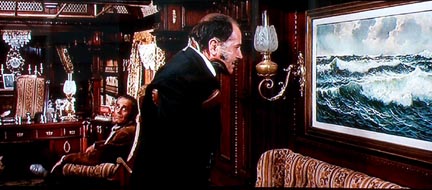
The rail magnate Morton gazes at a picture of his dream, the Pacific. The closest he gets is the shallow pool of dusty desert water, where he dies.

If there's anything to nitpick, one is that Leone often pushes verisimilitude to the back so that clever film style can be front and center. Some scenes are easy to dismiss as a bit silly and unrealistic, such as when Frank's thugs silently take over the auction for the Sweetwater property. A touch goofy it may be, but even scenes like this are simply chances for Leone to use visual rather than dialectic storytelling. And, as anyone who has seen and knows his films can attest, he was brilliant at this. I've always been a fan of being forced to actually watch the movie, and not just rely on exposition. I can see why some viewers might poo-poo these sequences as parlor tricks of sorts, but I'm always amused and impressed by them.

My only other minor gripe is that the Ennio Morricone soundtrack in Once Upon a Time is not quite as strong as The Good, The Bad, and the Ugly. It's certainly as quirky and unique, but I actually found the integrated harmonica wail mostly annoying. Luckily, Cheyenne's theme song had a playful bounce to it, which accompanied the character's more amiable nature nicely.

Jason Robards has the look and psychology of the cynically humorous thief, Cheyenne, down pat.

Any who enjoy westerns or simply well-crafted movies that make full use of the techniques particular to the medium should give this one a serious shot. As I suggested in my review of The Good, The Bad, and The Ugly, a good primer is working through Leone's three films with Clint Eastwood, starting with the 90-minute A Fistful of Dollars. The production isn't nearly as sharp (it was probably made with about $45), but the director's skill is easy to see. If you enjoy that, work your way through the rest, and cap it off with Once Upon a Time in the West, probably the most enduring of them all.

Take 2: Why Film Geeks Love This Movie (Done after a little more research on the film.)

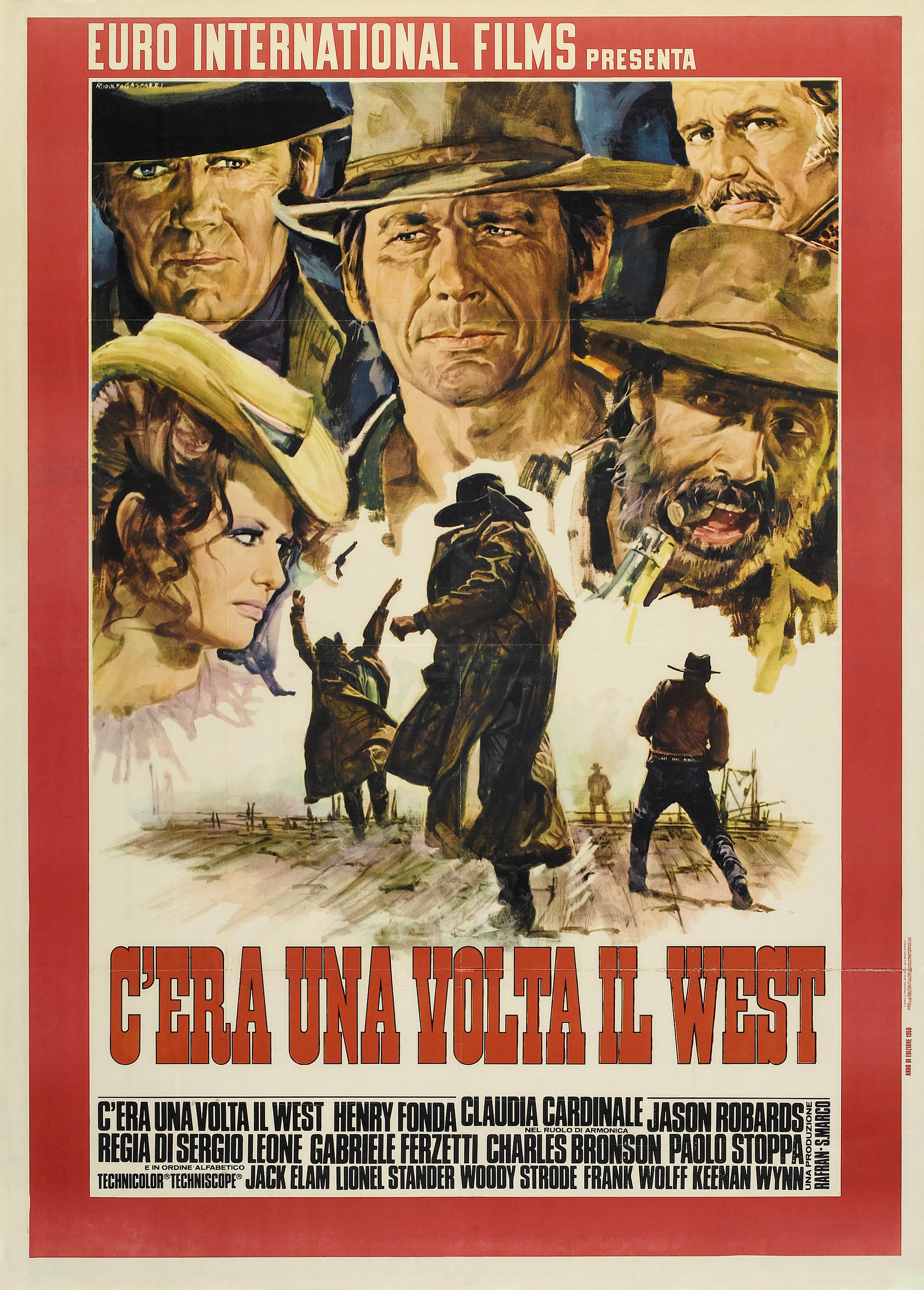
After some digging, I am reminded why many movie lovers can be forgiven if they have never seen or even heard of this movie. Here in the U.S., it was a total flop.

Thanks to Paramount's meddling and editing, the original had 20 minutes cut out of it, which never helps narrative cohesion. More than this, though, was a seeming lack of preparation on the parts of the viewers. Both Paramount and American audiences were hoping for another skewed, high-paced action flick like the previous "Dollars" trilogy. They weren't ready for such a slow, deliberately paced movie. Even Roger Ebert, who was often ahead of the critical curve with his viewing eye, was lukewarm in his original review in 1969. In contrast, French and Italian audiences loved it. So much so that the movie would run in some places for up to four years following the initial release. In the U.S., it barely lasted a few months.

It wasn't until the mid-80s that the studio restored the original version, and the few American cinephiles who had always revered it could share their vindication. With the intercession of decades, you see the movie pop up all over “best movie” lists.

On the DVD I watched, the most recent special release, there are some excellent short documentaries, featuring past and modern interviews with some of the cast and crew, as well as several prominent modern film directors. They all marvel at how Leone concocted an ultimate summation of the greatest American westerns in Once Upon a Time. The list of films from which he drew is almost an encyclopedia of the genre's greatest works – High Noon, Shane, the Monument Valley films of John Ford, and around a dozen others. Leone not only blended the strongest elements of them all, but he added his own style and cynicism to the themes and characters. One modern commentator called it a massive homage to, and final dirge for, the film Western.

Taking a play right out of the John Ford play book, Leone shot several scenes in the exact same spots of Monument Valley. This shot, along with dozens of others, capture the expansiveness of the whole region.

A note of more specific interest was learning how the music for the film fit into the process. Contrary to almost all other films, the music score was composed first, and the scenes shot to match. The four primary pieces of music, each specific to the four main characters, are introduced separately in turn, and then blended by the end of the movie. The effect is truly remarkable, and a testament to Leone's vision.

Actors loved working with Sergio Leone. This only came as a surprise to me in light of the fact that he was such a visual perfectionist. Another renowned perfectionist, Stanley Kubrick, was notoriously difficult for actors to work with, because of his demands and inflexibility. Leone, on the other hand, gave his actors plenty of latitude to do as they saw fit. Integrating such freedom from performers with his own crystal clear vision is something that boggles my mind.

A final note on Leone's film genius. As I'd heard mentioned when researching The Good, The Bad, and The Ugly, apparently Leone never did any story boarding of any kind. Unlike nearly all other highly visual directors, who physically map out their scenes so that the sequencing is correct, Leone had a pure, completely finished tale worked out in his head by the time filming began. I'm reminded of the scene in Milos Foreman's Amadeus when Salieri marvels at seeing Mozart's uncorrected, flawless first drafts of his symphonic and operatic scores. Whether this was true of Mozart or not, it was very true in Leone's case. The fruits of such a sharp imagination can be seen in all of his works.

So again, I highly recommend seeing this movie for those with the time and who know what they're in for. Be patient, soak up the beauty of it, and know that you are watching a film Western classic the likes of which can only be imitated, but never replicated.

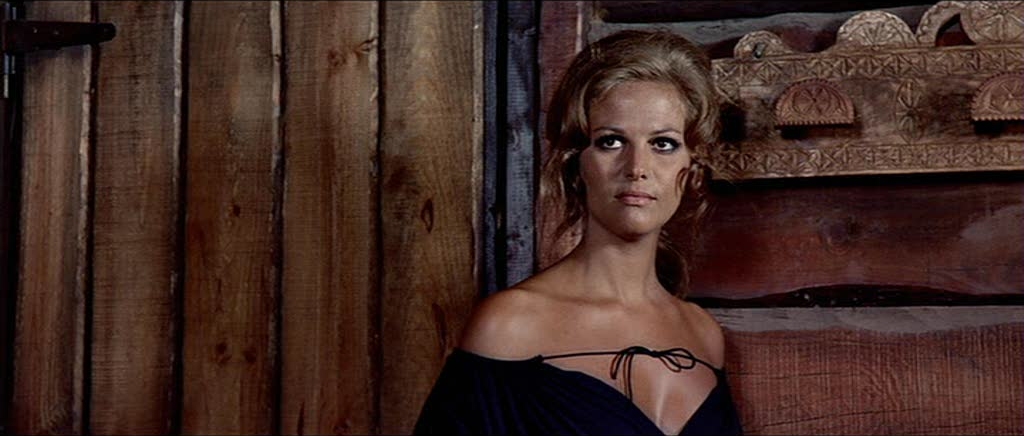
If the film artistry isn't enough of a draw for you, maybe this shot will entice you. It also explains why Claudia Cardinale as Jill had jaws dropping across oceans.

That's a wrap. 66 shows down. 39 to go.

Coming Soon: A Touch of Zen (1971)


I'm totally in the dark about this movie. Never heard of it, and only know that it looks like a sword-swinging kung-fu extravaganza. It'll also be the first Chinese movie that I review for this project.

Please be sure to pick up all empties on the way out.

Tuesday, November 1, 2011

Film #65: Bonnie and Clyde (1967)


Director: Arthur Penn

Initial Release Country: United States

Times Previously Seen: once (about 10 years ago)

Teaser Summary (No spoilers)

Restless Texas redneck lovers go on a bank-robbing spree during the Great Depression. “Laws”, emotional highs and lows dog their heels.

Extended Summary (More complete plot synopsis, including spoilers. Fair warning.)

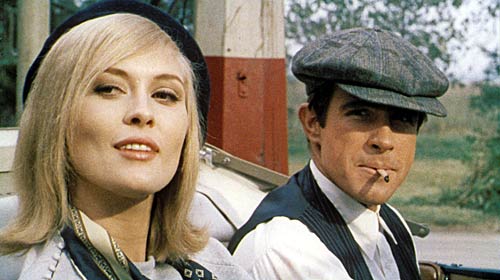
Rural Texas, 1931. The 21-year old Bonnie Parker (Faye Dunaway) is agitated by her dead-end life as a waitress living with her mother in a small town. She spies a handsome, dapper young man outside of her house, casing her mother's car, seemingly to rob it. After running out to stop him, the two strike up a conversation during which the man, Clyde Barrow (Warren Beatty), readily admits that he has recently been released from prison for an attempted robbery. Bonnie is skeptical to the point of egging Clyde into robbing a nearby grocery store. When Clyde does just that, Bonnie, rather than flee the armed robber, readily hops into a stolen car with him and drives out of town.

When the pair stop just outside of town, Bonnie is so overcome with excitement that she throws herself at Clyde. Surprisingly, Clyde roughly rebuffs her, claiming that he “ain't no loverboy”. Despite this odd reaction to the beautiful and willing Bonnie's advances, the two see that they have a unique connection with each other. Both are seeking to make names for themselves by breaking away from societies' rules. Clyde plans to rob his way to fortune and fame, and Bonnie is all too happy to join him.


The pair of fugitives size up the next member of their little gang.

The two make a failed attempt to rob a bank that has recently gone out of business, but they soon start to find more success. After picking up a strange and disenfranchised young gas station attendant, C.W. Moss, as their getaway driver, they manage a successful bank robbery. However, Clyde shoots and kills a man during their semi-bungled escape.

Once in a safe hotel room, Clyde offers Bonnie a chance for escape. Realizing that he will now be wanted for murder, he urges Bonnie to return home and avoid any potential capital punishment. Bonnie refuses to leave Clyde, thus reaffirming their bond to one another. The two attempt to consummate their love, but Clyde's impotence prevents it yet again.

The trio of fugitives soon meets up with Clyde's older brother, Buck (Gene Hackman), a fellow ex-con, and Buck's wife, the reserved and rather dim-witted Blanche. The fun-loving and simpler Buck readily joins his younger brother's crime spree, Blanche in tow. Clyde welcomes the company of his brother, but Bonnie soon becomes highly agitated at Buck and Blanche's utter lack of sophistication. While Bonnie has some spark of creativity, even writing poetry, Buck, Blanche and C.W. seem to find the game of checkers the height of mental gymnastics. The tensions begin early and grow steadily.

The gang of 5 continue robbing banks throughout Texas, Kansas, Oklahoma, and other nearby states, hopping borders in order to avoid capture. They avoid some early attempts at capture as they perfect their thievery. They efficiently loot multiple banks, but never take any money from the more humble farmers and locals. Their legend and fame grows rapidly, as newspapers regularly report the deeds, as well as falsely attributing several robberies to the gang.

The gang grows more confident and skilled in their robberies.

Eventually, the law begins to close in. After C.W. Allows himself to be seen in a little town, the police raid the gang's hotel room. After a furious and bloody shootout, the gang escapes, but not without serious injuries. Buck sustains a horrible head wound, Blanche suffers eye damage, and Clyde is shot in the arm. After camping outside to recover slightly, the gang is once again tracked down and attacked. Bonnie, Clyde, and C.W. Manage to get away, though Bonnie is also wounded in the arm. Buck and Blanche are not so lucky. Buck is shot again and soon dies. Blanche, now completely blind, is taken away by the police.

The injured Bonnie and Clyde are driven to safety by C.W., receiving a little support along the way from impoverished Dust Bowlers who are awestruck by the celebrity thieves. C.W. takes the pair to his father's tiny farm, and the man seems to welcome them. This ostensible kindness is merely a front, though. As Bonnie and Clyde recuperate, C.W.'s father privately berates his son for a fool and eventually informs the Texas Rangers about the two fugitives.

In a simple set-up while Bonnie and Clyde return from buying groceries in town, C.W.'s father pretends at having car trouble. The pair pull over to assist, but do not sense the trap. Before either Bonnie or Clyde can react, let alone surrender, a score of Rangers and lawmen open fire upon them from behind the nearby bushes, riddling the couple and their car with dozens of bullets. The mutilated corpses of Bonnie Parker and Clyde Barrow fall limp onto the ground, ending their renowned spree.

Take 1: My Gut Reaction (Done after this most recent viewing, before any research on the movie.)

Really good movie that holds up exceptionally well.

Bonnie and Clyde may not seem so special to modern, first-time viewer, but with a little awareness of the context, it's not hard to see why it is considered so very influential. Based on my film-watching experience, it created a unique blend of tried-and-true standard film-making conventions with a dash of the novel, leading to entire shifts in the way that crime stories have been told in film.

The story itself is intriguing enough, being based in reality. I personally don't know much about the real Bonnie and Clyde, but I'm eager to do the research for the Part 2. I have to assume that the screenwriters took certain liberties with the dialogue, and even some of the action. What little I do know, however, tells me that the singular personalities and passion of the titular pair of thieves is not a mere fantasy. The bizarre quirks of the two – Bonnie's predilections towards intellectualism and Clyde's sexual impotence, to name the most obvious – give the story a very compelling eccentricity that is lacking in most crime films.

Of course, such unique characters can only be given life by solid acting, and Faye Dunaway and Warren Beatty do phenomenally well. While Beatty's Texas accent is a bit inconsistent at times (maybe I can say that only because it's my home state), this is a minor gripe. In all other things, the two actors nail the charm, passion, foolishness, pretentiousness, and rebelliousness that make for intriguing and rounded characters. Being able to pull off such a range of traits can't be easy, but Dunaway and Beatty do just that.

The supporting cast is also quite solid. A young Gene Hackman stands out wonderfully as the loud-mouthed yokel, Buck, and his wife is played to pitch-perfect annoyance by Estelle Parsons. It doesn't take long to see why the more reflective Bonnie takes an instant dislike to the shrieking, mulish Blanche. Even the minor roles by Michael J. Pollard and Gene Wilder (!) make great accents to the film.

The performances and story are certainly strong, but no stronger than quite a few other good crime movies. What sets this one above the rest, I feel, is the direction. Bonnie and Clyde is one of those rare films that wastes nary a second. Every scene, every word, every glance between characters means something and adds to the tale. From the opening shots of a bored Bonnie Parker, pining away in her room, to the final shots of hers and Clyde's lifeless bodies on the ground, this movie is about as tight as they come. There are certainly quiet moments, as well, but even they invite the viewer to pay close attention, as body language and eye movements are telling stories that words aren't. One needs only see a few of Bonnie's eye rolls to see my point.

The quarters get tighter, and Bonnie's patience with her goober gang-mates runs thinner.

Even beyond all of this is the overall story arc and the tone. Bonnie and Clyde might have been the first movie to tell the tale of two criminals in a way that endears them to the audience, and then shoves their bloodied corpses right in your face. The first half of the movie is far heavier on comedy, a lot of which holds up really well, 45 years later. It feels like you're on a fun little escapade with a few young renegades. However, there are allusions of what is to come. After one bank robbery, a farmer whose money Clyde purposefully did not steal, says to a reporter, “That Clyde Barrow done alright by me. I'll be bringin' the Missus to their funeral.” This and other signs remind the viewer of just how this will all end.

Once the “laws”, as Clyde and Buck call them, begin to close in, the humor begins to fade and deadly seriousness takes over. There's a sequence in the film when, at Bonnie's behest, they go out to see her mother and family in a remote rock quarry. The scenes are shot in a washed-out, sepia tone that lends a hazy heaviness to this part of the story. This is totally appropriate, as Bonnie mother senses her daughter's imminent demise and detaches herself with a final, matter-of-fact goodbye.

When the end finally comes, director Arthur Penn puts his ultimate stamp on violent film-making. With a death scene that would be emulated within a scant few years in films such as The Godfather and others, Bonnie and Clyde are mowed down in quick, brutal fashion. In such scenes in earlier films, I can't recall them ever being so shockingly realistic. The likable duo are machine-gunned to death with a scant few seconds. There is no slow-motion or music score to add any semblance of romance or glory to it. There are no death throes or final words from either of the two lovers. One moment they are smiling and alive; the next they are simply no more.

This single frame gives a good sense of just how brutal the finale is. It's lightning-quick and ultimate.

It is the elements in this final scene that set a standard for film violence that many directors misunderstand and misuse today. Someone like Michael Bay seems to think that the violence itself is the artistry and the draw of such things. However, he glamorizes and ultimately anesthetizes people to it through cinematic slight-of-hand. David Cronenberg, on the other hand, follows the Arthur Penn model, in his way. If you watch the death scenes in his recent films A History of Violence or Eastern Promises, you see that these scenes, while few in number, are brutally graphic and shockingly quick. I heard him explain in an interview that this is because he wants the audience to know that violence is not to be polished up for easier consumption, even in a tale of fiction. I think Arthur Penn had this figured out long before his imitators.

Bonnie and Clyde is a revolutionary film, though probably not so obviously a one as other films. It wasn't until I watched it, slept on it, and thought about it for a day that I realize this. I would recommend it virtually anyone who is not completely turned off by rather graphic violence, as the latter half of the film features plenty of it. This aside, it has something for nearly any attentive film-watcher.

Take 2; Or, Why Film Geeks Love This Movie (Done after further research on the film.)

There's almost no end of material that one can lose oneself into when it comes to the Bonnie and Clyde film. Let's start with the real history:

Volumes have been written, so in the interest of time, I went to that oh-so-reliable reference source, wikipedia (hey, I'm running a blog for fun here, not writing a dissertation!). It becomes quite clear that Arthur Penn's movie, as is usually the case with movies, plays extremely fast and loose with the facts. Sure, some of the locales and people's names are correct, and even a few of the general actions are true to fact. Still, a large portion of the true story was molded, shaved, and fashioned into something very different. And this, of course, was the only way that it would work.

The reality of Bonnie Parker and Clyde Barrow is, of course, far less sexy and far more tragic than a Hollywood movie can convey. While true that the two were renegades and had no small affection for each other, the film conveniently leaves out just how many civilians they murdered. Or about Barrow's very troubled younger days, being raped in prison at age 16, essentially channeling his rage to become the personification of the philosophy “Get rich or die trying.” If you read a brief description of Bonnie and Clyde's exploits throughout the Dust Bowl, you become less sympathetic than you probably would be for Beatty's and Dunaway's more affable duo.

The real deal Bonnie and Clyde, goofing around with a shotgun. Unlike the film, in which the duo are unarmed when killed, the originals were loaded for bear and had already taken the lives of multiple civilians and lawmen, alike.

Of course, Arthur Penn's film makes no claims at being a documentary, and so we can view it in a very different way.

Apparently, the going was very rough for the production of the film. A few very talented people were interested, but Warren Beatty landed the production rights. After the film was made, the studio and test audiences apparently hated it, so much so that the studio was planning to only release it in Texas drive-ins. The story goes that Beatty literally begged the studio, on hands and knees, to give it a real chance. They did, to initially lukewarm and even poor reviews. When it was released, the original TIME reviewer called it “sheer, tasteless aimlessness”.

After several months hovering in obscurity, people eventually came around. Once again, Roger Ebert, having only been at the professional film critic gig for less than 6 months, was ahead of the curve. In this more modern 1998 review, he outlines the story of the film with far more detail. He also points out some of the more interesting tones and themes in it, some of which I mentioned in my own “Take 1” above.

In short, the novelty of the movie has resonated right through the succeeding decades, into out very own. For those of us who have grown up with Thelma & Louis or Natural Born Killers as part of the mainstream movie landscape, Bonnie and Clyde may seem rather tame. One only has to realize, however, that this movie was the granddaddy of them. As with Citizen Kane, in inspiring so many imitators in terms of techniques and styles, it's almost hard to see Bonnie and Clyde for just how embedded its innovations are in so many movies that have followed.

I suppose what brought some of it home to me was reading about how many of the early 1967 audiences were shocked, bordering on disgusted. Bonnie and Clyde was seen by many as more violent and sexual than any movie had a right to be.

And you know what? The kids loved it.

Even now, in 2011, some of the scenes have a somewhat uncomfortable promiscuity to them, but maybe that's just that 1960's, grainy look that the film has. Whatever the characters are doing, it always seems to be more illicit when it was filmed in the 1960s and 1970s. Whatever the case, younger viewers were right on board with the maverick tones of sex and violence flying right in the face of the moral majority.

All of this just scratches the surface of the myth-versus-reality angle, the story of the film angle, and any of a number of others. All I really need to do is reiterate that, if you haven't seen this movie, you really should give it a shot. If you do, and you really watch what's being said and done, it's easy to see it for the a truly revolutionary work.

That's a wrap! 65 shows down. 40 to go.

Coming Soon: Once Upon a Time in the West (1968)


As much as I love Sergio Leone and his movies, I was surprised that they put a second Western of his on the list, already giving The Good, The Bad, and The Ugly a slot. Whatever the reason, I certainly don't mind setting aside about three hours to watch more long shots, extended close-ups, and bizzaro sound effects, as scuzzy buckaroos try to out-shoot and out-stare each other.

Please be sure to pick up all empties on the way out.