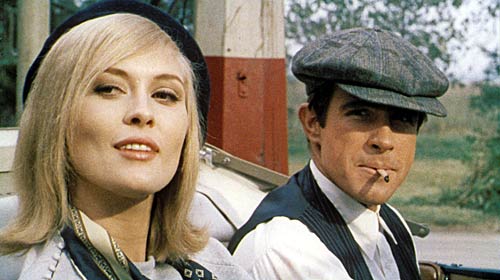
Director: Arthur Penn
Initial Release Country: United States
Times Previously Seen: once (about 10 years ago)
Teaser Summary (No spoilers)
Restless Texas redneck lovers go on a bank-robbing spree during the Great Depression. “Laws”, emotional highs and lows dog their heels.
Extended Summary (More complete plot synopsis, including spoilers. Fair warning.)
Rural Texas, 1931. The 21-year old Bonnie Parker (Faye Dunaway) is agitated by her dead-end life as a waitress living with her mother in a small town. She spies a handsome, dapper young man outside of her house, casing her mother's car, seemingly to rob it. After running out to stop him, the two strike up a conversation during which the man, Clyde Barrow (Warren Beatty), readily admits that he has recently been released from prison for an attempted robbery. Bonnie is skeptical to the point of egging Clyde into robbing a nearby grocery store. When Clyde does just that, Bonnie, rather than flee the armed robber, readily hops into a stolen car with him and drives out of town.
When the pair stop just outside of town, Bonnie is so overcome with excitement that she throws herself at Clyde. Surprisingly, Clyde roughly rebuffs her, claiming that he “ain't no loverboy”. Despite this odd reaction to the beautiful and willing Bonnie's advances, the two see that they have a unique connection with each other. Both are seeking to make names for themselves by breaking away from societies' rules. Clyde plans to rob his way to fortune and fame, and Bonnie is all too happy to join him.
The pair of fugitives size up the next member of their little gang.
The two make a failed attempt to rob a bank that has recently gone out of business, but they soon start to find more success. After picking up a strange and disenfranchised young gas station attendant, C.W. Moss, as their getaway driver, they manage a successful bank robbery. However, Clyde shoots and kills a man during their semi-bungled escape.
Once in a safe hotel room, Clyde offers Bonnie a chance for escape. Realizing that he will now be wanted for murder, he urges Bonnie to return home and avoid any potential capital punishment. Bonnie refuses to leave Clyde, thus reaffirming their bond to one another. The two attempt to consummate their love, but Clyde's impotence prevents it yet again.
The trio of fugitives soon meets up with Clyde's older brother, Buck (Gene Hackman), a fellow ex-con, and Buck's wife, the reserved and rather dim-witted Blanche. The fun-loving and simpler Buck readily joins his younger brother's crime spree, Blanche in tow. Clyde welcomes the company of his brother, but Bonnie soon becomes highly agitated at Buck and Blanche's utter lack of sophistication. While Bonnie has some spark of creativity, even writing poetry, Buck, Blanche and C.W. seem to find the game of checkers the height of mental gymnastics. The tensions begin early and grow steadily.
The gang of 5 continue robbing banks throughout Texas, Kansas, Oklahoma, and other nearby states, hopping borders in order to avoid capture. They avoid some early attempts at capture as they perfect their thievery. They efficiently loot multiple banks, but never take any money from the more humble farmers and locals. Their legend and fame grows rapidly, as newspapers regularly report the deeds, as well as falsely attributing several robberies to the gang.
The gang grows more confident and skilled in their robberies.
Eventually, the law begins to close in. After C.W. Allows himself to be seen in a little town, the police raid the gang's hotel room. After a furious and bloody shootout, the gang escapes, but not without serious injuries. Buck sustains a horrible head wound, Blanche suffers eye damage, and Clyde is shot in the arm. After camping outside to recover slightly, the gang is once again tracked down and attacked. Bonnie, Clyde, and C.W. Manage to get away, though Bonnie is also wounded in the arm. Buck and Blanche are not so lucky. Buck is shot again and soon dies. Blanche, now completely blind, is taken away by the police.
The injured Bonnie and Clyde are driven to safety by C.W., receiving a little support along the way from impoverished Dust Bowlers who are awestruck by the celebrity thieves. C.W. takes the pair to his father's tiny farm, and the man seems to welcome them. This ostensible kindness is merely a front, though. As Bonnie and Clyde recuperate, C.W.'s father privately berates his son for a fool and eventually informs the Texas Rangers about the two fugitives.
In a simple set-up while Bonnie and Clyde return from buying groceries in town, C.W.'s father pretends at having car trouble. The pair pull over to assist, but do not sense the trap. Before either Bonnie or Clyde can react, let alone surrender, a score of Rangers and lawmen open fire upon them from behind the nearby bushes, riddling the couple and their car with dozens of bullets. The mutilated corpses of Bonnie Parker and Clyde Barrow fall limp onto the ground, ending their renowned spree.
Take 1: My Gut Reaction (Done after this most recent viewing, before any research on the movie.)
Really good movie that holds up exceptionally well.
Bonnie and Clyde may not seem so special to modern, first-time viewer, but with a little awareness of the context, it's not hard to see why it is considered so very influential. Based on my film-watching experience, it created a unique blend of tried-and-true standard film-making conventions with a dash of the novel, leading to entire shifts in the way that crime stories have been told in film.
The story itself is intriguing enough, being based in reality. I personally don't know much about the real Bonnie and Clyde, but I'm eager to do the research for the Part 2. I have to assume that the screenwriters took certain liberties with the dialogue, and even some of the action. What little I do know, however, tells me that the singular personalities and passion of the titular pair of thieves is not a mere fantasy. The bizarre quirks of the two – Bonnie's predilections towards intellectualism and Clyde's sexual impotence, to name the most obvious – give the story a very compelling eccentricity that is lacking in most crime films.
Of course, such unique characters can only be given life by solid acting, and Faye Dunaway and Warren Beatty do phenomenally well. While Beatty's Texas accent is a bit inconsistent at times (maybe I can say that only because it's my home state), this is a minor gripe. In all other things, the two actors nail the charm, passion, foolishness, pretentiousness, and rebelliousness that make for intriguing and rounded characters. Being able to pull off such a range of traits can't be easy, but Dunaway and Beatty do just that.
The supporting cast is also quite solid. A young Gene Hackman stands out wonderfully as the loud-mouthed yokel, Buck, and his wife is played to pitch-perfect annoyance by Estelle Parsons. It doesn't take long to see why the more reflective Bonnie takes an instant dislike to the shrieking, mulish Blanche. Even the minor roles by Michael J. Pollard and Gene Wilder (!) make great accents to the film.
The performances and story are certainly strong, but no stronger than quite a few other good crime movies. What sets this one above the rest, I feel, is the direction.
Bonnie and Clyde is one of those rare films that wastes nary a second. Every scene, every word, every glance between characters means something and adds to the tale. From the opening shots of a bored Bonnie Parker, pining away in her room, to the final shots of hers and Clyde's lifeless bodies on the ground, this movie is about as tight as they come. There are certainly quiet moments, as well, but even they invite the viewer to pay close attention, as body language and eye movements are telling stories that words aren't. One needs only see a few of Bonnie's eye rolls to see my point.
The quarters get tighter, and Bonnie's patience with her goober gang-mates runs thinner.
Even beyond all of this is the overall story arc and the tone.
Bonnie and Clyde might have been the first movie to tell the tale of two criminals in a way that endears them to the audience, and then shoves their bloodied corpses right in your face. The first half of the movie is far heavier on comedy, a lot of which holds up really well, 45 years later. It feels like you're on a fun little escapade with a few young renegades. However, there are allusions of what is to come. After one bank robbery, a farmer whose money Clyde purposefully did not steal, says to a reporter, “That Clyde Barrow done alright by me. I'll be bringin' the Missus to their funeral.” This and other signs remind the viewer of just how this will all end.
Once the “laws”, as Clyde and Buck call them, begin to close in, the humor begins to fade and deadly seriousness takes over. There's a sequence in the film when, at Bonnie's behest, they go out to see her mother and family in a remote rock quarry. The scenes are shot in a washed-out, sepia tone that lends a hazy heaviness to this part of the story. This is totally appropriate, as Bonnie mother senses her daughter's imminent demise and detaches herself with a final, matter-of-fact goodbye.
When the end finally comes, director Arthur Penn puts his ultimate stamp on violent film-making. With a death scene that would be emulated within a scant few years in films such as
The Godfather and others, Bonnie and Clyde are mowed down in quick, brutal fashion. In such scenes in earlier films, I can't recall them ever being so shockingly realistic. The likable duo are machine-gunned to death with a scant few seconds. There is no slow-motion or music score to add any semblance of romance or glory to it. There are no death throes or final words from either of the two lovers. One moment they are smiling and alive; the next they are simply no more.
This single frame gives a good sense of just how brutal the finale is. It's lightning-quick and ultimate.
It is the elements in this final scene that set a standard for film violence that many directors misunderstand and misuse today. Someone like Michael Bay seems to think that the violence itself is the artistry and the draw of such things. However, he glamorizes and ultimately anesthetizes people to it through cinematic slight-of-hand. David Cronenberg, on the other hand, follows the Arthur Penn model, in his way. If you watch the death scenes in his recent films
A History of Violence or
Eastern Promises, you see that these scenes, while few in number, are brutally graphic and shockingly quick. I heard him explain in an interview that this is because he wants the audience to know that violence is not to be polished up for easier consumption, even in a tale of fiction. I think Arthur Penn had this figured out long before his imitators.
Bonnie and Clyde is a revolutionary film, though probably not so obviously a one as other films. It wasn't until I watched it, slept on it, and thought about it for a day that I realize this. I would recommend it virtually anyone who is not completely turned off by rather graphic violence, as the latter half of the film features plenty of it. This aside, it has something for nearly any attentive film-watcher.
Take 2; Or, Why Film Geeks Love This Movie (Done after further research on the film.)
There's almost no end of material that one can lose oneself into when it comes to the
Bonnie and Clyde film. Let's start with the real history:
Volumes have been written, so in the interest of time, I went to that oh-so-reliable reference source, wikipedia (hey, I'm running a blog for fun here, not writing a dissertation!). It becomes quite clear that Arthur Penn's movie, as is usually the case with movies, plays extremely fast and loose with the facts. Sure, some of the locales and people's names are correct, and even a few of the general actions are true to fact. Still, a large portion of the true story was molded, shaved, and fashioned into something very different. And this, of course, was the only way that it would work.
The reality of Bonnie Parker and Clyde Barrow is, of course, far less sexy and far more tragic than a Hollywood movie can convey. While true that the two were renegades and had no small affection for each other, the film conveniently leaves out just how many civilians they murdered. Or about Barrow's very troubled younger days, being raped in prison at age 16, essentially channeling his rage to become the personification of the philosophy “Get rich or die trying.” If you read a brief description of Bonnie and Clyde's exploits throughout the Dust Bowl, you become less sympathetic than you probably would be for Beatty's and Dunaway's more affable duo.
The real deal Bonnie and Clyde, goofing around with a shotgun. Unlike the film, in which the duo are unarmed when killed, the originals were loaded for bear and had already taken the lives of multiple civilians and lawmen, alike.
Of course, Arthur Penn's film makes no claims at being a documentary, and so we can view it in a very different way.
Apparently, the going was very rough for the production of the film. A few very talented people were interested, but Warren Beatty landed the production rights. After the film was made, the studio and test audiences apparently hated it, so much so that the studio was planning to only release it in Texas drive-ins. The story goes that Beatty literally begged the studio, on hands and knees, to give it a real chance. They did, to initially lukewarm and even poor reviews. When it was released, the original TIME reviewer called it “sheer, tasteless aimlessness”.
After several months hovering in obscurity, people eventually came around. Once again, Roger Ebert, having only been at the professional film critic gig for less than 6 months, was ahead of the curve. In
this more modern 1998 review, he outlines the story of the film with far more detail. He also points out some of the more interesting tones and themes in it, some of which I mentioned in my own “Take 1” above.
In short, the novelty of the movie has resonated right through the succeeding decades, into out very own. For those of us who have grown up with
Thelma & Louis or
Natural Born Killers as part of the mainstream movie landscape,
Bonnie and Clyde may seem rather tame. One only has to realize, however, that this movie was the granddaddy of them. As with
Citizen Kane, in inspiring so many imitators in terms of techniques and styles, it's almost hard to see
Bonnie and Clyde for just how embedded its innovations are in so many movies that have followed.
I suppose what brought some of it home to me was reading about how many of the early 1967 audiences were shocked, bordering on disgusted.
Bonnie and Clyde was seen by many as more violent and sexual than any movie had a right to be.
And you know what? The kids loved it.
Even now, in 2011, some of the scenes have a somewhat uncomfortable promiscuity to them, but maybe that's just that 1960's, grainy look that the film has. Whatever the characters are doing, it always seems to be more illicit when it was filmed in the 1960s and 1970s. Whatever the case, younger viewers were right on board with the maverick tones of sex and violence flying right in the face of the moral majority.
All of this just scratches the surface of the myth-versus-reality angle, the story of the film angle, and any of a number of others. All I really need to do is reiterate that, if you haven't seen this movie, you really should give it a shot. If you do, and you really watch what's being said and done, it's easy to see it for the a truly revolutionary work.
That's a wrap! 65 shows down. 40 to go.
Coming Soon: Once Upon a Time in the West (1968)
As much as I love Sergio Leone and his movies, I was surprised that they put a second Western of his on the list, already giving The Good, The Bad, and The Ugly a slot. Whatever the reason, I certainly don't mind setting aside about three hours to watch more long shots, extended close-ups, and bizzaro sound effects, as scuzzy buckaroos try to out-shoot and out-stare each other.
Please be sure to pick up all empties on the way out.