Thursday, April 30, 2020

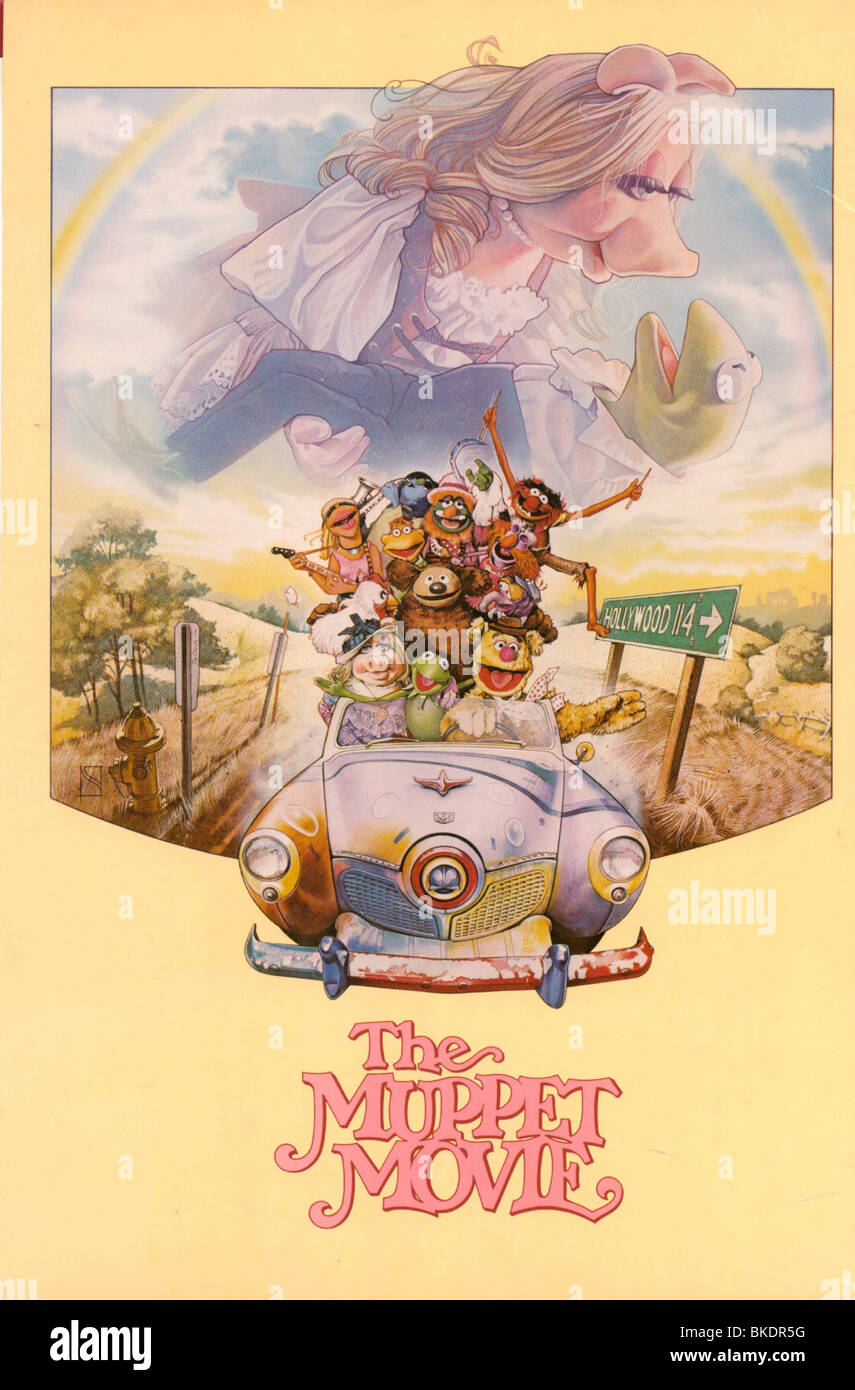
The Muppet Movie (1979)

Director: James Frawley

Still a fun, clever, goofy flick that can still please adults as well as kids.

Considering that we watched The Muppet Movie, one might think that my wife and I have kids. We don't. One might also assume that we watched this during the Coronavirus quarantine. We didn't. No, we actually watched this late in 2019, well before the COVID-19 virus altered all of our lives and viewing habits. We watched it just because it was a movie that we had watched plenty of times as kids in the early 1980s but neither of us had watched in decades. So one evening, after a long week, we decided to return to what we remembered as a gem of our youth.

We weren't disappointed.

The actual Muppet Show on television, which ran from 1976 to 1981, was known as a wonderfully hilarious, all-ages show that was ostensibly for kids but had more than its fair share of broad appeal. It had cranky adult characters, thinly-veiled sexuality, and a roster of massively famous celebrity guests that most late-night talk shows would have killed to have. It was a variety show run by raucous, wild puppets, and it quickly became legendary.

The 1979 feature film carried over all of the zaniness and fun of the TV show, using a road show plotline to keep things humming along. Kermit the Frog is offered a chance to be a big star in Hollywood, after a movie producer hears him singing in his home swamp. As Kermit makes his way to Tinsel Town, he meets and befriends nearly all of the other characters familiar to those who know the Muppet Show - Fozzie the Bear, Miss Piggy, Gonzo, and all of the other memorable characters. They are pursued by the mogul of a fast-food franchise that sells frogs' legs, who wants Kermit first as a spokes-, uh, frog, but then to simply cook up and serve in his restaurant.

Madelaine Kahn and Telly Savalas - just two of the many, many
great little celebrity cameos which were always been part of
the early Muppet movies.
Yes, it's all very silly, as it should be. But The Muppet Movie was great at the very thing that the TV was great at - breaking the fourth wall and cracking plenty of great jokes. There are more than a few puns and plenty of Zucker Brothers-style deadpan humor. And there are even a few solid jabs thrown at the entertainment industry here and there. And, of course, there are a few musical numbers thrown in, which is something that I'm always lukewarm about but certainly didn't mind, even in my mid-forties. The icing is always the many celebrity cameos, including names like Milton Berle, Mel Brooks, James Coburn, and plenty of others.

This was a every bit the fun, comforting stroll down memory lane that my wife and I wanted it to be. Jim Henson, creator of all things Muppet, was an absolute genius of family entertainment, and this movie will stand as testament to that for many, many decades to come. 

Wednesday, April 29, 2020

Dolemite Is My Name (2019)

Director: Craig Brewer

Hilarious "based on a true" underdog story that helps remind all of us of just how great a comic actor Eddie Murphy was and still is.

The movie tells the story of the creation of the blacksploitation movie Dolemite, a crass, low-budget, crime-action movie centered about the title character. Dolemite was the brainchild of then-struggling stand-up comedian Rudy Ray Moore. Inspired by stories from a local vagrant blessed with a dash of the raconteur and a gift for foul language, Moore developed the fictional character Dolemite, a pimp-like figure who spoke in dirty rhymes about his toughness and sexual prowess. The character soon became a huge hit within the black community, and Moore quickly found a modicum of success by selling records of his performances, usually given in night clubs in black neighborhoods. Moore's ultimate dream, though, was to bring the character to the big screen - something highly unlikely, given the blue nature of the character and the seemingly niche fanbase. Yet, the energetic comedian hustles his way to finding the resources to make it happen. He and a ragtag crew of semi-professional actors and young filmmakers manage to cobble together the low-budget action comedy movie of Moore's dreams. By any measure of the mainstream, it should have died on a cutting room floor. Instead, it became one of that year's biggest hits, and a cult classic that still lives to this day.

This was such a fun movie. The origin of Rudy Ray Moore's Dolemite character is compelling enough, but the dramatization of elevating such a clearly adult-oriented persona into a movie star, albeit a cult one, makes this a great overall dramatization of real-life events. I was familiar with Moore and the Dolemite character before seeing this movie, so I knew what to expect to an extent. The pleasant surprise was that my wife, mostly unfamiliar with Moore, seemed to enjoy it just as much as I did. This speaks to the movie's clear strengths.

A curious fun fact which I never knew - Moore's Dolemite
character is widely credited as being the godfather/proto-
type for the rap and hip-hop styles of rhyming which would
emerge within about five years after Dolemite's stage debut.
The story is a great underdog tale, which is hard to pass up. Moore was a down-on-his-luck, mediocre stand-up comedian performing at strip clubs before he hit on the Dolemite persona. And watching Eddie Murphy enact Moore's conception of Dolemite and gradually bring him to life is a treat. There is something about the character that is such pure performance. He's not telling jokes. He's not telling stories. Almost all he does is just brag on himself using one-sentence rhymes. But he carries it off with such pizzazz and swagger that it's as magnetic as it is hilarious. And while it's a bit of a trope, seeing his motley film crew put the Dolemite movie together is as satisfying and funny as any "can pull this off?" tale you've seen in film.

Perhaps the greatest takeaway for me from this movie is how it serves as a reminder of just how great a comic actor Eddie Murphy is. Like nearly every Gen-X English speaker on the planet, I grew up with the legend of Eddie Murphy's stand-up and comedy film genius through the 1980s. I also watched the steady decline through the 1990s in the quality of his movies, right through to the G- and PG-rated disposable family fare that he's almost exclusively been doing for the last two decades. But Dolemite is My Name says this loud and clear: the man is just as funny and as good an actor as he ever was.

Highly recommend this movie. Get ready for some seriously R-rated, blue humor, but if that's not an issue for you, then you'll dig it. 

Tuesday, April 28, 2020

Office Space (1999)

Director: Mike Judge

Brilliant satirical comedy of modern cubicle culture, and one that really hasn't aged much at all despite being over two decades old now.

For those who somehow haven't seen it, here's the brief summary: computer programmer Peter (Ron Livingston) is burned out with his cubicle job. After he has a mental snap brought on by a hypnosis session gone awry, he becomes magically apathetic towards the job, ignoring bosses and blissfully drifting through his day doing whatever he wants. He soon hatches a scheme with two friends and highly disgruntled co-workers to rob the company with a computer program of their own design. Things do not go as planned, sending the trio scrambling to solve the far greater problem which they've created for themselves.

That summary does zero justice to just how hilarious and witty this movie is. Written and directed by Mike Judge (Beavis and Butthead, Idiocracy, Silicon Valley, Tales from the Tour Bus, and others), this was one of the all-time great comic indictments of cubicle and corporate culture that really crystalized in the 1990s and ran right up through the following decades. To this day, over 20 years later, there are dozens of characters, lines, and situations that people know as well as any comedy or classic drama in film history. Whether it's the boss Bill Lumberg's detached, "yeah..." or a reference to "flare" or the gangster-style beatdown of a copy machine, this movie had so many great, brilliantly-executed comic ideas that they were bound to live on for many, many years. This, despite the fact that it was a box office flop.

Many of the quietly miserable sad sacks that work at Initech -
a bland, soul-sucking company that drives several of its
employees to go off the rails in myriad ways.
And like Mike Judge's other works, especially Idiocracy, Office Space has some very smart commentary about work, detachment, and the dynamic between employers and employees - a dynamic that has weirdly morphed into something more like what was present during the 1930s and '40s than what began happening in the '60s and '70s. By the late 1990s, large companies had begun growing far larger, only exacerbating the distance between managers and the front-line employees. This is very much where so many of the gags in Office Space are born, which is why the movie holds up so well. While certain elements have changed in terms of how big businesses operate, there still exists in many of them infinite layers of middle-management and socioeconomic disparity that anger and resentment from lower-level employees has only intensified. Peter, as goofy and ill-advised as his decisions can be, embodies a lot of that frustration here, and he cracks us up while doing it.

I don't know that this movie will ever really get old. I go back to it every few years, and while it will never be quite as fresh or funny as it was the first time I watched it two decades ago, it's still among the all-time greats. 

Monday, April 27, 2020

Can You Ever Forgive Me? (2018)

Director: Marielle Heller

A very solid if not spectacular rendering of a rather unique, based on real life tale focused on an unconventional protagonist.

Can You Ever Forgive Me? related the criminal activities of Lee Israel (Melissa McCarthy), a once-successful biographer, when her writing career has dried up to the point that she can no longer even make rent or pay for several bare necessities. Unable and unwilling to change her highly irritable personality or take suggestions from her publisher, Israel begins forging letters from dead celebrities and selling them to to bookstores around New York City for tidy sums. Her writing mimicry skills are excellent enough to fool even professionals for some time, but eventually the collector scene catches on and she has to go to greater lengths to pull of her forgeries. She even enlists her newly-made friend Jack (Richard E. Grant), an aged and charismatic party-goer and survivor who manages to couch-surf his way through a drug-addled existence.

Being a bibliophile who worked in bookstores for years, this story was one of great interest to me. It certainly benefits greatly from the fact that it is based on the very real Lee Israel and uses many of the facts around her life as a writer and forger. Anyone who can appreciate the artist's eye or ear for writing can marvel at what Israel was able to pull off for years, aping the styles of many different celebrity writers and playwrights well enough to fool even discriminating collectors. A viewer who doesn't care much for that subject matter probably won't find the story terribly engaging, but it was plenty for me and my wife, herself a poet and appreciator of writing ability.

The performances were also great. This should come as no surprise when it comes to Richard E. Grant, who has long been a fantastic actor, especially when playing charismatic, irresponsible addicts such as Jack. The real surprise is just how excellent McCarthy is, given the need for some real dramatic gravitas for the role. Lee Israel is portrayed as a mostly unlikable, alcoholic recluse who is in the deep throes of self pity and inflexibility. While she has a biting wit that lends some levity to her character and the film, it is never of the more bombastic, even slapstick variety of humor for which McCarthy is best known. Instead, McCarthy conveys every bit of Israel's dry, caustic humor with just the right amount of jaded cynicism required. It certainly makes me curious to see her in more dramatic roles in the future.

I will say that I found the movie's dialogue, and even the dynamic between Israel and Jack to be flat and a bit under-developed. It seemed to think that some of the jokes were a bit funnier than I found them to be, and the bond between Israel and Jack at times felt a tad forced. Neither of these was a fatal flaw by any means - just a few areas that I felt could have been stronger.

I enjoyed this one, though. Highly recommended for those who are into literature and real-life tales about those on the fringes of the industry. 

Sunday, April 26, 2020

Colossal (2016)

Director: Nacho Vigalondo

Kind of disappointing, actually.

I finally got around to watching this, after regretting not catching it in theaters several years back. I knew of the premise, which sounded fun and intriguing, and the movie got a fair amount of positive critical acclaim. And it's not that I found it bad. Rather, it just didn't come together enough to live up to what may have been overly high expectations.

The story is mostly that of Gloria (Anne Hathaway), a trainwreck of a party girl who has to retreat from New York City after yet another wild night out that leaves a trail of drunken bodies and self-involved hedonism leads her boyfriend to break up with her. She returns to the modest little town where she grew up and begins to reconnect with childhood friend Oscar (Jason Sudeikis). Things become wildly bizarre when Gloria and Oscar discover that their actions towards each other sync up with a pair of gigantic, Godzilla-like monsters which have been periodically materializing and destroying parts of downtown Seoul, South Korea.

You have to admit - that's a premise you probably haven't heard before. And for the first 30 or 45 minutes of the film, it shows some serious potential. Gloria and Oscar are clearly damaged people, with some sort of pain from their pasts that is connected to each other. They both drink heavily to keep away whatever is eating them up, and having such repression expressed in a movie through East Asian kaiju is a fun approach. But there were two problems with this movie that never resolved themselves:

I stuck with the Oscar and Gloria story to see if the resolution
explained the issues I had with the movie. It really didn't.
It was a shame, since I really like Sudeikis and Hathaway, and
they do fine acting work in this movie. 
One was that the characters, especially Oscar, didn't seem to be fully formed enough to explain their behavior. Erratic would be one thing, and it would make sense to an extent with these characters. But Oscar's actions often showed little to no rational from one moment to the next. Within the span of a few days, he goes from being a fairly likable, if boozy, old friend, to an absolutely self-obsessed and murderous maniac. The reasons the story offers for this dramatic transformation really don't add up enough to make it satisfying.

The other issue I had was how the movie unabashedly equates the inner turmoil of two pretty run-of-the-mill white Americans with the death and suffering of thousands of East Asian people. Perhaps this was part of the greater message of the movie - that privileged people can lose sight of how their petty concerns and personal issues can have massive impacts on other societies, but that message didn't seem to be set up or explored well at all, if such was even the case. 

Saturday, April 25, 2020

Phantom Lady (1944)

This is the blu-ray cover art from Arrow Video,
whose great transfew I watched. Arrow is a
great company that is really the "Criterion
Collection" for under-the-radar and cult films.
Director: Robert Siodmak

An odd but decent little B-grade noir flick.

The story goes something like this: a fairly well-to-do fellow, Scott Henderson (Alan Curtis), wanders into a bar late one night, after yet another row with his wife. He strikes up a conversation with a lady who also seems to be drowning her sorrows, and the two decide to make a night of it, though the woman purposefully never tells him her name. They do little more than go to a few bars and see a musical show, before Scott returns home and discovers the police there and his wife dead. When Scott tries to establish his alibi by leading the police to all the places he attended with the mysterious woman, nobody recalls his being with any woman at all. Henderson is locked up for murder, leaving his devoted secretary Carol (Ella Raines) to try and unravel the strange circumstances and try to save her boss.

Phantom Lady isn't great at too many things. The acting is mediocre at best, the dialog is rather forgettable when it's not laughably over-the-top, and the sets speak to a somewhat limited budget. But it does have one thing that can pull a viewer through an otherwise-run-of-the-mill affair: a solid plot hook and good pacing. In a rather tidy, brisk 87 minutes, the tale wastes no time in getting us right to the thick of things, with the murder and the bizarre mystery surrounding it laid out in little more than the film's first ten minutes. And the labyrinth of the dark underworld through which Carol seeks out those responsible for her boss's frame-up.

Despite a script that trying a bit too hard, resulting in some unintentional humor, director Siodmak knew how to shoot noir movie. It has so many of the shadows and askew camera angles that one might know from more famous films of the genre such as Out of the Past or Double Indemnity. This one certainly isn't up to the overall quality of those classics, but it definitely should satisfy fans of the genre.

This was one of those movies that I put on late one night, only planning to give about 15 minutes before giving up on it. Before I knew it, though, I was invested and quite willing to see it through. For anyone looking for a lesser-known crime noir flick, this one is worth a shot.

Tuesday, April 21, 2020

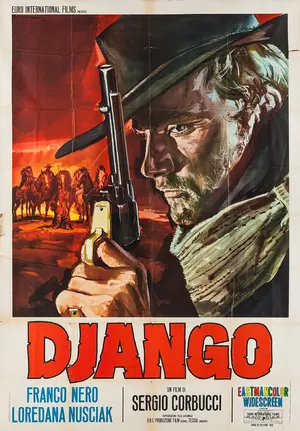
Django (1966)

Director: Sergio Corbucci

An OK second-tier spaghetti Western, clearly aping the style so inimitably pioneered by Sergio Leone a few years prior.

The movie follows Django, a mysterious and lethal drifter who drags around a coffin everywhere he goes. When Django wanders into a town, he finds himself quickly caught between two feuding groups - one a gang of Mexican revolutionaries and the other a crew of ex-Confederate soldiers. Django rescues a young woman, Maria, from one side, and soon is shifting his allegiances between groups, eventually including a group of bank robbers, to serve his own ends. In the end, he cunningly kills off his adversaries and drags his wounded self off to begin a new life with Maria.

Django is decent enough fare for the genre, but I can't say it spurred any desire to watch more of its ilk. I absolutely love Sergio Leone's "Man With No Name" movies, along with his others. But as much as I love them, I also realize how ultimately silly they can be in certain respects, and it's only in the hands of a narrative and cinematic master that one can easily look beyond those films' weaknesses in terms of emotional depth or complexity. Django does a nice job using solid film technique to capture that same hyper-colored-yet-dusty aesthetic of Leone's movies, and it even has a few of the clever plot devices of those earlier movies. But it doesn't all come together or have quite the complete sense of coherence of the originals.

This was apparently a huge movie, though, Maybe not quite as big, worldwide, as Leone's westerns, but big enough to spawn a ton of sequel films, starring quite a few different actors in the lead roles. It really was like a spaghetti western Jame Bond kind of franchise through the 1960s and 1970s, and even hanging on well beyond that, with the most obvious recent incarnation being Quentin Tarantino's version of the character, starring Jamie Foxx. With this in mind, I would recommend it to those who love the look and feel of A Fistful of Dollars and its semi-sequels enough that they want more of the same. For my part, I won't be going out of my way to take in more of them.