Showing posts with label Alec Guinness. Show all posts

Friday, November 20, 2015

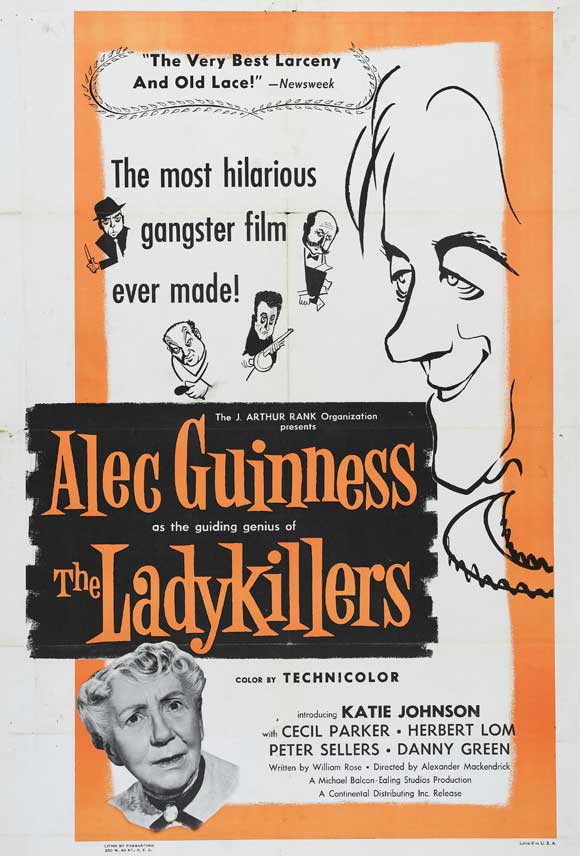
Before I Die # 552: The Ladykillers (1955)

This is the 552nd of the 1,162 films on the "Before You Die" list that I'm gradually working my way through.

Director: Alexander Mackendrick

A fairly amusing dark comedy, though not as thoroughly entertaining as I had hoped.

I had seen the misguided 2004 Coen Brothers remake, so I knew the basic story. The original is set in 1950s London, England, where a group of thieves pose as musicians who practice their string quartet in the home of the elderly and somewhat loopy Mrs. Wilberforce. They are led by the abundantly sinister Professor Marcus (Alec Guinness), whose master plan involves using Mrs. Wilberforce's home, conveniently situated just above the train station, as a headquarters for a daring robbery of an incoming delivery of cash. The heist initially goes as planned, but things go awry when Mrs. Wilberforce learns of the larceny before the crooks can get the money away from the house. This forces the thieves into the grim conclusoin that Mrs. Wilberforce must be eliminated, permanently. The rest of the movie is comprised of the group deciding who will kill her and how the dark deed will be done.

While that description may sound like a horribly macabre story, rest assured that it is merely the stuff of black humor. This is a great concept, and it is not difficult to see why the Coen Brothers decided to try their hand at updating it. Alas, though the original is certainly far better than the 2004 remake, I did find it a chore to watch much of the time. Many of the scenes and situations smack of a comedy sketch that goes on a bit longer than necessary, and most of the characters, while amusing in theory and stature, lack enough memorable dialogue to make a real mark.

This crew had a lot more potential than was met, especially
given the acting talents involved.
The movie was even more of a disappointment after I had seen the name Peter Sellers in the opening credits. Though quite young at the time, he would go on to become an absolute legend of comedy, so I was hoping for an early look at this budding genius. Alas, there was nothing in the performance that demanded any of Sellers's prodigious comic talents. His character, Harry, was only mildly amusing, and it could have been played by any one of countless other actors. With so much hindsight, it seems to be one of the most obvious wastes of talent that one is likely to find. While the other characters were more interesting in theory, they were never given the script to bring the humor to life.

Now having seen them both, it seems like the original and remake were two parts of a potentially greater whole. The original had the set-up and casting right, whereas the 2004 version misfired on setting and some casting. Conversely, the 2004 version understood how to punch up the dark humor, especially when the bodies start piling up, while the original couldn't maintain the comedic element consistently. An even better comparison lies in the 1949 movie Kind Hearts and Coronets, which also starred Alec Guinnes in a variety of roles. That earlier movie is a case study in dark humor, and The Ladykillers of 1955 might have been better had it taken a few lessons from it.

For those who like dark British humor, this is worth a watch, though I would advise tempered expectations.

That's 552 movies down. Only 610 to go before I can die. 

Thursday, March 15, 2012

Film # 76: Star Wars (1977)


Director: George Lucas

Initial Release Country: United States

Times Previously Seen: No idea for sure, but easily 25 times. (Last time – about 3 years ago)

Teaser Summary (No spoilers)

Backwater planet yokel gets swept up in intergalactic war. Learns spirituality and how to use a magic wand.

Extended Summary (More detailed plot synopsis, spoilers included. Fair warning.)

Note: OK. I’m going to assume that virtually everyone reading this has seen Star Wars. If not, first of all, you should probably have your United States citizenship revoked. Second of all, I’m going to make this relatively brief. Third of all, if you really need a blow-by-blow of the narrative, check it out at imdb’s site here, where some detail-obsessed Star Wars nerd has gone way overboard (right down to the make and model of all of the machinery and droids).

Long ago, in a galaxy far away, on the fringe desert planet of Tatooine, young farmer Luke Skywalker (Mark Hamill) buys a couple of droids for his aunt and uncle’s farm. Little does he know that these droids, C-3PO and R2-D2 by name, were sent by Princess Leia Organa of the planet Alderaan (Carrie Fisher) to abscond with technical blueprints for the Galactic Empire’s massive, planet-destroying space station known as the Death Star. Leia is part of a rebellion against the Empire, which rules the known galaxy with an iron fist. Leia had just been captured by Lord Darth Vader (David Prowse, voiced by James Earl Jones), an imposing, black-clad prime figure within the Empire. She sent the droids away in a desperate attempt at assistance.

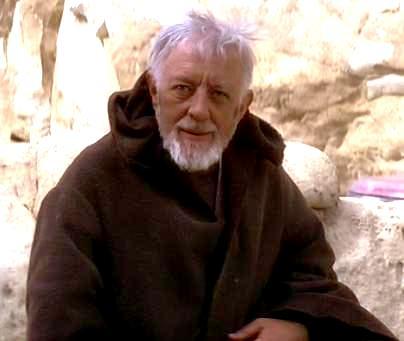
Following Leia’s orders, R2-D2 leads C-3PO and Luke deep into the desert, to the hermit Ben “Obi-Wan” Kenobi, who had long before been a Jedi Knight, an order of peace-keeping warrior monks. Obi-Wan seems to know something of Luke’s history, and after they retrieve Leia’s plea for help from R2-D2, they set out to help. Luke is reluctant at first, but his resolve is solidified when he discovers his aunt and uncle have been killed in his absence by the Empire, who are pursuing the droids. Obi-Wan also begins training Luke in the use of “The Force”, which is an energy field that binds all life and can be harnessed through concentration and discipline. It was this that Jedi used as their source of power, until they were all but wiped out by Darth Vader and the Empire.

In the desert wastes of Tatooine, the ever-patient Ben "Obi-Wan" Kenobi guides the whiny C-3PO and naive Luke Skywalker towards their destinies in the skies.

In the nearby space station of Mos Eisley, Luke, the droids and Obi-Wan hire the mercenary rogue pilot Han Solo and his companion Chewbacca, a towering, fur-covered alien with expertise in machinery and fighting. The sextet narrowly escape capture in Solo’s spacecraft, the Millennium Falcon. They head toward Leia’s home planet of Alderaan, only to find that it has been destroyed by the Death Star. They also find a massive Imperial “Star Destroyer” battleship, which captures the Millennium Falcon.

Through several tricks and some good luck, the six companions avoid capture on the Star Destroyer and rescue Princess Leia, though not without some help from Leia herself. Unfortunately, they also watch as Obi-Wan, after an extended light saber battle with his former pupil Darth Vader, is cut down and seemingly dissipates into thin air.

The remaining five companions and Princess Leia flee the Star Destroyer, though they have been, in effect, allowed to escape so that the Empire can follow them to the Rebellion’s secret base. Leia and the Rebellion use the Death Star blueprints to find a weak point, though it will require a highly risky and daring aerial assault. Luke, hungry to make a difference, immediately signs on. The self-serving Han Solo, on the other hand, takes the reward that he has been promised and leaves the Rebellion to its fate.

Luke, Leia, and Han Solo in the midst of their daring escape from the Star Destroyer. Leia insults Solo at every turn, but I think her hand in this still shot tells us everything.

With the Death Star approaching an attack window that will allow it to obliterate the rebel base, the rebel fighter squadrons attack. After an intense battle, Luke and his two wing men make a last-ditch attempt to hit the Death Star’s minuscule weak spot. With his wing men both shot down, and none other than ace pilot Darth Vader himself positioning his cross-hairs on Luke’s fighter craft, Han Solo swoops in and scatters the pursuing Imperial fighters. Luke, listening to the disembodied voice of Obi-Wan, turns off his targeting computer and uses The Force by relying on his instincts. Doing so, he hits the target and the Death Star is destroyed, saving the rebel base and fending off the Empire. At least for a time…

Take 1: My Gut Reaction (Done after this most recent viewing, before any further research.)

What does one of my generation say about this movie? In short, it’s still damn good, though some viewer maturity and the benefit of hindsight cast much more light on its shortcomings.

Star Wars is arguably the greatest pop culture phenomenon in history. Very few, if any, single entity, individual, or fictional realm in entertainment has become so famous, so widespread, and so embraced by so much of the world. Having seen this movie dozens of times, starting at age 4, it’s impossible for me to view it with fresh eyes. Yet try, I did. (Sorry, Yoda.)

It had been a few years since I’ve watched the movie (this time, I watched the original, theatrical version), and I am now 36 years old. This being the case, I can be slightly more objective than I would have been fifteen or even ten years ago. Please keep in mind that I am fully aware of the deconstruction of the Star Wars movies into their basic elements, and the fact that Lucas “borrowed” heavily from several major sources. Still…

Honestly, who wouldn't want to find out what these four chaps were up to?

Star Wars is still a lot of fun to watch, and I’m still impressed by the magic of the formula that George Lucas concocted. Until this movie, there had been absolutely nothing like it in movies. Sure, there were some highly innovative, creative, intelligent, and even visually stunning science fiction movies. However, there was nothing on Star Wars’ scale, in terms of epic storytelling and breadth of captivating elements.

True to the spirit of classic adventure movies, Star Wars tells a pretty gripping tale of a damsel in distress (though Leia is hardly helpless), fighting against tyrannical powers. The entire universe is a mystery in the beginning, but from that very first moment that you see the pursuit of Leia’s spacecraft by a gargantuan Star Destroyer, you want to know more. With every passing scene, we are given hints at a universe that is as much fantasy as science fiction. This mythical quality is given to us right away with the now-iconic phrase, “Long ago, in a galaxy far, far away…” With these words, high-tech is no longer equivalent to “futuristic”. Already, the tale has our minds expanding a bit.

The true trick of Lucas’s Star Wars galaxy was just how he blended the elements. There are cool gadgets and star ships for the techie, science fiction types. There is the mysticism and philosophy of The Force, the Jedi, and the Sith for the dreamier, more spiritual types. Most importantly for its mass appeal, though, is that there are all of the elements of a rip-roaring adventure story, complete with daring escapes and rescues, gun fights, and aerial battles. And of course, the light sabers. My cousin believes that it is the lightsaber that truly makes Star Wars what it is, and he has a point. If you take out those stately, blazing, “elegant weapons”, as Obi-Wan refers to them, then the Star Wars galaxy gets significantly blander.

The first lightsaber battle in the entire Star Wars movie franchise. These would become the hallmark ending of every single one of the six films in the series. One could argue that the lightsaber is the single most iconic prop in the history of film.

The main characters that everyone knows are almost all on display in this first film, save Yoda, who first appears in The Empire Strikes Back. Basically everyone on Earth is familiar with at least a few of the eight main characters in Star Wars. Oddly enough, in watching it this most recent time, I found Luke to be more annoying than anything else. He is rather whiny, but it’s easy to dismiss this, as he is basically a redneck farm boy who has no idea just what he’s stuck his dusty little toes into.

As much if not more than the characters, though, is simply the spectacle of the entire thing. From highly-functioning robots to bizarre species of creatures like the Jawas, Bantas, to the entire motley crew in Mos Eisley space station, so many things in the movie capture the eye and the imagination. I do have to say, also, that this is where the original, untouched theatrical release needs to be cherished. Lucas’s attempts to go back and give his own films facelifts met with harsh criticism from purists, and I wholeheartedly agree. There was absolutely nothing wrong with anything in the originals, in terms of the visuals. Simply using makeup and costumes, without the benefits of computer generated imaging, always makes those characters more tangible to me. Computer graphics are incredible these days, but let’s face it – we can always tell when they’re computer graphics. Not using these high-tech methods helps us suspend our disbelief a little more easily, in my opinion, and the original Star Wars was and is testament to this.

One thing that does not hold up over the years, or at least has become a more obvious weakness, is the dialogue in the movie. Now that most of us have seen the other George Lucas-penned scripts in Phantom Menace and Attack of the Clones, it’s even easier to see that the man was simply atrocious at writing dialogue. While Star Wars isn’t nearly as bad as Episodes I or II, it’s far from good. There’s a lot of hokum and very hackneyed attempts at humor. Probably the main reason that it doesn’t stand out as much is that the actors are talented enough to gloss it over. Hamill, Ford, Fisher, Guinness, and Jones are much stronger presences than Hayden Christensen and Natalie Portman, and the discrepancy in their abilities to sell lame dialogue shows it. The cast of the original Star Wars was, three-fingered hands down, far superior.

Even hungover with horrendous bed-head, Alec Guinness could out-act anyone else in the Star Wars series. He needed all of his skill to overcome the oft-lame dialogue.

So upon watching it this time, the movie is still great fun to watch. Perhaps I can’t really look at it with total objectivity since it captured a place in my heart at the time when all of our hearts are so impressionable – those magic years between ages three and ten when fantastic stories and movies can imprint themselves on our very beings. I suppose an older viewer who watches Star Wars for the first time may be a tad disappointed, considering just how massive the entire franchise has become. All the same, I think anyone can marvel at just how unique a potion George Lucas mixed up for us, and I know that I’ll never tire of the original trilogy.

Take 2: Further Thoughts (Based on the context of the entire Star Wars series & random factoids.)

Did you notice how, on the “All-TIME 100 Films” list, certain film series are put together and counted as one movie? Namely, The Apu Trilogy, The Godfather Parts I and II, and The Lord of the Rings? Notice how Star Wars sits alone, without either of its immediate sequels, The Empire Strikes Back or Return of the Jedi? Did you notice that? I did. So, why do you think it is?

My guess is that, while the original trilogy was just that, Star Wars can actually stand alone and separate from the latter two films, which rely on the other two. When any Star Wars dork is asked which of the six films in the series is the best, the answer is almost overwhelmingly The Empire Strikes Back, and I agree. I suppose that this movie wasn’t included because, unlike Star Wars, it did not end with any sense of closure. It was therefore connected to the slightly inferior Return of the Jedi (only made weaker by those silly little Disney puppets, the Ewoks). With the choice of either putting only Star Wars on the list or having to include the entire trilogy, I guess the list compilers went with the former option. It makes sense to me.

That's right, fellas. Your respectable series just got down-graded to pre-kindergarten levels. Don't worry in the back there, Luke. In a little while, you'll have an awesome lightsaber fight with your pops...

So, in light of Episodes I, II and III, what do I think? Basically, Episode I is nearly putrid. I remember how, back in 1999, as a 23-year old who was unspeakably excited about the new films, I was bafflingly disappointed. Like many of my ilk, the entire Jar-Jar Binks character was insulting to my intelligence (and, I assume, the intelligence of anyone over the age of four). Liam Neeson and Ewan McGregor were fine, but Jake Lloyd as the young Anakin Skywalker was dreadful (I checked imdb and he hasn’t had an acting gig since then. Small wonder.) The film is only watchable because of the pod races and the three-way light saber battle at the end between Obi-Wan, Qui-Gon and Darth Maul. Aside from these few things, The Phantom Menace was a flashy mess.

After that debacle, things got a tad better with Episode II, and even closer to tolerable with Episode III. Still, none of these prequels could hold a Yoda-levitated candle to any of the original three, not even its weakest link, Return of the Jedi. To me, the reason is simple. George Lucas got too crazy trying to use modern movie magic to try and please every fan. Star Wars and Empire Strikes Back did things using special effects to greatly enhance an engaging, if simple, adventure story. When he went back and did the prequels, it was almost as if the effects became the story.

After Episode II, Attack of the Clones, came out, a friend of mine was disgruntled with it and told me that it seemed like George Lucas had basically read a bunch of fan emails and tried to satisfy every fanboy’s wildest fantasies. You want to see more of Boba Fett? Well, here’s his daddy, Jango Fett! You want to see Yoda use a light saber? Well, here’s Yoda bouncing around with a light saber! It continued in Episode III, but not as egregiously.

Yoda getting his game on in Attack of the Clones. One of several elements Lucas put in seemingly to appease many fans' daydream desires. Personally, I liked it better when Yoda's martial prowess was merely implied and never revealed.

When I go back and watch Episodes IV and V, I absolutely love how scaled down the effects are and how the tale itself is the dominating force. There are many things that are hinted at, but never completely explained. How did Obi-Wan and Luke end up in the Tatooine desert? How did Yoda end up in the swamps of Dagobah? What pushed Darth Vader to the dark side of the force? In truth, I didn’t really need to know the answers to these questions, though I wanted to. Now that I do know, I basically wish that Lucas hadn’t even bothered with the prequels and simple left it all up to our imaginations. It would have saved me a lot of disappointment and would have left Episodes IV, V and VI to stand on their own, something they can do quite well.

Now that nearly three decades have passed since Return of the Jedi was originally released, there has been no end of study done of the Star Wars phenomenon. By now, many people are aware that its tremendous success was no accident. In conceiving his “science fiction soap opera”, George Lucas consulted the renowned cultural anthropologist Joseph Campbell on just what constituted the ultimate story. In a thoughtful (some cynics might say Machiavellian) approach, Lucas used what he learned about popular myths to construct the overall drama of the Skywalkers. The archetypical protagonist that is universal to the greatest of human mythology became Anakin Skywalker/Darth Vader – the flawed hero who falls from grace, then redeems himself in his waning hours.

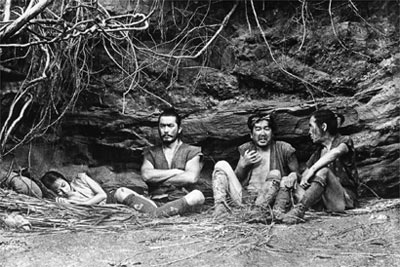
We also learned long ago that the filming of the original Star Wars itself was far from original. In basic narrative and even in shot composition, George Lucas “borrowed” (many say “stole”) from Akira Kurosawa’s classic adventure tale The Hidden Fortress. Despite these borrowed elements, Lucas was one of the earliest to depict a science fiction universe that was used up and grungy, unlike nearly all of the sleek, polished looks of sci-fi TV shows and films that had come previously. Sort of like what Sergio Leone did to the Western picture.

A shot from Akira Kurosawa's 1958 samurai movie, The Hidden Fortress. In this shot, you see the "inspirations" for Princess Leia, Obi-Wan Kenobi, and the droids C-3PO and R2-D2. Lucas also used the settings and locations in his first Star Wars movie.

Out of the countless other oddities and peculiarities about this series, there are two about the cast that have always intrigued me. Perhaps not surprisingly, they both deal with actors who were talented and professional, but didn’t really think much of their roles.

The first is Harrison Ford. He basically thought Han Solo was an idiot. And you know what? After watching the Star Wars movies as an adult, it’s obvious that Han Solo was not the sharpest tool in the shed. He was brave and funny, and he was an amusing rogue, but mostly he was a dolt. Harrison Ford has always said that he would always play Indiana Jones as often as possible because he liked the character, but that he would never play Han Solo again because he was a dunce. In fact, Ford tried to convince George Lucas to have Solo killed off at the end of either Empire or Jedi, to no avail.

The other is Alec Guinness. Anyone who has seen Alec Guinness in his film roles between the 1940s and 1970s knows that he was incredible. Whether it was as Fagan in Oliver Twist, his multitude of roles in Kind Hearts and Coronets, Colonel Nicholson in Bridge on the River Kwai, or any others, you know that he was an actor of incredible range and skill. As Obi-Wan Kenobi, he absolutely nailed the part as the wizened old knight who could quietly harness supernatural powers while mentoring the clueless young Luke. Guinness himself, however, seriously disliked certain things about playing Kenobi. One was that he found the dialogue to be atrocious, and could barely stomach delivering such hokey lines. He even succeeded where Harrison Ford failed – he convinced George Lucas to kill off Kenobi, ostensibly because he felt it strengthened Kenobi as a character (which it does). Later, though, Guinness admitted that it was also because he wanted to get out of reading dialogue that he found horrendous. More nuisance was to come in the succeeding years, as Star Wars mania grew to epic proportions. Guinness, a man of staggering accomplishment on both stage and film long before Star Wars, would forever after be known as “Obi-Wan Kenobi”.

In very limited screen time, Guinness played Kenobi so well that it became his blessing and his curse. This "silly role with terrible lines" overshadowed his previous decades of outstanding work. Oh well. At least he made serious cash out of it.

I used to feel sorry for Alec Guinness in that last respect. That was until I found out that he did something that showed great foresight. Unlike nearly everyone else involved with the original Star Wars movie, he thought that it would be highly successful. He therefore negotiated a contract that would pay him percentage royalties rather than a flat fee. As you can imagine, this ultimately led him to live very comfortably for the rest of his days. I guess in the end, it was a decent enough trade-off for him. Leave it to the Brit to show some foresight and do the responsible thing.

I could, like nearly any fan of science fiction and films, go on forever about the Star Wars franchise. Suffice it to say that it’s an incredible world that Lucas constructed, and it’s fun to go back into that world from time to time. These days, people can do it through novels, video games, role playing games, comic books, and myriad other sources. Still, there’s nothing quite like going right back to where it all started – with that massive, groundbreaking film in 1977 that set new standards for wondrous adventure movies. I’ll be shocked and amazed if the phenomenon of Star Wars dies out in my lifetime, and I know that I’ll go back and watch those original three every few years for as long as I live.

That’s a wrap. 76 shows down. 29 to go.

Coming Soon: Mon oncle d’amerique (1980)


This is one of the few “modern” movies that I know absolutely nothing about. It’s French and Gerard Depardieau is in it. That’s all I’ve got. Come on back in a week or so to find out what I think of it.

Please be sure to pick up all empties on the way out.

Sunday, May 15, 2011

Film #55: Lawrence of Arabia (1962)


Director: David Lean

Initial Release Country: United Kingdom

Times Previously Seen: once (about 12 years ago)

Teaser Summary (No spoilers)

Bright, charismatic, and quixotic young British officer fosters & leads major Arab military campaigns during World War I.

Extended Summary (Spoilers included. Fair warning.)

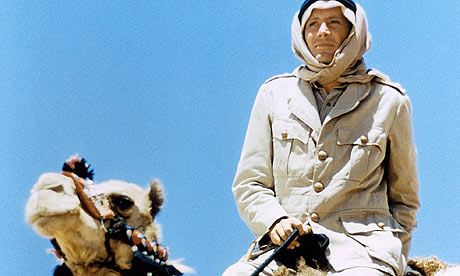
In Cairo, in the midst of World War I, a young British military intelligence officer, T.E. Lawrence (Peter O'Toole), whiles away his time and immense intellectual abilities making maps. This all changes when his commanding officer decides to send him to the Arabian desert. Despite Lawrence's seeming lack of respect for authority and discipline, he is fluent in multiple languages and shows a rare and genuine interest in the region. He accept the assignment to seek out the British ally, Arabian Prince Feisal (Alec Guinness), and see how his battle against the enemy Turks is going.

In western Arabia, after an arduously scorching journey across the desert, Lawrence meets up with his superior officer, Colonel Brighton, and finds Prince Feisal just as he and his tribes suffer an air raid by the Turks. Although Brighton and high British command urge Prince Feisal to move his people to the south and await British aide, Lawrence expresses his distaste at the Arabs relying solely on foreign assistance, though it comes from his mother country. He convinces one of Feisal's warlords, Sherif Ali (Omar Sharif), to launch an assault on the heavily fortified, Turkish held port city of Aqabbah. To show his confidence in the plan, Lawrence agrees to go along with the fifty-odd fighting men on their perilous trek across the desert towards the occupied coastal city.

Still clad in mostly British soldier gear, Lawrence makes one of his first forays into the scorching Arabian desert.

After a weeks-long journey under the punishing Arabian sun, during which several companions die, Lawrence and Sherif Ali's fighting force clear the desert. They are met by Auda Abu Tai (Anthony Quinn), the local sheik who has been bought off by the Turks not to attack Aqabbah. Ignoring Sherif Ali's disgust and personal desires not to accept help from such a man, Lawrence stokes Abu Tai's pride and thirst for gold, and he convinces him to join forces to take Aqabbah from the Turks. The plan works to perfection, as the Turks never expect a landward attack and are quickly routed. However, Abu Tai is disgusted to find no gold anywhere in Aqabbah, and centuries-long blood feuds threaten to break out between the two Arab tribes. Lawrence decides to head back to Cairo, across the Sinai peninsula, to bring word of the victory and ask for more military aide from his British commanders.

After yet another brutal journey across the desert wastes of the Sinai, this one killing one of Lawrence's body servants, he makes it back to headquarters. The mere sight of him, sun-stroked and wearing a tattered robe of a local khalif, shocks the standard British officers and high commanders. After a few emotional outbursts, Lawrence calms enough to explain the situation in Aqabbah and convince his commanders to supply armaments and training to the Arabs. The goal will be to disrupt the Turkish rail supply chain through guerrilla attacks that Lawrence will lead himself.

Lawrence and Sharif Ali, on the brink of yet another one of their guerrilla raids.

Many months pass, and Lawrence's guerrilla fighters are succeeding beyond expectations. Their hit-and-run dynamiting tactics are sending Turkish supply routes into chaos. The fighters have become famous enough that Lawrence has even attracted an American photojournalist, whom Lawrence is more than happy to indulge.

In the middle of the Arabs' wild successes, however, Lawrence finds himself extremely torn. All this time, he has fought with the Arabs for their own freedom from foreign control, and he has become a hero of near mythic proportions both in Arabia and abroad. Still, he feels a mounting desire to set down the mantle of responsibility, turn away from all of the bloodshed, and just become an average person again. Complicating his moods even more are his equally strong feelings of vanity and sense of importance. It is all of these conflicting emotions that pull Lawrence briefly back to headquarters in Cairo.

At British headquarters, Lawrence makes a desperate plea to be allowed to become just an average soldier again. His commanding officers convince him that he is too valuable and send him back to Arabia.

Once back in Arabia, Lawrence continues to fight, but has become a gruesome specter. He leads his ever-dwindling number of troops northward towards Damascus, where Britain and her allies hope to deal a death blow to Turkish forces. On his march, the previously-compassionate Lawrence no longer balks at wholesale massacres of Turkish forces, and nearly all evidence of his past flamboyance and vanity have been burned away. After another spell of self-doubt, Lawrence actually wanders into a nearby town, allows himself to be captured and brutally beaten by Turkish forces.

After being treated for his wounds, Lawrence returns once again to headquarters in Cairo. This stay is very brief, but before leaving, Lawrence extracts a guarantee from his general and the local British diplomat: that Britain has no designs on moving in and taking over Arabia once they have banished the Turks.

On returning to Arabia, Lawrence's Arab forces make their final push northward, and manage to take over Damascus even before the European forces arrive. As such, the various Arab tribes have sectioned off the city by tribe, leading to different segments of the infrastructure being under that control of rival groups, including his old comrades-in-arms, Sherif Ali and Abu Tai. Lawrence attempts to get the divergent groups to sit, talk, and negotiate, but seemingly for naught. He sees the chaos that is resulting from centuries-old tribalism, and decides that he can do no more. He leaves Arabia and becomes an anonymous British soldier once again.

An exhausted Lawrence makes his final attempts to unify the Arab League, with Abu Tai at his side.

Years later, in 1935, at the age of 47, Lawrence dies in a motorcycle accident. It is only at his funeral that people seem to recall what an extraordinary person he had been, though none can rightly say that they knew exactly what had been in his heart.

My Take on the Film:

Lawrence of Arabia is a true epic, and one that I really enjoyed watching, even if I don't find it flawless.

Part of the reason I enjoyed this massive picture is that I knew what I was in for. Having a running time of 216 minutes staring me in the face, I set aside a Saturday morning with nothing else to do. Mother nature helped me out by adding a rainstorm. Perfect movie-watching weather. Anyone who's thinking of taking in this classic, be sure you understand what's expected of you, and plan accordingly.

So, what does Lawrence of Arabia give you? The most obviously stunning element is the visuals. As far as the TIME list goes, this was only the fourth color film that I've watched (Pinocchio, Meet Me In St. Louis, and The Searchers being the others). In 1962, the vast majority of films were still being filmed in much more cost-effective black-and-white. If they were filmed in color, nearly all backgrounds were painted mock-ups. When Lawrence of Arabia hit the screens, it must have completely blown people away. The sweeping, on-location desert landscapes are incredible. Even someone like myself, who has grown up in an age of unparalleled cinematic visuals, has to marvel at David Lean's eye. The wide-angle shots convey the beautiful vastness and desolation of the Arabian desert, as well as the affects that such a landscape would have on humanity. The setting is clearly as much a character as T.E. Lawrence himself.

One of the almost countless stunning images of the pitiless yet oft-beautiful desert as it surrounds the characters.

The history of the modern Arab world is also a major theme. This may not be of interest to some viewers, but it certainly has a certain bearing, considering the changes the Middle East is undergoing as I write these words. This relatively brief slice of European doings in modern Saudi Arabia and its neighbors is likely to pique the curiosity of most. I realize that it is a dramatized version of events, but I do plan to dig a bit to find out more about this very seminal moment in world history.

Of course, the movie is not called “History of The Middle East”. The titular protagonist is certainly one of the most intriguing people the West has ever produced. A rather tortured intellectual, Lawrence was, by the few accounts that I've read, a walking collection of contradictions. The movie does as well as it can at displaying as may of the facets of T.E. Lawrence as possible. The quiet, ponderous scenes in the desert evoke his passive, philosophical nature; while the desert fighting scenes show a savage, sadistic warrior in the throes of battle rage. We get a fantastic scene of Lawrence alone and preening in his newly-given khalif robes, clearly absorbed in his own vanity; later, we have an emotionally shattered Lawrence begging to return to the British military, desperate to be “just one of the chaps” again.

Of course, it was a very young Peter O'Toole tasked with acting out David Lean's visionary bio-pic. O'Toole's performance is certainly packed with emotion, and is very effective. However, I do have to say that, after three-and-a-half hours, I had grown a bit weary of all of the quivering. It seemed to be the way that was decided upon (by O'Toole or Lean, I don't know) to convey a range of Lawrence's various emotions. Lawrence is angry? He shakes with rage. He's crushed by sadness? He shakes in despair. And so on. There are more tranquil moments that offset this; it's just an impression that I come away with.

The only other element of the movie that I found a bit frustrating is one that probably cannot be avoided. Because the real T.E. Lawrence was apparently such a difficult man to pin down, I came away from the movie rather befuddled by the title subject. As most people are, I am accustomed to protagonists who are, on the whole, clearly defined, be they “hero” or “villain”. Lawrence was one who clearly defied easy categorization. It's the thing that makes him fascinating, but also left me with the sense that the movie's study of him, despite being nearly four hours, was somehow incomplete. I don't really feel that this was due to poor storytelling on the parts of the filmmakers; it's simply the subject matter.

Lawrence of Arabia is a great film, though one that may seem like an unsatisfying trial to many viewers. If you can be patient and drink in everything it offers, its merits shine as brightly as any film's. If longer films without pat conclusions are not your thing, you may not have the wherewithal for this one.

That's a wrap. 55 shows down, 50 to go.

Coming Soon: 8 ½ (1963)


The Italian filmmaker's filmmaker, Federico Fellini's well-known film on making a film. Say all of that five times, quickly.

Please be sure to pick up all empties on the way out.
*Note on future content: As a few of you may have notices, I did not include the “Take 2” segment in this review. From this point on, I will cease doing this portion of my reviews, as they had become simply too time-consuming. Henceforth, I will keep it limited to a brief summary and my impressions of each movie. I hope that you will still enjoy them.

Thursday, June 24, 2010

Film #32: Kind Hearts and Coronets (1949)


Director: Robert Hamer

Initial Release Country: England

Times Previously Seen: none

Teaser Summary (20 words or fewer - no spoilers):

Ostensible gentleman coolly and hilariously murders his way up the tree of succession to a dukedom.

Uncut Summary (the whole shebang, spoilers included. Fair warning):

Louis Mazzini (Dennis Price) is a quiet, polite young man of a seemingly common, working class family. His English mother was turned out by her wealthy family, the D'Ascoynes, for marrying an Italian opera singer. The two left the D'Ascoyne estate for much more modest settings. Shortly after marriage, Louis is born, overwhelming the new father so much that he dies of joy, leaving Louis and his mother essentially alone.

Over the years, Louis grows up while his mother works in menial jobs and takes on a boarder to pay the bills. All the while, she sends Louis to the best schools. He eventually lands a job selling linens and even works his way up to selling women's underwear! All the while, his mother has been educating him on his family heritage, dispossessed though it may be. By this, Louis learns that he is roughly 12th in line for the Dukedom. Not much to go on, really, but time marches on.

Then, tragedy. Luois's mother suffers a tragic accident. She sends a plea to her estranged family to allow her to be buried on the family estate, but she is coldly refused. Shortly after, she dies. Louis becomes furious at the D'Ascoyne's callousness towards his beloved mother. He vows to kill each and every member of the family until he attains the Dukedom for himself. He begins in a benign enough way: he takes a job for his kindly great uncle D'Ascoyne in a large bank.
A determined Louis (left) ingratiates himself to his first future victim (middle) and his future wife, Edith.

Over the next several years, Louis both climbs the corporate ladder at the bank and exacts his cold revenge. Keeping a tally on a family tree, he "X"-es off any family member who dies. In some cases, he is helped by fate; scarlet fever does in twin infant D'Ascoynes and their mother; a fatal blunder at sea sinks Admiral D'Ascoyne; and so on. In many other cases, however, Louis plays the part of the reaper. By poison, explosives, bow and arrow, drowning, and the gun, he gradually does in every remaining living D'Ascoyne (all eight played by Alec Guinness) between himself and the Dukedom, finally claiming the title as his own.

Then, an ironic twist. Shortly after marrying the beautiful, noble and honorable Edith (Valerie Hobson), whose previous husband was one of Louis' victims, the newly coroneted Duke Louis D'Ascoyne is arrested for a murder that he didn't commit. In truth, he is being framed for the suicide of the husband of his past acquaintance and lover, the sensual and greedy Sibella (Joan Greenwood). Her ploy is to blackmail Louis into killing Edith and marrying her, making her the new duchess.

In the end, Louis agrees to Sibella's terms. She produces a previously-unfound suicide note which exonerates Louis. Upon his release, Louis stands outside of the jail gates to look upon two carriages: his upstanding and forgiving wife, Edith; and his egotistic and avaricious blackmailer, Sibella. Just when Louis seems to be back in the driver's seat, he realizes that he has left his faithful and honest memoirs in the middle of his jail cell, a thorough condemnation written by his own hand.

Take 1: My Gut Reaction (done before any further research):

A movie like this is one of the main reasons I started this little project: to find brilliant films that were previously unknown to me. Kind Hearts and Coronets is phenomenal comedy.

Only knowing the basic plot and that the film was British, I guessed that it would be black humor, and boy, was I right. It is black. Pitch black. To quote "the cowboy narrator" from The Big Lebowski, "...darker than a steer's tukus on a moonless prairie night." But it's black humor of the highest degree. It's the type of dry, dark, literate humor that I think only the British could pull off.

Louis Mazzoni, the serial murderer out for vengeance and the title that his beloved mother turned her back on, is far from warm, cuddly, or sympathetic. But damn, he sure is entertaining to watch and listen to. This is thanks to an brilliant script worthy of the wittiest Irish and British writers at their finest, as well as Dennis Price's portrayal as the mixed race, avenging devil. He's all manners, sophistication, and sly wit as he condemns and slays English aristocratic society both in word and in deed.

Equally worthy of attention is Alec Giunness as the eight D'Ascoynes. His performances are as incredible as they are hilarious. The eight aristocrats: the kindly banker, the bluff patriarch, the arrogant dandy, the blowhard Colonel, the bombastic Admiral, the ferocious suffragette, the rambling parson, and the emasculated photography enthusiast; each one is given his or her own attitude, bearing, voicing, and even posture. Each one is distinct and distinctly hilarious. Among the many jewels in Guiness' acting crown, this one is worthy of a prime place.

Here's perhaps the most hilarious little sequence of deaths. My favorite is the death of Admiral D'Ascoyne, which comes second in this clip. Sorry, but I can only give the hyperlink to the youtube clip.

A side-note on Alec Guinness. I heard once that one of his great regrets was playing Obi Wan Kenobi in Star Wars. The reason being that, after five decades of stellar acting work on the stage and screen, he would forever after 1977 be known almost exclusively as the bearded and robed mentor to a weenie Luke Skywalker. A true tragedy, in my book.

Back to Kind Hearts and Coronets. My girlfriend and I laughed so hard at this movie that I had to wonder why it isn't better known. My only theory is that U.S. culture has never embraced dark humor, en masse. When I think about our popular culture in terms of TV shows or movies, I find it still mostly composed of yuk-yuk jokes, slapstick gags, and very obvious, sophomoric humor. There have been some strides made lately, with a few successful shows dropping their laugh tracks ("But how will I know when to laugh!?") and relying on (gasp!) the actual script and acting.

The Office has done rather well with this very British approach, though a notable casualty was the incredible show Arrested Development, which Fox bungled horribly. I can only hope that more people begin to see the value in such shows, and realize that taking otherwise serious or dire situations and mixing them with a dash of ridiculous fiction can create storytelling magic. Kind Hearts and Coronets was a key forefather to such things in film, and I highly recommend and fan of dry, off-beat humor give it a watch.

Take 2: Why Film Geeks Love this Movie (done after some further research):

Some really interesting factoids about this movie out there, most notably in this great little essay by Philip Kemp.

The adaptation process was an interesting one. The original novel, Israel Rank: the Autobiography of a Criminal (1907) by Roy Horniman, was a very similar dark satire that subverted the aristocratic system in England. However, some key changes were made by the scriptwriters. Firstly, Horniman's half-Jewish killer was made to be half-Italian, given the political climate of post-WWII England. More importantly, however, were the additions of various methods of assassination (in the book, Rank poisons everyone) and the clever witticisms delivered by Louis Mazzini. Kemp points out how these latter two changes enhanced the story invaluably, and I can't help but agree.

Equally interesting is the life of the film's director and co-scripter, Robert Hamer. Kind Hearts and Coronets was quite a departure for the Ealing production company, which had mostly done lighthearted films of fancy. It was only through many battles and Hamer's sheer genius that the film was made. Hamer was, by all accounts, a true man of film and brilliance, extremely creative and beloved by the actors with whom he worked. He was an alcoholic whose anger at the established, stuffy British culture fueled his creativity. His discontent seemingly only grew over the years and eventually wore him down, leading to his death at a relatively young age, another casualty of artistic constraint.
A still from one of several scenes cut for the American version, for openly admitting to infidelity.

Speaking of limiting creativity, it's interesting to see how the film was changed for the American release, several months after the London premier. Certain scenes between Louis and Sibella were deemed too erotic and suggestive, so they were cut. The scenes that ridiculed the dim-witted parson D'Ascoyne violated movie codes. They were cut. And, the most grievous affront in my mind, the ending was altered. Since the Hayes code forbade the mere suggestion of a criminal getting away with a crime, the American version added ten seconds of footage to show Louis' memoirs actually being found at the end, thus eliminating any chance that the murderous Mazzini would get off scot free. Yet another example of amusing ambiguity crushed by the Hayes code, a la Baby Face.

On a more critical note, most reviews seem to laud Joan Greenwood's performance as the petulant Sibella as outstandingly alluring. While I can't deny her skill, I disliked the character so much that I can't agree with the original TIME magazine review that she's basically the sexiest thing on the planet. I found her a little to elf-like to put her on a level with some of the sultrier vixens of the day, Barbra Stanwyck and Ingrid Bergman, to name a few.

Kind Hearts and Coronets deserves much more modern recognition that I think it receives. Any person who gets hearty laughs from calm, cool, literate humor would do well to track down this 60-year old classic. I'll certainly be watching it with any new viewers that I can find.

That's a wrap. 32 shows down, 73 to go.

Coming Soon: White Heat (1950):


"Top of the world, ma!!" I've seen this one, and remember liking it. I enjoy James Cagney's "ornery little man" persona, and if I remember rightly, he plays a whack-job, mother-loving criminal in this one. Should be fun.

Please be sure to pick up all empties on the way out.