Showing posts with label George Lucas. Show all posts

Thursday, May 31, 2012

Film # 82: Brazil (1985)

Director: Terry Gilliam

Initial Release Country: United States

Times Previously Seen: twice; last time about 10 years ago.

Teaser Summary (No spoilers)

Lonely bureaucrat in an Orwellian alternate reality seeks to escape his society’s trappings to find romantic love.

Extended Summary (More detailed synopsis, including spoilers. Fair warning.)

In an unspecified time, in an unspecified European country, Sam Lowry (Jonathan Price) is a mid-level bureaucrat working for the massive government machine. He works in a dismal factory environment crammed with pipes, papers, and employees who spend plenty of time shuffling around both themselves and various order forms. Amid all of this, Lowry has daydreams of flying among the clouds as an angel, seeking out a beautiful, unnamed woman who is trapped in gossamer netting.

One day, his office receives notice of an error made by one of the countless departments within the system – a typo has led to the brutal arrest, retrieval, torture, and death of an innocent man, Harry Buttle. Buttle has been mistaken for Harry Tuttle (Robert De Niro), a known “renegade and terrorist” engineer who runs around the city, illegally fixing people’s electrical problems without the proper paperwork. Lowry recognizes the mistake and volunteers to bring a pittance check to the bereaved widow.

 Sam assists his lazy boss in sorting out the "error" that led to Buttle's death. This kick-starts Sam's quest for his dream girl, Jill.

At the Buttle widow’s apartment, Sam comes in contact with Jill Layton (Kim Greist), the Buttles’ upstairs neighbor, who also happens to be the very vision of the woman in his dreams. Since Buttle’s erroneous arrest and death, Jill has been working her way through the endless government channels to find who is responsible for her neighbor’s wrongful death. Her tireless pursuit of justice through these channels has also earned her status as a fellow terrorist aid to the renegade Tuttle. Sam tries to pursue her, but Jill offers no information and flees, fearing anyone from the government.

Back at his apartment, Sam runs into the real Harry Tuttle, who barges in so that he can fix Sam’s broken air conditioner. While efficiently fixing the problem, Tuttle explains that he was a government engineer, but left because the amount of paperwork. Before Tuttle leaves, Sam also helps him deal with a pair of government workers who show up (many hours late) to fix his air conditioner.

Now obsessed with finding Jill, Sam decides to take a previously-offered promotion into the Ministry of Information Retrieval, the department in charge of all information gathering. Sam had refused the offer, which was the result of the machinations of his image-obsessed and vain mother, due to his contentment with his low-level, low-stress job. Now, he accepts and becomes an Information Retrieval officer.

After obtaining some general information about Jill, he comes across her in the office building as she continues to seek justice for Buttle’s death. Sam finally reaches her. Jill at first tries to shake Sam away from her, but he eventually convinces her that he is, indeed, deeply infatuated with her. With government officers on her trail, Jill goes with Sam into hiding. Sam sneaks back to the Ministry of Information Retrieval and falsifies the records so that Jill shows up as “deceased”. He returns to her and the two share a romantic evening together.

 Though unglamorous and unassuming in real life, Jill is the object of Sam's self-destructive pursuit of love.

The next morning, the state police barge in and take Sam away. He is run through the draconian, yet clinically anaesthetized legal process, and ends up in a torture room. Just as he is about to be tortured (by his old “friend”, Jack Lint (Michael Palin) from his previous job), his torturer is shot through the head by Harry Tuttle and a gang of terrorist raiders. The raiders pull Sam out of the building, and he flees with Tuttle.

The world around Sam starts to become more fantastic and dreamlike during his escape. He and Tuttle run into a shopping center, where Tuttle inexplicably becomes shrouded by massive amount of flying papers. When Sam tries to pull the papers off, Tuttle seems to have vanished altogether. Sam runs into what appears to be a church, in which a funeral is taking place. The deceased is announced as one of Sam’s mother’s frenemies – a fellow plastic surgery addict who had been growing ever-more deformed through botched procedures. Next to the coffin is Sam’s mother, now transformed into a woman who appears to be in her mid-20s, and who looks exactly like Jill. She is being fawned over by eager young men, and she brushes Sam away from her.

Retreating outside, Sam is once again in a world even bleaker than anything we’ve yet seen – the buildings are cold, rigid, flat, gray structures that tower over him. A gang of policemen pick up their pursuit of him again, chasing him into a massive wall of the flex-piping that is ubiquitous in Sam’s life. After frantically digging through the pipes, Sam finds himself in a trailer being driven by Jill. Once again united with his lost love, the two drive off in seeming bliss.

However, this perfect happy ending abruptly ends when we see Sam back in the torture chair deep within the Ministry of Information Retrieval. In fact, the entire escape from the torture room was a pure fantasy brought on by the torture. Sam, now thoroughly insane, has sought refuge in his unrealistic and childish fantasies of escape from the system that has now effectively destroyed him.
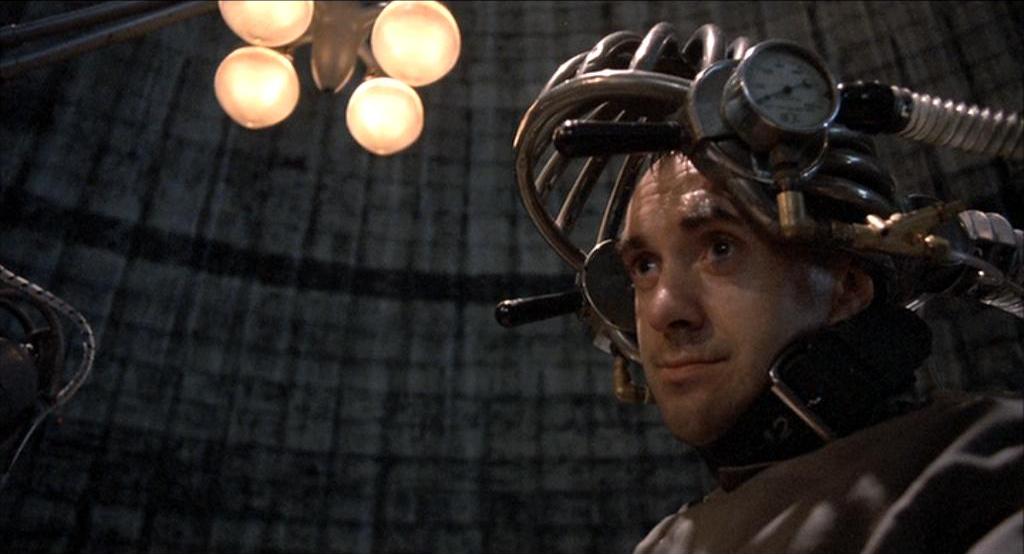
Sam's destiny ends here - in the torturer's chair, completely insane and disconnected from his warped reality.

 Take 1: My Gut Reaction (Done after this most recent viewing, before any further research.)

A very brief history: I love Terry Gilliam. I’m not a blind worshipper, by any means, and there are a few of his films that have fallen flat for me (The Fisher King and Tideland, specifically). Most of his work, though, I find wonderful, in the truest sense of the word. From the moment I watched Time Bandits as an 8–year old child, I was hooked. With this movie, and others like The Adventures of Baron Munchausen, I got a great combination of childlike wonder, fun adventure, and humor that magnificently ran from silly to wry.

With Brazil, it was only upon this recent viewing that I can say that I now fully appreciate it. It really is his best film, and it is not difficult to see just why it made the TIME 100 list.

Brazil is not Gilliam’s gravest or most serious work, but it is his most artful and will ultimately be his most lasting. By drawing from the more timeless themes of the human condition, namely individuality versus conformity, he sets this work above all of his others and makes a visually arresting statement about human psychology in the post-Industrial Age. It was something that writers and observers had been doing for decades prior to Brazil, but Gilliam was the first to express it so stunningly in cinema.

It’s not hard to see in the protagonist, Sam Lowry, the essence of George Orwell’s Winston Smith in the seminal novel 1984. Lowry, like Smith, is part of a totalitarian system in which a sprawling and invasive government has molded its citizens into a populace that has sacrificed its creativity and freedom for the “security” of bland superficiality. The various “Ministries” in Brazil are virtual parallel to those in 1984. The contribution that Gilliam made in his film is that we can now see the results in the form of revolting starkness. Between the towering grey buildings and the endless miles of piping in Brazil, a viewer feels totally crushed and hemmed in on all sides. As a viewer, I found myself yearning for the more colorful, fantastic dreams that Lowry would drift into, childish and unrealistic as they might be.

 Sam's dream self. These play out like the fantasies of a 13-year-old boy, which is what Sam is, emotionally.

It is this childishness of Lowry that was my grand revelation upon this most recent viewing. When watching this film times past, I never quite realized that Lowry is meant to be seen as completely out of touch with his own reality. This is something that, at one point, Jill expresses to him in those exact words. Once Lowry sees Jill for the first time, he becomes possessed of a completely juvenile mania to track her down, in the process destroying his own life and any chance of happiness. I realized that this is not due to a lack of intelligence on Sam’s part, but rather the fact that he has been so repressed by the hulking system around him that he is not capable of handling emotions such as love (or at least, infatuation) as a mature adult. Instead, he charges headlong after Jill and is inevitably crushed in all ways possible.

Someone who hasn’t seen the movie and reads my previous paragraphs would think that Brazil is a humorless slog through dour sociopolitical commentary. Far from it. As with all of his other films, Terry Gilliam gives us plenty of humor to carry us through. Gilliam was an original key member of Monty Python, and it’s not hard to see it in any of his films, including Brazil. No, there are no “Lumberjack” songs or overtly silly antics, but a certain “Python” tone is there. Whether it’s the goofy hats that the government electricians wear or the willful obliviousness of a professional torturer, there are plenty of comedic moments, light and pitch dark, alike. It’s not stuff of gut-busting hilarity; rather, it’s humor calculated for extreme effect. It all conveys just how unaware nearly all of the characters in the film are to their situation.

One of the best examples of this lack of admission is when Lowry tracks down the Ministry’s “Information Retrieval” department on his mission to find Jill. When he reaches the office, he hears the bloodcurdling screams of a “detainee” being tortured in an otherwise stately-looking office. Once the session is finished, Sam walks in to see the back of the torturer (the Jack Lint character played by Monty Python alum Michael Palin), hunched over as he sobs uncontrollably. Once Sam announces his presence, though, Lint turns and composes himself in a split second, utterly refusing to face just how horrific are the acts that he performs on a daily basis. This perpetual denial is arguably the most lasting notion of the entire film.

 Jack Lint, covered in blood from his latest victim, though putting on the eternal "good show" of a smile to others.

And it is scenes such as this one in which Gilliam’s humor is a tremendous asset to the movie. The entire tone of the scene is one of chilling horror, and yet you almost can’t help but chuckle when Sam confronts his former coworker. It is one of dozens of moments that elevate Brazil from straightforward social commentary into more Swiftian satire. It was this entire angle that had eluded me in previous viewings, and which I am very glad to have noticed this time around.

As you may glean, Brazil is not a barrel of laughs. Anyone familiar with Gilliam’s other more popular, much more “Python-esque” movies should not expect a sibling of Time Bandits, Holy Grail, or similar ilk. Rather, Brazil is those movies’ distant, dark cousin. A dark, brooding, and far more intelligent cousin whose somewhat silly gags can mask brutally sardonic observations.

Take 2: Why Film Geeks Love This Movie (Done after some further research.)

The story of Brazil’s creation and execution is rather interesting, but nearly as interesting and highly publicized as its studio release.

When you watch Brazil, you’ll probably be highly amused, if not dazzled, at some of the brilliantly funny lines of dialogue. If so, then you probably won’t be surprised by the fact that one of the co-writers was Tom Stoppard, accomplished writer of witty gems like Rosencrantz & Guildenstern Are Dead. As gifted as Gilliam is, he needed some help adding narrative cohesion and sharper dialogue to his tale, and Stoppard obliged.

Reading about Gilliam’s filmmaking reveals a few things. Often, his crew has nightmares about the scenes that he writes, due to their highly fantastic nature. One can easily say (as Gilliam himself probably would) that his artistic visions usually push or pass the boundaries of practicality, in terms of actual production. This is something that links to one of Gilliam’s favorite filmmakers – Federico Fellini. In Fellini’s 8 ½, the very subject is a talented director’s disconnection from reality and how this plays out in both his life and his films. While I can’t speak to Gilliam’s personal life, it is a problem that has almost always been a characteristic of his movies, which often get squeezed or completely crushed by financial backers who will not fund the grand designs of Gilliam’s dreams. When they do happen, though, the results are often magical.

 Executing shots like this has always been a nightmare for crews who work on Gilliam's films, but the end results are often stunning and impressive.

An interesting side note about Gilliam, based on past interviews – he has a real chip on his shoulder about certain directors, namely Steven Spielberg and George Lucas. He has considered them as panderers to the masses, and overly commercial. In addition, he sees Lucas as particularly personifying the uglification of movies through overuse of CGI. I have to agree, as my own sentiments echo Gilliam’s, regarding the StarWars prequel trilogy.

The eventual release of Brazil is probably the most interesting tale behind the finished product. To make a long story short, the studio executives did not see Brazil as “commercially viable”, being too long, too dark, and too quirky for a wider audience to enjoy. Gilliam, who had contractual final cut on the movie, staged something of a guerrilla war against one particular executive who stalled the film’s release and who pushed for a much-altered version of the film. A quick look at the two versions is very telling.

Gilliam’s version (as described above) is obviously very dark, making the point that the society portrayed in Brazil is so bleak and entrenched that a lone, unrealistic dreamer never stands a chance. It’s a bold and interesting, if not exactly uplifting, statement. The studio, and one man in particular named Sid Sheinberg, had the fantasy sequences almost completely eliminated, pared the film by over 40 minutes, and gave the film a happy ending with Sam and Jill living on a “happy valley” farm outside of the totalitarian city in which they had lived. This is interesting since it is almost exactly what was encountered by Ridley Scott’s Blade Runner several years prior.

 One of the final shots of the legitimate Gilliam ending. The serene landscape in the background contains the "happy ending" that Sheinberg wanted to release. If he had had his way, Brazil would not only have been forgettable, but also probably a plain old, bad movie.

Gilliam flipped. He refused to put his name on any such film, as it so distorted the story that he was telling. What followed was a drawn out back-and-forth between studio, Gilliam, and a gaggle of lawyers. In the end, Gilliam’s version of Brazil was released, much to the delight of certain parties who were fighting for its artistic integrity.

The critical reaction was actually rather mixed upon its release in late 1985. Some hailed it as a masterpiece work, and it won several regional awards. Other groups of critics all but ignored the movie, or gave it lukewarm reviews. Commercially, it managed to just break even.

In the 17 years since its release, Brazil’s stature has grown impressively. While no one is going to call it the greatest movie of all time, it is widely considered exceptional, and is easily one of the most singular and interesting films of the 1980s. It also served as a clear inspiration for later films, such as the Coen brothers’ The Hudsucker Proxy and others. The “retro-future” designs of the costumes and sets, which blend older Victorian-era styles with hyper-Industrialized and futuristic elements, has also been seen as an inspiration for the “steam-punk” sub-culture.

Gilliam himself looks back at Brazil with overall fondness. Despite the insane headaches that its final release caused, and the fact that he shot himself in the foot, in terms of Hollywood, he still sees it as a success for “the little guy”. Ultimately, it was an off-kilter movie that was made and shown as he intended. It’s not hard to see the parallels between his fight for his movie and his character Sam Lowry’s pursuit of his own dream. The difference is that Gilliam got the satisfying ending that he denied Sam.

That’s a wrap. 82 shows down, 23 to go.

Coming Soon: The Purple Rose of Cairo (1985)
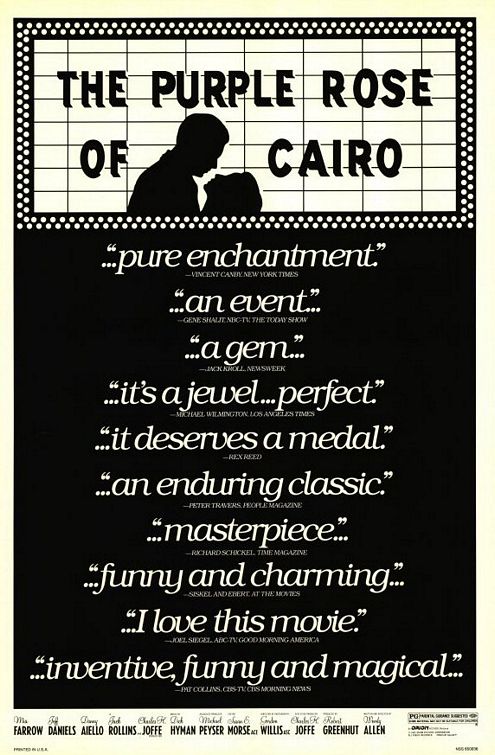

Woody Allen makes the list. The neurotic little New Yorker is hit or miss with me. The one and only time I watched this movie, it was a miss. I’ll try again very shortly. Come on back to see if I change my mind with this little historical flight of fancy.

Please be sure to pick up all empties on the way out.

Thursday, March 15, 2012

Film # 76: Star Wars (1977)


Director: George Lucas

Initial Release Country: United States

Times Previously Seen: No idea for sure, but easily 25 times. (Last time – about 3 years ago)

Teaser Summary (No spoilers)

Backwater planet yokel gets swept up in intergalactic war. Learns spirituality and how to use a magic wand.

Extended Summary (More detailed plot synopsis, spoilers included. Fair warning.)

Note: OK. I’m going to assume that virtually everyone reading this has seen Star Wars. If not, first of all, you should probably have your United States citizenship revoked. Second of all, I’m going to make this relatively brief. Third of all, if you really need a blow-by-blow of the narrative, check it out at imdb’s site here, where some detail-obsessed Star Wars nerd has gone way overboard (right down to the make and model of all of the machinery and droids).

Long ago, in a galaxy far away, on the fringe desert planet of Tatooine, young farmer Luke Skywalker (Mark Hamill) buys a couple of droids for his aunt and uncle’s farm. Little does he know that these droids, C-3PO and R2-D2 by name, were sent by Princess Leia Organa of the planet Alderaan (Carrie Fisher) to abscond with technical blueprints for the Galactic Empire’s massive, planet-destroying space station known as the Death Star. Leia is part of a rebellion against the Empire, which rules the known galaxy with an iron fist. Leia had just been captured by Lord Darth Vader (David Prowse, voiced by James Earl Jones), an imposing, black-clad prime figure within the Empire. She sent the droids away in a desperate attempt at assistance.

Following Leia’s orders, R2-D2 leads C-3PO and Luke deep into the desert, to the hermit Ben “Obi-Wan” Kenobi, who had long before been a Jedi Knight, an order of peace-keeping warrior monks. Obi-Wan seems to know something of Luke’s history, and after they retrieve Leia’s plea for help from R2-D2, they set out to help. Luke is reluctant at first, but his resolve is solidified when he discovers his aunt and uncle have been killed in his absence by the Empire, who are pursuing the droids. Obi-Wan also begins training Luke in the use of “The Force”, which is an energy field that binds all life and can be harnessed through concentration and discipline. It was this that Jedi used as their source of power, until they were all but wiped out by Darth Vader and the Empire.

In the desert wastes of Tatooine, the ever-patient Ben "Obi-Wan" Kenobi guides the whiny C-3PO and naive Luke Skywalker towards their destinies in the skies.

In the nearby space station of Mos Eisley, Luke, the droids and Obi-Wan hire the mercenary rogue pilot Han Solo and his companion Chewbacca, a towering, fur-covered alien with expertise in machinery and fighting. The sextet narrowly escape capture in Solo’s spacecraft, the Millennium Falcon. They head toward Leia’s home planet of Alderaan, only to find that it has been destroyed by the Death Star. They also find a massive Imperial “Star Destroyer” battleship, which captures the Millennium Falcon.

Through several tricks and some good luck, the six companions avoid capture on the Star Destroyer and rescue Princess Leia, though not without some help from Leia herself. Unfortunately, they also watch as Obi-Wan, after an extended light saber battle with his former pupil Darth Vader, is cut down and seemingly dissipates into thin air.

The remaining five companions and Princess Leia flee the Star Destroyer, though they have been, in effect, allowed to escape so that the Empire can follow them to the Rebellion’s secret base. Leia and the Rebellion use the Death Star blueprints to find a weak point, though it will require a highly risky and daring aerial assault. Luke, hungry to make a difference, immediately signs on. The self-serving Han Solo, on the other hand, takes the reward that he has been promised and leaves the Rebellion to its fate.

Luke, Leia, and Han Solo in the midst of their daring escape from the Star Destroyer. Leia insults Solo at every turn, but I think her hand in this still shot tells us everything.

With the Death Star approaching an attack window that will allow it to obliterate the rebel base, the rebel fighter squadrons attack. After an intense battle, Luke and his two wing men make a last-ditch attempt to hit the Death Star’s minuscule weak spot. With his wing men both shot down, and none other than ace pilot Darth Vader himself positioning his cross-hairs on Luke’s fighter craft, Han Solo swoops in and scatters the pursuing Imperial fighters. Luke, listening to the disembodied voice of Obi-Wan, turns off his targeting computer and uses The Force by relying on his instincts. Doing so, he hits the target and the Death Star is destroyed, saving the rebel base and fending off the Empire. At least for a time…

Take 1: My Gut Reaction (Done after this most recent viewing, before any further research.)

What does one of my generation say about this movie? In short, it’s still damn good, though some viewer maturity and the benefit of hindsight cast much more light on its shortcomings.

Star Wars is arguably the greatest pop culture phenomenon in history. Very few, if any, single entity, individual, or fictional realm in entertainment has become so famous, so widespread, and so embraced by so much of the world. Having seen this movie dozens of times, starting at age 4, it’s impossible for me to view it with fresh eyes. Yet try, I did. (Sorry, Yoda.)

It had been a few years since I’ve watched the movie (this time, I watched the original, theatrical version), and I am now 36 years old. This being the case, I can be slightly more objective than I would have been fifteen or even ten years ago. Please keep in mind that I am fully aware of the deconstruction of the Star Wars movies into their basic elements, and the fact that Lucas “borrowed” heavily from several major sources. Still…

Honestly, who wouldn't want to find out what these four chaps were up to?

Star Wars is still a lot of fun to watch, and I’m still impressed by the magic of the formula that George Lucas concocted. Until this movie, there had been absolutely nothing like it in movies. Sure, there were some highly innovative, creative, intelligent, and even visually stunning science fiction movies. However, there was nothing on Star Wars’ scale, in terms of epic storytelling and breadth of captivating elements.

True to the spirit of classic adventure movies, Star Wars tells a pretty gripping tale of a damsel in distress (though Leia is hardly helpless), fighting against tyrannical powers. The entire universe is a mystery in the beginning, but from that very first moment that you see the pursuit of Leia’s spacecraft by a gargantuan Star Destroyer, you want to know more. With every passing scene, we are given hints at a universe that is as much fantasy as science fiction. This mythical quality is given to us right away with the now-iconic phrase, “Long ago, in a galaxy far, far away…” With these words, high-tech is no longer equivalent to “futuristic”. Already, the tale has our minds expanding a bit.

The true trick of Lucas’s Star Wars galaxy was just how he blended the elements. There are cool gadgets and star ships for the techie, science fiction types. There is the mysticism and philosophy of The Force, the Jedi, and the Sith for the dreamier, more spiritual types. Most importantly for its mass appeal, though, is that there are all of the elements of a rip-roaring adventure story, complete with daring escapes and rescues, gun fights, and aerial battles. And of course, the light sabers. My cousin believes that it is the lightsaber that truly makes Star Wars what it is, and he has a point. If you take out those stately, blazing, “elegant weapons”, as Obi-Wan refers to them, then the Star Wars galaxy gets significantly blander.

The first lightsaber battle in the entire Star Wars movie franchise. These would become the hallmark ending of every single one of the six films in the series. One could argue that the lightsaber is the single most iconic prop in the history of film.

The main characters that everyone knows are almost all on display in this first film, save Yoda, who first appears in The Empire Strikes Back. Basically everyone on Earth is familiar with at least a few of the eight main characters in Star Wars. Oddly enough, in watching it this most recent time, I found Luke to be more annoying than anything else. He is rather whiny, but it’s easy to dismiss this, as he is basically a redneck farm boy who has no idea just what he’s stuck his dusty little toes into.

As much if not more than the characters, though, is simply the spectacle of the entire thing. From highly-functioning robots to bizarre species of creatures like the Jawas, Bantas, to the entire motley crew in Mos Eisley space station, so many things in the movie capture the eye and the imagination. I do have to say, also, that this is where the original, untouched theatrical release needs to be cherished. Lucas’s attempts to go back and give his own films facelifts met with harsh criticism from purists, and I wholeheartedly agree. There was absolutely nothing wrong with anything in the originals, in terms of the visuals. Simply using makeup and costumes, without the benefits of computer generated imaging, always makes those characters more tangible to me. Computer graphics are incredible these days, but let’s face it – we can always tell when they’re computer graphics. Not using these high-tech methods helps us suspend our disbelief a little more easily, in my opinion, and the original Star Wars was and is testament to this.

One thing that does not hold up over the years, or at least has become a more obvious weakness, is the dialogue in the movie. Now that most of us have seen the other George Lucas-penned scripts in Phantom Menace and Attack of the Clones, it’s even easier to see that the man was simply atrocious at writing dialogue. While Star Wars isn’t nearly as bad as Episodes I or II, it’s far from good. There’s a lot of hokum and very hackneyed attempts at humor. Probably the main reason that it doesn’t stand out as much is that the actors are talented enough to gloss it over. Hamill, Ford, Fisher, Guinness, and Jones are much stronger presences than Hayden Christensen and Natalie Portman, and the discrepancy in their abilities to sell lame dialogue shows it. The cast of the original Star Wars was, three-fingered hands down, far superior.

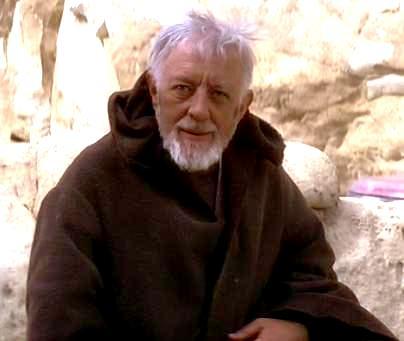
Even hungover with horrendous bed-head, Alec Guinness could out-act anyone else in the Star Wars series. He needed all of his skill to overcome the oft-lame dialogue.

So upon watching it this time, the movie is still great fun to watch. Perhaps I can’t really look at it with total objectivity since it captured a place in my heart at the time when all of our hearts are so impressionable – those magic years between ages three and ten when fantastic stories and movies can imprint themselves on our very beings. I suppose an older viewer who watches Star Wars for the first time may be a tad disappointed, considering just how massive the entire franchise has become. All the same, I think anyone can marvel at just how unique a potion George Lucas mixed up for us, and I know that I’ll never tire of the original trilogy.

Take 2: Further Thoughts (Based on the context of the entire Star Wars series & random factoids.)

Did you notice how, on the “All-TIME 100 Films” list, certain film series are put together and counted as one movie? Namely, The Apu Trilogy, The Godfather Parts I and II, and The Lord of the Rings? Notice how Star Wars sits alone, without either of its immediate sequels, The Empire Strikes Back or Return of the Jedi? Did you notice that? I did. So, why do you think it is?

My guess is that, while the original trilogy was just that, Star Wars can actually stand alone and separate from the latter two films, which rely on the other two. When any Star Wars dork is asked which of the six films in the series is the best, the answer is almost overwhelmingly The Empire Strikes Back, and I agree. I suppose that this movie wasn’t included because, unlike Star Wars, it did not end with any sense of closure. It was therefore connected to the slightly inferior Return of the Jedi (only made weaker by those silly little Disney puppets, the Ewoks). With the choice of either putting only Star Wars on the list or having to include the entire trilogy, I guess the list compilers went with the former option. It makes sense to me.

That's right, fellas. Your respectable series just got down-graded to pre-kindergarten levels. Don't worry in the back there, Luke. In a little while, you'll have an awesome lightsaber fight with your pops...

So, in light of Episodes I, II and III, what do I think? Basically, Episode I is nearly putrid. I remember how, back in 1999, as a 23-year old who was unspeakably excited about the new films, I was bafflingly disappointed. Like many of my ilk, the entire Jar-Jar Binks character was insulting to my intelligence (and, I assume, the intelligence of anyone over the age of four). Liam Neeson and Ewan McGregor were fine, but Jake Lloyd as the young Anakin Skywalker was dreadful (I checked imdb and he hasn’t had an acting gig since then. Small wonder.) The film is only watchable because of the pod races and the three-way light saber battle at the end between Obi-Wan, Qui-Gon and Darth Maul. Aside from these few things, The Phantom Menace was a flashy mess.

After that debacle, things got a tad better with Episode II, and even closer to tolerable with Episode III. Still, none of these prequels could hold a Yoda-levitated candle to any of the original three, not even its weakest link, Return of the Jedi. To me, the reason is simple. George Lucas got too crazy trying to use modern movie magic to try and please every fan. Star Wars and Empire Strikes Back did things using special effects to greatly enhance an engaging, if simple, adventure story. When he went back and did the prequels, it was almost as if the effects became the story.

After Episode II, Attack of the Clones, came out, a friend of mine was disgruntled with it and told me that it seemed like George Lucas had basically read a bunch of fan emails and tried to satisfy every fanboy’s wildest fantasies. You want to see more of Boba Fett? Well, here’s his daddy, Jango Fett! You want to see Yoda use a light saber? Well, here’s Yoda bouncing around with a light saber! It continued in Episode III, but not as egregiously.

Yoda getting his game on in Attack of the Clones. One of several elements Lucas put in seemingly to appease many fans' daydream desires. Personally, I liked it better when Yoda's martial prowess was merely implied and never revealed.

When I go back and watch Episodes IV and V, I absolutely love how scaled down the effects are and how the tale itself is the dominating force. There are many things that are hinted at, but never completely explained. How did Obi-Wan and Luke end up in the Tatooine desert? How did Yoda end up in the swamps of Dagobah? What pushed Darth Vader to the dark side of the force? In truth, I didn’t really need to know the answers to these questions, though I wanted to. Now that I do know, I basically wish that Lucas hadn’t even bothered with the prequels and simple left it all up to our imaginations. It would have saved me a lot of disappointment and would have left Episodes IV, V and VI to stand on their own, something they can do quite well.

Now that nearly three decades have passed since Return of the Jedi was originally released, there has been no end of study done of the Star Wars phenomenon. By now, many people are aware that its tremendous success was no accident. In conceiving his “science fiction soap opera”, George Lucas consulted the renowned cultural anthropologist Joseph Campbell on just what constituted the ultimate story. In a thoughtful (some cynics might say Machiavellian) approach, Lucas used what he learned about popular myths to construct the overall drama of the Skywalkers. The archetypical protagonist that is universal to the greatest of human mythology became Anakin Skywalker/Darth Vader – the flawed hero who falls from grace, then redeems himself in his waning hours.

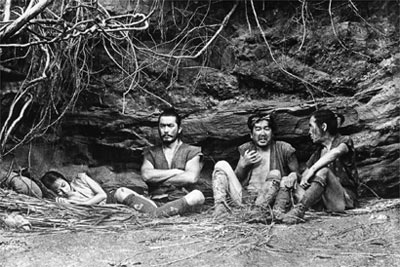
We also learned long ago that the filming of the original Star Wars itself was far from original. In basic narrative and even in shot composition, George Lucas “borrowed” (many say “stole”) from Akira Kurosawa’s classic adventure tale The Hidden Fortress. Despite these borrowed elements, Lucas was one of the earliest to depict a science fiction universe that was used up and grungy, unlike nearly all of the sleek, polished looks of sci-fi TV shows and films that had come previously. Sort of like what Sergio Leone did to the Western picture.

A shot from Akira Kurosawa's 1958 samurai movie, The Hidden Fortress. In this shot, you see the "inspirations" for Princess Leia, Obi-Wan Kenobi, and the droids C-3PO and R2-D2. Lucas also used the settings and locations in his first Star Wars movie.

Out of the countless other oddities and peculiarities about this series, there are two about the cast that have always intrigued me. Perhaps not surprisingly, they both deal with actors who were talented and professional, but didn’t really think much of their roles.

The first is Harrison Ford. He basically thought Han Solo was an idiot. And you know what? After watching the Star Wars movies as an adult, it’s obvious that Han Solo was not the sharpest tool in the shed. He was brave and funny, and he was an amusing rogue, but mostly he was a dolt. Harrison Ford has always said that he would always play Indiana Jones as often as possible because he liked the character, but that he would never play Han Solo again because he was a dunce. In fact, Ford tried to convince George Lucas to have Solo killed off at the end of either Empire or Jedi, to no avail.

The other is Alec Guinness. Anyone who has seen Alec Guinness in his film roles between the 1940s and 1970s knows that he was incredible. Whether it was as Fagan in Oliver Twist, his multitude of roles in Kind Hearts and Coronets, Colonel Nicholson in Bridge on the River Kwai, or any others, you know that he was an actor of incredible range and skill. As Obi-Wan Kenobi, he absolutely nailed the part as the wizened old knight who could quietly harness supernatural powers while mentoring the clueless young Luke. Guinness himself, however, seriously disliked certain things about playing Kenobi. One was that he found the dialogue to be atrocious, and could barely stomach delivering such hokey lines. He even succeeded where Harrison Ford failed – he convinced George Lucas to kill off Kenobi, ostensibly because he felt it strengthened Kenobi as a character (which it does). Later, though, Guinness admitted that it was also because he wanted to get out of reading dialogue that he found horrendous. More nuisance was to come in the succeeding years, as Star Wars mania grew to epic proportions. Guinness, a man of staggering accomplishment on both stage and film long before Star Wars, would forever after be known as “Obi-Wan Kenobi”.

In very limited screen time, Guinness played Kenobi so well that it became his blessing and his curse. This "silly role with terrible lines" overshadowed his previous decades of outstanding work. Oh well. At least he made serious cash out of it.

I used to feel sorry for Alec Guinness in that last respect. That was until I found out that he did something that showed great foresight. Unlike nearly everyone else involved with the original Star Wars movie, he thought that it would be highly successful. He therefore negotiated a contract that would pay him percentage royalties rather than a flat fee. As you can imagine, this ultimately led him to live very comfortably for the rest of his days. I guess in the end, it was a decent enough trade-off for him. Leave it to the Brit to show some foresight and do the responsible thing.

I could, like nearly any fan of science fiction and films, go on forever about the Star Wars franchise. Suffice it to say that it’s an incredible world that Lucas constructed, and it’s fun to go back into that world from time to time. These days, people can do it through novels, video games, role playing games, comic books, and myriad other sources. Still, there’s nothing quite like going right back to where it all started – with that massive, groundbreaking film in 1977 that set new standards for wondrous adventure movies. I’ll be shocked and amazed if the phenomenon of Star Wars dies out in my lifetime, and I know that I’ll go back and watch those original three every few years for as long as I live.

That’s a wrap. 76 shows down. 29 to go.

Coming Soon: Mon oncle d’amerique (1980)


This is one of the few “modern” movies that I know absolutely nothing about. It’s French and Gerard Depardieau is in it. That’s all I’ve got. Come on back in a week or so to find out what I think of it.

Please be sure to pick up all empties on the way out.