Showing posts with label novel adaptations. Show all posts

Friday, July 7, 2017

New-ish Releases: Julieta (2016); The Red Turtle (2016)

Julieta (2016)

Director: Pedro Almodovar

Another excellent movie by Almodovar, if not one that bears all the familiar tones of the living directing legend's many other brilliant films.

Based on a trio of short stories by Alice Munroe, Julieta follows the titular protagonist over the course of a couple of decades, during which she experiences euphoria, depression, and many of the emotions in between. The tale is told in flashback, beginning with a middle-aged Julieta (Emma Suarez) unexpectedly running into an old friend of her estranged daughter's. This sends her mind reeling into the past, when she was a young woman (Adriana Ugarte) just getting into teaching. She randomly meets and has an affair with Xoan - a charming, attractive fisherman from a small coastal town. Despite some markedly peculiar circumstances, she ends up living with him and having his baby, whom they name Antia. Julieta's relationship with Xoan and Antia become troubling due to an affiar and an unexpected death, both of which send Julieta into a deep depression that takes many years to completely manifest and recover from.

Julieta is, as you might imagine from my description, far from a joyous affair. While there are some moments of levity and amusement, one of this movie's grand themes is the grievous impact that personal relationship failings can have. It deals with passion, lust, platonic love, dedication, betrayal, and a host of other emotions that are unlikely to leave one slapping their knees in amusement. All the same, it is a rather compelling movie. As with the many other Almodovar films I've seen, the man is incredibly deft at telling emotional stories that can have considerable impact without the proceedings becoming quagmires of darkness and depression. However, this movie does have a somewhat different feel than the other more recent Almodovar movies I've seen. Perhaps it is because it is an adaptation of another's writing - in this case, the much-lauded Alice Walker - but the playful vibrancy found in even Almodovar's most challenging and controversial movies is often absent. This isn't really a problem, but it is an observation one cannot help but make after seeing many of the director's other distinctive movies.

It's an excellent drama, to be sure. While I am not one who goes out of his way to watch deeply emotional movies about mothers attempting to reckon with damaged relationships with daughters, it was easy to see the mastery of this movie. Like nearly all Almodovar movies, it does not offer pat resolutions or "messages," but rather tells a story of troubled relationships and how people attempt to deal with them. It may not be one that I ever need to watch again, but discriminating movie-goers are likely to appreciate how well-crafted and well-acted this movie is.


The Red Turtle (2016)

Director: Michael Dudok de Wit

A moving, melancholy animated tale that can serve as a metaphor for life, or can just be enjoyed as a stirring mythological story. A well-deserved nominee for the Academy Awards' Best Animated Feature from 2016, and one that wrung more than a few tears from me and my wife.

Much of the movie's power comes from not knowing what will happen; with that in mind, I'll limit this synopsis to the beginning portions. It begins with a man lost at sea in a small boat, crashing into a tropical island. He spends time figuring out what resources he has to survive, and attempting to built a rudimentary sea craft to escape. However, even when he does put together seaworthy, if simple, vessels, they get inexplicably destroyed by some underwater force ramming into them. This turns out to be the titular red turtle, and the turtle's nature becomes the focal point of the rest of the story.

The Red Turtle is very much a mythical tale. The time period is all but indeterminable, the characters have no names, and the island on which the entire story unfolds is never given a specific location or name. What's more, there is virtually no dialogue beyond the man yelling a barely articulate "Hey!" a handful of times. When topped off with the fact that the main characters' physical features could make them natives of any part of about half of the earth, then you get a story that is nearly as universal as such a story could be. This is no mean feat for even a short cinematic story, let alone a 90-minute feature film.

Much more than the universal nature of the characters and setting, though, are the actual story and deeper themes. Without giving anything away, this silent, sublime, and sometimes sad tale is all but guaranteed to wring a few tears out of you. This is not due to base sentimentality but rather the realities of simple but mature depictions of life, regret, love, sacrifice, and death. Though the story unfolds with very few characters, on a tiny island, and with only a handful of conflicts, each one achieves maximum impact thanks to the expert level of visual storytelling.

An adjective that comes to mind with this film is "confident." Film is, by nature, a medium that allows visual wizardry and dynamic action to mask a multitude of other narrative sins. It takes a very bold filmmaker to create a movie like The Red Turtle - quiet, subdued, and relatively simple. This makes it all the more impressive for the impact it ultimately has. It probably won't have you running back for repeat viewings over and over, but this is one of the most touching and memorable animated movies I've ever seen. 

Sunday, December 11, 2016

Retro Trio: High Heels (1991); Starred Up (2013); The Painted Veil (2006)

High Heels (1991)

Original Spanish Title: Tacones Lejanos

Director: Pedro Almodovar

This was the latest in my little trip through the films of renowned Spanish director Pedro Almodovar. I found High Heels yet another early example of his unique voice and masterful skill as a film-maker.

The story focuses on Rebeca Giner (Victoria Abril), a young Spanish TV news anchor with some very complex, and occasionally lethal, ideas and relationships with men in her life. As a very young girl, Rebeca knowingly drugged her boorish step-father so that he would fall asleep at the wheel and die in an accident. Rather than being out of some mere urge to kill, her purpose was to free up her mother, Becky (Marisa Paredes), to take an acting job which her husband was preventing her from accepting. Oblivious to her daughter's hand in the death, Becky leaves her daughter behind and goes to Argentina to begin the acting career which is her dream.

A strange but amusing dance number thrown into the
proceedings ensures that we never take things too seriously,
even when things take a few rather dark turns.
Flash forward twenty years. Rebeca is a TV news anchor, and her mother has long since become a world-famous actress. Rebeca's mother returns to Madrid upon hearing that her daughter has married a former lover of hers, another rather loutish older man not unlike the father-in-law whom Rebeca drugged two decades earlier. When he is found dead several weeks after Becky's return, the mother and daughter become the prime suspects in an investigation headed by bloodhound judge Juez Dominguez (Miguel Bose). The associates of the two women include a colorful bunch, including several transvestites.

While the murder-mystery elements may, on the surface, make this seem like a fairly typical whodunit, this is an Almodovar movie. And being one of his earlier films, there is a range of humor, from virtual slapstick right through to the most pitch black, running through the proceedings. As with the other four films that I've seen of his, this one deals heavily with themes of personal identity and the feeling of loss and absence. Much of the movie can be very amusing, as there are more than a few absurd situations and interactions. But at the heart of it are universal emotions revolving around relationships between parents and children, spouses, and lovers. The movie bears many of the familiar hallmarks of the other Almodovar films I've seen, but once again is completely its own story.

Now having seen five of his movies, it seems to go without saying that the movie looks incredible. I've already described my impressions of the visuals in Almodovar's movies, so suffice it to write that High Heels is no different. This, in conjunction with all of the other merits of the film, simply solidify my admiration for the man as a film-maker. It's truly amazing stuff.


Starred Up (2013)

Director: David Mackenzie

I am now officially a fan of David Mackenzie. I watched Starred Up after seeing and loving Mackenzie's neo-Western film Hell or High Water. Based on that movie and this 2013 offering, I am willing to go see whatever his next few projects are, out of hand.

Starred Up is a prison drama focused on Eric Love, an extremely violent 19-year old convict who has aged out of the juvenile system and has been moved into an adult maximum security penitentiary. It also happens to be the very same prison which houses his convict father, Neville, who has been serving a life sentence since Eric was a small child. In less than a few hours after processing, Eric gets into a brutal fight with another inmate and in placed in solitary. Soon after release, he has another serious scrap with the guards. Just as the guards are ready to pummel him, though, a prison counselor sees all that is going on and taps Eric to take part in a discussion/therapy group which he runs. The guards reluctantly agree, and Eric is all but forced to attend the group.

The movie is an astounding, if highly disturbing, look at violence, masculinity, and how a young man grapples with trying to harness them to not just survive but also grow as a human. There are many extremely intense scenes, of both a physical and psychological nature. The young and hyper-pugnacious Eric is our fractured looking glass into the strict hierarchy of the lethally stratified federal prison system (the movie takes place in England, but it is easy to apply the environment to nearly any maximum security prison in the world). Watching Eric rein in his fury at his father and nearly everyone else around him in order to first survive and then to find some modicum of growth is as fascinating as it is disturbing. The setting and themes are not for the faint of heart, grim as they are, but there is real humanity sitting just beneath the surface of the entire movie.

The group therapy sessions are arguably the best scenes in
this great movie. You can almost see the waves of violent
aggression emanating from these guys, as well as their
immense struggle to deal with it all.
The acting is outstanding. The only actor whom I recognized was the incredible Sam Mendelson, who does a brilliant job as Eric's hard-as-nails father, Neville. All of the others, although not familiar to me, were amazing. Jack O'Connell is ferocious as Eric, and Rupert Friend is equally brilliant as the counselor Oliver Baumer. Not to be outdone are all of the men who are part of the therapy group. It is during these group meetings that we get some of the most powerful scenes. Some of these do not even involve words, but rather a palpable tension arising from extremely violent men wrestling with themselves and each other on a level that goes far beyond physical struggles.

Being a movie that was clearly going for an authenticity which few prison movies approach, Starred Up does not offer a rosy conclusion. It does, however, offer the satisfaction of having seen something that reveals some profound aspects of human nature, and it offers us all a hard look at what incarceration means. It is the type of movie that, even if I don't feel the need to see it again, I would recommend nearly everyone watch at least once.


The Painted Veil (2006)

Director: John Curran

The wife and I decided to go "full nerd" recently and read the same classic English novel before watching the film adaptation of it. The novel was The Painted Veil by W. Somerset Maugham, an author whose other novels I've loved. My wife had seen the movie already, but I was coming at it from the novel first.

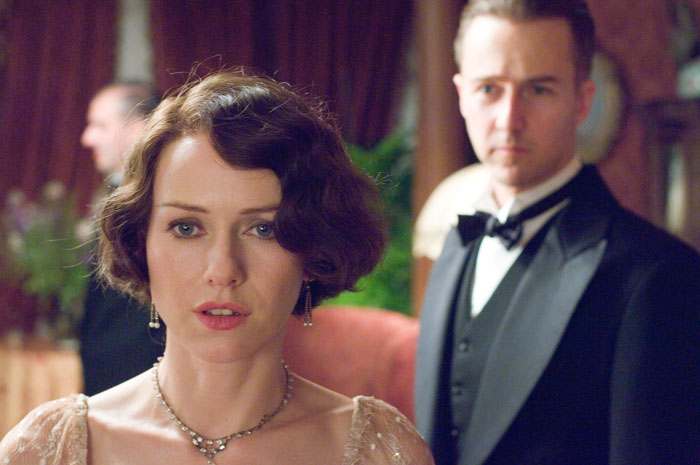
The movie stays true to most of the spirit of the novel, set in the 1920s, in which Kitty (Naomi Watts), a young socialite Englishwoman, marries Walter Fane (Ed Norton). Walter is a rather dry but civil bacteriologist who takes her to Hong Kong where he does research. Soon after their arrival, Kitty grows bored with her new husband and begins an affair with an attractive up-and-comer in the British colonial government. Walter discovers the affair just as he accepts an assignment to go to a cholera-ravaged area deeper into the Chinese countryside. Under threat of a messy and public divorce, Walter forces Kitty to accompany him. While terrified that her husband wishes her death from the cholera epidemic, Kitty sees no other option but to accept and go with him. Amid the cholera-infected area, Walter and Kitty find themselves among great suffering of the native population, and they meet several other Westerners who are there for their own reasons.

Kitty and Walter - two people who probably weren't right for
each other from the start, but whose shared struggles among
the cholera epidemic lead them to grow themselves and their
respect for each other.
This film adaptation hits nearly all of the strongest, most poignant notes of Maugham's brilliant novel. The relationship between Walter and Kitty grows increasingly deeper and more complex once they are among the cholera epidemic. And while lesser writers would have milked this situation for no end of sentimentality and trite reconciliations, Maugham was far too experienced and skilled an author to travel such beaten paths. When reading the novel, I was constantly surprised at how the story unfolded and how the characters developed. And the unexpected turns are not merely inserted for the sake of surprise. They feel quite organic, and they touch upon the messy nature of human desires and our ability to alter and expand our perspectives. The movie retains many of the novel's subtler turns of character, which only increases its value. To be sure, a few things are simplified and given slightly tidier resolutions, but this is to be expected from most commercially-minded films. In the case of this movie, they don't greatly diminish the overall tale.

Beyond the clear strengths of story and character, the movie is visually stunning. The cinematography captures the beauty of the Chinese countryside, as well as the exquisite beauty of the period's buildings and clothing. Cinematographer Stuart Dryburgh has plenty of dazzling movies and TV shows to his credit, and this one may be his crown jewel. An added technical merit is, unsurprisingly, that the acting is excellent. Naomi Watts and Ed Norton are typically great, as are all of the supporting cast.

I'd recommend this movie to nearly anyone, just as I'd recommend that anyone read the novel first. While readers who deeply love the novel may be a bit disappointed in what the film changes or omits, I don't feel that there are any crippling alterations or omissions. Both are first-rate pieces of art, and they make for great comparisons to each other. 

Tuesday, August 19, 2014

Before I Die #516: A Room with a View (1985)


This is the 516th of 1,149 films on the "Before You Die" lists that I've watched. 

Director: James Ivory

Not exactly my kind of movie, but it does what it sets out to do very well.

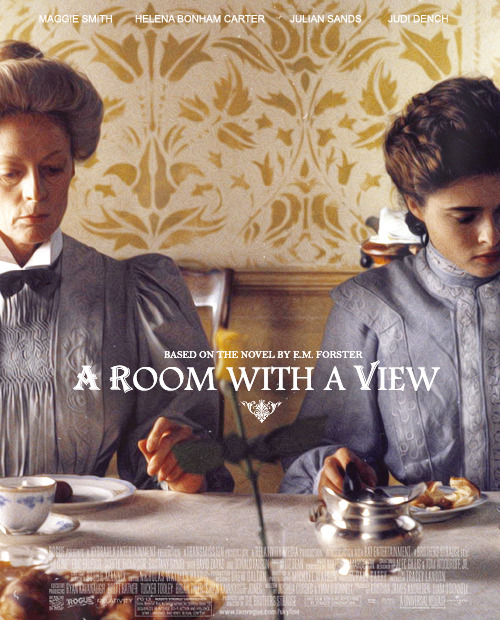
Based on the 1908 novel by E.M. Forester, A Room With a View is a well-done adaptation that hits all its marks. It tells the story of Lucy Middlechurch (Helena Bonham Carter), a young, English middle-class woman who becomes embroiled in a classic "which man should I marry?" quandry. The opposing forces are what any fan of such period English tales would expect: marry for love or to meet social expectations and find financial security? For Lucy, these two sides are represented by the free-spirited and exuberant George Emerson (Julian Sands) and the priggish, upper-class Cecil Vyse (Daniel Day-Lewis).

Just from the artful composition of this scene, I don't even
need to tell you which is the uptight Cecil and which is the
self-assured George.
The pieces are set into place over the course of an initial trip to Florence, where Lucy meets George. When she returns to England, she starts to weigh her feelings for George against the pressure of marrying Cecil. What follows is the typical tap dance through social propriety and class-conscious protocols with which any reader of Jane Austen is familiar. Lucy is pulled one way and then another by various friends and family members, culminating in the rejection of one hopeful suitor in favor of the other.

Again, it's not exactly my cup of tea, but the film does a good job of telling the story. The acting is superb. In addition to the talents listed above, the film also includes Judy Dench, Maggie Smith, Denholm Eliot, and basically any English actor worth his or her salt who was alive in 1985. They all nail it.

Though I may have found the themes of class consciousness a bit dull, there is enough humor to pull through a more cynical viewer like myself. I may have found Maggie Smith's "poor cousin Charlotte" character annoying, but that's easily balanced by the more biting humor of other characters like George and his father. Even Lucy herself has grit, which is nice to see.

It's easy to recommend this to those who love this kind of movie, and in fact, I'm sure that any fan of Pride and Prejudice and its ilk has probably already seen this one several times. If you haven't, then I'm confident that you'll love it (my wife does, and she's a tremendous appreciator of such films). If you're more like me, don't be surprised if you enjoy it a little more than you expect. You can think of it as a sophisticated "date movie," if  it helps.

So, 516 films seen. Only 633 to go before I die...

Friday, April 13, 2012

Film #78: Berlin Alexanderplatz (1980)


Director: Rainer Werner Fassbinder

Initial Release Country: Germany

Times Previously Seen: none

Teaser Summary (No spoilers)

Former thug gets out of jail, tries to go straight, fails miserably, goes crazy, embraces crime, goes crazy again, and then gets well. Sort of.

Extended Summary (Relatively more complete pot synopsis, including spoilers. Fair warning.)

* This film is reeeeaaaally long, so I’m giving you a very short version of the plot. If you’re really curious about the little details, check out this more complete synopsis at wikipedia.

Berlin, 1928. Germany is in the middle of a horrible economic depression. Franz Biberkopf (Günther Lamprecht) has just been released from prison, where he has spent the past four years for the involuntary manslaughter of his prostitute girlfriend. After an initial period of confusion about how to reintegrate himself into society, Franz decides to leave his criminal past behind him and live a straight life, free of illegal activities.

It doesn’t take long for Franz’s plan to fail. Despite trying to go straight by taking menial jobs selling newspapers and hawking various wares on the streets and going door-to-door, he starts to be taken advantage of. One business partner robs one of Franz’s clients, sending Franz into a manic depressive bout of heavy drinking, away from any friends or associates.

When Franz emerges from his bender, he finds one of his old criminal associates, the kindly Meck, who introduces him to the highly unsavory Reinholt. Franz begins a bizarre scam with Reinholt, who is a compulsive womanizer, to take Reinholt’s girlfriends off of his hands after he inevitably tires of them. Franz eventually ties of these strange deceptions, though he maintains his friendship with the warped Reinholt.

Franz Biberkopf, the man at the middle of this massive, swirling tale.

Franz then takes up with a local crime gang. He is initially taken on a night robbery, without his knowledge, and forced to be the lookout. Franz reluctantly goes along with it, but as the gang is driving away, a car begins to follow them, merely by chance. Reinholt becomes suspicious and soon pushes Franz out of the back of their vehicle. Franz has his arm run over by the following car. The arm is so badly damaged that it must be amputated.

Franz, now without his right arm, rejoins a pair of old friends to recuperate. One is a former prostitute who was under his control in his days as a pimp – Eva, who still has deep affection for Franz. The other his Eva’s lover, Herbert, who is also involved in various petty crimes. The two take in Franz and tend to him carefully, seeing Franz as a decent person who is prone to bad decisions, bad luck, and strange fits of emotion. Eva and Herbert even find a young woman to be Franz’s new lover – the prostitute whom Franz names Mieze. The two instantly fall in love with each other.

Franz and Mieze move in together and they continue to adore each other, though their relationship is not without difficulty. The one-armed Franz begins pulling robberies with the local gang again, and Mieze’s job as a prostitute leads Franz to become severely jealous at times. The worst is when Mieze admits to an unplanned affair with a client’s younger son, whom she claims to have fallen in love with. Franz goes into a rage and beats Mieze bloody, stopping just short of killing her. Despite the brutal attack, the two make up with each other shortly afterwards.

A few days later, Franz brings Mieze to their local bar to introduce her to Meck, Reinholt, and the rest of the gang. The compulsive Reinholt immediately blackmails Meck into setting up a meeting between him and Mieze. Meck does so, and he brings Mieze out to a forest retreat to meet with Reinholt, Mieze hoping to learn more about her beloved Franz from his friends. Instead, when Reinholt brings Mieze out to the woods, he tries to force himself on her repeatedly. Mieze teases some information about Franz out of Reinholt, including the fact that Reinholt was responsible for Franz losing his arm. This disgusts Mieze and she repels Reinholt. Reinholt, in a fit or rage, strangles Mieze to death and leaves her in the woods.

The utterly twisted Reinholt, attempting to seduce his "friend" Franz's girlfriend, Mieze.

Back in the city, Franz grows worried after not hearing from Mieze for several days. Meck, who had helped Reinholt bury Mieze’s body despite not knowing that Reinholt would kill her, decides to inform the police. When Mieze’s death is reported in the newspaper the next day, Franz breaks into a crazed laughter, deliriously happy that Mieze’s absence was due to her death and not due to a willful abandonment of Franz.

Franz goes into a complete daze. We start to see his tale from a bizarre perspective, including two angels following him and commenting on his confused state. Franz walks along in an odd dreamlike realm in which the dead are strewn about. Back in reality, Franz is taken to an asylum, and Reinholt is being held in prison under and mistaken identity. In the asylum, we see inside Franz’s tortured mind. He sees himself interacting with various characters from his life in the past year, both dead and alive. He shifts perspectives with many of them, and even faces off with the specter of Death. Franz seems to see himself as deserving of any punishment he receives, as he and others are butchered in an abattoir.

We snap back to reality, at a court hearing for Reinholt, who is on trial for Mieze’s murder. Franz testifies to Reinholt’s good character, which helps Reinholt receive a relatively lenient sentence of ten years in prison. Franz takes a job as an assistant gatekeeper at a car factory. He is attentive to his work, but seems utterly detached from anything happening in the word around him.

Take 1: My Gut Reaction (Done after the viewing, but before any further research.)

Looooooooooooong.

Berlin Alexanderplatz is fifteen and a half hours long. Fifteen. And a half. Hours.

I watched it over the course of about three weeks, and by the end, I was ready for it to be over. Perhaps I would have been better served to spread it out more, but hey, I have nearly 30 more of these reviews to do, and I want to get on with it.

It’s not really the length itself that it a little tough to take. Some people might be able to watch all of this show in a few days, but I would find it rather tough. However, this is not because it is bad in any way. It’s merely that the tone and look can be a tad monotonous.

That said, this is a haunting humanist story. This itself was a bit surprising, as I was expecting a more epic tale that connected one man’s journey into the Third Reich. I expected to see plenty of direct references to the rise of the Nazi party and their growing control of Germany. Such is not the case at all.

This may seem odd, by I couldn’t help but think of Henry Miller’s novel, Tropic of Cancer. That novel was a lightning rod for being so honest and frank about the human experience, including the most sensual (some thought indecent, at the time) elements. The difference is that Tropic of Cancer had a relatively rosier tone and outlook; Berlin Alexanderplatz takes a hard look at the mental degeneration of a man who has slipped right through the cracks of a failing society.

Franz partakes in one of his favorite vices to escape - binge drinking on a level that would would make even a German (maybe even an Irishman) blanch. [note: I'm of Irish descent, so don't get up in arms.]

Berlin Alexanderplatz tells the story of a man who is, in many ways, highly unsavory. And yet, it’s impossible to dismiss Franz Biberkopf as a purely despicable villain. Unlike the titular protagonist of Barry Lyndon, Franz actually has several admirable traits. With his close friends, he has incredible loyalty and enthusiasm. His emotions are on his sleeve for all to see, and he is generally a social creature. His vices are, at root, ones that most people who are honest with themselves can understand – booze and women. Franz is at his most despicable when he is in the throes of passion or rage, or when he is victim to his own mental instability. Not long into the massive film, you start to see him as pitiful as much as anything. This is not unlike another film character that I will be seeing soon on this blog – the very real Jake LaMotta as depicted in Raging Bull. Both can be destructive, though Biberkopf is easier to like.

Most of Franz Biberkopf’s tale is easy enough to follow, in basic terms. He gets out of prison, he tries to go straight, he fails, and he suffers several brutal losses. However, there is a reason that the director chose to use over fifteen hours to tell the story and not two. Franz is complicated, and some of his actions are plainly irrational. To make any sense of them, we need the time to see how his more reasonable friends react to him. This gives us a better compass to navigate with. When characters like Eva, Herbert, and Meck show up to help Franz, we viewers need them just as much as Franz does. When the narrative of Franz’s life loses direction, they give us some semblance of meaning.

During the course of watching this whole thing, I often found myself pondering just what such an environment would be like. I can only imagine what it is like to live in the middle of a true economic depression, and how this affects one’s life choices. It would be hard enough for a person of decent means, but I believe Berlin Alexanderplatz gives a very real and disturbing view of how such a depression affects the already downtrodden. Those at the bottom of the socioeconomic ladder begin to engage in strange, irrational, short-term gain behaviors. A lot of people will watch this film and find the actions in it too distasteful to stomach, and to be honest, I did at first, as well. However, once I thought about it some more, I couldn’t help but feel that there was a disturbing authenticity to the entire tale. The corrupt actions of the characters reflect the polluted environment they are in, as they do whatever they can to survive and find any sort of solace that they can.

Franz and Mieze, a criminal and a prostitute, find some measure of happiness together. Their relationship may seem perverted to some, but it makes far more sense within their constraints.

There are some rather strange elements to Franz’s tale, though. Some are ones that I found a bit perplexing. Throughout the show, we have a disembodied and unknown narrator offering commentary that sometimes includes observations about the characters, but also Biblical verse, song lyrics, and readings from philosophical treatises. The connections are sometimes clear, but other times simply baffling.

Related to this is the final Epilogue episode, which is right out of surrealist left field. The previous 14 hours of the show are quite straightforward, with only occasional lapses into the aforementioned narration. The final episode, though, goes right into the realm of mind-blowing oddity. At least, that’s how it seems at first. When I thought about what all of the stunning and wild images had to do with Franz, most of them became clear. It didn’t make them any less shocking, though.

Just one of the many dark, disturbing images that we see in the Epilogue. This shows the tattered, tortured state of Franz's mind after losing his beloved Mieze.

Aside from the story itself, the other elements of the film are not ones that I would call spectacular, though they are very strong. The acting is very solid, all around. Günther Lamprecht is outstanding as Franz. Considering the incredible range of emotions and attitudes that he needs to show, it’s remarkable how he pulls them all off naturally – he can be charming, funny, pathetic, crazed, manic, depressed, or meditative at nearly any moment. Among the rest of the cast, there are really no weak links.

The visuals are rather intriguing. There is a somewhat dreamy, soft glow to most of the shots. This also often leads to an unusual halo effect that reminds me of the look of Sergio Leone’s 1984 gangster epic, Once Upon a Time in America. Beyond that, the several scenes in the forests outside of Berlin, where Mieze is killed, look eerily like the woods used in Miller’s Crossing. Some of the scenes even seem to be set up the same way. I will have to check on whether the Coen Brothers in fact used this show as inspiration.

While the technical merits are all there, this show is really all about where this one singular character, Franz Biberkopf, fits into his own strange sub-society – a sub-society that exists in shadows that most of us don’t want to think about or acknowledge.

Take 2: Why Film Geeks Love This Movie (Done after some further research)

Researching this massive film is filled with peaks and valleys. I watched a documentary that got behind the scenes and had a few good interviews, but didn’t add much to my understanding. There is a lack of information in my normal go-to places for this sort of thing, as well.

Then, there is Peter Jelavich. Jelavich is a professor of European history, especially German historical culture. I watched an amazingly concise, 25-minute documentary in which the man clearly answered my every question about Berlin Alexanderplatz.

The novel, by Alfred Döblin, was a masterpiece of its day. Written in 1929, it was one of the very earliest “metropolitan” novels that effectively depicted life in a modern mega-city, such as Berlin. Jelavich likens it to the contemporary novel Manhattan Transfer, by John Dos Passos. I haven’t read that novel, but having read Dos Passos’ U.S.A. trilogy, I know exactly what he means. The narrative is an enormous, sometimes dizzying, literary montage of sights, sounds, and images as perceived by an individual living in those days.

A major theme of these works is the rise of mass media. In watching the movie, this was something that confounded me; I did not understand the narrator giving me little snippets of songs, advertisements, articles, political treatises, and so on. Now knowing the intent, it all makes perfect sense. All of these little phrases are the straggling pieces of information that Franz has inadvertently picked up simply by living in Berlin. On top of that, I realize how genius Döblin was, and just how much foresight he had. When I think about my own mental state, and how much information and little, random tidbits flow through my mind on a daily basis, it’s amazing to think that Döblin saw it all coming long before its impacts were fully realized.

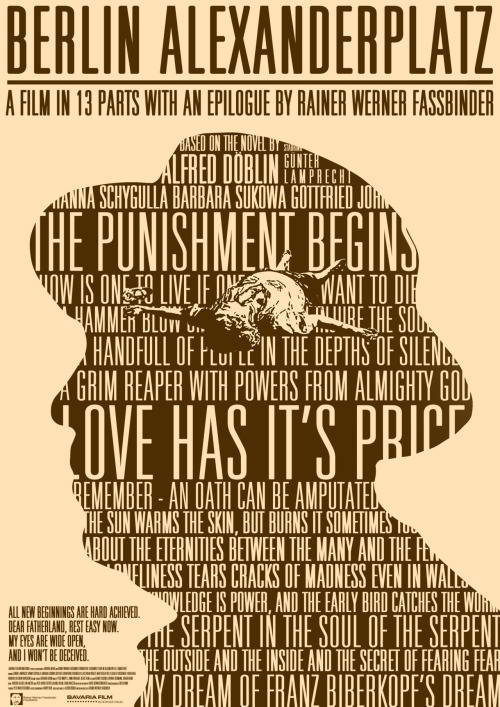
The original cover for the novel. It conveys the life Franz Biberkopf, surrounded by an overwhelming amount of text and information.

The other significant thing that Jelavich confirmed for me is just how to take Biberkopf the character. He is, as I felt, meant to be seen as a sympathetic figure. He essentially has a good heart and wants to do the right things, but he is incapable of it. Sometimes this is due to the endless social pressures around him, and sometimes it is because of his own lack of abilities. Either way, you want to see him find some sort of happiness. This makes it more tragic when he fails.

Believe it or not, there was a film version done shortly after the novel, back in 1931. Despite having Döblin himself working as a writer, it was far shorter and had a much sunnier ending. When Fassbinder took on the project in 1979, he was already established as something of an eccentric genius of film. He was given a lot of latitude, and he had been an incredible fan of Alfred Döblin’s novel. Wanting to do it justice, he stayed very close to the source material. The only personal touches he added were some aural references to 1960s and ‘70s pop culture, drawing a parallel between the 1929 novel and his own world in the late 1970s.

There is also a 2007 essay here by Tom Tykwer, which seems very thorough and probing. However, it dives into elements and connections with German culture that fly right over my head, in most cases. For anyone who can get something out of it, though, check it out.

The reception of the film was fairly positive, especially among critics. As you can imagine, some viewers weren’t sure what to make of the gargantuan film. Many complained that the visuals were too dark, but this was really the only common gripe. Overall, people saw it for an amazing piece of work.

That’s a wrap. 78 shows down. 27 to go.

Coming Soon: Raging Bull (1980)


 This is one of my all-time favorites. I love several of Scorsese’s movies, but I think I put this one at the top of the list. Come back and see how I break down the sad but entrancing life of the very real Jake LaMotta.

Please be sure to pick up all empties on the way out.

Sunday, August 8, 2010

Film #34: In A Lonely Place (1950)


Director: Nicholas Ray

Initial Release Country: United States

Times Previously Seen: none

Teaser Summary (no spoilers):

Brilliant but haunted screen-writer with vicious mean streak finds love amidst murder accusation.

Uncut Summary (The full plot, spoilers included. Fair warning)

Dixon Steele (Humphrey Bogart) is a phenomenally talented film writer, but one with demons. He has the love of loyal friends and the respect of the film industry, but has been out of work for some time. This is due to his penchant for getting into fist fights with anyone who he feels slights him. His career lull is also due to his lack of artistic inspiration.

One night in Hollywood, “Dix” meets several acquaintances in a favorite restaurant. He rubs elbows, and convinces the coat-check girl, Mildred, back to his apartment to give him a quick summary of a novel that he is supposed to adapt for the screen. Upon arriving at his apartment, Dix and Mildred catch a brief glimpse of Dix's neighbor, the beautiful Laurel. Inside Dix's apartment, the somewhat shady meeting of Dix and Mildred becomes quite benign as Mildred merely gives Dix a summary of the novel. Dix sends Mildred on her way and heads to bed.


Laurel and Dixon drive ahead, each shrouded in their own shadows.

The next morning, a cop, also an old army buddy of Dix's, arrives at his apartment and informs him that Mildred has been found murdered by the side of a road. Dix is taken to the police station and grilled by the police captain, but rebuffs any accusations of murder with chilling indifference. Dix is let off the hook when Laurel shows up and tells the police that she had seen Dix at his apartment, alone, after Mildred had left. For the moment, Dix is in the clear, though he remains a suspect, along with Mildred's boyfriend.

After she has provided him an alibi, Laurel and Dix fall deeply in love with one another. They spend nearly every waking moment together, seemingly to both people's benefit. Laurel sees and adores all of Dix's good qualities: his generosity, loyalty, and passion; and Dix has found his muse, which leads to a rekindling of his artistic gifts.

Nevertheless, certain threats remain. Through conversations with present and past friends of Dix, Laurel and the police start to realize just how violent the otherwise brilliant and charming Dix can sometimes be. Laurel comes to see this first-hand when, after a wrong word sends Dix on a rampage, he very nearly kills a local college student. Laurel begins to doubt whether Dix is truly innocent of Mildred's murder, and even wonders whether she could have a life with a man tormented by such dark demons.

Dix begins to sense Laurel's reluctance and grows increasingly paranoid and afraid of losing the one thing that he loves in the world. Despite having a newly-finished movie script that will likely reassert his position as a top-flight screen-writer, his obsession for Laurel's love blinds him. He pushes her into admitting her fear of him, and he comes within a hair's breadth of choking her to death. He pulls back at the last moment, leaving Laurel alive.

Just after this terrifying episode, Dix and Laurel learn that the Mildred was, in actuality, murdered by her ex-boyfriend, leaving Dix cleared of all suspicion. All this is for naught to Dix, though, as he realizes that he has brutally pushed away his final chance at love and redemption in the world.

Take 1: My Gut Reaction (Done after one viewing, before any further research):

This movie is incredible. It's been another of the fantastic surprises that have come from this list so far.

The basic “Netflix” summary of the film gives no indication of the many intricacies at play in this story. I thought I was more in for a “movie about movies” akin to something like Robert Altman's The Player. Instead, In A Lonely Place merely uses Hollywood and film-making as a backdrop for a haunting character study.

Dixon Steele (it only took about 10 minutes before I stopped giggling at the “porno name” thing) is a character unlike anyone that I've seen in movies. He may be the most realistic and well-rounded, if tragic, figure I can think of. He is a well-rendered example of a person who toes the elusive line between genius and insanity, and in Dix's case, the insanity is of a violent nature.

Humphrey Bogart pulls off this complex figure amazingly well. At this point in his career, Bogie had carved himself a place as a lovable, world-weary hero in films like Casablanca and even The Maltese Falcon. He had played the odd gangster and bad guy in early film roles, but his turn as Dixon Steele pulls together his ability to be supremely charming and disturbingly nasty in the same figure. He conjured up images of the few people I know of the same attitude: the real-life Jekyll and Hydes of the world who make for no easy answers in terms of loyalty and friendship. I think nearly all of us know the type – lovable in most circumstances, but thoroughly repellent when certain switches are thrown.

Here's the fiercest example of Steele's volatile temper (start at about 1:00 to get the full build-up and impact when he goes off on the college kid):


The story allows Dix's warring halves to be shown exceptionally well. The dark murder at the center of the study serves as the perfect foil for the viewer's shifting opinions of the tortured writer. At certain moments, you totally buy the possibility that Dix may have brutally murdered the innocent Mildred; at others, you almost feel guilty of having suspected the angry but highly principled artist.

In addition to the murder, the character of Laurel offers the other end of the spectrum. She is the oft-distant beauty who elicits Dix's passion and nearly all of the things that make him admirable. Gloria Grahame is great in the role, initially seeming cool but earnest in her attraction for Dix, but growing quickly as impassioned for him as he is for her. As her doubts and suspicions about him grow, she makes the transition from loving to horrified flawlessly.

This movie is yet another in which the supporting cast may be easily overlooked but shouldn't be. Dix's various friends and enemies serve their parts and purposes well, and they add the final brushstrokes needed to complete the portrait. Their own puzzlement at Dix's condition mirrors our own, and they offer some modicum of relief in admitting that Dix is not the complete villain that we at times are led to see him as. Of course, neither is he a man to be envied, despite his artistic gifts.

In A Lonely Place came out of nowhere to offer me a truly engaging tale of the pitch-black side of certain otherwise likable people. I'd recommend it to anyone who enjoys tense, dark character studies that revolve around romance, slightly twisted though it may be.

Even better, you can watch the whole thing for free, right here.

Take 2: Why Film Geeks Love This Movie (Done after some further research)

In A Lonely Place was not hailed as a masterpiece upon initial release. It was fairly well-respected, but not without its critics, including this one from TIME magazine itself back in 1950. Apparently, some felt that it belabored certain points and took too long in the telling.

But such assessments were few. Over the years, it has grown in stature among noir and all other films. Interestingly, it's less because it's considered a flawless film and more because it seems to have a clear peal of truth to it. Apparently, this wasn't a mystery. Bogart was, by many accounts, not too dissimilar from Dixon Steele himself: often personable, but sometimes frustrated into inexplicable bouts of depression that could lead to drunkenness and anger. No doubt this is why his performance seems so authentic.

Certainly another reason that this movie is not simply heaped in with other, more mundane, dark murder mysteries is the theme and actuality of story adaptation. One of the sources of Steele's frustration is the way that his artistry is regularly stifled by the Hollywood hit machine. Funny then, that this whole element was something completely added by director/co-screen-writer Nicholas Ray to the tale based on the novel by Dorothy B. Hughes.

This was far from the only change made. In the novel, Dixon Steele is a disturbed stalker and legitimate murderer. The filmmakers somehow saw the potential in a standard murder mystery and altered it into something far more creative and timeless: an existential tale of a man who nearly gains salvation through love and art, only to have the darkness within him blot out the light.

Here's the finale, perhaps one of the saddest and most quietly tragic in popular film history:


That's a wrap. 34 shows down. 71 to go.

Coming Soon: A Streetcar Named Desire (1951):


Stella!!! I've watched this one only once, it was about ten years ago, and I don't remember liking it too much. I'll see if an older, more seasoned me sees it any differently.

Please be sure to pick up all empties on the way out.

Friday, April 9, 2010

Film #21: Pinocchio (1940)

Directors: Hamilton Luske & Ben Sharpsteen
Release Country: United States
Times Previously Seen: Maybe once or twice as a wee tyke. Don't really remember.
20-Words-or-Fewer Review (no spoilers):
Marionette youngster comes to life, learns right from wrong from wild experiences and a kindly insect.
The Full Story (A detailed plot summary, spoilers and all. Fair warning):
In a little Italian village, a kindly master toy-maker, Geppetto, makes a wooden marionette in the figure of a young boy, naming it Pinocchio. Upon retiring for bed that evening, he wishes upon a single star that his newly-crafted companion might come to life, perhaps to offer him some companionship. After Geppetto falls asleep, the star transforms into a fairy who alights in the craftsman's bedroom and grants his wish, bestowing life upon Pinocchio.
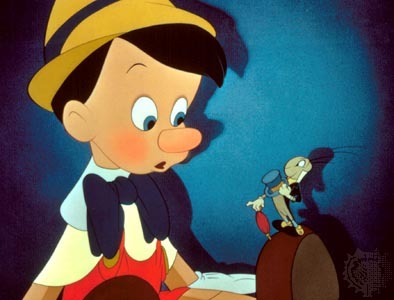
Watching the entire scene unfold has been the kindly bug, Jiminy Cricket. Little Jiminy agrees to become Pinocchio's conscience, as the animated puppet will not achieve true human life until he learns right from wrong, as per the fairy's guidelines.
The little wooden fellow first meets his newly-minted, top-hatted conscience.
Pinocchio wakes Geppetto who, after the initial shock, is overcome with joy. In the morning, he sends his new son to school. Pinocchio, however, is waylaid by the wicked Honest John, a conniving fox who sees Pinocchio as a cash cow, lures him with promises of fame and glory, then sells him to the greedy gypsy, Stromboli. Stromboli has Pinocchio perform once to great success, then locks him in a cage to prevent his escape. Upon realizing the hopelessness of the situation, Pinocchio and Jiminy despair until the star fairy descends and frees him. She says, however, that this is the final time that they can rely on her help.
It isn't long, however, before Pinocchio is once again fooled by the ever-rakish Honest John; this time leading Pinocchio to the ministrations of "The Coachman," an oily predator looking for troublemaking little boys to spirit away to "Pleasure Island" for some mysterious purpose. Pinocchio, along with a gaggle of other local truants, follow the Coachman to the enclosed island, where they discover that Pleasure Island is a paradise for the mischievous young lad: there are cigars to be smoked, fights to be gotten into, and palatial houses to be destroyed, all for their amusement. Little do they realize, however, that once night falls, they will all transform into donkeys which the Coachmen sells to various labor camps across the globe. Jimeny discovers this and warns Pinocchio, just as his transformation begins. They manage to escape just in time, leaving the other ne'er-do-well boys to their fates.
Upon returning to the toy shop, Pinocchio and Jiminy discover that Geppetto has gone looking for his prosthetic son, only to be swallowed up by the mythical whale, Monstro. The two searchers find the nearest shore, plunge themselves into the deeps and begin the search for the kindly toymaker. They do eventually find the terrifying Monstro and, after a titanic battle with the leviathan, liberate Geppetto, though Pinocchio seems to have been killed in the process.
Back at the toy store, a distraught Geppetto cries over the body of his dead creation but then is revived when the fairy returns a final time and, in recognition of Pinocchio's selfless acts of courage, deems him worthy of real life.
He's a real boy!!
Take 1: My Gut Reaction (done after 1 viewing & before any research):
I feel I have to section this review off into two sections of my brain.
If I were a kid watching this, it would be incredible. I realize that modern animation, most of which is CG, is peerless in terms of detail and fluidity. Still, Pinocchio trumps damn near all of its followers in terms of pure life and magic. Every scene is a treasure chest of movement and vivid kinetics. There are plenty of scenes where the eye doesn't know where to look, there are so many intricate dances of objects and characters.
This scene only gives you the tiniest of tastes, but the early moments in Geppetto's shop are vibrant marvels of color in motion.
What kid wouldn't want to spend the rest of their lives in that place?
On top of the visuals is the pure adventure of the story. It takes no time to get a puppet-brought-to-life and a magical blue fairy. Form there, we get the brief and terrifying domination of the gypsy Stromboli's suffocating wagon. Then, the sinister evil of Pleasure Island, followed by the epic force of nature of the sea beast, Monstro. Pinocchio's involvement in it all is almost incidental, and if I were a kid, I may barely remember his place in the story. Much more memorable are the strange and frightening things going on around him.
As an adult seeing this film all the way through for the first time, the film is almost as good. The visuals are still incredible. Sure, modern animation has grown by leaps and bounds in terms of technique and smoothness, but I don't know that I've ever seen another animated movie that conveys the mood in such a singular and effective way. The hand-painted backgrounds and the omnipresent shadows create alternating coziness, power, and terror, as the tale dictates.
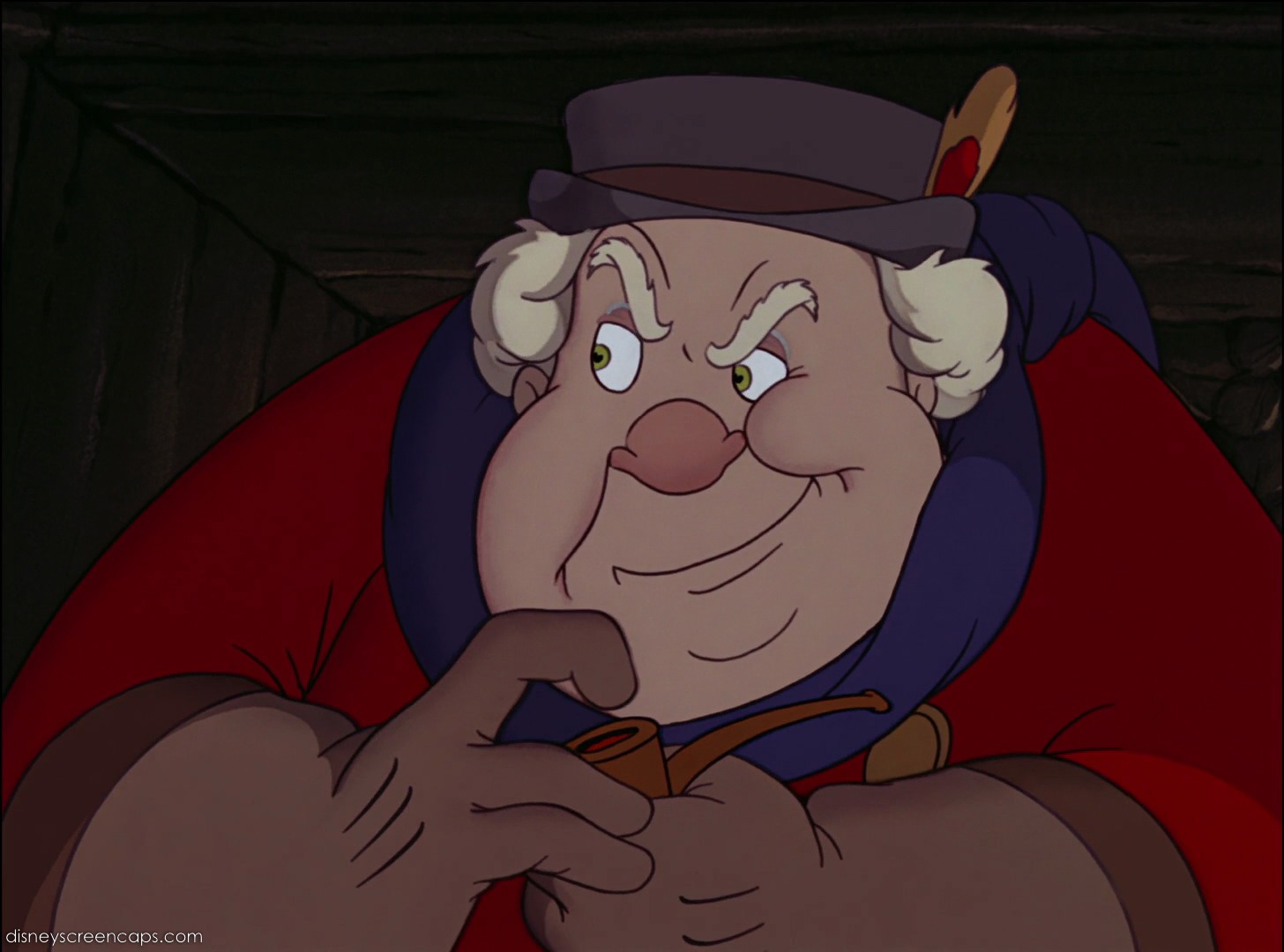
This is the pedophilic-looking rogue who pays to have young boys whisked away to "Pleasure Island". The scene where we first see him is creepy beyond belief, for children or adults.

One of the things that I loved about an animated feature like this is its timelessness. Disney actually used to be much better at this, and their subsidiary Pixar has rediscovered the formula, to a degree. The keys seemed to be source material and, more importantly, the script. Pinocchio, released in 1940, is blessedly devoid of any "topical" jokes or dialogue. No allusions or mentions of communists, Nazis, movie stars, or any other subjects that were relevant way back then. Disney really lost its way with this in the mid and late 1990s, with films such as Aladdin, Hercules, and the atrociously-named The Emperor's New Groove, which relied way too much on gags that were better suited to late night talk show monologues and would be stale in a matter of years. Pinocchio avoided dating itself this way.
There are some seriously murky things lurking beneath the surface of this tale. Perhaps the obvious one is the entire Pleasure Island episode. Cynical adults will look at the story of a fat, leering man looking for little boys to kidnap as a thinly veiled metaphor for pedophilia. It's not as obvious as all that, but I won't deny that the writers may have been intentionally tapping into that primal fear of parents the world over.
The other thing that makes for analytical thought is the entire story of Pinocchio as a vessel. It dawned on me that, really, the Disney version of Pinocchio is oddly like a somewhat positive inverse of Frankenstein's monster. Both the wooden lad and the monstrous construct of Shelley's novel were tabulae rasa, vessels with no initial concept of themselves, or anything else for that matter. Oddly enough in Pinocchio, it's not Geppetto but the Blue Fairy who serves as the Dr. Frankenstein; she imbues the marionette with a soul, then leaves him nothing more than a woodland insect to figure out ethics. As a result, Pinocchio nearly gets kidnapped by a greedy gypsy, half turned into a donkey by a wicked boy-peddler, and swallowed whole by a massive, boat-swilling whale. What kind of sick bitch does that? I'll tell you who - the same kind of person that creates a massive creature from dead tissue and then abandons him. That's who. At least the fairy came through in the end, unlike our misguided Austrian doctor.
There were only two things that truly struck me as weak, both of which I only notice as a hyper-critical adult. One is that Pinocchio, as alluded to above, is a bit of a dope. I know it's by design, but he has zero personality, unlike virtually all other cartoon protagonists. He's laughably led astray by the fiendish fox Honest John twice, and one can hardly say that he learns his lessons. To reiterate, though, it's a minor point. If you're one to look for lessons and morals in animated movies, they are there to be found, even if the title character is a dunce.
The other, lesser, problem is the pacing. There are a few jumps that are dizzyingly quick. When we learn that Geppetto has been swallowed by a whale, it's as much a shock to the viewer as it is to Pinocchio. Pinocchio takes it in relative stride; I, however, thought that perhaps I had missed part of the movie. When the hell did that happen? There were a few other moments like this when the film seemed to be rushed. Not a great problem, but it stood out.
Pinocchio is an animated film that I think can stand up to all but the very best animated movies released in the seven successive decades. The folks over at Pixar are the modern masters, but they are certainly riding the coattails of standards like Pinocchio.
Take 2: or, Why Film Geeks Love This Movie (done after some further research):
There certainly is no shortage of interesting research to be done on this one.
Pinocchio was the second feature length animated film from Disney (following Snow White in '37), and both clearly display the master formula that has served that franchise to this day: (1) take a well-written fairy tale (2) clean out all of the objectionable bits (3) get phenomenal animators and story-writers to tell the story. Repeat.

A very early rendering of Pinocchio from the 1880s.

The source material in this case in an original Italian "fairy" tale written by Carlo Collodi in the 1880s. Just like the original Grimm's Fairy Tales, Collodi's tale was not exactly meant specifically for children. An allegory for social commentary, the original Pinocchio features a truly irascible marionette who kills "the cricket" (the name "Jiminy" was a Disney invention) with a hammer, lies repeatedly to his father, and is even hung at the end for his foolish deviance. This ending was actually changed by Collodi at the behest of his publisher, so that it may be a bit more palatable to a wider audience. I guess one could say that Collodi Disneyfied his own story a bit before Walt and his team could finish the job 60 years later.
It has been pointed out, through Pinocchio and many other films, that animation can be appreciated on a level that goes far beyond childish amusement. Leonard Maltin points out that, "There are no accidents in animation." This struck me as meaningful as I looked at the splendor and vivacity of a film like Pinocchio and I realized that every scene, every background, every character, and every color had to be sweated over. It's a wonder that they finished the thing in a mere two years, to be honest.
In addition to the craftsmanship is the sheer skill in terms of film making. Walt Disney was once asked about making movies only for kids, to which he replied that he did no such thing, pointing out that, "If I only made movies for children, I'd be severely limiting my audience." I suppose a cynic would see this as an early sign of Disney's quest for domination of the world's minds. I see it a bit more as a storyteller who just wanted as many people as possible to hear his tales. He and the crew that he assembled showed it in the outstanding films that they crafted in those early decades of work.
A few of the details. In hearing some commentary from Disney aficionados, I realized that my dubbing of the Disney Pinocchio character as "a dope" and "a dunce" may be a touch mean. A better word may be "guileless." Still, it doesn't do any more to attract me to him or make him any stronger a character.
One final piece of trivia: a very young Mel Blanc, the late, great voice actor known the world over as the voice of nearly every major Warner Brothers character, actually provided the voice of Gideon, Honest John's companion in Pinocchio. However, it was decided that the Gideon character was going to be a mute, so Blanc got edited out of the entire audio, save for a solitary hiccup. If only they'd known.
That's a wrap. 21 shows down. 84 to go.
Coming Soon: The Lady Eve (1941):

The final screwball comedy on the list. At least it has Barbara Stanwyck and Henry Fonda in it.
Please be sure to pick up all empties on the way out.

Friday, March 19, 2010

Film #16: Dodsworth (1936)


Director: William Wyler

Release Country: United States

Times Previously Seen: none

The Story (In which I shamelessly give away the entire plot, spoilers and all. Fair warning):

Sixty-ish American industrialist Sam Dodsworth has just sold the auto company that he created and has operated for 20 years. He decides to follow his forty-ish wife, Fran's pleas to go with her to Europe, where she wants them to expand their horizons and enjoy life. While the very blue-collar Sam is a bit concerned about being lost in the sophistication of Europe, he acquiesces, goes along and even begins to enjoy the cruise across the Atlantic.

Before long on the ship, it becomes obvious that Fran is just as interested in delving into a more "worldly" realm of flirtation and possible affairs with European men. She sees herself as meant to be in with what she sees as the more cultured Old World of Europe. As such, she drifts away from her brusque, though undeniably kind, honest, and capable older husband. Eventually, Fran chooses a young German man who wishes to marry her, and requests divorce from Sam. Sam still loves his wife, yet realizes that her path has become totally different from his. They separate and await divorce.


The 3 main players plus one: random sleaze #1, Fran, Sam, and Edith
During the separation, Sam reconnects with Edith Cortright, a divorcee whom he met on the initial cruise to Europe, and who is roughly the same age and has the calm wisdom that goes with it; wisdom that Fran sorely lacks. During a stay at Edith's modest coastal village in Italy, the two fall into gentle and mature love and are on the cusp of embarking on some adventurous globe-trotting when Fran enters the scene again. She calls and informs Sam that her fiance, Kurt's baroness mother has disapproved of their union, pointing out with brutal honesty that she will not allow her thirty-ish son to marry a forty-ish woman. The tables have now been turned, and Sam is moved to abandon his plans to take up with Edith, instead agreeing to rejoin Fran on a return cruise to America. Edith is crushed.

Just when it seems that Sam is going to swallow his own desires, forgive Fran's selfishness and thoughtlessness, and go back to taking care of her again, things take a final turn. When the two meet on the ship, Sam begins to listen to Fran's petty gossiping and back-stabbing. Upon realizing that she has learned nothing and is still the same immature snob from whom he had separated, he quickly leaves her and returns to Edith for an emotional reunion.


Take 1: My Gut Reaction (Done upon 1 viewing, before any research):

Ahhh. This one was a breath of fresh air after the effort of The Awful Truth. Dodsworth is a really solid film, with all of the sophistication and maturity that screwball comedies eschew. Right from the get-go, I could tell that Dodsworth was going to be more to my liking. The scene opens with Sam Dodsworth forlornly looking out over his auto plant, contemplating what he's going to do with the rest of his life, now that he's moving past his life's work. This early quiet moment hints at the depth to come in the rest of the movie. Here's the opening.

Jump right to 1:00 in to see the forerunner of Welles' opening to Citizen Kane:


There's a great balance to everything in this story. It takes no time to see that Sam Dodsworth represents the American dream - a man who has worked extremely hard to create a successful company, yet has not lost his zest for life. The only thing missing at the beginning of the story is his ability to enjoy leisurely pursuits. Once in Europe, we see the stark contrast between a man like Sam and the upper-crust Europeans who are wealthy from their ancestors' deeds rather than their own; people for whom the mere pursuit of leisure and culture has been the point of their entire lives. They have education, wit, and worldly sensibilities, but none of the grit or character of Sam. Sam soon comes to realize this, but his wife falls under the spell of the Old World sophistication and European charm. The rift between the two is not immediately apparent, but it is masterfully revealed through a series of near-affairs, full-blown affairs, and subtle culture clashes.

Unless you've read the Sinclair Lewis novel that's the basis for the film, it's very difficult to imagine just how things will turn out. Not because of weak storytelling, but because the tale represents the very real complexity of differing philosophies regarding fidelity and the purpose of one's life. It's obvious that the older Sam desperately wants to make his wife happy, which makes it all the more upsetting when he finally realizes that the divide between them cannot be bridged.

Beyond the engaging plot is the cinematography. Between the carefully crafted long shots and the unwavering still shots of certain scenes, the director gives you plenty of moments to drink in the situations and ponder the gravity of the characters' thoughts. I noticed a few scenes like this is Le Crime de Monsieur Lange, but Wyler uses it more often and to great effect. There are several excellent scenes with Sam, and a particularly powerful scene with Fran and her finance Kurt's baroness mother. Here's the scene, with less than a minute chopped from the beginning, but the power of it is in the first 3-4 minutes. It's awesome:


The acting is excellent. While Ruth Chatterton's turn as the snobbish Fran Dodsworth is appropriately annoying with her New England affectation and selfish arrogance, Walter Huston is awesome. I completely buy into his salt-of-the-earth persona who is, in turns, sensitive and tortured, calm and commanding, and exuberant. Even the minor roles are exceptional, especially Mary Astor as Edith Cortright, the mature soul-mate whom Sam eventually finds. With this movie, I'm finally seeing consistently relaxed and more naturalistic acting.

If I have any complaints about this film it's that there are a few moments in which the melodrama gets laid on a bit thick. During several scenes between Sam and Fran, there's a swell in the orchestral score and a lot of "Oh, Fran!" and "Oh, Sam!" kind of dialogue. During these scenes, I felt a touch of the impatience that I feel when watching films like Camille.

Overall, this one was a treat to watch, and I'd see it again. Anyone who enjoys classic movies with more depth than your standard Hollywood romance would be well served to check this one out. 

Take 2: Why Film Geeks Love This Movie (done after some research):

Apparently, for very much the same reasons I enjoyed it so much - the maturity. In the midst of many light-hearted and fancy-free movies of the day (understandable, being in the middle of the Depression), Dodsworth stood out for its thoughtful and skilled handling of the topic of mature marital distress. I'm apparently far from the first to notice the consistently excellent acting, as well. Here's the original TIME magazine review from 74 years ago.

The modern fellows at TIME also have some really interesting points about how Wyler was from Germany, yet managed to direct the tale of an all-American protagonist with whom the viewer sympathizes. Here's their quick-capsule write-up.

Also of note is the source material. Sinclair Lewis certainly had much more famous novels, but Sam Dodsworth is noted as being a rare thing for Lewis - a self-confident and self-assured man. The novel goes much more into the courtship and early marriage of the Dodsworths, but even critics agree that the meat of the tale begins with Sam's selling of his Revelation Motor Company (not exactly a veiled name, that). It looks like the adaptations (it was a play before a film) made the right call in trimming away these background elements.

There seemed to be some kind of ground-swell support for Mary Astor's appearance in the film too, due to personal battles that she was dealing with. It's described vaguely in the TIME review above.

That's a wrap. 16 shows down. 89 to go.

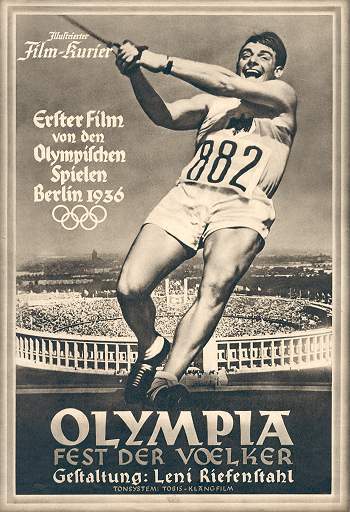
Coming Soon: Olympia (1938):


This one should be interesting - the 1936 Olympics, which took place in Nazi Germany, filmed by a phenomenally skilled director with heaps of cash to work with. Come on back in a little while, if for no other reason than to see Jesse Owens ram it up Hitler's sheise hole.

Please pick up all empties on the way out.