Showing posts with label Indian films. Show all posts

Wednesday, October 25, 2017

Before You Die #618: A Throw of Dice (1930)

This is the 618th film that I've now seen out of the 1,199 movies on the "Before You Die" list that I'm gradually working my way through.much 

Original Hindi Title: Prapancha Pash

Director: Franz Osten

A rather fun, relatively light drama with a distinctively mythic feel. It doesn't break new narrative or acting ground, but the visual merits are noteworthy.

A Throw of Dice tells the story of two cousin kings living during an unspecified medieval period in India. The elder cousin, the greedy King Sohat, attempts to take over the kingdom of his younger, more handsome cousin, King Ranjit. Through assassinations and other underhanded tricks, Sohat very nearly manages to make a pauper out of Ranjit, as well as taking his beloved Sunita. In the end though, Sohat's various deceptions are revealed, he is defeated by Ranjit's supporters, and Ranjit takes back his kingdom.

The movie has plenty of plot swings, and they come off very much like a condensed soap opera. The pace is fun and brisk, and Sohat makes for a despicabble enough villain to make his demise rather satisfying. The characters are rather one-dimensional, though, with the only real complexity coming from the fact that the otherwise-amiable King Ranjit has a compulsion for gambling. This is what brings him to the very brink of total ruin, although everything does work out in the end. In this way, the movie comes off as a standard cautionary tale that one might tell children, making its appeal a bit more limited than a more nuanced story might hold.

Compared to contemporary films, A Throw of Dice feels rather lavish and exotic, not unlike The Thief of Baghdad. It isn't going to dazzle modern viewers used to much more advanced visuals, but for its time, this movie stood out. I have to think that it had a certain allure to those interested in foreign regions, as such places and customs were simply not seen in moving pictures much at the time. In fact, there are even a few documentary-style sequences which have nothing to do with plot and are presumably put into the film to simply amaze viewers who hadn't seen such footage of elephant riders, snake charmers, and other bizarre figures whom they had only read about or seen still photos of.

A Throw of Dice is a breezy, easily accessible affair from the silent era. It like a silent, black and white version of an extended parable. It won't challenge your values, and it won't expand your views of the world or humanity, but it can entertain your for its concise 75-minute run time.

That's 618 movies down. Only 581 to go before I can die.

Saturday, September 22, 2012

Film #87: Nayakan (1987)


Director: Mani Ratnam

Initial Release Country: India

Times Previously Seen: none

Semi-Rapid-Fire Summary:

A young boy, Velu Naiker, in the Tamil region of India sees his union-leader father brutally shot by local government officials. Naiker flees to a massive slum in Bombay, where is taken in and fostered by a Muslim man who smuggles local goods and uses his profits to help those in poverty like himself.

When he becomes a young man, the clever and capable Naiker decides to help his foster father with a smuggling run. Naiker is successful, but his father is discovered and killed. Naiker takes revenge by finding the man responsible, a corrupt police official, and killing him in the middle of the slum. Naiker’s neighbors witness the act, but see him as a brave protector against the government, so they all support him rather than turn him in.

Over the next several years, Naiker continues to expand his smuggling empire, while also defending the poor in his foster neighborhood. His status grows into a man who is respected by other organized criminals, loved by his neighbors, and feared by the privileged elite. Naiker marries a former prostitute and has two children with her.

The young Naiker, complete with high-rise bouffant hairdo, ruminates in the presence of his future wife.

Nearing middle age, Naiker is stricken by tragedy when his wife is killed during an attempt on his life, as revenge by one of his criminal rivals. In retaliation, Naiker kills all of those responsible, further consolidating his power hold on the Bombay underworld.

More years pass, and Naiker’s two children are nearing their late teens. Despite his father’s desire that he have nothing to do with his criminal empire, Naiker’s son wants to involve himself in the organization. He takes it upon himself to set up an assassination of a potential witness against his father. The witness is killed, but Naiker’s son is also killed in the process. Naiker is grief-stricken, and his daughter leaves the family, so as to remove herself from the death surrounding them.

About another decade passes, and Naiker is now a patriarchal crime overlord. A new, young police commissioner launches an all-out war on Naiker, in an attempt to take him down. Unbeknownst to either Naiker or the officer, the officer’s wife is Naiker’s daughter. When Naiker is finally captured and brought to court, his daughter helps to negotiate a peace between them. Naiker actually escapes conviction, as he is far too beloved for anyone to testify against him. However, he is assassinated upon exiting the court by the deranged son of the corrupt policeman whom he had killed when he was a young man.

The aged Naiker, shortly before he is acquitted and then assassinated.

My Take on the Film:

Nayakan is billed as “India’s answer to The Godfather”, according to many summaries. If so, then it’s a rather weak answer, in my opinion.

Maybe I would have a different feeling about it if I weren’t so heavily steeped in the high-quality film making and masterful execution of The Godfather, Parts I and II. It is quite clear that, while having its own Indian influences and adaptations, Nayakan rather shamelessly takes more than a few elements from Mario Puzo and Francis Ford Coppolla’s classic movies. So many that it nearly crosses the line between “homage” and “rip-off”.

The Naiker character is a very thinly veiled Tamil version of Vito Corleone – a young man on the run from corruption who enters the criminal world out of survival, and whose intelligence, personal integrity, and character set him apart from other criminals. These kinds of stories are usually compelling, and maybe Nayakan’s would have been as well. Except for the fact that it really is Vito Corleone’s story – one that I’ve watched at least half a dozen times.

The young Velu Naiker, facing off against the corrupt cop who eventually kills his father, a la a young Vito Corleone in Sicily. This is just the first of many aspects that the movie apes from The Godfather films.

Granted, it’s not a wholesale rip-off. The tale of Velu Naiker involves social and political themes that are nowhere to be found in The Godfather story. Naiker represents a dark defender of the absolute poorest of the poor in Bombay. His refusal to buckle under the pressure of selfish and power-hungry authoritarians puts a different twist on the familiar story, and it makes him sympathetic in a way somewhat different from Vito Corleone. This is one of the few novel strengths of the picture.

Another way that Nayakan pales in comparison to The Godfather is character depth. Naiker himself is actually rather well fleshed-out, and is easily the most complex character in the movie. His wife and children also show some range. Virtually every other character, though, is at best two-dimensional. Aside from the Naiker family, nearly everyone else is either a sneering, leering, scuzzy criminal or simply not given enough time to show any depth beyond blind loyalty to their benefactor. This lack of time for development is at least partially due to another hallmark of Indian films – the music.

Ahh, the music. First of all, I am no fan of musicals, as I have chronicled in my reviews of Meet Me in Saint Louis and Singin’ in the Rain. At least in that latter film, though, the music was integrated into the movie in a logical way. Nayakan, just as literally every movie produced in India, has a handful of musical and dance numbers. A few of them fit into the story somewhat organically, and the theme song is actually really good (I might even download it on iTunes). Most of them, however, are shoe-horned into the tale in ways that are really bizarre and awkward. I’m sure that, to a viewer from Asia Minor, this does not seem in the least bit odd. For someone like me, though, it’s completely incoherent. It was a far cry from the mostly enjoyable melodies in the other Indian film I reviewed last year, Pyaasa.

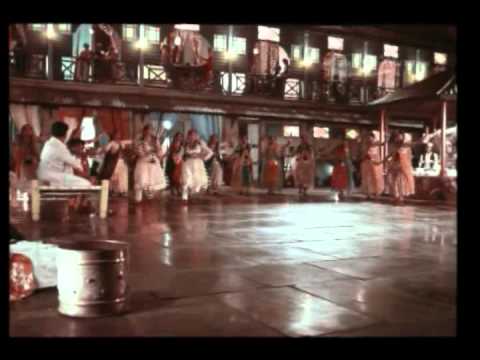
The setting of the first music and dance number of the film - the brothel where Velu meets his future wife. While there isn't a massive amount of musical numbers in the picture, most of them are oddly placed and break up the coherent tone of the film.

As far as the filming goes, there is actually a bit of merit. While this movie was made in 1987, it was clearly working on a budget of, I would guess, around $87. The visuals and sound effects have that cheap, grainy quality of the cheesiest of Kung-Fu Theater movies from the 1970s. Despite these limitations, there are actually some really well-framed and choreographed shots. Also, some of the long shots in Bombay are rather stunning, capturing the different regions of that massive, ancient city. For the most part, the cinematographers did a lot with very few resources.

A final problem I had with the movie is something that could not be controlled by the filmmakers – the subtitles. Nayakan is not an easy movie to get a hold of, and there has seemingly been no high-quality version of it produced for Western audiences. The subtitles were sometimes linguistically clunky and sometimes grammatically mangled. Also, multiple characters’ lines would pop up on the screen simultaneously, often before the second or third person would even speak. This added to the “Kung-Fu Theater Effect”. If a company like the Criterion Collection could get the rights to this movie, polish it up, and do the translation justice, it would help immensely.

Actor Kamal Hassan does a good job of bringing the necessary intensity and heart to the role of Velu Naiker. Unfortunately, it wasn't enough to overcome the elements that I didn't like about the movie.

Ultimately, I have no real idea exactly why the reviewers at TIME magazine put this movie on their “All-TIME 100 Movies” list. While there are some clear merits and strengths to it, Nayakan did not give me anything original. It recycled one of the most famous film stories, and did it with weaker visuals, far less character development, and shoddier execution. Will I ever watch it again? I think you know the answer to that question.

That’s a wrap. 87 shows down. 18 to go.

Coming Soon: The Decalogue (1989):


 This is another film “series”, consisting of ten one-hour movies by the famed director of the Red-White-Blue trilogy, Krzysztof Kieslowski. These will take me a while, but I’m going to do multiple posts on it, so stay tuned.

Please be sure to pick up all empties on the way out. 

Sunday, February 13, 2011

Film #50: Apur Sansor (1959)


Note: Apur Sansar is the final installment of the Apu Trilogy. Here are my reviews of the first two, Pather Panchali and Aparajito,

Title for Us English-Speaking Types: The World of Apu

Director: Satyajit Ray

Initial Release Country: Bangladesh

Times Previously Seen: none

Teaser Summary (No spoilers)

Young and artistic Bengali man faces myriad of emotional swings when reality clashes with his ideals.

Uncut Summary (A full plot synopsis, spoilers included. Fair warning)

When last we saw the young Apu Roy, he was leaving his ancestral home after his mother's tragic death. He was returning to Calcutta to proceed with his university education. It is now a few years down the road, and he has only been able to partially complete his education due to lack of money. With only an Intermediate diploma, he is hard-pressed to find work. He dreams of being a writer, and works diligently at it, but can only pay his bills through modest tutoring jobs.

Under the threat of eviction from his worn-down room, he seeks a more regular job. However, when he learns that the only jobs available are the most menial and mind-numbing of tasks, he decides to continue eking out his living through tutoring and writing. He does receive word that one of his short stories has been accepted for publication. This is perhaps a hint at potential future success.

A very poor but fairly contented Apu plays his pipe to while away time in his battered room.

Apu is eventually visited by his old college friend, Pulu. Pulu is initially disappointed that Apu has not been heard of since leaving college, and the two bicker over Apu's idealist notions compared to Pulu's more practical approach to life. The two do rekindle their friendship for one another, though.

On Pulu's invitation, Apu travels to his friend's impressive family home to witness his younger cousin, Apurna's, forthcoming wedding. Things go horribly wrong, though, when the groom-to-be shows up and appears to be stark mad. Pulu's family is distraught, as they believe that a cancellation of the wedding will curse Apurna for the rest of her life. Desperate, they ask Apu if he will marry Apurna so that their family will not be cursed and disgraced. Apu is at first appalled, and he angrily refuses. After some thought, though, he decides that it would be highly virtuous to accede to their request. As such, he becomes the unexpected groom.

On the wedding night, Apu comes clean to his new wife, who is quite beautiful, if rather young. Apu explains his reasons for marrying her and admits that his artistic aspirations likely preclude any possibility of riches. He has accepted a life of poverty and asks if she is willing to do the same. Despite being from a family of significant means, Apurna accepts the situation and agrees to go with her new husband back to Calcutta.

Apu and his new wife, complete strangers, make awkward attempts to get to know each other.

On first arriving, Apurna has a few moments of quiet sadness as, in Apu's dilapidated apartment, the realization of her new life hits her. And yet, she soon comes to love her husband's kind nature. She even rebuffs his proposal to find more work so that they may be a little more comfortable, preferring instead to simply spend the time with him. She has realized that any material wealth is as nothing compared to being with the man that she loves. Apu sees this and his love for his wife grows deep and profound.

Soon, Apurna becomes pregnant. She leaves Apu in Calcutta, in order to be with her family for the few months leading up to the birth. Then, tragedy. One of Apurna's brothers unexpectedly shows on Apu's door to inform him that Apurna has died in a premature birth. His child lives, but Apu has lost the one thing that he treasures above all else in the world – his loving wife.

With Apurna gone, Apu becomes a shell of the man he was. He turns his back on nearly everything, including his newborn son, Kajal. Leaving Kajal with Apurna's family, Apu becomes a wanderer who has lost faith in everything. He even takes his novel,his semi-autobiographical prized work, and jettisons the pages off of a cliff. Everything that was his has now been taken or thrown away.

Five years pass. All who once knew him now know almost nothing of Apu's whereabouts. His young son is now a very troubled child, causing no end of mischief for his de facto guardians, his great aunt and uncle. In the midst of Kajal's turmoil, Pulu shows up. Upon seeing Kajal's behavior, he decides to seek out his old friend, Apu.

After losing his beloved wife, Apu becomes an aimless drifter.

After a little searching, Pulu finds Apu drifting between coal mining and writing jobs, saving money in order to leave the country. At Pulu's insistence, Apu confesses that he feels nothing for his son. He explains that he cannot get past the fact that it was Kajal's life that caused Apurna's death. Apu, therefore, feels that he cannot act as the child's father. Nevertheless, Pulu convinces Apu to at least visit his son to see if he might have a change of heart.

On returning to his in-laws' home, where Kajal is living, Apu faces more difficulty. His in-laws are rightfully accusatory, and Kajal greets him with willful reluctance. Apu explains who he is to his son, and even tries to melt away some of the bitter iciness that Kajal has for him. Alas, it does not seem to be, and Apu decides to leave for good.

On walking along the road from his son and his keepers' house, however, Apu turns back to see Kajal following him. Kajal seems to be interested in Apu, even if he does not want to believe that he is his real father. Kajal asks if, should he agree to go with Apu, they could go to Calcutta to “find his father,” a pact that Apu is glad to make. Father and son continue along the road, one tiny stitch mended from the shredded fabric of their relationship.

Take 1: My Gut Reaction (Done after this first viewing, before any research)

The Apu Trilogy is an amazing piece of work, though one I may never feel the need to watch again.

After taking in the entire trilogy, it is clear that Satyajit Ray constructed a wonderfully unique set of films. The tale of Apu's growth into his late twenties blends universal sentiments that can move any viewer, yet the films have a distinctively regional feel. This masterful mixture is due to many components.

Here's a fantastic sequence from before and through the botched marriage. It actually makes for a great little mini-tale that can be taken completely on its own. Just start at the beginning and watch for a few minutes:


The story is one that has something for every fan of humanistic movies. Apu overcomes nearly-crushing poverty and personal tragedies through his intelligence and perseverance. Through the three movies, each successive death in his family takes a greater and greater toll on him. The first, his sister Durga's death, is one that the six-year old Apu moves past with an alacrity that only a young child can possess. In the second film, his father's passing is also overcome by the ten-year-old Apu's further bonding with his mother. When she too dies, he turns towards the beckoning word of academics for solace. When he is unable to see this through, his surprise marriage promises to give him the love that is missing. With the death of Apurna, however, Apu seems unable to cope any more. His devastation at this loss turns him into a rather unsympathetic character, though one can understand his plight in light of everything.

Running through the second half of the roughly five-and-a-half hour fully story is the conflict between Apu the artist and Apu the man. Any person who has attempted to carve out a livelihood in the creative arts can easily understand the friction that results when idealism meets the cold, hard realities of being a husband and father. The family tensions are always palpable, though not presented in the highly dramatic fashion of most popular drama.

How does director Ray communicate this to the viewer? Unlike most other directors, he uses very quiet moments of reflection during which you can see the calm anguish on certain characters' faces. With Ray often not relying on the dialogue to pass this along, we viewers have to adopt the same contemplative state that the characters show. It brings us closer to them by allowing us into their minds and spirits in a more authentic manner. A fine example is Apurna's arrival at Apu's run-down apartment in Calcutta. She arrives and Apu leaves the room for a moment. Apurna, still adorned in her wedding dress and make-up, sits down on his bed, looks out at the tattered neighborhood, and begins to cry softly. She never voices this initial disappointment, but I could feel it almost as if it were my own.

Here is a clip which includes that very scene. Start it at 6:20:


The backgrounds of India and Bangladesh, and Ray's integration of these areas, are a major part of what give the Apu Trilogy its distinctive look, sound and feel. With the eye of a cultural anthropologist, he includes the locales, music and customs of Bangladesh and India. We foreign viewers may not understand the reasons and feelings behind some of the traditions we see, but we can certainly grasp their significance for the characters in the tale. One of the many sequences that exemplifies this is the wedding. From Apurna being dressed up by her mother, aunts and sisters, to the actual ceremony itself, there is a wealth of visual wonders to take in. Ray set up these scenes and shot them so as to maximize our ability to slowly absorb them and dwell on what they mean to all characters involved.

I need to say more about Ray's general filming style. I still need to check on who the primary cinematographer was, but the final product is dazzling in its efficiency. An array of great work is done, from still to low-angle to wide-angle to panning shots, each technique is measured and executed perfectly. They draw the eye to exactly where it needs to be, while allowing one to take in the greater whole when necessary. Between the first and third films, I feel that Ray went from great to phenomenal in these respects. By even summoning certain sounds and images from the earlier films, such as windows, trains and beds, The World of Apu adds a satisfying sense of cohesion to the whole.

Here's a clip from near the end. You can pick any place and just watch for a little while. The work is so well-done that it's not hard to pick up the mood of the entire scene or figure out exactly what's going on:


The only complaint I can possibly imagine anyone leveling at these movies is that they are rather slow and mildly depressing. The truth is that I can't really argue against this. However, these are certainly cultural biases that would lead one to feel that the Apu Trilogy is not an “entertaining” set of films. Entertaining they may not be, but I feel that they transcend mere entertainment, and bring us something of greater depth and artistry. I may not ever be in the right frame of mind to sit through them again, but I have no doubt that these three movies will stay with me for the rest of my days.

Take 2: Why Film Geeks Love This Movie (Done after some further research)

No real shockers in the digging. Here's what the professionals say:

Right from the jump, The Apu Trilogy, including the final installment, was recognized as a phenomenal piece of work. Between the three films, it raked in heaps of awards at film shows all over the world, and it opened up entire new worlds for Indian/Bengali filmmakers. Apparently, virtually all films in the region had been basic swashbucklers or musical romances (which is ironic, since there is a scene in the third film in which Apu and Apurna enjoy taking in an Indian pirate flick of just such fare). Even the TIME magazine reviewer in 1960 gushed about it. Here's their review.

Even more recent critics seem unable to ignore this black and white story that was done for a pittance. Roger Ebert brings up many of the things that I couldn't help notice, but articulates them better than I can, and of course adds a few minor observations in his review here.

The only other note of interest was what I dug up on the photographer. He was a man named Subrata Mitra, and, like nearly everyone else on the cast and crew, had never done any film work before Pather Panchali. To this day, filmmakers and critics alike all seem to marvel at just how Mitra, along with everyone else, wrung so much from such meager finances (the entire trilogy was made for $3,000! Try that in today's market!). I suppose it's amazing what true talent can do.

That's a wrap. 50 shows down, 53 to go.

Coming Soon: The 400 Blows (1959)

Joy of joys – French cinema verite comes alive. (Be sure to read that last sentence with an extremely sarcastic tone.) I can't say I've enjoyed the verite films that I've seen, including this one, but I'll try to watch this one with fresh eyes. Wish me "bon chance!"

Please be sure to pick up all empties on the way out.

Saturday, December 11, 2010

Film #42: Pather Panchali (1955)


* Pather Panchali is the 1st of a trilogy known as “The Apu Trilogy”. The 2nd and 3rd films, Aparajito & The World of Apu will be reviewed later in the list, but are considered a part of the same “film” by the reviewers at TIME who compiled the list that I'm working from.

Title for We English-Speaking Types: “Song of the Little Road”

Director: Satyajit Ray

Initial Release Country: India

Times Previously Seen: once (about 10 years ago)

Teaser Summary (Plot synopsis in 20 words or fewer. No spoilers)

Young Indian boy is born into poverty, lives with his sister, mother and oft-absent father.

Uncut Summary (The full plot, spoilers included. Fair warning)

In the 1940s (?) Bengal, India, the child Apu is born into a poor family. His father is a priest and poet who often struggles greatly to find work and pay for his family's needs. Apu's mother is a woman anguished by her own poverty, but is steadfast is trying to do right by her husband and children. Apu's sister, Durga, is roughly five years his senior, and is kindhearted, though she is mischievous enough to occasionally steal fruits from her wealthier aunt and cousins' nearby orchards. Also living with the family is their extremely elderly great aunt, who does little more than sit and make the occasional observation.

When Apu reaches the age of six, he is sent to school, a place where he finds the teacher rather frightening. By now, he has developed a very typical brother-sister relationship with Durga – the two annoy each other plenty, but genuinely love and protect each other from any possible harm, whether it be their scowling aunt, the absence of their wandering father, their sometimes angered mother, or the more abstract shame of being obviously poor.

Apu and Durga share a typical sibling moment.

One afternoon, with their father off in a large city to find work in either a religious or artistic capacity, a monsoon tears into the forest where Apu and his family live. Apu and Durga are stuck outside of their home, and Durga huddles close to her little brother to protect him from the relentless rains. After the storm passes, Durga takes horribly ill and dies within a few days. Apu's father returns the next day to discover the tragedy and collapses with his wife in grief.

In the wake of their daughter's death, Apu's parents decide to move the family away from their ancestral home and to the massive city of Benares, where they home to find more work, a better life, and leave their tragedies behind them. As a wagon takes the family away, Apu looks back on the only place he has known for his six years on earth.

Apu dons a hand-made prince's crown, perhaps suggesting a desire for greater things.

Take 1: My Gut Reaction (Done after this most recent viewing, before any research on the film)

Entrancing movie, if you're in just the right mood for it. If you're not, you're bound to find it slow, boring and may have trouble finding the point of it. I was in the mood, so count me in the former group.

Of the 42 films I've watched for this blog, Pather Panchali is easily the most humanist and naturalistic of the lot, and I suspect it may end up holding that title throughout the list. The story is the furthest thing possible from high drama that you can get. It's all about communicating all of the most basic, shared human emotions. The vehicle for this is the six year old boy Apu, a cute-as-can-be kid whose happiness, fear, love, disappointment, and shame shine as clear as day in his massive eyes.

This is the link to a great youtube clip that shows the great relationship between Apu and Durga. It's actually enhanced by the lack of English subtitles, as the dynamics, facial expressions, gestures and music tell the tale as well as any dialogue could.

The trick is that, on the surface, this story may seem as foreign as humanly possible. Not many of us in the Western Hemisphere would have an inkling of how a family in India lives, let alone a dirt-poor family in a small village in 1940s India. Yet, it only takes about 10 minutes of film to completely see so much of the universally human qualities being displayed in the tale Apu and his family. Even more than the stylistically similar Tokyo Story, Pather Panchali gives the feeling of watching a documentary rather than a piece of fiction.

This is not to say that the movie is solely a grim or depressing affair. Generously sprinkled throughout the tale of Apu's boyhood are many moments of good humor and pleasantness, those essential assets of survival for anyone in arduous conditions. His ancient great aunt makes a few good cracks and her constant threats to leave become rather amusing. The little looks of mocking and impish glee that Apu and Durga share between each other are bound to make anyone with a soul smile despite themselves. These lighthearted elements make it all the more tragic when Durga dies suddenly later in the film. These are no longer carefully crafted characters, but very real people whose pain is evident and evokes real emotion.

When I think about the acting, my educational background in anthropology kicks in a bit, and I try to think in term of cultural relativity. While I don't know what the standards are for Indian actors, the acting in Pather Panchali seems very solid to me. However, it's impossible to compare them to performances like Marlon Brando or Humphrey Bogart. Playing Terry Malloy or Rick Blaine is a different animal altogether, but the actors in Satyajit Ray's humanist drama do exactly what they are supposed to – act like completely real people. It's more subtle and perhaps not quite as demanding as the western tradition of drama, but it works marvelously for this movie.

The technical merits of the movie are fantastic. From the very beginning, as we follow a 7-year old Durga running through the forest, the soundtrack sitar playfully accompanies her traipsing along. This same instrument appropriately picks in during several other moments of joy and happiness in the film, and it's just one of several sound and camera elements that enhance the various moods experienced by the characters. The filming is done so that I felt very much like I had a excellent sense of Apu's little part of the Bengali forest and everything in it. It's very much the same feeling I get when watching Kurosawa's Seven Samurai – by the end of that movie, I feel like I know that little Japanese village, front to back. Pather Panchali has the same absorbing effect.

This isn't a movie for all comers. Like films that I've reviewed recently (Tokyo Story, Ikiru, Umberto D.), it's one that everyone should probably watch at least once, though one that I can hardly guarantee will be “enjoyed”. It is now clear that the 1950s was the beginning of the very real transition of films from mere fantastic, melodramatic storytelling medium to one of very somber, humanist tales. Up until this point, such things had been the purview of literature. No longer. Films like those aforementioned were clearly changing films as people knew them.

Entertaining? Perhaps not. Revolutionary? Definitely.

Take 2: Why Film Geeks Love This Movie (Done after some further research)

Being the first of a coherent trilogy, isolated research on Pather Panchali is a bit tricky. As such, I'll keep this section brief and do a more thorough look at all three films after watching them all.

One of the most remarkable things about Pather Panchali is that it was Satyajit Ray's first film, was done on a budget of approximately $3000 U.S., and that very few of the actors or production crew had any kind of experience in cinema. This undoubtedly lent the air of needed verisimilitude. For such a crew to create such a landmark film is indeed a rarity that speaks to Ray's unique vision.

However, the vision was not without its powerful influences. Probably the two most notable are the French director Jean Renoir and the then-blooming style of Italian neorealism. Apparently, Jean Renoir went to India to film The River, and was put into contact with Ray, who was then working as an illustrator and general film enthusiast. When Ray discussed his ideas for adapting the novel Pather Panchali, Renoir offered plenty of encouragement. After spending several months in London, absorbing every movie he could get his hands on, Ray returned to India with the mission of making his movie.

After watching such films as The Bicycle Thieves, the neorealist film by Vittorio de Sica and forerunner of other movies like Umberto D., Ray knew that this was the style that would best suit the tale of the young Apu in his impoverished Bengali village. When one sees both films, the similarities are as clear as day.

Critical reception of Pather Panchali was mostly glowing, though this was not universal. While many saw the movie as an incredibly powerful document of human life in a previously little-known segment of the world, others found it difficult to stomach. French film titan Francois Truffaut claimed to never want to watch “peasants eating with their hands,” and some in the Indian government thought the film was “exporting poverty”. Still, the detractors were outnumbered by those who found endless lyricism and merit in the movie.

A final, less important note is that the snappy sitar soundtrack was provided by none other than the now internationally famous Ravi Shankar (just how many sitar players can you name?), a then little-known musician who was just starting to carve out his career. This was just one of the many little things that fell into just the right place to make this singular movie.

Here's another link to the final moments of the movie. Be warned that it contains serious spoilers for anyone interested in watching the film and maintaining the power of the unknown. Otherwise, it's a good representation of the things that the movie conveyed.

Again, there is obviously more to the tale of Apu that is told in the second and third installments of the series, and a more complete run-down of the analysis will accompany my reviews of those movies. For now, though...

That's a wrap. 42 shows down, 63 to go.

Coming Soon: Smiles of a Summer Night (1955)


A relatively early film by the insanely prolific Swedish film icon, Ingmar Bergman. I've seen quite a few of Bergman's other film, which can be challenging, to say the least. This one, by the looks of the poster however, may be of lighter fair. We shall see.

Please be sure to pick up all empties on the way out.