Directors: Hamilton Luske & Ben Sharpsteen
Release Country: United States
Times Previously Seen: Maybe once or twice as a wee tyke. Don't really remember.
20-Words-or-Fewer Review (no spoilers):
Marionette youngster comes to life, learns right from wrong from wild experiences and a kindly insect.
The Full Story (A detailed plot summary, spoilers and all. Fair warning):
In a little Italian village, a kindly master toy-maker, Geppetto, makes a wooden marionette in the figure of a young boy, naming it Pinocchio. Upon retiring for bed that evening, he wishes upon a single star that his newly-crafted companion might come to life, perhaps to offer him some companionship. After Geppetto falls asleep, the star transforms into a fairy who alights in the craftsman's bedroom and grants his wish, bestowing life upon Pinocchio.
Watching the entire scene unfold has been the kindly bug, Jiminy Cricket. Little Jiminy agrees to become Pinocchio's conscience, as the animated puppet will not achieve true human life until he learns right from wrong, as per the fairy's guidelines.
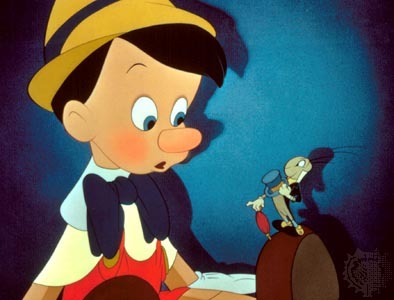
The little wooden fellow first meets his newly-minted, top-hatted conscience.
Pinocchio wakes Geppetto who, after the initial shock, is overcome with joy. In the morning, he sends his new son to school. Pinocchio, however, is waylaid by the wicked Honest John, a conniving fox who sees Pinocchio as a cash cow, lures him with promises of fame and glory, then sells him to the greedy gypsy, Stromboli. Stromboli has Pinocchio perform once to great success, then locks him in a cage to prevent his escape. Upon realizing the hopelessness of the situation, Pinocchio and Jiminy despair until the star fairy descends and frees him. She says, however, that this is the final time that they can rely on her help.It isn't long, however, before Pinocchio is once again fooled by the ever-rakish Honest John; this time leading Pinocchio to the ministrations of "The Coachman," an oily predator looking for troublemaking little boys to spirit away to "Pleasure Island" for some mysterious purpose. Pinocchio, along with a gaggle of other local truants, follow the Coachman to the enclosed island, where they discover that Pleasure Island is a paradise for the mischievous young lad: there are cigars to be smoked, fights to be gotten into, and palatial houses to be destroyed, all for their amusement. Little do they realize, however, that once night falls, they will all transform into donkeys which the Coachmen sells to various labor camps across the globe. Jimeny discovers this and warns Pinocchio, just as his transformation begins. They manage to escape just in time, leaving the other ne'er-do-well boys to their fates.
Upon returning to the toy shop, Pinocchio and Jiminy discover that Geppetto has gone looking for his prosthetic son, only to be swallowed up by the mythical whale, Monstro. The two searchers find the nearest shore, plunge themselves into the deeps and begin the search for the kindly toymaker. They do eventually find the terrifying Monstro and, after a titanic battle with the leviathan, liberate Geppetto, though Pinocchio seems to have been killed in the process.
Back at the toy store, a distraught Geppetto cries over the body of his dead creation but then is revived when the fairy returns a final time and, in recognition of Pinocchio's selfless acts of courage, deems him worthy of real life.
He's a real boy!!
Take 1: My Gut Reaction (done after 1 viewing & before any research):
I feel I have to section this review off into two sections of my brain.
If I were a kid watching this, it would be incredible. I realize that modern animation, most of which is CG, is peerless in terms of detail and fluidity. Still, Pinocchio trumps damn near all of its followers in terms of pure life and magic. Every scene is a treasure chest of movement and vivid kinetics. There are plenty of scenes where the eye doesn't know where to look, there are so many intricate dances of objects and characters.

This scene only gives you the tiniest of tastes, but the early moments in Geppetto's shop are vibrant marvels of color in motion.
What kid wouldn't want to spend the rest of their lives in that place?On top of the visuals is the pure adventure of the story. It takes no time to get a puppet-brought-to-life and a magical blue fairy. Form there, we get the brief and terrifying domination of the gypsy Stromboli's suffocating wagon. Then, the sinister evil of Pleasure Island, followed by the epic force of nature of the sea beast, Monstro. Pinocchio's involvement in it all is almost incidental, and if I were a kid, I may barely remember his place in the story. Much more memorable are the strange and frightening things going on around him.
As an adult seeing this film all the way through for the first time, the film is almost as good. The visuals are still incredible. Sure, modern animation has grown by leaps and bounds in terms of technique and smoothness, but I don't know that I've ever seen another animated movie that conveys the mood in such a singular and effective way. The hand-painted backgrounds and the omnipresent shadows create alternating coziness, power, and terror, as the tale dictates.
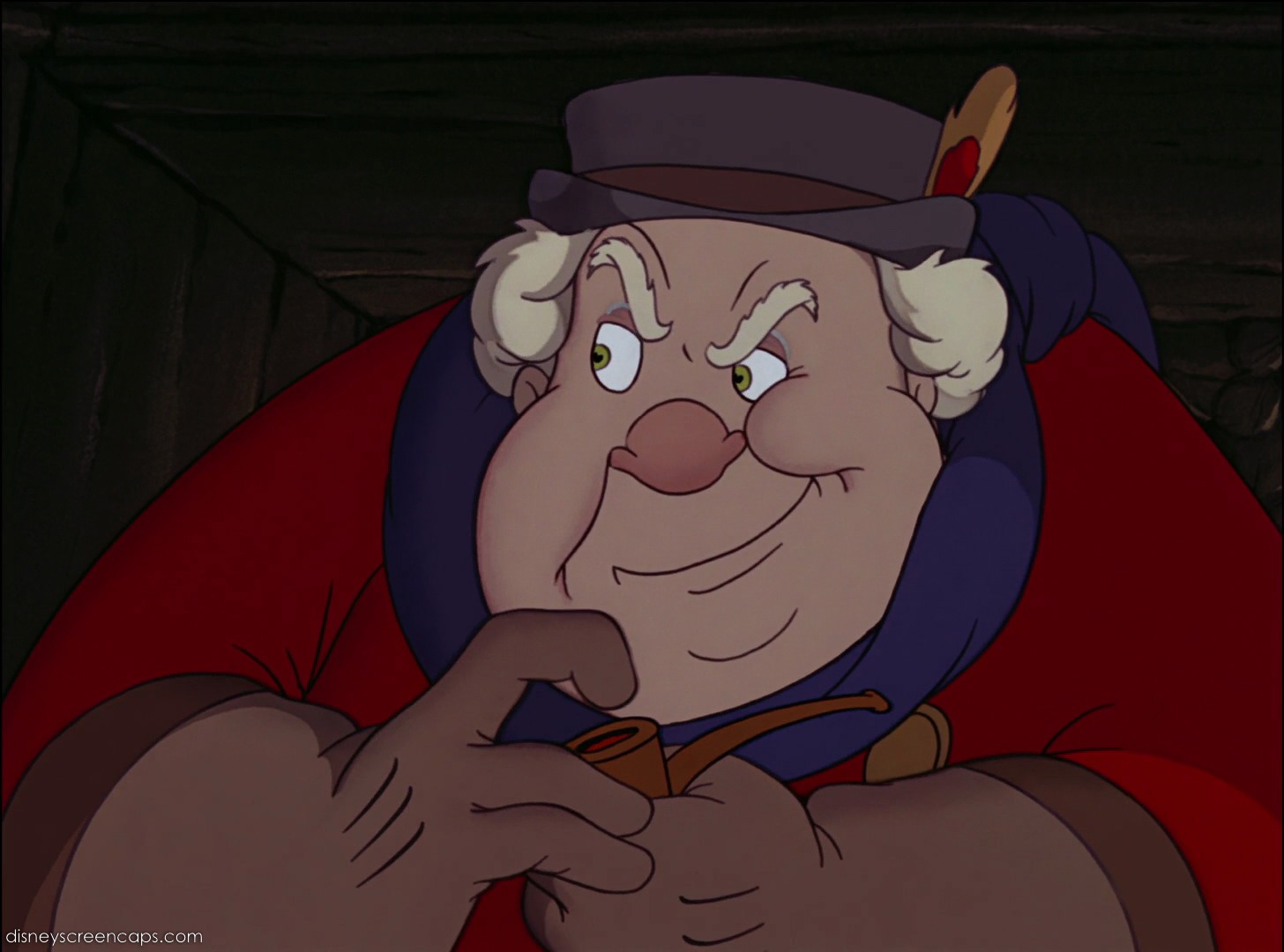
This is the pedophilic-looking rogue who pays to have young boys whisked away to "Pleasure Island". The scene where we first see him is creepy beyond belief, for children or adults.
One of the things that I loved about an animated feature like this is its timelessness. Disney actually used to be much better at this, and their subsidiary Pixar has rediscovered the formula, to a degree. The keys seemed to be source material and, more importantly, the script. Pinocchio, released in 1940, is blessedly devoid of any "topical" jokes or dialogue. No allusions or mentions of communists, Nazis, movie stars, or any other subjects that were relevant way back then. Disney really lost its way with this in the mid and late 1990s, with films such as Aladdin, Hercules, and the atrociously-named The Emperor's New Groove, which relied way too much on gags that were better suited to late night talk show monologues and would be stale in a matter of years. Pinocchio avoided dating itself this way.
There are some seriously murky things lurking beneath the surface of this tale. Perhaps the obvious one is the entire Pleasure Island episode. Cynical adults will look at the story of a fat, leering man looking for little boys to kidnap as a thinly veiled metaphor for pedophilia. It's not as obvious as all that, but I won't deny that the writers may have been intentionally tapping into that primal fear of parents the world over.
The other thing that makes for analytical thought is the entire story of Pinocchio as a vessel. It dawned on me that, really, the Disney version of Pinocchio is oddly like a somewhat positive inverse of Frankenstein's monster. Both the wooden lad and the monstrous construct of Shelley's novel were tabulae rasa, vessels with no initial concept of themselves, or anything else for that matter. Oddly enough in Pinocchio, it's not Geppetto but the Blue Fairy who serves as the Dr. Frankenstein; she imbues the marionette with a soul, then leaves him nothing more than a woodland insect to figure out ethics. As a result, Pinocchio nearly gets kidnapped by a greedy gypsy, half turned into a donkey by a wicked boy-peddler, and swallowed whole by a massive, boat-swilling whale. What kind of sick bitch does that? I'll tell you who - the same kind of person that creates a massive creature from dead tissue and then abandons him. That's who. At least the fairy came through in the end, unlike our misguided Austrian doctor.
There were only two things that truly struck me as weak, both of which I only notice as a hyper-critical adult. One is that Pinocchio, as alluded to above, is a bit of a dope. I know it's by design, but he has zero personality, unlike virtually all other cartoon protagonists. He's laughably led astray by the fiendish fox Honest John twice, and one can hardly say that he learns his lessons. To reiterate, though, it's a minor point. If you're one to look for lessons and morals in animated movies, they are there to be found, even if the title character is a dunce.
The other, lesser, problem is the pacing. There are a few jumps that are dizzyingly quick. When we learn that Geppetto has been swallowed by a whale, it's as much a shock to the viewer as it is to Pinocchio. Pinocchio takes it in relative stride; I, however, thought that perhaps I had missed part of the movie. When the hell did that happen? There were a few other moments like this when the film seemed to be rushed. Not a great problem, but it stood out.
Pinocchio is an animated film that I think can stand up to all but the very best animated movies released in the seven successive decades. The folks over at Pixar are the modern masters, but they are certainly riding the coattails of standards like Pinocchio.
Take 2: or, Why Film Geeks Love This Movie (done after some further research):
There certainly is no shortage of interesting research to be done on this one.
Pinocchio was the second feature length animated film from Disney (following Snow White in '37), and both clearly display the master formula that has served that franchise to this day: (1) take a well-written fairy tale (2) clean out all of the objectionable bits (3) get phenomenal animators and story-writers to tell the story. Repeat.
 A very early rendering of Pinocchio from the 1880s.
The source material in this case in an original Italian "fairy" tale written by Carlo Collodi in the 1880s. Just like the original Grimm's Fairy Tales, Collodi's tale was not exactly meant specifically for children. An allegory for social commentary, the original Pinocchio features a truly irascible marionette who kills "the cricket" (the name "Jiminy" was a Disney invention) with a hammer, lies repeatedly to his father, and is even hung at the end for his foolish deviance. This ending was actually changed by Collodi at the behest of his publisher, so that it may be a bit more palatable to a wider audience. I guess one could say that Collodi Disneyfied his own story a bit before Walt and his team could finish the job 60 years later.
It has been pointed out, through Pinocchio and many other films, that animation can be appreciated on a level that goes far beyond childish amusement. Leonard Maltin points out that, "There are no accidents in animation." This struck me as meaningful as I looked at the splendor and vivacity of a film like Pinocchio and I realized that every scene, every background, every character, and every color had to be sweated over. It's a wonder that they finished the thing in a mere two years, to be honest.
In addition to the craftsmanship is the sheer skill in terms of film making. Walt Disney was once asked about making movies only for kids, to which he replied that he did no such thing, pointing out that, "If I only made movies for children, I'd be severely limiting my audience." I suppose a cynic would see this as an early sign of Disney's quest for domination of the world's minds. I see it a bit more as a storyteller who just wanted as many people as possible to hear his tales. He and the crew that he assembled showed it in the outstanding films that they crafted in those early decades of work.
A few of the details. In hearing some commentary from Disney aficionados, I realized that my dubbing of the Disney Pinocchio character as "a dope" and "a dunce" may be a touch mean. A better word may be "guileless." Still, it doesn't do any more to attract me to him or make him any stronger a character.
One final piece of trivia: a very young Mel Blanc, the late, great voice actor known the world over as the voice of nearly every major Warner Brothers character, actually provided the voice of Gideon, Honest John's companion in Pinocchio. However, it was decided that the Gideon character was going to be a mute, so Blanc got edited out of the entire audio, save for a solitary hiccup. If only they'd known.
That's a wrap. 21 shows down. 84 to go.
Coming Soon: The Lady Eve (1941):

The final screwball comedy on the list. At least it has Barbara Stanwyck and Henry Fonda in it.
Please be sure to pick up all empties on the way out.