Showing posts with label book adaptations. Show all posts

Tuesday, July 7, 2020

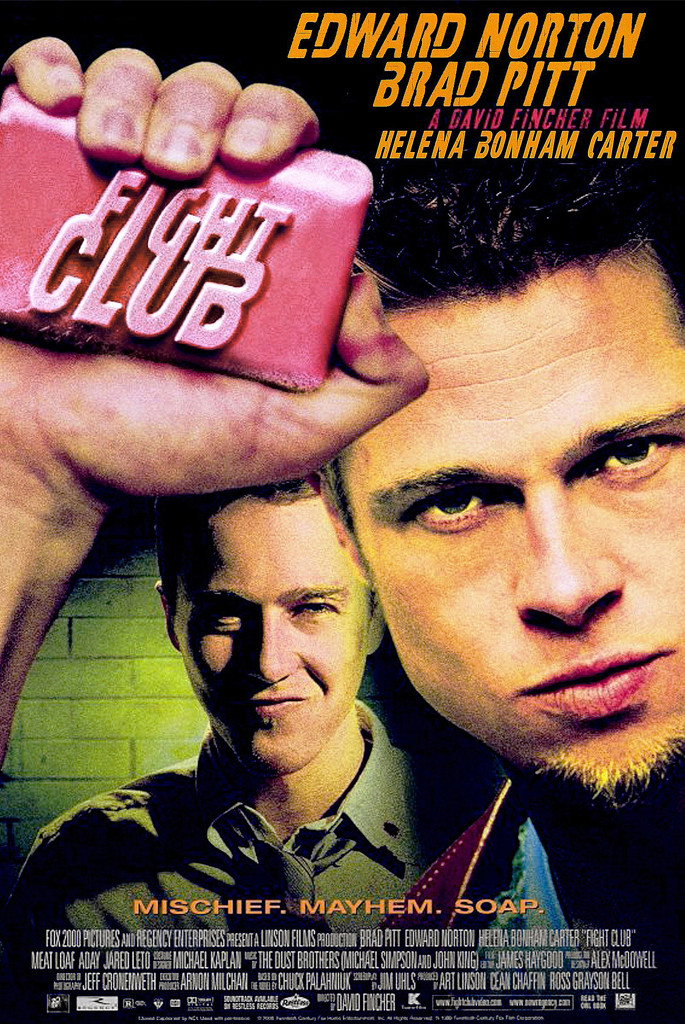
Fight Club (1999)

Director: David Fincher

Still a great, wild ride of a movie that showcases so many of director David Fincher's many strengths as a filmmaker. 

The movie, based on the novel of the same name by Chuck Palahniuk, follows an unnamed protagonist (Ed Norton) whose life has become such a drone that he is a virtual zombie. To paraphrase him, he is never fully awake but can never fully sleep. This continues until a chance meeting with Tyler Durden (Brad Pitt), a whip-smart renegade with the ultimate punk rock sensibility. Durden squats in an abandoned house, refuses to live by any of society's rules, and eventually convinces our protagonist to begin an underground fight club for men like themselves - disenfranchised and feeling like they've been sold a bill of goods by capitalist, consumer culture. Eventually, Durden molds this ostensible underground MMA group into something much more potent and frightening, with our anonymous main character being pulled along in ways that he can't even begin to imagine. 

I can't recall just how many times I've seen this movie, but it's easily in the double digits. I saw it a couple of time in theaters upon its release back in 1999, and would routinely go back to it for many years after. I'd gone quite a few years since a full rewatch, until reading Brian Raftery's recent book Best. Movie. Year. Ever., which catalogs the insane number of great films that came out in 1999. My enthusiasm fully stoked, I snapped up a cheap blu-ray copy of Fight Club and took it all in again. My thoughts about the film have evolved over two decades, but I still find it to be a satisfying, subversive, funny, and extremely well-crafted middle finger to large segments of the film industry. 

In those first years after the movie came out, like a lot of guys in the early and mid-twenties, I saw the Tyler Durden character as an icon of cool. He was a take-no-bullshit badass who just got things done, and seemed to be on the side of righteousness. To slightly paraphrase Durden himself, he looks like you want to look, f***s like you want to f***. He is smart, capable, and most importantly, free in all the ways that you are not. It's a great sales pitch to young men who are in desperate need of leadership, wherever that leadership takes them. Durden's appeal to "enlightened" macho violence is one that is still fully relevant today, with the immense popularity of "smart" MMA bros like Joe Rogan and similar "intelligent" Alpha males who have millions of devoted fans and followers. Chuck Pahlaniuk was onto something when he wrote the novel, and David Fincher was clearly aware of it.

If you need to illustrate the idea of self-destructive anarchy
having sex appeal, then Brad Pitt is a pretty good choice
as your spokesmodel.
What has changed, though, is the realization that being punk rock isn't really the hard part. And looking and sounding cool while doing isn't even the hard part. As calculating and slick as Tyler Durden is, his plan doesn't go beyond "blow stuff up." It's really a punk rock sensibility, which has a very strong appeal in the hands of such a charismatic character. When I watch Fight Club now, I can't help but wonder just how likely it is that Durden's master plan actually works, after the credits roll. Or whether he ends up being happy with Marla. Yes, Project Mayhem's bombs go off, destroying the headquarters of major credit card companies, essentially annihilating debt and giving everyone a fresh start. But will that actually work? And yes, Durden's fractured mind reunifies, and he seems to reconcile with Marla. But they're both clearly still very damaged people. Such grounded thoughts, though, are not what Fincher had in mind. He was looking to tell a raucous tale of a modern anarchist, and he gave us just that.

If the themes are what elevate the story well above just being a sweaty trek through underground fight clubs, then the film technique is what makes the whole show so wildly entertaining. You have three actors in Norton, Pitt, and Carter, who are as good as they've ever been. And the sharp writing is still absolutely hilarious. The look of the movie, along with the editing and cool-as-hell Dust Brother soundtrack bring it all together to give us a movie that's simply a blast to watch.

It's both fascinating and unsurprising that this movie fell on its face when it was released back in 1999. Up until then, there really hadn't been anything quite like it - an in-your-face, crotch-grabbing "screw you" to capitalism lightly disguised by a "pretty boy" actor in Pitt and "up and coming" fresh face in Norton. There were obviously people like me, who saw it in the theaters and loved the dark humor and the deeper themes and ideas, but most people were either baffled, disgusted, or just stayed well away from it. However, you might view Fight Club now - a worthy, dark satire; flawed attempt at profundity; or something else - I think most would agree that there's more than a little solid film technique happening, and that the movie had a serious impact on movies for years to come. 

Monday, February 10, 2020

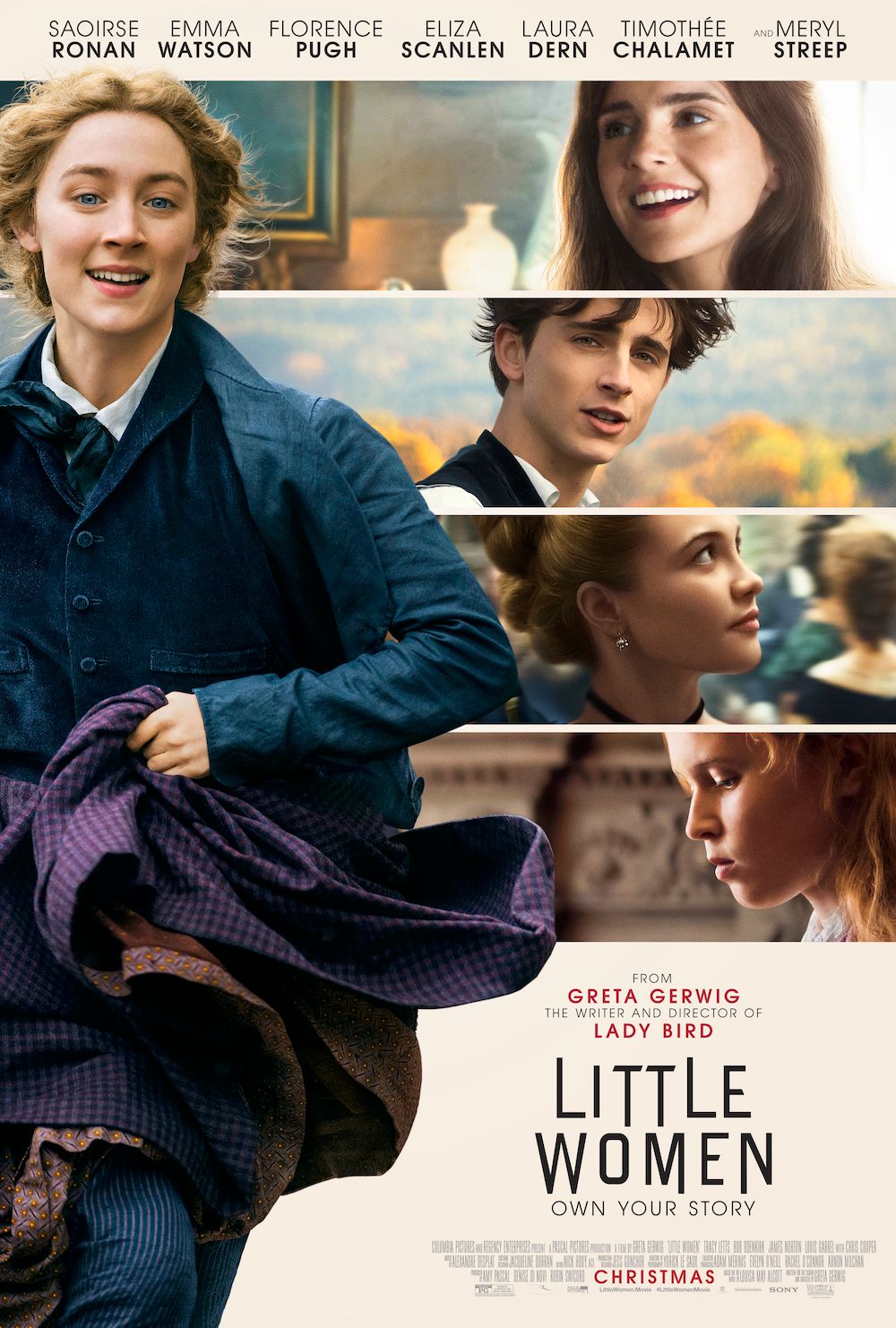
Little Women (2019)

Director: Greta Gerwig

Somewhat surprisingly, I found this movie excellent and highly entertaining.

For a touch of perspective, I'm a mid-forties Gen X dude who thoroughly enjoys sports, Marvel movies, and dirty humor. Like, a lot. But those aren't my only interests, and I'm able to appreciate things outside of my normal comfort zones. Exhibit A: I found Little Women to be a delight.

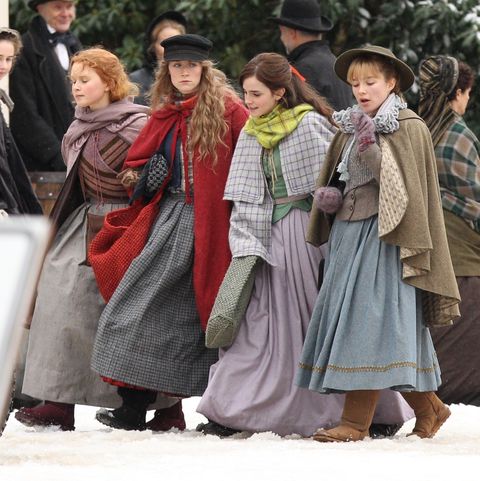
The movie mostly follows four sisters who live with their parents in Massachusetts during and several years after the American Civil War. As with many families, the four siblings have different attitudes, talents, and temperaments. Jo is a free-spirited rebel; Meg is something of a romantic; Amy has an eye for sophistication and feels rivalry with Jo; and the youngest, Beth, is sickly but possessed of considerable musical ability. Over the course of roughly seven years, the four sisters deal with interpersonal drama and tragedy, as they and their mother deal with their own aspirations, often while their father is away for the war.

The story is based on an immensely popular novel written by Louisa May Alcott, aimed at young female readers and published in the 1870s. Given that, it was no surprise for me to find that the story has a relatively gentle mood, and it never gets terribly dark. It also wasn't surprising that there was a bit of sappiness and sentimentality laced into the overall work. Despite this, though, I found the movie completely enjoyable. It helped that Gerwig made some very smart creative decisions in her changes to Alcott's original story. Melding Jo with Louisa May Alcott herself (whom the character was based upon originally, anyway) was an organic and highly effective choice. It also allowed for a bit more direct commentary on gender biases and a certain amount of progress which bold young women had carved out for themselves during times when such things were far from easy.

Just one of the many, many shots that is composed and framed
so well that you may not even realize how pleasing it is to
simply look at. There's often a coziness to the film that makes
one feel quite welcome, especially during the "good" times.
Probably the primary reason is just how technically excellent the entire film is. The narrative is laid out in a perfectly-executed, non-linear fashion, often using visual cues to let us know that we have jumped either backwards or forwards in time, drawing poetic connections along the arcs of characters' lives. Beyond that, all of the visual elements are stunning. Thanks to top-notch costume work, set design, lighting, and cinematography, the various tones and moods come right through the screen with every ounce of power that you would hope.

Then there's the acting. It's as good as it gets. Yes, there's the aforementioned sappiness here and there, but that's outweighed by some solid drama and innocent humor executed masterfully by an outstanding cast. Once again, Saoirse Ronan shows why she's one of the best young actors around, nailing the primary role of Jo. Not to be outdone, though, Emma Watson and Florence Pugh are great as Meg and Amy March. The one prominent male character, "Laurie," is played to with impish, self-absorbed charm by the waifish Timothee Chalamet, whom I hadn't seen play a major role before this.

Obviously, all of the elements are there, and it all comes together as well as possible. Yes, the film is geared for a very wide audience, so older and more serious viewers will find themselves rolling their eyes in a few moments. But this is such a well-told story that it's difficult for even a fairly cynical 'Merican fella like me to not appreciate its clear merits. 

Friday, February 19, 2010

Film #11: Bride of Frankenstein (1935)


Director: James Whale

Release Country: United States

Times Previously Seen: once (about 4 years ago)

The Story (in which I completely give away all plot points, including any spoilers. Fair warning):

*In order to tell the full tale, I feel it necessary to cover the original film, Frankenstein. In addition, all readers should be aware that these reviews cover the film versions, not the book. The films take much "artistic" license with Mary Shelley's novel, which will be briefly covered later.

Frankenstein: Young Doctor Henry Frankenstein robs a few graves to assemble the final pieces that he needs to complete his ultimate experiment - to create human life from previously-dead tissue. He is successful in creating a hulking but inarticulate being. To the horror of his onlooking fiancee, Elizabeth, and closest friend, Victor, Frankenstein revels in the majesty of his accomplishment. Unfortunately, Frankenstein's sadistic henchman, Fritz, frightens the creature, who escapes into the countryside. Henry returns home to marry Elizabeth. Meanwhile, the creature roams free, seeking friendship but finding only horrified villagers. After mistakenly killing several people, including young children, the monster is chased by Frankenstein and a German posse into a windmill , where he is seemingly burned to death.

Bride of Frankenstein: Picking up where the previous film left off, we see that the creature escaped death by falling into a deep, watery recess underneath the burning windmill. Back at Frankenstein's nearby home, the doctor prepares to marry his betrothed. A mysterious and sinister character from Dr.Frankenstein's past named Dr. Pretorius arrives on the scene and entreats Henry to work with him to recreate his experiment. We soon see that Pretorius is a death-obsessed, maniacal genius who has created a bizarre menagerie of strange creatures of his own. He will stop at nothing to force Frankenstein to help him realize his ghoulish vision.

All the while, Frankenstein's creature roams about, initially finding the same hatred as before, until he finds an old, blind hermit in the woods. Not seeing the creature's hideous exterior, the blind man takes him for a mute, treats him with kindness, and even teaches him how to speak, though in a limited capacity. Eventually, a few villagers show up, see the monster, and run him off once again.

The monster, amazingly, comes across Dr. Pretorius, and they conspire together to kidnap Elizabeth and force Frankenstein to construct a female companion for the creature. The young doctor concedes and creates the female abomination. However, once she becomes aware and sees the original creature, her intended mate, she recoils in horror. Upon realizing that he has no hope of finding a kindred spirit in this world, the creature sabotages the machinery in the massive laboratory, killing himself, his "bride" and Doctor Pretorius, with Frankenstein and Elizabeth narrowly escaping.

Take 1: My Opinion (done after one viewing, before any research on the film):
Bride of Frankenstein is a really good movie, though steeped in some old, B-Horror movie conventions. It's clearly better than its predecessor, even though both were directed by the renowned horrormeister James Whale. The primary difference is that Bride moves closer to the deeper themes of Mary Shelley's timeless novel, whereas the first Frankenstein keeps things relatively simple.

While in Frankenstein, the creature is portrayed as almost more monstrous than sympathetic, in Bride, there is a much better balance. By allowing him to speak and giving more time to his obvious pleas for companionship, I felt much more for him than in the first film. This touches on the creator/creation relationship that was so key to the novel. The vehicle for this shift comes in the scenes between the "monster" and the blind man who takes him in. In these few minutes of the film, we really see the creature as a young, desperate and tormented child who wants nothing more than contact. Here's a taste of the interaction:


Scenes like this one set this classic horror flick far above its peers. Perhaps the capper is the literally explosive grand finale. By accepting death rather than a tormented and solitary life, the creature represents a certain existentialism that belies the B-horror veneer.

My main problem with the movie is that it is rooted in a few clumsy elements. Dr. Pretorius, played extremely eerily by Ernest Thesiger, seems somewhat contrived. While the character himself is somewhat intriguing, he represents the biggest of several serious gaps in the narrative. Who is Pretorius? Why the death fixation? This guy quite literally just shows up on the doorstep and takes control of the entire movie, with nary an explanation. The plot was obviously highly streamlined in order to keep the pace quick, but it leaves a few too many questions to be answered for my liking.

In addition to the semi-choppy narrative, there are several insanely coincidental occurrences that defy my ability to suspend disbelief. Chief among them is the monster happening across Dr. Pretorius in a tomb. I suppose you could argue that it fits that these two beings, both having affinities for the macabre, would meet in such a place. I had to roll my eyes a bit at it, all the same.

In all, though, it's a really good movie that earns the moniker of "classic". Modern viewers, especially young adults, may not be able to see past the outdated effects and occasional silliness of some scenes. If, however, the viewer can look past the surface, they may see a lot of things that the vast majority of films, horror and otherwise, are sorely lacking.

Take 2; Why Film Geeks Love this Movie (done after some research on the film):

This film is hailed as one of the greatest horror films ever. Film historian Scott McQeen even goes so far as to call it, "the perfect horror film." In listening to his audio commentary, he certainly makes his case well. He points out a lot of the meticulously-planned elements of the movie, including the visuals and the overall character interactions. I agree that the aesthetic of the film is really engaging and cohesive, with elements of baroque, rococo, and expressionism blending really well to create a slightly alien feel to the world. Even a non-art buff like me can appreciate these things.

I also discovered that my initial feelings about the narrative being a touch choppy were not just subjective. Apparently, the script and film went through several edits, thanks in large part to objections by the Hays censorship board. In the end, a longer scene that explains the relationship between Frankenstein and Pretorius was cut, along with several other scenes in which the monster kills people.

One surprising thing is that the original TIME magazine review saw Bride as equal to the original, rather than superior. Here's their original review.

The really interesting thing about the creative forces behind the films is director James Whale. A somewhat flamboyant, totally atheistic man, Whale was a playful and strong-willed man who had a vision and tried all he could not to compromise. He may have been one of the earliest users of campiness in his films. 

Dr. Pretorius, displaying his bizarre menagerie of experiments. This character gleefully and skillfully tiptoed the line between genuine eeriness and laughable camp.

A lot of analysis has been done on the possible religious and homosexual symbolism or themes in the film. In the end, it all sounded like people with too much time on their hands (ahem...). There's a great story about the movie: In the late 40s, James Whale went to a review showing of Bride. Throughout the show, Whale was obviously amused by his own cleverness is telling the equally horrifying and entertaining story that he wanted to, while tap-dancing around censors and critics, so he kept chuckling during the moments he knew were meant to be humorous. A woman in front of him, not knowing who he was, agitatedly turned and said, "Look, if you don't like the film, you can damn well leave!"

Just goes to show that few, if any, of us ever completely see all of the things that a filmmaker is showing us. Or, if we do, it's not for years or decades after they first revealed it to us.

Related Media

"Frankenstein; Or, The Modern Prometheus" (novel; Mary Shelley): brilliant novel that has been and will be around for centuries. The universal themes of existentialism and the search for knowledge through technology are still as, of not more, relevant today as when the novel first came out 200 years ago. James Whale took a lot of liberties with the story, right down to the names of some of the main characters, but retains some of Shelley's more brilliant ideas.

Mary Shelley's Frankenstein (film; 1994): Pretty wretched attempt to blend a faithful rendering of the original novel and the more popular conceptions of the story as created by James Whale. Director and main man Kenneth Brannagh was trying to do way too much with this one, and ended up creating a technicolored mess. Cool visuals. DeNiro as the creature is pretty good. The rest of the this thing is totally overblown, though, and in only a few moments does it approach anything worthwhile. I got through about two-thirds of it but couldn't take any more. Give me the original James Whale movies any day.

That's a wrap. 11 shows down. 94 to go.

Please be sure to pick up all empties on the way out.

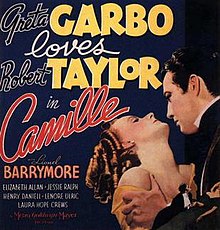
Coming Soon: Camille (1936):


This one looks a little froo-froo, so I don't know what to expect. I may have to follow it up by watching Mike Tyson's Greatest Knockouts, just to keep my feminine/masculine equilibrium.