Showing posts with label Helen Mirren. Show all posts

Monday, June 26, 2017

Retro Duo: Excalibur (1981); The Fountain (2006)

Excalibur (1981)

Director: John Boorman

This was probably the third or fourth time I've seen this movie over the last 20-odd years. The over-the-top nature of it just gets more and more obvious, though it is still arguably the best film version of the Arthurian legend out there.

Drawing mostly from Sir Thomas Malory's 15th century novel Le Morte d'Arthur, the film is an abbreviated and lavish telling of how Arthur Pendragon came into being, obtained the mythical sword Excalibur to become King of England, and oversaw the unification and defense of the country in the late 5th and early 6th centuries. The movie goes all-in with the melodrama, with nary a character speaking in anything less than florid epigrams or acting in any way less than the grandest of gestures. When one takes half a step back from it all, it can come off as rather silly, pompous, and pretentious. If, however, one gets wrapped up in the movie, it can, much of the time, actually be as grand as it attempts. This is in no small part due to the fact that we are dealing with one of the oldest, best-known myths of Western civilization.

The story is the foundation of so much high fantasy. A savior figure is born of blood and sorcery, eventually obtains a magic sword, and forges and era whose name will ring through the centuries. To tell such a story in film, a director needs to swing for the fences, and John Boorman did just that. He brought in a ton of great British and Irish acting talent, including then up-an-coming young actors like Gabriel Byrne, Patrick Stewart, Liam Niesen, and Helen Mirren, to name just a few. The actors were well-schooled in larger-than-life performances, which fit a film such as Excalibur to a tee. Again, some of it is campy, both intentionally and accidentally, but it's still quite fun. The stand out is Nicol Williamson, whose bombastic, vibrato delivery of his lines as the legendary sorcerer Merlin shows the correct level of ridiculous joy in the role.

One's take on the visuals will depend on how well they can suspend disbelief and look past the limitations of the effects. Certainly, compared to what had been and would eventually be done with advanced makeup, computer effects, and much larger budgets, this 1981 movie will seem cut-rate. But Excalibur has a look that is very much a cohesive representation of what Boorman wanted to do, and it can be very effective much of the time. Through vivid lighting, highly burnished armor, and some trippy visual distortions, many sections of the movie feel just as dreamlike and hallucinatory as a 1,500-year-old myth should feel.

The movie does, admittedly, take some patience and a certain mental state to enjoy. Some scenes can drag, and it does rely on a certain familiarity with the legend of Arthur and the Knights of the Round Table. If one has those things, though, then this 35-year-old flick will hold up nicely for you. From what I've read of Guy Ritchie's most recent crack at the Arthurian legend, you may be in the mood for a more successful cinematic take on the entire affair.


The Fountain (2006)

Director: Darren Aronofsky

One of my absolute favorite movies, despite being its noted director's least-known film.

Darren Aronofsky, known best for his award-winning movies The Wrestler and Black Swan, as well as his controversial adaptation in Noah, was an immediate critical darling with his first two films, the dark, intelligent, and edgy Pi and Requiem for a Dream. Following that second film, he took several years to create The Fountain, easily his most ambitious movie to that point. He was initially given a sizable budget to bring his impressive vision to life, and mega-stars Brad Pitt and Cate Blanchett were lined up to star in the picture. However, after several unexpected changes, Aronofsky was left to make alterations that led to using Hugh Jackman and Rachel Weisz in the main roles, and the film having to be made on half of its original budget. The film met very mixed reviews and did poorly at the box office.

I did not see the movie until a couple of years after its lackluster performance in theaters. When I did, though, I was completely blown away. Knowing nothing about the movie, I took in this visually stunning narrative puzzle that did not offer clear, direct answers. The images were mesmerizing, and the acting was so affecting that the movie stayed on my mind for days afterward, as my brain tried to put all of the pieces into place. While I couldn't completely penetrate all of the components of the movie and how they fit together, I was incredibly moved by the themes which I could pick up on, and their conveyance through the impressive and iconic images.

Because I feel that part of one's enjoyment of this movie is in seeing it and allowing it to reveal itself to the viewer, I won't give a complete synopsis but rather a basic description, even though the movie is now over a decade old. It tells three stories in three different time periods: one is of a Spanish conquistador on a desperate mission from his queen, another is of a modern neuroscientist seeking to find a cure for brain tumors, and the final is of a mysterious traveler, moving through space in a glass bubble housing himself and a tree. Explaining much more than that would rob any new viewers of the potential joy of working out the film's connections for themselves.

This recent viewing was my fourth, and each viewing increases my enthusiasm for the film. Across his six feature films, Darren Aronofksy has shown himself to be an exceptionally thoughtful filmmaker who pays extremely close attention to detail. He clearly takes pride in creating tight, carefully-crafted pictures in which little to nothing is out of place, either narratively or visually. This can be seen in his other movies, from his debut Pi to his most recent, Noah. But perhaps in no other film was his dedication to symmetry and cohesion brought to fruition the way that it was in The Fountain. This is why I have enjoyed it so many times. Even after I had worked out the non-linear and less-than-obvious narrative, I was able to drink in the stunning visual imagery running through the entire movie. Between the lighting, sets, costumes, and overall cinematography, many of the scenes and sequences are, by themselves, works of visual art which could be studied in isolation. Movies such as this, which continue to offer engagement viewing after viewing, are rare for me.

Stunning images like this one will likely amaze and baffle
upon one's first viewing. Once it is put into the greater context,
though, its meaning takes on even greater value.
I'm also a sucker for a soundtrack with mournful string instruments, especially when it sets the mood for a romance. And this story is a romance of considerable quality. Amazingly, I am no particular fan of romances, but The Fountain balances what could have been overly sentimental elements with an intelligent, creative narrative device that I find immensely engaging.

It's no great mystery to me why this movie never quite caught on with a wider audience. It hardly follows any standard Hollywood movie tropes: it asks more than a little from its viewers, it is a deeply emotional tale, and it's grand theme is not one that is likely to put a great pep in anyone's step, so to speak. This is, of course, why I love it so much. So much, in fact, that I have a difficult time imagining any point in my life when I won't be able to take several rewards from each future viewing. 

Tuesday, June 7, 2016

Gangster Flick 3-Pack: The Friends of Eddie Coyle (1973); The Long Good Friday (1980); American Gangster (2007)

The taglines on the original movie poster say it all.
The Friends of Eddie Coyle (1973)

Director: Peter Yates

A curious movie which oozes despair and fatalism like only 1970s movies can.

Acting legend Robert Mitchum, no stranger to great noir films, plays Eddie Coyle, a mafia middle-man of the lowest-rent variety. Coyle dabbles steadily enough in the purchase and exchange of guns, but he barely manages to eke out a meager existence by which he lives in an uninspiring home with his wife and three children. Eddie is not even particularly great at what he does. As penance for flubbing a job earlier in life, he had his fingers broken in a drawer, earning the nickname "Eddie Fingers". As this movie begins, he has already been collared for illegally transporting stolen goods, and is only free on bail until he can be tried and locked away. That is, unless he turns evidence on some of his more powerful bosses.

The movie isn't always as tight as it could be. A fair amount of time is spent showing how an arms dealer whom Eddie knows goes about the dangerous work of selling guns to criminals of both the professional and amateur variety. While much of this isn't necessary to the central tale of Coyle, it is actually done well enough to remain intriguing. Many of these scenes actually exhibit much that other filmmakers could learn about how to execute tense and suspenseful scenes which still feel fairly organic.

In spite of these mildly tangential moments, the movie coheres at the end, without leaving any dangling elements. Thanks to the generally sordid nature of his business and a horribly unfortunate mix-up, Coyle is targeted for assassination. I couldn't help but think that this movie is essentially the third act of Goodfellas, when Henry Hill sees all of his past glories and successes fall away as he becomes severed from the life of crime which had nurtured him for so long. The difference with Eddie Coyle, however, is that we have no sense that Coyle ever had a "heyday" when he lived the high life and rubbed elbows with mafia big shots. For this reason, Eddie Coyle feels more sadly authentic, and of course far less entertaining, than a Scorsese or Coppola gangster movie.

The Friends of Eddie Coyle is probably too dreary for me to watch again. Still, I have to admit that it is extremely well done and still shows why it is, to this day, considered among the best gangster movies.


Harold Shand - a man who wants profitable peace but has
a frightening violent streak dragged out over the course
of this tense film.
The Long Good Friday (1980)

Director: John Mackenzie

This was the second time I've seen this one. I found it excellent the first time, and it only improved.

The only difficulty I can point out has nothing to do with the film itself. It is merely that there is an abundance of cockney crime slang, which can be tough to decipher, even for one who is familiar with it through movies and novels, like me.

Foreign phrases aside, this movie is an all-time great. Even more than 1971's Get Carter, The Long Good Friday paints a portrait of a British gangster that is as compelling as it is creative. Bob Hoskins plays Harold Shand, a London-based gangster who has overseen nearly a decade of peace and prosperity in the organized crime world. With the 1980s freshly underway, Harold has big plans for massive, mostly-legitimate expansion, and he is about to host a representative of the Sicilian-American mafia in order to forge a partnership. Just as the visit is about to begin, though, some very bad things start happening. A few of Harold's top lieutenants are killed. One of his pubs is bombed. Another bomb is found in one of his casinos. Somebody clearly has it in for him.

The movie follows Harold as he tries to figure out first what is going on, and then who is responsible, so that he knows where to aim his murderous rage. The details of the plot can be rather difficult to follow at times, due in part to the heavy accents and regional slang, but the gist is quite clear: someone is out to get Harold, and Harold is not a man who takes kindly to being gotten. It's the stuff of some of the very best gangster tales, be they in literature or film. There is an almost noir-like impenetrability to the plot, so that it is much easier to feel Harold's disorientation. It's easy to see why he makes several missteps, and its also easy to see why he reacts so violently when certain details are revealed. With each new piece of information he discovers or weeds out through beatings and torture, either the mystery deepens or the scope grows to frightening proportions. This movie is very clearly where plenty of modern British crime movies like those of Guy Ritchie took many of their cues. While the more recent movies exaggerate the entertaining aspects of hard-boiled criminals and their exploits, though, The Long Good Friday keeps the tone far darker and more menacing.

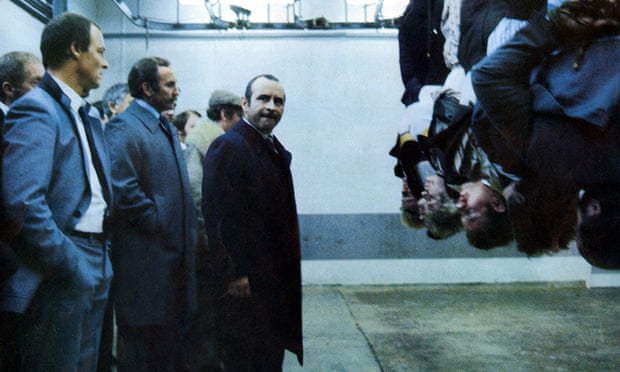
Harold Shand (middle), showing some creativity with his
methods of information extraction.
The performances by the stars of the movie are phenomenal. The secondary characters are played by many faces familiar to those who have seen some of the more popular British crime movies, and a few were even used by Guy Ritchie later in Lock, Stock, and Two Smoking Barrels and Snatch. We also get a rather young Helen Mirren as Harold's sophisticated, modern gun moll, and Mirren predictably nails the role. Most amazing of all of the strong performances, though, is that of Bob Hoskins. His turn as besieged crime lord Harold Shand is one that is arguably unmatched in British crime movies. His shifts in personality, from gregariously charismatic optimist to snarling, vengeful, and brutal thug are completely natural and captivating. His is one of those performances that draws the eye to his character in virtually every scene, and even warrants multiple viewings.

This was the second time that I've watched this movie, and I'm quite likely to watch it again. Anyone who has ever enjoyed British gangster movies owes it to themselves to watch this touchstone film in the genre.


American Gangster (2007)

Director: Ridley Scott

A solid offering of a Scarface-style, making-of-a-gangster movie of a different breed, if not exactly a modern classic.

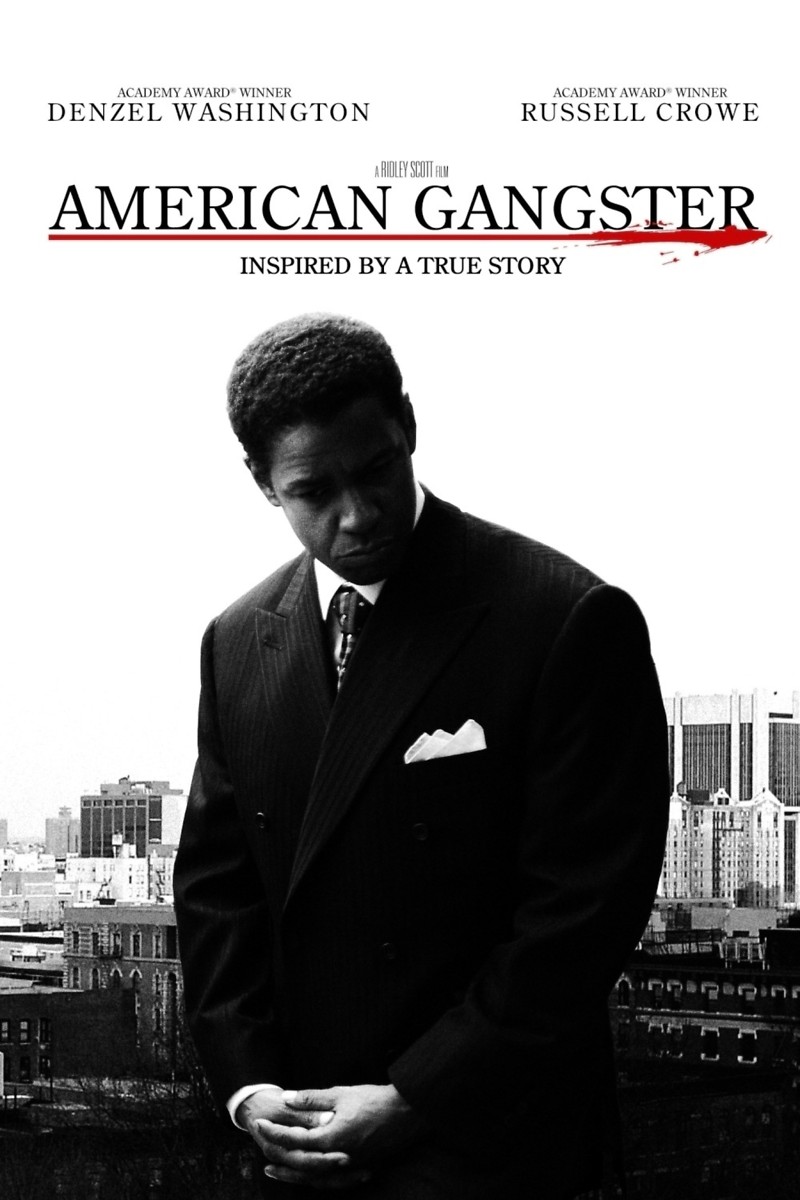
Based on real events, American Gangster follows the rise of Frank Lucas, the very real drug kingpin who rose to power in Harlem in the 1960s and 1970s. Prior to his climb to crime-lord, Lucas (Denzel Washington) had been an associate of the powerful and influential boss Bumpy Johnson. When Johnson dies, Lucas sees the opportunity to place himself in the gap left by Johnson's death, a gap left mostly in the heroin market. Knowing the landscape of the local illegal drug trade, Lucas knows that he can't compete with the already-entrenched forces of smaller local drug lords and the corrupt police force. He therefore goes directly to a major source of heroin - Vietnam. Using a few old neighborhood friends, the enterprising Lucas cuts a deal with a Vietnamese opium grower and purveyor to sell to him directly. Lucas also organizes a method for getting the opium into the U.S. on board military planes making regular trips between Vietnam and the U.S.

While Lucas's power begins to grow, New Jersey police officer Richie Roberts (Russel Crowe) is fighting the good fight. In ways very reminiscent of Serpico - another story based on true events - Roberts is one of the very few clean cops on the force, which alienates him from nearly all of his fellow officers. It is, however, his incorruptibility that brings him to the eye of state officials who make him head of a force tasked with bringing down the ever-growing illegal drug trade in the greater New York City area. This sets Roberts on the path to tracking down Frank Lucas and attempting to put together a case that will bring down the cautious and savvy criminal and his organization.

The movie bears plenty of familiar elements, the most obvious being the two well-known crime movies already mentioned. But while there may not be much that is exactly novel about the basic elements of the story, director Ridley Scott spins the tale out in entertaining and engaging ways. Richie Roberts's detective work is not unlike what we see in the first season of The Wire, with a small crew of dedicated cops using all of their wits to grasp the scope and details of a massive illegal operation and bring down those in control. The cast does plenty to elevate many of the confrontations and exchanges above their occasional mediocrity, and watching the inevitable collision between Lucas and Roberts slowly develop is engaging. The resolution of the movie is a bit atypical of such movies, and it provides a really solid scene between Washington and Crowe.

As with most movies based on real events, I did a bit of informal research to see just how close to reality the events in the film came. The short answer is: not very close. By most accounts, the real Lucas was not nearly as suave or endearing as the on-screen version, and Roberts is actually portrayed in a slightly less appealing light than the real man. This is another case in which I feel that I would almost prefer to watch a well-done documentary on this topic, even when the dramatized version is of high quality.