Showing posts with label Liam Neeson. Show all posts

Monday, July 24, 2017

New(ish) Releases: Hunt for the Wilderpeople (2015); Silence (2016)

Hunt for the Wilderpeople (2015)

Director: Taika Waititi

Great little movie which feels like New Zealand's comedic answer to the films of Tom McCarthy, such as Win Win.

The story follows the often funny, sometimes sad bond which grows between Ricky (Julian Dennison), an orphan and wanna-be gangster of Maori descent, and Hec (Sam Neill), the crotchety old husband of Bella, the woman who adopted Ricky. Ricky is brought to the couple as his last chance to avoid being put into the juvenile detention system for repeated minor acts of delinquency and vandalism. His new home is in the "bush" area of New Zealand - a rural area where Hec and Bella carve out a modest but fairly happy life by the sweat of their brows. When Bella passes away unexpectedly, though, the overly vigilant child protective services come to reclaim Ricky in order to put him back into the system. Ricky and an very reluctant Hec then go on the run, into the untamed wilderness area around Hec and Bella's rustic home.

The movie has plenty of odd and off-color humor which feels like a novel blend of sillier British shows and the more thoughtful dramedies of the aforementioned Tom McCarthy. The classic setup of two wildly mismatched characters finding themselves stuck together works brilliantly here, thanks to sharp writing and directing, along with typically excellent acting from Neill and Dennison. There is plenty of humor poking fun at some New Zealand culture, most of which I followed but some of which was a bit lost on me. It may be a very regional movie in many ways, but there is certainly a rather universal appeal to the greater story.

Though I did feel the movie lost a little bit of steam during its third act, it does offer a fairly satisfying ending. This was the second film I've seen directed by New Zealand native Taika Waititi, along with his hilarious 2014 vampire mockumentary What We Do in the Shadows, and he's becoming one of my favorites. I can't be sure how he'll do with his massive-budget, fantasy/action fest Thor: Ragnarok later this year, but I'm definitely pulling for his success.


Silence (2016)

Director: Martin Scorsese

Visually stunning drama that packs more intellectual than spiritual or emotional punch than probably intended.

Based on the Japanese author Shuusake Endo's novel of the same name, the movie follows a pair of Jesuit priest from Portugal who, in the 17th century, make an ill-advised journey to Japan. The priests, Rodrigues and Garupe (Andrew Garfield and Adam Driver), set out to find their old mentor, Father Ferreira (Liam Neeson), after they receive word that he has renounced Christ and become an apostate upon torture at the hands of the Japanese imperial government. The two young priests secretly make their way to a small village where Ferreira had previously ministered, though they must exercise extreme secrecy and caution due to Japan's official outlawing of the Christian faith. Over many torturous months, they are separated and face physical and spiritual hardships of immense intensity. Father Rodrigues does eventually track down Father Ferreira, although their reunion is far from what the younger priest had been hoping for.

This story was based on the highly-regarded novel of the same name by Japanese author Shuusaku Endo, published in 1966. Endo, himself a Catholic, often explored the theme of Catholicism's tortured history in the country of his birth. As such, this story looks back at one of the earliest and most brutal periods of friction between the East and West, as metastasized in the ruthless torture and killing of thousands of Jesuit priests at the time. Endo's novel and Scorsese's movie take a fascinating look at the idea that Catholicism was like a seed that would never find purchase in the "swamp" of Japan, in terms of spirituality. The notion that the two were simply incompatible is probably the most engaging part of the story, especially in seeing the lengths to which both sides will go to either maintain their faith or annihilate what is seen as a foreign infection of the mind and soul.

One of several brutal, if brilliantly filmed, scenes of Christians
being persecuted to death by hardline government officials.
Yet, the movie never completely impacted me the way that I was hoping. I've long been interested in religious history (though an agnostic myself), especially in Jesuit history. The Jesuit tradition of forging into foreign lands to bring not only their religious message but also broader education has long been one that I admire in many ways. And there have been a few excellent movies depicting the rigors of their mission, namely Black Robe and The Mission. That latter movie, in particular, did an excellent job depicting the larger Jesuit pursuits while also imbuing a tale with sympathetic characters and emotional heft. Unfortunately, Silence never quite elicited that same feeling from me. The young priests are clearly very dedicated, but I couldn't shake the feeling that we never fully get to know either of them as real people. Instead, they are simply vessels of faith, swimming upstream for reasons that I wish had been more thoroughly explored.

The one other issue I had with this movie is the depiction of government official Inoue, who is tasked with tracking down and weeding out any vestiges of Christianity in his district. I found that this character comes off with over-the-top unctuousness which makes him cartoonishly villainous. This was a shame, since there are actually a few thoughtful and philosophical verbal exchanges between him and the young Jesuit priests. But these and nearly everything else Inoue does are undermined by an overly sleazy, slurred delivery of his lines that would be more fitting for a B-grade horror movie bad guy. Yes, the character is meant to be dislikable, but I feel that it would have been far more interesting had they given him a more noble carriage and not made him so easy to despise.

If you've heard anything about this movie, it is likely about the visuals. They are truly stunning. As Martin Scorsese has shown time and time again, he knows how to find cinematographers and put them in positions to create visual masterpieces. Silence is no exception. It is an odd contrast to the spiritual turmoil and physical tortures being suffered throughout the picture, but the landscapes, costumes, and sets are beautifully captured, making the movie a pleasure to drink in for much of its considerable running length. It also helps that the acting is (aside from Issei Ogata's portrayal of Inoue) strong.

I recently read the novel, which Scorsese remained highly faithful to. While anyone interested in solid film making or the religious and spiritual themes would appreciate the movie's strengths, those more intrigued by the latter would perhaps gain more from reading the novel. 

Monday, June 26, 2017

Retro Duo: Excalibur (1981); The Fountain (2006)

Excalibur (1981)

Director: John Boorman

This was probably the third or fourth time I've seen this movie over the last 20-odd years. The over-the-top nature of it just gets more and more obvious, though it is still arguably the best film version of the Arthurian legend out there.

Drawing mostly from Sir Thomas Malory's 15th century novel Le Morte d'Arthur, the film is an abbreviated and lavish telling of how Arthur Pendragon came into being, obtained the mythical sword Excalibur to become King of England, and oversaw the unification and defense of the country in the late 5th and early 6th centuries. The movie goes all-in with the melodrama, with nary a character speaking in anything less than florid epigrams or acting in any way less than the grandest of gestures. When one takes half a step back from it all, it can come off as rather silly, pompous, and pretentious. If, however, one gets wrapped up in the movie, it can, much of the time, actually be as grand as it attempts. This is in no small part due to the fact that we are dealing with one of the oldest, best-known myths of Western civilization.

The story is the foundation of so much high fantasy. A savior figure is born of blood and sorcery, eventually obtains a magic sword, and forges and era whose name will ring through the centuries. To tell such a story in film, a director needs to swing for the fences, and John Boorman did just that. He brought in a ton of great British and Irish acting talent, including then up-an-coming young actors like Gabriel Byrne, Patrick Stewart, Liam Niesen, and Helen Mirren, to name just a few. The actors were well-schooled in larger-than-life performances, which fit a film such as Excalibur to a tee. Again, some of it is campy, both intentionally and accidentally, but it's still quite fun. The stand out is Nicol Williamson, whose bombastic, vibrato delivery of his lines as the legendary sorcerer Merlin shows the correct level of ridiculous joy in the role.

One's take on the visuals will depend on how well they can suspend disbelief and look past the limitations of the effects. Certainly, compared to what had been and would eventually be done with advanced makeup, computer effects, and much larger budgets, this 1981 movie will seem cut-rate. But Excalibur has a look that is very much a cohesive representation of what Boorman wanted to do, and it can be very effective much of the time. Through vivid lighting, highly burnished armor, and some trippy visual distortions, many sections of the movie feel just as dreamlike and hallucinatory as a 1,500-year-old myth should feel.

The movie does, admittedly, take some patience and a certain mental state to enjoy. Some scenes can drag, and it does rely on a certain familiarity with the legend of Arthur and the Knights of the Round Table. If one has those things, though, then this 35-year-old flick will hold up nicely for you. From what I've read of Guy Ritchie's most recent crack at the Arthurian legend, you may be in the mood for a more successful cinematic take on the entire affair.


The Fountain (2006)

Director: Darren Aronofsky

One of my absolute favorite movies, despite being its noted director's least-known film.

Darren Aronofsky, known best for his award-winning movies The Wrestler and Black Swan, as well as his controversial adaptation in Noah, was an immediate critical darling with his first two films, the dark, intelligent, and edgy Pi and Requiem for a Dream. Following that second film, he took several years to create The Fountain, easily his most ambitious movie to that point. He was initially given a sizable budget to bring his impressive vision to life, and mega-stars Brad Pitt and Cate Blanchett were lined up to star in the picture. However, after several unexpected changes, Aronofsky was left to make alterations that led to using Hugh Jackman and Rachel Weisz in the main roles, and the film having to be made on half of its original budget. The film met very mixed reviews and did poorly at the box office.

I did not see the movie until a couple of years after its lackluster performance in theaters. When I did, though, I was completely blown away. Knowing nothing about the movie, I took in this visually stunning narrative puzzle that did not offer clear, direct answers. The images were mesmerizing, and the acting was so affecting that the movie stayed on my mind for days afterward, as my brain tried to put all of the pieces into place. While I couldn't completely penetrate all of the components of the movie and how they fit together, I was incredibly moved by the themes which I could pick up on, and their conveyance through the impressive and iconic images.

Because I feel that part of one's enjoyment of this movie is in seeing it and allowing it to reveal itself to the viewer, I won't give a complete synopsis but rather a basic description, even though the movie is now over a decade old. It tells three stories in three different time periods: one is of a Spanish conquistador on a desperate mission from his queen, another is of a modern neuroscientist seeking to find a cure for brain tumors, and the final is of a mysterious traveler, moving through space in a glass bubble housing himself and a tree. Explaining much more than that would rob any new viewers of the potential joy of working out the film's connections for themselves.

This recent viewing was my fourth, and each viewing increases my enthusiasm for the film. Across his six feature films, Darren Aronofksy has shown himself to be an exceptionally thoughtful filmmaker who pays extremely close attention to detail. He clearly takes pride in creating tight, carefully-crafted pictures in which little to nothing is out of place, either narratively or visually. This can be seen in his other movies, from his debut Pi to his most recent, Noah. But perhaps in no other film was his dedication to symmetry and cohesion brought to fruition the way that it was in The Fountain. This is why I have enjoyed it so many times. Even after I had worked out the non-linear and less-than-obvious narrative, I was able to drink in the stunning visual imagery running through the entire movie. Between the lighting, sets, costumes, and overall cinematography, many of the scenes and sequences are, by themselves, works of visual art which could be studied in isolation. Movies such as this, which continue to offer engagement viewing after viewing, are rare for me.

Stunning images like this one will likely amaze and baffle
upon one's first viewing. Once it is put into the greater context,
though, its meaning takes on even greater value.
I'm also a sucker for a soundtrack with mournful string instruments, especially when it sets the mood for a romance. And this story is a romance of considerable quality. Amazingly, I am no particular fan of romances, but The Fountain balances what could have been overly sentimental elements with an intelligent, creative narrative device that I find immensely engaging.

It's no great mystery to me why this movie never quite caught on with a wider audience. It hardly follows any standard Hollywood movie tropes: it asks more than a little from its viewers, it is a deeply emotional tale, and it's grand theme is not one that is likely to put a great pep in anyone's step, so to speak. This is, of course, why I love it so much. So much, in fact, that I have a difficult time imagining any point in my life when I won't be able to take several rewards from each future viewing. 

Saturday, January 19, 2013

Film #94: Schindler's List (1993)


Director: Steven Spielberg

Initial Release Country: United States

Times Previously Seen: twice (last time about twelve years ago)

Rapid-Fire Summary

For a complete plot synopsis, check here at imdb’s website.

In 1940, the Nazi machine is taking hold in Poland. They are starting to herd all Jews together and force them into ghettos. Amidst these massive and horrific changes, the Czech-German businessman Oskar Schindler (Liam Neeson) arrives in Krakow with dollar signs in his eyes. Through clever business machinations and a flare for panache, Schindler quickly ingratiates himself to Nazi high commanders, secures a factory and a Jewish prisoner labor force for himself.

Over the next few years, business is good for Oskar Schindler. His factory produces quality pots and other metal goods, and his chief accountant, the Jewish Itzhak Stern (Ben Kingsly) sees that the factory runs smoothly and profitably. IN the early going, the only seeming bump in the road is the assignment of Nazi officer Amon Goeth (Ralph Fiennes) as the commander of the labor camp in Krakow. Goeth is an unpredictable and homicidal maniac who kills Jews without rhyme or reason. Schindler, however, manages to become civil, if not friendly, with the treacherous killer, in the name of keeping the money flowing in.

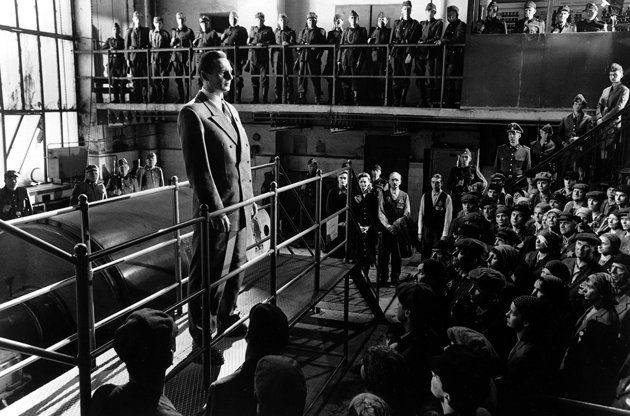
Oskar Schindler - in the middle of one of his many negotiations. These eventually evolve from purely self interested to completely altruistic.

Gradually, Schindler begins to have a change of heart, though a somewhat quiet and slow-building one. Upon seeing the murderous brutality of the Nazis against the Jews, Schindler, on the gentle but unwavering urging of Stern, begins to bring more Jewish laborers into his factory. He tells everyone that it is simply to maintain efficiency, but those who are closest to him can see that his sympathies for the Jews are growing. Schindler even tries, unsuccessfully, to change the brutal nature of Goeth. This failure aside, he continues to take Jewish prisoners into his factory to save them from the horrors of working in the labor camp every day.

As the War enters its final year, things become more desperate. Word comes down that Hitler has ordered the complete extermination of Jews – the so-called “Solution.” In the face of this, Oskar Schindler takes all of his massive profits, and even convinces a few other businessmen to do the same, and purchases over a thousand Jewish laborers. He assures Goeth that it is merely for convenience, as these laborers and their children are known commodities. The deal is made, and Schindler even ensures their safe transport to Czechoslovakia after his Jewish workers are mistakenly sent to Auschwitz and nearly killed, along with thousands of their fellow Jews.

At the official surrender of the Nazis to the Allied forces, Schindler addresses the hundreds of people that he has saved. The following day, as an ultimate irony and sacrifice, he must flee punishment for the crime of war profiteering.

When the war ends with the unconditional surrender of the Axis powers, the Jews are free, but Oskar Schindler is now, officially, a war criminal for profiteering. With the blessing of the thousand that he helped save, Schindler and his wife flee into the night.

My Take on the Film (done after this most recent viewing)

This was the third time that I’ve seen this movie, and my feelings haven’t changed – it’s a very good film in many ways, but there are a few things that irk me.

Schindler’s List is definitely one of the boldest of Spielberg’s films. The movie portrays the stark and horrific actions of the Nazi regime against the Jews in a way that I had never seen before. It goes far beyond mere sensational, almost action/suspense route that could have been taken. Seeing silent, morose masses of Krakow’s Jewish citizens, lined up to be classified and segregated by the conquering Germans has much more authentic emotional power. This is one of many subtle details that the movie exhibits in order to convey the crushing reality of the Holocaust.

As always, Spielberg is a master of the technical aspects of film. The man has always known how to tell stories through the moving picture, and Schindler’s List is no exception. From the opening scenes of Oskar Schindler schmoozing his way into the good graces of the Nazi commanders, to and through Goeth’s failed attempt at becoming a forgiving overlord, the movie balances dialogue and visuals to tell the tale as well as anything Spielberg has ever done.

The maniacal Goeth and the savior Schindler, during one of their many talks. The two are dark-and-light reflections of one another. This scene displays how effectively Spielberg used the black and white medium. No one can say that the man doesn't know what he's doing with a camera.

Unfortunately, as important as these things are, and as well as the movie does them, there are several gripes that I have. One is that I have always found a certain flatness to the main characters. Oskar Schindler’s soul goes through a massive transformation, and yet we are left with virtually nothing to explain why this might have occurred. Aside from a few ponderous gazers at the horrors around him, we are left in the dark as to why, exactly, this self-absorbed capitalist would abandon his fortune to save a group of people whom he has only seen as a means to his financial ends. There are moments when we get hints, but I’ve always felt a little cheated when it comes to this aspect of the film. There is also an enigmatic quality to Goeth. The character never feels completely real to me – almost more of a monster construct than a person who actually could have existed.

The idea of constructs is another problem I have with the film. Far too many times, I felt as if I could see Steven Spielberg’s hand prints on the movie, and not in a good way. He was clearly trying to present a “realistic” look at the terrors of the Holocaust, and in some notable ways, he succeeded. However, there are a few too many scenes and moments that feel very contrived to me. One is the “secretary” scene, when the libidinous Schindler is “interviewing” potential secretaries by watching them type. This sequence, with no dialogue, is a very wink-wink, nudge-nudge, humorous moment in the movie. In other words, it seems way out of place. There are several others, but none so egregious as the final scene in which Schindler is walking towards his car, about to leave behind all of the people he has saved. In a scene that seemed straight out of a hackneyed melodrama from the 1940s, the hundreds of Jews quietly stand around him as he slowly starts to cry and despair over how many more lives he could have saved, had he not been so selfish. On paper, it seems to make for a great scene. On film though, to me, it seems rather artificial.

The final scene, in which Spielberg and Neeson overplay their emotional hands (in my opinion). The melodrama becomes thick to the point that it does a disservice to the reality upon which the film is based.

Related to this is something that has been a bugaboo in virtually every Spielberg film – shying away from truly, completely shocking the audience, even when it may be appropriate. The particular scene I have in mind is towards the end of the movie, when Schindler’s Jews have all been mistakenly taken to Auschwitz. The women are all stripped naked and forced into a large warehouse, which they and we the audience all presume to be a gas chamber in which they will all be killed. Just at the height of our fears, water rather than gas rains down from the shower heads, merely cleaning the terrorized women. I don’t know whether this event actually occurred, but it struck me as strange that the director, who has already shown us multiple brutal murders in the movie, would shy away from presenting perhaps the most disturbing crimes perpetrated during those years – the mass executions of helpless innocents. I’m not saying that I would have enjoyed seeing such a thing, but this film is clearly not about enjoying what you are seeing. It is about witnessing the atrocities committed against the Jews, and it only seems right to witness the greatest of those atrocities.

Schindler’s List is one of those films on historical tragedy that merely makes me want to learn more about the actual story, not unlike The Last King of Scotland or Hotel Rwanda. In fact, the scene that has by far the most impact on me, and the only one during which I cry, is at the very end, when the credits start to roll. We shift to 1993, when the film was released, and we watch the surviving “Schindler’s Jews” and some of their descendants process towards the real Schindler’s grave and place flowers along it. This is when the reality of the story hits me, and this is when I feel a real sense of loss.

I ultimately think of Schindler’s List as a “near miss.” It tells an important story, and it does many things well. However, I feel that, had the few “Hollywood” moments been eliminated and had Spielberg gone more minimalist in a few of his techniques, the movie would have had even more power.

In other words, three times in more than enough for me. I don’t need to watch this movie ever again.

That’s a wrap. 94 shows down; 11 to go.

Coming Soon: The Legend of Drunken Master (1994)


Ahhhh. A nice breath of fresh air, after emotional weightiness of the prior three movies. Kung-fu action up the wah-zoo. As of writing this, apparently Jackie Chan is in some hot water for an anti-American rant. Whatever. I just want to see one guy jumping around, kicking the stuffing out of a bunch of other guys.