Showing posts with label John Boorman. Show all posts

Monday, June 26, 2017

Retro Duo: Excalibur (1981); The Fountain (2006)

Excalibur (1981)

Director: John Boorman

This was probably the third or fourth time I've seen this movie over the last 20-odd years. The over-the-top nature of it just gets more and more obvious, though it is still arguably the best film version of the Arthurian legend out there.

Drawing mostly from Sir Thomas Malory's 15th century novel Le Morte d'Arthur, the film is an abbreviated and lavish telling of how Arthur Pendragon came into being, obtained the mythical sword Excalibur to become King of England, and oversaw the unification and defense of the country in the late 5th and early 6th centuries. The movie goes all-in with the melodrama, with nary a character speaking in anything less than florid epigrams or acting in any way less than the grandest of gestures. When one takes half a step back from it all, it can come off as rather silly, pompous, and pretentious. If, however, one gets wrapped up in the movie, it can, much of the time, actually be as grand as it attempts. This is in no small part due to the fact that we are dealing with one of the oldest, best-known myths of Western civilization.

The story is the foundation of so much high fantasy. A savior figure is born of blood and sorcery, eventually obtains a magic sword, and forges and era whose name will ring through the centuries. To tell such a story in film, a director needs to swing for the fences, and John Boorman did just that. He brought in a ton of great British and Irish acting talent, including then up-an-coming young actors like Gabriel Byrne, Patrick Stewart, Liam Niesen, and Helen Mirren, to name just a few. The actors were well-schooled in larger-than-life performances, which fit a film such as Excalibur to a tee. Again, some of it is campy, both intentionally and accidentally, but it's still quite fun. The stand out is Nicol Williamson, whose bombastic, vibrato delivery of his lines as the legendary sorcerer Merlin shows the correct level of ridiculous joy in the role.

One's take on the visuals will depend on how well they can suspend disbelief and look past the limitations of the effects. Certainly, compared to what had been and would eventually be done with advanced makeup, computer effects, and much larger budgets, this 1981 movie will seem cut-rate. But Excalibur has a look that is very much a cohesive representation of what Boorman wanted to do, and it can be very effective much of the time. Through vivid lighting, highly burnished armor, and some trippy visual distortions, many sections of the movie feel just as dreamlike and hallucinatory as a 1,500-year-old myth should feel.

The movie does, admittedly, take some patience and a certain mental state to enjoy. Some scenes can drag, and it does rely on a certain familiarity with the legend of Arthur and the Knights of the Round Table. If one has those things, though, then this 35-year-old flick will hold up nicely for you. From what I've read of Guy Ritchie's most recent crack at the Arthurian legend, you may be in the mood for a more successful cinematic take on the entire affair.


The Fountain (2006)

Director: Darren Aronofsky

One of my absolute favorite movies, despite being its noted director's least-known film.

Darren Aronofsky, known best for his award-winning movies The Wrestler and Black Swan, as well as his controversial adaptation in Noah, was an immediate critical darling with his first two films, the dark, intelligent, and edgy Pi and Requiem for a Dream. Following that second film, he took several years to create The Fountain, easily his most ambitious movie to that point. He was initially given a sizable budget to bring his impressive vision to life, and mega-stars Brad Pitt and Cate Blanchett were lined up to star in the picture. However, after several unexpected changes, Aronofsky was left to make alterations that led to using Hugh Jackman and Rachel Weisz in the main roles, and the film having to be made on half of its original budget. The film met very mixed reviews and did poorly at the box office.

I did not see the movie until a couple of years after its lackluster performance in theaters. When I did, though, I was completely blown away. Knowing nothing about the movie, I took in this visually stunning narrative puzzle that did not offer clear, direct answers. The images were mesmerizing, and the acting was so affecting that the movie stayed on my mind for days afterward, as my brain tried to put all of the pieces into place. While I couldn't completely penetrate all of the components of the movie and how they fit together, I was incredibly moved by the themes which I could pick up on, and their conveyance through the impressive and iconic images.

Because I feel that part of one's enjoyment of this movie is in seeing it and allowing it to reveal itself to the viewer, I won't give a complete synopsis but rather a basic description, even though the movie is now over a decade old. It tells three stories in three different time periods: one is of a Spanish conquistador on a desperate mission from his queen, another is of a modern neuroscientist seeking to find a cure for brain tumors, and the final is of a mysterious traveler, moving through space in a glass bubble housing himself and a tree. Explaining much more than that would rob any new viewers of the potential joy of working out the film's connections for themselves.

This recent viewing was my fourth, and each viewing increases my enthusiasm for the film. Across his six feature films, Darren Aronofksy has shown himself to be an exceptionally thoughtful filmmaker who pays extremely close attention to detail. He clearly takes pride in creating tight, carefully-crafted pictures in which little to nothing is out of place, either narratively or visually. This can be seen in his other movies, from his debut Pi to his most recent, Noah. But perhaps in no other film was his dedication to symmetry and cohesion brought to fruition the way that it was in The Fountain. This is why I have enjoyed it so many times. Even after I had worked out the non-linear and less-than-obvious narrative, I was able to drink in the stunning visual imagery running through the entire movie. Between the lighting, sets, costumes, and overall cinematography, many of the scenes and sequences are, by themselves, works of visual art which could be studied in isolation. Movies such as this, which continue to offer engagement viewing after viewing, are rare for me.

Stunning images like this one will likely amaze and baffle
upon one's first viewing. Once it is put into the greater context,
though, its meaning takes on even greater value.
I'm also a sucker for a soundtrack with mournful string instruments, especially when it sets the mood for a romance. And this story is a romance of considerable quality. Amazingly, I am no particular fan of romances, but The Fountain balances what could have been overly sentimental elements with an intelligent, creative narrative device that I find immensely engaging.

It's no great mystery to me why this movie never quite caught on with a wider audience. It hardly follows any standard Hollywood movie tropes: it asks more than a little from its viewers, it is a deeply emotional tale, and it's grand theme is not one that is likely to put a great pep in anyone's step, so to speak. This is, of course, why I love it so much. So much, in fact, that I have a difficult time imagining any point in my life when I won't be able to take several rewards from each future viewing. 

Saturday, November 22, 2014

Gangster Flick 3-Pack: Lucky Number Slevin (2006); Gloria (1980); Point Blank (1967)

Lucky Number Slevin (2006)

Director: Paul McGuigan

A fun, stylish, rapid-fire gangster movie that carves out its own niche.

There are a ton of influences at work in Lucky Number Slevin, which can be a dangerous thing in the wrong hands. Fortunately, director Paul McGuigan juggles and balances them all impressively well. While the result may not be an all-time classic, it is still a tight, fun viewing experience.

Without giving too much away, the basic story set up is that a young man named Slevin arrives in New York City to stay with a friend named Nick Fisher. All too soon, Slevin is whisked away by men who think he is Fisher, and Slevin is quickly embroiled in a bizarre gang cold war between two powerful yet reclusive crime lords known as "The Boss" and "The Rabbi," performed with playful menace by Morgan Freeman and Ben Kingsley, respectively.

It might be easy to write this movie off as one of the countless Tarantino Pulp Fiction clones, but this would be a slight injuctice. While the nonlinear narrative and rapid-fire dialogue might suggest that earlier modern crime classic, Slevin is much more in the style of The Boondock Saints. It leaves behind the endless pop culture references and isn't nearly as gritty as a Tarantino picture, but is rather more visually polished and overtly fun. The script has more in common with film noir, with its staccato back-and-forth sarcasm.

Odd scenes like this one are the norm. Some are trying a
little too hard to be quirky, but others are effective enough.
Much of the amusement of the movie comes from the disorientation of the tale. The lead character, Slevin (Josh Hartnett), is often whisked around by and between oddball gangsters, a la Roger Thornhill in North by Northwest (which is openly referenced in Slevin). Slevin's wise-ass reactions to his surroundings and circumstances, along with their inevitable consequences, are often hilarious. And then there's the fun as the viewer of simply trying to piece together all of the seemingly disparate puzzle pieces, not unlike when one first watches The Usual Suspects. Of course, as is usually the case with such breakneck-paced films, the speed masks plot holes that are really only noticed when one has time to look back along the path. Still, it doesn't detract from the immediate experience, as the movie clearly doesn't take itself too seriously.

An interesting observation was how this movie might have the single longest "reveal" of any film I've ever seen. For the first 90 minutes or so, the story hustles along and teases a far more complex and sinister motive behind all of the actions. This motive is explained at the end but takes (no joke) twenty minutes to fully reveal all of the mysteries. This seems ridiculous because it is ridiculous, but the details are engaging enough to prevent boredom.

Gloria (1980)

Director: John Cassavetes

I'm not altogether sure why this movie gets so much acclaim. For my part, I just couldn't see it.

The movie tells the story of the eponymous Gloria, who finds herself protecting a 6-year old boy whose family has been murdered as part of a massive mafia hit. Gloria, though, is no ordinary neighbor. She happens to have been the mistress to the mafia overlord behind the massacre, although she has left that life behind her. As Gloria escorts and protects her charge, Phil, she wrestles with just how far she's willing to go to save him.

That basic premise is not a bad one at all, and it's one that was used in Luc Besson's 1994 film Leon: The Professional. To me, the latter film did a far better job of it, though. Gloria is a good idea completely mucked up by incoherent emotional tone, vague plot points, unimaginative mafia characters, and outright terrible acting and dialogue by child actor John Adames. This last one was the most intolerable for me, as Phil is in the vast majority of scenes, and it is his relationship with Gloria that is meant to be the lifeblood of the film. Alas, the script for Phil often comes off as unnatural, as if written by an adult with a point to make rather than as words of an actual child.

The setting is another bone of contention for me. Perhaps I simply wasn't in the right mood, but the film depicts the same New York City that we usually see in films from the late 70's - the grungy, grimy, scum-laden concrete jungle that seems to ooze depravity and hide menace around every corner. I'm not saying that this can't be effective, but it became tiresome and simply a chore to watch after about an hour.

I was expecting quite a bit more from this one, but hey, they can't all be winners.

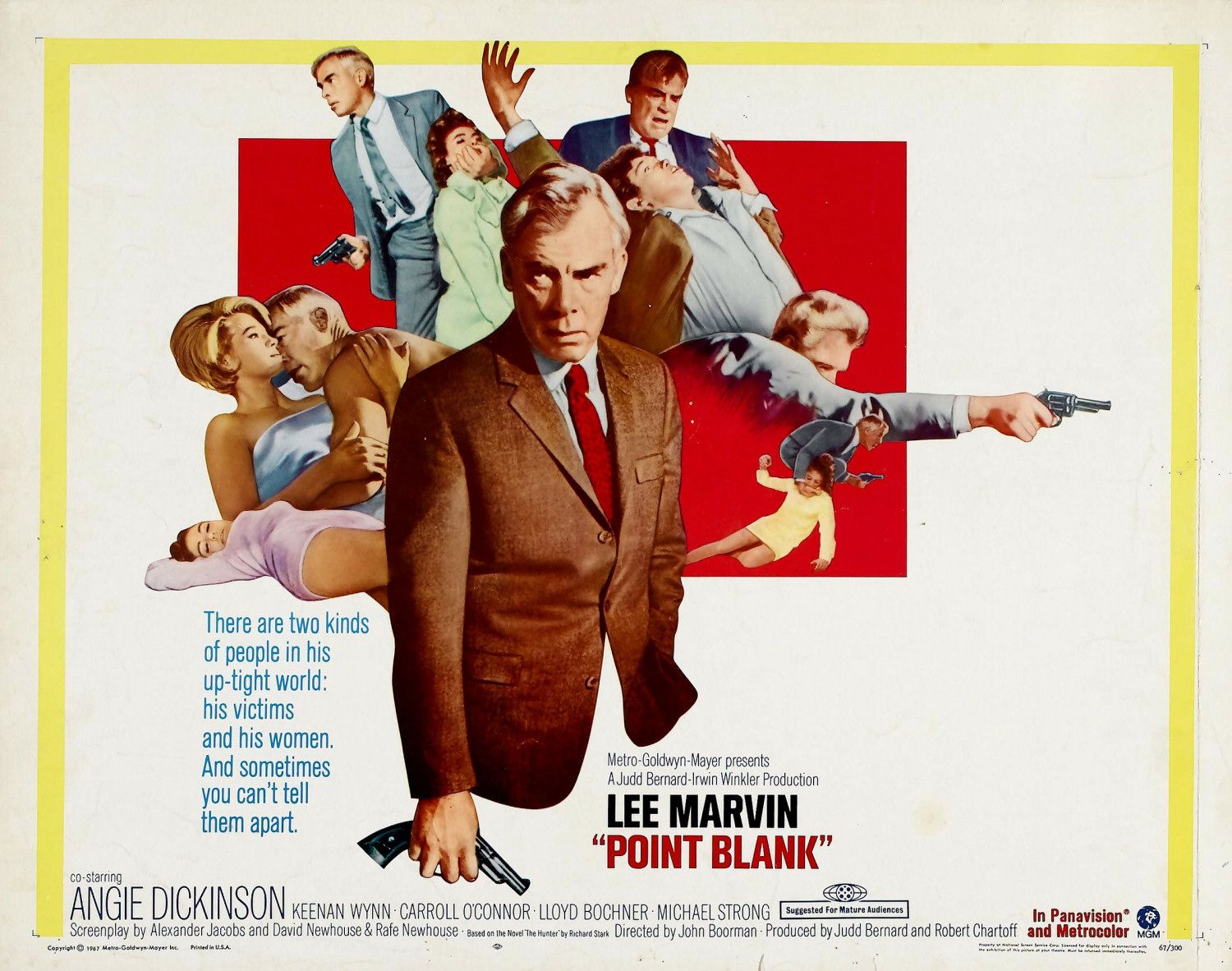
Point Blank (1967)

Director: John Boorman

Not a bad movie, though not quite as strong as I was hoping for.

If you're like me, you pick up this movie because you want to see Lee Marvin (who I once saw referred to as "the toughest-looking son of a bitch who ever was born") wreck some serious shop. Well, you pretty much get that with Point Blank. The big drawback, though, is the aesthetic and settings within which he has to do it.

Marvin plays Walker (who, in classic tough guy fashion, adamantly never reveals his first name), who is out for revenge against a former friend who has double crossed him, shot him, and left him for dead in order to pay back a crime syndicate known as "The Organization." Well, Walker survives and comes back two years later to track down his betrayer between San Francisco and Los Angeles. He starts to target anyone who knows anything about his former friend, Reese (John Vernon), and he essentially kills his way up the criminal food chain to get to him.

Watching Walker go to work is fairly satisfying, though it's a story that's been done better in movies like Get Carter (the original 1971 version), A History of Violence, and others. Sure, the bad guys are scuzzy enough, but Walker doesn't ever have to display overly exceptional wits or physical prowess. He's smart enough to see various double-crosses before they get to him, but his skills are more often implied rather than actually displayed.

If you think these outfits are terrible, they're actually some
of the tamer ones that you'll see in the movie. And the
seediness of this still frame also indicates a pervasive tone.
What weakens the movie and has caused it to fade so much over the years are the look and feel of the film. Filmed in 1967, it hurls every groovy, mod-tastic piece of dated music and fashion that it can manage at you. There are hinky jazz clubs, a bombastic musical score and sound effects, and costumes that might as well smack you in the mouth. These may all have been chic and cool when the movie was released, but they were undoubtedly rather comical a mere decade later. Forty-five years later, they have become an obnoxious distraction.

It also didn't help that, aside from Lee Marvin playing Walker, there aren't any other compelling characters. Reese and everyone in the organization is a one-dimensional egoist who first tries to placate Walker before trying to stab him in the back. Even Angie Dickinson, who is pleasant enough to look at, plays a character who is arguably the work of a obliviously misogynistic mind. Perhaps thinking they were creating a woman of "depth," they have her swing between raging at Walker, punching and cursing him, and then jumping into bed with him. In between these weird bouts, she plays it cool as a cucumber, though we never have any clear idea how or why the transitions are made. What we're left with is a woman who can only be described as a traumatized schizoid. Either that or just poorly conceived and written.

Fortunately, the film is only 93 minutes long, and it's fairly streamlined. There are a few throwaway scenes, but not many. The story clicks along fine, with Walker moving from one punching bag to the next, doling out underworld justice. I've no need to watch it again, but it was fine one-shot viewing.