Showing posts with label New York films. Show all posts

Wednesday, January 15, 2020

New Release! Uncut Gems (2019) [Spoiler-Free Review]

Spoiler-Free!

Directors: Benny and Josh Safdie

Like watching an amazingly agile weasel side-step and juke away from rabid predators for two hours and ten minutes, all with brilliant cinematography and lighting.

Uncut Gems is a feat. I had only seen one of the young Safdie brothers' previous films, 2017s Good Time, which I found to be a gritty, sweaty, fast-paced and amazingly authentic excursion into the shadowy places that desperate losers on Long Island dwell. Uncut Gems is very much in the same vein, even if the setting and main character hail from environs slightly to the west.

This movie follows rare gem dealer Howard (Howie) Ratner, a fast-talking, charismatic hustler who has a severe gambling problem. This tale picks up in 2012, with Howie already deeply in debt to some gangsters whom he keeps at bay with half-empty promises and a knack for escapism. Howie's big chance arrives when basketball superstar Kevin Garnett is brought to his jewelry store and takes a profound liking to a massive raw stone which Howie has just procured from Ethiopia. Garnett feels such an intense spiritual connection to the stone that Howie loans it to him. This kicks off another round of wild betting by Howie on Garnett, whom he's sure will now play a fantastic game. And so it goes, with ever-increasing chances taken and with ever-more pressure placed on Howie via ever-more serious threats on his life by his gangster creditors.

This movie is done so incredibly well that you're likely to feel your blood pressure rise significantly, just watching Howie finagle and bullshit his neck out of one noose and almost immediately into another. All through it, we're being let in on an entire universe which many of us are not privy to - that of high-rolling, high-stakes action junkies. In the world of the Manhattan Diamond District, the adrenaline comes from a hot rare gem sale as much as from a huge bet coming through and paying off. While the movie is fiction, every ounce of it feels authentic. And as someone with a fair bit of family in the New York City area, I can attest to having met more than one Howie Ratner over my time spent with relatives in the area.

There are so many little details in this film that one can appreciate. To name just a couple, there is a depth to Howie as seen through his relationship to his family. It speaks to his perceived social pressure that he feels the need to appease the material desires of everyone around him, whether its toys and trendy gadgets for his children or pricey gifts for his wife and mistress. And there are moments of clear emotional vulnerability where the brash, confident front breaks down, even if it is in somewhat humorous ways.

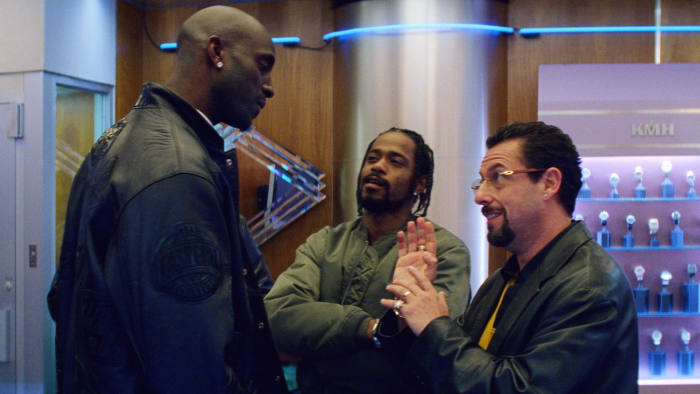
NBA mega-star Kevin Garnett (left) listens to Howie's rap.
Garnett is just one of many who are bound by Howie's spell.
The acting is as good as it gets. If you're only familiar with Adam Sandler's comedic roles, his turn as Howie may surprise you in its flawless execution. Outfitted with brilliant, fake teeth and scumbag shades, Sandler channels some of his far-too-often untapped range as an actor. The charisma he exudes is not terribly surprising, but the sweaty urgency and flashes of self-serving profundity may show you different facets to his game. It's a marvel to watch. As great as Sandler is, I'd be remiss if I didn't mention the entire supporting cast, which includes some familiar faces like Lakeith Stanfield and Judd Hirsh, among others. Yes, even Kevin Garnett holds his own. They're all great, though Sandler is clearly the star around which this film galaxy spins.

A movie like this could probably have fallen flat without just the right direction, but the Safdie brothers do not fail. As they did in Good Time, they create just the right atmosphere of claustrophobia and desperation. There's a dazzling amount of masterful framing and editing, which is quite a feat when having to follow around a character as frenetic as Howie Ratner. I fully expect a few prestigious award nominations to be thrown at this movie for its direction and filming.

Obviously, I'm a fan. I can very easily see myself watching this movie many more times in the future, which is about as good an endorsement as I can give a movie. 

Sunday, February 11, 2018

New-ish Releases: Good Time (2017); The Great Wall (2016)

Good Time (2017)

Directors: Benny and Josh Safdie

A frenetic, wild ride that captures a crazy day in the life of a native, desperate New Yorker whose bad decisions collide with insane situations at a dizzying rate.

In an extremely tense 100 minutes, we follow Connie Nikas (Robert Pattinson) after a bungled bank robbery he pulls with his mentally challenged brother, Nick (co-writer and co-director Benny Safdie). Though Connie manages to elude the police, the ever-confused Benny is captured and sent to jail. Connie, a consummate fast-talker and short-term thinker, tries to call in every favor and use any idea he can to get his challenged brother out of jail. As one plan of action after another either goes completely wrong or creates new problems, Connie grows more and more desperate, finding himself zipping all over Queens, his sole purpose to free the helpless Benny.

Good Time is, while bearing similarities to a few other films, one of the most unique heist movies I've ever seen. Sure, there have been bank robbery movies where things go comically wrong at every turn, a la Quick Change and others, and there have been dozens and dozens of New York crime stories.
There have also been plenty of films focusing on would-be criminals too dumb or myopic to get out of their own way, with Martin Scorsese's classics arguably being the best among them. But Good Time somehow conveys the sweaty, off-the-rails insanity of such situations as authentically as I've ever seen. It's not that anything in the story is implausible. Quite the contrary. Almost all of us have met a few people who were like Connie: clearly intelligent to a degree, but whose mental faculties are all steered towards the wrong objectives. In Connie's case, it's nabbing short-term gains at the expense of virtually anything else. In real life, it can be depressingly tragic; in a film, though, it can actually be engaging and even entertaining at times. Such is the case in Good Time.

The acting is amazing in this movie. Like most, I only really knew Robert Pattinson from trailers for the laughable Twilight series of films, a young-adult-oriented fantasy/horror series in which Pattinson played the main role of a dreamy vampire. After seeing him play Connie in Good Time, though, it is very clear that this guy can act. He basically carries the entire movie with his feverish energy and ability to downshift into a scuzzier version of a silver-tongued devil when the situation demands it. The several supporting cast members are all perfect, as well, only adding to the highly palpable atmosphere of the film.

I've now heard that the co-writers and co-directors, the Safdie brothers, have established a solid reputation in their relatively short resume. I'll be keeping an eye out to see what they do next, as Good Time lived up to its quiet but solid critical acclaim.


The Great Wall (2016)

Director: Yimou Zhang

A decent enough, fun action/adventure movie that got a bit of a bad wrap upon its release a year ago.

The movie mostly follows a pair of mercenaries from Western Europe - William (Matt Damon) and Tovar (Pedro Pascal) - who were part of a band out to find the rumored Chinese "black powder" (gunpowder in modern parlance) and buy, beg, or steal it back to their bidders back in the West. William and Tovar's band is harried by local bandits, and then attacked by some strange creature at night, leaving only the two of them alive. They are then soon taken as prisoners by the Chinese army at their astonishingly impressive Great Wall. There, William and Tovar learn that the Wall and the impressively skilled and disciplined army stationed there are the major line of defense against a horde of monsters. These monsters - Tao Tie, in Chinese - have a sort of hive-mind intelligence governed by a queen. They are eerily cunning, and they attack in calculated waves against the Wall's forces of male and female warriors, who are divided into specialized units to maximize their differing abilities. As William watches the Chinese fight for the lives of their civilization, he must decide whether he is more interested in the profit he can make from smuggling out the highly-coveted black powder or in putting his preternatural skills as an archer to use in assisting the Chinese against the monstrous Tao Tie.

For what it is, this movie was pretty fun. I honestly put it on with the plan of giving it 15 or 20 minutes to catch my interest. It did, and it held it all the way through to the end. It is not especially creative in terms of overall narrative or character depth, to be sure, but it is a fairly entertaining, visually lush and dazzling fantasy action-adventure tale, as you might expect from Yimou Zhang. While the fight choreography isn't on par with the best martial arts flicks, the set pieces, costumes, and general action scene set-ups are enjoyably creative and sights to behold. Not the best I've ever seen, but engaging if you're in the mood for such things. There was also some novelty in how the Chinese defense force is organized into its various fighting units, using different, brightly colored uniforms to differentiate each unit.

The acting? Meh. Surprisingly, Matt Damon does fine, even with the faux Irish/English/Unplaceable accent that he's putting on. He didn't bother me one bit, and I thought he was solid. His fellow Westerner Pedro Pascal also does well. Willem Dafoe, whom I absolutely love, feels rather out of place as the shifty hangabout Ballard. Female lead Tian Jing seems fine, especially when she is able to work in her native language of Chinese. When delivering her English lines, though, she seems uncomfortable, as if she's reciting phonetically-memorized scripts rather than using natural fluency (I feel confident assessing this, given that I am actually a professional English as a Second Language instructor who has worked with literally hundreds of Chinese-speakers of every possible level). That said, my hat is off for doing as well as she does, as acting in a language not ones native tongue must be exceedingly challenging.

William, alongside several of the higher-ranking members of
the Wall's impressive defense force. Rather than a "white
savior," Damon's character is much more of an accidental
hero who assists rather than outright saves the local warriors.
Some of you may remember that when The Great Wall was released in late 2016/early 2017, it got blasted pretty hard and was considered a "bust" at the box office. Firstly, it should be noted that it was really only a "bomb" in the United States, where is pulled in just over $45 million. That is a rather low total for such a large-scale, big-budget spectacle film, but it should be noted that the cinema universe does not revolve solely around the U.S. anymore. The movie actually made over $330 million worldwide, which was more than double its budget. In that respect, it did well enough, if not exactly Marvel Cinematic Universe or James Cameron type levels of profit.

So why did it do so "poorly" in the U.S.? The main reason may be the one that you recall the movie for - the "whitewashing" accusations. This is something that Hollywood has certainly been guilty of, without question - casting a white actor in a "savior" role, especially when the character he is playing is meant to be a person of color. This was no doubt the case in recent movies like The Prince of Persia, Gods of Egypt, and others. However, I think this accusation was applied incorrectly to The Great Wall. If one watches the movie, it's clear that Matt Damon's character is meant as the "outsider" - which is a tried and true method for storytelling. His being a white man makes perfect sense in the story, and is hardly a case of white washing. One could perhaps argue that he is placed in a "savior" role for the sake of Western audiences, but I would also point out that he only "saves the day" right alongside his female Chinese general Lin Mae (played by Tian Jing). So I have to feel that the harsh criticism levied upon the movie was mostly unfounded.

I am comfortable in recommending this movie to those who want a fairly light, fun, and yes, culturally inclusive movie that has a bunch of kick-ass warriors fighting off hordes of reptilian monsters. Simply the stuff of fun, fantasy, popcorn flicks. No more, no less. 

Thursday, August 4, 2016

Gangster Flick Home Stretch: A Bronx Tale (1993)

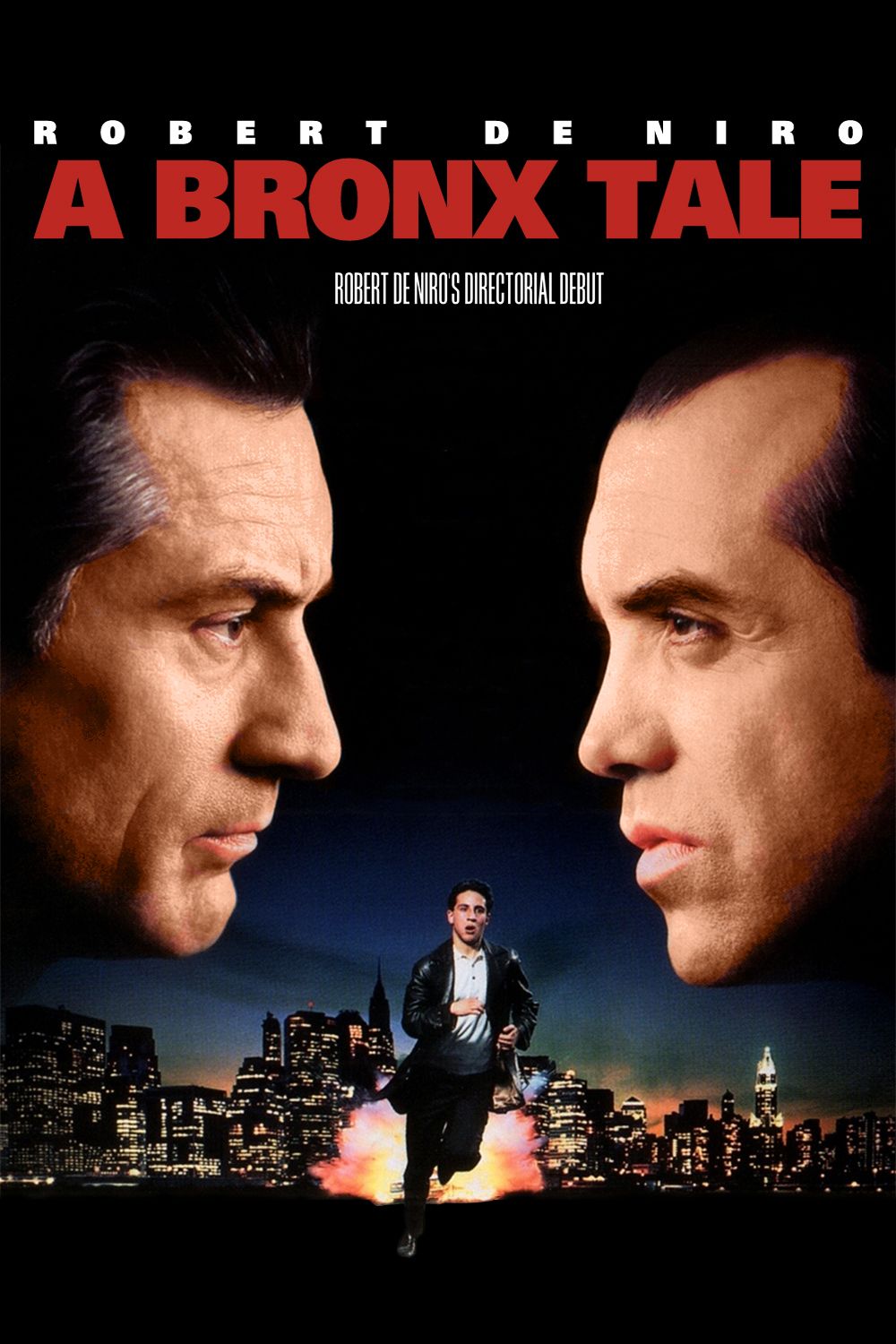
A Bronx Tale (1993)

Director: Robert De Niro

A strong and unique gangster movie that overcomes some noticeably weaker aspects.

Based on a stage play by Chazz Palminteri written from his own experience growing up in the Bronx, the movie looks at two key periods in the life of Calogero as he struggles between the lessons taught by his father and a local mafia figure. In 1960, a 10-year-old Calogero is enamored by the swagger and presence of Sonny (Chazz Palmenteri), a neighborhood guy who is the most powerful crime figure. Despite the warnings of his parents, the impressionable Calogero can't help but be mesmerized by the sharp dress and image of strength found in Sonny. Sonny takes no notice of the fawning young Calogero until the boy publicly refuses to tell the police that he witnessed Sonny kill a man in broad daylight. From that point, Sonny tries to take Calogero under his wing and introduce him to the criminal lifestyle. When Calogero is caught spending time in Sonny's bar by his father Lorenzo (Robert De Niro), a tense standoff occurs between Sonny and Lorenzo. While no violence occurs, a quiet but severe tension arises between the earnest, hard-working Lorenzo and the lethal Sonny.

The story flashes forward eight years to 1968, when we learn that the now-18-year-old Calogero has been managing to toe the delicate line between doing what his father wants while also maintaining ties with his wastrel friends as well as the still-powerful Sonny. Calogero dresses the part of a would-be hoodlum and even does some low-level loan sharking, but always stops short of committing any serious acts of violence or criminality. Things eventually come to a head when Calogero develops a crush on an African-American girl, Jane, from a nearby neighborhood, something which could potentially make him a pariah among his intensely racist friends.

One of the more intense confrontations between Sonny and
Lorenzo. The battle over Calogero's life and upbringing is
one of the most human dramas you'll see in a gangster movie.
The movie bears many aspects familiar to those who have seen the New York gangster movies of Martin Scorsese, but Palminteri tells a story that is far more personal and presents several unique elements. For one, the character of Sonny is splendidly well-rounded. Yes, he is a brutal criminal who garners respect through fear. At the same time, he is more than a mere thug. He displays an intelligence and wisdom with Calogero that is unusual in such a character but authentic in this story. It is Sonny who repeatedly tells Calogero to get away from his small-minded friends, who Sonny says will eventually bring him down. It is Sonny who urges Calogero to stay in school and create opportunities for himself. It is also Sonny who tells the young man to follow his heart and start seeing Jane, regardless of what his ignorant peers think. At the same time, Sonny still runs a criminal operation through violence and intimidation, which is why Calogero's father is continually fighting for his son to turn away from Sonny as any sort of mentor. The specific dilemmas are often wonderfully subtle, such as when Lorenzo takes his son to a boxing match, where Sonny offers to bring the two down to their ring-side seats. Lorenzo, trying to maintain his integrity, refuses the offer but has to watch his son fight the urge to join Sonny. Simpler moments like these are rare for gangster movies, and A Bronx Tale includes several very well-executed sequences like it.

The movie isn't flawless. Some of the performances are rather weak, most notably Taral Hicks as Jane and even Lillo Brancato as the older Calogero at times. Part of this is due to a script that is occasionally tepid, but it also doesn't help that the performances by Palminteri and De Niro are typically phenomenal. I suppose this can always be a risk when using such amazingly talented actors - that the shortcomings of any other actors become much more obvious. The weaker performances hardly undermine the movie, but I did find them occasionally distracting.

I really enjoyed this movie, and I wish that I had seen it earlier. I would recommend that anyone watch A Bronx Tale, and then follow it up with a viewing of Scorsese's Mean Streets - two movies very different in general theme and tone but which take place at very similar times and within similar settings. They are two of the very best New York gangster movies that one could possibly watch, although for different reasons. 

Friday, July 8, 2016

Gangster Flick One-Two Punch: The Petrified Forest (1936); The Pope of Greenwich Village (1984)

The Petrified Forest (1936)

Director: Archie Mayo

An interesting old gangster flick with an novel arc and a few thoughtfully-crafted characters, but one which suffered from the trappings of many of its contemporaries.

The story begins with a drifter wandering through the Arizona desert and happening upon an isolated gas station. The drifter, Alan (Leslie Howard), is an Englishman who has left behind a life of ease and luxury in order to find something profound in the expanse of the American Southwest. At the gas station, he finds Gaby (Bette Davis), the daughter of the station manager and a young woman who seeks to escape the desolation and confinement of the family business. Alan and Gaby quickly find somewhat kindred spirits in each other, and a spark of passion is ignited. While the older Alan eventually leaves Gaby, things are thrown into chaos when a fugutive criminal, Duke Mantee (Humphrey Bogart), arrives in the area with his small crew of bank robbers and killers on the run. Once they take over the gas station and the threat of death becomes palpable, the tone becomes rather existential for several of the captives.

The main story is very solid, and the primary characters are deep enough to be compelling through their interactions. However, the execution is heavily rooted in standard screenwriting of the time. The dialogue can be a bit cliche, especially with the gangsters. A bigger problem for me, though, is the pacing, which seemed very rushed, making the plot points feel more forced and quite implausible. When we consider that the setting is the middle of nowhere, it becomes ridiculous to think that a lone drifter, a quartet of fugitive thugs, and a wealthy couple and their driver all end up at the same spot at the same time. In fact, the wealthy couple hardly seemed essential to the true heart of the plot, and I felt that the movie could have been stronger without them. The movie had a very similar feeling to another Bogart movie - Key Largo - which bore several of the same strengths and weaknesses. Both movies also had the feel of a tale meant for the stage rather than the silver screen (as they both were).

Fortunuately, The Petrified Forest clocks in at a very modest 82 minutes, making it an easy watch. Because of its brevity, it is well worth watching for fans of old-time gangster movies or just Humphrey Bogart. This was an earlier, non-starring role for Bogie, but he could pull off a rather menacing bad guy just as well as anybody ever has.


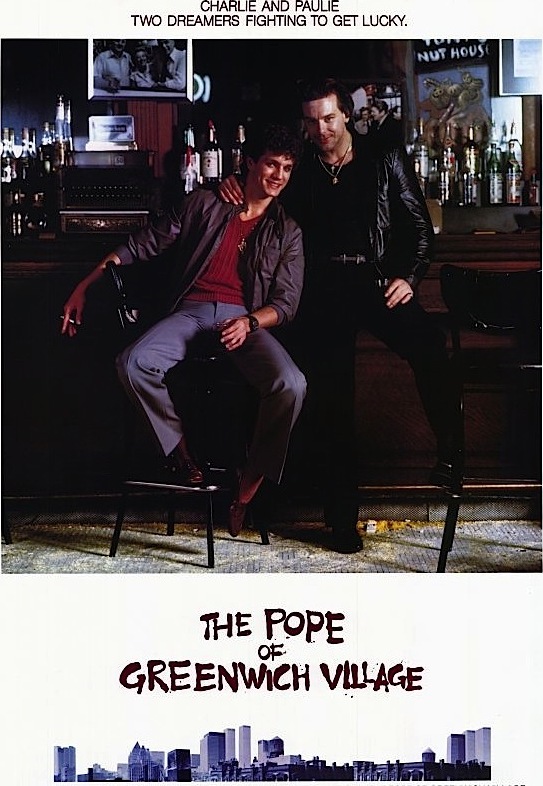
The Pope of Greenwich Village (1984)

Director: Stuart Rosenberg

I realize that this movie is highly admired by plenty of people, both casual movie-viewers and a fair number of critics. And while it has some clear merit, it really didn't come very close to living up to its reputation for me.

The tale follows Charlie (Mickey Rourke) and his cousin Paulie (Eric Roberts), a pair of local Italian-American boys in Greenwich Village, New York City. Both work in a restaurant but aspire to greater wealth, and neither is above illegal means to obtain it. Their approaches towards life could hardly be more different, though. Charlie, while not exactly a master criminal or life winner, at least has some style and a sense of patience and propriety. Paulie, though, is a complete mess of a human being. Painfully loud and boorishly obnoxious, he can hardly sit still for a second without trying to con someone or get some kind of get-rich-quick scheme underway. His latest is to rob a safe which houses tens of thousands of dollars. He ropes in Charlie and a neighborhood safe-cracker to pull off the job, hoping to split the take. Running along with this scam is Paulie's ill-advised investment in a racehorse.

There are the makings of a good crime tale in the movie. There is a somewhat suspenseful little heist that goes wrong. There are several looming mafiosi. There is the dynamic between the woefully immature Paulie and the less-immature Charlie as they try to navigate some extremely treacherous waters. Still, the movie came off as a patchwork of sometimes-compelling scenes rather than a cohesive whole that had anything particularly interesting to say. While there is some character study involved, it ultimately feels downplayed by the time the final credits roll.

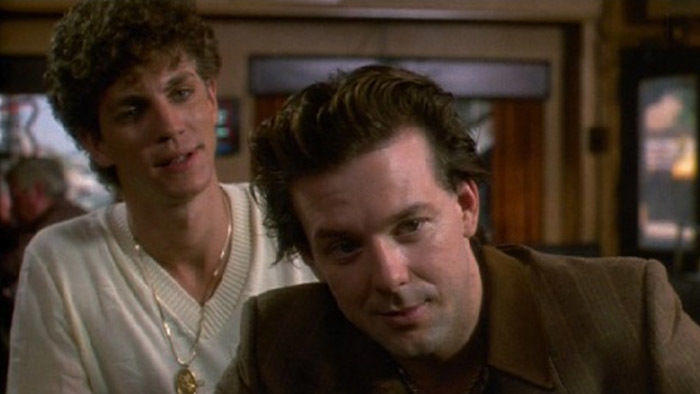
Paulie (left), trying yet again to convince his relatively more
mature cousin Charlie to take a ridiculous risk. I wonder if,
deep down, Mickey Rourke was as irked by Eric Roberts's
performance as I was. 
When I guess about the movie's popularity, I must concede that many of the performances are strong and the fascination with "authentic" New Yorkers can compel. Mickey Rourke was just hitting his early peak at this time, and his turn as Charlie was another example of why he impressed so many viewers at the time. And most of the secondary roles are solid, including the likes of Burt Young, Daryl Hannah, and several other experienced character actors. Eric Roberts, on the other hand, I found almost insufferable. While the Paulie character is supposed to be the kind of twitchy, irresponsible street guy whom we're not meant to like, Roberts went way over the top in many of the scenes. His performance shifts so often and so drastically that the character becomes almost a caricature, or at the very least someone who is far too dumb and far too unstable to function. It didn't help that Roberts's New York accent was spotty at best, which stood out all the more among so many other native New Yorkers. Also stacked against Roberts is the fact that the character type of a fast-talking, irresponsible, selfish, and greedy sleaze has been done too well by others. Robert DeNiro's performance as Johnny Boy in Mean Streets and even Edward Norton's as Worm in Rounders make Roberts's acting look strained.

It also not hard to see why many people have found the movie entertaining. Not unlike The Godfather before it and Goodfellas after, The Pope of Greenwich village gives us more than few amusing verbal exchanges of the distinctly New York Italian-American variety. Plenty of balls are busted and many hands are waved around as the several none-too-bright characters baffle each other with their ineptitude. For those moments, the movie can be fun.

As he did so many times with other movies, Roger Ebert articulated what I felt about this movie far better than I could. He generally liked the movie, but he felt that it was far more about the performances than about any story or message. It is what he dubbed a "Behavior Movie". When I read this, I realized just how right he was. I also realized that, despite many strong performances, I was disappointed in this movie, and I feel no need to see it again. 

Wednesday, March 4, 2015

Before I Die #541: Prizzi's Honor (1985)

This is the 541st I've now watched of the 1,162 movies on the "Before You Die" list that I'm gradually working my way through...

It's past the statute of limitations, but I still
feel like suing this poster for false
advertising. 
Director: John Huston

Totally disappointing.

When I see the words: "mafia," "Jack Nicholson," and "John Huston," I start to think good things. Such thinking resulted in the sad shock I felt in watching this movie.

The basic story is thus: Charley Partanna is a man quite literally born into the mafia. His father and god-father swear, immediately after his birth, to raise him within the Prizzi "family." Charley doesn't disappoint, growing to become one of the most feared mafia enforcer/assassins in the country. A very serious problem arises, however, when Charley falls in love with Irene Walker, a fellow assassin who robs the Prizzis. Things are further complicated when Charley's ex-wife, Maerose Prizzi, gets involved in the entire mess.

The story seems, on paper, to make for a solid mafia movie. When you add in a brilliant cast including Jack Nicholson, Kathleen Turner, Anjelica Huston, and many other great character actors, then you would expect movie gold. What I saw was a borderline-mess of a film that fell completely flat.

Firstly, Jack Nicholson's New York accent is horrendous. This is very odd to me, as he was born and raised in New Jersey. Despite this, his faux New York street guy affect is even worse than the shakey Boston accent he put on in The Departed. This wouldn't be such a nuisance if Nicholson weren't in nearly every scene. He is, though, so it's a nuisance. A larger, less superficial problem to me is that the tone is never consistent. At times it wants to be a dark comedy; at others a touching dramedy; and at others a suspenseful crime tale. It's a very difficult trick to pull off, and John Huston (an indisputably great director) failed on every count. Neither the characters nor their motivations ever fully gel, leaving a bizarre, rambling story in which I cared about no one and nothing.

I couldn't shake the feeling that this movie is one that could have been done by filmmakers like the Coen Brothers, whose quirky sense of genre and tone blending might have resulted in a brilliant cult classic. As it is, though, I'm left to wonder just why so many film critics have hailed Prizzi's Honor as an "all-time great gangster movie." I just don't see it.

That's 541 movies seen. Only 621 to go before I can die...

Friday, November 23, 2012

Film #90: Goodfellas (1990)


Director: Martin Scorsese

Initial Release Country: United States

Timed Previously Seen: probably around eight or nine. Maybe more. 

Rapid-Fire Summary

Goodfellas is a rather epic movie, spanning several centuries. I’ll keep my summary short, but if you want many more of the details, you can check out the synopsis here at imdb’s website. Here’s my version:

In the late 1950s in Queens, New York, young teenager Henry Hill has big dreams. He dreams of becoming a gangster, like the fellows that he sees regularly on the streets of his neighborhood. Though his parents completely disapprove, Henry gets more and more involved with the crime circuit in the area – starting with simple errand-running for book-makers, progressing to orchestrated property destruction, and advancing to the sale of stolen goods. The more he gets entrenched in the life of a criminal, the more he feels welcomed by his fellow criminals, and the more normal it all becomes for him.

This normalized life of larceny follows Henry into adult life (played by Ray Liotta), when he regularly partners with two other noted crooks – the thief and hitman, Irishman Jimmy Conway (Robert De Niro) and the volatile yet charismatic Sicilian mobster Tommy DeVito (Joe Pesci). These three, along with many other local hoods, spend the next few decades of their adult lives robbing, and occasionally killing, their way to lives of luxury for themselves, their wives, children, and mistresses. Though their methods of attaining wealth are highly illegal, all of them keep up the appearances of being responsible family men who are “providers” for their friends and families. This is all in keeping with the Italian mafia tenets of organized crime, to which all of these three men pay homage.

Tommy, Henry, and Jimmy taking a look at on of their many stashes of ill-gotten money.

Eventually, however, things start to crumble. Starting in the later 1970s and into the early 1980s, Henry starts to get involved in selling cocaine. Despite clear warnings from the mafia father-figure, Paulie Cicero (Paul Sorvino), Henry continues to sell the highly illegal substance. His mistakes catch up to him, and he is caught by the police. Now facing the very likely prospect that he will be killed by any one of his criminal associates, in order to prevent him from informing on them, Henry and his wife Karen (Lorraine Bracco) decide that their only recourse is to join the witness protection program. Henry testifies against all of his former friends and criminal associates, thus escaping jail time. However, he lives out the rest of his days in a sterilized suburban neighborhood, far removed from the action, money, and excitement of his former life of crime.

My Take on the Film (Done after this most recent viewing)

Goodfellas is an absolute classic, and it may be the only English-language mafia movie that can hold a candle to The Godfather, in terms of scope, technique, and revolutionizing the genre.

I first saw this movie in the theater when my mother brought me to see it. I was only fourteen or fifteen at the time, and I remember the language blowing me away. The characters drop the f-bomb like most people blink, and violence is as normal as getting a haircut. About an hour into the movie, my mother, who grew up in Queens right at the time that this movie’s events were taking place, leans over to me and says “I think I grew up with these guys.” Now, she didn’t mean that she literally grew up with Henry Hill and the gang; she just meant that she grew up with guys eerily like them. She always said that the dialogue and attitudes depicted in Goodfellas were spot-on, in terms of how the guys from those neighborhoods spoke and acted.

This authenticity has been a hallmark of Scorsece’s New York pictures right from the very beginning. While he’s certainly done other excellent movies that are not based in New York (The Departed, Kundun, et al), his street-level stories have always been his signature ones. The verbal exchanges in Goodfellas, like Raging Bull and Taxi Driver, feel completely organic. Despite being so deeply rooted in a particular region, even people who have never been within a thousand miles of Long Island can sense and be hypnotized and amused by it.

Just another night of booze and poker. This is one of the many scenes in which the dialog and interactions between the New York tough guys are at their most realistic. 

But the dialogue is simply one of several triumphs of this movie. If The Godfather was the ultimate American criminal take on a classical Greek tragedy, Goodfellas is the ultimate deconstruction of the gangster myth. Based on the real story of Henry Hill, the movie depicts the ground-level thugs who made the mob go. There are no honorable Vito Corleones here. Henry Hill and his cohorts were unapologetic thieves and murderers who reveled in their power over others. One line that sums them up fairly well is when Henry Hill is describing Jimmy: “The one thing Jimmy loved to do was to steal. I mean, he actually liked it. Jimmy was the kind of guy who rooted for the bad guys in the movies.” These guys knew they were bad, embraced it, and pummeled anyone who had a problem with it.

Tied to this is probably the element that truly sets the movie apart from other classic gangster movies. Through Henry Hill’s life story, we see the complete and utter sham that the “honor” of the mafia is. All of the seeming friendships that Henry makes are only authentic as long as they don’t threaten any of his fellow thieves’ illicit livelihoods. The moment any one of the crew is suspected of threatening others’ freedom and fortunes, that crew member is not long for this world. The camaraderie is revealed as shallow in the face of real adversity, as evidenced by the protagonist himself. After decades of thinking of his criminal associates as family, he turns on them to protect himself and sends them all to prison. Goodfellas may have been the first film to so carefully and stylishly deconstruct the myth of honor among mobster thieves.

Normally, much of the above would make for thoroughly repugnant, unwatchable characters. Yet herein lies one of the most brilliant part of this movie – at times, you forget what they are and get completely caught up with who they are. Whether it’s Tommy cracking up his fellow mobsters with hilarious stories, Jimmy railing against the stupidity of his partners in crime, or Henry trying to juggle his passionately crazy wife and mistresses, it’s simply fun to watch. Most of the time, you laugh at them, but some of the time you actually laugh with them. There are even times when you feel a twinge of sympathy, as when Henry learns that Karen has flushed their bags of cocaine, their only remaining source of revenue, down the toilet, effectively flushing his entire life down the toilet. His desperation and fear are so palpable that you might be tempted to forget, just for a few seconds, that it’s all his selfish own doing.

Karen visits Henry while he serves time. At this point, it almost seems as normal for us the viewers as it does for the troubled couple and their kids.

All of these moments come through in large part due to the acting. While De Niro rightfully got top billing for this movie and did an outstanding job as Jimmy, it was Pesci, Liotta, and the entire ensemble crew that fully rounds out the picture and makes it come to life. By using that rare combination of world-class actors with lesser known, fully capable New York regionals, not one moment of Goodfellas rings untrue. For the full two-and-a-half hours, they pull you right into a completely different world.

It goes without saying that Scorsese was arguably at his finest with this movie. The cinematography, editing, and music are all blended into a fast-paced story that hums along without missing a single beat. Of his great films (of which there are many), this one is arguably his very best, and one would be hard-pressed to find much fault with it. At this point, anyone who is into crime movies has seen and loves this film. If, by chance, you haven’t seen it, do yourself a favor. As long as you are not put off by rough language and graphic violence (none of which is gratuitous, by the way – we need to see how visceral these thugs can be, lest we start to glamorize them), you need to watch this true modern masterpiece.

Henry takes one last look at us from his quaint little house, courtesy of the Witness Protection Program. While he survives, he would hardly call it a "life," as he came to know it on the streets of New York.

A side-note: Any fan of Goodfellas should watch Casino. It’s sometimes called “Goodfellas 2” with good reason. It’s certainly not a sequel, but so much of the tone and feel of it is the same, that one might feel like they’re watching the companion piece to the earlier film. Casino is a bit more sprawling, and some say bloated (I disagree), but it’s another excellent film in the same vein.

That’s a wrap. 90 shows down. 15 to go.

Coming Soon: Unforgiven (1992)


From the movie that deconstructed mafia gangsterism to the movie that deconstructed the American Western film. This is another of my absolute, hands-down, all-time favorites. I’m looking forward to watching it again and writing out my thoughts on the dark tale of Will Munny. 

Friday, April 20, 2012

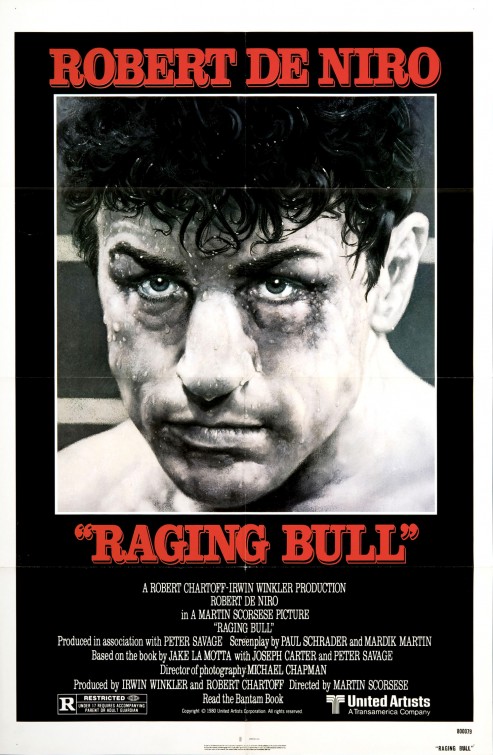
Film # 79: Raging Bull (1980)


Director: Martin Scorsese

Initial Release Country: United States

Times Previously Seen: three or four (last time – about 5 years ago)

Teaser Summary (No spoilers)

Real-life boxing champion and general dealer in violence Jake LaMotta doles out serious beatings to opponents in the ring, as well as to his closest family members outside the ring.

Extended Summary (More detailed synopsis, including spoilers. Fair warning.)

It’s the early 1940s, and middle-weight boxer Jake LaMotta (Robert De Niro) is coming into his own. A bruising, tenacious fighter from the Bronx, New York, LaMotta makes up for in sheer will and toughness what he lacks in grace and technique. His punishing style of boxing has him on a path towards a championship title fight, except for the fact that his way is blocked by the New York mafia, which controls boxing in order to manipulate outcomes to its own advantage. Jake’s manager and younger brother, Joey (Joe Pesci), tries to convince Jake to relent and allow the mobsters to help them get their title shot, but the eminently stubborn Jake refuses any outside assistance.

Jake soon becomes infatuated with a fifteen-year old neighborhood girl, Vicki (Cathy Moriarty), for whom he leaves his wife. After a few years, the two get married. Jake grows ever more jealous and controlling of Vicki as the years go on, relentlessly questioning her every move and suspecting every man around her as trying to take her from him. Through it all, Jake continues to win fight after fight in the ring, though he is still refused any shot at the title. Even after two solid fights, including a victory, against the other prime fighter of the era, Sugar Ray Robinson, Jake is blocked from championship contention by the corrupt powers that control the sport.

Joey and Jake, sweating it out in a training session. Despite Jake's prodigious in-ring toughness, the mafia blocks their title shot for years.

Jake continues to win in the ring, with his main rival Robinson now in the army. He even pummels a supposedly handsome up-and-coming young fighter into a bloody mess, after Vicki offhandedly calls him “good-looking”. Shortly after this fight, with Jake out of town, Joey spies Vicki in a bar with a few local men. Though her evening out is innocent enough, Joey loudly proclaims that Vicki is embarrassing his brother, and he demands that Vicki go home. She refuses, Joey becomes enraged, and attacks one of the men she’s with, local Mafioso and former friend, Salvy. The fight is soon straightened out by the local Mafia boss.

Jake is then allowed his title shot by local gangsters, but on one major condition – he must throw the fight so that the mob can make a killing by betting against him. Jake reluctantly accepts. Throwing the fight, though, is easier said than done. His opponent, Billy Fox, is far inferior to Jake. Jake almost knocks him out on accident, and then refuses to fall down at any point in the fight. The fight is stopped and victory briefly given to Fox, but an investigation in launched and LaMotta is banned from boxing for a time. However, when the ban in up, he receives his first true shot at the title, winning convincingly against current champion, Marcel Cerdan.

Three years pass, and Jake manages to retain his title throughout, though maintaining his fighting weight becomes more and more difficult. One day, he begins to question Joey about the fight that he had with Salvy. Jake, now so obsessed with jealousy over his wife, suspects that Vicki has been having affairs, including with Joey himself. Joey refuses to answer the interrogation and leaves. Jake then begins to question Vicki, who is frustration sarcastically screams that she has had affairs with every man in the neighborhood, including Joey. Jake, too enraged to see that his wife is being sarcastic, storms over to Joey’s house and begins to beat him unmercifully. Vicki catches up and tries to stop Jake, but Jake knocks her out with vicious punch to the face. When the dust settles, Vicki starts to pack up and leave Jake, but decides to stay after Jake apologizes and begs her forgiveness.

Jake wins his next fight, and tries to call Joey afterwards, in order to try and mend their broken relationship. The attempt fails, though. Jake’s next fight against Sugar Ray Robinson is a bloodbath. Jake, either outmatched or simply in a completely masochistic temper, allows Robinson to land vicious blow after vicious blow, though he refuses to fall down. The fight is stopped, and Jake loses his championship title.

The Bronx Bull, in the midst of getting mangled by long-time rival, Sugar Ray Robinson. It all goes downhill from here for the champ.

Several years later, Jake is tremendously out of shape and with his family in Miami. He has retired from boxing and opens a night club, where he spends his evenings drinking hard and doing bad standup routines. Vicki soon divorces him and takes their children with her. Jake’s life slides down even farther, as he gets arrested for serving under-aged girls and introducing them to older male patrons in his night club. In an attempt to raise bribe money, Jake even hammers the gems out of his middleweight champion belt, but all for naught as the gems without the belt are far less valuable. Jake does several months in a Miami-Dade county prison, in which he breaks down and wails in despair at his own stupidity.

Jake is eventually released, and he returns to New York, where he does more shoddy standup routines in dive bars. He runs into his brother Joey, with whom he tries to reconnect, with very little success.

The last we see of Jake, he is preparing to do a stage performance for a modest crowd in New York. He gives himself a pep talk, as if he were still the fierce fighter of his younger days.

Take 1: My Gut Reaction (Done after this most recent viewing, before any further research.)

One of my all-time favorite films, and the one that I think is Scorsese’s best. And that’s saying something.

The real-life story of Jake LaMotta, as Scorsese tells it, is arguably the most artful and profound sports movie of all time. It exhibits the psyche of an athlete as it spills into his personal life, and does not blanch for one second at showing you the ugliest parts of it.

I don’t know that every person would feel as I do about this movie. For one thing, it helps that I find boxing fascinating. I’m no expert, but I know a little bit of my history and went through several years in the 1990s when I followed the sport rather closely. Though it’s one of the most brutal of popular sports, there is an undeniable artistry to it. More than this, I am enthralled by the psychology of stepping into a ring and voluntarily exchanging blows with another human, until one of you is likely knocked unconscious. Raging Bull gives us a shocking and entrancing look at a man who was, even by boxing terms, a unique specimen.

Though a disaster in his personal life, Jake LaMotta was arguably the toughest middleweight fighter in boxing history.

Boxing has been called, by the sports’ devotees, “the sweet science”. What Jake LaMotta did, though, was neither sweet nor scientific. He walked towards his opponent, took every punch they could dish out, and never backed away. His ability to take an unholy number of punches without going down is admirable in a way, but it does make the stomach turn. Though filmed in a less visceral black-and-white, Raging Bull is shot in a way that conveys the brutality not only of boxing, but especially of La Motta’s style, which of course earned him his nickname, “The Bronx Bull”. The ever-present smoke, sweat, and dark pools and rivers of blood seen during the matches threaten to choke the viewer. Every time I watch this movie, I feel like toweling myself off.

While the in-ring scenes are brilliantly filmed (my only gripe is that there are more than a few “phantom punches” that are easily noticed), the real tale is what goes on outside of the ring. LaMotta’s personal life is what vaults this movie to a higher plane of film. Scorsese’s approach strikes me as something akin to the way Stanley Kubrick would have made a boxing movie, or the way that Darren Aronofsky approaches his major theme of obsession in all of his films. The darkness in La Motta’s soul, which we see as irrepressible jealousy and unstoppable rage, is the stuff of universal fascination. As disturbing as it is, it’s hard to look away from it.

I compare Raging Bull in certain ways to Kubrick and Aronofsky, but there is a major difference that is all Scorsese – the dialogue. As with all of his New York films, Scorsese nails the urban language dead on. There is a pace, rhythm, and vulgarity that can be wonderfully entertaining to listen to, and Scorsese has always been well aware of this. This is also where we get moments of levity. Let’s face it – these characters are generally not very bright, and it’s easy to laugh at them much of the time. And when we’re not laughing at them, we’re laughing at the insults that they hurl at each other. These moments keep the movie from becoming a two-hour slog through bloody violence and depression. In other words, it’s an incredibly well-rounded story, with many of the elements of real life, good and bad.

Many of the exchanges between the LaMotta brothers (De Niro and Pesci's first film together, by the way) are as funny as they are insightful towards their relationship.

Every time I watch this movie, the time flies. The story, scenes, and character interactions are so gripping that I will continue to watch this movie every few years for as long as I live. This is the reason that it is one of the very few DVDs that I personally own. Whether a sports fan, boxing fan or not, as long as one can stomach the gritty violence in the picture, I feel that nearly any mature film lover can watch and appreciate Raging Bull.

Take 2: Why Film Geeks Love This Movie (Done after some further research.)

There are all kinds of great little documentary pieces on Raging Bull. The ones I mostly delved into came on the bonus disc of the special DVD release in 2004.

The story of the film’s making is rather interesting. It basically was made because of Robert De Niro’s fascination with LaMotta’s autobiography. De Niro approached Scorsese repeatedly to do it with him, but Scorsese was ambivalent, not being any find of sports fan and knowing virtually nothing about boxing.

Eventually, though, Scorsese took interest, wanting to do something a bit different. After a crash course in boxing, Scorsese took the story of La Motta and found the universality in it. He described how he saw it in 2004: “The hardest opponent that you have in the ring [of life] is yourself.” Who better to exemplify this than the tragically unaware La Motta?

Around 1977, there was a renewed interest in boxing films by the viewing public. This, of course, was due to the 1976 smash hit, Rocky. While some of the producers of Raging Bull were initially interested in doing another Rocky film, they were intrigued enough to sign onto De Niro and Scorsese’s project.

De Niro, a noted practitioner of "The Method", felt strongly enough about LaMotta's story that he famously put on a solid 60 pounds of weight, just as the real LaMotta did in his post-boxing years.

I was stunned to learn how little interest in or knowledge of boxing Scorsese had. It’s a tribute to the man’s dedication and artistic genius that he managed to bring a novel approach to filming boxing matches as they happen. He employed several very clever visual special effects to create various moods and convey La Motta’s psyche. These and the strange and evocative sound effects add immense power to the fight scenes. To give an example, in some scenes the ring was expanded to give a sense of openness and freedom, while in another it is obscured by smoke and distorted visuals. I never quite realized the effect that these components were having on me, but they are absolutely true.

Another interesting note about the visuals is the decision to film it in black and white. Why did they do this? The main reason is that Scorsese didn’t like the way that the colors were coming through, particularly the bright red of the boxing gloves. Once they talked it over with the crew, everyone was on board. Also, it helped distinguish Raging Bull from the four other boxing movies coming out that year.

Upon the film’s release, the initial reviews were very mixed. Some reviewers didn’t know what to make of it, and they even advised MGM not to distribute it. Alas, they did. The movie was a modest commercial success, but really garnered attention at the Academy Awards, being nominated for eight awards and winning two.

Maybe the most interesting story I heard about the film’s release comes from Jake La Motta himself. In 2004, the real Bronx Bull recalled going to see the movie upon its release in 1980. He had brought his ex-wife Vicki, also prominently depicted in the film, to watch the portrayal of Jake as the relentless, brutal, thuggish character that we can all see. After the film was over, Jake asked Vicki, “Jesus, was I that bad?” Vicki looked at him and replied, “You were worse.” When you see the movie Raging Bull, you will see why this is a rather stunning announcement.

Hard to believe after you watch the film, but the real Vicki told her ex-husband that he was worse in real life than the film's portrayal of him.

The other fascinating notion I heard came from Scorsese. It had to do with sports culture, and boxing culture in general. There is a very unreal expectation thrust upon prize fighters that few fans of the sport are willing to accept – we demand that the fighters be relentless, vicious, and violent inside the ring, but tend to act with shock and reprehension when they behave that way out of the ring. (Mike Tyson, anyone?).

In Raging Bull, it is clear as day that the man inside the ropes and outside the ropes cannot easily be separated, if at all. This is why, to me, anyone who revels in the violent aspects of certain sports has little room to criticize any of the athletes in those sports when they behave similarly outside of the lines. These are the kinds of topics that a great movie like Raging Bull brings up, and it is why it will not fade into obscurity for as long as more violent sports like boxing or mixed martial arts remain popular.

That’s a wrap. 79 shows down. 26 to go.

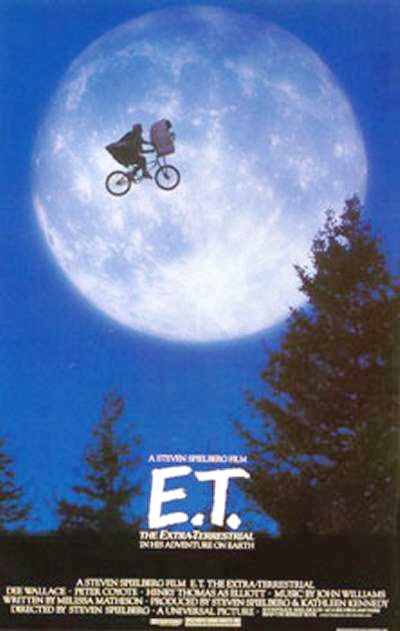
Coming Soon: E.T.: The Extra-Terrestrial (1982):


This is the second in a break-neck 1-2-3 sequence of movies: Raging Bull, E.T., and then Blade Runner. This middle flick was one of the first ones that I remember going to see in the theater multiple times. It’s been a while, but come on back to see how it holds up to me.

Please be sure to pick up all empties on the way out.

Tuesday, February 28, 2012

Film # 75: Taxi Driver (1976)


Director: Martin Scorsese

Initial Release Country: United States

Times Previously Seen: twice (last time about 8 years ago)

Teaser Summary (No spoilers.)

Lonely cab driver tries to maintain his sanity & humanity in the grunge of 1970s New York City.

Extended Summary (More detailed plot synopsis, spoilers included. Fair warning.)

In mid-1970s New York City, Travis Bickle (Robert De Niro) is struggling. An honorably discharged Marine, Travis is now making a living as a cabbie in Gotham City, though the going isn’t easy. His insomnia and constant headaches lead him to add night shifts to his busy schedule. To take his mind off of his nagging unrest, he tells his dispatcher that he will go “Anywhere, anytime.”

As Travis works through his shifts, he sees some of the darkest aspects of humanity. Drug pushers and abusers, prostitutes and pimps, killers and victims. Travis sees it all pass both outside and inside of his cab. He feels a desire to do something about it, but he doesn’t know what or how, and he cannot articulate his feelings to anyone. Added to this is that he has no close friends. The only people he sees regularly are a handful of other cabbies, who are as jaded and he is becoming.

Travis one day sees a stunningly beautiful woman, Betsy (Cybill Shepherd) walking along the street. He becomes transfixed and begins regularly driving past her place of work, the campaign headquarters for presidential hopeful Senator Charles Palantine. He eventually musters up the courage to walk in, awkwardly introduce himself and ask Betsy to coffee. Betsy, seemingly intrigued by Travis’s unusual energy and intensity, agrees. Over coffee, Travis professes his loneliness to Betsy, but also claims that he senses the same loneliness in her. Betsy continues to be intrigued, though in a somewhat reserved way.

Travis and Betsy get to know each other a bit. Betsy is intrigued by the "contradiction" of Travis, never suspecting the darkness with which he is struggling.

A few days later, Betsy agrees to see a movie with Travis. Much to her surprise and disgust, the socially inept Travis brings her to a graphic, X-rated film. Betsy gets up and walks out. Travis tries to stop her and apologize, but she hustles away. Travis tries to call and make amends over the next several days, but Betsy does not return his calls.

Travis begins to grow more hateful towards the world around him, his personal failure with Betsy now piled on top of the degradations that he sees nightly in his job. He soon becomes totally insulated. He buys several handguns from an illegal dealer, and stays in his cramped apartment, fantasizing and acting out confrontations with invisible enemies. He even studies himself in the mirror as he vocalizes his delusional conversations.

Travis begins to focus on Senator Palantine in a strange way, noting his campaign speeches and their locations. He also goes back to the campaign headquarters, where he loudly berates Betsy and condemns her, only to be escorted out of the building. A few nights after, Travis accidentally stumbles across a robbery in progress. He guns down the thief and flees the scene at the shop owner’s urging.

Travis later has a run-in with a painfully young prostitute named Iris (Jodie Foster), who tries to get into his cab. She is pulled forcefully out by a rough pimp named Matthew, or “Sport” (Harvey Keitel), who bribes Travis to stay quiet about the whole thing. Travis continues to dwell on this for several days, and he eventually finds Iris and talks to her. Travis learns that she is a runaway and is not even 13 years old. He tries in his clumsy if passionate way to convince her to leave her life in New York and return to her parents. Iris leaves, considering Travis’s urging. However, Sport smooth talks Iris into staying, with Travis watching through a window.

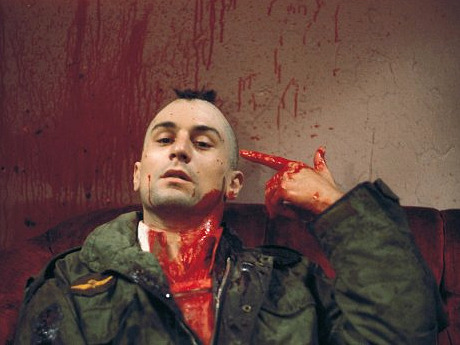
Travis, now gone completely off the deep end. He has taken on his "warrior" garb and prepares for his suicide mission to kill the Senator.

Now seemingly devastated, Travis goes home and loads for bear. He writes a farewell letter to Iris and puts it in an envelope with all of his remaining money. He then goes to Senator Palantine’s next public speech. Sporting a wild-looking mohawk and an oversized army jacket (hiding Travis’s veritable arsenal underneath), Travis makes towards the Senator and nearly has his chance to shoot him. He is spotted just before he pulls his gun, though, and flees the scene.

That same night, Travis goes into the lower East Side of Manhattan and confronts Sport. After a heated exchange, Travis shoots Sport, then continues to shoot his way past one of Sport’s lookouts, into Iris’s room. Travis also shoots the “john” that is with Iris, but not before being shot himself, once in the neck and once in the shoulder. Bleeding profusely, Travis sits on a couch while Iris crouches in horror next to it. The police arrive to find the bloodbath.

After a short time in a coma, Travis recovers his health. He wakes to find a letter from Iris’s parents, who explain that after the shooting, they came from their home in Pittsburgh and brought Iris home. Travis is also hailed as a sort of vigilante hero in the newspapers. Once recovered, he returns to his job driving a cab, and seems to be more well-balanced. One night, his fare happens to be Betsy. When she asks Travis about it, he denies that he was any kind of hero, and he quietly and calmly does not charge her for her fare.

Take 1: My Gut Reaction (Done after this most recent viewing, before any research.)

I remember a classmate of mine back in college once telling me that he would watch Taxi Driver once every year. He explained that this was so he could keep a certain perspective on everything. In keeping with this, I understand and agree with what he meant. Taxi Driver is an incredible movie that, while difficult to stomach in several ways, should be required viewing for everyone, at least once in their lifetimes.

Watching the mental fracturing of Travis Bickle is as fascinating as it is uncomfortable. Currently, in the year 2012, we are far more familiar with the psychological profile of the classic “loner(s)-turned-madman”, as in the cases of the Columbine or Gabby Giffords shootings, just to name a few. I have to guess, though, that on Taxi Driver’s release in 1976, this was very new and frightening territory. New because it made a homicidal man the protagonist, and frightening because of just how real it all seemed. Even more, it still has the same power, 36 years later.

I was hardly a year old in 1976, but I wouldn’t time travel back there if you paid me. My general impression of that short era, based solely on films between 1976 and 1978, is that it was hell on earth. The movies are always grainy and shrouded in shadows, and the themes were often doom-saying prophecies spawned by decades of Cold War paradigms and hopelessness. Taxi Driver is, for me, the epitome of it all, boiled down and distilled into the form of Travis Bickle.

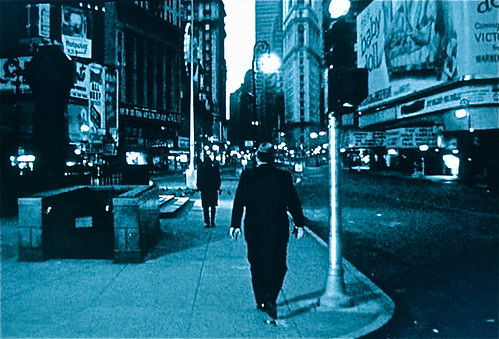
An early shot in the film. The washed-out browns, shadows, fluorescent lighting, and disheveled humans are what seemed to be part of every U.S. film made between 1976 and 1978.

Travis Bickle, however, cannot be written off as simply a maniac. Faced with depravity and degradation at nearly every turn, Travis has a powerful desire to see it made better, but he isn’t equipped to enact it. Any attempt he makes at a positive connection is stymied by his own lack of awareness or social graces. His frustration simply fuels his hatred for the things that he sees, rightly or wrongly, as cancerous elements. Eventually, it erupts into the final shooting spree and killings.

What I picked up far more on this recent viewing were not the iconic scenes of Travis doing his “You talkin’ to me?” monologue or the visceral final shootout. Instead, it was Travis’s attempts at real human connection with people. Not only with Betsy and Iris, but even with his fellow cabbie “Wizard” (played well by Peter Boyle) and Senator Palantine, Travis makes a real attempt to communicate to people his pain and frustration at watching the world die around him. The problem is that either he isn’t able to articulate it, or his listeners aren’t willing or able to really hear him. Taxi Driver is easily as much about human contact (or lack of) as it is about social ills and mental instability. Again, this is not an amusing topic, but one that this film explores in an entrancing way.

What can I say about De Niro’s performance that hasn’t been said before? Nothing, really. While he had already made his name in The Godfather Part II, his role in Taxi Driver put him in rarefied air for actors. The man’s range even within this one movie is incredible. Bickle is terrifying at times, but the real power of the movie comes from the more delicate moments when he’s trying to reach out, in his confused and reserved way. As he would show in another Scorsese film, The King of Comedy, several years later, De Niro was equally effective at conveying the vulnerability that the role demanded. As someone who has grown disappointed in Robert De Niro’s roles in the last 10 or so years (don’t get me started on the whole Meet the Parents atrocities), I was glad to go back and be reminded of exactly why he is a film acting legend.

De Niro is obviously the big draw in the movie, but even the lesser roles played by familiar faces are great. A disturbingly young Jodie Foster is perfect, and Harvey Keitel is as I can’t recall seeing him in any picture – a street-jiving pimp, complete with red velvet bellbottom pants and wide-brim hat. Even Peter Boyle in his very small role as Wizard adds to the film.

Yes, that is indeed Harvey Keitel as the long-haired pimp, Sport. Keitel's is one of several excellent minor performances in the movie.

Scorsese’s direction of this movie is rock solid. I need to research it, but I can’t imagine that he had a tremendous budget for this movie. Either way, the entire tone of it is just right for the story it tells. Granted, most of us would want to take a shower after watching it, so grungy and distasteful are the environments and behavior in it, but this is exactly the point. It is this filth that sends Travis Bickle down the road of madness, and we are riding shotgun the entire way, as much as we don’t want to.

At this point, I have seen most of Scorsese’s feature films, and he’s one of my favorites. Seeing Taxi Driver again reminds me of the man’s strengths. While he’s clearly a director of the highest order, no matter what kind of film he decides to do, his greatest seem to come from his home – New York City. Sure, nearly all of his movies set there involve crime, insanity, depravity, and any number of other deadly vices, but the stories he tells of them have always been incredibly gripping. Taxi Driver was one of his very first in this vein. I come away from this latest viewing about the same way I went in: I’m glad I watched it again, and I was able to glean several more things from it than before. I will now let five, seven, maybe ten years pass before I feel the need to watch it again. Watch it again, I will though.

Take 2: Why Film Geeks Love This Movie (Done after some further research.)

This is another film that one doesn’t have to research much, in order to learn why it has been put on the “All TIME 100” and many other “best films” lists. The craftsmanship of the tale and the acting is superb, and critics early on proclaimed it an outstanding film. The public also appreciated it; while Taxi Driver was far from a smash hit, it did make a relatively nice profit, grossing just under $30 million. I would say that this is surprising for such a dismal tale of urban decay and insanity, but I suppose it struck a chord with people.

It’s interesting to learn how Taxi Driver was a sort of unintentional bridge between two high profile assassination attempts. To write the script, Paul Schrader researched the personal diaries of Arthur Bremer, who shot presidential candidate George Wallace in 1972. (Travis Bickle’s journal entries are fairly prominent as insight into his mind in Taxi Driver.) Fast forward to 1981. In a delusional effort to impress Jodie Foster, John Hinckley Jr. dons a Bickle-inspired Mohawk and shoots then-president Ronald Reagan. Life imitating art, imitating life, I guess.

Initially deemed too bloody and given an X rating, Scorsese washed out the colors a bit, lessening the visceral nature of Bickle's final suicide assault to rescue Iris. Still, it's plenty disturbing.

In researching the film’s influences, it’s hard not to think of several more modern movies that use a rough Travis Bickle template. The John Doe character in Se7en and even Tyler Durden in Fight Club are clearly cut from the same cloth. Those were also films of malcontented loners who first internalized their disgust at the world around them, and then lashed out with the force of a natural disaster.

Back to Taxi Driver. The ending is certainly food for thought. After the final, bloody shootout and Travis’s recovery, the final scenes at first seem out of place to me. Travis is back out on the street, driving his cab, seemingly in far better mental condition. After picking up and dropping off Betsy, there is a very brief flash of Travis’s face in the rearview mirror, reacting with surprise and anger to some kind of blurred motion. Before you know it, though, the moment is gone. I was left to wonder if I had even really seen it.
Well, it turns out that I did see it, and it is an allusion to the fact that Travis is far from OK at the end of the movie. This was something that sparked debate and confusion upon Taxi Driver’s initial release. However, Martin Scorsese and script writer Paul Schrader confirmed that the scene is, indeed, meant to show that Travis is still thoroughly unstable, and that final, lightning-quick flash of his contorted face portends another violent outburst sometime in his future. This also banished a theory that the final few minutes of the film were a dream sequence and we were seeing inside Travis’s mind for a short while. Not so.

And here’s a final perplexing oddity. In surfing around, I discovered that there are plans out there to make a sequel to Taxi Driver. In both 2010 and 2011, both De Niro and Scorsese confirmed this, and director Lars von Trier is rumored to be involved. Don’t ask me exactly how they plan to do this, as the only information out there says that it would be about an older Travis Bickle. If it really comes off, I don’t know what to expect. Scorsese is an absolute master, no doubt, but it’s hard for me to imagine him capturing the feel of the original setting and character without diminishing it somehow. We shall see.

That’s a wrap. 75 shows down. 30 to go.

Coming Soon: Star Wars (1977):


Talk about a thematic shift. I go from a violent loner in a scum-encrusted New York to an intergalactic hick getting wrapped up in a space opera and learning how to fight with a glowing magic wand. It goes to show how movies truly can take you anywhere…

Please be sure to pick up all empties on the way out.

Thursday, January 20, 2011

Film #48:Sweet Smell of Success (1957)


Director: Alexander Mackendrick

Initial Release Country: United States

Times Previously Seen: once (about 2 years ago)

Teaser Summary (No spoilers)

Unscrupulous press agent hustles through New York, stabbing backs to climb the social and professional ladder.

Uncut Summary (A full plot synopsis, spoilers and all. Fair warning)

New York City, 1957. Sidney Falco (Tony Curtis) is the hustlingest press agent around. He's also a very minor player in the big city, but he's willing to try every dirty trick in the book to climb out of his self-described hole. At story's beginning, he has just been frustrated by his meal ticket, the immensely influential newspaper columnist and nationalist television pundit, J. J. Hunsecker (Burt Lancaster). Falco believed that one of his clients would be given a positive review in the day's paper, but Hunsecker has left it out.

Sidney scrambles to Hunsecker to find the reason for the snub. He learns that Hunsecker is ignoring Falco's clients because Falco has not yet performed a requested service for him; namely, breaking apart the relationship between Hunsecker's young sister, Susie (Susan Harrison) and an up-and-coming jazz guitarist, Steve Dallas (Martin Milner). Realizing that his career won't advance until the relationship is ended, Falco races to the night club where Dallas is playing.

"Match me, Sidney," says cock-of-the-walk Hunsecker (right) to the ambitious weasel, Sidney Falco.

At the club, Falco discovers that not only are Susie and Dallas still together, but that he has proposed marriage to her. Falco and Dallas have a confrontation during which Dallas accuses Falco of being a sneaky henchman for J.J. Hunsecker. The two part ways without blows, but only just.

When Falco relays the news to J.J., Hunsecker reiterates that Falco will get no meaningful work in the town unless he sabotages Susie and Dallas's relationship. Hunsecker also reveals his reason – that Susie is the only family that he has left, and he refuses to lose her to anyone else, especially not a jazz musician. Falco sets out again.

The first place he goes is to a rival columnist of Hunsecker's, Al Evans. He tries to get a smear piece run on Dallas, claiming he is a druggy and communist, by attempting to blackmail Evans. He threatens to reveal to his wife that Evans made advances on a cigarette girl at another club. The plan backfires, as Evans confesses the truth of the story to his wife, leaving Falco with nothing to show for it. Falco happens upon another rival columnist immediately after, the lusty Otis Elwell, who agrees to run the column if Falco can find him some female companionship. Falco obliges, pimping out the very cigarette girl that Evans had propositioned. The smear piece is run the next morning and Dallas' band is promptly fired by their night club.

On Falco's advice and to maintain the illusion that he is not behind the subterfuge, J.J. Hunsecker calls the night club the next morning. With Susie looking on, he vouches for Dallas and has him rehired. Falco's notion is that Dallas will never accept the charity, refuse to take the job, and the strain will divide Susie and Dallas. He's almost right, too.

Dallas shows up on the set of Hunsecker's television show, and the two have a confrontation that begins calmly but escalates into Dallas accusing Hunsecker and Falco of being totally devoid of morals. Susie watches the entire scene, and is terribly unnerved by everything. After Dallas leaves, Hunsecker tells Susie that she must not marry him, and she demurs. Seemingly, J.J. Hunsecker has obtained what he wanted. This, however, does not seem to be enough. He now wants Steve Dallas's career destroyed as punishment for casting aspersions as Hunsecker's character, claiming that an attack on him is an attack on his “60 million readers.”

Hunsecker and Falco deal with an increasingly agitated Steve Dallas (far right).

Later that night, Hunsecker directs Falco to plant marijuana on Dallas and call a crooked cop to make a bogus arrest. Falco initially balks at this vicious plan, but soon agrees on the promise that he will be allowed to write Hunsecker's column for a three month period while the man is away with his sister. Falco does the deed and Dallas is arrested.

Some time later, after he has had many a celebratory drink to toast his diabolical success, Falco is contacted by Hunsecker. He is told to get to his apartment right away. When Falco arrives at the Hunseckers', he finds Susie, who has heard of Steve's arrest and is wracked by grief to point of being suicidal. Falco coldly assures her that she is merely being immature and that it will pass. However, Susie nearly makes good on her threat by attempting to throw herself over the balcony. Falco stops her, and begins to calm her down.

Just then, Hunsecker arrives. He disavows Falco's claim that he was the one who had called him, and it soon becomes clear that Falco has been set up. Hunsecker has planned to have Falco framed for an attempted assault on Susie. Hunsecker begins to batter Falco, and eventually Falco blurts out how Hunsecker had arranged the frame on Dallas. Hunsecker relents just long enough for Falco to flee from the apartment, but Susie has heard everything.

The fighting over, Susie sadly packs her bag and leaves the apartment, but not before performing a final act of courage: she looks her domineering older brother straight in the eye, tells him that she would rather die than live with him, and that she pities him. Out on the street, Falco is captured by the police and arrested. Nearby, the immensely powerful J.J. Hunsecker watches helplessly as his young sister walks out of his life.

Comeuppance, I'd like you to meet Mister Sidney Falco...

Take 1: My Gut Reaction (Done after this most recent viewing, before any research)

This film confirms one thing: I'm a full-fledged United States citizen, all right.

Don't get me wrong. This is not some patriotic thing. I mean to say that, after watching several slower, meditative, humanistic films of a realistic bent, made in foreign lands, watching Sweet Smell of Success spoke to me loudly and clearly. It said, “You, my son, were raised on fast-moving, slick-looking movies about fast-moving, slick-looking characters, and by God, you'll always love them!”

Who am I to argue?

I watched this movie once about a few years ago and was ambivalent, but upon this recent viewing I have decided that I simply wasn't paying close enough attention. It's great. Sure, there may not be a probing, deeper message beyond the “greed kills” theme, but it has enough substance to match all of the flash that it has.

The story intrigued me plenty. Seeing the curtain pulled back on the press agent and publicity businesses is interesting enough. As most are well-aware, the news sleeps for no one, and anyone who's desperate to make their mark in the field had better be tireless. Sidney Falco is certainly that, which sets up that great dichotomy that, while not distinctly American, can probably be found in our films in greater numbers than anywhere – that obsession can lead to an inexhaustible work ethic but a complete absence of circumspection and self-reflection. Following Falco around from one seedy, shadowy locale and deed to another is fascinating. The tale only slows down a few times just long enough to catch your breath and try to keep up with the impassioned hustlers involved. Unlike longer, more measured films like Aparajito and Pyaasa, the time flew by while I watched this movie.

Greater than the plot itself are the characters. It's rare that not one but both main characters are unlikable in a movie. Sidney Falco is a self-obsessed monomaniac whose complete lack of compassion for others is only matched by his utter absence of ethics. His idol and partner-in-crime, J.J. Hunsecker, is the 1950s version of Rush Limbaugh or Glen Beck – a media mastodon who wraps himself in a flag and uses his power to raise up or cast down those he deems worthy, with extreme prejudice and without moral compunction. Seeing them try to manipulate the events around them and each other would be entertaining enough, but Susan Hunsecker turns out to be the final ingredient. She's really the only character who evolves and is sympathetic in the end, though she is not in the picture nearly as much as either Falco or her brother. Quite a storytelling trick, that.

Here's a great scene. It's the introduction of J.J. Hunsecker. Start it at 2:00. It takes a few dozen seconds to pick up the glacial intimidation that Lancaster emits:


As always, great characters can only truly shine through when put in the hands of great actors, and here we have a couple of “legends” in their prime. While I'm not a particular Tony Curtis fan, I have to say that he was spot on as the slimy Sidney Falco, complete with impish good looks and devilish wit and charm. Burt Lancaster, solid in everything I've seen him in, does a great turn as a powerful megalomaniac. Despite the dorky glasses that he sports, he uses his broad frame, clenched jaw and granite-cold eyes to bore holes into anyone he sees as lesser than himself. Which, in his view, is everyone.

The script is great. Co-adapted for the screen by the author of the source novella, Ernest Lehman, it crackles with all of the silver-tongued, noir-ish dialogue you would hope for from a tale of the New York media scumbag biz. There are plenty of quotable lines, not the least of which is the oh-so-revealing quip by Falco, “Don't do anything I wouldn't do. And that gives you a lot of leeway.” And he wasn't joking in the least. Sure, there are a few moments during which the script gets a little too clever for its own good, a la older screwball comedies, but this is rare, in my view.

Here's a clip of one Falco's particularly sleazy moments. Start from the beginning and watch for a few minutes. You may even see Falco's skin taking on a scaley quality:


The dialogue is noir-ish, but the cinematography is noir unfiltered. At this point, I'm sure that United Artists could have sprung for a color picture, but this film demanded black and white. This was essential to enhance the mood of the darkness, shadows, and looming gray facades and harsh, glaring lights of Manhattan and midnight. Falco is one of countless weasels who wants to be a big shot, and J.J. Hunsecker may be a big shot, but they're all gnats in the shadows of the city itself.

I'd watch this movie again in a heartbeat. It's one of those movies that sails along at such a fast clip that it virtually demands more than one viewing. Now that I know all of the twists and turns of Falco's ethical gymnastics, I can watch to enjoy the performances and nuances a little more.

Take 2: Why Film Geeks Love This Movie (Done after some further research)

Sweet Smell of Success was not received well by a test audience, which led producers to think that they had a severe flop on their hands. Apparently, Burt Lancaster physically threatened director Mackendrick after the initial test screening, thinking that he had sunk them. This, however, was premature. That first audience was apparently taken aback by seeing two established “good guys”, Lancaster and pretty-boy Curtis, as utter scoundrels. Once released to wider audiences, though, the high praise came flowing in. This is rather clear from this first review back in 1957 by TIME magazine. This review, along with nearly every other that I've read, cites the tight, “whiplash” dialogue as being the element that makes the movie so singular and worthy of respect.

This is probably the most well-rounded scene, in which all of the major characters go after each other. Start it at 4:00 to see the verbal showdown between Hunsecker, Falco, Dallas and Susie:


As is often the case, the story behind the story is interesting. The Hunsecker character was modeled on real-life New York gossip columnist Walter Winchell, who held sway in the big city for decades. Original novelette and co-screenwriter Ernest Lehman had been a columnist and used his experiences with press agents to build the tale.

The thrumming urgency of the plot and dialogue was very likely the product of the filming process. Lehman had become ill just before shooting, so Clifford Odets was brought on to finish the job. Instead of doing a two- or three-week quick polish, he dismantled much of the script and began reconstructing all of the relationships through the dialogue. It took several months – so long that filming began before Odets had completed the work. The result was that Odets was often finishing pages mere hours before the scenes were shot. I have to believe that this added to the built-in stress and tension in many of the scenes. There's a snippet of director Mackendrick's description of the process here.

Worth looking at more closely is the interplay between Falco and Hunsecker. Roger Ebert does a nice job breaking down their symbiotic relationship in his review here. Ebert actually suggests something else that others have also picked out – a possibly latent sexual interest by Hunsecker towards both his young sister and Sidney Falco. I suppose that this is fair, though it's hardly what makes the film truly entertaining.

Some modern critics point out that a few of the aspects of the film are dated: that 1950s version of the hip New York and the age of the all-powerful gossip columnist. Still, even those who point these things out concede that they do little to diminish the timeless strengths of the movie.

That's a wrap. 48 shows down, 57 to go.

Coming Soon: Some Like It Hot (1959)

From one Tony Curtis movie to another. One with Jack Lemon and Marilyn Monroe, to boot. This one is invariably put in every critic's “top 10 American comedies list”. I watched it some years ago, and have never felt a desire to watch again. Well, I was surprised in my re-viewing of film #47, so I should go into this one hoping for the best.

Please be sure to pick up all empties on the way out.