Showing posts with label Tokyo Story. Show all posts

Monday, October 24, 2011

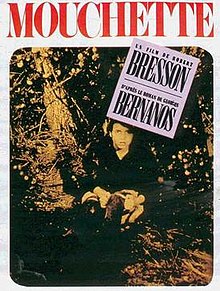
Film #64: Mouchette (1967)


Director: Robert Bresson

Initial Release Country: France

Times Previously Seen: none

Teaser Summary (No spoilers)

Sad young teen girl, in sad family situation, in a sad town, gets even sadder due to uncontrollable forces.

Extended Summary (More complete plot synopsis, including spoilers. Fair warning):

Mouchette (Nadine Nortier) is a 14-year old girl in a small town in France in the 1960s. She has virtually nothing going for her. She lives in poverty with a slowly dying invalid mother, a drunken thief of a father, and a helpless infant brother. Whether at school, at work, or removed from either, the only person who seems to value Mouchette at all is her mother, who is confined to her bed and is barely conscious most times. Otherwise, Mouchette is humiliated by teachers and classmates, abused and extorted by her father, and generally given little more than a passing glance by anyone else. Any brief moments of pleasure that she can steal for herself seems to be promptly quashed by some larger, oppressive force in her life.

At a local fair, Mouchette follows a young man she takes a fancy to. Soon after, she is slapped and derided by her domineering, scumbag father.

While sulking through all of this drudgery, Mouchette's life suddenly becomes more frightening and exciting. While hiding in the woods nearby her school to escape a heavy rain one evening, she is near a scuffle between the school's gamekeeper and a local poacher, Arsene (Jean-Claude Guilbert). The two men have romantic designs on the same woman in town, and the gamekeeper confronts Arsene. They tussle a bit and seem to settle their differences by sharing a few shots of liquor.

Some time shortly after, a drunken Arsene wanders through the woods and comes across Mouchette, still huddled under a tree. Arsene, thinking Mouchette may have seen something, brings her out of the woods and to a nearby shelter. Mouchette is aware that Arsene had fought with the gamekeeper, but neither she nor Arsene is sure of the exact outcome, which may have been a murder; Mouchette because she was not there and Arsene because he is too drunk to recall. To be safe, Arsene gives Mouchette an alibi that she can use for Arsene, in the event that the poacher has killed the gamekeeper. Mouchette seems to go along with it, out of either fear or some strange attraction to the nefarious rogue.

Arsene brings Mouchette to a safe-house in the town, where he plans to burn tons of firewood in order to corroborate his concocted alibi of being there all night. As he continues to grill Mouchette on their story, he goes into an epileptic fit. Mouchette comforts him briefly. When Arsene recovers, however, he becomes suspicious and will not let Mouchette leave. After a brief chase around the room, he captures her and forces himself upon her. She resists at first, but then relents to his sexual advance.

Mouchette is bullied by yet another force - the poacher Arsene.

Early the next morning, Mouchette returns home to find her mother in dire condition. After a brief exchange with her, her mother dies quietly, leaving Mouchette with only her father and infant brother.

The next day, as her father sits in mourning over his wife, Mouchette leaves the house on an errand for milk. On her way, she stops at a bakery, where the proprietress is kind at first, but turns insulting when a shaken Mouchette begins to act strangely. Mouchette then goes to the gamekeeper's house, where she unexpectedly finds the man alive and well. She is pulled inside and grilled for a bit by the man and a housemaid, the latter being more sympathetic. The two get the story out of Mouchette of what, exactly, happened with Arsene, with Mouchette embellishing slightly by calling Arsene her “lover”. Mouchette then leaves on her way back home. Along the way, she makes one last stop at an elderly townswoman's house. The woman rambles a bit, but tries to speak to Mouchette about her own life. She even gives the sullen young girl a dress with which to cover her deceased mother at the funeral. Mouchette merely hurls an insult at the old woman and runs out.

Instead of returning home, the thoroughly dejected Mouchette goes to the side of stream and looks out over the water. After some time pondering, she attempts to roll herself down the hill and into the water, only to be prevented by a collection of rushes on the bank. Once more, the girl goes back up the hill. Rolling down with more force of will, she send her body through the rushes and into the water, drowning herself.

Take 1: My Gut Reaction (Done after this first viewing, before any research):

Boy, these realist films don't play around.

Before watching Mouchette, I did the same thing almost anyone would do – I read the little summary on the DVD sleeve. Within that tight little sub-100 word reading, all of the following words and terms can be found: “...haunting...bleak, hopeless life...alcoholic father and terminally ill mother...grim surroundings...harsh...tragic tale...”

So yeah. I knew what I was in for.

With this foreknowledge, I was spared any nasty surprises, and I probably enjoyed the movie a little more than I would have. Still, it truly is a downer of a movie after which I can't help but ask “What's the point?”

Mouchette's visuals right up there with the best of the naturalist black and white films of Ingmar Bergman and others. While the director, Robert Bresson, used a few more cameras than Bergman, thus creating slightly more kinetic motion, he also used dialogue much more sparingly. Instead, he used wonderful visual storytelling a la the older silent filmmakers and contemporaries like Sergio Leone (though Leone told tales of a completely different ilk).


One of Mouchette's few pleasure. For several minutes, you can see every ounce of joy and attraction on her face as she rides the bumper cars around.

It's also not hard to see how different this film is compared to what was mainstream in the day. Yes, realism had already been around for a few decades, and had even achieved international recognition through films like the Apu Trilogy, Umberto D., Tokyo Story, and plenty of others. Of all of them, though, only the Apu Trilogy comes close to this sad tale of a lonely little girl who has nothing truly going for her, in terms of the weeping factor. And Mouchette goes even further down the road of depression, as the title character is left in the end with absolutely no hope, unlike the young Apu. Hence Mouchette's ultimate decision to end her own life.


Along the way, Mouchette's tale is told with heart-rending realism and subtlety. Often through mere facial expressions and body language, we can see every ounce of humiliation, anger, and even, short-live though it may be, joy that the girl goes through. One can realize that, while poverty is doubtlessly crushing for anyone, it might be even more so for a young person just reaching the age at which she is most emotional, quixotic, and malleable. The only moment of contact she has is a virtual rape. While it is understandable to see this scene with anger at the “she was asking for it” implication as Mouchette rapidly goes from resisting to embracing Arsene, I think it is incorrect. I took it to mean that Mouchette sees this horrific violation of herself as the only connection she can have with anyone. So much so that she even convinces herself that she is now Arsene's lover. Such is the result of utter poverty: physical, emotional, and spiritual.


The end is the icing on the cake, so to speak. I can't pretend to understand suicidal tendencies, but it's not hard to see how the title character's environment would lead to such a mental state. I suspect, though, that most viewers would, like I did, merely want to shake the girl and tell her to snap out of it. When she finally does herself in, I wasn't even sure what to feel. I would have to describe my mental state as the emotional equivalent of a shoulder shrug: “Oh, well. Saw that coming.”


Mouchette's first, failed, attempt at suicide. She gets it right on the next go-round.

As depressing as it all is, it wasn't as much of a chore to watch as I had feared. Mouchette's tale is told with the backdrop of a sexier story involving a jealousy between the gamekeeper and the rakish Arsene. With these more dynamic characters' confrontations adding a spice of energy to things, the movie avoids being an hour-and-twenty-minute drag.

If it isn't obvious from this review, I do not plan to watch this film again. As strong as the technical merits are, and as bold as it is for telling a harrowingly realistic tale, I can't see getting anything more out of repeated viewings. I would only recommend it to those who enjoy such melancholy fare, or are hard-core fans of very sound filmmaking.

Take 2: Why Film Geeks Love this Movie (Done after some further research.)

There's actually not much to be found on this movie, at least not in my basic searches. However, watching 2 of the documentaries offered on the Criterion Collection DVD that I had offered a little more.

The most interesting tidbit is why director Robert Bresson chose to tell the sad tale of the adolescent Mouchette, something he had done several times in previous films. Apparently, Bresson was fascinated with the malleability and unpredictability of adolescence. I can see his point – in this film, Mouchette succumbs to the abuse and neglect she faces. She attempts to get past it, but ultimately cannot. If this had been a Hollywood film, the title character would almost certainly have triumphed over the negative elements in some way. It may be far more cliche, but it doesn't make it any less probable. One never knows how a young person with react to adversity. Mouchette looked at the darkest side of it.

“[Mouchette] can't be summarized. If it could, it'd be awful.” - Robert Bresson.

After writing my own summary for this movie, I was glad to hear Bresson say this. The story of Mouchette (which is based on a French novel) is exceedingly simple. And yet, no summary can convey the tragedy and the reality of the tale. The truth is, you never quite know how Mouchette will react to the different forces acting on her, and therein lies the little bit of intrigue that can pull a viewer through the movie. It worked for me, even if the film isn't terribly exciting.

On a final note, I have to say that it was nice to watch a few “behind-the-scenes” documentaries about Mouchette. If nothing else, seeing Nadine Nortier smiling and laughing helped to wash the taste of the melancholic fatalism out of my mouth.

That's a wrap. 64 shows down. 41 to go.

Coming Soon: Bonnie and Clyde (1967):


Whew! After the Thorazine pill that was Mouchette, a rootin', tootin' Hollywood shoot-'em-up is just what I need. I haven't watched this one in many a year, so I'm looking forward to it.

Please be sure to pick up all empties on the way out.

Saturday, December 11, 2010

Film #42: Pather Panchali (1955)


* Pather Panchali is the 1st of a trilogy known as “The Apu Trilogy”. The 2nd and 3rd films, Aparajito & The World of Apu will be reviewed later in the list, but are considered a part of the same “film” by the reviewers at TIME who compiled the list that I'm working from.

Title for We English-Speaking Types: “Song of the Little Road”

Director: Satyajit Ray

Initial Release Country: India

Times Previously Seen: once (about 10 years ago)

Teaser Summary (Plot synopsis in 20 words or fewer. No spoilers)

Young Indian boy is born into poverty, lives with his sister, mother and oft-absent father.

Uncut Summary (The full plot, spoilers included. Fair warning)

In the 1940s (?) Bengal, India, the child Apu is born into a poor family. His father is a priest and poet who often struggles greatly to find work and pay for his family's needs. Apu's mother is a woman anguished by her own poverty, but is steadfast is trying to do right by her husband and children. Apu's sister, Durga, is roughly five years his senior, and is kindhearted, though she is mischievous enough to occasionally steal fruits from her wealthier aunt and cousins' nearby orchards. Also living with the family is their extremely elderly great aunt, who does little more than sit and make the occasional observation.

When Apu reaches the age of six, he is sent to school, a place where he finds the teacher rather frightening. By now, he has developed a very typical brother-sister relationship with Durga – the two annoy each other plenty, but genuinely love and protect each other from any possible harm, whether it be their scowling aunt, the absence of their wandering father, their sometimes angered mother, or the more abstract shame of being obviously poor.

Apu and Durga share a typical sibling moment.

One afternoon, with their father off in a large city to find work in either a religious or artistic capacity, a monsoon tears into the forest where Apu and his family live. Apu and Durga are stuck outside of their home, and Durga huddles close to her little brother to protect him from the relentless rains. After the storm passes, Durga takes horribly ill and dies within a few days. Apu's father returns the next day to discover the tragedy and collapses with his wife in grief.

In the wake of their daughter's death, Apu's parents decide to move the family away from their ancestral home and to the massive city of Benares, where they home to find more work, a better life, and leave their tragedies behind them. As a wagon takes the family away, Apu looks back on the only place he has known for his six years on earth.

Apu dons a hand-made prince's crown, perhaps suggesting a desire for greater things.

Take 1: My Gut Reaction (Done after this most recent viewing, before any research on the film)

Entrancing movie, if you're in just the right mood for it. If you're not, you're bound to find it slow, boring and may have trouble finding the point of it. I was in the mood, so count me in the former group.

Of the 42 films I've watched for this blog, Pather Panchali is easily the most humanist and naturalistic of the lot, and I suspect it may end up holding that title throughout the list. The story is the furthest thing possible from high drama that you can get. It's all about communicating all of the most basic, shared human emotions. The vehicle for this is the six year old boy Apu, a cute-as-can-be kid whose happiness, fear, love, disappointment, and shame shine as clear as day in his massive eyes.

This is the link to a great youtube clip that shows the great relationship between Apu and Durga. It's actually enhanced by the lack of English subtitles, as the dynamics, facial expressions, gestures and music tell the tale as well as any dialogue could.

The trick is that, on the surface, this story may seem as foreign as humanly possible. Not many of us in the Western Hemisphere would have an inkling of how a family in India lives, let alone a dirt-poor family in a small village in 1940s India. Yet, it only takes about 10 minutes of film to completely see so much of the universally human qualities being displayed in the tale Apu and his family. Even more than the stylistically similar Tokyo Story, Pather Panchali gives the feeling of watching a documentary rather than a piece of fiction.

This is not to say that the movie is solely a grim or depressing affair. Generously sprinkled throughout the tale of Apu's boyhood are many moments of good humor and pleasantness, those essential assets of survival for anyone in arduous conditions. His ancient great aunt makes a few good cracks and her constant threats to leave become rather amusing. The little looks of mocking and impish glee that Apu and Durga share between each other are bound to make anyone with a soul smile despite themselves. These lighthearted elements make it all the more tragic when Durga dies suddenly later in the film. These are no longer carefully crafted characters, but very real people whose pain is evident and evokes real emotion.

When I think about the acting, my educational background in anthropology kicks in a bit, and I try to think in term of cultural relativity. While I don't know what the standards are for Indian actors, the acting in Pather Panchali seems very solid to me. However, it's impossible to compare them to performances like Marlon Brando or Humphrey Bogart. Playing Terry Malloy or Rick Blaine is a different animal altogether, but the actors in Satyajit Ray's humanist drama do exactly what they are supposed to – act like completely real people. It's more subtle and perhaps not quite as demanding as the western tradition of drama, but it works marvelously for this movie.

The technical merits of the movie are fantastic. From the very beginning, as we follow a 7-year old Durga running through the forest, the soundtrack sitar playfully accompanies her traipsing along. This same instrument appropriately picks in during several other moments of joy and happiness in the film, and it's just one of several sound and camera elements that enhance the various moods experienced by the characters. The filming is done so that I felt very much like I had a excellent sense of Apu's little part of the Bengali forest and everything in it. It's very much the same feeling I get when watching Kurosawa's Seven Samurai – by the end of that movie, I feel like I know that little Japanese village, front to back. Pather Panchali has the same absorbing effect.

This isn't a movie for all comers. Like films that I've reviewed recently (Tokyo Story, Ikiru, Umberto D.), it's one that everyone should probably watch at least once, though one that I can hardly guarantee will be “enjoyed”. It is now clear that the 1950s was the beginning of the very real transition of films from mere fantastic, melodramatic storytelling medium to one of very somber, humanist tales. Up until this point, such things had been the purview of literature. No longer. Films like those aforementioned were clearly changing films as people knew them.

Entertaining? Perhaps not. Revolutionary? Definitely.

Take 2: Why Film Geeks Love This Movie (Done after some further research)

Being the first of a coherent trilogy, isolated research on Pather Panchali is a bit tricky. As such, I'll keep this section brief and do a more thorough look at all three films after watching them all.

One of the most remarkable things about Pather Panchali is that it was Satyajit Ray's first film, was done on a budget of approximately $3000 U.S., and that very few of the actors or production crew had any kind of experience in cinema. This undoubtedly lent the air of needed verisimilitude. For such a crew to create such a landmark film is indeed a rarity that speaks to Ray's unique vision.

However, the vision was not without its powerful influences. Probably the two most notable are the French director Jean Renoir and the then-blooming style of Italian neorealism. Apparently, Jean Renoir went to India to film The River, and was put into contact with Ray, who was then working as an illustrator and general film enthusiast. When Ray discussed his ideas for adapting the novel Pather Panchali, Renoir offered plenty of encouragement. After spending several months in London, absorbing every movie he could get his hands on, Ray returned to India with the mission of making his movie.

After watching such films as The Bicycle Thieves, the neorealist film by Vittorio de Sica and forerunner of other movies like Umberto D., Ray knew that this was the style that would best suit the tale of the young Apu in his impoverished Bengali village. When one sees both films, the similarities are as clear as day.

Critical reception of Pather Panchali was mostly glowing, though this was not universal. While many saw the movie as an incredibly powerful document of human life in a previously little-known segment of the world, others found it difficult to stomach. French film titan Francois Truffaut claimed to never want to watch “peasants eating with their hands,” and some in the Indian government thought the film was “exporting poverty”. Still, the detractors were outnumbered by those who found endless lyricism and merit in the movie.

A final, less important note is that the snappy sitar soundtrack was provided by none other than the now internationally famous Ravi Shankar (just how many sitar players can you name?), a then little-known musician who was just starting to carve out his career. This was just one of the many little things that fell into just the right place to make this singular movie.

Here's another link to the final moments of the movie. Be warned that it contains serious spoilers for anyone interested in watching the film and maintaining the power of the unknown. Otherwise, it's a good representation of the things that the movie conveyed.

Again, there is obviously more to the tale of Apu that is told in the second and third installments of the series, and a more complete run-down of the analysis will accompany my reviews of those movies. For now, though...

That's a wrap. 42 shows down, 63 to go.

Coming Soon: Smiles of a Summer Night (1955)


A relatively early film by the insanely prolific Swedish film icon, Ingmar Bergman. I've seen quite a few of Bergman's other film, which can be challenging, to say the least. This one, by the looks of the poster however, may be of lighter fair. We shall see.

Please be sure to pick up all empties on the way out.

Saturday, December 4, 2010

Film #40: Tokyo Story (1953)


Director: Yasujiro Ozu

Initial Release Country: Japan

Times Previously Seen: once (about 10 years ago)

Teaser Summary in Haiku:

Fogies visit kids
The children are too busy
Mama keels over

Uncut Summary (a full plot synopsis)

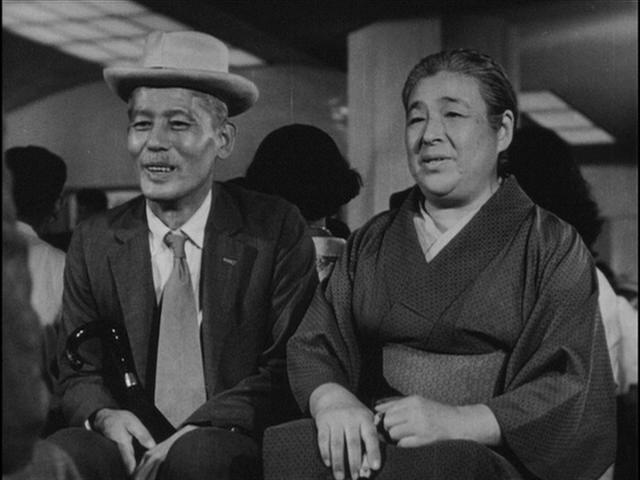
In 1950s Japan, retired Shukishi and Tomi Hirayama leave their home village in the south of Japan to visit their children in Tokyo. The elder Hirayamas are nearing their 70s and haven't seen their busy children in some time.

When they arrive in Tokyo, however, they are not afforded the pleasure of truly spending any quality time with any of their natural children. Their sons and daughters are all too busy with their work lives to make time or space for their parents. The Hirayama children even send their parents off to a nearby pricey spa, ostensibly for them to “relax,” but in truth merely to alleviate the nuisance of having to accommodate them.


Shukishi and Tomi Hirayama's pleasant demeanors mask deep disappointment.

The only one who shows any form of true welcome is their widowed daughter-in-law, Noriko. Through the Hirayama's interactions with her and a few of their older friends, we see that the old couple is coming to grips with the reality that they are no longer a part of their children's lives. After several days of being shuffled between houses, the parents decide to cut their trip a bit short and head back to their hometown.

On the train back, however, Tomi takes ill. By the time she and her husband reach home, she is in a coma. The children finally break away from their daily hustles to be with their mother on her death bed. After she passes away, three of the five callously rush to get back to their lives in Tokyo. The two who remain with their father, the widow Noriko and the bachelorette Kyoko, share a sad moment realizing that they both may likely become just as detached from their father as their siblings have, should they start their own families some day.


The surviving Hirayamas make their final farewells & realizations

Take 1: My Gut Reaction (done after this most recent viewing, before any research)

Oof. Good thing I watched this on a grey, rainy day.

Tokyo Story is about as melancholy as they come, made all the more sad by the sheer reality and fatalism of it, as well as the skill with which the story themes are conveyed.

In the same vein as Umberto D., director Yasujiro Ozu turns his gaze toward a younger generation's attitude towards its forebears. It certainly seems that the Hirayama family is meant to represent the larger Japanese society, one in which the modernizing world has no place for maintaining deep, steady ties with anything or anyone, including one's parents.

The thing is, whereas Umberto D. had a quicker pace, a few lively characters, and a cute dog as some comic relief, Tokyo Story gives it to you raw and is much further-reaching. The former Italian film was really about an isolated loner, but Tokyo Story is about a very average family, making it far easier to feel empathy towards the characters. The dialogue and acting is so naturalistic that it almost feels like a film ethnography. In fact, of all the 40 films I've seen so far, this one has the most naturalistic acting. This is what gives it its power, especially to one as myself – a person whose parents are still alive and nearing the age of the Hirayamas. It was impossible for me to not get reflective about so many of the things the elder couple brings to light: their mild disappointment in their children, their sense of loss at their detachment from them, and their sad acceptance that nothing is to be done about it.

Here's a great moment in which Shukishi is at his most unguarded about his children. This is also a scene that reminds me an awful lot of my own time in Japan. A little too much sake in the system, coming down over a steaming bowl of ramen. Start it at time 4:40:


The pace of this movie is something quite novel, relative to the other films from the list that I've watched thus far. I'm sure some people would have a hard time sitting through the measured, quiet moments depicting everyday life. As far as I was concerned, it did get a bit tedious, but I completely understand that this is necessary and intentional. Actually, by the end I found Shukishi and Tomi's slow, almost catatonic speech soothing and very much in keeping with what they were meant to represent: a more carefully, cautiously paced generation that was being left behind in the rapidly booming 1950s.

Part of my interest in this film certainly comes from the fact that I lived and worked in Japan for two years. Very much in evidence is the famed Japanese formality and ostensible kindness, which is a theme that Ozu later explored with his film Good Morning. Most Westerners may find alien the almost mannequin-like smiles that Shukishi and Tomi wear throughout nearly the entire film, despite their growing sadness. This is what makes the few moments that they break the formality all the more potent, if not very dramatic. Were anyone I know to ask what Japanese culture is like, I could show nearly any 10-minute clip from this 57-year old movie and feel confident that it stands as a solid representative of Japanese behavior and culture. One of the several very “Japanese” moments that stood out was an exchange between Noriko and Kyoko, when the latter says, “Isn't life disappointing?” to which a calmly smiling Noriko replies, “Yes.”

As alluded to, the technical merits of the film are beyond reproach, in my opinion. It may not have been the most challenging movie to film, or the most taxing on its actors, but everything is done to perfection. Long shots convey isolation, interior shots give the sense of relative claustrophobia inside the family houses, and it's not hard to buy into the Hirayama family as thoroughly authentic.

All of these accolades aside, this is another movie that I very likely will not see again, and would only recommend with several caveats. A person must be ready for a 2-hour, 15-minute gaze into the very real but very subtle generational tensions of a Japanese family. If this doesn't sound overly entertaining, it's because it isn't. Watching this movie is an exercise of a different sort. It's one that is probably worth making at least once, but not one that's guaranteed to touch everyone.

Take 2: Why Film Geeks Love This Movie (done after further research)

One doesn't have to do much research to confirm just why Tokyo Story has a place in film history: it's that rare and classic thing that does so much in reality while seemingly doing very little. All that's needed is the viewer's careful attention and patience.

In more detail and with more erudition than I could muster, David Bordwell's analysis carefully points out just how subtle Ozu is with his lack of camera motion and his refusal to cut away from a character while they speak. Roger Ebert covers the same ground, perhaps more thoroughly in this review. What both men point to is both just how Japanese the story is, while being equally accessible to any viewer with a marginally open mind.

In reading the essays echoing the theme of a slower, older generation (aren't all younger generations “faster” these days?), I almost can't help but wonder if Tokyo Story is the very thing that it speaks of. In an age when generation gaps and attention spans seem to be shrinking astronomically, will a slow and careful look at such gaps, which is what Tokyo Story truly is, eventually be dismissed and pushed to the side?

Here's a thoughtful clip of the very end of the movie, with the new widower, Shukishi, slowly absorbing his isolation with the same measured calm as everything else. Being at time 8:20:


That's a wrap. 40 shows down. 65 to go.

Coming Soon: On the Waterfront (1954)


“I could'a been somebody! I could'a been a contendah!!” One of the few films on the list that I've already seen and absolutely love. I can't wait to watch old Terry Malloy do his thing on the docks again. Come on back and see how I feel about my latest viewing of an irrefutable classic.

Please be sure to pick up all empties on the way out.