Showing posts with label Joaquin Phoenix. Show all posts

Sunday, February 16, 2020

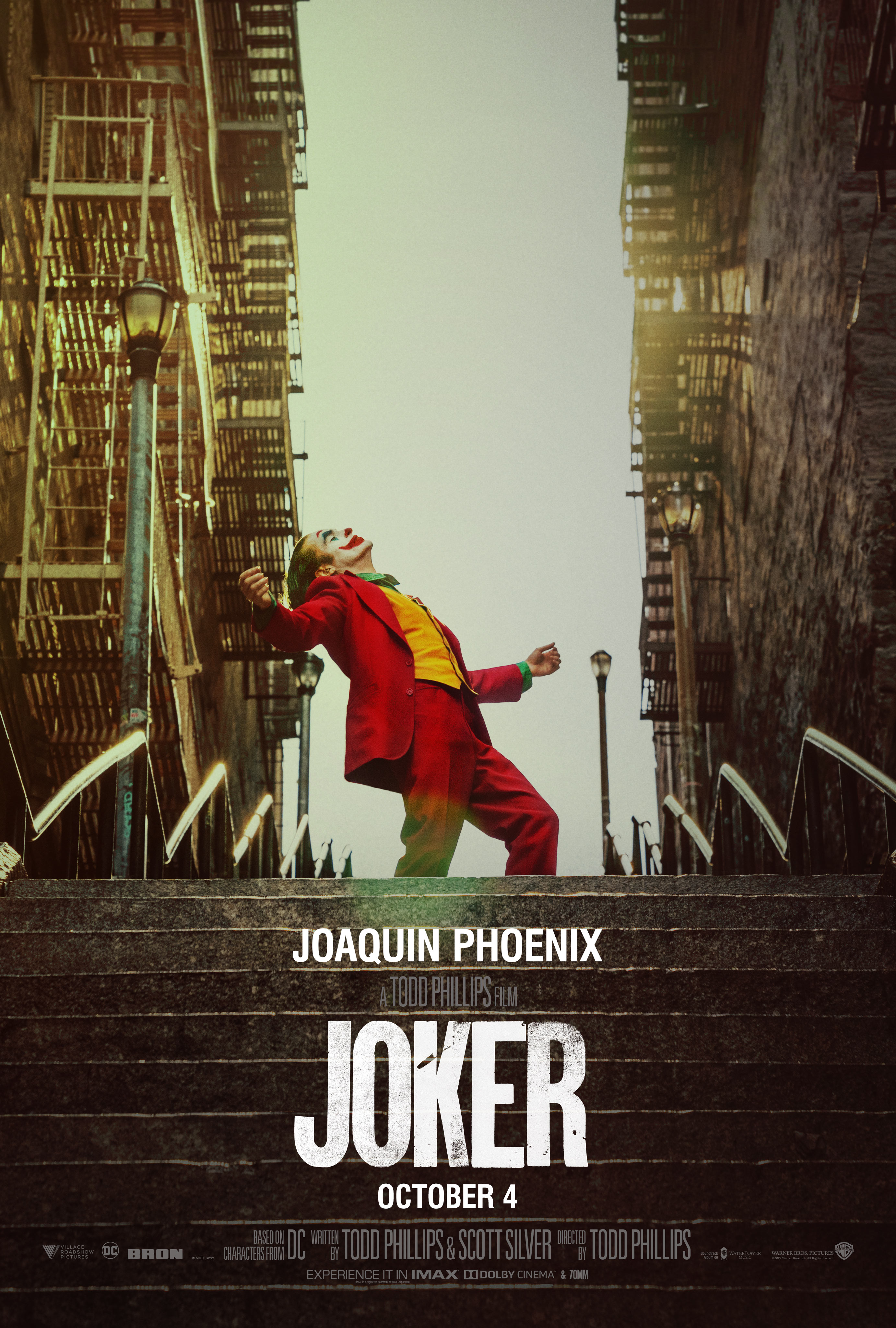
Joker (2019)

Director: Todd Phillips

Extremely well-done film that was compelling but grim enough to not demand a re-watch by me anytime soon.

Ostensibly offering a possible origin story for arch Batman villain "The Joker," Joker tells the story of Arthur Fleck (Joaquin Phoenix), a mentally troubled, severely down-on-his-luck man who is trying to find some place for himself in a grim and deteriorating city. Fleck is an aspiring stand-up comedian who lives at home with and cares for his invalid mother, while trying to make ends meet through menial clowning jobs around the depressed metropolis. In addition to generally being very awkward socially, he suffers from emotional swings and a condition which causes him to laugh hysterically and uncontrollably at random moments. When Fleck is bullied one night on a train, he lashes back and kills his tormentors, setting in motion a spiral into violence and true madness for not only Fleck but also the entire city.

More than any "comic book" movie I've seen, Joker has a very clear vision, and it is exceptionally dark. Writer and director Todd Phillips has himself admitted that he sort of hoodwinked Warner Bros studios by dressing up his movie as an origin story for one of the most famous villains in modern pop culture (in an interview on NPR, Phillips pointed out how the title of the movie is "Joker" and not "The Joker"). What he really offered was a brooding commentary on the state of modern U.S. society and its social ills. Fleck can easily be seen as one of the countless people afflicted with mental illness and carrying the burden of caring for unwell family members, but who have been abandoned by the world around them. Fleck and his mother have no other family, no friends, and early in the movie, Arthur's public assistance and medical care are stripped away from him, leaving him to deal with his myriad difficulties on his own. One doesn't have to look very far in the real world to see much of what is portrayed in Joker. The clarity and commitment to this theme distinguish this film from any other "comic book" movie that I can think of (and I've seen tons of them).

For a better comparison, one need only look at several of the grittier films by Martin Scorsese and Paul Schrader. Todd Phillips doesn't bother disguising the fact that he's drawing heavily from movies like The King of Comedy, Taxi Driver, or even the more recent First Reformed. All of these movies deal with angry men who are already teetering on the edge of sanity, and whom we see pushed off. Arthur Fleck is the latest version of a Rupert Pupkin, Travis Bickle, or Toller - people who are struggling to keep a toehold in society but fail in spectacular or violent fashion. What is impressive is not only that Phillips decided to draw from such dark inspirations for this kind of movie, but that he so clearly succeeded.

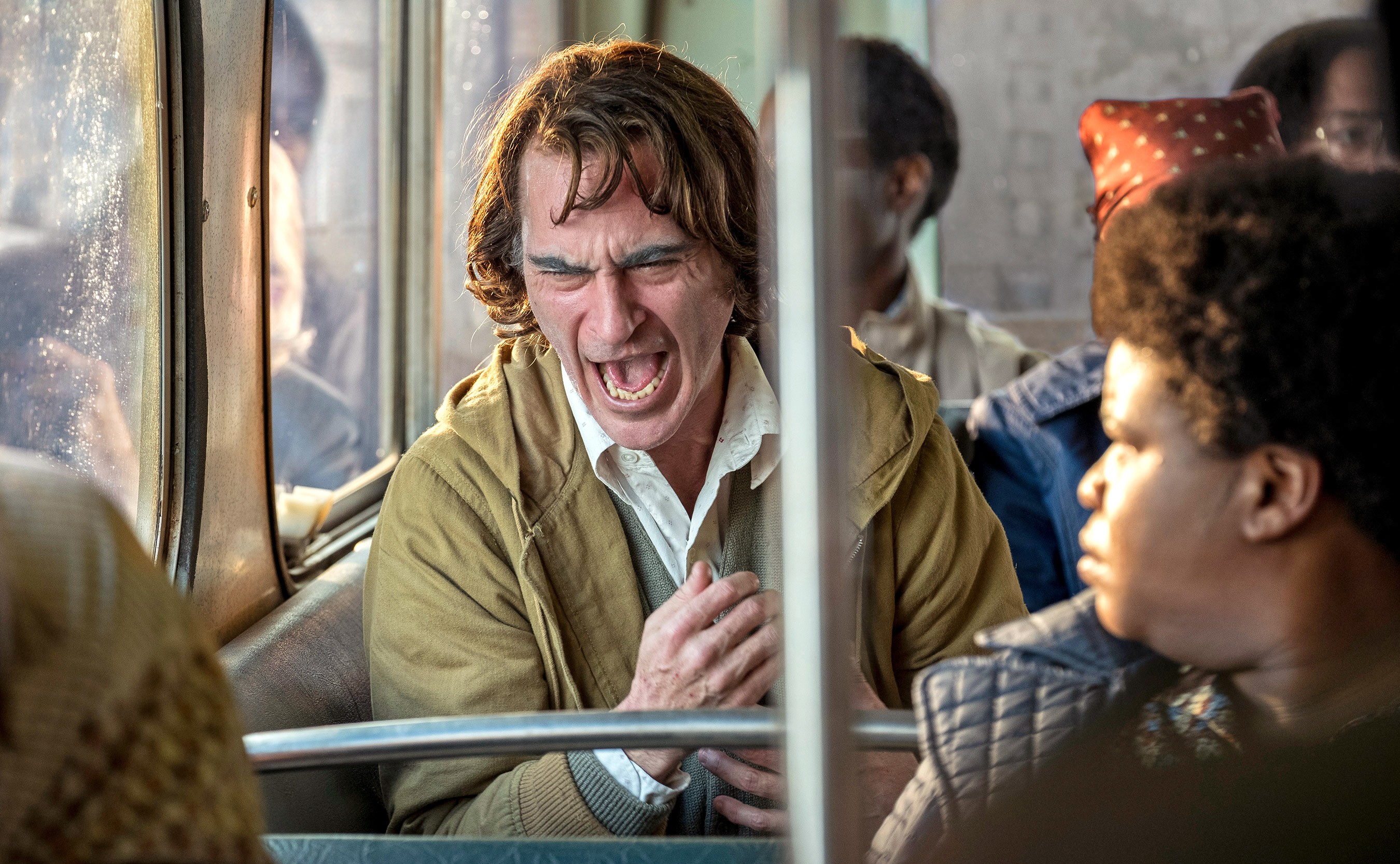
Arthur, in the middle of one of his uncontrollable and often
out-of-place bouts of laughter. As of now, Joaquin Phoenix is
the second actor to win Oscar Best Actor playing the
notorious villain of comic book origins.
By this time, I probably don't need to point out that Joaquin Phoenix's performance is brilliant (I write this only about a week after he won Best Actor for the role). It is truly a marvel, as painful as it is to take in. All of the supporting cast does a fine job as well, including Robert De Niro himself as an echo of the talk show host character played by Jerry Lewis in The King of Comedy. These performances, along with outstanding costume and set design, lighting, cinematography, and an Oscar-winning musical score, shape the story into something that really is a piece of art.

It must be said, though, that the movie is just as depressing as it sounds. Also in keeping with its inspirations and themes, this is not the easiest film to take. Yes, there are a few moments of dark and gallows humor in a few places, but for the most part this movie is one gut punch after another. And just like those aforementioned Scorsese and Schrader films, Joker is a great movie that I find too tough to take more than once in a very rare while. 

Sunday, November 29, 2015

New(ish) Releases: Inherent Vice (2014); What We Do in the Shadows (2015); Get Hard (2015)

Inherent Vice (2014)

Director: Paul Thomas Anderson

The Big Lebowski meets Fear and Loathing in Las Vegas. As you may imagine, this works brilliantly at times but is a hazy mess at others.

Inherent Vice bears many hallmarks of the noir film genre: A male detective protagonist. A (quasi) femme fatale. An array of strange and suspicious characters. A nefarious plot which grows complex enough to baffle nearly any viewer. The story was clearly taking from the pages of the earliest noir novelists like Chandler and Hammett, as well as the classic noir film directors such as Raoul Walsh and Billy Wilder.

Where Inherent Vice would seemingly take a different slant on the noir genre is how it makes the private investigator protagonist a semi-burned out stoner, Larry "Doc" Sportello (Joaquin Phoenix). That is, it would be a different slant if the Coen brothers hadn't already done it nearly 20 years ago in The Big Lebowski. Granted, there is far less comedy and far more grasping for some sort of vague profundity in Inherent Vice. Still, it is impossible to watch the parade of comically bizarre and eminently "Los Angeles" characters and not think of the dozens of oddballs whom The Dude encounters while trying to track down Bunny Lebowski. The Dude had Walter, Jackie Treehorn, Maude Lebowski, the German nihilists, and plenty of others. Doc has Michael Wolfmann (Eric Roberts, in a solid performance), Detective "Bigfoot" Bjornsen (Josh Brolin, the same), Jade the hooker, Dr. Blatnoyd, D.D.S., the Nazi skinhead bikers, and plenty of others. Vice is clearly the spiritual successor of The Big Lebowski's tale of "a strange dude among far stranger and scarier people." It does make for a rather fun, trippy, 20th century American odyssey.

I have not read Thomas Pynchon's source novel, though I must assume that it provides the film adaptation's inconsistent, incoherent voice-over narration. Amidst what is sometimes very straightforward slapstick or gumshoe storytelling, the thoughts and observations of the nebulous character Sortilege often seem out of place and pretentious, if not downright ridiculous. The main characters also suffer from this same strange inability to completely flesh themselves out, whether through their actions or dialogue. It is simply quite difficult to get any firm grasp on who or what each person is supposed to be. When you mix in the sometimes-frantic tone, which I associate with Terry Gilliam's wildly uneven adaptation of Hunter S. Thompson's Fear and Loathing in Las Vegas, then there tends to be just a little too much emulation of earlier iconic pieces of work. Honestly, Inherent Vice even has Benicio del Toro in a cameo playing a fast-talking, unhinged lawyer, just like in Fear and Loathing.

All of this said, I will likely watch this movie again in the future, probably after reading Pynchon's novel. The performances are certainly commendable, even hypnotic at times. The movie seems strongest when at its most comical, even if this is also when it wanders too deeply into the territory of being a Lebowski clone. The story also includes enough of the noir hallmark twists and turns to provide amusing mental exercise in simply keeping up with everything. Some of the work pays off, while some left me wondering at the exact purposes of certain parts of the film.

Inherent Vice is another film in the Paul Thomas Anderson catalogue which shows the director's eye for visuals and dedication to crafting something engaging. This recent effort, though, is arguably his least accessible film to date. Those who like a clear, straightforward narrative and tone will probably find this 140-plus minute movie frustrating. Even those who appreciate elements of the film will likely find their patience tried more than a few times.

What We Do in the Shadows (2015)

Directors: Jemaine Clement and Taika Waititi

Maybe not quite an instant classic in the Spinal Tap class, but this is a great mockumentary.

Mimicking the tone of "days in the lives of" documentaries, What We Do in the Shadows follows four flatmates in New Zealand who happen to be vampires, ranging in age from around 150 to over 8,000 years old. Though having all of the powers glamorized through popular fiction, the four undead roomies are not immune to many nuisances similar to those experienced by the living, though their problems have very peculiar twists. They bicker about who has to clean the dishes, but they do it while floating in the air and hissing at each other. They try to keep the carpets clean, but mostly from their accidentally hitting a victim's artery and spraying blood all over the apartment. Since they can't cast a reflection in a mirror, they have to draw rough sketches of each other in order to know what they look like. And on it goes.

The movie is hilarious in a variety of ways. Some of the gags and lines are immediately and gut-bustingly funny. Others are far more wry, but they are likely to stay with you and grow funnier the more you think about them. One example is how the vampires, in their attempts to go clubbing, are constantly frustrated by the fact that they must, in keeping with well-known vampire lore, be invited inside. Watching the main trio of powerful creatures get turned away from club after club grew funnier the more I replayed it in my mind. This was just one of dozens of similar gags.

The cast is all but perfect. True to the humor seen in director/star Jemaine Clement's HBO series The Flight of the Conchords, everything is done in complete deadpan. The actors were, to a person, spot on in their absurd matter-of-fact approach to being vampires, meeting vampires, or even being eaten by vampires. A particular standout is co-director Taika Waititi, who plays Viago, the single most amusing and memorable character in the film. Viago was born in 18th century Austria, and is a hilariously chipper "dandy," as his roommate and fellow vampire Vladimir calls him. Waititi plays this undead creature of the night with such hilarious cheerfulness that his performance alone is worth your time.

I have a feeling that this movie will only grow funnier upon repeat viewings, as do the very best mockumentaries.


Get Hard (2015)

Director: Etan Cohen

Enjoying this movie requires two simple things: Be a fan of either Will Ferrell or Kevin Hart, and check your brain in before you watch it. I am, and I did, and I had just enough fun to justify spending 100 minutes with this comedy.

The  movie has problems, to be sure. The script and tone smack of disorganization and overreliance on improv by the highly energetic co-stars. The attempts to use race and racial stereo-typing as sources of humor sometimes fall flat at best, and horribly offensive at worst. Many of the scenarios are far too ridiculous to hold up to even the slightest bit of scrutiny. All the same, it provided just enough of the stupid humor that I was looking for that night.

My main concern going in was that I would find the hyper-active Kevin Hart extremely annoying. Blessedly, he's the far straighter character, resulting in his toning down his energy level enough to remain funny without getting too clownish. Ferrell is the far more ridiculous character here, which has always been his comfort zone. Between his occasionally manic outbursts and deadpan absurdity, he can carry many would-be dud scenes. Granted, there are several scenes so ill-conceived that neither Ferrell nor Hart could breath humor into them.  All the same, I got a good solid laugh every 5 or 10 minutes, which is all I really look for in a movie that clocks a 29% positive rating on Rotten Tomatoes.

The most frustrating thing about movies like Get Hard is that they have far more potential. In the opening scenes, it seems as if we are in for a well-done satire on wealth, privilege, and racial stereotyping. Around 15 minutes in, though, the satire fades and an oddly serious tone takes over. The remaining hour or so continue to zig-zag between complete zaniness and half-baked or misguided attempts at social commentary. If the movie had had a clearer vision of itself and more imagination and courage with the script, it could have been far better. As it was, it ends up in the same barrel as Talladega Nights - an intermittently funny flick that I'll never watch again. 

Sunday, September 28, 2014

Retro Trio: Made (2001), Escape Plan (2013), We Own the Night (2007)

Made (2001)

Director: Jon Favreau

In a word: lame.

The look on Favreau's face here is pretty
much how I felt watching this movie.
This was a surprise for me, since I've generally liked Favreau's writing and direction in his various films. From Swingers to Elf to the first two Iron Man movies, I thought he was solid enough, if not exactly spectacular. I don't put him in any kind of pantheon of great directors, but he's solid. Even films of his that I wasn't terribly enthused about, such as Chef, are well-done, for what they are. 

So it was disappointing to watch this earlier stab of his at spoofing the mafia genre. It's not hard to see what Favreau was trying to do - throw a couple of bickering buddies into the lower levels of the mafia that has been glamorized by countless great movies. But it never gets any real steam. First of all, Vince Vaughn's character is supremely annoying. I'm no Vaughn hater (even though he has absolutely zero range, outside of playing himself), and I actually think he's hilarious when cast in the right movies. But imagine his typical motormouth character firing off line after line, without a single thing actually being funny. Well, that's what he is in Made. I actually wanted him to get whacked after about 15 minutes.

Second off is that the story rambles through a sluggish and vague narrative that seems to have been meant as a mafioso Odyssey of sorts. There are a few mildly amusing scenarios here and there, but most of the scenes simply drag. In the end, the big "reveal" of the plot only made me think that the movie should have been about 45 minutes shorter and saved us viewers the trouble.

This movie had potential, with a decent idea and really good cast, including Favreau, Vaughn, Peter Falk, and about half the cast of The Sopranos. Alas, the whole was far, far less than he sum of its parts. So much so that I was surprised that it made a "Top 100" list of gangster movies compiled by a few Philadelphia area film aficionados. Not sure what they were seeing on this one. 


Escape Plan (2013)

Director: Mikael Haefstrom

This movie fell just slightly on the wrong side of "mediocre." It's not terrible, but there's no way one can call it "good." 

The plot is all but given away by the two-word title. Stallone plays Ray Breslin - a security professional who breaks out of prisons in order to expose any weaknesses, so that they can be corrected. When his services are procured by a a mysterious woman working with the C.I.A., things start to go wrong. All of his safeguards are stripped, and he is truly stuck in a high-tech, ultra-secret, maximum security prison which is completely off of the grid. Inside, he meets a sly German inmate (Schwarzenegger) who takes great interest in his demeanor and skill set. From there, the two try to (you guessed it) escape.

Escape movies' biggest strength is always waiting to see just how the escapee will use his cunning to make his way past all sorts of obstacles to gain his freedom. In that respect, Escape Plan gets it right. The set up is fine, and the super max prison presents a few interesting obstacles that Breslin has to surmount. But none of them are so creative that they become memorable. Breslin's methods for studying and using his environment are just compelling enough to have kept me watching, but they weren't exactly mind-blowing.

One must absolutely NOT think too hard about this movie's story. There are a laughably high number of logical inconsistencies. I was able to shrug them off for the most part, as it didn't take too much away from the escape element of the movie, but they are pretty bad. If the very reason for the prison's existence doesn't hold up to some mild questioning, then the scriptwriters have done a pretty poor job. There are more than a few other massive oversights that are nearly as awful, so a viewer will need to be ready not to analyze things too closely. You'll only be disappointed.

The aesthetic is just hilariously bad. Clearly going for style over any kind of pragmatics, the prison design is unnecessarily silly, and the guard uniforms look like bad Halloween costumes. Style over substance can work, as long as there is actual style. Escape Plan's notion of "style" equated to what an 11-year old boy would find "cool-looking."

There is also one missing element that I had mixed feelings about. When you sit down to watch a movie with Stallone and Schwarzenegger, then you would expect more than a few one-liners, right? Well, this movie is woefully lacking in that department. Yes, there are a few attempts at some zingers here and there, and one or two of them are half-decent. But mostly, the banter is absent, and much of what is there is thoroughly forgettable.

Do I feel like I wasted my time watching this? Not quite, but close. And there's absolutely no need for me to watch it again. It's a barely passable popcorn flick that you can turn your brain off for, and we all need one of those every once in a while. 


We Own the Night (2007)

Director: James Gray

A good crime flick, if not quite an outright "classic."

The movie tells the tale of Bobby Green - a self-absorbed, semi-outcast brother of one cop and son of another. Played by Joaquin Phoenix, his is a story of self-actualization and transformation through suffering. It's a unique story for the crime film genre, in the type of character that serves as the focus, and just how that character evolves throughout. While it does seem a tad extreme and rushed to an all-too tidy ending, it is a rather satisfying arc.

The movie's two greatest strengths are the acting and the fact that it doesn't pull too many punches. The large-scale "crime" conflict is between the local cops and an ever-increasing Russian mob presence, and Bobby is caught between the two. The tightrope that Bobby walks through most of the movie is constantly wavering in the winds of his own indecision, and we viewers know that he will eventually fall off. The suspense comes from waiting to see if Bobby will make the choice of which direction he falls towards, or if the decision will be made for him. The emotional ramifications make for great theater, as Joaquin Phoenix wears the struggle exceptionally well. He has to struggle through several dilemmas that threaten either his body or his peace of mind, without a single easy answer or fully acceptable outcome for himself or his loved ones. The grey areas certainly set this film apart from many others of its ilk.

Though much of the movie focuses on emotional turmoil, there are certainly several highly suspenseful action sequences, which are quite well-done and affecting. More than simply adding some visceral excitement to the proceedings, they often serve to jar Bobby out of his sometimes paralyzing indecision.

The clearest weakness to me is simply that the transformation goes a bit too far, by the end. I won't give anything away, but the end of Bobby's journey went to a place that I thought oversold just how far he had transformed by story's end. It hardly ruins the film by any means, but it wasn't completely to my liking.

A very good movie that I would certainly recommend to anyone who is a fan of more sophisticated crime tales that focus more on individual character study and transformation, rather than the more procedural elements of most crime films.