Showing posts with label Joe Pesci. Show all posts

Wednesday, January 29, 2020

The Irishman (2019) [No spoilers]

Spoilers ahead (it's mostly historical record, though).

Director: Martin Scorsese

It's a mammoth of a gangster movie by arguably the greatest director of such films, and it is among his very best.

If you only know a few of Scorsese's rather large and impressive filmography, chances are that Goodfellas and Casino are two of them. They both offered dramatic re-tellings of real-life events in the world of organized crime. In Goodfellas, we saw the rise and fall of Henry Hill, a street-level soldier for the Italian mafia in New York who, after living the criminal life from the 1960s to the early 1980s, turned state's evidence and testified against his former colleagues and bosses. Casino followed the closely intertwined lives of Sam "Ace" Rothstein and Nicky Santoro, who both served to help the mafia carve out a solid niche in Las Vegas during the 1970s. Both movies offered us a view of the rises and falls of the more violent, influential mafia figures, but seen from the perspective of guys - Hill and Rothstein - who were just far enough away from the truly violent and powerful that they avoided complete disaster.

The Irishman follows a very similar blueprint, for most of the way. Scorsese mainstay Robert DeNiro plays Frank Sheeran, an Irish-American truck driver and World War II veteran who eases his way into working for the Italian mafia during the 1950s. Through a chance encounter with Russell Bufalino (Joe Pesci), a high-ranking mafia boss, Sheeran soon works his way into becoming a reliable hitman. Despite being a foot solider, he builds a great deal of trust with Bufalino, who eventually introduces him to Teamsters Union president Jimmy Hoffa (Al Pacino). At this point in history, the mid-1950s, Jimmy Hoffa was about as famous a figure as there was in the United States. A hard-nosed and charismatic people's man, Hoffa was never above a little strong-arming and bribery to accomplish his goals, which were often to the benefit of himself as much as the Teamsters. Sheeran and Hoffa strike up a friendship, with Sheeran becoming Hoffa's bodyguard and occasional confidante for a number of years.

In the succeeding decades, Hoffa's star famously falls, starts to rise again, and then completely disappears under famously mysterious circumstances. The Irishman, however, offers an answer to the mystery - that a highly conflicted Sheeran played a role in sabotaging and assassinating Hoffa after he refused to take marching orders from the powerful mafia figures with whom he had previously worked. After Hoffa's death, Sheeran himself remains connected to Bufalino in both professional and friendship capacities. Eventually, though, Bufalino and all of Sheeran's human connections to the mafia and Hoffa pass away, leaving him the last one alive to recount his tale a few decades later.

The epic scope and the sordid nature of organized crime dealings prevalent in The Irishman will feel very familiar to anyone who knows Scorsese's mafia flicks. Some low-rent, morally dubious dude is lured in by the money, and gets a front row seat to some pretty dastardly business, all set to a great soundtrack. But The Irishman does offer something more. Sure, the thugy killings and beatdowns are there. Yes, the hilarious exchanges between not-so-smart guys trying to sound smart are there. But what elevates this movie above even Scorsese's past mafia masterpieces is the final analysis of Sheeran. In the much quieter final 30-or-so minutes of the movie, we see Frank Sheeran reckoning with the cost of his loyalty to Bufalino, Hoffa, and forces far more powerful, personal, and spirit-crushing than he ever quite realized. It all leaves a much deeper impact than Scorsese's earlier mob movies, not unlike how Clint Eastwood's Unforgiven left an indelible final stamp on his own career in Western movies.

As important as any of the typical gangster-film violence in
the movie is the bond that forms between Frank and Jimmy
Hoffa, as well as Russell Bufalino. In the end, Frank has to
live with the decisions he made regarding both, which is
far from easy.
The only thing that might be surprising about the fact that The Irishman is so technically brilliant is that Martin Scorsese is still doing this in his late-70s. The movie is no less sharp or eye-catching than anything in his exemplary career. And it was probably his age, wisdom, and the fact that Netflix granted him the freedom to make a three-and-a-half hour movie that he could extend his previous boundaries a bit and offer broader circumspection on a character type whose story he's told so expertly several times before.

It feels a bit silly to nitpick over such a well-crafted movie, but there were a few things that I couldn't help but notice. Mainly, the fact that DeNiro and Pesci, both 76 years old, are playing characters over a span of four to five decades. Rather than find younger "look-similars," Scorsese had the late-septuagenarians play their own late-30/early-40 year old selves in the earlier flashbacks of the tale. And no amount of makeup and costume ingenuity could cover all of that up, making few of the scenes from the earlier times a tad distracting.

That little gripe aside, it's an excellent movie. The length and relatively somber final act may prevent me from firing it up again anytime soon, but I'll certainly see it again in the future. 

Friday, November 23, 2012

Film #90: Goodfellas (1990)


Director: Martin Scorsese

Initial Release Country: United States

Timed Previously Seen: probably around eight or nine. Maybe more. 

Rapid-Fire Summary

Goodfellas is a rather epic movie, spanning several centuries. I’ll keep my summary short, but if you want many more of the details, you can check out the synopsis here at imdb’s website. Here’s my version:

In the late 1950s in Queens, New York, young teenager Henry Hill has big dreams. He dreams of becoming a gangster, like the fellows that he sees regularly on the streets of his neighborhood. Though his parents completely disapprove, Henry gets more and more involved with the crime circuit in the area – starting with simple errand-running for book-makers, progressing to orchestrated property destruction, and advancing to the sale of stolen goods. The more he gets entrenched in the life of a criminal, the more he feels welcomed by his fellow criminals, and the more normal it all becomes for him.

This normalized life of larceny follows Henry into adult life (played by Ray Liotta), when he regularly partners with two other noted crooks – the thief and hitman, Irishman Jimmy Conway (Robert De Niro) and the volatile yet charismatic Sicilian mobster Tommy DeVito (Joe Pesci). These three, along with many other local hoods, spend the next few decades of their adult lives robbing, and occasionally killing, their way to lives of luxury for themselves, their wives, children, and mistresses. Though their methods of attaining wealth are highly illegal, all of them keep up the appearances of being responsible family men who are “providers” for their friends and families. This is all in keeping with the Italian mafia tenets of organized crime, to which all of these three men pay homage.

Tommy, Henry, and Jimmy taking a look at on of their many stashes of ill-gotten money.

Eventually, however, things start to crumble. Starting in the later 1970s and into the early 1980s, Henry starts to get involved in selling cocaine. Despite clear warnings from the mafia father-figure, Paulie Cicero (Paul Sorvino), Henry continues to sell the highly illegal substance. His mistakes catch up to him, and he is caught by the police. Now facing the very likely prospect that he will be killed by any one of his criminal associates, in order to prevent him from informing on them, Henry and his wife Karen (Lorraine Bracco) decide that their only recourse is to join the witness protection program. Henry testifies against all of his former friends and criminal associates, thus escaping jail time. However, he lives out the rest of his days in a sterilized suburban neighborhood, far removed from the action, money, and excitement of his former life of crime.

My Take on the Film (Done after this most recent viewing)

Goodfellas is an absolute classic, and it may be the only English-language mafia movie that can hold a candle to The Godfather, in terms of scope, technique, and revolutionizing the genre.

I first saw this movie in the theater when my mother brought me to see it. I was only fourteen or fifteen at the time, and I remember the language blowing me away. The characters drop the f-bomb like most people blink, and violence is as normal as getting a haircut. About an hour into the movie, my mother, who grew up in Queens right at the time that this movie’s events were taking place, leans over to me and says “I think I grew up with these guys.” Now, she didn’t mean that she literally grew up with Henry Hill and the gang; she just meant that she grew up with guys eerily like them. She always said that the dialogue and attitudes depicted in Goodfellas were spot-on, in terms of how the guys from those neighborhoods spoke and acted.

This authenticity has been a hallmark of Scorsece’s New York pictures right from the very beginning. While he’s certainly done other excellent movies that are not based in New York (The Departed, Kundun, et al), his street-level stories have always been his signature ones. The verbal exchanges in Goodfellas, like Raging Bull and Taxi Driver, feel completely organic. Despite being so deeply rooted in a particular region, even people who have never been within a thousand miles of Long Island can sense and be hypnotized and amused by it.

Just another night of booze and poker. This is one of the many scenes in which the dialog and interactions between the New York tough guys are at their most realistic. 

But the dialogue is simply one of several triumphs of this movie. If The Godfather was the ultimate American criminal take on a classical Greek tragedy, Goodfellas is the ultimate deconstruction of the gangster myth. Based on the real story of Henry Hill, the movie depicts the ground-level thugs who made the mob go. There are no honorable Vito Corleones here. Henry Hill and his cohorts were unapologetic thieves and murderers who reveled in their power over others. One line that sums them up fairly well is when Henry Hill is describing Jimmy: “The one thing Jimmy loved to do was to steal. I mean, he actually liked it. Jimmy was the kind of guy who rooted for the bad guys in the movies.” These guys knew they were bad, embraced it, and pummeled anyone who had a problem with it.

Tied to this is probably the element that truly sets the movie apart from other classic gangster movies. Through Henry Hill’s life story, we see the complete and utter sham that the “honor” of the mafia is. All of the seeming friendships that Henry makes are only authentic as long as they don’t threaten any of his fellow thieves’ illicit livelihoods. The moment any one of the crew is suspected of threatening others’ freedom and fortunes, that crew member is not long for this world. The camaraderie is revealed as shallow in the face of real adversity, as evidenced by the protagonist himself. After decades of thinking of his criminal associates as family, he turns on them to protect himself and sends them all to prison. Goodfellas may have been the first film to so carefully and stylishly deconstruct the myth of honor among mobster thieves.

Normally, much of the above would make for thoroughly repugnant, unwatchable characters. Yet herein lies one of the most brilliant part of this movie – at times, you forget what they are and get completely caught up with who they are. Whether it’s Tommy cracking up his fellow mobsters with hilarious stories, Jimmy railing against the stupidity of his partners in crime, or Henry trying to juggle his passionately crazy wife and mistresses, it’s simply fun to watch. Most of the time, you laugh at them, but some of the time you actually laugh with them. There are even times when you feel a twinge of sympathy, as when Henry learns that Karen has flushed their bags of cocaine, their only remaining source of revenue, down the toilet, effectively flushing his entire life down the toilet. His desperation and fear are so palpable that you might be tempted to forget, just for a few seconds, that it’s all his selfish own doing.

Karen visits Henry while he serves time. At this point, it almost seems as normal for us the viewers as it does for the troubled couple and their kids.

All of these moments come through in large part due to the acting. While De Niro rightfully got top billing for this movie and did an outstanding job as Jimmy, it was Pesci, Liotta, and the entire ensemble crew that fully rounds out the picture and makes it come to life. By using that rare combination of world-class actors with lesser known, fully capable New York regionals, not one moment of Goodfellas rings untrue. For the full two-and-a-half hours, they pull you right into a completely different world.

It goes without saying that Scorsese was arguably at his finest with this movie. The cinematography, editing, and music are all blended into a fast-paced story that hums along without missing a single beat. Of his great films (of which there are many), this one is arguably his very best, and one would be hard-pressed to find much fault with it. At this point, anyone who is into crime movies has seen and loves this film. If, by chance, you haven’t seen it, do yourself a favor. As long as you are not put off by rough language and graphic violence (none of which is gratuitous, by the way – we need to see how visceral these thugs can be, lest we start to glamorize them), you need to watch this true modern masterpiece.

Henry takes one last look at us from his quaint little house, courtesy of the Witness Protection Program. While he survives, he would hardly call it a "life," as he came to know it on the streets of New York.

A side-note: Any fan of Goodfellas should watch Casino. It’s sometimes called “Goodfellas 2” with good reason. It’s certainly not a sequel, but so much of the tone and feel of it is the same, that one might feel like they’re watching the companion piece to the earlier film. Casino is a bit more sprawling, and some say bloated (I disagree), but it’s another excellent film in the same vein.

That’s a wrap. 90 shows down. 15 to go.

Coming Soon: Unforgiven (1992)


From the movie that deconstructed mafia gangsterism to the movie that deconstructed the American Western film. This is another of my absolute, hands-down, all-time favorites. I’m looking forward to watching it again and writing out my thoughts on the dark tale of Will Munny. 

Friday, April 20, 2012

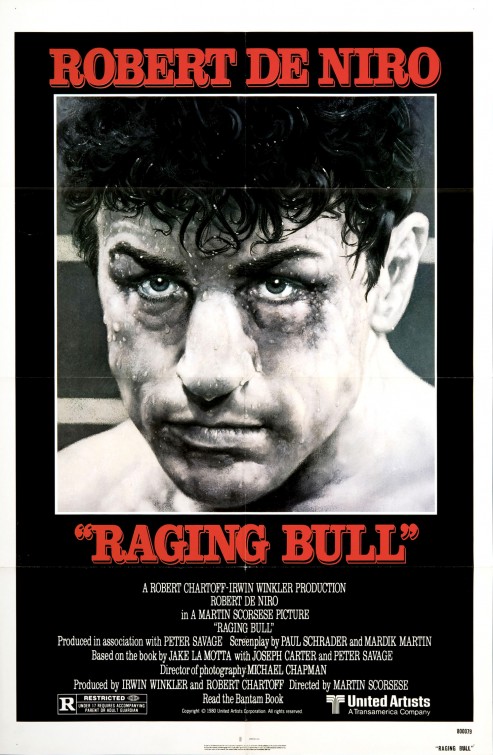
Film # 79: Raging Bull (1980)


Director: Martin Scorsese

Initial Release Country: United States

Times Previously Seen: three or four (last time – about 5 years ago)

Teaser Summary (No spoilers)

Real-life boxing champion and general dealer in violence Jake LaMotta doles out serious beatings to opponents in the ring, as well as to his closest family members outside the ring.

Extended Summary (More detailed synopsis, including spoilers. Fair warning.)

It’s the early 1940s, and middle-weight boxer Jake LaMotta (Robert De Niro) is coming into his own. A bruising, tenacious fighter from the Bronx, New York, LaMotta makes up for in sheer will and toughness what he lacks in grace and technique. His punishing style of boxing has him on a path towards a championship title fight, except for the fact that his way is blocked by the New York mafia, which controls boxing in order to manipulate outcomes to its own advantage. Jake’s manager and younger brother, Joey (Joe Pesci), tries to convince Jake to relent and allow the mobsters to help them get their title shot, but the eminently stubborn Jake refuses any outside assistance.

Jake soon becomes infatuated with a fifteen-year old neighborhood girl, Vicki (Cathy Moriarty), for whom he leaves his wife. After a few years, the two get married. Jake grows ever more jealous and controlling of Vicki as the years go on, relentlessly questioning her every move and suspecting every man around her as trying to take her from him. Through it all, Jake continues to win fight after fight in the ring, though he is still refused any shot at the title. Even after two solid fights, including a victory, against the other prime fighter of the era, Sugar Ray Robinson, Jake is blocked from championship contention by the corrupt powers that control the sport.

Joey and Jake, sweating it out in a training session. Despite Jake's prodigious in-ring toughness, the mafia blocks their title shot for years.

Jake continues to win in the ring, with his main rival Robinson now in the army. He even pummels a supposedly handsome up-and-coming young fighter into a bloody mess, after Vicki offhandedly calls him “good-looking”. Shortly after this fight, with Jake out of town, Joey spies Vicki in a bar with a few local men. Though her evening out is innocent enough, Joey loudly proclaims that Vicki is embarrassing his brother, and he demands that Vicki go home. She refuses, Joey becomes enraged, and attacks one of the men she’s with, local Mafioso and former friend, Salvy. The fight is soon straightened out by the local Mafia boss.

Jake is then allowed his title shot by local gangsters, but on one major condition – he must throw the fight so that the mob can make a killing by betting against him. Jake reluctantly accepts. Throwing the fight, though, is easier said than done. His opponent, Billy Fox, is far inferior to Jake. Jake almost knocks him out on accident, and then refuses to fall down at any point in the fight. The fight is stopped and victory briefly given to Fox, but an investigation in launched and LaMotta is banned from boxing for a time. However, when the ban in up, he receives his first true shot at the title, winning convincingly against current champion, Marcel Cerdan.

Three years pass, and Jake manages to retain his title throughout, though maintaining his fighting weight becomes more and more difficult. One day, he begins to question Joey about the fight that he had with Salvy. Jake, now so obsessed with jealousy over his wife, suspects that Vicki has been having affairs, including with Joey himself. Joey refuses to answer the interrogation and leaves. Jake then begins to question Vicki, who is frustration sarcastically screams that she has had affairs with every man in the neighborhood, including Joey. Jake, too enraged to see that his wife is being sarcastic, storms over to Joey’s house and begins to beat him unmercifully. Vicki catches up and tries to stop Jake, but Jake knocks her out with vicious punch to the face. When the dust settles, Vicki starts to pack up and leave Jake, but decides to stay after Jake apologizes and begs her forgiveness.

Jake wins his next fight, and tries to call Joey afterwards, in order to try and mend their broken relationship. The attempt fails, though. Jake’s next fight against Sugar Ray Robinson is a bloodbath. Jake, either outmatched or simply in a completely masochistic temper, allows Robinson to land vicious blow after vicious blow, though he refuses to fall down. The fight is stopped, and Jake loses his championship title.

The Bronx Bull, in the midst of getting mangled by long-time rival, Sugar Ray Robinson. It all goes downhill from here for the champ.

Several years later, Jake is tremendously out of shape and with his family in Miami. He has retired from boxing and opens a night club, where he spends his evenings drinking hard and doing bad standup routines. Vicki soon divorces him and takes their children with her. Jake’s life slides down even farther, as he gets arrested for serving under-aged girls and introducing them to older male patrons in his night club. In an attempt to raise bribe money, Jake even hammers the gems out of his middleweight champion belt, but all for naught as the gems without the belt are far less valuable. Jake does several months in a Miami-Dade county prison, in which he breaks down and wails in despair at his own stupidity.

Jake is eventually released, and he returns to New York, where he does more shoddy standup routines in dive bars. He runs into his brother Joey, with whom he tries to reconnect, with very little success.

The last we see of Jake, he is preparing to do a stage performance for a modest crowd in New York. He gives himself a pep talk, as if he were still the fierce fighter of his younger days.

Take 1: My Gut Reaction (Done after this most recent viewing, before any further research.)

One of my all-time favorite films, and the one that I think is Scorsese’s best. And that’s saying something.

The real-life story of Jake LaMotta, as Scorsese tells it, is arguably the most artful and profound sports movie of all time. It exhibits the psyche of an athlete as it spills into his personal life, and does not blanch for one second at showing you the ugliest parts of it.

I don’t know that every person would feel as I do about this movie. For one thing, it helps that I find boxing fascinating. I’m no expert, but I know a little bit of my history and went through several years in the 1990s when I followed the sport rather closely. Though it’s one of the most brutal of popular sports, there is an undeniable artistry to it. More than this, I am enthralled by the psychology of stepping into a ring and voluntarily exchanging blows with another human, until one of you is likely knocked unconscious. Raging Bull gives us a shocking and entrancing look at a man who was, even by boxing terms, a unique specimen.

Though a disaster in his personal life, Jake LaMotta was arguably the toughest middleweight fighter in boxing history.

Boxing has been called, by the sports’ devotees, “the sweet science”. What Jake LaMotta did, though, was neither sweet nor scientific. He walked towards his opponent, took every punch they could dish out, and never backed away. His ability to take an unholy number of punches without going down is admirable in a way, but it does make the stomach turn. Though filmed in a less visceral black-and-white, Raging Bull is shot in a way that conveys the brutality not only of boxing, but especially of La Motta’s style, which of course earned him his nickname, “The Bronx Bull”. The ever-present smoke, sweat, and dark pools and rivers of blood seen during the matches threaten to choke the viewer. Every time I watch this movie, I feel like toweling myself off.

While the in-ring scenes are brilliantly filmed (my only gripe is that there are more than a few “phantom punches” that are easily noticed), the real tale is what goes on outside of the ring. LaMotta’s personal life is what vaults this movie to a higher plane of film. Scorsese’s approach strikes me as something akin to the way Stanley Kubrick would have made a boxing movie, or the way that Darren Aronofsky approaches his major theme of obsession in all of his films. The darkness in La Motta’s soul, which we see as irrepressible jealousy and unstoppable rage, is the stuff of universal fascination. As disturbing as it is, it’s hard to look away from it.

I compare Raging Bull in certain ways to Kubrick and Aronofsky, but there is a major difference that is all Scorsese – the dialogue. As with all of his New York films, Scorsese nails the urban language dead on. There is a pace, rhythm, and vulgarity that can be wonderfully entertaining to listen to, and Scorsese has always been well aware of this. This is also where we get moments of levity. Let’s face it – these characters are generally not very bright, and it’s easy to laugh at them much of the time. And when we’re not laughing at them, we’re laughing at the insults that they hurl at each other. These moments keep the movie from becoming a two-hour slog through bloody violence and depression. In other words, it’s an incredibly well-rounded story, with many of the elements of real life, good and bad.

Many of the exchanges between the LaMotta brothers (De Niro and Pesci's first film together, by the way) are as funny as they are insightful towards their relationship.

Every time I watch this movie, the time flies. The story, scenes, and character interactions are so gripping that I will continue to watch this movie every few years for as long as I live. This is the reason that it is one of the very few DVDs that I personally own. Whether a sports fan, boxing fan or not, as long as one can stomach the gritty violence in the picture, I feel that nearly any mature film lover can watch and appreciate Raging Bull.

Take 2: Why Film Geeks Love This Movie (Done after some further research.)

There are all kinds of great little documentary pieces on Raging Bull. The ones I mostly delved into came on the bonus disc of the special DVD release in 2004.

The story of the film’s making is rather interesting. It basically was made because of Robert De Niro’s fascination with LaMotta’s autobiography. De Niro approached Scorsese repeatedly to do it with him, but Scorsese was ambivalent, not being any find of sports fan and knowing virtually nothing about boxing.

Eventually, though, Scorsese took interest, wanting to do something a bit different. After a crash course in boxing, Scorsese took the story of La Motta and found the universality in it. He described how he saw it in 2004: “The hardest opponent that you have in the ring [of life] is yourself.” Who better to exemplify this than the tragically unaware La Motta?

Around 1977, there was a renewed interest in boxing films by the viewing public. This, of course, was due to the 1976 smash hit, Rocky. While some of the producers of Raging Bull were initially interested in doing another Rocky film, they were intrigued enough to sign onto De Niro and Scorsese’s project.

De Niro, a noted practitioner of "The Method", felt strongly enough about LaMotta's story that he famously put on a solid 60 pounds of weight, just as the real LaMotta did in his post-boxing years.

I was stunned to learn how little interest in or knowledge of boxing Scorsese had. It’s a tribute to the man’s dedication and artistic genius that he managed to bring a novel approach to filming boxing matches as they happen. He employed several very clever visual special effects to create various moods and convey La Motta’s psyche. These and the strange and evocative sound effects add immense power to the fight scenes. To give an example, in some scenes the ring was expanded to give a sense of openness and freedom, while in another it is obscured by smoke and distorted visuals. I never quite realized the effect that these components were having on me, but they are absolutely true.

Another interesting note about the visuals is the decision to film it in black and white. Why did they do this? The main reason is that Scorsese didn’t like the way that the colors were coming through, particularly the bright red of the boxing gloves. Once they talked it over with the crew, everyone was on board. Also, it helped distinguish Raging Bull from the four other boxing movies coming out that year.

Upon the film’s release, the initial reviews were very mixed. Some reviewers didn’t know what to make of it, and they even advised MGM not to distribute it. Alas, they did. The movie was a modest commercial success, but really garnered attention at the Academy Awards, being nominated for eight awards and winning two.

Maybe the most interesting story I heard about the film’s release comes from Jake La Motta himself. In 2004, the real Bronx Bull recalled going to see the movie upon its release in 1980. He had brought his ex-wife Vicki, also prominently depicted in the film, to watch the portrayal of Jake as the relentless, brutal, thuggish character that we can all see. After the film was over, Jake asked Vicki, “Jesus, was I that bad?” Vicki looked at him and replied, “You were worse.” When you see the movie Raging Bull, you will see why this is a rather stunning announcement.

Hard to believe after you watch the film, but the real Vicki told her ex-husband that he was worse in real life than the film's portrayal of him.

The other fascinating notion I heard came from Scorsese. It had to do with sports culture, and boxing culture in general. There is a very unreal expectation thrust upon prize fighters that few fans of the sport are willing to accept – we demand that the fighters be relentless, vicious, and violent inside the ring, but tend to act with shock and reprehension when they behave that way out of the ring. (Mike Tyson, anyone?).

In Raging Bull, it is clear as day that the man inside the ropes and outside the ropes cannot easily be separated, if at all. This is why, to me, anyone who revels in the violent aspects of certain sports has little room to criticize any of the athletes in those sports when they behave similarly outside of the lines. These are the kinds of topics that a great movie like Raging Bull brings up, and it is why it will not fade into obscurity for as long as more violent sports like boxing or mixed martial arts remain popular.

That’s a wrap. 79 shows down. 26 to go.

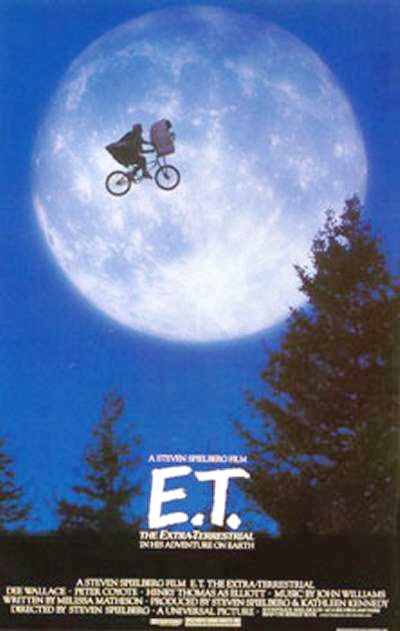
Coming Soon: E.T.: The Extra-Terrestrial (1982):


This is the second in a break-neck 1-2-3 sequence of movies: Raging Bull, E.T., and then Blade Runner. This middle flick was one of the first ones that I remember going to see in the theater multiple times. It’s been a while, but come on back to see how it holds up to me.

Please be sure to pick up all empties on the way out.