Showing posts with label Raging Bull. Show all posts

Friday, April 20, 2012

Film # 79: Raging Bull (1980)


Director: Martin Scorsese

Initial Release Country: United States

Times Previously Seen: three or four (last time – about 5 years ago)

Teaser Summary (No spoilers)

Real-life boxing champion and general dealer in violence Jake LaMotta doles out serious beatings to opponents in the ring, as well as to his closest family members outside the ring.

Extended Summary (More detailed synopsis, including spoilers. Fair warning.)

It’s the early 1940s, and middle-weight boxer Jake LaMotta (Robert De Niro) is coming into his own. A bruising, tenacious fighter from the Bronx, New York, LaMotta makes up for in sheer will and toughness what he lacks in grace and technique. His punishing style of boxing has him on a path towards a championship title fight, except for the fact that his way is blocked by the New York mafia, which controls boxing in order to manipulate outcomes to its own advantage. Jake’s manager and younger brother, Joey (Joe Pesci), tries to convince Jake to relent and allow the mobsters to help them get their title shot, but the eminently stubborn Jake refuses any outside assistance.

Jake soon becomes infatuated with a fifteen-year old neighborhood girl, Vicki (Cathy Moriarty), for whom he leaves his wife. After a few years, the two get married. Jake grows ever more jealous and controlling of Vicki as the years go on, relentlessly questioning her every move and suspecting every man around her as trying to take her from him. Through it all, Jake continues to win fight after fight in the ring, though he is still refused any shot at the title. Even after two solid fights, including a victory, against the other prime fighter of the era, Sugar Ray Robinson, Jake is blocked from championship contention by the corrupt powers that control the sport.

Joey and Jake, sweating it out in a training session. Despite Jake's prodigious in-ring toughness, the mafia blocks their title shot for years.

Jake continues to win in the ring, with his main rival Robinson now in the army. He even pummels a supposedly handsome up-and-coming young fighter into a bloody mess, after Vicki offhandedly calls him “good-looking”. Shortly after this fight, with Jake out of town, Joey spies Vicki in a bar with a few local men. Though her evening out is innocent enough, Joey loudly proclaims that Vicki is embarrassing his brother, and he demands that Vicki go home. She refuses, Joey becomes enraged, and attacks one of the men she’s with, local Mafioso and former friend, Salvy. The fight is soon straightened out by the local Mafia boss.

Jake is then allowed his title shot by local gangsters, but on one major condition – he must throw the fight so that the mob can make a killing by betting against him. Jake reluctantly accepts. Throwing the fight, though, is easier said than done. His opponent, Billy Fox, is far inferior to Jake. Jake almost knocks him out on accident, and then refuses to fall down at any point in the fight. The fight is stopped and victory briefly given to Fox, but an investigation in launched and LaMotta is banned from boxing for a time. However, when the ban in up, he receives his first true shot at the title, winning convincingly against current champion, Marcel Cerdan.

Three years pass, and Jake manages to retain his title throughout, though maintaining his fighting weight becomes more and more difficult. One day, he begins to question Joey about the fight that he had with Salvy. Jake, now so obsessed with jealousy over his wife, suspects that Vicki has been having affairs, including with Joey himself. Joey refuses to answer the interrogation and leaves. Jake then begins to question Vicki, who is frustration sarcastically screams that she has had affairs with every man in the neighborhood, including Joey. Jake, too enraged to see that his wife is being sarcastic, storms over to Joey’s house and begins to beat him unmercifully. Vicki catches up and tries to stop Jake, but Jake knocks her out with vicious punch to the face. When the dust settles, Vicki starts to pack up and leave Jake, but decides to stay after Jake apologizes and begs her forgiveness.

Jake wins his next fight, and tries to call Joey afterwards, in order to try and mend their broken relationship. The attempt fails, though. Jake’s next fight against Sugar Ray Robinson is a bloodbath. Jake, either outmatched or simply in a completely masochistic temper, allows Robinson to land vicious blow after vicious blow, though he refuses to fall down. The fight is stopped, and Jake loses his championship title.

The Bronx Bull, in the midst of getting mangled by long-time rival, Sugar Ray Robinson. It all goes downhill from here for the champ.

Several years later, Jake is tremendously out of shape and with his family in Miami. He has retired from boxing and opens a night club, where he spends his evenings drinking hard and doing bad standup routines. Vicki soon divorces him and takes their children with her. Jake’s life slides down even farther, as he gets arrested for serving under-aged girls and introducing them to older male patrons in his night club. In an attempt to raise bribe money, Jake even hammers the gems out of his middleweight champion belt, but all for naught as the gems without the belt are far less valuable. Jake does several months in a Miami-Dade county prison, in which he breaks down and wails in despair at his own stupidity.

Jake is eventually released, and he returns to New York, where he does more shoddy standup routines in dive bars. He runs into his brother Joey, with whom he tries to reconnect, with very little success.

The last we see of Jake, he is preparing to do a stage performance for a modest crowd in New York. He gives himself a pep talk, as if he were still the fierce fighter of his younger days.

Take 1: My Gut Reaction (Done after this most recent viewing, before any further research.)

One of my all-time favorite films, and the one that I think is Scorsese’s best. And that’s saying something.

The real-life story of Jake LaMotta, as Scorsese tells it, is arguably the most artful and profound sports movie of all time. It exhibits the psyche of an athlete as it spills into his personal life, and does not blanch for one second at showing you the ugliest parts of it.

I don’t know that every person would feel as I do about this movie. For one thing, it helps that I find boxing fascinating. I’m no expert, but I know a little bit of my history and went through several years in the 1990s when I followed the sport rather closely. Though it’s one of the most brutal of popular sports, there is an undeniable artistry to it. More than this, I am enthralled by the psychology of stepping into a ring and voluntarily exchanging blows with another human, until one of you is likely knocked unconscious. Raging Bull gives us a shocking and entrancing look at a man who was, even by boxing terms, a unique specimen.

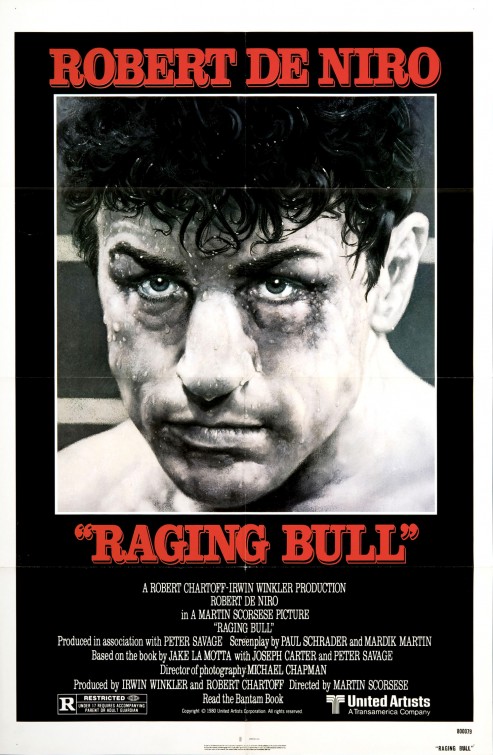
Though a disaster in his personal life, Jake LaMotta was arguably the toughest middleweight fighter in boxing history.

Boxing has been called, by the sports’ devotees, “the sweet science”. What Jake LaMotta did, though, was neither sweet nor scientific. He walked towards his opponent, took every punch they could dish out, and never backed away. His ability to take an unholy number of punches without going down is admirable in a way, but it does make the stomach turn. Though filmed in a less visceral black-and-white, Raging Bull is shot in a way that conveys the brutality not only of boxing, but especially of La Motta’s style, which of course earned him his nickname, “The Bronx Bull”. The ever-present smoke, sweat, and dark pools and rivers of blood seen during the matches threaten to choke the viewer. Every time I watch this movie, I feel like toweling myself off.

While the in-ring scenes are brilliantly filmed (my only gripe is that there are more than a few “phantom punches” that are easily noticed), the real tale is what goes on outside of the ring. LaMotta’s personal life is what vaults this movie to a higher plane of film. Scorsese’s approach strikes me as something akin to the way Stanley Kubrick would have made a boxing movie, or the way that Darren Aronofsky approaches his major theme of obsession in all of his films. The darkness in La Motta’s soul, which we see as irrepressible jealousy and unstoppable rage, is the stuff of universal fascination. As disturbing as it is, it’s hard to look away from it.

I compare Raging Bull in certain ways to Kubrick and Aronofsky, but there is a major difference that is all Scorsese – the dialogue. As with all of his New York films, Scorsese nails the urban language dead on. There is a pace, rhythm, and vulgarity that can be wonderfully entertaining to listen to, and Scorsese has always been well aware of this. This is also where we get moments of levity. Let’s face it – these characters are generally not very bright, and it’s easy to laugh at them much of the time. And when we’re not laughing at them, we’re laughing at the insults that they hurl at each other. These moments keep the movie from becoming a two-hour slog through bloody violence and depression. In other words, it’s an incredibly well-rounded story, with many of the elements of real life, good and bad.

Many of the exchanges between the LaMotta brothers (De Niro and Pesci's first film together, by the way) are as funny as they are insightful towards their relationship.

Every time I watch this movie, the time flies. The story, scenes, and character interactions are so gripping that I will continue to watch this movie every few years for as long as I live. This is the reason that it is one of the very few DVDs that I personally own. Whether a sports fan, boxing fan or not, as long as one can stomach the gritty violence in the picture, I feel that nearly any mature film lover can watch and appreciate Raging Bull.

Take 2: Why Film Geeks Love This Movie (Done after some further research.)

There are all kinds of great little documentary pieces on Raging Bull. The ones I mostly delved into came on the bonus disc of the special DVD release in 2004.

The story of the film’s making is rather interesting. It basically was made because of Robert De Niro’s fascination with LaMotta’s autobiography. De Niro approached Scorsese repeatedly to do it with him, but Scorsese was ambivalent, not being any find of sports fan and knowing virtually nothing about boxing.

Eventually, though, Scorsese took interest, wanting to do something a bit different. After a crash course in boxing, Scorsese took the story of La Motta and found the universality in it. He described how he saw it in 2004: “The hardest opponent that you have in the ring [of life] is yourself.” Who better to exemplify this than the tragically unaware La Motta?

Around 1977, there was a renewed interest in boxing films by the viewing public. This, of course, was due to the 1976 smash hit, Rocky. While some of the producers of Raging Bull were initially interested in doing another Rocky film, they were intrigued enough to sign onto De Niro and Scorsese’s project.

De Niro, a noted practitioner of "The Method", felt strongly enough about LaMotta's story that he famously put on a solid 60 pounds of weight, just as the real LaMotta did in his post-boxing years.

I was stunned to learn how little interest in or knowledge of boxing Scorsese had. It’s a tribute to the man’s dedication and artistic genius that he managed to bring a novel approach to filming boxing matches as they happen. He employed several very clever visual special effects to create various moods and convey La Motta’s psyche. These and the strange and evocative sound effects add immense power to the fight scenes. To give an example, in some scenes the ring was expanded to give a sense of openness and freedom, while in another it is obscured by smoke and distorted visuals. I never quite realized the effect that these components were having on me, but they are absolutely true.

Another interesting note about the visuals is the decision to film it in black and white. Why did they do this? The main reason is that Scorsese didn’t like the way that the colors were coming through, particularly the bright red of the boxing gloves. Once they talked it over with the crew, everyone was on board. Also, it helped distinguish Raging Bull from the four other boxing movies coming out that year.

Upon the film’s release, the initial reviews were very mixed. Some reviewers didn’t know what to make of it, and they even advised MGM not to distribute it. Alas, they did. The movie was a modest commercial success, but really garnered attention at the Academy Awards, being nominated for eight awards and winning two.

Maybe the most interesting story I heard about the film’s release comes from Jake La Motta himself. In 2004, the real Bronx Bull recalled going to see the movie upon its release in 1980. He had brought his ex-wife Vicki, also prominently depicted in the film, to watch the portrayal of Jake as the relentless, brutal, thuggish character that we can all see. After the film was over, Jake asked Vicki, “Jesus, was I that bad?” Vicki looked at him and replied, “You were worse.” When you see the movie Raging Bull, you will see why this is a rather stunning announcement.

Hard to believe after you watch the film, but the real Vicki told her ex-husband that he was worse in real life than the film's portrayal of him.

The other fascinating notion I heard came from Scorsese. It had to do with sports culture, and boxing culture in general. There is a very unreal expectation thrust upon prize fighters that few fans of the sport are willing to accept – we demand that the fighters be relentless, vicious, and violent inside the ring, but tend to act with shock and reprehension when they behave that way out of the ring. (Mike Tyson, anyone?).

In Raging Bull, it is clear as day that the man inside the ropes and outside the ropes cannot easily be separated, if at all. This is why, to me, anyone who revels in the violent aspects of certain sports has little room to criticize any of the athletes in those sports when they behave similarly outside of the lines. These are the kinds of topics that a great movie like Raging Bull brings up, and it is why it will not fade into obscurity for as long as more violent sports like boxing or mixed martial arts remain popular.

That’s a wrap. 79 shows down. 26 to go.

Coming Soon: E.T.: The Extra-Terrestrial (1982):
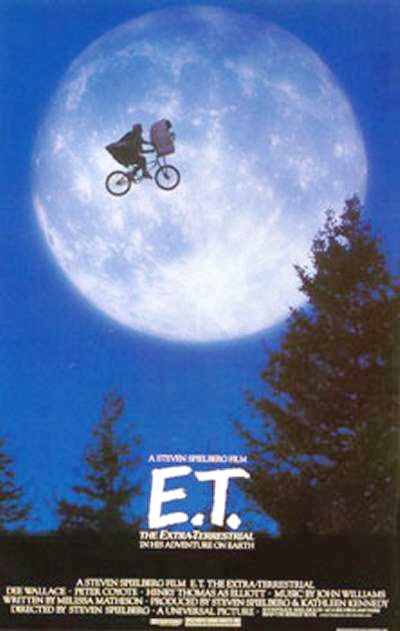

This is the second in a break-neck 1-2-3 sequence of movies: Raging Bull, E.T., and then Blade Runner. This middle flick was one of the first ones that I remember going to see in the theater multiple times. It’s been a while, but come on back to see how it holds up to me.

Please be sure to pick up all empties on the way out.

Friday, April 13, 2012

Film #78: Berlin Alexanderplatz (1980)


Director: Rainer Werner Fassbinder

Initial Release Country: Germany

Times Previously Seen: none

Teaser Summary (No spoilers)

Former thug gets out of jail, tries to go straight, fails miserably, goes crazy, embraces crime, goes crazy again, and then gets well. Sort of.

Extended Summary (Relatively more complete pot synopsis, including spoilers. Fair warning.)

* This film is reeeeaaaally long, so I’m giving you a very short version of the plot. If you’re really curious about the little details, check out this more complete synopsis at wikipedia.

Berlin, 1928. Germany is in the middle of a horrible economic depression. Franz Biberkopf (Günther Lamprecht) has just been released from prison, where he has spent the past four years for the involuntary manslaughter of his prostitute girlfriend. After an initial period of confusion about how to reintegrate himself into society, Franz decides to leave his criminal past behind him and live a straight life, free of illegal activities.

It doesn’t take long for Franz’s plan to fail. Despite trying to go straight by taking menial jobs selling newspapers and hawking various wares on the streets and going door-to-door, he starts to be taken advantage of. One business partner robs one of Franz’s clients, sending Franz into a manic depressive bout of heavy drinking, away from any friends or associates.

When Franz emerges from his bender, he finds one of his old criminal associates, the kindly Meck, who introduces him to the highly unsavory Reinholt. Franz begins a bizarre scam with Reinholt, who is a compulsive womanizer, to take Reinholt’s girlfriends off of his hands after he inevitably tires of them. Franz eventually ties of these strange deceptions, though he maintains his friendship with the warped Reinholt.

Franz Biberkopf, the man at the middle of this massive, swirling tale.

Franz then takes up with a local crime gang. He is initially taken on a night robbery, without his knowledge, and forced to be the lookout. Franz reluctantly goes along with it, but as the gang is driving away, a car begins to follow them, merely by chance. Reinholt becomes suspicious and soon pushes Franz out of the back of their vehicle. Franz has his arm run over by the following car. The arm is so badly damaged that it must be amputated.

Franz, now without his right arm, rejoins a pair of old friends to recuperate. One is a former prostitute who was under his control in his days as a pimp – Eva, who still has deep affection for Franz. The other his Eva’s lover, Herbert, who is also involved in various petty crimes. The two take in Franz and tend to him carefully, seeing Franz as a decent person who is prone to bad decisions, bad luck, and strange fits of emotion. Eva and Herbert even find a young woman to be Franz’s new lover – the prostitute whom Franz names Mieze. The two instantly fall in love with each other.

Franz and Mieze move in together and they continue to adore each other, though their relationship is not without difficulty. The one-armed Franz begins pulling robberies with the local gang again, and Mieze’s job as a prostitute leads Franz to become severely jealous at times. The worst is when Mieze admits to an unplanned affair with a client’s younger son, whom she claims to have fallen in love with. Franz goes into a rage and beats Mieze bloody, stopping just short of killing her. Despite the brutal attack, the two make up with each other shortly afterwards.

A few days later, Franz brings Mieze to their local bar to introduce her to Meck, Reinholt, and the rest of the gang. The compulsive Reinholt immediately blackmails Meck into setting up a meeting between him and Mieze. Meck does so, and he brings Mieze out to a forest retreat to meet with Reinholt, Mieze hoping to learn more about her beloved Franz from his friends. Instead, when Reinholt brings Mieze out to the woods, he tries to force himself on her repeatedly. Mieze teases some information about Franz out of Reinholt, including the fact that Reinholt was responsible for Franz losing his arm. This disgusts Mieze and she repels Reinholt. Reinholt, in a fit or rage, strangles Mieze to death and leaves her in the woods.

The utterly twisted Reinholt, attempting to seduce his "friend" Franz's girlfriend, Mieze.

Back in the city, Franz grows worried after not hearing from Mieze for several days. Meck, who had helped Reinholt bury Mieze’s body despite not knowing that Reinholt would kill her, decides to inform the police. When Mieze’s death is reported in the newspaper the next day, Franz breaks into a crazed laughter, deliriously happy that Mieze’s absence was due to her death and not due to a willful abandonment of Franz.

Franz goes into a complete daze. We start to see his tale from a bizarre perspective, including two angels following him and commenting on his confused state. Franz walks along in an odd dreamlike realm in which the dead are strewn about. Back in reality, Franz is taken to an asylum, and Reinholt is being held in prison under and mistaken identity. In the asylum, we see inside Franz’s tortured mind. He sees himself interacting with various characters from his life in the past year, both dead and alive. He shifts perspectives with many of them, and even faces off with the specter of Death. Franz seems to see himself as deserving of any punishment he receives, as he and others are butchered in an abattoir.

We snap back to reality, at a court hearing for Reinholt, who is on trial for Mieze’s murder. Franz testifies to Reinholt’s good character, which helps Reinholt receive a relatively lenient sentence of ten years in prison. Franz takes a job as an assistant gatekeeper at a car factory. He is attentive to his work, but seems utterly detached from anything happening in the word around him.

Take 1: My Gut Reaction (Done after the viewing, but before any further research.)

Looooooooooooong.

Berlin Alexanderplatz is fifteen and a half hours long. Fifteen. And a half. Hours.

I watched it over the course of about three weeks, and by the end, I was ready for it to be over. Perhaps I would have been better served to spread it out more, but hey, I have nearly 30 more of these reviews to do, and I want to get on with it.

It’s not really the length itself that it a little tough to take. Some people might be able to watch all of this show in a few days, but I would find it rather tough. However, this is not because it is bad in any way. It’s merely that the tone and look can be a tad monotonous.

That said, this is a haunting humanist story. This itself was a bit surprising, as I was expecting a more epic tale that connected one man’s journey into the Third Reich. I expected to see plenty of direct references to the rise of the Nazi party and their growing control of Germany. Such is not the case at all.

This may seem odd, by I couldn’t help but think of Henry Miller’s novel, Tropic of Cancer. That novel was a lightning rod for being so honest and frank about the human experience, including the most sensual (some thought indecent, at the time) elements. The difference is that Tropic of Cancer had a relatively rosier tone and outlook; Berlin Alexanderplatz takes a hard look at the mental degeneration of a man who has slipped right through the cracks of a failing society.

Franz partakes in one of his favorite vices to escape - binge drinking on a level that would would make even a German (maybe even an Irishman) blanch. [note: I'm of Irish descent, so don't get up in arms.]

Berlin Alexanderplatz tells the story of a man who is, in many ways, highly unsavory. And yet, it’s impossible to dismiss Franz Biberkopf as a purely despicable villain. Unlike the titular protagonist of Barry Lyndon, Franz actually has several admirable traits. With his close friends, he has incredible loyalty and enthusiasm. His emotions are on his sleeve for all to see, and he is generally a social creature. His vices are, at root, ones that most people who are honest with themselves can understand – booze and women. Franz is at his most despicable when he is in the throes of passion or rage, or when he is victim to his own mental instability. Not long into the massive film, you start to see him as pitiful as much as anything. This is not unlike another film character that I will be seeing soon on this blog – the very real Jake LaMotta as depicted in Raging Bull. Both can be destructive, though Biberkopf is easier to like.

Most of Franz Biberkopf’s tale is easy enough to follow, in basic terms. He gets out of prison, he tries to go straight, he fails, and he suffers several brutal losses. However, there is a reason that the director chose to use over fifteen hours to tell the story and not two. Franz is complicated, and some of his actions are plainly irrational. To make any sense of them, we need the time to see how his more reasonable friends react to him. This gives us a better compass to navigate with. When characters like Eva, Herbert, and Meck show up to help Franz, we viewers need them just as much as Franz does. When the narrative of Franz’s life loses direction, they give us some semblance of meaning.

During the course of watching this whole thing, I often found myself pondering just what such an environment would be like. I can only imagine what it is like to live in the middle of a true economic depression, and how this affects one’s life choices. It would be hard enough for a person of decent means, but I believe Berlin Alexanderplatz gives a very real and disturbing view of how such a depression affects the already downtrodden. Those at the bottom of the socioeconomic ladder begin to engage in strange, irrational, short-term gain behaviors. A lot of people will watch this film and find the actions in it too distasteful to stomach, and to be honest, I did at first, as well. However, once I thought about it some more, I couldn’t help but feel that there was a disturbing authenticity to the entire tale. The corrupt actions of the characters reflect the polluted environment they are in, as they do whatever they can to survive and find any sort of solace that they can.

Franz and Mieze, a criminal and a prostitute, find some measure of happiness together. Their relationship may seem perverted to some, but it makes far more sense within their constraints.

There are some rather strange elements to Franz’s tale, though. Some are ones that I found a bit perplexing. Throughout the show, we have a disembodied and unknown narrator offering commentary that sometimes includes observations about the characters, but also Biblical verse, song lyrics, and readings from philosophical treatises. The connections are sometimes clear, but other times simply baffling.

Related to this is the final Epilogue episode, which is right out of surrealist left field. The previous 14 hours of the show are quite straightforward, with only occasional lapses into the aforementioned narration. The final episode, though, goes right into the realm of mind-blowing oddity. At least, that’s how it seems at first. When I thought about what all of the stunning and wild images had to do with Franz, most of them became clear. It didn’t make them any less shocking, though.

Just one of the many dark, disturbing images that we see in the Epilogue. This shows the tattered, tortured state of Franz's mind after losing his beloved Mieze.

Aside from the story itself, the other elements of the film are not ones that I would call spectacular, though they are very strong. The acting is very solid, all around. Günther Lamprecht is outstanding as Franz. Considering the incredible range of emotions and attitudes that he needs to show, it’s remarkable how he pulls them all off naturally – he can be charming, funny, pathetic, crazed, manic, depressed, or meditative at nearly any moment. Among the rest of the cast, there are really no weak links.

The visuals are rather intriguing. There is a somewhat dreamy, soft glow to most of the shots. This also often leads to an unusual halo effect that reminds me of the look of Sergio Leone’s 1984 gangster epic, Once Upon a Time in America. Beyond that, the several scenes in the forests outside of Berlin, where Mieze is killed, look eerily like the woods used in Miller’s Crossing. Some of the scenes even seem to be set up the same way. I will have to check on whether the Coen Brothers in fact used this show as inspiration.

While the technical merits are all there, this show is really all about where this one singular character, Franz Biberkopf, fits into his own strange sub-society – a sub-society that exists in shadows that most of us don’t want to think about or acknowledge.

Take 2: Why Film Geeks Love This Movie (Done after some further research)

Researching this massive film is filled with peaks and valleys. I watched a documentary that got behind the scenes and had a few good interviews, but didn’t add much to my understanding. There is a lack of information in my normal go-to places for this sort of thing, as well.

Then, there is Peter Jelavich. Jelavich is a professor of European history, especially German historical culture. I watched an amazingly concise, 25-minute documentary in which the man clearly answered my every question about Berlin Alexanderplatz.

The novel, by Alfred Döblin, was a masterpiece of its day. Written in 1929, it was one of the very earliest “metropolitan” novels that effectively depicted life in a modern mega-city, such as Berlin. Jelavich likens it to the contemporary novel Manhattan Transfer, by John Dos Passos. I haven’t read that novel, but having read Dos Passos’ U.S.A. trilogy, I know exactly what he means. The narrative is an enormous, sometimes dizzying, literary montage of sights, sounds, and images as perceived by an individual living in those days.

A major theme of these works is the rise of mass media. In watching the movie, this was something that confounded me; I did not understand the narrator giving me little snippets of songs, advertisements, articles, political treatises, and so on. Now knowing the intent, it all makes perfect sense. All of these little phrases are the straggling pieces of information that Franz has inadvertently picked up simply by living in Berlin. On top of that, I realize how genius Döblin was, and just how much foresight he had. When I think about my own mental state, and how much information and little, random tidbits flow through my mind on a daily basis, it’s amazing to think that Döblin saw it all coming long before its impacts were fully realized.

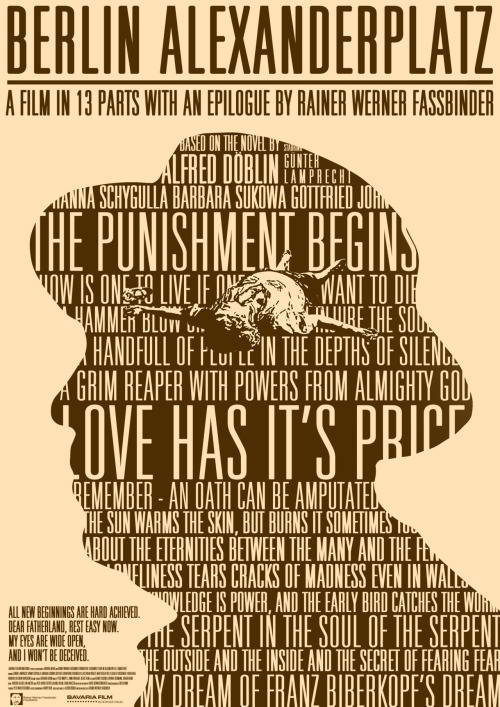
The original cover for the novel. It conveys the life Franz Biberkopf, surrounded by an overwhelming amount of text and information.

The other significant thing that Jelavich confirmed for me is just how to take Biberkopf the character. He is, as I felt, meant to be seen as a sympathetic figure. He essentially has a good heart and wants to do the right things, but he is incapable of it. Sometimes this is due to the endless social pressures around him, and sometimes it is because of his own lack of abilities. Either way, you want to see him find some sort of happiness. This makes it more tragic when he fails.

Believe it or not, there was a film version done shortly after the novel, back in 1931. Despite having Döblin himself working as a writer, it was far shorter and had a much sunnier ending. When Fassbinder took on the project in 1979, he was already established as something of an eccentric genius of film. He was given a lot of latitude, and he had been an incredible fan of Alfred Döblin’s novel. Wanting to do it justice, he stayed very close to the source material. The only personal touches he added were some aural references to 1960s and ‘70s pop culture, drawing a parallel between the 1929 novel and his own world in the late 1970s.

There is also a 2007 essay here by Tom Tykwer, which seems very thorough and probing. However, it dives into elements and connections with German culture that fly right over my head, in most cases. For anyone who can get something out of it, though, check it out.

The reception of the film was fairly positive, especially among critics. As you can imagine, some viewers weren’t sure what to make of the gargantuan film. Many complained that the visuals were too dark, but this was really the only common gripe. Overall, people saw it for an amazing piece of work.

That’s a wrap. 78 shows down. 27 to go.

Coming Soon: Raging Bull (1980)


 This is one of my all-time favorites. I love several of Scorsese’s movies, but I think I put this one at the top of the list. Come back and see how I break down the sad but entrancing life of the very real Jake LaMotta.

Please be sure to pick up all empties on the way out.