Showing posts with label sports films. Show all posts

Tuesday, August 11, 2020

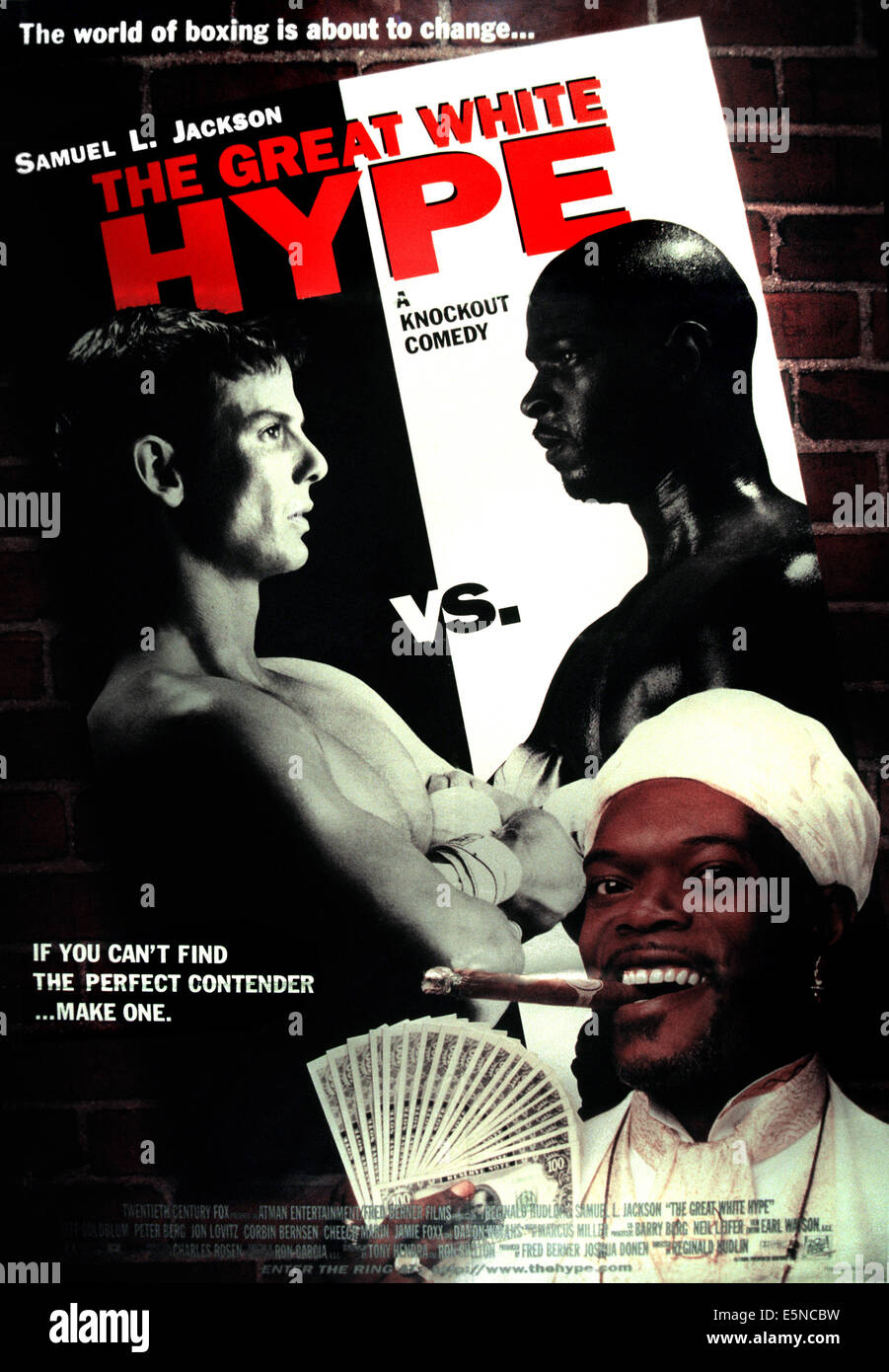
The Great White Hype (1996)

Director: Reginald Hudlin

Still a vastly underrated satire of the last gasps of boxing as a premier sport in the US.

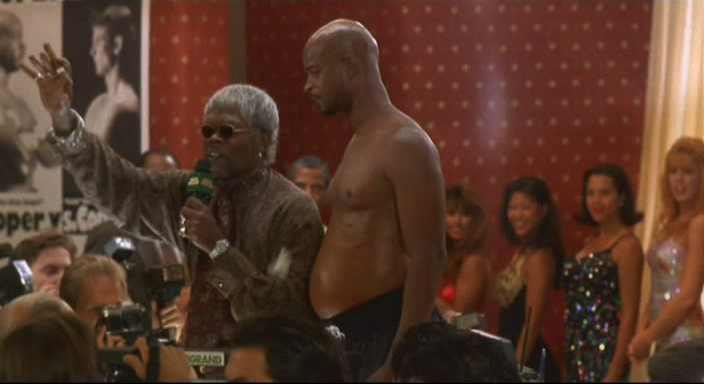
Released in 1996 and obviously drawing heavily on the realities of the boxing world at the time, The Great White Hype tells the tale of the attempt to find a challenger to the current undefeated heavyweight champion, James "The Grim Reaper" Roper (Damon Wayans). But the problem is not that legitimate challengers don't exist - it's that the sport is rapidly fading in popularity, resulting in ever-decreasing profits for those who seek to profit from the once-wildly-lucrative industry. Seeking to crack this nut is Reverend Fred Sultan (Samuel L. Jackson), a Don King-like figure who is a shifty, manipulative promoter not above anything it takes to make a huge payday for himself. The grand solution, as he sees it, is to find a modern rarity - a white boxer who can square off against Roper and encourage greater interest through subtle and not-so-subtle race-baiting of the viewing public. The obvious problem, though, is that there isn't a decent white heavyweight fighter anywhere on the scene. The Sultan's solution? Concoct one. The Sultan and his team of sleazy underlings find heavy metal rocker Terry Conklin (Peter Berg), who had once beat the champion Roper when the two were amateurs. The rather dim Conklin hasn't fought in about a decade, but the Sultan convinces him to return to the ring, all the while whipping up a huge marketing campaign around the first black-versus-white heavyweight title bout in ages. 

I hadn't seen this movie since my college days back in the mid- and late-1990s, when I watched it several times and would regularly quote it with my friends. While I would never argue that it's a "great" movie, I'm still somewhat baffled that it's not given more respect as a funny, clever sports satire. I was actually completely unaware of its theatrical release, despite its having several well-known actors like Samuel L. Jackson, Jeff Goldblum, and plenty of others. A little research shows that it wasn't very well received by critics at the time, and still sports very mediocre reviews on any major film ratings site. My only guess is that the R-rating and slightly loose feel to the film may have turned off some viewers. Also, being a satire of a notoriously seedy sports industry, the movie derives a lot of its humor and message from the darker aspects of human nature. There is also a chance that, like me the first time I watched it, viewers didn't know what to make of the ending. For my part, I hadn't picked up on just how satirical the entire story was meant to be, until a friend explained it to me. Once I understood that, the movie actually went considerably up in my estimation.

The Sultan hyping up the fight in front of the champ,
"The Grim Reaper" Roper. Roper's disdain for his
opponent manifests itself as an utter refusal to even
train for the fight.
The greatest strength here is the comedy, on all of its levels. You have plenty of broad humor, often in the form of sharp insults hurled back and forth between the fighters, promoters, and various hangers-on and greedy leeches who populate the world of pro boxing. And there's plenty of great physical humor, too, often in the form of subtle facial expressions or body movements, courtesy of brilliant comic actors like Jackson and Goldblum, but also veteran comedians like Damon Wayans, Jamie Foxx (before he showed us his serious dramatic chops a few years later), Jon Lovitz, and plenty of others. The timing and delivery of everything is spot-on; so much so that my wife, who has no great interest in boxing, was laughing plenty throughout the show. On top of the more obvious comedy is the satire element. Anyone with the slightest sense of the corruption and greed rife in boxing, coming to a fatal crescendo in the 1990s, can see that the movie knew just what to target. Perhaps the greatest fault of the sport is the comic element in The Great White Hype that's easiest to overlook - that of the Marvin Shabazz character. In the movie, Shabazz is presented as a true, legitimate contender to the champion Roper. But just as often happened in boxing in its final waning years, fractures and corruption in and around the sport prevented fans from seeing the actual two best fighters square off against each other. It was a slow, bitter pill for fans and aficionados of boxing to swallow, and it's what ultimately saw the long-popular sport slip so far down in the sports-viewing public's consciousness. By the end of the 1990s, MMA fighting was on the upswing and soon took over boxings coveted place as a wildly popular combat sport.

Anyone who enjoys boxing really should give this one a watch, and I would also recommend it to anyone who can appreciate a solid R-rated satire of any form of entertainment. The comedy and acting are enough to give you some good laughs, even if you don't have any great care about boxing. 

Sunday, February 23, 2020

Retro! The Hills Have Eyes (1977); I, Tonya (2017)

The Hills Have Eyes (1971)

Director: Wes Craven

This was one of a few 1970s, grindhouse-style horror "classics," along with Texas Chainsaw Massacre, that I had never seen. While I've always been able to appreciate a good horror movie, watching this one reminded me that my appreciation only goes so far. Simply put, these grittier, wilder flicks don't do anything for me.

In a short 89 minutes, the movie chronicles a small family; including an elder married couple, their four children and children-in-law, and an infant granddaughter, whose trailer breaks down in the middle of a desert closed to the public. A weathered old man at a worn out service station gives them parts, but also warns against some sort of menace out in the wastelands. Sure enough, a pack of savage cannibals emerges and terrorizes the family over the next 24 hours.

A film like The Hills Have Eyes is really just too sweaty and wild for my tastes. Don't get me wrong - it's an impressive feat that Wes Craven pulled off here. On a razor-thin budget, he created an entire mood of agoraphobic menace amidst a blasted landscape that could be the stuff of nightmares. Still, I only found the movie so compelling. I admire Craven's willingness to not just threaten the innocents in this movie, but to actually kill a few of them, which in my mind is in keeping with true horror. That aside, the film only did so much for me.


I, Tonya (2017)

Director: Craig Gillespie

An entertaining "based on real accounts" telling of the infamous ice skater-on-ice skater crime that was the entire Tonya Harding/Nancy Kerrigan scandal leading up to the 1994 Winter Olympics.

Anyone who grew up in the U.S. and is over the age of 35 almost certainly remembers the Harding/Kerrigan scandal, wherein Kerrigan was infamously bashed in the leg by a man hired by associates of Harding. It was one of the biggest, weirdest stories during the early years of sensational, 24-hour news cycles. Using on-the-record testimony from both Tonya Harding and her former husband Jeff Gillooly, the movie offers their versions of the wild story. There are bizarre characters everywhere in it, and none of them had the smarts or awareness to deal with what they had unleashed.

I knew and remembered a fair bit about the entire affair from when it all broke, since I was in my late-teens at the time. This movie, though, offered plenty of fascinating nuggets about those involved and their more personal stories. While realizing that more than a little of the narrative is coming from Harding's own accounts, I couldn't help but admire and sympathize with her in a few ways. Unlike most stars in the women's figure skating world, she grew up dirt poor. She also had a vile and abusive mother who bullied her daughter constantly. Still, Harding broke into the world of "ice princesses" and became a champion, such was her raw skill and power on the ice. But through bad relationship decisions and an inability to reckon with her dysfunctional husband, Jeff, she ended up the center and the blame of the entire scandal.

Though there are certainly sad elements about Harding's life - and they are depicted as such - the movie manages to balance that with a humorous tone much of the time. The root of most of it is in the breathtaking ineptitude of the dopes who end up orbiting Harding during her time leading up to and through the Winter Olympics in 1992 and 1994 (this was when the reshuffling happened, resulting in the Winter Games occurring only two years apart). Gillooly (Sebastian Stan) and especially his buffoonish friend Shawn Eckardt (Paul Walter Hauser) provide plenty of laughs just for how doltish they are. Then there's Tonya's mother, LaVona, played in an Oscar-nominated, foul-mouthed performance by Alison Janey. The circus of characters keeps things entertaining, despite the strain of darkness that runs through their lives.

There's always something questionable about making a "bio-memoir" about people who are still alive, especially when it's not long after the actions which made them (in)famous. I suppose it's easier to swallow when nobody was killed. But this is the movie's final message and question: since it was Tonya Harding herself who came out of the affair as the primary villain, being banned for life from the sport which was the one thing that she was great at, who are we looking to blame when our collective narratives fall apart? This is what elevates I, Tonya above merely a salacious re-telling of gossip magazine fodder or strange sports trivia. 

Wednesday, August 14, 2019

New Release! Maiden (2019)

Director: Alex Holmes

An excellent documentary on something which I knew nothing about - the very first all-woman crew to sail in the Whitbread Round the World yachting race between 1989 and 1990.

The film mostly follows Tracy Edwards, an Englishwoman with a rather turbulent childhood who, at age 24, gathered the world's first all-woman crew for one of the most famous and prestigious boat races in the world. It was a race that takes the better part of a full year, taking the competitors along five "legs," each consisting of anywhere from 10 days up to several months at sea. It's a grueling test of a crew's skills, even in the best of circumstances. But Edwards and her entire crew faced an even stiffer uphill battle just to find funding and respect in a sport that, until that time, had been thoroughly dominated by men and completely all-male crews.

The chronicle of Edwards' family background does a great job of creating the profile of the type of person it might take to accomplish such a feat, though it does not unfold quite how you might expect. There were certain elements in her background that clearly explain how she was able to accomplish what she did, but there are also some massive obstacles and personal demons which she had to overcome to even get into a position to start realistically mustering a crew and a ship for the race. There's plenty of great historical footage of the planning, preparations, and the race itself, but having Tracy Edwards offering her current recollections and reflections on herself and the entire venture is priceless.

Another wonderful thing about the documentary is that nearly every woman who was part of the crew offers current commentary on the entire experience, so you get a great multi-perspective view from everyone. Even better is that the crew was made up of women from various countries: Ireland, England, Wales, the U.S., Germany, and France, and many of them have brilliant personalities that come through in their interviews. While a fair bit of the humor is of a rather dry, British variety, it certainly elicits more than a few solid chuckles and laughs along the way.

Maiden also obliges with plenty of great original footage taken during the preparations and the actual race itself. This coveys some sense of just how arduous the circumnavigation really is, and allows us to see most of those involved, as the story unfolds. The perils of the journey are far more palpable when you're seeing the crew have to forge their way through polar storms and between treacherous icebergs. Ultimately, I was actually left wanting to know more about some of the seafaring aspects of the race, as it is something that I know almost nothing about, but this may have detracted from the primary story of Edwards's and her crew's struggle against the seas and, at times, their own psyches.

Check this one out, if you're at all interested in good documentaries. My wife went in with only a passing interest, but came out fairly amazed at the story and the women involved. 

Tuesday, April 25, 2017

Documentary Fest: Mike Tyson: The Undisputed Truth (2013); OJ: Made in America (2016)

Some of the best moments are when Tyson is recounting his
moments as a boxer- the profession in which he achieved
historic greatness.
Mike Tyson: The Undisputed Truth (2013)

Director: Spike Lee

OK, so technically this isn't a "documentary," but I don't often review recordings of Broadway shows. This category seems to fit as well as any.

Not long ago, I did post on the documentary Tyson, which was released a couple of years before The Undisputed Truth. In that post, I describe how Tyson has always been a  rather fascinating figure to me, as an unstoppable boxing force of nature when I was a kid, right up through all of the troubling and bizarre trials and tribulations that would dog him for the decades following his loss of the heavyweight title. So I was surprised that it took me so long to get around to watching the one-man show that he put on several years ago on Broadway.

The Undisputed Truth can be a somewhat strange viewing experience that is likely to be enjoyable for fans and supporter of Tyson but probably won't win over any new supporters. In fact, there are some segments of the show that emphasize some of the less appealing aspects of Tyson's nature which he seems to still harbor.

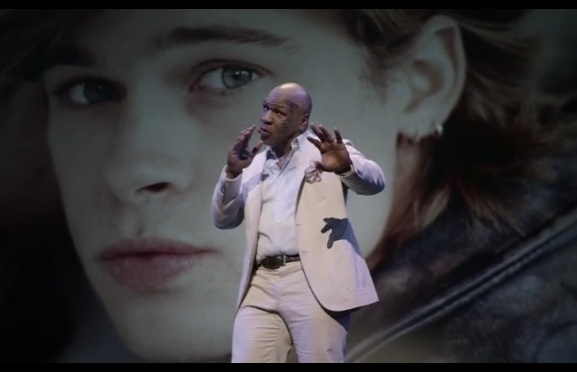
The show is built around Tyson giving his autobiography while on stage, with visual images projected behind him onto a large screen. He start with his birth and covers many of the major turning points of his life, both in his historic boxing career and in his infamous and well-documented
When Tyson gets humorous, such as when he recounts his
first meeting with a very young Brad Pitt, the comedy some-
times gets unintentionally awkward.
personal struggles. For much of the show, Tyson doesn't lay blame for his failings anywhere but with himself. There are, however, some moments when he intentionally lapses back into the ultra-macho, street fighter mentality when recounting more barbaric encounters like his admittedlly humorous run-ins with Mitch "Blood" Green. Green was a former heavyweight fighter and notorious meat-head whom Tyson pummeled both inside the ring and outside of the ring, the latter tale is one which Tyson clearly relishes in telling. It's one of a few stories that are meant for pure comic effect, and it does work to an extent. There are times, though, when the humor didn't hit, at least not with me. When he tells of seeing his ex-wife Robin Givens riding around with a very young, up-and-coming actor named Brad Pitt and says that he didn't know whether "to fuck him or fight him," it smacks of the type of unsavory machismo that doesn't appeal to me. In moments like this, he was clearly playing to his crowd, which was composed of no small amount of NYC locals who are obviously in his corner.

Many other segments of the show are more serious in tone, as Tyson speaks of his rape conviction and the accidental, freak death of his young daughter. During these moments, there is a vulnerability to the man that is what has often made him a deeper and sometimes more tragic figure than many people have admitted. Anyone who has really listened to Mike Tyson, going back many years, could see that there was more to him than just a thug who was one of the greatest boxers of all time. Amid the mental chaos that he experienced (he has long since admitted suffering from clinical mental disorders) was an intelligent and often even thoughtful and empathetic person. These things can and do shine through at times, including in this one-man show.

While I wouldn't recommend it to everyone, those with the slightest curiosity about Tyson will likely find something of interest in the performance.


O.J.: Made in America (2016)

Director: Ezra Edelman

Incredibly brilliant, deeply disturbing, and immensely informative. These are what documentaries can be, when done with a broad persepctive, in skilled hands.

Like many, when I heard about this documentary, I presumed that it was another barely-necessary rehashing of one of the most infamous celebrity court cases in the history of the United States. I expected a simple rundown of the murder case, done in an almost Law & Order style summary palatable for the morbidly curious. What we all got, though, is an in-depth study of the making of a celebrity who put his immense charisma and skills as an athlete to his own purpose of transcending race and repressing his own background. It also ties all of this together with the larger and vastly more uncomfortable topic of race relations in the United States, in Los Angeles in particular.

At this point, any American over the age of twenty knows the basic O.J. Simpson story. He was a superstar athlete who achieved phenomenal glory on the football field in the 1960s and '70s. He also expanded into being a highly successful endorser of various big-name products, and even had a notable acting career. In 1994, though, he was arrested for the brutal murder of his separated wife and her then-boyfriend. O.J. would go through a bizarre apprehension and trial, which resulted in his acquittal, despite the fact that evidence strongly suggested his guilt. He went free, but his life would spiral in odd ways, until he was again arrested in 2007 for a gang-style show of strength aimed at reclaiming sporting memorabilia which he believed to have been stolen from him. He currently remains behind bars.

Those are the bare bones of the tale, and it's one that has been recapped hundreds, if not thousands, of times in the last decade. What director Ezra Edelman did with O.J.: Made In America was to look at the larger picture surrounding such a singularly tragic story. While weaker documentaries work hard to paint a very particular and often biased picture based on the director's subjective vision, the very best documentaries reveal truths which are much more difficult to argue against. Edelman crafted an excellent film that reveals much about American society and the nature of especially narcissistic and self-obsessed individuals. The focus begins on Simpson at the University of Southern California (USC), where he first attained national stardom as an award-winning running back for their powerhouse football team. Then we shift back briefly to Simpson's childhood in Oakland, where he grew up impoverished in an all-black neighborhood. From that moment, the film shifts back and forth, between O.J.'s rise to and through superstardom and the larger conflicts between the poor black community in Los Angeles and the L.A. Police Department. As one gains a larger understanding of that societal conflict, the seemingly illogical attitudes of certain groups during and after the murder trial become far more comprehensible.

Simpson and his attornies react to the verdict that polarized
the nation like few, if any, ever have. The full context around
the decision and reactions offers a fascinating and
disturbing look at the darker aspects of the American soul
and the human condition.
Beyond the most important facts that the film illuminates about race in the U.S. is the fascinating look into the nature of celebrity and narcissism. A theme throughout the entire series is that Simpson was, from an early age, virtually obsessed with appealing to the widest possible audience in order to attain and maintain fame. Seemingly born with dazzling charisma to go along with his physical gifts as an athlete, he was able to charm millions and millions of people not only through his sports and acting careers, but even through and after the horror that was the double murder of Nicole Brown-Simpson and Ron Goldman. Hearing the testimony of Simpson's former friends and associates is highly compelling, if ultimately greatly disturbing. We are allowed insight into the nature of a diabolical character - one who quite literally was so charming that he could get away with murder. And we are not allowed the comfort of forgetting just how horrendous the murder was, with the crime scene photos shown repeatedly. This decision by Edelmen feels completely appropriate, lest we viewers lose sight of the real loss among the peculiar and morbidly fascinating characters that Simpson morphed from and into.

O.J.: Made in America is no small viewing chore. Whereas most of the films in ESPN's excellent 30 for 30 series run between 60 and 90 minutes, this one was released as five separate episodes, clocking in at a grand total of seven-and-a-half hours. Honestly, though, I was hypnotized by it. There wasn't a single aspect or segment of the film that dragged or seemed superfluous. Anyone who enjoys well-done documentaries, even ones that cover unsavory topics, would do well to take this one in. It's a masterpiece. 

Monday, December 7, 2015

Documentary Series Review: ESPNs 30 for 30 (2009 to present)


I'm a maniac for sports, and I love good documentaries. It follows that ESPNs massive 30 for 30 series of sports documentaries done by different directors on a vast range of topics would appeal to me. Over the past several years, I've seen nearly every single one of the seventy-three films released, and the series as a whole has been excellent. It would take an insanely long post to go over the individual films, but here are the highlights and lowlights as I see them. You can assume that any of the films not specifically mentioned are quite good, if not my absolute favorites.

30 for 30 Volume I (2009 to 2010)

Highlights:

The Legend of Jimmy the Greek. This chronicles the rise and fall of the man who brought sports betting to the national consciousness of the United States. Jimmy was a street guy with a knack for picking winners as a young man, and he created and sold his own persona to a national audience on one of the very first sports talk TV shows in the 1970s. It's a gripping look at the rise of sports gambling, a man in the middle of much of it, and how a racially insensitive, though scientifically logical, remark began his fall out of public acceptance.

The U. Following the Miami University football program's rise to national dominance during a time when college sports was just becoming a cultural and commercial juggernaut. The football part of the film is interesting enough, but the connections between the players, the program, and the local Miami community make this a study of social values as much as sports fandom.

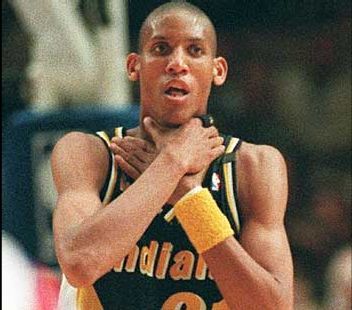
Miller's antics used to drive me nuts.
This doc showed me just how funny
he was, though.
Winning Time: Reggie Miller vs. The New York Knicks. I'll admit it. I mostly love this film because Reggie Miller was a hilarious trash-talker who loved getting under the skins of equally annoying opponents. Miller's recounting of his various scuffles, his inferiority complex caused by being the younger brother to the greatest female basketball player of all time, and his mind-game tactics is endlessly entertaining. Of course, if you simply hate Reggie Miller, you'll want nothing to do with this film. He actually used to annoy the hell out of me during his playing days, but this film helped endear him to me a lot more.

The 16th Man. The powerful story of South Africa's championship run during the 1995 Rugby World Cup, held in their home country. The tale of what this team meant to a country still trying to come to grips with the abolition of apartheid is incredible. Much time is given to then-president Nelson Mandela's connection to the team, and the ways that he viewed them as a source for national healing rather than division. This story was dramatized in the Clint Eastwood film Invictus, which I haven't seen, but I doubt it can be as moving as this documentary.

The tragic story of Andres Escobar made for my favorite
doc in the 30 for 30 series so far. 
The Two Escobars. My favorite of Volume I. This is the tragic tale of Andres Escobar, the brilliant Columbian soccer star who had the horrible misfortune of kicking the ball into his team's own goal during the 1994 World Cup held in the U.S., resulting in his team's loss and unexpected early exit from the tournament. He would then be gunned down by vengeful thugs a few weeks later in Colombia. The film documents the deep and long-running connections between the all-powerful drug cartels and the national soccer league teams in the country, connecting some curious dots between Andres and the "other Escobar" - notorious drug lord Pablo. Fascinating, chilling, and heart-wrenching, to say the least.

Once Brothers. The story of Drazen Petrovic and Vlade Divac, two great basketball players who were friends and teammates on the Yugoslavian men's national team. The team was one of the best in the world, before the country was torn apart by civil war in the early 1990s. This war separated Petrovic and Divac for years, though both went on to play in the NBA. Divac had a very long and successful career, while the supermely talented Petrovic had his highly promising career and life cut short when he was killed in an auto accident in 1993. The film, done with oversight by the NBA, has incurred criticism for its omissions and inaccuracies, but the basics of the story are still very moving, and they show how sports can reflect, connect, or divide the societies and cultures that value them.

Lowlight

The House of Steinbrenner. This whole thing was essentially a puff piece love letter to the New York Yankees. I love baseball and its history, but all but the most devout Yankees fans are likely to find this glossy piece a bit nauseating. You might as well just buy a "History of the Bronx Bombers" DVD set and not bother with this one.

ESPN Presents (Aired from 2011 to 2012)
The film Renee, about a transgender woman who fought for
the right to play on the women's tennis tour, is one of the most
fascinating of the "Presents" series.

These were thirteen other documentaries that were made but not included in Volume I of the series. I've seen all except the two films
Goose and Right to Play. Curiously, nearly every one of the eleven that I've seen is excellent, leading me to wonder why they weren't included in the original volume over weaker entries. The only three that were not outstanding were Charismatic, The Dotted Line, and Roll Tide/War Eagle. None of these was a "bad" film; they just suffer from being in the same group as so many other great films.

Volume II (Aired 2012 to June 2015)

Highlights

Survive and Advance. It mostly follows the North Carolina State basketball team's improbable and amazing run towards the National Championship in 1983. This story is fascinating from a sports angle, but what makes the documentary is how it also tells the story of the team's larger-than-life coach, Jim Valvano. Valvano was a boisterous, funny, endlessly energetic man who practically willed his team to win through positive visualization and faith, rather than the dogged dictatorial style of coaching often associated with high-level athletics. Valvano's eventual losing battle against cancer puts a sad but inspiring note into this tale. I would challenge anyone to watch this whole documentary and not get choked up at some point.

Hawaiian: The Legend of Eddie Aikau. As much an anthrolological documentary as a biographical account, this tells the story of Eddie Aikau, the first native Hawaiian surfer to compete on the world stage in the sport that his ancestors had invented. I had never heard of Aikau before this documentary, but I was enthralled by what kind of person he was and just what he meant to his native Hawaii.

If, like most of America, you had written off Maurice
Clarette (left) as an idiotic thug, then the film
Youngstown
Boys may very well change your opinion.
Youngstown Boys. The tale of two guys from Youngstown. Ohio - running back Maurice Clarette and head coach Jim Tressel - who resurrected the Ohio State football program in the early 2000s, only to have it come crashing down. Like most people, I had last heard of Clarette being put in jail after driving drunk in a car filled with firearms. This documentary paints a fuller, updated picture that I found highly moving. It reminded me not to simply judge a celebrity by the headlines his actions may inspire.

Lowlights

There's No Place Like Home. To date, this is the only 30 for 30 film that I stopped watching before its end. It traces the efforts of a University of Kansas alumnus and basketball fan to raise enough money to allow UK to purchase basketball inventor James Naismith's original rules for the game, written on the original piece of paper. The fan in question has some rather serious priority issues, which are disturbing enough, but once I saw the disingenuous tactic he started to use to hit up wealthy alumni for money, I couldn't stomach the film any more. A hardcore Jayhawk might love the show; the rest of us are likely to find it dull at best and highly annoying at worst. I was frankly surprised that the people in charge of the 30 for 30 series gave this one the thumbs up.

The Day the Series Stopped. This one details the day in 1989 when, right in the middle of game 3 of the World Series of baseball between the Oakland Athletics and San Fransisco Giants, a massive earthquake struck the Bay Area. The film isn't really a terrible one, but it is only loosely a "sports" documentary. It rightfully focuses more on the actual victims of the disaster, but this makes it seem far more appropriate for the History or Discovery Channel, rather than in the middle of an ESPN sports documentary series. This, coupled with some odd decisions in terms of visuals and editing, made this 50-minute film a bit of a chore at times.

ESPN has begun airing its third season of "30 for 30." I'm sure I'll work my way through those, as well, and will give a run-down once they've all been aired over the next few years.

Monday, June 8, 2015

New(ish) Releases: The Tale of Princess Kaguya (2014); Nightcrawler (2014); Draft Day (2014)

The Tale of Princess Kaguya (2014)

Director: Isao Takahata

One of the most beautiful, and saddest, animated films that you will ever see.

Director Isao Takahata, long-time collaborator with iconic Japanese animation master Hayao Miyazaki, drew from Japanese folklore for this film. The story, better known as The Tale of the Bamboo Cutter, is at least 1,300 years old, and it is arguably the single-most famous story in all of Japan.

The tale is of a middle-aged bamboo cutter who, while working in the forest one day, discovers a tiny princess embedded inside a bamboo shoot. He brings her home, where she magically transforms into a normal-sized human infant whom they name Kaguya. Over the next few years, Kaguya grows with supernatural speed, both physically and intellectually, in the rural town where her surrogate parents raise her with unbridled love. She eventually understands that she came from the moon, her true home, but she was sent to Earth for some purpose which she cannot recall. Just as Kaguya approaches womanhood, her father decides to use a magically-produced cache of precious gems to finance her entrance into the aristocracy based in the capital city. Kaguya then must decide just who she wishes to be and what she truly loves about earth, her adopted home.

Being an animated movie, you might wonder just how much emotional punch the story may have. I can tell you that it is extremely powerful. Using techniques best utilized in the animated medium, the emotional tone of key moments are conveyed beautifully and powerfully, occasionally using impressionistic and wild visuals. The resolution of the story bears many hallmarks of Japanese Zen existentialism, which adds impressive depth to what might appear to be a mere fable for children.

I would guess that a young child will enjoy this movie. However, the deeper themes and emotions will only be perceived by viewers with a greater wealth of life experience. The Tale of Princess Kaguya can only be fully appreciated by mature viewers, and it shows exactly why a film should never be written off artistically simply because it is animated.

Nightcrawler (2014)

Director: Dan Gilroy

As the title might indicate, Nightcrawler is bound to leave you feeling uncomfortable and disturbed. Even so, this is an exceptionally well-done film.

The movie follows the rise of Lou Bloom, an unemployed petty thief who gets involved in the field of "nightcrawling," the finding and filming of violent accidents and crimes which occur at night in the Los Angeles area. Such footage can be sold to covetous morning news shows which follow the credo "if it bleeds, it leads." Bloom proves himself a highly capable and energetic study of the profession, and he will stop at nothing to become the premier provider for such graphic footage.

The technical elements of the movie are virtually flawless, capturing the danger and fear of not only the profession of nightcrawling but also the nighttime environment of L.A. The camerawork and framing carry the story along visually,which is no small merit given the subject of the film.

What sets the movie apart, though, is the character Bloom himself. Though it is difficult to imagine such a person existing in reality, he certainly represents an engaging amalgam of several very real characteristics. Some of these are actually admirable: his diligence, intelligence, and tenacity are the stuff of "The American Dream." However, Bloom's obsession with success and his utter lack of morals or empathy reflect the darkest aspects of a monomaniacal desire to reach "the top." Bloom is unnervingly persuasive, especially with those who share his selfish need for personal success. Jake Gyllenhaal is eerily effective at bringing the singularly creepy Bloom to life.

Nightcrawler is not a movie that will leave you feeling warm or fuzzy. It is, though, an extremely well done piece of cinema with one of the more unique protagonists you are bound to find.

Draft Day (2014)

Director: Ivan Reitman

Though far from terrible, Draft Day is a rather lame movie, however you look at it.

The plot follows the roughly 24 hours of the first day of the National Football League (NFL) Draft - the day on which professional teams get to select the very best players from college to play for their franchises. It's a day on which entire futures can be made or broken, based on how effective teams are at projecting potential success or failure of young, extremely talented and aspiring athletes. There is certainly more than enough drama built into this real-life sports event that a clever filmmaker could construct a solid movie from such material. Such is not the case here, though.

Specifically, the movie is about fictional coaches and administrators of real teams in the NFL, with the primary focus on the Cleveland Browns and its general manager, Sonny Weaver (Kevin Costner). Weaver is a second-year GM who is feeling pressure from all sides to make the draft selection that will change the fortunes of the Browns' franchise. The problem is that Sonny's ideas about player evaluation are at odds with his fiery new head coach, Penn (Denis Leary), the team owner, other draft analysts on his staff, and of course, the seething masses of rabid Cleveland Browns fans. The three players most under Weaver's microscope are a "can't miss" quarterback, and a linebacker and running back who both show extreme talent but also have a few character concerns.

The basic ingredients are there for some decent drama, and I admit to being just curious enough about the outcome to watch the entire movie. However, as a passionate fan of football and movies in general, the outcome was never really a mystery. Once the first few little wrinkles in the plot surface early in the picture, it's no great leap to figure out almost exactly what will happen and how. Though the actors all acquit themselves well, the lack of suspense lets far too much air out of the proceedings (no apologies to Tom Brady).

Just one of the many unrealistically tense confrontations
between coworkers in the film. Anyone who has seen
Hard
Knocks, or has some sense, will find them implausible.
Three greater weakness really sink this movie to no better than mediocrity. One is that anyone who has closely followed a football team will notice all sorts of unrealistic depictions. A college coach gets extremely snarky with an NFL GM. The GM for Jacksonville is sweating and shaking in his boots on draft day like a kid who forgot to prepare for his fifth grade oral book report. Several GMs seem to have absolutely zero back-up plans when their targeted player is taken unexpectedly, leading to laughably unrealistic panic. Several GMs, including Weaver, seem to forget the draft order. A veteran quarterback goes into a rage and trashes the GMs office. These and several other ridiculous actions completely undermine the credibility of the movie's attempt to be authentic in its depiction of this real event.

The second weakness is one that dogged Costner's other late-stage sports movie The Perfect Game, which is the attempt to insert a completely unrelated romantic story into it. Weaver is in a secretive relationship with the Browns' financial expert, Ali (Jennifer Garner), who has just that morning informed Weaver that she is pregnant. It's a completely tangential storyline that does nothing to enhance anything else about what is otherwise a movie completely about sports. Nevermind the fact that we get yet another relationship featuring an attractive woman and man nearly old enough to be her father.

The final problem is that there is no true sense of closure. Anyone who follows sports teams knows that draft picks, no matter how sure a team might be about their strengths or weaknesses, have the potential to brutally disappoint or pleasantly surprise. Draft Day never gives any indication of what, exactly, happens with the players whom the Browns select. The day of the draft ends, everybody hugs, and that is all. I was expecting, at the very least, some final title cards giving the future lifetime statistics of the three players involved, just so we could get the satisfaction of knowing for certain that Weaver's evaluations were correct. No such information is given, leaving us to simply assume that the players would go on to fail or succeed just as Weaver hoped and expected. Sports simply don't work this way, as it is a true meritocracy in which the proof must be in the pudding and not just look good on a recipe card.

With a better script and a better understanding of just how in tune many football fans are with the inner workings of their teams, Draft Day could probably have been a much better movie. As is, I wouldn't recommend it to any serious football fan. A very casual football fan might enjoy the artificial drama of it, but few others will. 

Friday, June 27, 2014

Goon (2011)


Director: Michael Dowse

Quick, One-Timer Summary

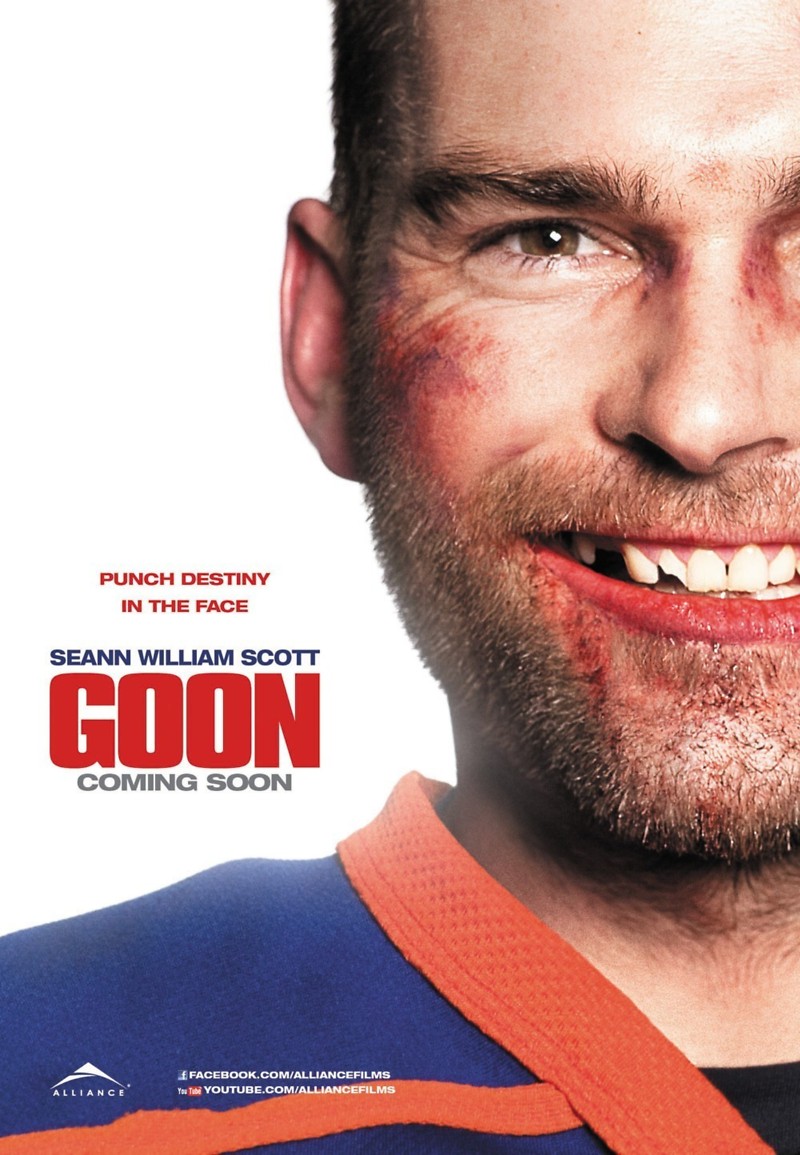
Doug Glatt is a simple young man living in small town in Massachusetts. He's big. He's strong. He's a bouncer. He's not very bright, but he has a good heart. Doug is generally a pleasant fellow, though he does lament the fact that he doesn't seem to have a real purpose in life.

One night, at a local minor league hockey game, Doug's purpose presents itself. When an unruly player for the visiting team charges into the stands while screaming homophobic slurs, Doug, whose brother is gay, absolutely destroys the vulgarian with his bare hands. This earns him a walk-on tryout from the local team's coach. Though Doug can barely skate, he becomes just proficient enough to stay upright and become a first-class "hockey goon" - a player whose sole purpose is to fight in defense of the more skilled players on his team.

Though Doug's a complete teddy bear off the ice, woe be to
any player whom he sizes up for a Biblical beat-down.
Doug's prodigious fighting prowess soon earns him a promotion to a more legitimate farm team, where he's tasked with serving as enforcer for an immensely talented but selfish and skittish young French Canadian named Xavier Laflamme. Doug overcomes the doubts of his teammates and earns their respect as an earnest, supportive comrade.

In the final game of the season, Doug's team is in a must-win game against a rival that features the most respected and legendary goon in the minor league hockey ranks - Ross "The Boss" Rhea (Liev Schreiber), a narrow-eyed, chain-smoking, savvy, calm, and tough-as-pig-iron veteran who knocks people out in the manner that most humans discard a used tissue. Doug's stand-off with Rhea is a dream scenario for every hockey fan with bloodlust in his or her heart.

Did I Like It?

Right off the stick - no, Goon is not as good as Slap Shot. But man, it's not that far off.

This was the second time that I watched this movie, and I love it. Though it can be a little uneven in just how stupid Doug is portrayed, it does nearly everything that it sets out to do very well.

The greatness that is Slap Shot and Goon are due to their focal subject matter - the unnecessary and idiotic yet often entertaining violence ingrained at many levels of hockey. Let's face it: most of these guys are not Rhodes Scholars. They play hockey. Some of them fight a lot on the ice. Nearly all of them curse a ton. And very few of them are aware of just how funny they can be - often unintentionally. Where Slap Shot gave us the ultimate comedic panoramic of minor league hockey culture, Goon gives us an oddly endearing and hilarious character study.

Doug is a great character, and Seann William Scott was a perfect casting choice. Doug is the textbook case of a man whose heart is vastly larger than his brain. The fact that he's an absolute tank whose fists are, as his gloriously vulgar best buddy Pat puts it, "bigger than my uncle's f****n' prostate," gives the story a soulful element that even a hands-down classic like Slap Shot is missing. You pull for Doug in the same way you pull for Rocky Balboa. Sure, Doug's not fighting for the heavyweight title, but his battles are just as epic in their way.

Featuring one of the best build-ups ever in sports film,
we're treated to the final confrontation between veteran
and rookie warriors - Rhea versus Glatt.
So enough with the mushy stuff. How are the fights? They're bloody awesome. If you enjoyed the thrill of seeing Mickey "The One-Punch Machine Gun" O'Neil do his thing in the ring in Snatch, you'll love what Doug does to the obnoxious ruffians on opposing teams. I'm probably revealing a bit of my own bloodlust here, but I find the thrashings that Doug dishes out wonderfully entertaining. And the elder statesman of goonery - Ross "The Boss" Rhea - is played to perfection by Liev Schreiber. Rhea's self-awareness of his station in the hockey world is a nice counter-point to Doug's innocence.

But there's an interesting revelation about the fights: there is, among certain practitioners of goonery, a kind of code that nearly borders on chivalric rules of engagement. At the beginning of one hockey match in the film, before the puck even drops, an opposing player and fellow enforcer (played by former real-life NHL enforcer Geroges Laraque) calmly turns to Doug and asks, "You wanna go?" Doug replies, "Okay, yeah." The instigator gives an earnest, "Good luck, man." The two punch the hell out of each other for a while, get separated, and the opposing player nods his head and offers Doug a "Good fight, man." Doug responds with a simple, "Thank you." There is a certain old-world charm about the entire exercise in ritualized violence.

So here's where I overthink it and almost doubt myself. Could Goon be a satire, perhaps even unintentional, for United States militarism? Or could it be seen a misplaced but humorous apology to excuse bloody violence? Are we supposed to think that Doug's lone stand-out talent - pummeling people into pulp - has merit as long as his heart's in the right place? Maybe so. Maybe not. Either way, there is something a bit deeper to be explored when one considers what, if any, greater message is being conveyed.

Whatever the case, I can't help but return to one simple axiom when I watch a movie like Goon: It's more important to be kind than to be intelligent. Doug is admittedly far from intelligent, but he has more than enough heart to go around, and he just wants comrades who need him and whom he can defend. These themes make Goon a bit more than just a solid sports comedy, and worth your time if you've no strong objection to some fairly graphic hockey violence. 

Sunday, June 22, 2014

Tyson (2008)


Director: James Toback

Many may disagree, but I think Mike Tyson is one of the most fascinating people of our generation. And this 2008 documentary presents him in ways that illustrate exactly why I find him so.

Between the ages of 12 and 15, I knew of Mike Tyson as nothing less than a force of nature. He was not only the heavyweight champion of the world (back when that title still held a good amount of heft), but he was known for annihilating opponents in the ring. World-class, enormous fighters who had trained for decades would get leveled by this smaller, unspeakable fast, powerful and ferocious kid in less time than it took the viewers to get through their first fight-time beer. The day that he lost his title to Buster Douglas in 1990 was as shocking to me as if someone had told me that the moon had exploded. Tyson's bizarre and tragic decline in the years after that loss have become the stuff of infamy.

At 22, Tyson became the youngest ever to win the
heavyweight title. This began a four-year span in which
he became one of the most dominant forces in sports in
the 20th century.
Tyson's life story has already carried more than one extremely interesting biopic, including the 2002 ESPN Outside the Lines series which focused on him. Of course, Tyson was still a semi-active boxer at the time, so his professional life was not yet finished. This more recent release offers the look back at a man who, at the time, had been three years fully retired from a the sport which he seemed to have been born to dominate.

This more recent documentary offers a more complete picture of a man who, though still only 47 years old, has been all of the following: Brutally poor, neglected and bullied child. Hardened street thug and thief. Repeat juvenile offender. The youngest undisputed heavyweight boxing champion of the world. Publicly (falsely?) accused wife beater. Drug addict. Expert boxing historian. Convicted (erroneously?) rapist. Muslim extremist. Philosopher. Bipolar disorder sufferer. Three-time husband. Father of six. Comedian. Broadway performer.

The story of a person who has been all of these things is interesting enough, but Tyson offers far more. The movie is told almost entirely in Tyson's own words, putting together various narratives, sound bites, and monologues given by the man himself as he recounts, reminisces, and reflects on his deeds and thoughts through his tumultuous rises and falls. And this is the real draw.

Those who mostly know of Tyson through the odd headline or occasional news bulletin about his more outrageous behavior are likely to have long ago labeled him "crazy." Or "an animal." Or things far worse. Such labeling is dismissive and ignorant, as Tyson clearly shows. Mike Tyson always has been, and still is, a strange and sometimes barely-coherent collection of a full range of human traits - rage, sorrow, joy, naivete, regret, profundity, profanity, lust, discipline, chaos, and more. When you listen to his words, often given in an almost-hypnotic stream-of-consciousness method, it is clear that there is intelligence and introspection, fractured and contradictory though it may sometimes be.

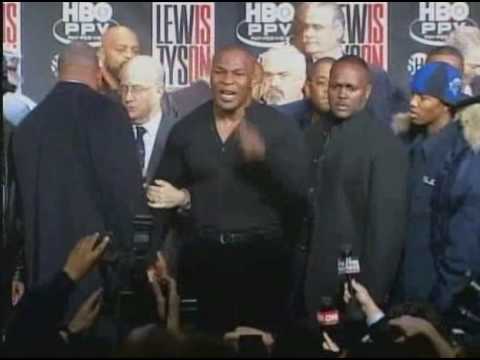
Tyson's infamous press conference meltdown in 2002. One
of many moments put in a different light in the film through
Tyson's narration.
One particular scene comes to mind. In 2002, Tyson was doing a press conference to promote his title fight against Lennox Lewis. During the Q and A, a reporter asked a question that greatly agitated Tyson, at which point Tyson went into a profanity-laced rage, nearly physically assaulting the reporter. When seen on its own merit, it seems very easy to come to two conclusion: (1) Tyson could have literally killed this man with his bare hands if his entourage hadn't held him back. (2) Tyson was a wild dog who would attack if he felt the slightest bit disrespected. However, the 2008 Tyson explains it differently. He calls himself "terrified" of people at that time. Once you hear him say this, some subtler details of the tirade become clear. His voice is cracking while he screams. He is actually on the verge of tears as he yells, "You wouldn't last two seconds in my world!!" From Tyson's own narrative of this event, it's clear that he is not talking about the realm of fighting, but the realm of his own mind. At that point in his life, his demons had been consuming him from the inside for nearly two decades. Hardly an enviable condition, especially when the person has moments of lucid introspection that offer the pain of awareness. Tyson offers this type of illumination several times.

It's hard to imagine another person even remotely like Mike Tyson coming around in my lifetime. This film may not be the exhaustive, definitive documentary about him when it's all said and done, but it offers the best first-hand account of the people and events that shaped him. Completely worth checking out for those interesting in boxing, sports, psychology, or just fascinating people.

Monday, June 2, 2014

Harvard Beats Yale, 29-29 (2008)

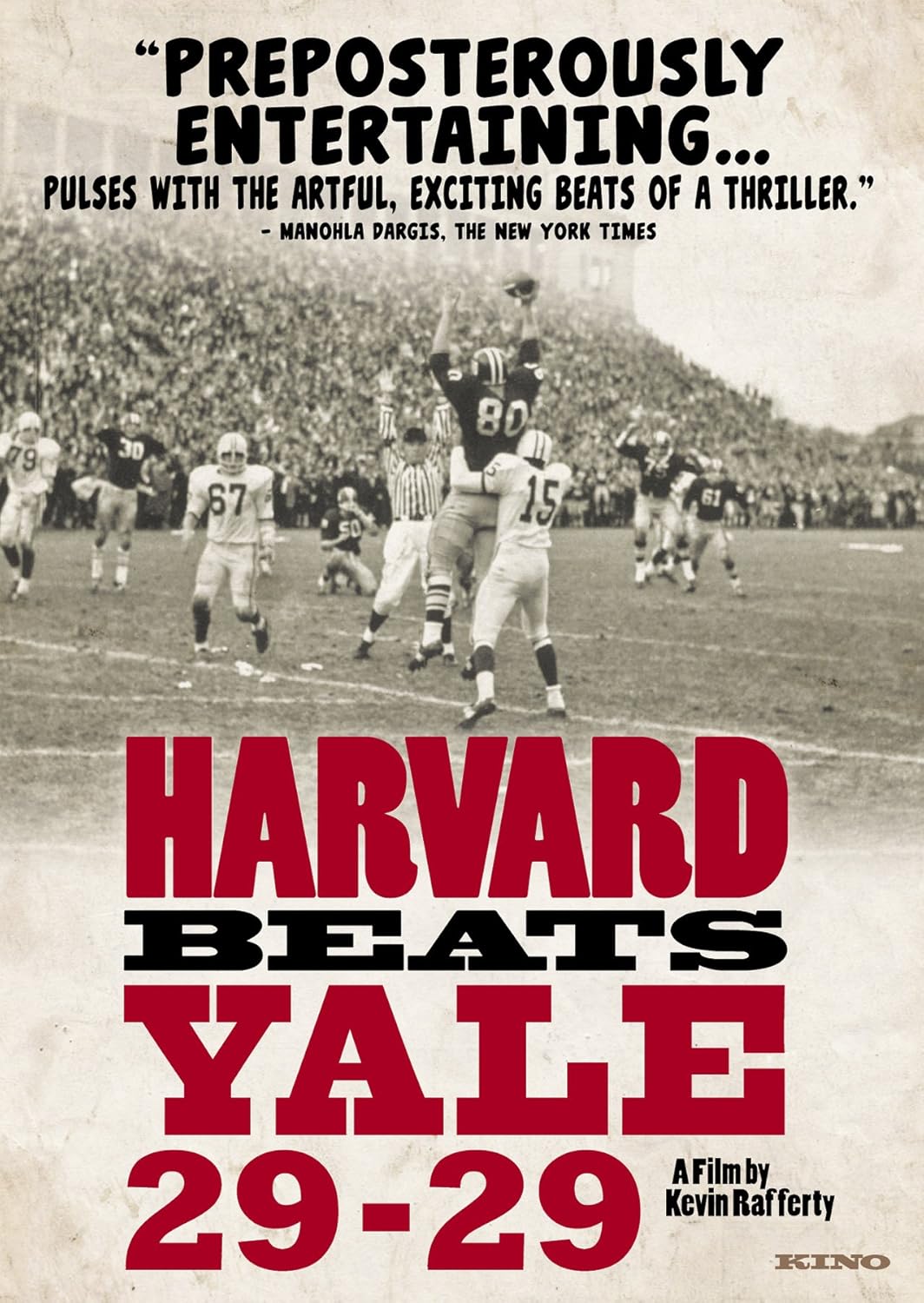
Quotes like that one at the top of this
movie poster are probably what led to
my ultimate feelings about this one...

Director: Kevin Rafferty

This documentary was a tad disappointing.

I'll watch a sports documentary about damn near anything. In watching nearly every one of ESPN's extraordinary 30 for 30 series, I've enjoyed tales about burnt-out football prodigies, trans-gendered tennis players, coked out NASCAR drivers, and plenty of other odd topics related to athletic endeavors. Because of my passion for the general topic, I was excited to see a well-received film on something I knew nothing about - an apparently epic football game played in 1968 between two long-time rivals of the Ivy League - Yale and Harvard. The movie was lauded when it came out in 2008, and I'd had it floating around my Netflix queue since around that time. Maybe 6 years of anticipation did the film a slight disservice.

The story of the game is well told. The contest is presented with chronologically-ordered clips of the pivotal plays, from the kick off to the final gun. Between the plays are interviews with various players from both teams, each giving his recollections and reminiscences about a game that was exceptional to those who cared.

And this is the problem for me. I felt that by the end, I should have cared more. But I didn't.

The original TV footage of the game is pretty cool to see.
It reminded me of the pre-HD days of my youth.
Yes, it was an exciting game in which an underdog (in this case, Harvard) came back from a major deficit to upset one of the better football teams in the country. However, Yale was not among the absolute elite in the nation. They were ranked #16 at the time. Nothing to scoff at, to be sure, but they weren't exactly the 1960s Boston Celtics. And Harvard wasn't a team of scrubs. Though they weren't ranked as highly as Yale, they were an undefeated team with some talented players. This sapped the game of a bit of drama for me.

Another expectation I had that went unmet was that the game symbolized some grander commentary about U.S. society at the time. Through the player interviews, we do get some sense of how the contrasting views of the Vietnam war and anti-government sentiment affected some of the players and their interactions with their teammates and classmates, but the game wasn't really the grand analogy for American society that I was expecting.

The men involved in the game, including a very young Tommy Lee Jones (who comes off as the ultimate curmudgeon in his interviews), have some personality. Some are amiable blue collar types, while others are self-important windbags. This certainly helps maintain some magnetism. But there weren't any classically memorable storytellers in the group, which would have helped.

A good sports documentary, but nothing approaching the very best the genre has to offer. I have to feel that there are much more compelling sports tales to be told, with more intriguing personalities and a stronger connection to society as a whole.

Friday, April 20, 2012

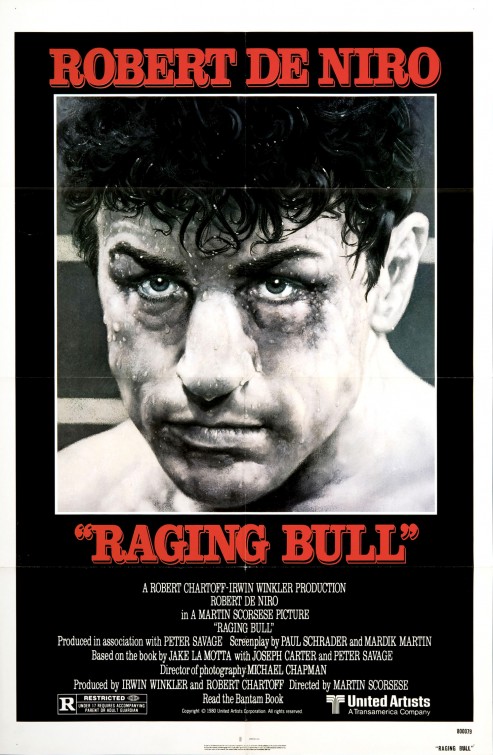
Film # 79: Raging Bull (1980)


Director: Martin Scorsese

Initial Release Country: United States

Times Previously Seen: three or four (last time – about 5 years ago)

Teaser Summary (No spoilers)

Real-life boxing champion and general dealer in violence Jake LaMotta doles out serious beatings to opponents in the ring, as well as to his closest family members outside the ring.

Extended Summary (More detailed synopsis, including spoilers. Fair warning.)

It’s the early 1940s, and middle-weight boxer Jake LaMotta (Robert De Niro) is coming into his own. A bruising, tenacious fighter from the Bronx, New York, LaMotta makes up for in sheer will and toughness what he lacks in grace and technique. His punishing style of boxing has him on a path towards a championship title fight, except for the fact that his way is blocked by the New York mafia, which controls boxing in order to manipulate outcomes to its own advantage. Jake’s manager and younger brother, Joey (Joe Pesci), tries to convince Jake to relent and allow the mobsters to help them get their title shot, but the eminently stubborn Jake refuses any outside assistance.

Jake soon becomes infatuated with a fifteen-year old neighborhood girl, Vicki (Cathy Moriarty), for whom he leaves his wife. After a few years, the two get married. Jake grows ever more jealous and controlling of Vicki as the years go on, relentlessly questioning her every move and suspecting every man around her as trying to take her from him. Through it all, Jake continues to win fight after fight in the ring, though he is still refused any shot at the title. Even after two solid fights, including a victory, against the other prime fighter of the era, Sugar Ray Robinson, Jake is blocked from championship contention by the corrupt powers that control the sport.

Joey and Jake, sweating it out in a training session. Despite Jake's prodigious in-ring toughness, the mafia blocks their title shot for years.

Jake continues to win in the ring, with his main rival Robinson now in the army. He even pummels a supposedly handsome up-and-coming young fighter into a bloody mess, after Vicki offhandedly calls him “good-looking”. Shortly after this fight, with Jake out of town, Joey spies Vicki in a bar with a few local men. Though her evening out is innocent enough, Joey loudly proclaims that Vicki is embarrassing his brother, and he demands that Vicki go home. She refuses, Joey becomes enraged, and attacks one of the men she’s with, local Mafioso and former friend, Salvy. The fight is soon straightened out by the local Mafia boss.

Jake is then allowed his title shot by local gangsters, but on one major condition – he must throw the fight so that the mob can make a killing by betting against him. Jake reluctantly accepts. Throwing the fight, though, is easier said than done. His opponent, Billy Fox, is far inferior to Jake. Jake almost knocks him out on accident, and then refuses to fall down at any point in the fight. The fight is stopped and victory briefly given to Fox, but an investigation in launched and LaMotta is banned from boxing for a time. However, when the ban in up, he receives his first true shot at the title, winning convincingly against current champion, Marcel Cerdan.

Three years pass, and Jake manages to retain his title throughout, though maintaining his fighting weight becomes more and more difficult. One day, he begins to question Joey about the fight that he had with Salvy. Jake, now so obsessed with jealousy over his wife, suspects that Vicki has been having affairs, including with Joey himself. Joey refuses to answer the interrogation and leaves. Jake then begins to question Vicki, who is frustration sarcastically screams that she has had affairs with every man in the neighborhood, including Joey. Jake, too enraged to see that his wife is being sarcastic, storms over to Joey’s house and begins to beat him unmercifully. Vicki catches up and tries to stop Jake, but Jake knocks her out with vicious punch to the face. When the dust settles, Vicki starts to pack up and leave Jake, but decides to stay after Jake apologizes and begs her forgiveness.

Jake wins his next fight, and tries to call Joey afterwards, in order to try and mend their broken relationship. The attempt fails, though. Jake’s next fight against Sugar Ray Robinson is a bloodbath. Jake, either outmatched or simply in a completely masochistic temper, allows Robinson to land vicious blow after vicious blow, though he refuses to fall down. The fight is stopped, and Jake loses his championship title.

The Bronx Bull, in the midst of getting mangled by long-time rival, Sugar Ray Robinson. It all goes downhill from here for the champ.

Several years later, Jake is tremendously out of shape and with his family in Miami. He has retired from boxing and opens a night club, where he spends his evenings drinking hard and doing bad standup routines. Vicki soon divorces him and takes their children with her. Jake’s life slides down even farther, as he gets arrested for serving under-aged girls and introducing them to older male patrons in his night club. In an attempt to raise bribe money, Jake even hammers the gems out of his middleweight champion belt, but all for naught as the gems without the belt are far less valuable. Jake does several months in a Miami-Dade county prison, in which he breaks down and wails in despair at his own stupidity.

Jake is eventually released, and he returns to New York, where he does more shoddy standup routines in dive bars. He runs into his brother Joey, with whom he tries to reconnect, with very little success.

The last we see of Jake, he is preparing to do a stage performance for a modest crowd in New York. He gives himself a pep talk, as if he were still the fierce fighter of his younger days.

Take 1: My Gut Reaction (Done after this most recent viewing, before any further research.)

One of my all-time favorite films, and the one that I think is Scorsese’s best. And that’s saying something.

The real-life story of Jake LaMotta, as Scorsese tells it, is arguably the most artful and profound sports movie of all time. It exhibits the psyche of an athlete as it spills into his personal life, and does not blanch for one second at showing you the ugliest parts of it.

I don’t know that every person would feel as I do about this movie. For one thing, it helps that I find boxing fascinating. I’m no expert, but I know a little bit of my history and went through several years in the 1990s when I followed the sport rather closely. Though it’s one of the most brutal of popular sports, there is an undeniable artistry to it. More than this, I am enthralled by the psychology of stepping into a ring and voluntarily exchanging blows with another human, until one of you is likely knocked unconscious. Raging Bull gives us a shocking and entrancing look at a man who was, even by boxing terms, a unique specimen.

Though a disaster in his personal life, Jake LaMotta was arguably the toughest middleweight fighter in boxing history.

Boxing has been called, by the sports’ devotees, “the sweet science”. What Jake LaMotta did, though, was neither sweet nor scientific. He walked towards his opponent, took every punch they could dish out, and never backed away. His ability to take an unholy number of punches without going down is admirable in a way, but it does make the stomach turn. Though filmed in a less visceral black-and-white, Raging Bull is shot in a way that conveys the brutality not only of boxing, but especially of La Motta’s style, which of course earned him his nickname, “The Bronx Bull”. The ever-present smoke, sweat, and dark pools and rivers of blood seen during the matches threaten to choke the viewer. Every time I watch this movie, I feel like toweling myself off.

While the in-ring scenes are brilliantly filmed (my only gripe is that there are more than a few “phantom punches” that are easily noticed), the real tale is what goes on outside of the ring. LaMotta’s personal life is what vaults this movie to a higher plane of film. Scorsese’s approach strikes me as something akin to the way Stanley Kubrick would have made a boxing movie, or the way that Darren Aronofsky approaches his major theme of obsession in all of his films. The darkness in La Motta’s soul, which we see as irrepressible jealousy and unstoppable rage, is the stuff of universal fascination. As disturbing as it is, it’s hard to look away from it.

I compare Raging Bull in certain ways to Kubrick and Aronofsky, but there is a major difference that is all Scorsese – the dialogue. As with all of his New York films, Scorsese nails the urban language dead on. There is a pace, rhythm, and vulgarity that can be wonderfully entertaining to listen to, and Scorsese has always been well aware of this. This is also where we get moments of levity. Let’s face it – these characters are generally not very bright, and it’s easy to laugh at them much of the time. And when we’re not laughing at them, we’re laughing at the insults that they hurl at each other. These moments keep the movie from becoming a two-hour slog through bloody violence and depression. In other words, it’s an incredibly well-rounded story, with many of the elements of real life, good and bad.

Many of the exchanges between the LaMotta brothers (De Niro and Pesci's first film together, by the way) are as funny as they are insightful towards their relationship.

Every time I watch this movie, the time flies. The story, scenes, and character interactions are so gripping that I will continue to watch this movie every few years for as long as I live. This is the reason that it is one of the very few DVDs that I personally own. Whether a sports fan, boxing fan or not, as long as one can stomach the gritty violence in the picture, I feel that nearly any mature film lover can watch and appreciate Raging Bull.

Take 2: Why Film Geeks Love This Movie (Done after some further research.)

There are all kinds of great little documentary pieces on Raging Bull. The ones I mostly delved into came on the bonus disc of the special DVD release in 2004.

The story of the film’s making is rather interesting. It basically was made because of Robert De Niro’s fascination with LaMotta’s autobiography. De Niro approached Scorsese repeatedly to do it with him, but Scorsese was ambivalent, not being any find of sports fan and knowing virtually nothing about boxing.

Eventually, though, Scorsese took interest, wanting to do something a bit different. After a crash course in boxing, Scorsese took the story of La Motta and found the universality in it. He described how he saw it in 2004: “The hardest opponent that you have in the ring [of life] is yourself.” Who better to exemplify this than the tragically unaware La Motta?

Around 1977, there was a renewed interest in boxing films by the viewing public. This, of course, was due to the 1976 smash hit, Rocky. While some of the producers of Raging Bull were initially interested in doing another Rocky film, they were intrigued enough to sign onto De Niro and Scorsese’s project.

De Niro, a noted practitioner of "The Method", felt strongly enough about LaMotta's story that he famously put on a solid 60 pounds of weight, just as the real LaMotta did in his post-boxing years.

I was stunned to learn how little interest in or knowledge of boxing Scorsese had. It’s a tribute to the man’s dedication and artistic genius that he managed to bring a novel approach to filming boxing matches as they happen. He employed several very clever visual special effects to create various moods and convey La Motta’s psyche. These and the strange and evocative sound effects add immense power to the fight scenes. To give an example, in some scenes the ring was expanded to give a sense of openness and freedom, while in another it is obscured by smoke and distorted visuals. I never quite realized the effect that these components were having on me, but they are absolutely true.

Another interesting note about the visuals is the decision to film it in black and white. Why did they do this? The main reason is that Scorsese didn’t like the way that the colors were coming through, particularly the bright red of the boxing gloves. Once they talked it over with the crew, everyone was on board. Also, it helped distinguish Raging Bull from the four other boxing movies coming out that year.

Upon the film’s release, the initial reviews were very mixed. Some reviewers didn’t know what to make of it, and they even advised MGM not to distribute it. Alas, they did. The movie was a modest commercial success, but really garnered attention at the Academy Awards, being nominated for eight awards and winning two.

Maybe the most interesting story I heard about the film’s release comes from Jake La Motta himself. In 2004, the real Bronx Bull recalled going to see the movie upon its release in 1980. He had brought his ex-wife Vicki, also prominently depicted in the film, to watch the portrayal of Jake as the relentless, brutal, thuggish character that we can all see. After the film was over, Jake asked Vicki, “Jesus, was I that bad?” Vicki looked at him and replied, “You were worse.” When you see the movie Raging Bull, you will see why this is a rather stunning announcement.

Hard to believe after you watch the film, but the real Vicki told her ex-husband that he was worse in real life than the film's portrayal of him.

The other fascinating notion I heard came from Scorsese. It had to do with sports culture, and boxing culture in general. There is a very unreal expectation thrust upon prize fighters that few fans of the sport are willing to accept – we demand that the fighters be relentless, vicious, and violent inside the ring, but tend to act with shock and reprehension when they behave that way out of the ring. (Mike Tyson, anyone?).

In Raging Bull, it is clear as day that the man inside the ropes and outside the ropes cannot easily be separated, if at all. This is why, to me, anyone who revels in the violent aspects of certain sports has little room to criticize any of the athletes in those sports when they behave similarly outside of the lines. These are the kinds of topics that a great movie like Raging Bull brings up, and it is why it will not fade into obscurity for as long as more violent sports like boxing or mixed martial arts remain popular.

That’s a wrap. 79 shows down. 26 to go.

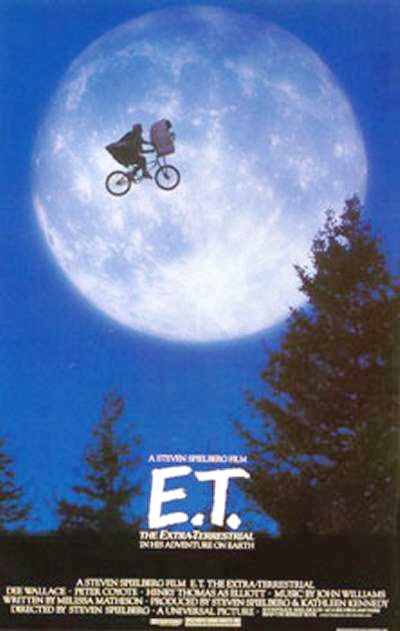
Coming Soon: E.T.: The Extra-Terrestrial (1982):


This is the second in a break-neck 1-2-3 sequence of movies: Raging Bull, E.T., and then Blade Runner. This middle flick was one of the first ones that I remember going to see in the theater multiple times. It’s been a while, but come on back to see how it holds up to me.

Please be sure to pick up all empties on the way out.

Sunday, March 28, 2010

Film #17: Olympiad (1938)


Director: Leni Riefenstal

Release Country: Germany

Times Previously Seen: none

The Story:

No story. This is a documentary of the 1936 Summer Olympics in Berlin. The production was directed by one of Hitler's favorite film makers, one who also did propaganda films for the Nazi party.

The film is divided into two parts: the first being the events that took place in and around the main arena: mostly track and field events. The second part covers the away-from-the-arena events, such as equestrian events, pentathlon, swimming and such.

Take 1: My Gut Reaction (Done after one viewing, before any research on the film):

This was a really enjoyable watch, and one that surprised me a bit. Knowing that Riefenstahl was a Nazi propaganda filmmaker, I fully expected this documentary to be ridiculously skewed and biased toward the German achievements at the Games. Such was most certainly not the case, to my delight. Rather than create a glorification of German superiority, the film focuses on the majesty and beauty of competition and the human physical form. Germany, having been the host country, had a large number of representatives, which means there are a lot of Deutchlanders in the film, but certainly to no greater ratios than you would see Americans during NBCs coverage of the games nowadays.

From the opening sequences, one gets the sense that this film goes beyond simply recording the events and results. There are slow pans along naked human forms, men and women alike, as they strike various athletic poses or engage in athletic activities. At first, the 6th grader still buried in my brain wanted to chuckle while saying "huh-huh. bare butts." Fortunately, this was short-lived and I was able to drink in the truly stunning symmetry and attraction of the human body at its peak. Certainly, there's a certain eroticism meant, but it goes far beyond this, into a very Platonic appreciation for visually attractive objects. From these forms, we get a few shots of Grecian ruins, which connect the 1936 Olympics to the traditions of the past, giving the viewer a real sense of the history behind everything. Here's the sweeping and majestic opening sequence:


Once the Games begin, a few unnerving things are shown. During the opening ceremonies (only 51 countries participated back then, by the way), each country's representatives were obliged to give the "Zieg Heil" salute to the Fuhrer, who was of course in attendance. Really eerie to see a bunch of Americans, French, and English doing that, a mere two years before all hell would break loose in Europe. When in Berlin,...

The events themselves were really interesting. Quite a bit has changed in 74 years, most notably the lack of universal techniques and equipment in sports. These days, thanks to the mountain of research done on such things, all athletes use essentially the same kinetics and the same uniforms. Back then, though, such was not the case. The variety of methods that the high-jumpers used (before the Fosbury Flop method became universal) equalled the number of jumpers. In terms of outfits, some runners went with fuller coverings, longer shorts and sleeved shirts; some were not afraid to go for what amounted to skin-tight hot pants. These days, we don't bat an eye at this, but it stood out back then.

Seeing the actual competitions was pretty engaging, for the most part. The definite highlight of the first part of the film was when they get to the men's 100 meter dash - the first appearance of one Jesse Owens at the Games. I had, of course, known the man and his accomplishments there, yet it was something else to see how this almost goofy-looking black kid absolutely destroyed the competition. Then, the stunned stillness of Adolf up in the stands made it even better. So much for that Aryan physical supremacy thing, eh? In addition to this, the film does not duck domination of events by countries other than Germany - a sweep by the Finns in the 10K run, the Japanese success in the high jump and pole vault, the U.S. taking over the long jump, and others are all given plenty of time. Here's a low-quality version of a somewhat nervous-looking Owens smoking the field (edited out was Hitler's petulent smacking of his knee):


Take that, you f***ing Nazis!!

The other thing it's easy to see early on is that Riefenstahl was not satisfied to simply keep the camera at a distance. Anyone who's watched sports footage from the 1930s, be it baseball, football, or (gag) soccer, you may remember that it was always a single camera, usually up in the cheap seats so that it could catch the entire field. Thanks to massive funding, Riefenstahl went far beyond this, positioning cameras all over the place and getting as close as humanly possible to the athletes while they were competing. You can see the sweat falling, the teeth gritted in concentration, and the pursed lips of the disappointed failures. I can only imagine how intense it must have seemed to viewers back then.

The second disc was even more interesting since it featured certain events that are off the beaten path or no longer exist in the Olympics. Of note was the pentathlon, which included horse-riding, pistol shooting, a 5K cross country run, swimming, and fencing. It was a series of very military activities, and the competitors were all soldiers who even competed in full dress uniform, at least for the equestrian and shooting events. Talk about something you simply wouldn't see these days. Even more eye-catching was a moment when, after the grueling 5K run, an American officer nearly collapses at the finish line, only to be caught and warmly seen to by a French officer on his left, and a Nazi German soldier on his right. Surreal in hindsight, to say the least.

The only gripe I can attempt to level at Olympia is that there is some manipulation of the editing for emotional impact. Many events are shown in isolation and there is always a swell of crowd noise during the more intense moments. After a while, you realize that it is not authentic, but dubbed in, much like the laugh track of lame TV sit-coms. It was meant for maximum dramatic effect, and it certainly doesn't kill the power that it has, but it does weaken it to be just a bit.

Olympia was a tremendous work in terms of sports filming and an absolute must-see for anyone interested in the history of sports, and aficionados of Olympic history would absolutely love it. Getting past the fact that it was a Nazi propagandist who did the work, which is not difficult, is the only small step required to appreciate the sheer artistry and innovation of the whole thing.

Take 2: or, Why Film Geeks Love This Movie (done after some further research):

Oh, those silly Nazis! They continued to screw things up for everyone, including incredibly talented German artists.

All joking aside, in reading up on Riefenstahl, it's not hard to see why her work got initially butchered by both editors and critics back in 1938. In the U.S., her initial 260-odd minute piece (the version I watched was a little over 210) was seriously hatcheted to erase any visuals of Hitler or even any German victories in the games, some of which are, admittedly, a bit bombastic. What the American public saw was a 92-minute version. Here's TIME magazine's 1948 (12 years later, mind you) review of it.

These days, however, as people far removed from the real threat of Nazis and with somewhat clearer vision, it's easy to see past what some mistook as propaganda. The fact is that Riefenstahl apparently only did one real propaganda film - and seemingly it was basically to pay the bills. Many essays and modern filmmakers strongly debate that there was any Nazi bias in Olympia at all. In fact, the film was not paid for by the Nazi party, but the I.O.C. Knowing this, I tend to agree with those who say there's very little evidence of a political agenda. How else does one explain the amount of time given to Owens' throwing a massive monkey wrench in Hitler's machine?

Above any debate is the technical artistry. Review after review points out how incredibly innovative the film was. It's still required viewing for many modern film students, as Riefenstahl invented many methods still at work today. The gents at TIME put it nicely.

On Riefenstahl herself, whole tomes could be written. Apparently, she was a phenomenal talent. Before film, she was a tremendously popular dancer in Germany. Injuries put a stop to that career, so she carved out her place in film history for a few decades. After WWII, she turned to photography and won even further acclaim. She went on to do documentary films in Africa and underwater films throughout the world. At the age of 100, she was directing a film in central Africa, was in a helicopter crash, and survived it. She did pass away a year later, but I'd say she managed to squeeze every ounce of life that a human can get in one body.

In finishing, here's a segment of the diving that I think showcases nearly all of Riefenstahl's mastery in using all that a camera could capture and relay to convey all that I wrote of up top:


That's a wrap. 17 shows down. 88 to go.

Coming (Very) Soon: Ninotchka (1939):


Oh, joy of joys...Greta Garbo again. I last saw her over a month ago in that overblown melodrama Camille. I've actually seen this one, and don't remember liking it too much. It's been a while, though, so I'll try to keep an open mind.

Please be sure to take all empties on the way out...