Showing posts with label John Huston. Show all posts

Friday, January 1, 2016

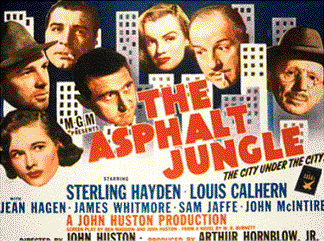
Before I Die #561: The Asphalt Jungle (1950)

This is the 561st that I've watched of the 1,172 films on the "Before You Die" List that I'm gradually working my way through.

Director: John Huston

A decent enough noir flick, but one that I'm a bit surprised is held in such high esteem.

The basic tale focuses on a bank heist, masterminded by a recently paroled master thief, Doc Riedenschneider (Sam Jaffe). Doc arrives in a new city, where he quickly gets to work assembling a small crew who will help him pull off his long-planned score. The gang he gathers includes the safe-cracker Louis Ciavelli, the gunman Dix Handley (Sterling Hayden), and the driver Gus Minissi. Doc has his plot bankrolled by a shady lawyer, Alonzo Emmerich (Louis Calhern). The heist begins well enough, but multiple complication start to arise, between one crew member being shot by police, and the entire gang being double-crossed by Emmerich.

In terms of noir crime plots, The Asphalt Jungle is solid, if not completely novel. It seems a sort of hybrid between 1946's The Killers and 1948's The Killing (noir films weren't noted for originality in their titles). In fact, the latter film also starred Sterling Hayden, who is also the key player in Jungle. The familiarity of the story and tone robbed the movie of some of its edge for me. Still, the suspense as the heist unfolds is on par with some of the very best crime movies.

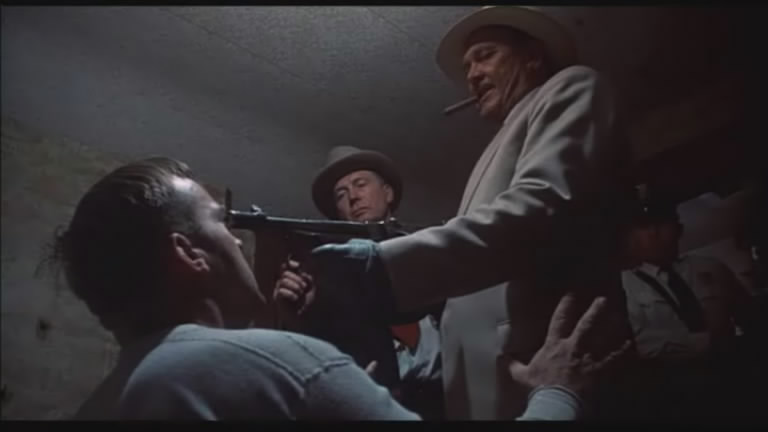
Dix (far left) and Riedenschneider (far right) display their
spoils to their ostensible patron, the oily Emmerich.
I found the characters varyingly engaging. Doc Riedenschneider is certainly the most unique and entertaining of the lot. A quirky and brilliant old thief with a weakness for young ladies is bound to be entertaining, and he is. The primary character Dix, however, I found rather dull compared to other classic noir protagonists. There is some complexity beneath his gruff exterior, but he's still rather simple. Sterling Hayden is an all-time great stoic, but it robbed the character of some intrigue. Most others in the film are fairly shallow, though acted well enough.

The classic noir era of the 1940s and '50s provided me with some of my absolute favorite movies. I still watch Double Indemnity and Out of the Past every few years with growing love and appreciation. Checking out another touted film from the era like The Asphalt Jungle was enjoyable, but I can't put it in the same class as those other masterpieces. 

Monday, August 3, 2015

Gangster Flick 3-Pack: Little Odessa (1995); Key Largo (1948); Dillinger (1973)

Few crime movies feel so authentic. Or so
numbingly grim.
Little Odessa (1995)

Director: James Gray

Hard and real, but faded around the edges.

Little Odessa follows a bleak few days in the bleak life of a young Long Island, New York hitman, Josh (Tim Roth), who is descended from Russian Jewish immigrants. Josh is told by his boss to return to his old neighborhood, Little Odessa, to perform a hit. Though reluctant to return for reasons not totally clear to us viewers, Josh does so all the same. As he hunkers down and prepares for the assassination, Josh attempts to reconnect with a few people, including his younger brother Reuben (Edward Furlong) and his former girlfriend, Alla. These things are not so easy, as he not only needs to keep a low profile, but he must also deal with a mother stricken with a brain tumor, as well as a stern father who has long since disowned him.

The movie has one of the grittiest, nastiest feels of any crime movie I've seen. Any glamor that one finds in most gangster movies is completely stripped away. There are certainly gunfights and killings, but they are presented with cold, disturbing realism. The matter-of-fact manner with which Josh goes about his business is unsettling, to say the least. Yet the juxtaposition with his attempts to rekindle some sort of connection with Reuben and his mother gives depth to this otherwise detached character. He's fiendish and heartless in most ways, but his interactions with these two hints at a person who may just have been redeemable at some time in the past. As the story unfolds, though, it becomes clear that Josh is truly beyond saving.

The film is written and shot with the same starkness as the themes and characters. The Little Odessa where the story takes place is all faded grays and browns, and speckled with urban blight. Everything happens in the cold, bitter wintertime, adding a greater chill to the grim proceedings. There are a few brief moments of gallows levity, but this is not a film that one "enjoys" as much as sees through with determination and a hope for some form of reconciliation.

It is a good movie, no doubt. Director James Gray, who would later do the much glossier We Own the Night, executed a very clear vision, despite having limited resources (this was his very first film). The dialogue feels very authentic, and the performances are excellent. Still, the entire tale is far too tragic and depressing to even border on "entertaining." Rather, it has the feel of a dramatization of all-too real events. It's worth seeing one time, especially for crime movie aficionadoes, but one time should suffice for most people.


A stand-off between Bogart and Robinson should have been
epic. As it was, I found Robinson's cigar-munching,
scenery-chewing Johnny Rocco a rather dull character.
Key Largo (1948)

Director
: John Huston

I can see why this movie has been labeled a classic, though I didn't enjoy it as much as I had hoped.

The story begins with World War II veteran Frank McCloud (Humphrey Bogart) arriving on the titular island, where he hopes to visit the father and sister of one of his fallen comrades. He finds the father James Temple (Lionel Barrymore) and sister Nora (Lauren Bacall) as the proprieters of a little hotel on the island, but not before running into several tough-looking individuals who are staying at the hotel. It isn't long before Frank and the Temples learn that the men are henchmen for Johnny Rocco (Edward G. Robinson), a formerly powerful Chicago ganglord who had fallen from power after the repeal of Prohibition (Al Capone, anyone?). Rocco is staying at the hotel in order to meet with former associates and transact some illegal deal which will give Rocco a foothold back in the criminal world.

Virtually the entire film takes place inside the hotel lobby, where Rocco and his men hold the Temples and McCloud hostage while they wait for Rocco's associates to arrive. To complicate things, a hurricane is bearing down on Key Largo. Things become more and more claustrophic as Rocco repeatedly bullies the Temples, McCloud, and even his own boozy girlfriend, in a effort to demonstrate his strength. McCloud is the biggest enigma, as he seems to be a man of principles and heroism, but he passes up more than one opportunity to stand up to Rocco. Things culminate after the hurricane passes and McCloud is forced to pilot Rocco's boat, with Rocco and goons aboard, to Cuba for their escape.

There is certainly enough in Key Largo to carry a viewer's attention. Bogart is always magnetic, especially when playing a morally ambiguous character such as McCloud. The movie also features great performances by some of the all-time greats such as Bacall and Robinson. Still, I found myself disappointed in much of the dialogue. Rocco and his thugs spout off the same, tired tough guy gangster lines that I've heard in dozens of other such films from the era. I wish I had a dollar for every time someone tagged a statement with "...see?!" These, along with far too many instances of Rocco exclaiming that "Rocco will be back on top!" became dull before very long. It bordered on unintentional self-parody.

Still, the finale was strong enough to redeem most of the weaknesses. The boat ride to Cuba has a nice amount of tension and suspense, making for a memorable finish. It also provides welcome closure to the most intriguing thread to the story - just what kind of man Frank McCloud is.

Key Largo is definitely not your typical gangster movie, as it feels far more like a stage play. With some tighter, more imaginative dialogue, it likely would have become one of my favorite films. As it is, though, it is a great idea somewhat dulled by imperfect execution.


Dillinger (1973)

Director
: George Milius

If there's a movie that should be watched in conjunction with Bonnie and Clyde, this is the one.

Warren Oates is great as the title criminal, but it is Ben
Johnson as "G-Man" Melvin Pruvis (seen here, with
Tommy gun) who steals the show.
Clearly taking his cue from that 1967 Arthur Penn masterpiece, director George Milius decided to meld a polished, Hollywood sheen with a violent, nasty presentation of the other infamous bank robbers of the Depression Era. As the title makes clear, the movie depicts the felonious acts of John Dillinger, the very first "Public Enemy Number One," as he robs and shoots his way across the Mid-West U.S. during the early 1930s. Dillinger was, along with a few others such as Bonnie and Clyde, among the very first "celebrity" criminals the country had seen. He was handsome and charismatic enough to build a rather strong following among many in the public. Like his fellow bank robbers, the support for him stemmed much from the public's emnity towards a banking industry viewed as the culprit of the country's desperate economic situation.

Though the movie does show Dillinger's charisma, it doesn't shy away from showing how brutal, ruthless, and irascible he was. Penn's Bonnie and Clyde conveniently left out several very sordid details about how the pair had killed several innocent people during their crime spree. Milius does not shy away from showing Dillinger for what he was: a greedy, selfish, and self-absorbed punk who cared very little for any collateral victims caught in his wake. Though Dillinger was only ever charged with one murder - that of a police officer - his open gun battles showed little concern for anything but his own escape.

The cast is excellent. Imagine my surprise when seeing Sergeant Hulka from Stripes, Warren Oates, playing the title criminal masterfully. He plays Dillinger's impishness, petulence, and arrogance all with equal skill. The other infamous robbers in his crew - the homicidal "Baby Face" Nelson and charming "Pretty Boy" Floyd - are also done extremely well by a very young Richard Dreyfus and Steve Kanaly, respectively. The most pleasant surprise came from an actor and character I knew nothing of. Ben Johnson plays Melvin Purvis - the stern F.B.I. man in charge of tracking down many of the infamous bank robbers of the day. Johnson's performance is magnetic, as he gives Purvis an icy, calculated toughness that draws the eye in every scene in which he appears.

Dillinger was definitely one of the stronger movies on the list from which I've been pulling these gangster films. Though it was clearly aping much of the style of Bonnie and Clyde, it did include just enough alterations and additions not to be seen as a straight ripoff of that earlier classic.

Wednesday, March 4, 2015

Before I Die #541: Prizzi's Honor (1985)

This is the 541st I've now watched of the 1,162 movies on the "Before You Die" list that I'm gradually working my way through...

It's past the statute of limitations, but I still
feel like suing this poster for false
advertising. 
Director: John Huston

Totally disappointing.

When I see the words: "mafia," "Jack Nicholson," and "John Huston," I start to think good things. Such thinking resulted in the sad shock I felt in watching this movie.

The basic story is thus: Charley Partanna is a man quite literally born into the mafia. His father and god-father swear, immediately after his birth, to raise him within the Prizzi "family." Charley doesn't disappoint, growing to become one of the most feared mafia enforcer/assassins in the country. A very serious problem arises, however, when Charley falls in love with Irene Walker, a fellow assassin who robs the Prizzis. Things are further complicated when Charley's ex-wife, Maerose Prizzi, gets involved in the entire mess.

The story seems, on paper, to make for a solid mafia movie. When you add in a brilliant cast including Jack Nicholson, Kathleen Turner, Anjelica Huston, and many other great character actors, then you would expect movie gold. What I saw was a borderline-mess of a film that fell completely flat.

Firstly, Jack Nicholson's New York accent is horrendous. This is very odd to me, as he was born and raised in New Jersey. Despite this, his faux New York street guy affect is even worse than the shakey Boston accent he put on in The Departed. This wouldn't be such a nuisance if Nicholson weren't in nearly every scene. He is, though, so it's a nuisance. A larger, less superficial problem to me is that the tone is never consistent. At times it wants to be a dark comedy; at others a touching dramedy; and at others a suspenseful crime tale. It's a very difficult trick to pull off, and John Huston (an indisputably great director) failed on every count. Neither the characters nor their motivations ever fully gel, leaving a bizarre, rambling story in which I cared about no one and nothing.

I couldn't shake the feeling that this movie is one that could have been done by filmmakers like the Coen Brothers, whose quirky sense of genre and tone blending might have resulted in a brilliant cult classic. As it is, though, I'm left to wonder just why so many film critics have hailed Prizzi's Honor as an "all-time great gangster movie." I just don't see it.

That's 541 movies seen. Only 621 to go before I can die...

Thursday, February 2, 2012

Film #72: Chinatown (1974)


Director: Roman Polanski

Initial Release Country: United States 

Times Previously Seen: two (last viewing about 7 or 8 years ago)

Teaser Summary (No spoilers)

Cunning, 1930s L.A. private eye gets wrapped up in a knotted case of small- and grand-scale corruption. Shoots his mouth off plenty.

Extended Summary (A slightly lengthier plot synopsis, spoilers included. Fair warning.) 

*Note: this will be a relatively short summary. For a fully detailed recounting, you can check out this one at Internet Movie Database.* 

In 1937 Los Angeles, private investigator Jake Gittes (Jack Nicholson) is hired by a woman, Evelyn Mulwray, to tail her husband, Hollis. Jake is to find proof of an extra-marital affair. In following him, Jake soon learns that Hollis is a chief engineer on the city’s water and power commission and that he spends nearly all of his time inspecting the lands around the city’s reservoirs. Eventually, Jake manages to witness and take photos of Hollis meeting with a young woman with whom he seems very close. The photos soon go public in the newspapers.

Jake and the real Evelyn Mulwray. Like any good noir film, many a cigarette is smoked by both hero and heroine. 

No sooner is Hollis Mulwray’s seeming infidelity made public than another woman turns up in Jake’s office. This woman is the real Evelyn Mulwray (Faye Dunaway), who threatens to sue Gittes over defamation. It is now clear that the woman who had hired Gittes was not, in fact, Hollis’s real wife. With his own investigator’s license on the line, Jake later makes an appeal to Evelyn and begins to investigate the case further. Evelyn agrees (suspiciously quickly) to drop any legal action against Jake, and Jake soon after discovers Hollis dead at one of the reservoirs that he would routinely inspect.

Over the course of the next several days, Gittes digs more and more deeply. Through his own ingenuity and brass, he figures out that Hollis was murdered by Evelyn’s father, Noah Cross (John Huston). The elderly Cross is exceptionally rich, but has grander designs on expanding his empire much farther. His plot involves having the very natural drought, along with his own hired thugs, spoil farmers’ crops to the point that their land becomes virtually worthless. Cross has been buying the land up cheaply, through false fronts, and plans to have the city build a dam that would bring water to his new properties. With a water supply, the land’s worth would grow exponentially. Hollis Mulwray, however, once Noah Cross’s partner on the water commission, was going to block the plan to build the dam, claiming that it would be unsafe. Hollis was, therefore, murdered by Noah Cross himself and brought out to the reservoir, to make it seem an accident.

In an even more sordid twist, Jake learns that the young girl that Hollis had visited before his death was not a mistress of any sort. She is, in fact, Evelyn’s illegitimate sister/daughter, Katherine, the product of a rape at the hands of her own father, Noah Cross. By the time Jake puts all of this together, both the police and Noah Cross are searching for Evelyn and Katherine, and they are hot on the pair’s heels. Jake decides to help them both escape to Mexico, and sets up a brief rendezvous in Chinatown. Noah Cross gets to Jake first, though, and forces him to lead him and his goons to Chinatown. Upon arriving, the police also show up and arrest Jake, who tries to explain all that he has discovered about the nefarious Mr. Cross. Evelyn and Katherine show up, manage to hustle past Noah into their car, and begin to drive away. The police open fire on the car and kill Evelyn. A screaming Katherine, staring at her murdered mother/sister, is pulled out of the car and taken away by Noah Cross. Jake, dumbfounded by the turn of events, is released by the police and slowly escorted away from the scene by his employee Walsh, who says merely, “Forget it, Jake, It’s Chinatown.”

The now-battered and weary Jake and Evelyn find brief solace with each other, shortly before it all comes crashing down. 

Take 1: My Gut Reaction (Done after this recent viewing, before any further research.) 

I really enjoy this movie, and I appreciated it even more this time than the previous two times that I’ve watched it. It stands out as a haunting classic which takes a genre that had been established several decades prior, molds it into a slightly different shape, and results in a familiar yet novel finished product.

The technical aspects of Chinatown are easy to laud. The sets, camerawork, and general look to things are flawless. Director Roman Polanski lent an attractive symmetry to many of the visuals, something that film noir movies had shown through a few outstanding movies like the Billy Wilder-directed Double Indemnity. The bit of spice added to Chinatown is the element of color. Color was nothing new at this point in movies, of course, but the splendor of the art deco Los Angeles in the 1930s is far grander when not limited to the black and white of the past. It also lends a sharper contrast to the far darker, more sinister deeds being done amidst this vibrant wonderland.

The acting is also top-notch, as can be expected from a cast that includes Nicholson and Dunaway. Nicholson, in one of his least “Nicholson” roles, shows just the right balance of weariness, heroism, cynicism, impudence, intelligence, and rebellion. The “wild man” roles he would become best known for are far removed from this far more restrained and highly effective one as Jake Gittes. Dunaway is equally potent as the infuriatingly enigmatic Evelyn Mulwray. The little cracks that she shows in her poise and grace are subtle hints at the horrors that she is working so hard not to reveal. In his more minor role, even John Huston is tremendous. There’s something truly terrifying about this tall, stooped, craggy old man and his dead black eyes that make me believe that Noah Cross truly is the embodiment of evil and greed.

He may look like a kindly old coot, but Noah Cross may just be the embodiment of pure evil. And it doesn't take long for Jake to realize it. 

The tale that these characters are part of is 99% the stuff of noir. A knowing, jaded protagonist gets hooked into a labyrinthine plot by a gorgeous woman. Said protagonist uses his own skill and wits to fight his way through various obstacles and find the truth behind the knotted lies and deceit, only to find that he comes up short in the end. And yet, the central figure, in his fatalism, somehow knew that such an end was fated for him. All of these things can be found in noir stories, classic and obscure, alike. However, these familiar elements are where Chinatown makes highly effective alterations. Noir protagonists and characters were often too slick to be real. They always have great, witty one-liners for all occasions. Jake Gittes certainly pops off at the mouth (with great wryness), but his sardonic wit and worldview seem more fleshed out. This was essential for a 1970s movie redoing a 1930s/’40s style.

The final component that I notice Chinatown remolded was just how dark it gets, figuratively. Certainly, all noir crime movies explore the seedier side of humanity. Chinatown, though, gets farther into the depths than any that I’ve ever seen. Beyond murders fueled by base greed, Chinatown gives you a look into the gaze of the devil himself in the form of Noah Cross – a man whose insatiable greed and utter lack of remorse for deeds unspeakable are appalling. Cross’s evils not only destroy the lives of his daughter and former business partner, his actions not only slowly crush the livelihood away from thousands of farmers, but also he shows not the least ounce of guilt. On top of it all, he actually gets away with all of it. There’s a dreary fatalism to it that hits far harder than other noir classics, in which the protagonist and any remaining sinister characters go down in flames. In Chinatown, though, you’re left with a voided sense of emptiness at the end.

If you expect a happy ending, just look at this last shot at Gittes's face and think again. 

So why do I like it so much? I guess it’s because it’s simply an incredible piece of storytelling, and its artistry is clear for all to see. And to be honest, I often appreciate stories that don’t give me the happy ending. Sometimes, there’s a sad beauty in destruction, as much as we might not want to admit it. And it’s this beauty that’s summed up at the end of Chinatown, with a defeated Jake Gittes walking away from the scene of the crime and the lonely trumpet wailing, signaling the final fade-out.

 Take 2: Why Film Geeks Love This Movie (Done after some further research.) 

Unlike a few other films on the TIME list, there is really no mystery as to why Chinatown is considered a great movie. There really are no weak points to it, and it created a novel concoction from familiar and enjoyable ingredients.

A few interesting notes, though. One is the script. In thinking about it after watching a few interviews with script writer Robert Towne and director Roman Polanski, it’s clear that Chinatown’s script is near perfect. I’m talking "Casablanca" perfect. Each line and scene flows smoothly into the next, burning the tale slowly into the conflagration in the end. Curious to learn two things about the original – one is that Towne wrote it with a happy ending, in which Gittes helps Evelyn Mulwray escape Noah Cross with her daughter. The movie studio was completely on board with this. Polanski, however, still in agony over the murder of his wife, Sharon Tate, at the hands on the Manson family, insisted on having a bleak finale. Polanski won his argument, and even now, Towne himself admits that it was the right call. In a 1999 interview, Polanksi even said, “If it doesn’t end in tragedy, then what’s the point?” A really interesting question, and one that many viewers might ask in a contrary way: “If the hero and heroine don’t survive hardship and win in the end, then what’s the point?” It’s this conundrum that still has viewers mulling over Chinatown.

Another interesting observation was made clear to me by an earlier film critic. As I vaguely alluded to in my first take, Faye Dunaway’s Evelyn Mulwray is very much an exotic species in film noir, though a deceptive one. On the surface and throughout much of Chinatown, she seems to be every inch the femme fatale – beautiful, deceitful, and seemingly luring the detective into some sort of trap. While all true, Mulwray is, actually, totally altruistic. She lies only to protect Katherine from the evils of her brutal father. The females in other noir films are always selfish in their motives, while Evelyn Mulwray is thoroughly selfless. This is one of the more prominent of several creative adaptations to the noir genre, and it adds spectacular depth. Chinatown is, almost 40 years later, still an outstanding movie that has lost none of its luster. Film noir may not be explored much any more, but Chinatown is a brilliant pillar of its strong past. If you haven’t seen it before, you’d do well to try it.

 That’s a wrap. 72 shows down. 33 to go.

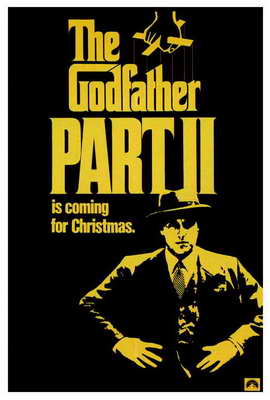
 Coming Soon: The Godfather, Part II (1974):
I know that Christmas of 2011 has come and gone, but I couldn’t resist this poster. I can’t wait to re-watch this rarity – a sequel to an absolute classic that equals, and arguably bests, its predecessor. Please be sure to pick up all empties on the way out.