Showing posts with label Roman Polanski. Show all posts

Friday, May 4, 2018

Before I Die #621: Rosemary's Baby (1968)

This is the 621st movie I've now seen out of the 1,199 films on the "Before You Die" list that I'm gradually working my way through.

Director: Roman Polanski

A horror "classic" that still has some power, though it is considerably faded by age and endless mimicry by countless imitators.

The story follows the titular Rosemary Woodhouse (Mia Farrow), who moves into an imposing and creepy old apartment building - the Bramford - in Manhattan with her aspiring actor husband, Guy (John Cassavetes). Despite the building's dark history of housing supposed witches, and being the setting for some gruesome deaths in the past, the Woodhouses take an apartment. They are soon set upon by a pair of strange upstairs neighbors, the Castevets, an elderly couple who show undue interest in the Woodhouses. Rosemary and and Guy try to play along with the Castevets and several other strange denizens of the Bramford. However, when the young couple express an interest in having a child, things become ever-more bizarre, as the Castevets' interest in Rosemary increases to unnerving levels. On a particularly disorienting night, Rosemary suffers through what seems to be a fever dream wherein she is impregnated by some demonic creature that initially posed as her husband, Guy. After this strange nightmare, Rosemary discovers that she is, indeed, pregnant. the neighbors continue to close ranks around her, slowly attempting to cut off Rosemary's contacts with outsiders. Rosemary begins to suspect that she is at the center of some sort of dark Satanic ritual, and that her baby might just be the child of Satan himself.

This movie made all sorts of waves when it came out, and it's not difficult to see why. At the time of its release in 1968, tales involving Satanism were hardly part of the popular culture landscape. What this movie did was to take such dark subject matter and include it in a relatively mainstream offering. It was such a hit that the idea of a "Satan's spawn" or demon possession has been used over and over, to varying degrees of success, ever since, with 1973's The Exorcist and 1976's The Omen being the obvious standouts. Because of the high volume of imitators, the suspense and ultimate reveal of the story loses its impact.

Another area where age hasn't helped is in the overall writing. The dialogue, which was probably adequate and perhaps even engaging fifty years ago, feels rather clunky much of the time. It's often the sort of cheesy, unimaginative fare that you might expect from classic, prime-time TV dramas or sit-coms. A larger problem is that the Rosemary character is immensely pathetic. This partially fits into one of the grander and still-relevant themes (which I'll cover below), but it can simply be painful to watch the waifish Mia Farrow get buffeted around by forces which she finds too strong to fight, even though there are plenty of more obvious paths of escape to us viewers, if only Rosemary would show a bit more pluck. Fans of strong female characters are likely to be frustrated by this movie's lead. And the grand finale/reveal of the movie can be almost laughably silly, despite the fact that it is meant to be the height of horror.

Ruth Gordon as the garish and eternally nosy Minni Castevet.
Her function as a menacing nuisance is played only too well -
I actually grew tired of her well before the halfway point in
the film, along with a few other characters.
The film still works very well in two main ways. One is the use of the Bramford itself. The eerie old building still has power as an imposing setting for the diabolical machinations taking place within its walls. Far more powerful, though, is the movie's strength as social commentary. The relentless pressure put upon Rosemary by everyone around her - from her obtrusive neighbors to her supposedly loving husband - to get pregnant, see it to term, and raise the child, despite her strong misgivings along the way - all of these still resonate as the types of social pressure thrust upon women to make motherhood their primary focus. The movie takes them to a wild extreme, but this is what successful horror allegories do. Rosemary's Baby still functions well in this regard, even if it often feels bloated and clumsy about it much of the time.

I was glad to finally take in this horror classic which I had somehow never seen before, but I'll feel zero need to see it again. It's strengths in general setting and theme are easily garnered in a single viewing, while its many dated elements quash any desire I would have to sit through the film's 130-minute run time again.

That's 621 movies down; only 578 movies to go before I can die. 

Thursday, April 19, 2018

Retro Trio: Talladega Nights (2006); The Conjuring 2 (2016); The Ninth Gate (1999)

Talladega Nights: The Ballad of Ricky Bobby (2006)

Director: Adam McKay

My second viewing of this Will Ferrell farce, the first one being shortly after its release 12 years ago. Still consistently funny, though a movie that relies on its cast more than any especially clever script.

To quickly recap, Will Ferrell plays Ricky Bobby, a NASCAR driver born with a desire to "drive fast" and eventually gets his shot on the big stage. He quickly rises to the top of the sport, but almost as quickly becomes immensely arrogant, seeing his success on the racetrack as validating his and his family's boorish behavior. Ricky's world is turned upside-down when he is first defeated at the hands of the gay, French Formula One driver Jean Girard (Sacha Baron Cohen), and the subsequent defeat sees his family and best friend abandon him. Ricky then must rediscover his shattered confidence and put his life back together with the help of his loving mother (Jane Lynch) and his estranged and ever-irresponsible father (Gary Cole).

What can one say about Talladega Nights other than it's certainly a "Will Ferrell" movie. Ferrell has always been a guy who can make me laugh with consistency, even if he's never been an intellectual or overly clever comedian. Virtually every memorable role and character has been the same for him - the obliviously over-confident boor. Thing is, he is so freakishly good at playing this buffoonish role in spot-on deadpan, that he's bound to make nearly anyone laugh at least a few times in every movie. Talladega Nights is no different.

What helps this movie rise above lesser Ferrell fare like Get Hard or Daddy's Home is the comedic talent of the supporting cast. Time-tested comedy pros like John C. Reilly, Jane Lynch, and Sacha Baron Cohen unsurprisingly hit their marks well. But even lesser-known comedic quantities like trophy-wife-playing Leslie Bibb do nice work here. But arguably the stand-out minor character is legendary comedic character-actor Gary Cole, who plays Ricky's transient, rebel-without-a-clue father, Reese Bobby. Many will recognize him as the droning boss Lumbergh from the classic Mike Judge movie Office Space, or more recently as the hilariously dry political analyst Kent Davidson on the HBO series Veep. But here, Cole gets to show off a more dynamic aspect of his comedy game, playing the brash, loud-mouthed father who sparks his son's love of driving as well as his supreme arrogance.

It helped that I watched this movie with my wife, who hadn't seen it. Seeing a goofy comedy like this is always more enjoyable with others, even if it's hardly what I would call an essential classic. Within the Will Ferrell comedy canon, though, I have it up with Blades of Glory as one of his two or three best.


The Conjuring 2 (2016)

Director: James Wan

A step down from the original, though a high-quality version of a mostly by-the-numbers horror flick.

The Conjuring told the based-on-true-events story of a haunting which called on Ed and Lorraine Warren to assist a family with a truly haunted house. After recovering from that harrowing experience, the couple is now asked to help a poor family in London England with strange phenomena in their run-down flat. There, a single mother's children are experiencing moving objects and terrifying visions. Most notably, the youngest girl Madison is seeing and perhaps sometimes being controlled by the spirit of the old man who previously lived in the home.

This sequel was not nearly as satisfying to me as the original. It sticks to the same formula in most ways - use tried-and-true classic haunted house tropes: creaky doors, things jumping out of shadows, eerie sounds and whispers in the night, and so on, and do them well. Director James Wan (who also oversaw the original) is an undisputed expert in this realm, to be sure. The problem is that they lose their effect when one has seen the original movie not long before (I saw it about two years ago). Yes, the jump scares are very effective, but I've always found such a tactic as being ultimately shallow. Fortunately, there are some visual sequences that are more original and nerve-tingling, even before the inevitable jump-scare, such as Lorraine Warren's daydream at home involving "The Nun" (I won't ruin it for those who haven't seen it) and a few others.

I think what stood out to me as being particularly inferior to the original were the non-horror elements. The dialogue was notably bad at times, either from being overly sappy or simply overwrought. While the original movie didn't have stand-out dialogue, it at least wasn't distracting in any way. The sequel, unfortunately, made some missteps by trying to get sentimental or explore more human emotional territory. When highly reliable actors like Vera Farmiga and Patrick Wilson are having trouble selling the lines, then you know the writing is a bit dubious.

So I obviously did not like The Conjuring 2 as much as the original. Still, it was loads better than the next movie I watched...


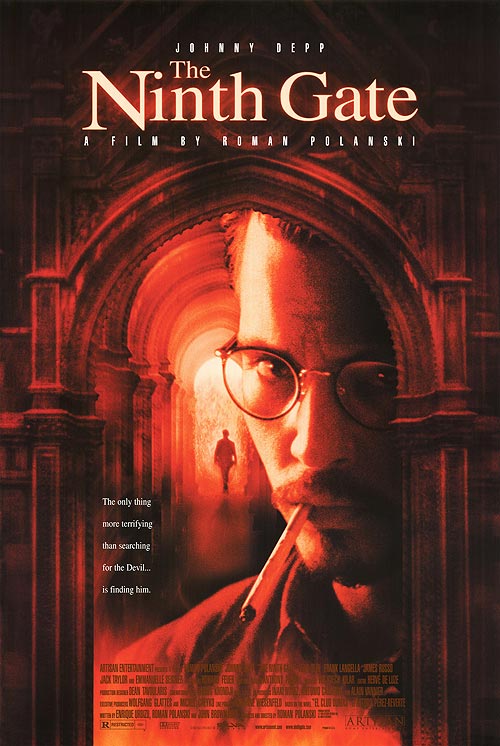
The Ninth Gate (1999)

Director: Roman Polanski

Disappointing, even though I pretty much knew to keep my expectations tempered.

All I knew about this movie was that it was about a rare book dealer who is sent to track down an ultra-rare volume reputed to be of particularly demonic nature. As a guy who loves books, used to work in book stores and collect books, and enjoys a good Biblical demon story, I thought there would be enough here to really enjoy. Not quite.

The story follows Dean Corso (Johnny Depp), a book dealer of highly dubious morals who is hired to track down a pair of books supposedly written by Satan himself. The man who hires him, Boris Balkan (Frank Lingella), has one copy of the volume and he wants it authenticated along with the other two. Corso infers that Balkan has been attempting to use the books to literally raise the devil and acquire unspeakable power in the process. Corso goes to Europe, where the other two copies are held. As he gets closer to the books and their owners, however, Corso becomes a person of interest for a few mysterious individuals. When people start to die around Corso and the books, things grow ever-more sinister. Everything culminates when Balkan ends up with the relevant information from the three texts and enacts a Satanic ritual, only to fail horribly and burn himself alive. Corso, who witnesses this first-hand, is then granted his own chance to pass through the titular "ninth gate," and into who knows what sort of demonic powers.

The movie has some solid ideas going for it. Unfortunately, I'm not sure what accomplished director Roman Polanski was thinking as he made this movie. I don't know if there was studio interference here, or if it was just a bad misfire in terms of vision (it happens to the best of them), but the movie never seems to get anything completely right. There are several plot turns which at first are intriguing but then fall flat due to either being unimaginative or simply lacking enough detail to be compelling. Characters act in illogical or wildly inconsistent ways. I often had the feeling that Polanski was trying to be too subtle, leaving the audience to figure something out but not giving us nearly enough clues to do so. What we are left with is a mess of overly vague suggestions that never coalesce into a satisfying narrative.

The acting is just as spotty as the narrative. The veterans like Depp, Langella, and even Lena Olin are fine. They do their typically-solid jobs here. But more than a few secondary characters were downright awful, most obviously "The Girl," played by Emmanuelle Seigner. I don't know any of Seigner's other work, but it looks like she has a solid resume in film and TV. That said, it was simply hard to watch her in this movie. I can only guess at the possible reasons; whatever it was, though, it resulted in line deliveries that were alternately stiff and oddly-stressed. There were also a few other bizarrely wooden actors in lesser parts, which rang of Polanski hiring them for their stunning good looks rather than any trace of acting ability.

This movie is a shame, really. It had the makings of something much scarier and memorable, rather than the frustrating mess that it was. 

Thursday, February 2, 2012

Film #72: Chinatown (1974)


Director: Roman Polanski

Initial Release Country: United States 

Times Previously Seen: two (last viewing about 7 or 8 years ago)

Teaser Summary (No spoilers)

Cunning, 1930s L.A. private eye gets wrapped up in a knotted case of small- and grand-scale corruption. Shoots his mouth off plenty.

Extended Summary (A slightly lengthier plot synopsis, spoilers included. Fair warning.) 

*Note: this will be a relatively short summary. For a fully detailed recounting, you can check out this one at Internet Movie Database.* 

In 1937 Los Angeles, private investigator Jake Gittes (Jack Nicholson) is hired by a woman, Evelyn Mulwray, to tail her husband, Hollis. Jake is to find proof of an extra-marital affair. In following him, Jake soon learns that Hollis is a chief engineer on the city’s water and power commission and that he spends nearly all of his time inspecting the lands around the city’s reservoirs. Eventually, Jake manages to witness and take photos of Hollis meeting with a young woman with whom he seems very close. The photos soon go public in the newspapers.

Jake and the real Evelyn Mulwray. Like any good noir film, many a cigarette is smoked by both hero and heroine. 

No sooner is Hollis Mulwray’s seeming infidelity made public than another woman turns up in Jake’s office. This woman is the real Evelyn Mulwray (Faye Dunaway), who threatens to sue Gittes over defamation. It is now clear that the woman who had hired Gittes was not, in fact, Hollis’s real wife. With his own investigator’s license on the line, Jake later makes an appeal to Evelyn and begins to investigate the case further. Evelyn agrees (suspiciously quickly) to drop any legal action against Jake, and Jake soon after discovers Hollis dead at one of the reservoirs that he would routinely inspect.

Over the course of the next several days, Gittes digs more and more deeply. Through his own ingenuity and brass, he figures out that Hollis was murdered by Evelyn’s father, Noah Cross (John Huston). The elderly Cross is exceptionally rich, but has grander designs on expanding his empire much farther. His plot involves having the very natural drought, along with his own hired thugs, spoil farmers’ crops to the point that their land becomes virtually worthless. Cross has been buying the land up cheaply, through false fronts, and plans to have the city build a dam that would bring water to his new properties. With a water supply, the land’s worth would grow exponentially. Hollis Mulwray, however, once Noah Cross’s partner on the water commission, was going to block the plan to build the dam, claiming that it would be unsafe. Hollis was, therefore, murdered by Noah Cross himself and brought out to the reservoir, to make it seem an accident.

In an even more sordid twist, Jake learns that the young girl that Hollis had visited before his death was not a mistress of any sort. She is, in fact, Evelyn’s illegitimate sister/daughter, Katherine, the product of a rape at the hands of her own father, Noah Cross. By the time Jake puts all of this together, both the police and Noah Cross are searching for Evelyn and Katherine, and they are hot on the pair’s heels. Jake decides to help them both escape to Mexico, and sets up a brief rendezvous in Chinatown. Noah Cross gets to Jake first, though, and forces him to lead him and his goons to Chinatown. Upon arriving, the police also show up and arrest Jake, who tries to explain all that he has discovered about the nefarious Mr. Cross. Evelyn and Katherine show up, manage to hustle past Noah into their car, and begin to drive away. The police open fire on the car and kill Evelyn. A screaming Katherine, staring at her murdered mother/sister, is pulled out of the car and taken away by Noah Cross. Jake, dumbfounded by the turn of events, is released by the police and slowly escorted away from the scene by his employee Walsh, who says merely, “Forget it, Jake, It’s Chinatown.”

The now-battered and weary Jake and Evelyn find brief solace with each other, shortly before it all comes crashing down. 

Take 1: My Gut Reaction (Done after this recent viewing, before any further research.) 

I really enjoy this movie, and I appreciated it even more this time than the previous two times that I’ve watched it. It stands out as a haunting classic which takes a genre that had been established several decades prior, molds it into a slightly different shape, and results in a familiar yet novel finished product.

The technical aspects of Chinatown are easy to laud. The sets, camerawork, and general look to things are flawless. Director Roman Polanski lent an attractive symmetry to many of the visuals, something that film noir movies had shown through a few outstanding movies like the Billy Wilder-directed Double Indemnity. The bit of spice added to Chinatown is the element of color. Color was nothing new at this point in movies, of course, but the splendor of the art deco Los Angeles in the 1930s is far grander when not limited to the black and white of the past. It also lends a sharper contrast to the far darker, more sinister deeds being done amidst this vibrant wonderland.

The acting is also top-notch, as can be expected from a cast that includes Nicholson and Dunaway. Nicholson, in one of his least “Nicholson” roles, shows just the right balance of weariness, heroism, cynicism, impudence, intelligence, and rebellion. The “wild man” roles he would become best known for are far removed from this far more restrained and highly effective one as Jake Gittes. Dunaway is equally potent as the infuriatingly enigmatic Evelyn Mulwray. The little cracks that she shows in her poise and grace are subtle hints at the horrors that she is working so hard not to reveal. In his more minor role, even John Huston is tremendous. There’s something truly terrifying about this tall, stooped, craggy old man and his dead black eyes that make me believe that Noah Cross truly is the embodiment of evil and greed.

He may look like a kindly old coot, but Noah Cross may just be the embodiment of pure evil. And it doesn't take long for Jake to realize it. 

The tale that these characters are part of is 99% the stuff of noir. A knowing, jaded protagonist gets hooked into a labyrinthine plot by a gorgeous woman. Said protagonist uses his own skill and wits to fight his way through various obstacles and find the truth behind the knotted lies and deceit, only to find that he comes up short in the end. And yet, the central figure, in his fatalism, somehow knew that such an end was fated for him. All of these things can be found in noir stories, classic and obscure, alike. However, these familiar elements are where Chinatown makes highly effective alterations. Noir protagonists and characters were often too slick to be real. They always have great, witty one-liners for all occasions. Jake Gittes certainly pops off at the mouth (with great wryness), but his sardonic wit and worldview seem more fleshed out. This was essential for a 1970s movie redoing a 1930s/’40s style.

The final component that I notice Chinatown remolded was just how dark it gets, figuratively. Certainly, all noir crime movies explore the seedier side of humanity. Chinatown, though, gets farther into the depths than any that I’ve ever seen. Beyond murders fueled by base greed, Chinatown gives you a look into the gaze of the devil himself in the form of Noah Cross – a man whose insatiable greed and utter lack of remorse for deeds unspeakable are appalling. Cross’s evils not only destroy the lives of his daughter and former business partner, his actions not only slowly crush the livelihood away from thousands of farmers, but also he shows not the least ounce of guilt. On top of it all, he actually gets away with all of it. There’s a dreary fatalism to it that hits far harder than other noir classics, in which the protagonist and any remaining sinister characters go down in flames. In Chinatown, though, you’re left with a voided sense of emptiness at the end.

If you expect a happy ending, just look at this last shot at Gittes's face and think again. 

So why do I like it so much? I guess it’s because it’s simply an incredible piece of storytelling, and its artistry is clear for all to see. And to be honest, I often appreciate stories that don’t give me the happy ending. Sometimes, there’s a sad beauty in destruction, as much as we might not want to admit it. And it’s this beauty that’s summed up at the end of Chinatown, with a defeated Jake Gittes walking away from the scene of the crime and the lonely trumpet wailing, signaling the final fade-out.

 Take 2: Why Film Geeks Love This Movie (Done after some further research.) 

Unlike a few other films on the TIME list, there is really no mystery as to why Chinatown is considered a great movie. There really are no weak points to it, and it created a novel concoction from familiar and enjoyable ingredients.

A few interesting notes, though. One is the script. In thinking about it after watching a few interviews with script writer Robert Towne and director Roman Polanski, it’s clear that Chinatown’s script is near perfect. I’m talking "Casablanca" perfect. Each line and scene flows smoothly into the next, burning the tale slowly into the conflagration in the end. Curious to learn two things about the original – one is that Towne wrote it with a happy ending, in which Gittes helps Evelyn Mulwray escape Noah Cross with her daughter. The movie studio was completely on board with this. Polanski, however, still in agony over the murder of his wife, Sharon Tate, at the hands on the Manson family, insisted on having a bleak finale. Polanski won his argument, and even now, Towne himself admits that it was the right call. In a 1999 interview, Polanksi even said, “If it doesn’t end in tragedy, then what’s the point?” A really interesting question, and one that many viewers might ask in a contrary way: “If the hero and heroine don’t survive hardship and win in the end, then what’s the point?” It’s this conundrum that still has viewers mulling over Chinatown.

Another interesting observation was made clear to me by an earlier film critic. As I vaguely alluded to in my first take, Faye Dunaway’s Evelyn Mulwray is very much an exotic species in film noir, though a deceptive one. On the surface and throughout much of Chinatown, she seems to be every inch the femme fatale – beautiful, deceitful, and seemingly luring the detective into some sort of trap. While all true, Mulwray is, actually, totally altruistic. She lies only to protect Katherine from the evils of her brutal father. The females in other noir films are always selfish in their motives, while Evelyn Mulwray is thoroughly selfless. This is one of the more prominent of several creative adaptations to the noir genre, and it adds spectacular depth. Chinatown is, almost 40 years later, still an outstanding movie that has lost none of its luster. Film noir may not be explored much any more, but Chinatown is a brilliant pillar of its strong past. If you haven’t seen it before, you’d do well to try it.

 That’s a wrap. 72 shows down. 33 to go.

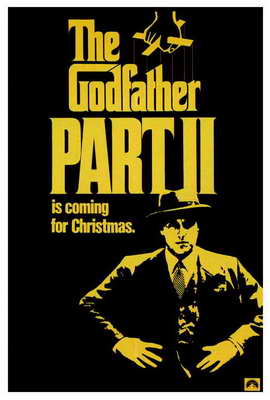
 Coming Soon: The Godfather, Part II (1974):
I know that Christmas of 2011 has come and gone, but I couldn’t resist this poster. I can’t wait to re-watch this rarity – a sequel to an absolute classic that equals, and arguably bests, its predecessor. Please be sure to pick up all empties on the way out.