Showing posts with label Ralph Fiennes. Show all posts

Thursday, July 9, 2020

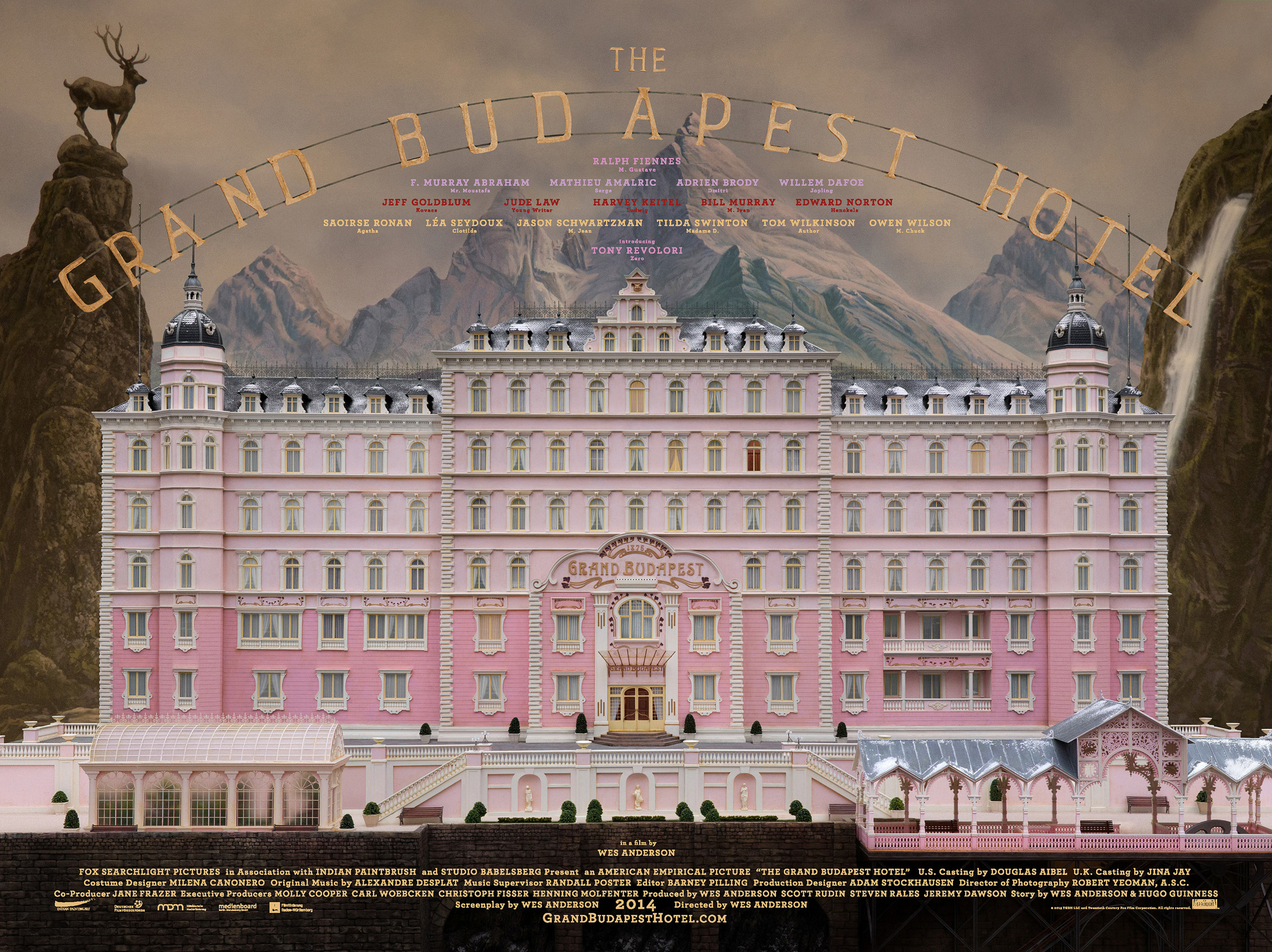
The Grand Budapest Hotel (2014)

Director: Wes Anderson

A solid Wes Anderson movie that's mostly carried by a brilliant comic performance by Ralph Fiennes.

As the final leg of our unplanned, incomplete return to Wes Anderson's movie catalog, my wife and I rewatched Grand Budapest Hotel for the first time since seeing it in the theater back in 2014. Before this, we had returned to The Darjeeling Limited, Rushmore, The Royal Tennenbaums, and The Life Aquatic with Steve Zissou. Now, the itch has been fully scratched.

Grand Budapest is a chronologically layered tale, beginning in the 1980s and quickly jumping two levels backward into the past, ultimately landing in the 1930s for the majority of the film. There (and then), we follow M. Gustave, the famed concierge of the luxurious Grand Budapest Hotel, through a wild adventure involving an invaluable painting and the viciously greedy family that covets it, all set to the backdrop of a rising, Nazi-esque fascist movement throughout this fictitious segment of Europe. Helping Gustave much of the way is the hotel's eager bellhop and concierge-in-training, Zero (Tony Revolori).

This movie is arguably Anderson's most sweeping, romantic picture. At least, romantic in Wes Anderson's unique way. More than any other of his live-action pictures, Anderson constructed an entire world. Yes, it's based on familiar elements of pre-World War II Europe, but the setting feels more exotic and romantic than anything we've seen from him. On top of that, this is the only Anderson film that doesn't hinge on the dynamics of a dysfunctional family unit. Instead, we focus on a uniquely charismatic, if not exactly honorable, figure in Gustave. He is an extremely polished, charmingly eloquent, and amusingly immoral character whose great tragedy is only that his era is slowly slipping away. Bittersweetness is always a part of Wes Anderson's movies, but never before had he examined the bittersweetness of feeling oneself slowly and inexorably becoming an anachronism. And it is a hilarious and touching study.

M. Gustave in the foreground. Ralph Fiennes's performance
here ranks among his very best, which is no mean feat for
such an accomplished actor. Ronan and Revolori do
excellent work here, as well. 
As one might expect, all of Wes Anderson's gifts as a visual filmmaker are on display, perhaps more than any other movie. By the time Grand Budapest - his seventh full-length live-action movie - arrived, we knew to expect the meticulous and vibrant sets and costumes, and carefully considered cinematography. What really jumps out, though, is Ralph Fiennes's performance as Gustave. Anderson's movies have often featured memorable turns as his quirky and flawed characters: Gene Hackman as Royal Tennenbaum. Jason Schwartzman as Max Fisher. But Fiennes turns in what I think is the best main performance of any Wes Anderson movie. It can't be easy to make an immoral hedonist like Gustave so amiable, but Fiennes pulls it off. Part of this is the great script, but even more of it is Fiennes's ability to shift registers and emotional tones with incredible agility. One moment, he's using wonderfully flowery and elevated language to wax poetic and profound, and in a blink he gives up and drops a completely resigned, "fuck it." And you feel that sad "fuck it" right along with him. It's brilliant, touching, and hilarious, and it happens several times throughout the movie.

As much as any Wes Anderson movie, this one features countless great actors filling in major and minor roles, alike. There are plenty of Anderson film mainstays like Willem Dafoe, Jeff Goldblum, and Harvey Keitel. But we also get an early and memorable performance by a then-less-known Saoirse Ronan (Brooklyn, Ladybird) and a nice turn by Tony Revolori as Zero the diminutive bellboy, whose character is revealed to be made of far sterner and deeper stuff than we might initially believe.

This second viewing reminded me of how much I enjoyed this one when I first saw it. While it doesn't quite rise to the level of Rushmore or The Royal Tenenbaums among Wes Anderson's canon, in my mind, it's in that close second-tier along with The Darjeeling Limited. This is one that I would happily recommend to someone who has seen and enjoyed one or two of Anderson's other films, and I'm sure to return to it in the future. 

Thursday, December 11, 2014

Before I Die #525: The English Patient (1996)


Director: Daniel Minghella

Masterfully constructed and beautifully shot, The English Patient nonetheless fell a bit flat for me. This is not unlike the director's later effort, The Talented Mr. Ripley, which I watched not long before this one.

The movie is, as you would expect, a true epic. Set before and during World War II, it follows the story of Count Lazlo de Almasy (Ralph Fiennes) and his love affair with Katherine Clifton (Kristen Scott Thomas). The way that their story is introduced and gradually revealed is brilliant, but I found the intended emotional impact lacking.

The movie opens with Lazlo and Katherine getting shot down by Germans in North Africa, with Lazlo being severely burned while lying next to Katherine's dead body. His body is found and transported to an Allied field hospital, where he is taken under the care of Hana (Juliette Binoche), a nurse with the terrible fortune of constantly falling in love with good men who get killed in the war. Hana decides to put Lazlo up in a bombed-out building and tend to him. From this, the movie uses flashbacks to fill us in on exactly how Lazlo came to be in such a sorry state.

Jumping back several years before the outbreak of the war, we see that Lazlo was an archaeologist who had been combing northern Africa for certain cave paintings. He is joined by Katherine and her husband, and he soon develops a deep and almost painful passion for Katherine. This is where the problems begin for me as a viewer. It was never fully clear to me why Lazlo and Katherine fall for each other. Lazlo is a taciturn, condescending man, with little to recommend him to any woman (aside from his dashing good looks, but Katherine seems to be above such superficiality). Katherine is a lively adventurer with an easy smile and quick wit. Sure, Lazlo is a moody romantic, which some would find attractive, but his actions don't often speak of admirable qualities. Given that the story of these two comprises much of the movie, it left me wanting a little more substance to their romance.

The story of Hana and her lovers, most notably the siekh
mine-sweeper Kip, contain the heart that the main story of
Lazlo and Katherine was lacking, in my view.
The more "modern" story of Hana is more interesting, though. Hana's relationships with the various men whom she loves and loses have real impact, since it is far easier to see what attracts her to the more grounded, truly heroic soldiers around her. When contrasted with Lazlo, these soldiers evoke far more empathy through Hana's loss of them, while Lazlo's loss of Katherine loses its emotional potency. This lack takes something away from the story.

The other elements of the film are difficult to criticize. Beautifully shot and edited, it is not surprising that the film raked in tons of awards back in 1996. The cinematography and acting justifiably invite comparisons to Lawrence of Arabia. The expanding and contracting scope of the personal wars within a greater, global war is conveyed wonderfully, so fans of large-scale, epic love stories are sure to be pleased.

The English Patient looks and often feels great. There are, however, just a few pieces of true heart that were missing for me to completely love it. 

Saturday, January 19, 2013

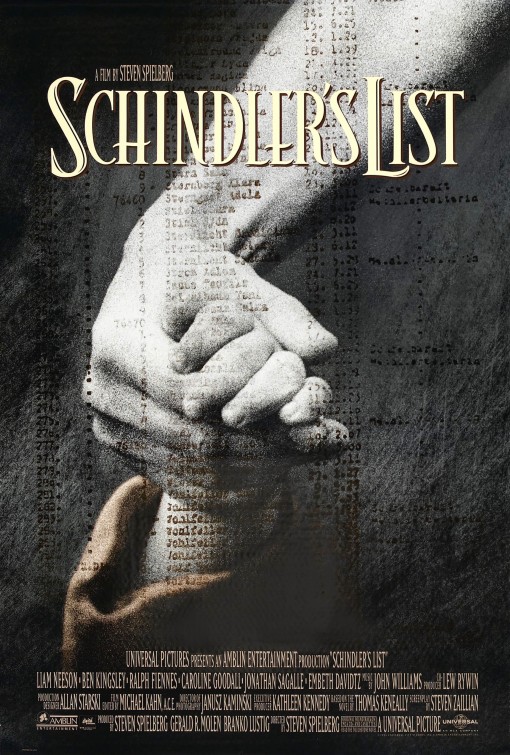
Film #94: Schindler's List (1993)


Director: Steven Spielberg

Initial Release Country: United States

Times Previously Seen: twice (last time about twelve years ago)

Rapid-Fire Summary

For a complete plot synopsis, check here at imdb’s website.

In 1940, the Nazi machine is taking hold in Poland. They are starting to herd all Jews together and force them into ghettos. Amidst these massive and horrific changes, the Czech-German businessman Oskar Schindler (Liam Neeson) arrives in Krakow with dollar signs in his eyes. Through clever business machinations and a flare for panache, Schindler quickly ingratiates himself to Nazi high commanders, secures a factory and a Jewish prisoner labor force for himself.

Over the next few years, business is good for Oskar Schindler. His factory produces quality pots and other metal goods, and his chief accountant, the Jewish Itzhak Stern (Ben Kingsly) sees that the factory runs smoothly and profitably. IN the early going, the only seeming bump in the road is the assignment of Nazi officer Amon Goeth (Ralph Fiennes) as the commander of the labor camp in Krakow. Goeth is an unpredictable and homicidal maniac who kills Jews without rhyme or reason. Schindler, however, manages to become civil, if not friendly, with the treacherous killer, in the name of keeping the money flowing in.

Oskar Schindler - in the middle of one of his many negotiations. These eventually evolve from purely self interested to completely altruistic.

Gradually, Schindler begins to have a change of heart, though a somewhat quiet and slow-building one. Upon seeing the murderous brutality of the Nazis against the Jews, Schindler, on the gentle but unwavering urging of Stern, begins to bring more Jewish laborers into his factory. He tells everyone that it is simply to maintain efficiency, but those who are closest to him can see that his sympathies for the Jews are growing. Schindler even tries, unsuccessfully, to change the brutal nature of Goeth. This failure aside, he continues to take Jewish prisoners into his factory to save them from the horrors of working in the labor camp every day.

As the War enters its final year, things become more desperate. Word comes down that Hitler has ordered the complete extermination of Jews – the so-called “Solution.” In the face of this, Oskar Schindler takes all of his massive profits, and even convinces a few other businessmen to do the same, and purchases over a thousand Jewish laborers. He assures Goeth that it is merely for convenience, as these laborers and their children are known commodities. The deal is made, and Schindler even ensures their safe transport to Czechoslovakia after his Jewish workers are mistakenly sent to Auschwitz and nearly killed, along with thousands of their fellow Jews.

At the official surrender of the Nazis to the Allied forces, Schindler addresses the hundreds of people that he has saved. The following day, as an ultimate irony and sacrifice, he must flee punishment for the crime of war profiteering.

When the war ends with the unconditional surrender of the Axis powers, the Jews are free, but Oskar Schindler is now, officially, a war criminal for profiteering. With the blessing of the thousand that he helped save, Schindler and his wife flee into the night.

My Take on the Film (done after this most recent viewing)

This was the third time that I’ve seen this movie, and my feelings haven’t changed – it’s a very good film in many ways, but there are a few things that irk me.

Schindler’s List is definitely one of the boldest of Spielberg’s films. The movie portrays the stark and horrific actions of the Nazi regime against the Jews in a way that I had never seen before. It goes far beyond mere sensational, almost action/suspense route that could have been taken. Seeing silent, morose masses of Krakow’s Jewish citizens, lined up to be classified and segregated by the conquering Germans has much more authentic emotional power. This is one of many subtle details that the movie exhibits in order to convey the crushing reality of the Holocaust.

As always, Spielberg is a master of the technical aspects of film. The man has always known how to tell stories through the moving picture, and Schindler’s List is no exception. From the opening scenes of Oskar Schindler schmoozing his way into the good graces of the Nazi commanders, to and through Goeth’s failed attempt at becoming a forgiving overlord, the movie balances dialogue and visuals to tell the tale as well as anything Spielberg has ever done.

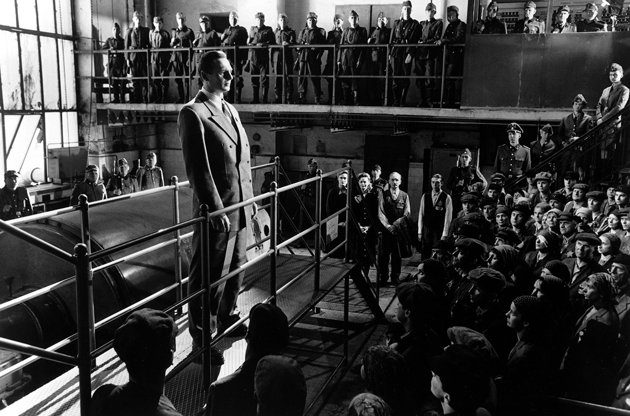
The maniacal Goeth and the savior Schindler, during one of their many talks. The two are dark-and-light reflections of one another. This scene displays how effectively Spielberg used the black and white medium. No one can say that the man doesn't know what he's doing with a camera.

Unfortunately, as important as these things are, and as well as the movie does them, there are several gripes that I have. One is that I have always found a certain flatness to the main characters. Oskar Schindler’s soul goes through a massive transformation, and yet we are left with virtually nothing to explain why this might have occurred. Aside from a few ponderous gazers at the horrors around him, we are left in the dark as to why, exactly, this self-absorbed capitalist would abandon his fortune to save a group of people whom he has only seen as a means to his financial ends. There are moments when we get hints, but I’ve always felt a little cheated when it comes to this aspect of the film. There is also an enigmatic quality to Goeth. The character never feels completely real to me – almost more of a monster construct than a person who actually could have existed.

The idea of constructs is another problem I have with the film. Far too many times, I felt as if I could see Steven Spielberg’s hand prints on the movie, and not in a good way. He was clearly trying to present a “realistic” look at the terrors of the Holocaust, and in some notable ways, he succeeded. However, there are a few too many scenes and moments that feel very contrived to me. One is the “secretary” scene, when the libidinous Schindler is “interviewing” potential secretaries by watching them type. This sequence, with no dialogue, is a very wink-wink, nudge-nudge, humorous moment in the movie. In other words, it seems way out of place. There are several others, but none so egregious as the final scene in which Schindler is walking towards his car, about to leave behind all of the people he has saved. In a scene that seemed straight out of a hackneyed melodrama from the 1940s, the hundreds of Jews quietly stand around him as he slowly starts to cry and despair over how many more lives he could have saved, had he not been so selfish. On paper, it seems to make for a great scene. On film though, to me, it seems rather artificial.

The final scene, in which Spielberg and Neeson overplay their emotional hands (in my opinion). The melodrama becomes thick to the point that it does a disservice to the reality upon which the film is based.

Related to this is something that has been a bugaboo in virtually every Spielberg film – shying away from truly, completely shocking the audience, even when it may be appropriate. The particular scene I have in mind is towards the end of the movie, when Schindler’s Jews have all been mistakenly taken to Auschwitz. The women are all stripped naked and forced into a large warehouse, which they and we the audience all presume to be a gas chamber in which they will all be killed. Just at the height of our fears, water rather than gas rains down from the shower heads, merely cleaning the terrorized women. I don’t know whether this event actually occurred, but it struck me as strange that the director, who has already shown us multiple brutal murders in the movie, would shy away from presenting perhaps the most disturbing crimes perpetrated during those years – the mass executions of helpless innocents. I’m not saying that I would have enjoyed seeing such a thing, but this film is clearly not about enjoying what you are seeing. It is about witnessing the atrocities committed against the Jews, and it only seems right to witness the greatest of those atrocities.

Schindler’s List is one of those films on historical tragedy that merely makes me want to learn more about the actual story, not unlike The Last King of Scotland or Hotel Rwanda. In fact, the scene that has by far the most impact on me, and the only one during which I cry, is at the very end, when the credits start to roll. We shift to 1993, when the film was released, and we watch the surviving “Schindler’s Jews” and some of their descendants process towards the real Schindler’s grave and place flowers along it. This is when the reality of the story hits me, and this is when I feel a real sense of loss.

I ultimately think of Schindler’s List as a “near miss.” It tells an important story, and it does many things well. However, I feel that, had the few “Hollywood” moments been eliminated and had Spielberg gone more minimalist in a few of his techniques, the movie would have had even more power.

In other words, three times in more than enough for me. I don’t need to watch this movie ever again.

That’s a wrap. 94 shows down; 11 to go.

Coming Soon: The Legend of Drunken Master (1994)


Ahhhh. A nice breath of fresh air, after emotional weightiness of the prior three movies. Kung-fu action up the wah-zoo. As of writing this, apparently Jackie Chan is in some hot water for an anti-American rant. Whatever. I just want to see one guy jumping around, kicking the stuffing out of a bunch of other guys.