Showing posts with label Sad-Ass Films. Show all posts

Saturday, January 19, 2013

Film #94: Schindler's List (1993)


Director: Steven Spielberg

Initial Release Country: United States

Times Previously Seen: twice (last time about twelve years ago)

Rapid-Fire Summary

For a complete plot synopsis, check here at imdb’s website.

In 1940, the Nazi machine is taking hold in Poland. They are starting to herd all Jews together and force them into ghettos. Amidst these massive and horrific changes, the Czech-German businessman Oskar Schindler (Liam Neeson) arrives in Krakow with dollar signs in his eyes. Through clever business machinations and a flare for panache, Schindler quickly ingratiates himself to Nazi high commanders, secures a factory and a Jewish prisoner labor force for himself.

Over the next few years, business is good for Oskar Schindler. His factory produces quality pots and other metal goods, and his chief accountant, the Jewish Itzhak Stern (Ben Kingsly) sees that the factory runs smoothly and profitably. IN the early going, the only seeming bump in the road is the assignment of Nazi officer Amon Goeth (Ralph Fiennes) as the commander of the labor camp in Krakow. Goeth is an unpredictable and homicidal maniac who kills Jews without rhyme or reason. Schindler, however, manages to become civil, if not friendly, with the treacherous killer, in the name of keeping the money flowing in.

Oskar Schindler - in the middle of one of his many negotiations. These eventually evolve from purely self interested to completely altruistic.

Gradually, Schindler begins to have a change of heart, though a somewhat quiet and slow-building one. Upon seeing the murderous brutality of the Nazis against the Jews, Schindler, on the gentle but unwavering urging of Stern, begins to bring more Jewish laborers into his factory. He tells everyone that it is simply to maintain efficiency, but those who are closest to him can see that his sympathies for the Jews are growing. Schindler even tries, unsuccessfully, to change the brutal nature of Goeth. This failure aside, he continues to take Jewish prisoners into his factory to save them from the horrors of working in the labor camp every day.

As the War enters its final year, things become more desperate. Word comes down that Hitler has ordered the complete extermination of Jews – the so-called “Solution.” In the face of this, Oskar Schindler takes all of his massive profits, and even convinces a few other businessmen to do the same, and purchases over a thousand Jewish laborers. He assures Goeth that it is merely for convenience, as these laborers and their children are known commodities. The deal is made, and Schindler even ensures their safe transport to Czechoslovakia after his Jewish workers are mistakenly sent to Auschwitz and nearly killed, along with thousands of their fellow Jews.
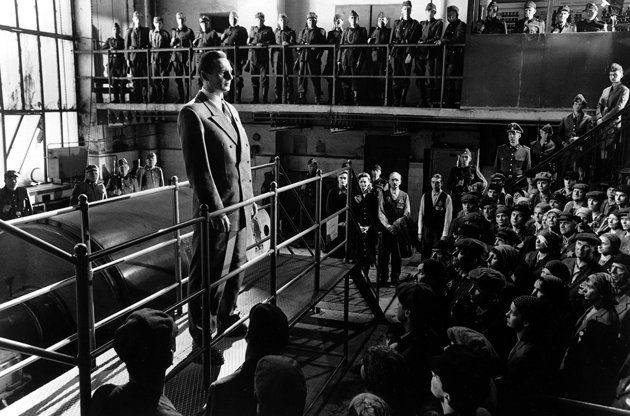
At the official surrender of the Nazis to the Allied forces, Schindler addresses the hundreds of people that he has saved. The following day, as an ultimate irony and sacrifice, he must flee punishment for the crime of war profiteering.

When the war ends with the unconditional surrender of the Axis powers, the Jews are free, but Oskar Schindler is now, officially, a war criminal for profiteering. With the blessing of the thousand that he helped save, Schindler and his wife flee into the night.

My Take on the Film (done after this most recent viewing)

This was the third time that I’ve seen this movie, and my feelings haven’t changed – it’s a very good film in many ways, but there are a few things that irk me.

Schindler’s List is definitely one of the boldest of Spielberg’s films. The movie portrays the stark and horrific actions of the Nazi regime against the Jews in a way that I had never seen before. It goes far beyond mere sensational, almost action/suspense route that could have been taken. Seeing silent, morose masses of Krakow’s Jewish citizens, lined up to be classified and segregated by the conquering Germans has much more authentic emotional power. This is one of many subtle details that the movie exhibits in order to convey the crushing reality of the Holocaust.

As always, Spielberg is a master of the technical aspects of film. The man has always known how to tell stories through the moving picture, and Schindler’s List is no exception. From the opening scenes of Oskar Schindler schmoozing his way into the good graces of the Nazi commanders, to and through Goeth’s failed attempt at becoming a forgiving overlord, the movie balances dialogue and visuals to tell the tale as well as anything Spielberg has ever done.

The maniacal Goeth and the savior Schindler, during one of their many talks. The two are dark-and-light reflections of one another. This scene displays how effectively Spielberg used the black and white medium. No one can say that the man doesn't know what he's doing with a camera.

Unfortunately, as important as these things are, and as well as the movie does them, there are several gripes that I have. One is that I have always found a certain flatness to the main characters. Oskar Schindler’s soul goes through a massive transformation, and yet we are left with virtually nothing to explain why this might have occurred. Aside from a few ponderous gazers at the horrors around him, we are left in the dark as to why, exactly, this self-absorbed capitalist would abandon his fortune to save a group of people whom he has only seen as a means to his financial ends. There are moments when we get hints, but I’ve always felt a little cheated when it comes to this aspect of the film. There is also an enigmatic quality to Goeth. The character never feels completely real to me – almost more of a monster construct than a person who actually could have existed.

The idea of constructs is another problem I have with the film. Far too many times, I felt as if I could see Steven Spielberg’s hand prints on the movie, and not in a good way. He was clearly trying to present a “realistic” look at the terrors of the Holocaust, and in some notable ways, he succeeded. However, there are a few too many scenes and moments that feel very contrived to me. One is the “secretary” scene, when the libidinous Schindler is “interviewing” potential secretaries by watching them type. This sequence, with no dialogue, is a very wink-wink, nudge-nudge, humorous moment in the movie. In other words, it seems way out of place. There are several others, but none so egregious as the final scene in which Schindler is walking towards his car, about to leave behind all of the people he has saved. In a scene that seemed straight out of a hackneyed melodrama from the 1940s, the hundreds of Jews quietly stand around him as he slowly starts to cry and despair over how many more lives he could have saved, had he not been so selfish. On paper, it seems to make for a great scene. On film though, to me, it seems rather artificial.

The final scene, in which Spielberg and Neeson overplay their emotional hands (in my opinion). The melodrama becomes thick to the point that it does a disservice to the reality upon which the film is based.

Related to this is something that has been a bugaboo in virtually every Spielberg film – shying away from truly, completely shocking the audience, even when it may be appropriate. The particular scene I have in mind is towards the end of the movie, when Schindler’s Jews have all been mistakenly taken to Auschwitz. The women are all stripped naked and forced into a large warehouse, which they and we the audience all presume to be a gas chamber in which they will all be killed. Just at the height of our fears, water rather than gas rains down from the shower heads, merely cleaning the terrorized women. I don’t know whether this event actually occurred, but it struck me as strange that the director, who has already shown us multiple brutal murders in the movie, would shy away from presenting perhaps the most disturbing crimes perpetrated during those years – the mass executions of helpless innocents. I’m not saying that I would have enjoyed seeing such a thing, but this film is clearly not about enjoying what you are seeing. It is about witnessing the atrocities committed against the Jews, and it only seems right to witness the greatest of those atrocities.

Schindler’s List is one of those films on historical tragedy that merely makes me want to learn more about the actual story, not unlike The Last King of Scotland or Hotel Rwanda. In fact, the scene that has by far the most impact on me, and the only one during which I cry, is at the very end, when the credits start to roll. We shift to 1993, when the film was released, and we watch the surviving “Schindler’s Jews” and some of their descendants process towards the real Schindler’s grave and place flowers along it. This is when the reality of the story hits me, and this is when I feel a real sense of loss.

I ultimately think of Schindler’s List as a “near miss.” It tells an important story, and it does many things well. However, I feel that, had the few “Hollywood” moments been eliminated and had Spielberg gone more minimalist in a few of his techniques, the movie would have had even more power.

In other words, three times in more than enough for me. I don’t need to watch this movie ever again.

That’s a wrap. 94 shows down; 11 to go.

Coming Soon: The Legend of Drunken Master (1994)


Ahhhh. A nice breath of fresh air, after emotional weightiness of the prior three movies. Kung-fu action up the wah-zoo. As of writing this, apparently Jackie Chan is in some hot water for an anti-American rant. Whatever. I just want to see one guy jumping around, kicking the stuffing out of a bunch of other guys. 

Monday, October 24, 2011

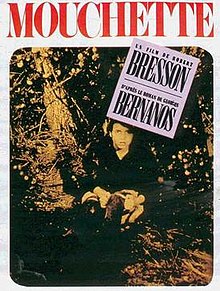
Film #64: Mouchette (1967)


Director: Robert Bresson

Initial Release Country: France

Times Previously Seen: none

Teaser Summary (No spoilers)

Sad young teen girl, in sad family situation, in a sad town, gets even sadder due to uncontrollable forces.

Extended Summary (More complete plot synopsis, including spoilers. Fair warning):

Mouchette (Nadine Nortier) is a 14-year old girl in a small town in France in the 1960s. She has virtually nothing going for her. She lives in poverty with a slowly dying invalid mother, a drunken thief of a father, and a helpless infant brother. Whether at school, at work, or removed from either, the only person who seems to value Mouchette at all is her mother, who is confined to her bed and is barely conscious most times. Otherwise, Mouchette is humiliated by teachers and classmates, abused and extorted by her father, and generally given little more than a passing glance by anyone else. Any brief moments of pleasure that she can steal for herself seems to be promptly quashed by some larger, oppressive force in her life.

At a local fair, Mouchette follows a young man she takes a fancy to. Soon after, she is slapped and derided by her domineering, scumbag father.

While sulking through all of this drudgery, Mouchette's life suddenly becomes more frightening and exciting. While hiding in the woods nearby her school to escape a heavy rain one evening, she is near a scuffle between the school's gamekeeper and a local poacher, Arsene (Jean-Claude Guilbert). The two men have romantic designs on the same woman in town, and the gamekeeper confronts Arsene. They tussle a bit and seem to settle their differences by sharing a few shots of liquor.

Some time shortly after, a drunken Arsene wanders through the woods and comes across Mouchette, still huddled under a tree. Arsene, thinking Mouchette may have seen something, brings her out of the woods and to a nearby shelter. Mouchette is aware that Arsene had fought with the gamekeeper, but neither she nor Arsene is sure of the exact outcome, which may have been a murder; Mouchette because she was not there and Arsene because he is too drunk to recall. To be safe, Arsene gives Mouchette an alibi that she can use for Arsene, in the event that the poacher has killed the gamekeeper. Mouchette seems to go along with it, out of either fear or some strange attraction to the nefarious rogue.

Arsene brings Mouchette to a safe-house in the town, where he plans to burn tons of firewood in order to corroborate his concocted alibi of being there all night. As he continues to grill Mouchette on their story, he goes into an epileptic fit. Mouchette comforts him briefly. When Arsene recovers, however, he becomes suspicious and will not let Mouchette leave. After a brief chase around the room, he captures her and forces himself upon her. She resists at first, but then relents to his sexual advance.

Mouchette is bullied by yet another force - the poacher Arsene.

Early the next morning, Mouchette returns home to find her mother in dire condition. After a brief exchange with her, her mother dies quietly, leaving Mouchette with only her father and infant brother.

The next day, as her father sits in mourning over his wife, Mouchette leaves the house on an errand for milk. On her way, she stops at a bakery, where the proprietress is kind at first, but turns insulting when a shaken Mouchette begins to act strangely. Mouchette then goes to the gamekeeper's house, where she unexpectedly finds the man alive and well. She is pulled inside and grilled for a bit by the man and a housemaid, the latter being more sympathetic. The two get the story out of Mouchette of what, exactly, happened with Arsene, with Mouchette embellishing slightly by calling Arsene her “lover”. Mouchette then leaves on her way back home. Along the way, she makes one last stop at an elderly townswoman's house. The woman rambles a bit, but tries to speak to Mouchette about her own life. She even gives the sullen young girl a dress with which to cover her deceased mother at the funeral. Mouchette merely hurls an insult at the old woman and runs out.

Instead of returning home, the thoroughly dejected Mouchette goes to the side of stream and looks out over the water. After some time pondering, she attempts to roll herself down the hill and into the water, only to be prevented by a collection of rushes on the bank. Once more, the girl goes back up the hill. Rolling down with more force of will, she send her body through the rushes and into the water, drowning herself.

Take 1: My Gut Reaction (Done after this first viewing, before any research):

Boy, these realist films don't play around.

Before watching Mouchette, I did the same thing almost anyone would do – I read the little summary on the DVD sleeve. Within that tight little sub-100 word reading, all of the following words and terms can be found: “...haunting...bleak, hopeless life...alcoholic father and terminally ill mother...grim surroundings...harsh...tragic tale...”

So yeah. I knew what I was in for.

With this foreknowledge, I was spared any nasty surprises, and I probably enjoyed the movie a little more than I would have. Still, it truly is a downer of a movie after which I can't help but ask “What's the point?”

Mouchette's visuals right up there with the best of the naturalist black and white films of Ingmar Bergman and others. While the director, Robert Bresson, used a few more cameras than Bergman, thus creating slightly more kinetic motion, he also used dialogue much more sparingly. Instead, he used wonderful visual storytelling a la the older silent filmmakers and contemporaries like Sergio Leone (though Leone told tales of a completely different ilk).


One of Mouchette's few pleasure. For several minutes, you can see every ounce of joy and attraction on her face as she rides the bumper cars around.

It's also not hard to see how different this film is compared to what was mainstream in the day. Yes, realism had already been around for a few decades, and had even achieved international recognition through films like the Apu Trilogy, Umberto D., Tokyo Story, and plenty of others. Of all of them, though, only the Apu Trilogy comes close to this sad tale of a lonely little girl who has nothing truly going for her, in terms of the weeping factor. And Mouchette goes even further down the road of depression, as the title character is left in the end with absolutely no hope, unlike the young Apu. Hence Mouchette's ultimate decision to end her own life.


Along the way, Mouchette's tale is told with heart-rending realism and subtlety. Often through mere facial expressions and body language, we can see every ounce of humiliation, anger, and even, short-live though it may be, joy that the girl goes through. One can realize that, while poverty is doubtlessly crushing for anyone, it might be even more so for a young person just reaching the age at which she is most emotional, quixotic, and malleable. The only moment of contact she has is a virtual rape. While it is understandable to see this scene with anger at the “she was asking for it” implication as Mouchette rapidly goes from resisting to embracing Arsene, I think it is incorrect. I took it to mean that Mouchette sees this horrific violation of herself as the only connection she can have with anyone. So much so that she even convinces herself that she is now Arsene's lover. Such is the result of utter poverty: physical, emotional, and spiritual.


The end is the icing on the cake, so to speak. I can't pretend to understand suicidal tendencies, but it's not hard to see how the title character's environment would lead to such a mental state. I suspect, though, that most viewers would, like I did, merely want to shake the girl and tell her to snap out of it. When she finally does herself in, I wasn't even sure what to feel. I would have to describe my mental state as the emotional equivalent of a shoulder shrug: “Oh, well. Saw that coming.”


Mouchette's first, failed, attempt at suicide. She gets it right on the next go-round.

As depressing as it all is, it wasn't as much of a chore to watch as I had feared. Mouchette's tale is told with the backdrop of a sexier story involving a jealousy between the gamekeeper and the rakish Arsene. With these more dynamic characters' confrontations adding a spice of energy to things, the movie avoids being an hour-and-twenty-minute drag.

If it isn't obvious from this review, I do not plan to watch this film again. As strong as the technical merits are, and as bold as it is for telling a harrowingly realistic tale, I can't see getting anything more out of repeated viewings. I would only recommend it to those who enjoy such melancholy fare, or are hard-core fans of very sound filmmaking.

Take 2: Why Film Geeks Love this Movie (Done after some further research.)

There's actually not much to be found on this movie, at least not in my basic searches. However, watching 2 of the documentaries offered on the Criterion Collection DVD that I had offered a little more.

The most interesting tidbit is why director Robert Bresson chose to tell the sad tale of the adolescent Mouchette, something he had done several times in previous films. Apparently, Bresson was fascinated with the malleability and unpredictability of adolescence. I can see his point – in this film, Mouchette succumbs to the abuse and neglect she faces. She attempts to get past it, but ultimately cannot. If this had been a Hollywood film, the title character would almost certainly have triumphed over the negative elements in some way. It may be far more cliche, but it doesn't make it any less probable. One never knows how a young person with react to adversity. Mouchette looked at the darkest side of it.

“[Mouchette] can't be summarized. If it could, it'd be awful.” - Robert Bresson.

After writing my own summary for this movie, I was glad to hear Bresson say this. The story of Mouchette (which is based on a French novel) is exceedingly simple. And yet, no summary can convey the tragedy and the reality of the tale. The truth is, you never quite know how Mouchette will react to the different forces acting on her, and therein lies the little bit of intrigue that can pull a viewer through the movie. It worked for me, even if the film isn't terribly exciting.

On a final note, I have to say that it was nice to watch a few “behind-the-scenes” documentaries about Mouchette. If nothing else, seeing Nadine Nortier smiling and laughing helped to wash the taste of the melancholic fatalism out of my mouth.

That's a wrap. 64 shows down. 41 to go.

Coming Soon: Bonnie and Clyde (1967):


Whew! After the Thorazine pill that was Mouchette, a rootin', tootin' Hollywood shoot-'em-up is just what I need. I haven't watched this one in many a year, so I'm looking forward to it.

Please be sure to pick up all empties on the way out.

Saturday, December 4, 2010

Film #40: Tokyo Story (1953)


Director: Yasujiro Ozu

Initial Release Country: Japan

Times Previously Seen: once (about 10 years ago)

Teaser Summary in Haiku:

Fogies visit kids
The children are too busy
Mama keels over

Uncut Summary (a full plot synopsis)

In 1950s Japan, retired Shukishi and Tomi Hirayama leave their home village in the south of Japan to visit their children in Tokyo. The elder Hirayamas are nearing their 70s and haven't seen their busy children in some time.

When they arrive in Tokyo, however, they are not afforded the pleasure of truly spending any quality time with any of their natural children. Their sons and daughters are all too busy with their work lives to make time or space for their parents. The Hirayama children even send their parents off to a nearby pricey spa, ostensibly for them to “relax,” but in truth merely to alleviate the nuisance of having to accommodate them.


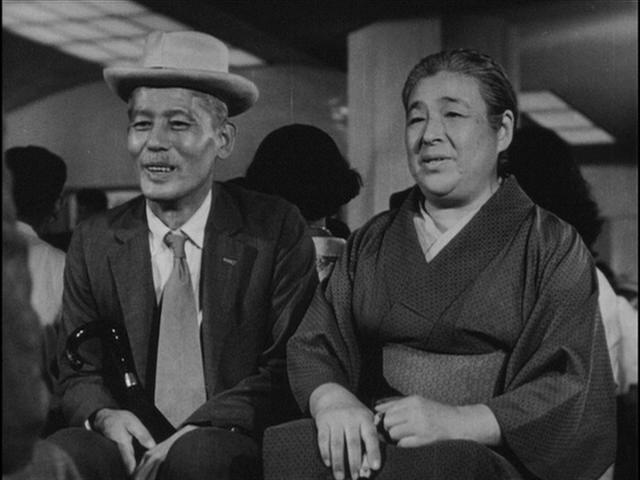
Shukishi and Tomi Hirayama's pleasant demeanors mask deep disappointment.

The only one who shows any form of true welcome is their widowed daughter-in-law, Noriko. Through the Hirayama's interactions with her and a few of their older friends, we see that the old couple is coming to grips with the reality that they are no longer a part of their children's lives. After several days of being shuffled between houses, the parents decide to cut their trip a bit short and head back to their hometown.

On the train back, however, Tomi takes ill. By the time she and her husband reach home, she is in a coma. The children finally break away from their daily hustles to be with their mother on her death bed. After she passes away, three of the five callously rush to get back to their lives in Tokyo. The two who remain with their father, the widow Noriko and the bachelorette Kyoko, share a sad moment realizing that they both may likely become just as detached from their father as their siblings have, should they start their own families some day.


The surviving Hirayamas make their final farewells & realizations

Take 1: My Gut Reaction (done after this most recent viewing, before any research)

Oof. Good thing I watched this on a grey, rainy day.

Tokyo Story is about as melancholy as they come, made all the more sad by the sheer reality and fatalism of it, as well as the skill with which the story themes are conveyed.

In the same vein as Umberto D., director Yasujiro Ozu turns his gaze toward a younger generation's attitude towards its forebears. It certainly seems that the Hirayama family is meant to represent the larger Japanese society, one in which the modernizing world has no place for maintaining deep, steady ties with anything or anyone, including one's parents.

The thing is, whereas Umberto D. had a quicker pace, a few lively characters, and a cute dog as some comic relief, Tokyo Story gives it to you raw and is much further-reaching. The former Italian film was really about an isolated loner, but Tokyo Story is about a very average family, making it far easier to feel empathy towards the characters. The dialogue and acting is so naturalistic that it almost feels like a film ethnography. In fact, of all the 40 films I've seen so far, this one has the most naturalistic acting. This is what gives it its power, especially to one as myself – a person whose parents are still alive and nearing the age of the Hirayamas. It was impossible for me to not get reflective about so many of the things the elder couple brings to light: their mild disappointment in their children, their sense of loss at their detachment from them, and their sad acceptance that nothing is to be done about it.

Here's a great moment in which Shukishi is at his most unguarded about his children. This is also a scene that reminds me an awful lot of my own time in Japan. A little too much sake in the system, coming down over a steaming bowl of ramen. Start it at time 4:40:


The pace of this movie is something quite novel, relative to the other films from the list that I've watched thus far. I'm sure some people would have a hard time sitting through the measured, quiet moments depicting everyday life. As far as I was concerned, it did get a bit tedious, but I completely understand that this is necessary and intentional. Actually, by the end I found Shukishi and Tomi's slow, almost catatonic speech soothing and very much in keeping with what they were meant to represent: a more carefully, cautiously paced generation that was being left behind in the rapidly booming 1950s.

Part of my interest in this film certainly comes from the fact that I lived and worked in Japan for two years. Very much in evidence is the famed Japanese formality and ostensible kindness, which is a theme that Ozu later explored with his film Good Morning. Most Westerners may find alien the almost mannequin-like smiles that Shukishi and Tomi wear throughout nearly the entire film, despite their growing sadness. This is what makes the few moments that they break the formality all the more potent, if not very dramatic. Were anyone I know to ask what Japanese culture is like, I could show nearly any 10-minute clip from this 57-year old movie and feel confident that it stands as a solid representative of Japanese behavior and culture. One of the several very “Japanese” moments that stood out was an exchange between Noriko and Kyoko, when the latter says, “Isn't life disappointing?” to which a calmly smiling Noriko replies, “Yes.”

As alluded to, the technical merits of the film are beyond reproach, in my opinion. It may not have been the most challenging movie to film, or the most taxing on its actors, but everything is done to perfection. Long shots convey isolation, interior shots give the sense of relative claustrophobia inside the family houses, and it's not hard to buy into the Hirayama family as thoroughly authentic.

All of these accolades aside, this is another movie that I very likely will not see again, and would only recommend with several caveats. A person must be ready for a 2-hour, 15-minute gaze into the very real but very subtle generational tensions of a Japanese family. If this doesn't sound overly entertaining, it's because it isn't. Watching this movie is an exercise of a different sort. It's one that is probably worth making at least once, but not one that's guaranteed to touch everyone.

Take 2: Why Film Geeks Love This Movie (done after further research)

One doesn't have to do much research to confirm just why Tokyo Story has a place in film history: it's that rare and classic thing that does so much in reality while seemingly doing very little. All that's needed is the viewer's careful attention and patience.

In more detail and with more erudition than I could muster, David Bordwell's analysis carefully points out just how subtle Ozu is with his lack of camera motion and his refusal to cut away from a character while they speak. Roger Ebert covers the same ground, perhaps more thoroughly in this review. What both men point to is both just how Japanese the story is, while being equally accessible to any viewer with a marginally open mind.

In reading the essays echoing the theme of a slower, older generation (aren't all younger generations “faster” these days?), I almost can't help but wonder if Tokyo Story is the very thing that it speaks of. In an age when generation gaps and attention spans seem to be shrinking astronomically, will a slow and careful look at such gaps, which is what Tokyo Story truly is, eventually be dismissed and pushed to the side?

Here's a thoughtful clip of the very end of the movie, with the new widower, Shukishi, slowly absorbing his isolation with the same measured calm as everything else. Being at time 8:20:


That's a wrap. 40 shows down. 65 to go.

Coming Soon: On the Waterfront (1954)


“I could'a been somebody! I could'a been a contendah!!” One of the few films on the list that I've already seen and absolutely love. I can't wait to watch old Terry Malloy do his thing on the docks again. Come on back and see how I feel about my latest viewing of an irrefutable classic.

Please be sure to pick up all empties on the way out.

Friday, November 12, 2010

Film #38: Ikiru (1952)


Title for Us English Types: “To Live”

Director: Akira Kurosawa

Initial Release Country: Japan

Times Previously Seen: none

Teaser Summary (no spoilers)

Crusty old bureaucrat is diagnosed with stomach cancer, seeks for ways to squeeze some life out of his remaining months.

Uncut Summary (the full plot, including spoilers; fair warning)

In a stuffy Japanese city hall building, the aging Kanji Watanabe (Takashi Shimura) sits at his desk for the section chief within the massive bureaucracy. He does nothing more than robotically stamp forms, a task that he has done for over thirty years.

And then, a change. He learns that he has stomach cancer. This shakes him to his very fiber, as he begins to realize that he has done nothing of substance with his life. He begins to dwell on his relationship with his son, whom he lives with, and realizes that they are totally detached emotionally. This is clear through his son and daughter-in-laws' plans to edge Watanabe out of his own house and pension. This becomes known to the now-terminal man, but he is lost in his search for his soul. He decides to try and spend his remaining months living. The problem, however, is that after 30 years of being an automaton he doesn't know how.

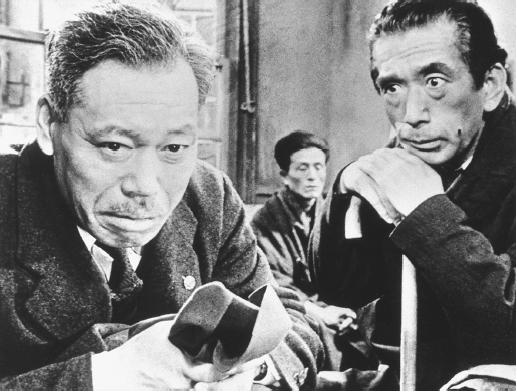
Kanji Watanabe (left) beginning to realize his mortality & wasted life.

He begins by trying the hedonistic route. While drinking heavily at a local bar, he confesses his condition to a young pulp writer. The writer takes Watanabe out for a wild night of drinking, dancing, singing, and women. Watanabe begins by having some fun, but in the end is left with a hollow feeling of being unsatisfied with this definition of “living”.

The next morning, Watanabe runs into his co-worker, Sakai, a lively and friendly woman young enough to be his daughter. Watanabe becomes taken with her vitality and general happiness, and begins to spend time with her. Sakai is happy to oblige at first, and the two enjoy each others' innocent company, but Sakai eventually becomes nervous about Watanabe's obsessive fascination with her. In the end, she leaves her job at the city office to work in a toy factory. When Watanabe finally grills her on how she can always be so cheerful, she responds that making toys for children simply makes her happy. This is the small spark Watanabe needs.

After his two mysterious and unprecedented weeks away from work, Watanabe returns with a new mission: to make some kind of difference in the world before he dies. He reviews old cases in his stacks of papers and finds a past request to have a children's park built in a small, squalid neighborhood. He decides to finally stop the “pass the buck” system of his offices and take charge. He gathers his staff and heads out to the potential park site.

Flash forward five months. Kanji Watanabe has just died and the mourners are all at the wake in the family home. In attendance are several of the more prominent politicians from city hall. It soon becomes clear that the park of Watanabe's quest has not only been built to phenomenal success, but the credit for it is being taken by the mayor. This claim of responsibility, however, is up for serious debate.

As Watanabe's co-workers, family, and acquaintances pay their respects and recall the final months of the deceased's life, it becomes clear that Watanabe was, indeed, the singular force that led to the park's construction. Through sheer force of will and a quiet, unwavering refusal to take “no” for an answer, he got the plan passed through every stodgy section in city hall, even openly defying local gangsters and the mayor himself. After overseeing the park's construction, it was here that Watanabe chose to die on a snowy winter night, finally succumbing to the cold while singing the forlorn old tune “Song of the Gondola”.

In recounting their co-worker's tale of dedication, the still-living bureaucracts make drunken pledges to reform their ways and begin to perform their tasks with more active compassion. Of course, their talk is only so much hot air. In the end, nothing changes at the city offices. However, we are left with the joy of young children playing in the glittering new park that was left by Watanabe's iron will. It was here that he decided to pour all of his remaining life energy, and we are left with children's joyous laughter to echo the final acts of a man who, in the end, figured out some way to imbue his otherwise forgettable life with some meaning.

Take 1: My Gut Reaction (done after 1 viewing, before any research)

Ikiru is another great movie that I'll likely never watch again.

I came into this one expecting an outright depressing tale, based on the synopsis on the DVD cover, and that's what I got for a while. In the last 45 minutes, though, an interesting transformation took place within the film itself and in my connection to it.

For the first 90 minutes or so, things played out not unlike I expected. A man learns that he has 6 to 12 months to live, begins to seriously examine his life and try to find the vitality that he's let drain out of himself for the previous three decades. In going to the likely areas of first vice, then young love, there are no great surprises. Still, there is something there that sets Ikiru apart from other end-of-life, soul-searching movies. It has the gumption to stare the abyss right in its terrifying face.

Throughout the various episodes Watanabe experiences, he perpetually wears a haunting death mask. His distant, eerie gaze belies the fact that he has turned his sight inward to the extent that he becomes downright creepy. During most of these moments in the film, there is absolutely no music or sound. If you allow yourself to become lost in Watanabe's stare and try to ponder the existential questions that consume him, you may find yourself in the same very real place as this loosely fictional man. We all may end up right where he is, and what, exactly will you think of your own life when you can see the end of the road coming? I found myself getting quite pensive at times during the watching.

Here's a haunting scene from Kanji's night on the town, when he breaks into a forlorn love song from his youth:


Back to the narrative. The last portion of the movie took me by surprise, as there is a severely abrupt jump from a Watanabe newly rejuvenated by the new park project, to his funeral five months later (the narrator dedicates about 3 seconds to explaining this to us, the addled viewers). From there, the movie becomes a series of flashbacks that tell the rest of the tale. In that final 45 minutes, the movie says so much about the value of living personal dedication while condemning the ineffectiveness of stale, bloated bureaucracy. In watching all of Watanabe's coworkers lament Watanabe's death, we see nearly every possible facet of humanity. They all go through periods of reverie, nostalgia, sycophancy, guilt, defensiveness, and in the end, dedication that they will become true difference-makers in their offices. These final booze-drenched promises, of course, come nowhere close to getting fulfilled. This leaves us with perhaps the ultimate message of the film: why is it that only a person who has nothing to lose is the only one who helps others in need?

In this, you can see that the themes and narrative are the true strengths of the movie. Some other aspects of the film are not exactly world-beating to me. The acting is old-school. It's solid, especially for its era, but there were still some conventions that were prevalent in a lot of acting of the day that stand out to me in a negative way. Mainly is the very slight overacting at certain moments of higher emotion, especially laughter or sorrow. It's not enough for the actors to chuckle naturally – they have to erupt with ear-piercing cackles. They can't just cry – they have to collapse into a heap on the floor. It's not as bad I may make it seem, but a few moments stood out to me.

One thing I can't knock is, as you may imagine, the directing and cinematography. Akira Kurosawa was an absolute master. Before this film, I had seen many of his dozens of films, including epic action masterpieces like The Seven Samurai or Throne of Blood, more humorous adventure tales like Yojimbo, and the more measured psychological crime dramas like High and Low. Even though I already thought it before, the humane Ikiru confirmed my notion that Kurosawa was incredible at any cinematic story he decided to tell. Between the camera work and use of sound, the meditative, somber mood is set beautifully.

The movie is pretty long, clocking in at 2 hours, 20 minutes, and to be honest, it sometimes feels like it. However, it's clear that there is no wasted time. By the time you get the end, with the near-death but redeemed Watanabe gently swaying back and forth on the park swing, contentedly singing the lonely lyric, “life is brief”, you can't help but feel that you've joined him on a spiritual journey every bit as epic as Ulysses or Beowulf.

Take 2: Why Film Geeks Love This Movie (done after further research)

Wow. Researching this movie is almost akin to a religious or epiphanal experience, not unlike the film itself.

While not exactly opening my eyes to anything in the film that I didn't notice upon first watching it, the thematic depth is confirmed and expanded upon. In reading several different essays and reviews, it becomes clear that, among Akira Kurosawa's brilliant films, Ikiru is often cited as his true masterpiece. This undoubtedly is for doing something that writer Alexander Sesonske points out as being exceptionally difficult: create a film about death that carries very real emotional power from start to finish. In this essay, Sesonske agrees that Ikiru is a masterwork, but he feels that Kurosawa's sexier tales of the samurai still have an equal place among the great films of the world. I agree.

Writer Donald Richie goes deep into analyzing the film's place among great existentialist tales in history with this piece. He reminds that Kurosawa's favorite writer was Dostoyevsky, whose stories sometimes featured protagonists very much like Kanji Watanabe – those who need their death to become tangible in order for them to enact a meaningful life. One can endlessly debate what “meaningful” is, and Richie points out that this is a hallmark of great tales – that they can be interpreted differently throughout time and among different peoples.

I think that, of all of the different summations of the ultimate message of Ikiru, my favorite comes from the original TIME magazine review, written upon Ikiru's delayed release in the U.S. in 1960:

“To live is to love; the rest is cancer.”

Watching it in isolation robs it of its emotional punch, but here's the extremely touching and iconic ending:


That's a wrap. 38 films down. 67 to go.

Coming Soon: Ugetsu (1953):


The second of a cluster of three movies done in the Land of the Rising Sun in the 1950s. I'll see how this one does in the wake of such a weighty film like Ikiru.

Please be sure to pick up all empties on your way out.

Friday, October 22, 2010

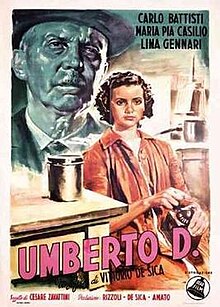
Film #36: Umberto D. (1952)


Director: Vittorio De Sica

Initial Release Country: Italy

Times Previously Seen: none

Teaser Summary (no spoilers)

Financially strapped geezer getting elbowed out of apartment ponders suicide. Has a cute dog.

Uncut Version (Full plot synopsis, spoilers and all. Fair warning)

Umberto Domenico Ferrari (Carlo Battisti) is a retired government pensioner in 1950 Rome. We see him with other retirees picketing for better pensions and learn that he is in some debt. This is only part of a larger problem, however.

Umberto owes most of his debt to his landlady, a self-absorbed social climber who has been raising Umberto's rent in order to force him out of her building. Umberto's only real friends seem to be his spunky little dog, Flike (pronounced like...well, “like”) and the pretty, guileless young maid (Maria-Pia Casilio) in his building. It doesn't take long to see that he is a rather lonely man who has no prospects to speak of. The only things that seem to keep him going are Flike and a mild sense of spite for the world around him, most notably his landlady.

Umberto and Flike in their dank, lonely apartment.

After becoming sick with a fever and spending some time in a public hospital, Umberto attempts to track down past friends and co-workers to borrow some of the money he needs to stay in his apartment. All of his efforts are, however, rebuffed. In the middle of hustling around, he loses Flike. After a nerve-wracking trip to the local pound, where he witnesses dozens of dogs put down, Umberto finds his trusty canine companion.

Following another bout of loan refusals from friends, Umberto comes a hair's breadth from panhandling on the street. His dignity, alas, does not allow him to stoop, though he tries to let Flike hold his hat out for a brief moment. At this point, he returns to his room, which is being stripped of his goods and remodeled around him. Despondent, he plans to end his own life by jumping in front of a train. Only one obstacle exists: Flike.

Umberto tries to find a boarding home for his dog, but cannot. He tries to give him to a young girl whom he knows, but her guardians will not allow it. He tries to fool Flike into running off with a group of young children in a park, but Flike will not part with his master. Resigned, Umberto decides that the only thing left for him is to take Flike in his arms and end both of their lives together.

Grabbing Flike and cradling him, Umberto slowly and slyly crosses the guard rails as a train comes. Just as the train roars close and he prepares to step in front, though, Flike resists and fights his way out of Umberto's arms, running from the tracks. Umberto runs after Flike, who is now too scared to come near his master. Rather than abandon Flike and turn his back on his own life, Umberto decides to coax Flike's trust back out of him and play catch. Our old pensioner has decided to live, as sparse as that life might be.

Man's best friend, indeed.

Take 1: My Gut Reaction (Done before any research on the film)

This was an effort to get through.

I chalk this one up as another that fits in the category of “Great Films that I'll Never Watch Again”. I can't say that there's anything wrong with the movie. Judged on its own merit, it's brilliant. It does something that, at the time, was probably very new, and it has a genuine emotional impact in the end.

But God, did it take a long time to get there. And the movie is only 90 minutes long. It felt like 180 at times. Watching Umberto schlep around Rome from one miserable failure to the next was just plain depressing. It reminded me a lot of the only other De Sica movie I've seen: The Bicycle Thief. One unfortunate fellow with little to live for getting dumped on repeatedly by the people around him and life in general.

Doesn't sound like a fun viewing experience? It isn't.

As I said, though, I can't complain about any technical merits at all. The story is constructed well, the script seems decent (though what do I know – I don't speak Italian), the cast was solid, and the cinematography is incredible (probably the greatest strength, in fact). It's just that, in the end, I was left with a hollow feeling.

I must admit to how effective the sentimental aspects of the film are; namely, the relationship between Umberto and Flike. The three most striking scenes involve both characters: the rescue of Flike from the pound, Umberto having Flike hold out his hat to beg for money (for he's still too proud), and the grande finale of near-suicide/canicide. Still, I couldn't help but feel that this sentimentality was a bit cheap, as strong as it was.

This is a good example of one of the few Flike-less touching moments, when Umberto's desperation is high enough for him to consider begging:


Without knowing the exact history of cinema (though I'll be looking it up), this movie seems a forerunner of the French verite films of the 50s and 60s – that “realistic” approach that was rife with world-weariness and “everyday” problems, and the social ills that were the cause and/or effect. Those movies were hailed as edgy for their “realism” and their unflinching gaze at the uncomfortable truths of life. I hate them. They always seemed to have some sly tone of melancholy and apathy that was dressed up in a chic aesthetic, seeming to say “We're fashionable and hip, but we can be depressed, too.” Umberto D. has none of the fashion sense, but all of the sadness.

Of course, some movies are sad as hell and I still love them. For instance, Aronofsky's The Fountain or Wong Kar-Wai's In the Mood For Love. Umberto D. is a whole other kind of sad, even if there is redemption in the end. There's a worn-in, all-too-familiar feel to the situations in De Sica's movie. Perhaps this was his point; he wanted to make people squirm as they looked at the fallout of a society that turns its back on the elderly. For Umberto, the only thing that saves him is his faithful mutt, though even that's unintentional on said mutt's part.

A movie like this just leaves me feeling that humanity is scum, and I don't really need cinema to feel that way. Just watching the evening news is enough.

Take 2: Why Film Geeks Love This Movie (done after some further research)

After dwelling upon this movie for several days, and reading several essays on it, I've softened my stance a little bit. I am still quite positive, though, that I'll never watch it again.

It seems that this movie, according to people who know a ton more than I, that Umberto D. marked a bit of a transitional era in film making. Prior to its release, Vittorio De Sica could seemingly do no wrong. He had been a shining acting star in the 20s and 30s, and his first several films has met with popular and critical acclaim in the mid-40s. Umberto D., however, bombed horribly within Italy. Why? The explanation offers some interesting insights.

De Sica's earlier films were what is known as “neorealist”, meaning that they eschewed formal actors, formal stories, and elaborate production for much more naturalistic tales told by non-professional actors. The idea was to present fictional tales that told tragic tales in a near-documentary style. This approach apparently struck a chord with people, as they saw it as revelatory and cathartic. They made a clear statement about the ills of society and their effect on the individual.

Umberto D., while still in a neorealist style, removed some of the core elements, namely the overt condemnation of social malfunctioning. When I think back on it, this is true. One is not really meant to see Umberto as the victim of some soulless government machine. He's simply a lonely man whose seclusion is as much his own doing as his environment's. This seems like a small change of pace, so why such a dramatic shift in reception within its home country?

According to this essay by Peter Becker, it was basically timing. In the 50s, as opposed to the 40s, there was an optimism washing through Italy that precluded the “airing of dirty laundry” to other countries through film. The government of this time, which had considerable influence on media, saw Umberto D. as a pointless look at a tiny pocket of quiet sadness that still dwelt within its own borders. Feeling that it cast a poor light on their country, they panned it and stifled any chance it had at commercial success in Italy. Such was not to be the case in other countries, however, as places like the U.S., France and England hailed it as a masterpiece.


Umberto as he awaits the oncoming train that he hopes will end his life.

On revisiting the sentimentality of the movie, which I initially felt was a bit base, I think that my opinion has been swayed by Stuart Klawans in this essay of his. He analyzes the purpose of Flike in the movie and makes a great case that sentimentality need not necessarily cheapen a film's emotional impact. He sums it up with the line, “ If the main character feels that his humanity itself is slipping away, his sense of being a proper man, then why shouldn’t he have a sentimental relationship with a dog?” Well put, and this point actually makes me feel much better about being choked up at the end of the film.

Here's the final scene, which can certainly be appreciated without having seen the rest of the film. Be warned - it's a spoiler if you're into the mystery of the tale:


Umberto D. - certainly an excellent movie, though one that you need to be in a somber mood for.
That's a wrap. 36 down. 69 to go.

Coming Soon: Singin' In The Rain (1952)


If this blog has taught you anything about me, it's that I hate musicals. This movie, surprisingly, is one that I've seen and remember liking. I'll see if my opinion holds after another viewing.

Please be sure to pick up all empties on the way out.