Lucky Number Slevin (2006)
Director: Paul McGuigan
A fun, stylish, rapid-fire gangster movie that carves out its own niche.
There are a ton of influences at work in
Lucky Number Slevin, which can be a dangerous thing in the wrong hands. Fortunately, director Paul McGuigan juggles and balances them all impressively well. While the result may not be an all-time classic, it is still a tight, fun viewing experience.
Without giving too much away, the basic story set up is that a young man named Slevin arrives in New York City to stay with a friend named Nick Fisher. All too soon, Slevin is whisked away by men who think he is Fisher, and Slevin is quickly embroiled in a bizarre gang cold war between two powerful yet reclusive crime lords known as "The Boss" and "The Rabbi," performed with playful menace by Morgan Freeman and Ben Kingsley, respectively.
It might be easy to write this movie off as one of the countless Tarantino
Pulp Fiction clones, but this would be a slight injuctice. While the nonlinear narrative and rapid-fire dialogue might suggest that earlier modern crime classic,
Slevin is much more in the style of
The Boondock Saints. It leaves behind the endless pop culture references and isn't nearly as gritty as a Tarantino picture, but is rather more visually polished and overtly fun. The script has more in common with film
noir, with its staccato back-and-forth sarcasm.
 |
Odd scenes like this one are the norm. Some are trying a
little too hard to be quirky, but others are effective enough. |
Much of the amusement of the movie comes from the disorientation of the tale. The lead character, Slevin (Josh Hartnett), is often whisked around by and between oddball gangsters, a la Roger Thornhill in
North by Northwest (which is openly referenced in
Slevin). Slevin's wise-ass reactions to his surroundings and circumstances, along with their inevitable consequences, are often hilarious. And then there's the fun as the viewer of simply trying to piece together all of the seemingly disparate puzzle pieces, not unlike when one first watches
The Usual Suspects. Of course, as is usually the case with such breakneck-paced films, the speed masks plot holes that are really only noticed when one has time to look back along the path. Still, it doesn't detract from the immediate experience, as the movie clearly doesn't take itself too seriously.
An interesting observation was how this movie might have the single longest "reveal" of any film I've ever seen. For the first 90 minutes or so, the story hustles along and teases a far more complex and sinister motive behind all of the actions. This motive is explained at the end but takes (no joke)
twenty minutes to fully reveal all of the mysteries. This seems ridiculous because it
is ridiculous, but the details are engaging enough to prevent boredom.
Gloria (1980)
Director: John Cassavetes
I'm not altogether sure why this movie gets so much acclaim. For my part, I just couldn't see it.
The movie tells the story of the eponymous Gloria, who finds herself protecting a 6-year old boy whose family has been murdered as part of a massive mafia hit. Gloria, though, is no ordinary neighbor. She happens to have been the mistress to the mafia overlord behind the massacre, although she has left that life behind her. As Gloria escorts and protects her charge, Phil, she wrestles with just how far she's willing to go to save him.
That basic premise is not a bad one at all, and it's one that was used in Luc Besson's 1994 film
Leon: The Professional. To me, the latter film did a far better job of it, though.
Gloria is a good idea completely mucked up by incoherent emotional tone, vague plot points, unimaginative mafia characters, and outright terrible acting and dialogue by child actor John Adames. This last one was the most intolerable for me, as Phil is in the vast majority of scenes, and it is his relationship with Gloria that is meant to be the lifeblood of the film. Alas, the script for Phil often comes off as unnatural, as if written by an adult with a point to make rather than as words of an actual child.
The setting is another bone of contention for me. Perhaps I simply wasn't in the right mood, but the film depicts the same New York City that we usually see in films from the late 70's - the grungy, grimy, scum-laden concrete jungle that seems to ooze depravity and hide menace around every corner. I'm not saying that this can't be effective, but it became tiresome and simply a chore to watch after about an hour.
I was expecting quite a bit more from this one, but hey, they can't all be winners.
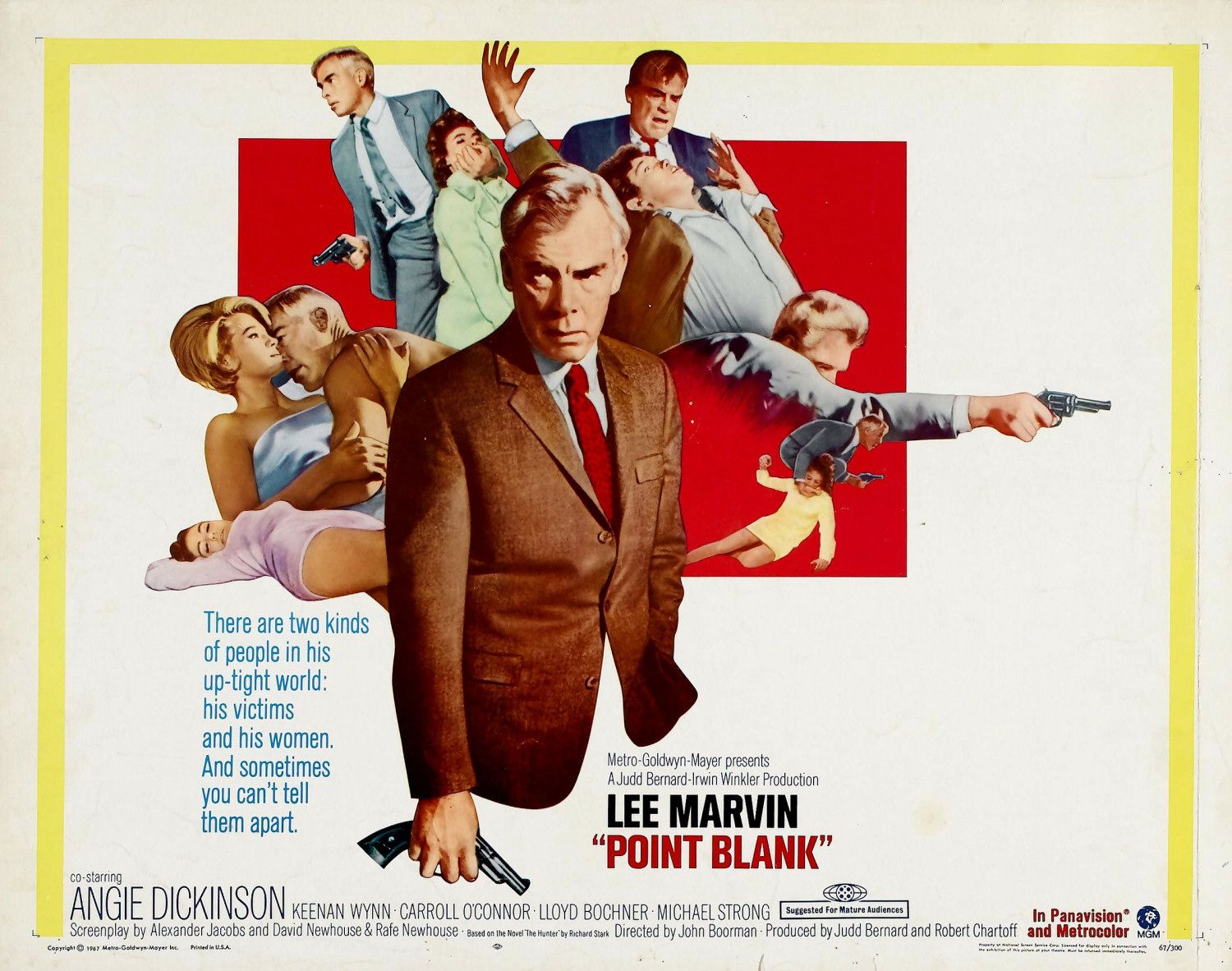
Point Blank (1967)
Director: John Boorman
Not a bad movie, though not quite as strong as I was hoping for.
If you're like me, you pick up this movie because you want to see Lee Marvin (who I once saw referred to as "the toughest-looking son of a bitch who ever was born") wreck some serious shop. Well, you pretty much get that with
Point Blank. The big drawback, though, is the aesthetic and settings within which he has to do it.
Marvin plays Walker (who, in classic tough guy fashion, adamantly never reveals his first name), who is out for revenge against a former friend who has double crossed him, shot him, and left him for dead in order to pay back a crime syndicate known as "The Organization." Well, Walker survives and comes back two years later to track down his betrayer between San Francisco and Los Angeles. He starts to target anyone who knows anything about his former friend, Reese (John Vernon), and he essentially kills his way up the criminal food chain to get to him.
Watching Walker go to work is fairly satisfying, though it's a story that's been done better in movies like
Get Carter (the original 1971 version),
A History of Violence, and others. Sure, the bad guys are scuzzy enough, but Walker doesn't ever have to display overly exceptional wits or physical prowess. He's smart enough to see various double-crosses before they get to him, but his skills are more often implied rather than actually displayed.
 |
If you think these outfits are terrible, they're actually some
of the tamer ones that you'll see in the movie. And the
seediness of this still frame also indicates a pervasive tone. |
What weakens the movie and has caused it to fade so much over the years are the look and feel of the film. Filmed in 1967, it hurls every groovy, mod-tastic piece of dated music and fashion that it can manage at you. There are hinky jazz clubs, a bombastic musical score and sound effects, and costumes that might as well smack you in the mouth. These may all have been chic and cool when the movie was released, but they were undoubtedly rather comical a mere decade later.
Forty-five years later, they have become an obnoxious distraction.
It also didn't help that, aside from Lee Marvin playing Walker, there aren't any other compelling characters. Reese and everyone in the organization is a one-dimensional egoist who first tries to placate Walker before trying to stab him in the back. Even Angie Dickinson, who is pleasant enough to look at, plays a character who is arguably the work of a obliviously misogynistic mind. Perhaps thinking they were creating a woman of "depth," they have her swing between raging at Walker, punching and cursing him, and then jumping into bed with him. In between these weird bouts, she plays it cool as a cucumber, though we never have any clear idea how or why the transitions are made. What we're left with is a woman who can only be described as a traumatized schizoid. Either that or just poorly conceived and written.
Fortunately, the film is only 93 minutes long, and it's fairly streamlined. There are a few throwaway scenes, but not many. The story clicks along fine, with Walker moving from one punching bag to the next, doling out underworld justice. I've no need to watch it again, but it was fine one-shot viewing.