|
This is Gep, in one of the countless amazing shots presented
in this outstanding movie. |
The Great Beauty (2013)
Original Italian Title:
La Grande Bellezza
Director: Paulo Sorrentino
An outstanding film, with an embarrassment of film technique riches.
For the first ten minutes or so of
The Great Beauty, one might think they've been lured into an endless patchwork of visual imagery, with no clear or personal narrative. The film opens with several sequences of tourists marveling at and photographing some of the well-worn paths and sights of Rome, to a background of choir song. We then shift to a raucous nighttime party, which includes revelers of various ages and states of drunkenness and euphoria. Just when you think that film is simply going to be a visual panorama of the ancient city and its denizens, though, the film slows and focuses on a dapper gentleman in his sixties, who begins to narrate his perspective. This is Gep Gambardella - the heart and soul of
The Great Beauty.
Gep is a writer who has produced nothing for over three decades. In his youth, though, he wrote a modern Italian masterpiece. Rather than build on this success by continuing his craft, though, he changed his goal to becoming the grandmaster of the Roman socialite scene. And he succeeded. For years and years, he was the epicenter of the social and artistic party world in the city.
Now, however, Gep is growing weary of the endless dance. Following Gep around the city, as he searches for more meaningful personal connections and even contemplates taking up his pen again, is a fantastic trip. He is affable, incredibly insightful and imaginative, and humorous, despite occasionally wearing his condescension on his sleeve. Watching Gep slowly disconnect from the shallower, more carnal, material realm that has been his comfort zone for so long, while he tries to reconnect with his own artistic nature, is captivating. And with his writer's eye, he is always aware of his own actions, in multiple contexts, and his commentary is priceless.
 |
This vibrant sequence, in addition to being a visually dazzling,
has a depth, complexity, and tragedy to it that can only be
experienced by viewing the film. It's one of many of its kind in
the movie. |
If Gep provides the emotional and intellectual substance of the film, cinematographer Luca Bigazzi provides the visual substance. Like an amazing number of Italian films, nearly every shot and sequence is perfectly framed and executed. You could pause the film at nearly any moment and be looking at something that could be hanging in an art gallery. Both the expansive exterior landscape shots and the interiors of the classical buildings are presented in all their glory, much to any film viewer's delight.
Gep's is a very personal story, but the context in which is occurs is just as important a theme. The writer's perspective has shifted to one of disgust for the hedonism that has consumed much of his city, including himself. It is a harsh criticism, and one that predictably resulted in confusion and outright anger from Italian intellectuals and artists who saw the film. Whether this was because they thought it was a gross, self-hating misrepresentation or whether they were uncomfortable seeing their own reflections a little too clearly, I can only guess.
The Great Beauty is too rich a film to adequately encapsulate in a post like this one. It should be clear, though, that I greatly enjoyed the film and will enjoy another viewing of it. Highly recommended.
Hara-Kiri: The Death of a Samurai (2011)
Director: Miike, Takashi
I was excited about this movie, having thoroughly enjoyed Miike's
13 Assassins. This other samurai period drama is equally as good, though in mostly different ways.
Hara-Kiri opens somewhat slowly, but very hypnotically. We watch as a local leader of a powerful clan of samurai grants an audience to a ragged-looking man who claims to be a
ronin - a masterless samurai - who has lost his feudal lord, and who seeks to commit ritual suicide on their grounds, in an effort to reclaim his honor. The leader is quietly informed that this is likely a scam, with the
ronin hoping that he will be given a modest amount of money and be sent on his way. This suspicion is confirmed when the samurai on the grounds find that the
ronin's "sword" is a wooden fake. Instead of merely chiding and banishing him, they sadistically force him to go through with the suicide,
with the wooden sword.
This scene is brutal to watch, as it is meant to be. What follows is a slow and painful revelation of exactly who the
ronin was, and how he found himself in such dire straits. We watch a sad tale of love, poverty, and hope repeatedly dashed, forcing a young man into taking a gamble that ends horrifically.
This may all sound like a painful viewing experience, and it certainly is at several points in the film. There is much of the stuff of high melodrama, complete with tears of anguish and string music. However, there is far more to the tale to recommend it to those of us who have less interest in simply being depressed. Highly involved in the story is the young man's father-in-law, Kageyu, a former samurai of an clan who had been wiped out. When Kageyu becomes involved in his son's death, the movie becomes a study of the ostensible and often hypocritical notion of "honor" in medieval samurai culture. This analysis is what vaults this movie beyond most of its ilk.
 |
Kageyu takes theh pose of ritual suicide, a posture that is
the touchstone for the entire picture. |
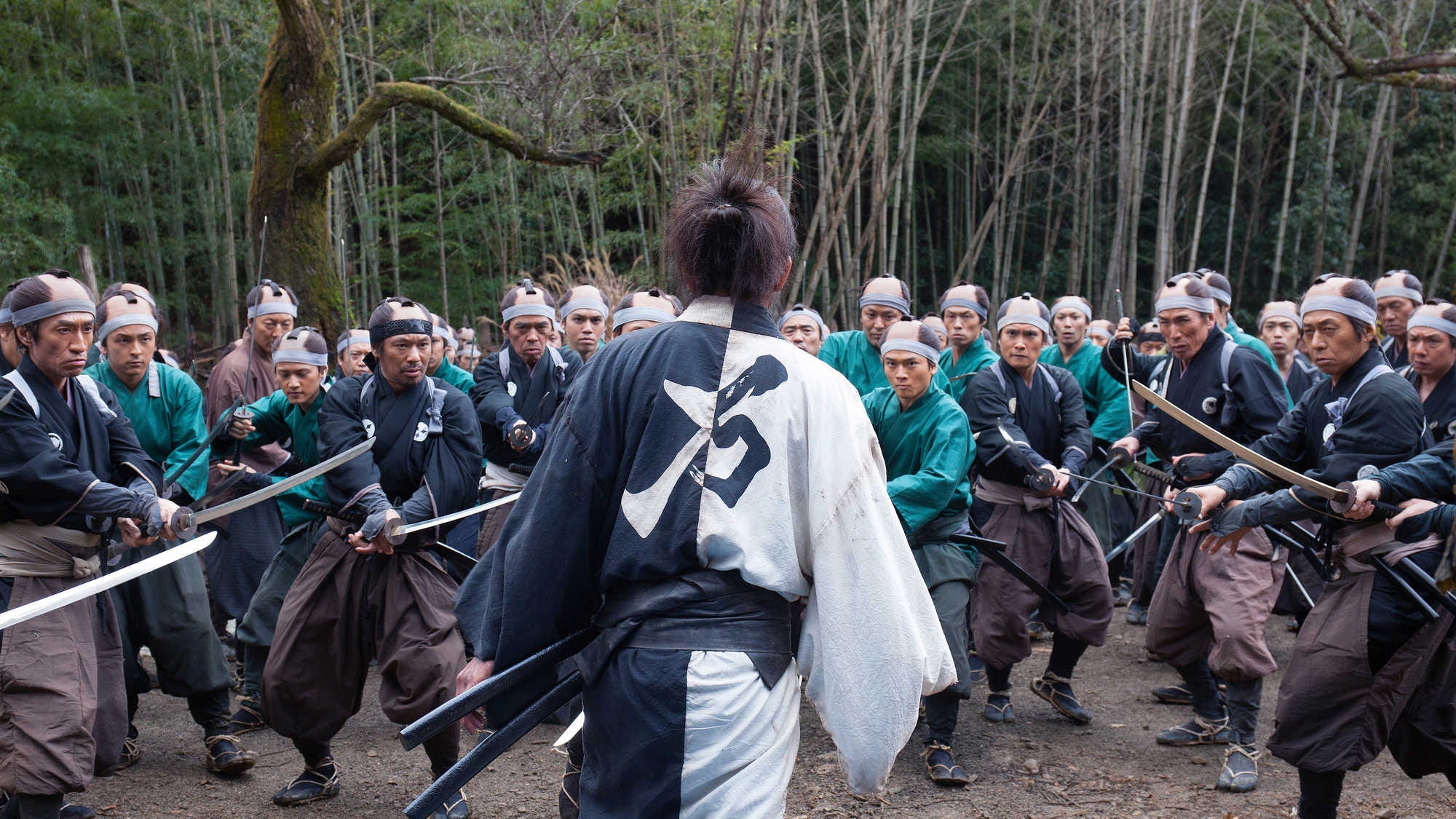
And in case you were wondering if there are any decent sword fights, the answer is a hearty "yes." Though they are few and far between for the first 90 minutes of the film or so, the movie ends with a wild one-man-versus-dozens whirlwind of sharp steel and righteous indignation. On its surface, it might seem like sensational, gratuitous action. But when you realize just what is driving that single warrior to fight so hard, the grander statement sinks in deeper and deeper. The final effect is powerful, to say the least.
Hara-Kiri: The Death of a Samurai is a great modern entry into an already-rich canon of samurai films. Highly recommended for anyone who doesn't mind a more brooding, challenging look at one of the most romanticized figures in the history of warfare.
Bad Santa (2003)
Director: Terry Zwigoff
Bad Santa is filthy, raw, and unrelenting. And it's hilarious.
The mission of this movie is clear, right from the jump: take the most cherished, purportedly selfless holiday in the land and tell a borderline-X-rated story centered on it. Mission riotously accomplished. Billy Bob Thornton plays Willie - a completely degenerate, alcoholic safe-cracker who, with his partner Marcus, poses as a mall Santa Claus in order to case the joint and rob the place blind on Christamas Eve.
You can probably guess where the humor derives from: the gloriously foul-mouthed, slovenly Willie interacting with hopeful kids is one area, but his generally fatalistic, hedonistic attitude towards the universe is the grander source of comedy. In a move that is initially self-serving, Willie invites himself into the home of Thurman - a socially awkward young boy who believes he is the real Santa Claus, and whose father is in prison for embezzlement. Willie takes every possible advantage of the naive Thurman, spewing language fit for a bar filled with drunken soldiers. Some of the funniest bits are Willie's puzzlement over Thurman's relentless attempts to gain his friendship, which Thornton converys through countless great facial expressions and deliveries of dialogue.
There's not a lot more to say about
Bad Santa. If you haven't seen it, there is this clear positive: you
will be able to tell whether you'll enjoy it by watching no more than the first 3 minutes. That's as long as it takes to get a sense of the film's humor, the protagonist's depravity, and the oncoming onslaught of linguistic filth. If you watch those initial moments and find yourself chuckling, then you'll certainly enjoy this extremely off-beat Christmas flick.