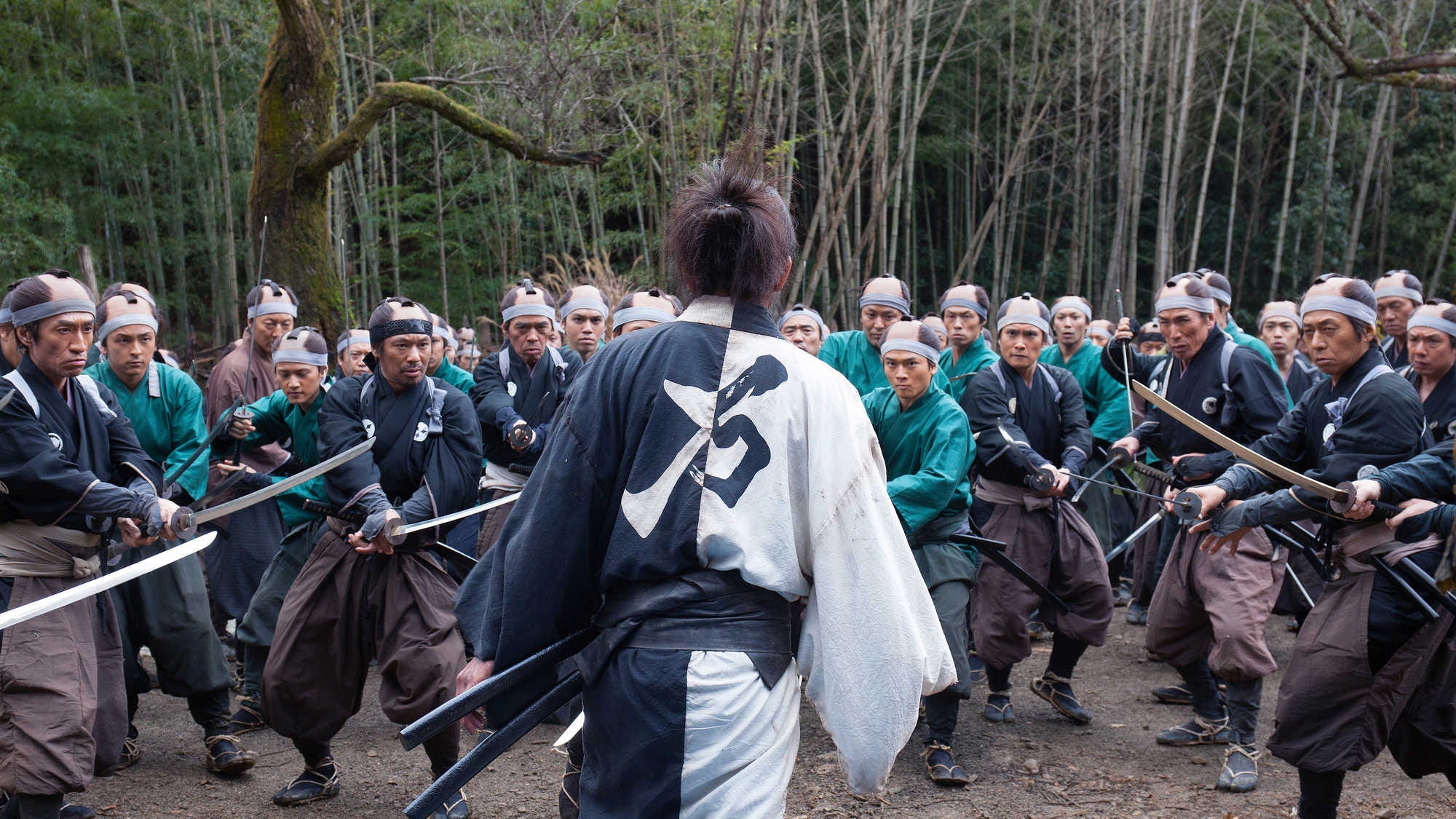
Title for Us English-Speaking Types: “The Bodyguard”
Director: Akira Kurosawa
Initial Release Country: Japan
Times Previously Seen: once (about 8 years ago)
Teaser Summary (no spoilers)
Skilled, masterless samurai whittles away two rival gangs in a dusty Japanese village. Drinks plenty of sake.
Uncut Summary (A full plot synopsis, including spoilers. Fair warning)
In 19th century feudal Japan, Sanjuro Kuwabakate (Toshiro Mifune), a drifter samurai with no retainer, wanders into a tiny village. He soon runs into a small horde of raggedy hoods who bar his path through the town. Not itching for a fight (yet), he casually retreats into the tiny nearby sake shop. While there, the owner, Gonji (Eijiro Tono), explains the ill-fated town's situation. The entire village is the setting of a current stalemate between two rival gang families, headed by Seibei on one side and Ushitora on the other. They are both competing for domination of the local silk and sake trade. The competition is so fierce that each boss has appointed his own mayor and essentially owns a complete half of the village. Sanjuro sees this as a money-making opportunity.
Sanjuro, getting the lowdown and considering his money-making options.
He first strolls over to the Ushitora gang, goads some of them into attacking him, and effortlessly slays three of them in full sight of the Seibei clan, who is watching from the far side of the village main street. He walks over to Seibei and extorts major cash from him to side with him. After the deal, though, Seibei's venomous wife pulls her husband aside and convinces him to kill Sanjuro after he helps them exterminate Ushitora and his minions. Sanjuro overhears this, but does nothing immediately.
Emboldened by his new-found sell-sword, Seibei calls out the Ushitora clan and calls for a showdown. Both sides square off, but just as they are about to begin their slow approach towards each other, Sanjuro throws Seibei's money into his and his wife's faces, loudly proclaiming how insulted he is that they were plotting to assassinate him. He then calmly scales the central bell-tower, overlooking everyone. Seibei, now in no position to back down, begins the slow march towards Ushitora's gang. From on high, Sanjuro gleefully watches what he hopes will be a bloodbath that eliminates both gangs at once, without much effort on his part.
Unfortunately, just as the two gangs are about to start fighting, an inspector rides into town. Sanjuro's plan is stymied. He returns to Gonji's shop to plot his next move. He learns of a nearby murder of a local magistrate (conducted by Ushitora's men), and decides to wait and see which clan outbids the other for his services. He doesn't have to wait long, as Ushitora's comes with a very generous offer. Sanjuro refuses, saying that he has many offers to consider. Later that night, Ushitora's youngest brother, the handsome but psychotic Unosuke arrives, brandishing a brand new pistol.
The night deepens, and Sanjuro approaches Ushitora, offering to spy on Seibei for him. Ushitora accepts and pays Sanjuro. Shortly after, Sanjuro runs across the two drunken thugs who Ushitora sent to kill the magistrate. Sanjuro quickly rounds them up and brings them to Seibei, who pays him handsomely for the chance to have proof of Ushitora's assassination order. Sanjuro then quickly returns to Ushitora and informs him that Seibei has captured his men (leaving out the fact that he's the one responsible). This leads to a quick deal for a hostage swap: Ushitora gets his men back, and he will return one of Seibei's prized stable girls, Nui, whom he had stolen and pimped out to his puppet mayor. After one failed attempt, the deal eventually goes down, much to the dismay of Nui's poor husband and young son. Sanjuro watches the exchange with these last two, and shows no sympathy for the quivering husband.
Sanjuro goes to work. Scum-thugs flee in terror.
Without much ado, the homicidal Unosuke kills the two returned assassins, and his elder brother Ushitora returns Nui to the lecherous mayor's home. Sanjuro learns of the latter and coyly suggests that he check on the house, despite the six armed guards that Ushitora has placed there. Sanjuro goes with Ushitora's middle brother, the dull-witted thug Inusuke. Just before they arrive at the mayor's house, Sanjuro distracts Inusuke, pretends to have inspected the mayor's house, and then tells Inusuke that the six guards have all been killed. Inusuke, without bothering to check Sanjuro's story, runs back to his brother's house to rouse the troops. Sanjuro then storms the mayor's house, easily slaughters the six guards, and grabs Nui, whom he returns to her husband and son, who have been hovering just outside. They try to stay and offer their profound thanks, but Sanjuro disgustedly ushers them on their way.
Ushitora's men soon arrive at the mayor's house, which Sanjuro has just demolished in order to lend credence to his lie that the place had been stormed by a group of Seibei's men. Ushitora buys it, and they all return to his place in anger.
A few days later, Sanjuro is relaxing in Gonji's sake shop when he receives a letter from Nui and her husband, thanking him again for saving their lives. Sanjuro repeats his distaste for such “weak people”, though Gonji openly admires Sanjuro's heroism. Then, the cold-blooded Unosuke arrives with Inusuke. He has had his doubts about Sanjuro's tale about the mayor's house. In addition, he has heard through the grapevine that Nui and her husband have been seen in a nearby village, claiming to have been saved by a single skilled samurai. Sanjuro plays it cool and tries to dismiss the accusations and inconspicuously dispatch the note from Nui, but Unosuke sees and snatches it first. Sanjuro is finally caught in his deception. His sword is taken from him, leaving him all but defenseless.
Back at the Ushitora compound, Sanjuro is locked in a side room and beaten mercilessly for a full day. Eventually, he is left alone and he takes his chance. He crawls inside a chest and waits. When his two thug guards return and don't immediately see him, they believe he has escaped, panic and run out of the room, leaving the door open. Sanjuro painstakingly crawls out the door and, with agonizing slowness and a little luck, manages to evade Ushitora's brothers and gang.
He makes it to Gonji's and asks the sake maker to smuggle him out of town. Gonji and the local casket maker load Sanjuro into a casket and begin to carry him to the local cemetery. Just as they begin their trek, though, they see that Ushitora has launched an all-out assault on Ushitora's compound. Ushitora believes that Seibei is responsible for Sanjuro's escape, and he sets fire to his rival's house, with all of those fleeing the inferno being either cut down by a gang member or gunned down by Unosuke. Sanjuro watches from afar, the fact that half of the town's cancerous crime is dead bringing his battered body some small relief. He is then carried to a safe house on the outside of the village.
Sanjuro spends several days quietly recuperating and practicing hitting a moving leaf with a throwing dagger. He has also heard that Ushitora has fired most of his thugs, now that Seibei's entire crime family is dead. Both Gonji and the casket maker have been smuggling him food and water during this time, but a serious problem emerges. The casket maker informs Sanjuro that Gonji has been discovered and captured, and that Ushitora has him strung up in the middle of town. Sanjuro's decides to cut his recovery shorter than expected.
The final stand-off commences.
In the middle of town, Gonji hangs from a low gibbet, tied around his body and awaiting his fate. Less than a dozen gang members are left to support Ushitora and his two deadly brothers. Sanjuro walks into the center of town, only to be met by these last, most powerful criminals. A few words are exchanged, and then the fighting breaks out. Unosuke, predictably, pulls his revolver first, but Sanjuro is faster and hurls his throwing dagger, striking Unosuke directly in his shooting forearm. With this primary threat neutralized, Sanjuro routinely mows down everyone left with his sword.
With all of the criminals now dead, Sanjuro pronounces the town clean of its human filth and walks out, leaving it to Gonji, the casket-maker, and the scant few others remaining to rebuild anew.
Take 1: My Gut Reaction (Done after this most recent viewing, before any research.)
To use one of Quentin Tarantino's favorite phrases, this movie is bad-ass. Or, perhaps more accurately, Sanjuro Kuwabakate is bad-ass. So, what accounts for its bad-assitude? I thought you'd never ask...
Before really looking at the greatest strength of this movie, I have to give credit to several other impressive aspects. First is the story. The notion of having a seeming mercenary drift into a lawless town, wreck shop, save the remaining innocents, and coolly walk away from it is legendary. I'll have to do some digging to see if this idea has been used before (I'm reasonably sure it has), but Kurosawa molded it into one hell of a fun film to watch. Waiting to see just how Sanjuro would play one side against the other and take advantage of their own insecurities and paranoia is as entertaining as can be.
Here's a great scene. Sanjuro uses hits wits to con the doltish Inusuke, then his unmatched swordsmanship to dispatch basically everyone else who gets in his way:
The setting itself is worthy of mention. While this tale could easily be told in a large, thriving city, and in a more modern time, doing it in a tiny 19th century village lends a perfect sense of unity to everything that's happening. With such a limited cast of main characters and individual places, one can really sense how connected everything is and just how imminent the dangers are.
Of course, these two previous components are only enhanced by the flawless direction of Akira Kurosawa. By this point, Kurosawa was fully established as a brilliant filmmaker. While I know that he had some critics, I don't think that anyone can see a film such as
Yojimbo and deny just how great he was at visual storytelling, pacing, and overall directing. Just one of the many great examples might be early in the movie, when Gonji is giving Sanjuro the low-down on all of the dirty dealings in the village. Both men are inside Gonji's weathered, wooden store, with Gonji excitedly throwing up the various windows as he points out the different factions and ne'er-do-wells. This short scene is filled with so much energy that you almost can't help but get caught up in it.
The crowning element of the whole thing, though, is Toshiro Mifune's turn as Sanjuro himself. Anyone who has seen both
The Seven Samurai and
Yojimbo has to marvel at the man's range. Sure, both roles were feudal-era Japan swordsmen, but they could not have contrasted more. Six years prior, he played an uncontrollable wildman. In
Yojimbo, he portrayed a character as psychologically poised as a bamboo reed and cool as the snowy slopes of Nagano.
However, it would be hasty just to lump him into the standard “calm, calculating maverick hero” department. With Kurosawa envisioning Sanjuro as a generally amoral, eminently scruffy, and only occasionally fallable rogue, he created something new. Mifune brought the master director's vision to full life with his lazy gaze, shifting shoulders, and unhurried manner. Mifune did in 1961 what great character actors like Johnny Depp and Brad Pitt made careers of decades later.
Upon dissection, my guess is that most, if not all, of the components of
Yojimbo have their inspiration in other direct sources. Still, I found it to be a fantastically unique and entertaining film. As long as one realizes that the scenarios and characters are rather ridiculous, it's easy to see this movie for the masterpiece that it is.
Take 2: Why Film Geeks Love This Movie (Done after some further research)
As suspected,
Yojimbo was not created in a vacuum. Akira Kurosawa, a junky of the western
noir and western film genres, apparently took the story and Sanjuro character ideas from one or two Dashiell Hammett novels, namely
The Glass Key and
Red Harvest. The visual style was adapted from classic John Ford westerns, most notably the now-standard scene of the hero in foreground, enemies in the distance, and dust blowing through the streets. In fact, this last element is almost comically overdone (intentionally?) in
Yojimbo.
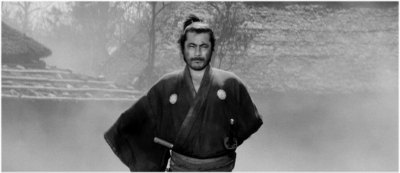
A great shot of Sanjuro, hopinng to watch the two gangs weed each other out, thanks to his own skillful machinations.
When it was released,
Yojimbo was a massive hit. Kurosawa's name had already been well-established throughout the cinema world, both popular and critical, but
Yojimbo offered something new. While it was still clearly a samurai movie, the character of Sanjuro provided a rather new creature: a true mercenary with only the odd pangs of morality. Essayist Alexander Sesonske gives a really interesting analysis of it
here.
Popular audiences loved the sword-swinging action and the steady dose of sarcasm throughout the movie, and this is no surprise. What was a tad surprising to me is how universal the critical praise was for such a “western style” action film.
This original TIME piece, in addition to raving about
Yojimbo, offers a really insightful look at Kurosawa himself and his place in Japanese film history (it was already clearly staked out, even back in 1961).
Yojimbo may have borrowed certain elements from other, earlier, sources, but its mark has been so indelible as to have spawned several direct remakes, set in different places. The first, and probably the greatest, is the Sergio Leone spaghetti western,
A Fistful of Dollars (1964). Other less notables include the science fiction version,
The Warrior and the Sorceress (1984), and the return to black-and-white
noir,
Last Man Standing (1996). Love the first one. Never seen the latter two.
My final word? Steam up some rice, warm up some sake, and fire
Yojimbo into the DVD player!
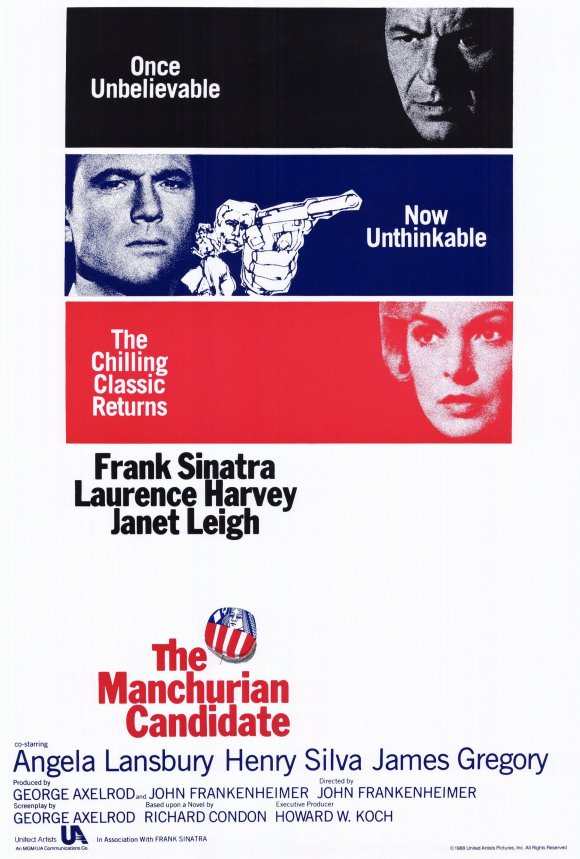
Coming Soon: The Manchurian Candidate (1962)
Chinese communists! Brainwashing!! Assassination plots!!! Angela Lansbury!!!! Frank Sinatra!!!!! How can one film have literally EVERYTHING??!!! Come on back later and find out!
Please be sure to pick up all empties on the way out.