Friday, April 9, 2010

Film #21: Pinocchio (1940)

Directors: Hamilton Luske & Ben Sharpsteen
Release Country: United States
Times Previously Seen: Maybe once or twice as a wee tyke. Don't really remember.
20-Words-or-Fewer Review (no spoilers):
Marionette youngster comes to life, learns right from wrong from wild experiences and a kindly insect.
The Full Story (A detailed plot summary, spoilers and all. Fair warning):
In a little Italian village, a kindly master toy-maker, Geppetto, makes a wooden marionette in the figure of a young boy, naming it Pinocchio. Upon retiring for bed that evening, he wishes upon a single star that his newly-crafted companion might come to life, perhaps to offer him some companionship. After Geppetto falls asleep, the star transforms into a fairy who alights in the craftsman's bedroom and grants his wish, bestowing life upon Pinocchio.
Watching the entire scene unfold has been the kindly bug, Jiminy Cricket. Little Jiminy agrees to become Pinocchio's conscience, as the animated puppet will not achieve true human life until he learns right from wrong, as per the fairy's guidelines.
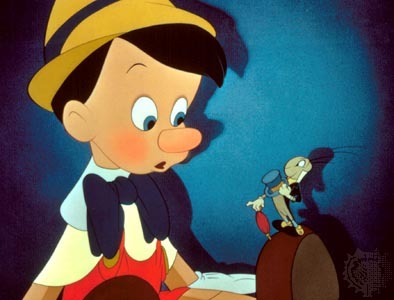
The little wooden fellow first meets his newly-minted, top-hatted conscience.
Pinocchio wakes Geppetto who, after the initial shock, is overcome with joy. In the morning, he sends his new son to school. Pinocchio, however, is waylaid by the wicked Honest John, a conniving fox who sees Pinocchio as a cash cow, lures him with promises of fame and glory, then sells him to the greedy gypsy, Stromboli. Stromboli has Pinocchio perform once to great success, then locks him in a cage to prevent his escape. Upon realizing the hopelessness of the situation, Pinocchio and Jiminy despair until the star fairy descends and frees him. She says, however, that this is the final time that they can rely on her help.
It isn't long, however, before Pinocchio is once again fooled by the ever-rakish Honest John; this time leading Pinocchio to the ministrations of "The Coachman," an oily predator looking for troublemaking little boys to spirit away to "Pleasure Island" for some mysterious purpose. Pinocchio, along with a gaggle of other local truants, follow the Coachman to the enclosed island, where they discover that Pleasure Island is a paradise for the mischievous young lad: there are cigars to be smoked, fights to be gotten into, and palatial houses to be destroyed, all for their amusement. Little do they realize, however, that once night falls, they will all transform into donkeys which the Coachmen sells to various labor camps across the globe. Jimeny discovers this and warns Pinocchio, just as his transformation begins. They manage to escape just in time, leaving the other ne'er-do-well boys to their fates.
Upon returning to the toy shop, Pinocchio and Jiminy discover that Geppetto has gone looking for his prosthetic son, only to be swallowed up by the mythical whale, Monstro. The two searchers find the nearest shore, plunge themselves into the deeps and begin the search for the kindly toymaker. They do eventually find the terrifying Monstro and, after a titanic battle with the leviathan, liberate Geppetto, though Pinocchio seems to have been killed in the process.
Back at the toy store, a distraught Geppetto cries over the body of his dead creation but then is revived when the fairy returns a final time and, in recognition of Pinocchio's selfless acts of courage, deems him worthy of real life.
He's a real boy!!
Take 1: My Gut Reaction (done after 1 viewing & before any research):
I feel I have to section this review off into two sections of my brain.
If I were a kid watching this, it would be incredible. I realize that modern animation, most of which is CG, is peerless in terms of detail and fluidity. Still, Pinocchio trumps damn near all of its followers in terms of pure life and magic. Every scene is a treasure chest of movement and vivid kinetics. There are plenty of scenes where the eye doesn't know where to look, there are so many intricate dances of objects and characters.
This scene only gives you the tiniest of tastes, but the early moments in Geppetto's shop are vibrant marvels of color in motion.
What kid wouldn't want to spend the rest of their lives in that place?
On top of the visuals is the pure adventure of the story. It takes no time to get a puppet-brought-to-life and a magical blue fairy. Form there, we get the brief and terrifying domination of the gypsy Stromboli's suffocating wagon. Then, the sinister evil of Pleasure Island, followed by the epic force of nature of the sea beast, Monstro. Pinocchio's involvement in it all is almost incidental, and if I were a kid, I may barely remember his place in the story. Much more memorable are the strange and frightening things going on around him.
As an adult seeing this film all the way through for the first time, the film is almost as good. The visuals are still incredible. Sure, modern animation has grown by leaps and bounds in terms of technique and smoothness, but I don't know that I've ever seen another animated movie that conveys the mood in such a singular and effective way. The hand-painted backgrounds and the omnipresent shadows create alternating coziness, power, and terror, as the tale dictates.
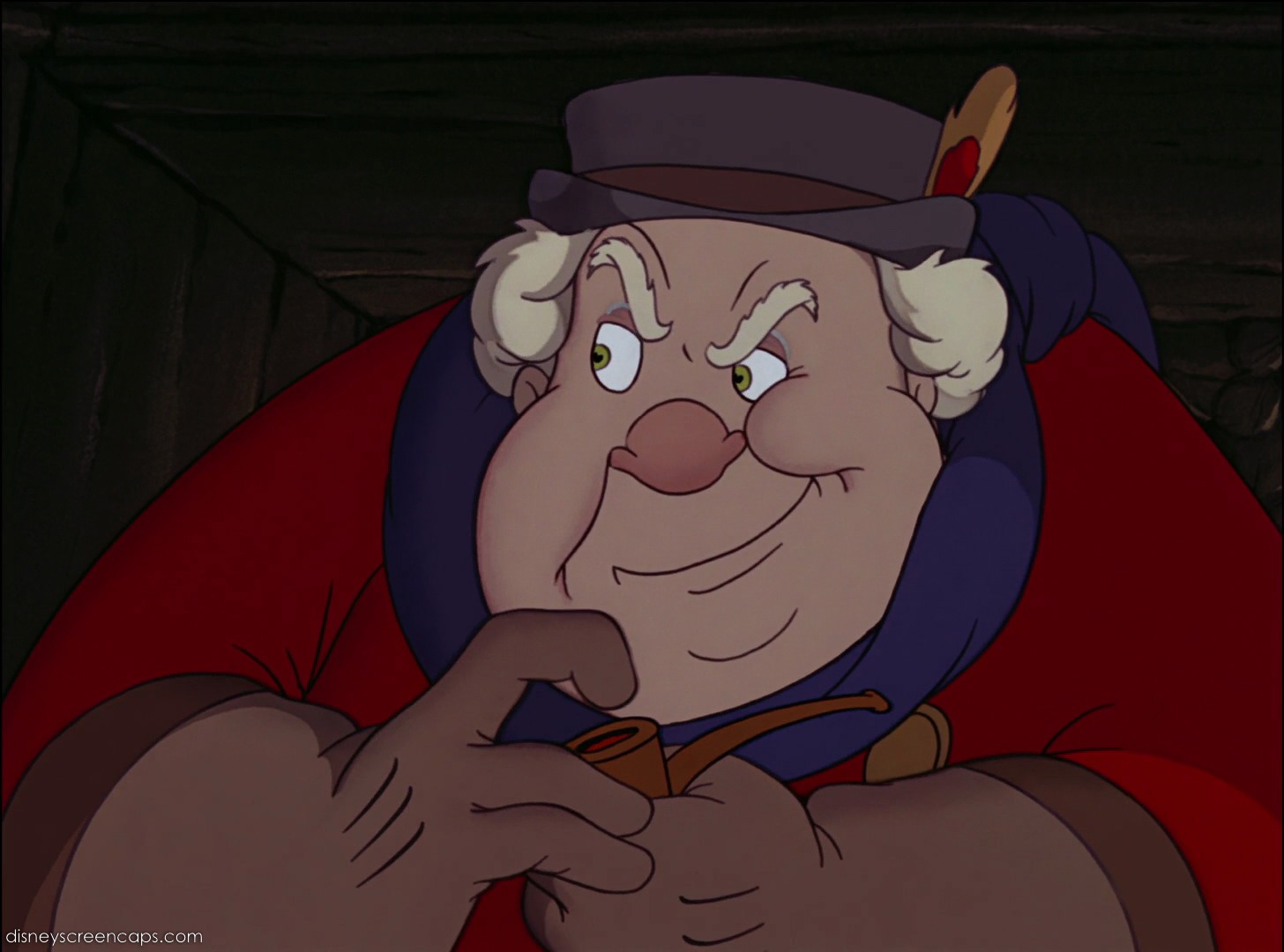
This is the pedophilic-looking rogue who pays to have young boys whisked away to "Pleasure Island". The scene where we first see him is creepy beyond belief, for children or adults.

One of the things that I loved about an animated feature like this is its timelessness. Disney actually used to be much better at this, and their subsidiary Pixar has rediscovered the formula, to a degree. The keys seemed to be source material and, more importantly, the script. Pinocchio, released in 1940, is blessedly devoid of any "topical" jokes or dialogue. No allusions or mentions of communists, Nazis, movie stars, or any other subjects that were relevant way back then. Disney really lost its way with this in the mid and late 1990s, with films such as Aladdin, Hercules, and the atrociously-named The Emperor's New Groove, which relied way too much on gags that were better suited to late night talk show monologues and would be stale in a matter of years. Pinocchio avoided dating itself this way.
There are some seriously murky things lurking beneath the surface of this tale. Perhaps the obvious one is the entire Pleasure Island episode. Cynical adults will look at the story of a fat, leering man looking for little boys to kidnap as a thinly veiled metaphor for pedophilia. It's not as obvious as all that, but I won't deny that the writers may have been intentionally tapping into that primal fear of parents the world over.
The other thing that makes for analytical thought is the entire story of Pinocchio as a vessel. It dawned on me that, really, the Disney version of Pinocchio is oddly like a somewhat positive inverse of Frankenstein's monster. Both the wooden lad and the monstrous construct of Shelley's novel were tabulae rasa, vessels with no initial concept of themselves, or anything else for that matter. Oddly enough in Pinocchio, it's not Geppetto but the Blue Fairy who serves as the Dr. Frankenstein; she imbues the marionette with a soul, then leaves him nothing more than a woodland insect to figure out ethics. As a result, Pinocchio nearly gets kidnapped by a greedy gypsy, half turned into a donkey by a wicked boy-peddler, and swallowed whole by a massive, boat-swilling whale. What kind of sick bitch does that? I'll tell you who - the same kind of person that creates a massive creature from dead tissue and then abandons him. That's who. At least the fairy came through in the end, unlike our misguided Austrian doctor.
There were only two things that truly struck me as weak, both of which I only notice as a hyper-critical adult. One is that Pinocchio, as alluded to above, is a bit of a dope. I know it's by design, but he has zero personality, unlike virtually all other cartoon protagonists. He's laughably led astray by the fiendish fox Honest John twice, and one can hardly say that he learns his lessons. To reiterate, though, it's a minor point. If you're one to look for lessons and morals in animated movies, they are there to be found, even if the title character is a dunce.
The other, lesser, problem is the pacing. There are a few jumps that are dizzyingly quick. When we learn that Geppetto has been swallowed by a whale, it's as much a shock to the viewer as it is to Pinocchio. Pinocchio takes it in relative stride; I, however, thought that perhaps I had missed part of the movie. When the hell did that happen? There were a few other moments like this when the film seemed to be rushed. Not a great problem, but it stood out.
Pinocchio is an animated film that I think can stand up to all but the very best animated movies released in the seven successive decades. The folks over at Pixar are the modern masters, but they are certainly riding the coattails of standards like Pinocchio.
Take 2: or, Why Film Geeks Love This Movie (done after some further research):
There certainly is no shortage of interesting research to be done on this one.
Pinocchio was the second feature length animated film from Disney (following Snow White in '37), and both clearly display the master formula that has served that franchise to this day: (1) take a well-written fairy tale (2) clean out all of the objectionable bits (3) get phenomenal animators and story-writers to tell the story. Repeat.

A very early rendering of Pinocchio from the 1880s.

The source material in this case in an original Italian "fairy" tale written by Carlo Collodi in the 1880s. Just like the original Grimm's Fairy Tales, Collodi's tale was not exactly meant specifically for children. An allegory for social commentary, the original Pinocchio features a truly irascible marionette who kills "the cricket" (the name "Jiminy" was a Disney invention) with a hammer, lies repeatedly to his father, and is even hung at the end for his foolish deviance. This ending was actually changed by Collodi at the behest of his publisher, so that it may be a bit more palatable to a wider audience. I guess one could say that Collodi Disneyfied his own story a bit before Walt and his team could finish the job 60 years later.
It has been pointed out, through Pinocchio and many other films, that animation can be appreciated on a level that goes far beyond childish amusement. Leonard Maltin points out that, "There are no accidents in animation." This struck me as meaningful as I looked at the splendor and vivacity of a film like Pinocchio and I realized that every scene, every background, every character, and every color had to be sweated over. It's a wonder that they finished the thing in a mere two years, to be honest.
In addition to the craftsmanship is the sheer skill in terms of film making. Walt Disney was once asked about making movies only for kids, to which he replied that he did no such thing, pointing out that, "If I only made movies for children, I'd be severely limiting my audience." I suppose a cynic would see this as an early sign of Disney's quest for domination of the world's minds. I see it a bit more as a storyteller who just wanted as many people as possible to hear his tales. He and the crew that he assembled showed it in the outstanding films that they crafted in those early decades of work.
A few of the details. In hearing some commentary from Disney aficionados, I realized that my dubbing of the Disney Pinocchio character as "a dope" and "a dunce" may be a touch mean. A better word may be "guileless." Still, it doesn't do any more to attract me to him or make him any stronger a character.
One final piece of trivia: a very young Mel Blanc, the late, great voice actor known the world over as the voice of nearly every major Warner Brothers character, actually provided the voice of Gideon, Honest John's companion in Pinocchio. However, it was decided that the Gideon character was going to be a mute, so Blanc got edited out of the entire audio, save for a solitary hiccup. If only they'd known.
That's a wrap. 21 shows down. 84 to go.
Coming Soon: The Lady Eve (1941):

The final screwball comedy on the list. At least it has Barbara Stanwyck and Henry Fonda in it.
Please be sure to pick up all empties on the way out.

Friday, April 2, 2010

Film #20: The Shop Around the Corner (1940)


Director: Ernst Lubitsch (also directed Ninotchka)

Release Country: United States

Times Previously Seen: none

20-Words-or-Fewer Summary (no spoilers):
In Hungary, an intelligent, sensitive & semi-stoic leather goods salesman finds love with mystery pen pal.

The Story (a detailed blow-by-blow, with spoilers. Fair warning):

In Budapest, Hungary, Alfred Kralik (Jimmy Stewart) is the top sales clerk at a high-end leather goods store. He is bright, pleasant, and the only man in the store with the ability and backbone to stand up to the quixotic nature of Mr. Matuschek, the owner of the shop. Kralik is excited about a running pen-pal exchange with an anonymous woman who seems to share his love of literature and romantic ideals, and with whom he soon plans to meet.

Just as we learn all of this, Mr. Matuschek hires the attractive and somewhat desperate Miss Klara Novak as a new sales clerk, much to the chagrin of the finance-conscious Kralik. Due to this rocky beginning, Novak and Kralik remain icy towards one another, never missing a chance to jab one another in their similarly passive-aggressive ways.

At the store, owner Matuschek begins to act ever-more erratically, eventually letting Kralik, his best and longest-standing worker, go. That evening, when a downtrodden Kralik is meant to have his fateful first meeting with his mysterious correspondent, he learns that she is, indeed, Miss Novak. Rather than completely reveal himself, he talks with her, picks her brain, dances around the truth, and leaves her at the café to wonder when her knight will appear.

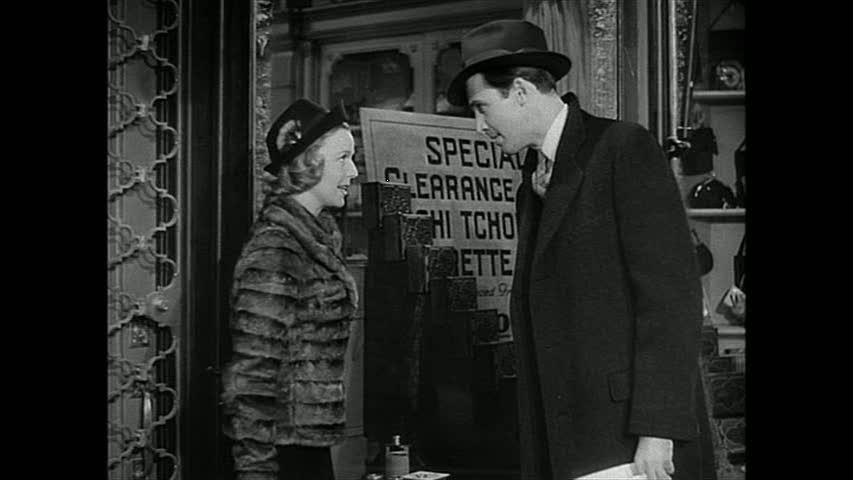
The three most prominent players, left to right: Novak, Kralik, and Matuschek

At the same time back at the store, we learn the cause of Matuschek’s anxiety. He has suspected his wife of having an affair with Kralik. He learns from a detective that he has been half right: she has been having an affair with one of this employees, but with the obviously unscrupulous Vadas rather than the forthright Kralik. Upon learning of his grievous mistake, Matuschek attempts suicide, only to be stopped by the store’s delivery boy, Pepe.

Matuschik goes to convalesce in a hospital and rehires Kralik as the acting manager of the store, just in time for the Christmas Eve shopping blitz. Kralik gladly returns and fires Vadas with impunity. Afterwards, Kralek visits Miss Novak, who has become “psychologically ill” as a result of the crushing silence from her pen pal. That is, until a letter appears once again and puts her soul at ease.

Christams Eve arrives and Kralik sees the store to its greatest sales day in history. As the evening closes, he takes the chance to coyly tease Miss Novak about her dreamed of “fiancĂ©.” After misleading her for a few minutes, he finally reveals himself as her mystery correspondent, and they fall into each others’ arms.

Merry Christmas, every one!

Take 1: My Gut Reaction (done after one viewing & before any research):
This film was like aloe on my movie-watching soul.

I was skeptical before watching, however. The summary of the film pointed out how it had been remade recently into the rom-com You've Got Mail, starring Tom Hanks and Meg Ryan. Upon seeing this, my expectations went off a cliff.

I really needn't have worried, though. A mere ten minutes into the film, I realized that this was going to be the type of Jimmy Stewart movie that I liked. While I'm not a major fan of his "American boy next door" roles (The Philadelphia Story, It's a Wonderful Life), I have found that I like him best when he is a bit dark and edgy, such as in the Hitchcock films Rope or Vertigo. In The Shop Around the Corner, he plays a really pleasing mid-point between the two. Alfred Kralik is a cool and effective intellectual at work, and a soft romantic outside of the workplace. The character is very well-rounded and Stewart plays him perfectly.

The interplay between Kralik and Novak is often scathing and humorous, in well-balanced turns.

This might be one of the best Christmas movies I've ever seen. Not that Christmas is the focal point, but the grand finale on Christmas Eve left me with the feeling that I presume one is meant to get at the end of Charles Dickens' "A Christmas Carol", yet I have never felt for that age-old classic. There are moments of playfulness, romance, and a touch of darkness through which you must travel in order to come into the light and feel a sense of relief and joy at the end. The fact that the setting is the far-off country of Hungary, and that it is a 40s black-and-white only add to the sense that you're watching a fairy tale unfold.

Back to the acting. Stewart was certainly the stand-out. Maragaet Sullavan does admirably, as she's certainly pretty enough and handles the character well, though I feel that there was nothing singular about her performance. The supporting cast is fine, if all rather 1- or 2-dimensional, but let's face it - that's the way most films were back in the day. Exhibit A in this film is the Ferencz Vadas character, an obvious scumbag with zero redeeming qualities. It doesn't take a very astute viewer to figure out that he's "the bad guy." I guess every fairytale needs a bald-faced villain.

I suppose if I had to narrow what I liked about the movie so much down to a word, it would be "balanced." The serious parts aren't too serious as to weigh down the lightheartedness of the tale, the clever parts aren't trying to be too clever (a la His Girl Friday), and the more obvious moments of humor never spill over into the absurd or slapstick.

The Shop Around the Corner is not a trailblazing masterpiece. It is not Citizen Kane, The Seven Samurai, or The Godfather. It won't challenge any of your core values, open new worlds to you, or dazzle you with artistic creativity. It is, however, a masterfully crafted and executed film that is a pleasure to watch. I'll certainly look forward to next winter, when December rolls in and the snow begins to fall, as I now have a new film to add to the short list of solid Christmas movies that complement the season.

Nearing the end of the film, Kralik's feelings start to blossom into touching sorrow, though Novak still doesn't know who her admirer really is.


Take 2; or, Why Film Geeks Love This Movie (done after some further research):

The Shop Around the Corner, being a fairly fancy-free movie devoid of literary sophistication, does not demand a ton of analysis and research. In fact, the original 1940 TIME magazine review uses some amazingly accurate word choices in describing the film. I especially like this trifecta of adjective phrases: "...completely unimportant, highly entertaining, expertly carpentered...". The other gem of the review is, "James Stewart walks through the amiable business of being James Stewart." They certainly had that one nailed - and that was a really early "James" Stewart role.

Richard Schickel's more contemporary review echoes the sentiments of the movie's lack of any grand depth or meaning. Yet he, too, is under the film's spell.

Of final note is just how timeless this admittedly "unimportant" film has been. Originally a play called Parfumerie by Hungarian playwright Miklos Laszlo, it has been remade and retold in the form of The Shop Around the Corner (1940), the musical film In the Good Old Summertime (1949), the musical She Loves Me (1963 and 1993), and the more familiar You've Got Mail (1999). Like any good dish, it seemingly never gets old.

That's a wrap. 20 films down. 85 to go.

Coming Soon: Pinocchio (1940):

What better way to usher in the very first color film on the list than a classic Walt Disney film, I ask you? This one should be interesting...

Please be sure to pick up all empties on the way out.

Monday, March 29, 2010

Film #19: His Girl Friday (1940)


Director: Howard Hawks

Release Country: United States

Times Previously Seen: Once (about 5 years ago)

20-Words-or-Fewer Summary (no spoilers)

Machine gun-tongued divorcees & journalists reconnect through hot news story.

The Story (A full blow-by-blow, including spoilers. Fair warning):

Hildegard "Hildy" Johnson (Rosalind Russell), former star journalist, returns to her former newspaper, which is headed by her ex-husband, Walter Burns (Cary Grant). She has come to announce her retirement and fresh engagement to simple nice guy Bruce Baldwin (Ralph Bellamy). Hildy intends to move to Albany with Bruce, an insurance salesman, and become a full-time house wife. Walter, the fast-talking, take-no-prisoners editor of the city's largest paper, is taken aback and immediately pleads with Hildy to stay on the staff and even remarry him. She steadfastly refuses, instead proclaiming her desire to leave behind the high stress life of a beat reporter.

A major story interrupts everyone's plans. A skittish murderer is on death row and is the focal point of some serious local electioneering. Burns sees this as the chance to keep Hildy around, show her that her place is in journalism and as his wife. He uses every chance he can to embarrass Baldwin and guide Hildy towards the story. Eventually, Walter's machinations stoke Hildy's natural journalistic curiosity and she's on the case.


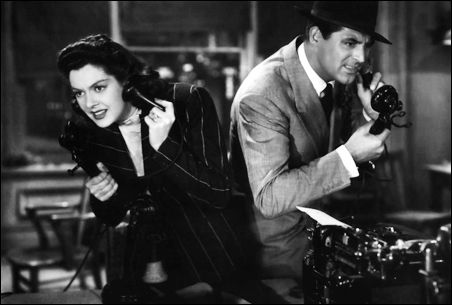
On the left, Walter Burns, master of the shit-eating grin.
Through a dizzying array of arrests, interviews, and lightning-quick dialogue exchanges, Hildy works out all of the kinks: the dead man walking is reprieved as insane, the corrupt local sheriff and mayor are revealed as frauds, and Hildy leaves Bruce to go back to her life with Walter.

Just like that.

Take 1: My Gut Reaction (done after one viewing & before any research):

If Cary Grant were alive, I would cold-cock him.

OK, maybe that's an exaggeration, but there were certainly plenty of moments in this film that I really felt this way. Not unlike his portrayal of Jerry Warriner in The Awful Truth, Grant's Walter Burns is so conniving and self-assured that one can't help but want to deck him. At least in His Girl Friday, he's not posing as a stand-up husband. He's pretty open about how he'll do damn near anything to get a story, including employing known felons as assistants and getting total innocents locked up to suit his professional and romantic aims. Had there not been a long period in the middle of the film when we don't see him, I may have been far more annoyed.

Like The Awful Truth, though, it wasn't necessarily Cary Grant that bugged me - it was the character. Walter Burns was written to be an amusing rogue, I suppose. I just found him bordering on contemptible.

One of the many rapid-fire dialogue scenes. It gets rather dizzying at times, and to me becomes a bit more style over substance/

Actually, a few decent laughs in there, but my fists were clenching during this stuff. For a more modern analogy, see explanation and video below.

Since His Girl Friday is by THE screwball comedy director, Howard Hawks, one shouldn't be surprised that it bears an almost hackish similarity to The Awful Truth, which is two years its senior. The romantic part of the story is almost a carbon copy of the earlier film, and the boobish fiance is even played by the same man, Ralph Bellamy. What made this one marginally more tolerable to me was that it wasn't solely about the privileged class. There are far more earthy characters in this film, which made it somewhat more engaging to me.

The crime story, while really just serving as a foil for the love story and verbal exchanges, is intriguing enough to keep things alive. While The Awful Truth had nothing more than the egocentric relationship of the Warriners, His Girl Friday has the inkling of a crime drama running through it. It's not a vast improvement, but an improvement nonetheless, in my view.

The dialogue. Good Lord. This is THE quintessential screwball film in terms of the ear-boggling dialogue that's like a ping-pong game played by two people on PCP. In one sense, it's fascinating since it's the first film I've seen from the list in which things are going so quickly that characters are talking over one another, and there's no way that a viewer can catch everything. The script is very sharp, but I felt like I was watching the film equivalent of an Yngwie Malmsteen guitar solo. Yeah, it's amazingly fast and takes immense skill and technique, yet it's often not very enjoyable, aesthetically.

Like a Malmsteen guitar solo, His Girl Friday is lightning quick, highly skilled, and often not very easy on the ears.

Big-haired, Swedish speed metal aside, I do need to mention the single biggest upgrade in this film from The Awful Truth - Rosalind Russell. She is so much more enjoyable than Irene Dunne that I can hardly describe it. Again, I believe that it came down to the character and the script to a great degree, but Russell exudes much more of an everywoman vibe that Dunne probably couldn't have done had you threatened to take away her diamonds and chiffon scarves.

This film, as much as it had in common with the spirit of The Awful Truth, was different in ways that made me further think about the screwball genre. While there is a slightly more universal appeal to it, there is still an almost mean-spirited ignorance about it. As a mentally imbalanced man's life hangs in the balance (pun intended - he's on his way to the gallows) and even escapes only to have the incompetent cops gun down a bunch of innocent civilians, Walter Burns still has plenty of time to make gags about it all. I'm not sure how I'm supposed to admire, pull for, or even laugh at the jokes of such a self-serving vulture, no matter how suave he may be. This would almost work if the film were meant as a full-on satire or farce, but it isn't. There are too many little moments of legitimate drama in relation to the condemned man for me to ignore, including his emotional girlfriend throwing herself out of a window in a suicide attempt. In my view, it's more upsetting than it is entertaining.

So there it is. Watching His Girl Friday was hardly the struggle that The Awful Truth was, but it's certainly not a film that I'll watch again. Like the latter film, though, lovers of old cinema and Cary Grant will certainly like it. I just couldn't ignore the little things that kept it from being either pure comedy or pure drama.

Take 2; or, Why Film Geeks Love This Movie (done after some further research):

After perusing a few original and modern reviews, it's clear that the dialogue is the pumping heart that keeps this movie alive in the annals of film history. The overlapping dialogue was apparently a major innovation back in '39, and the speed of the exchanges baffled and delighted people from the get-go. Here's the original TIME review upon the film's release.

I felt a little less hyper-critical when I saw Richard Schickel's 2005 review. I especially noted his almost throw-away use of the adjective "heartless" when describing the "hilarity". I guess he found it charming; I found it a tad off-putting.

A few interesting notes. Rosalind Russell was way down the line when it came to casting. Turning down the role were well-established actresses such as Katherine Hepburn (thank God), Irene Dunne (thank Allah), Claudette Colbert, and Ginger Rogers, among others. Russell was non-plussed about it, and secretly hired her own script writer to punch up her lines, which she felt were not as sharp or witty as Cary Grant's, so that she could insert them as "ad libs". Grant caught on and would greet her every morning with "What have you got today?" Man, that guy was either the smoothest cat on the planet or a 5-star asshole.

On final note is that in the original source play, Front Page, Rosalind Russell's character was a man. I suppose Hollywood wasn't yet ready to have a star-studded movie without a love story.

That's a wrap. 19 shows down. 86 to go.

Coming Soon: The Shop Around the Corner (1940):


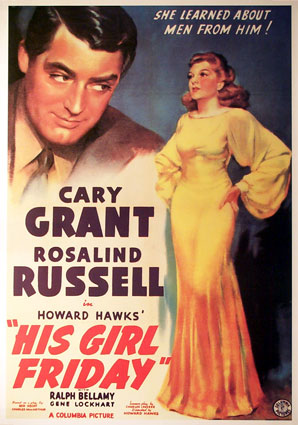
This is the same director as Ninotchka, which wasn't a bad film, but not my favortie thus far on this little cinematic journey. And yes, by "James Stewart," the poster means "Jimmy Stewart." We'll see just how Mr. All-American does in this one.

Please be sure to pick up all empties on the way out.

Sunday, March 28, 2010

Film #18: Ninotchka (1939)


Director: Ernst Lubitsch

Release Country: United States

Times Previously Seen: Once (about five years ago)

20 Words or Fewer Summary (no spoilers):

Robotic Commie cutie goes to Paris, falls in love with a Frenchy.

The Story (A full blow-by-blow, with spoilers. Fair warning):

Cold-as-ice Communist Russian negotiator Ninotchka is sent to Paris to clean up a bungled attempt by three clownish comrades to sell off some jewels confiscated from a past Russian aristocrat. When she arrives, she is hard as steel, forged by the communist ideals of Marx and Lenin. She soon meets French Duke Leon, an easy-going, semi-rakish lawyer whom she initially sees as representing all of the excesses of capitalistic society.


The first meeting of Ninotchka & Leon

And yet, she is attracted to him. Leon steadfastly melts her icy exterior and gets her to embrace some of the joys of living for the moment rather than eternal self-sacrifice. Even though they truly love each other, Ninotchka's imminent return to Russia upon the completion of her mission hovers over everything. Pushing a final fly in the ointment is Duchess Swana, the original owner of the jewels and Leon's past lover. Swana manages to ferret away her jewels and sends Ninotchka back to Russia with no Leon and no jewels. Leon is distraught and tries, by hook or by crook, to get a visa into Russia to see his love. Alas, he fails.

Back in the Soviet Union, Ninotchka cannot abandon her memories of Leon and the freedoms she had in Paris. Eventually, her superior sends her as an envoy to Constantinople, seemingly to clean up a mess similar to the one that begins the whole story, even involving the same three goofs from the first jewel mission. Once she arrives, however, she learns that the "mess" has all been a contrivance by Leon to get her out of Russia and reunite with her. Ninotchka agrees to stay with him and they live, presumably, happily ever after.

How sweet.

Take 1: My Gut Reaction (done after one viewing, before any research):

Eh - it was OK. This was how I remember feeling about it the first time I watched it. What you basically have is a romantic comedy with the added weight of certain social ideals thrown into the mix. I certainly wasn't counting down the minutes to the final credits, and I was even quite engaged for certain parts, but I won't go out of my way to watch it again.

The story itself is half-decent, and it's what kept me watching. The rightful possession of the jewels serves to conjure up questions about rightful ownership of aristocratic property. Who owns royal jewelry? The nobles whose families bought them and passed them through the decades and centuries, or the laborers whose toils truly paid for them? These interesting questions are raised and touched upon in several places, but serve as mere spice to the larger tale of love and freedom.

The love story isn't too bad. There's a light peal of truth to the fascination that the worldly Leon and the stoic Ninotchka have for one another. Yet it needs to be said that the viewer is quite obviously meant to sympathize with Leon's point of view. I guess this is natural since this was a Hollywood picture, and Paramount sure as hell wasn't going to try and sell any sympathy for communist Russian ideals.

Comedically, the film is very flat to me. There are a few bits that I think are funny. This was an early work for Billy Wilder, who co-scripted it, and his fingerprints are all over it. From the first scene, we can see the sly visual humor at work. The script is clever enough, though it's sometimes much in the screwball comedy vein of rapid-fire dialogue and predictable hoakiness that seems ingenuine to me. Still, the actors pull them off well.

Here's the initial appearance of the title character, wearing her bone-chillingly scientific efficiency on her sleeves:


Acting-wise, things are solid, with Melvyn Douglas's turn as the affable Duke Leon the standout. Garbo is good, but, as I mentioned in my review of Camille, I don't totally get the Greta Garbo sensation. The old movie posters proclaim, "Garbo Laughs!!", which is a clear indication that her frigid exterior was a selling point. She has a masculine quality that doesn't do it for me, but that's just one heterosexual man's opinion, I guess.

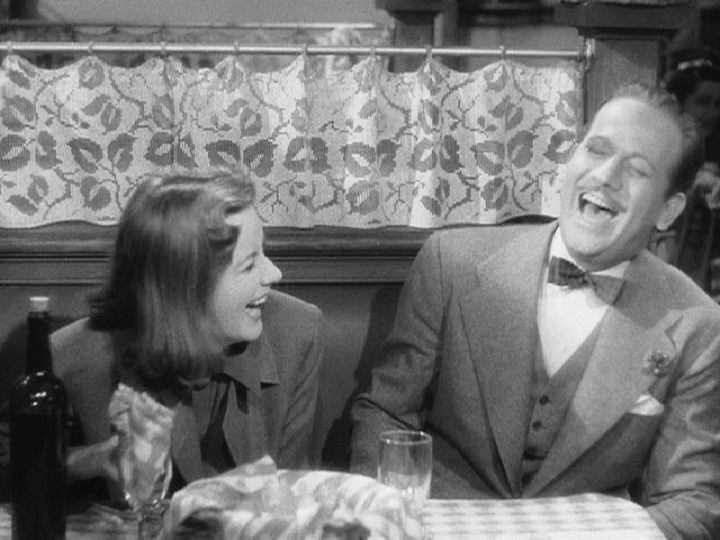
I had three main problems with this film. One. The break-neck turnaround of Ninotchka from hard-core commie to dreamy-eyed lovebird borders on ridiculous. For the first part of the film, she's as immovable in her beliefs as a pillar of iron, and is as humorless. She literally doesn't so much as crack a smile. Then, at a restaurant, Leon decides to try and break her by telling her jokes. One joke after another fails miserably until he slips and falls out of his chair. At this point, the entire restaurant breaks into uproarious laughter, Ninotchka included. It was too odd. It would have been like watching Terminator 2 during the scene where a stone-faced Arnie annihilates the entire squadron of police from the second story of Cyberdine Systems, only to then have Sarah Connor slip on a banana peel, at which the T-101 starts giggling like a school girl. It just ain't right.

This laughter comes across as authentic as a seventeen-dollar bill.

Which brings up another pair of personal bugaboos. Forced laughter and faux drunkenness. I hate the way they did it in those old films. The aforementioned restaurant scene is a perfect example, as was the last ten minutes of Swing Time. In Ninotchka, I got the double whammy of seeing Garbo and Douglas pretend to be completely shitfaced. This was almost always overdone in old films, and this was no exception. Why was no one ever the quiet, sullen drunk? Or maybe the frighteningly violent drunk? We all know those people, right? Well, Hollywood films back then had no use for them. Everyone always did the same things - slurred speech and wobbling back and forth. That's it. It annoys me.

The final nuisance was that I was a bit uneasy at the way communist Russia was protrayed. This film was made in 1939, when the serious problems that the Soviet Union was facing were becoming very real. And yet, Hollywood seemed to have no trouble poking fun and making light of it all in a somewhat condescending way. Can you imagine if George Clooney decided to do a romantic comedy in which he fell in love with a North Korean woman, and then made light of the horrors and deprivations of that society, just to give us a few yuks? I suppose I can imagine it, but it's a freaking nightmare. Ninotchka isn't as severe as all that, but there is a taint of such insensitivity there.

Ninotchka's got things that obviously bug me, but it's not bad. I certainly enjoyed it more than the trial that was The Awful Truth, or even slightly-less-annoying films like Camille or The Crowd. As with others of its day, any lover of classic cinema would surely enjoy it, as its extremely well-produced and effective in its purpose.

Take 2; or, Why Film Geeks Love This Movie (done after some further research):

No real shockers here. Back in the day, viewers loved the potent combination of clever humor, the "opposites attract" love tale, and the clear jabs at Stalinist Russia. Even the original TIME magazine reviewer back in '39 wasn't above admitting the schadenfreude felt in trashing the already-cracking communist experiment: here's his review.

Interesting to note how all of the reviews that I've read do admit to the perplexing attraction that Duke Leon inspires in Ninotchka. While I didn't see it as too absurd, I have to disagree with modern reviewer Richard Schickel's take, in which he seems to have adored the "Garbo Laughs" selling point. I found it really contrived and phony, myself.

One final point of interest is how this film was marketed in the U.S. as Garbo's first comedy, hence the focus on her laughter on the movie posters and such. Such was actually not the case, as she had done various comedy and dancing films years before in European releases. Whatever the case, it worked like gangbusters - Ninotchka grossed a mint in the U.S. and was nominated for four Academy Awards, including Best Picture.

Side-note: One of the minor roles of Ninotchka's superior officer in Russia was played by none other than Dracula himself - Bela Lugosi. In an odd twist, right after I watched this film, I caught a few minutes of Tim Burton's Ed Wood on TV. If you haven't seen Ed Wood, for God's sake, do yourself a favor and watch it now! One of the most underrated quirky comedy films ever.

That's a wrap. 18 shows down. 87 to go.

Coming Soon: His Girl Friday (1940):


Oh boy. Another screwball comedy with Cary Grant. That last one, The Awful Truth, was the most trying thus far. I have actually seen this one, and the memories are not good. The things I do for...actually, I don't know why I'm doing it. Still, inertia is a helluva thing.
Please be sure to pick up all empties on the way out...

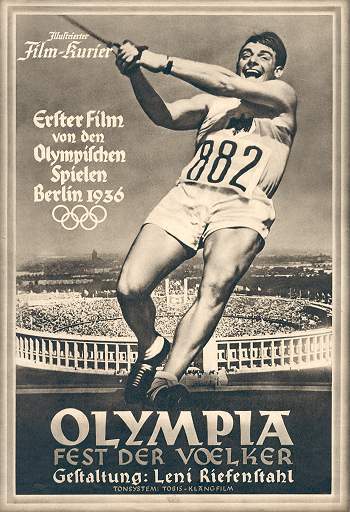
Film #17: Olympiad (1938)


Director: Leni Riefenstal

Release Country: Germany

Times Previously Seen: none

The Story:

No story. This is a documentary of the 1936 Summer Olympics in Berlin. The production was directed by one of Hitler's favorite film makers, one who also did propaganda films for the Nazi party.

The film is divided into two parts: the first being the events that took place in and around the main arena: mostly track and field events. The second part covers the away-from-the-arena events, such as equestrian events, pentathlon, swimming and such.

Take 1: My Gut Reaction (Done after one viewing, before any research on the film):

This was a really enjoyable watch, and one that surprised me a bit. Knowing that Riefenstahl was a Nazi propaganda filmmaker, I fully expected this documentary to be ridiculously skewed and biased toward the German achievements at the Games. Such was most certainly not the case, to my delight. Rather than create a glorification of German superiority, the film focuses on the majesty and beauty of competition and the human physical form. Germany, having been the host country, had a large number of representatives, which means there are a lot of Deutchlanders in the film, but certainly to no greater ratios than you would see Americans during NBCs coverage of the games nowadays.

From the opening sequences, one gets the sense that this film goes beyond simply recording the events and results. There are slow pans along naked human forms, men and women alike, as they strike various athletic poses or engage in athletic activities. At first, the 6th grader still buried in my brain wanted to chuckle while saying "huh-huh. bare butts." Fortunately, this was short-lived and I was able to drink in the truly stunning symmetry and attraction of the human body at its peak. Certainly, there's a certain eroticism meant, but it goes far beyond this, into a very Platonic appreciation for visually attractive objects. From these forms, we get a few shots of Grecian ruins, which connect the 1936 Olympics to the traditions of the past, giving the viewer a real sense of the history behind everything. Here's the sweeping and majestic opening sequence:


Once the Games begin, a few unnerving things are shown. During the opening ceremonies (only 51 countries participated back then, by the way), each country's representatives were obliged to give the "Zieg Heil" salute to the Fuhrer, who was of course in attendance. Really eerie to see a bunch of Americans, French, and English doing that, a mere two years before all hell would break loose in Europe. When in Berlin,...

The events themselves were really interesting. Quite a bit has changed in 74 years, most notably the lack of universal techniques and equipment in sports. These days, thanks to the mountain of research done on such things, all athletes use essentially the same kinetics and the same uniforms. Back then, though, such was not the case. The variety of methods that the high-jumpers used (before the Fosbury Flop method became universal) equalled the number of jumpers. In terms of outfits, some runners went with fuller coverings, longer shorts and sleeved shirts; some were not afraid to go for what amounted to skin-tight hot pants. These days, we don't bat an eye at this, but it stood out back then.

Seeing the actual competitions was pretty engaging, for the most part. The definite highlight of the first part of the film was when they get to the men's 100 meter dash - the first appearance of one Jesse Owens at the Games. I had, of course, known the man and his accomplishments there, yet it was something else to see how this almost goofy-looking black kid absolutely destroyed the competition. Then, the stunned stillness of Adolf up in the stands made it even better. So much for that Aryan physical supremacy thing, eh? In addition to this, the film does not duck domination of events by countries other than Germany - a sweep by the Finns in the 10K run, the Japanese success in the high jump and pole vault, the U.S. taking over the long jump, and others are all given plenty of time. Here's a low-quality version of a somewhat nervous-looking Owens smoking the field (edited out was Hitler's petulent smacking of his knee):


Take that, you f***ing Nazis!!

The other thing it's easy to see early on is that Riefenstahl was not satisfied to simply keep the camera at a distance. Anyone who's watched sports footage from the 1930s, be it baseball, football, or (gag) soccer, you may remember that it was always a single camera, usually up in the cheap seats so that it could catch the entire field. Thanks to massive funding, Riefenstahl went far beyond this, positioning cameras all over the place and getting as close as humanly possible to the athletes while they were competing. You can see the sweat falling, the teeth gritted in concentration, and the pursed lips of the disappointed failures. I can only imagine how intense it must have seemed to viewers back then.

The second disc was even more interesting since it featured certain events that are off the beaten path or no longer exist in the Olympics. Of note was the pentathlon, which included horse-riding, pistol shooting, a 5K cross country run, swimming, and fencing. It was a series of very military activities, and the competitors were all soldiers who even competed in full dress uniform, at least for the equestrian and shooting events. Talk about something you simply wouldn't see these days. Even more eye-catching was a moment when, after the grueling 5K run, an American officer nearly collapses at the finish line, only to be caught and warmly seen to by a French officer on his left, and a Nazi German soldier on his right. Surreal in hindsight, to say the least.

The only gripe I can attempt to level at Olympia is that there is some manipulation of the editing for emotional impact. Many events are shown in isolation and there is always a swell of crowd noise during the more intense moments. After a while, you realize that it is not authentic, but dubbed in, much like the laugh track of lame TV sit-coms. It was meant for maximum dramatic effect, and it certainly doesn't kill the power that it has, but it does weaken it to be just a bit.

Olympia was a tremendous work in terms of sports filming and an absolute must-see for anyone interested in the history of sports, and aficionados of Olympic history would absolutely love it. Getting past the fact that it was a Nazi propagandist who did the work, which is not difficult, is the only small step required to appreciate the sheer artistry and innovation of the whole thing.

Take 2: or, Why Film Geeks Love This Movie (done after some further research):

Oh, those silly Nazis! They continued to screw things up for everyone, including incredibly talented German artists.

All joking aside, in reading up on Riefenstahl, it's not hard to see why her work got initially butchered by both editors and critics back in 1938. In the U.S., her initial 260-odd minute piece (the version I watched was a little over 210) was seriously hatcheted to erase any visuals of Hitler or even any German victories in the games, some of which are, admittedly, a bit bombastic. What the American public saw was a 92-minute version. Here's TIME magazine's 1948 (12 years later, mind you) review of it.

These days, however, as people far removed from the real threat of Nazis and with somewhat clearer vision, it's easy to see past what some mistook as propaganda. The fact is that Riefenstahl apparently only did one real propaganda film - and seemingly it was basically to pay the bills. Many essays and modern filmmakers strongly debate that there was any Nazi bias in Olympia at all. In fact, the film was not paid for by the Nazi party, but the I.O.C. Knowing this, I tend to agree with those who say there's very little evidence of a political agenda. How else does one explain the amount of time given to Owens' throwing a massive monkey wrench in Hitler's machine?

Above any debate is the technical artistry. Review after review points out how incredibly innovative the film was. It's still required viewing for many modern film students, as Riefenstahl invented many methods still at work today. The gents at TIME put it nicely.

On Riefenstahl herself, whole tomes could be written. Apparently, she was a phenomenal talent. Before film, she was a tremendously popular dancer in Germany. Injuries put a stop to that career, so she carved out her place in film history for a few decades. After WWII, she turned to photography and won even further acclaim. She went on to do documentary films in Africa and underwater films throughout the world. At the age of 100, she was directing a film in central Africa, was in a helicopter crash, and survived it. She did pass away a year later, but I'd say she managed to squeeze every ounce of life that a human can get in one body.

In finishing, here's a segment of the diving that I think showcases nearly all of Riefenstahl's mastery in using all that a camera could capture and relay to convey all that I wrote of up top:


That's a wrap. 17 shows down. 88 to go.

Coming (Very) Soon: Ninotchka (1939):


Oh, joy of joys...Greta Garbo again. I last saw her over a month ago in that overblown melodrama Camille. I've actually seen this one, and don't remember liking it too much. It's been a while, though, so I'll try to keep an open mind.

Please be sure to take all empties on the way out...

Friday, March 19, 2010

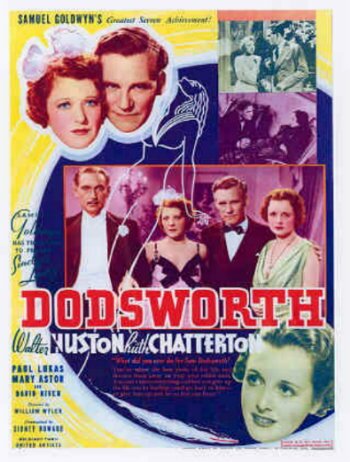
Film #16: Dodsworth (1936)


Director: William Wyler

Release Country: United States

Times Previously Seen: none

The Story (In which I shamelessly give away the entire plot, spoilers and all. Fair warning):

Sixty-ish American industrialist Sam Dodsworth has just sold the auto company that he created and has operated for 20 years. He decides to follow his forty-ish wife, Fran's pleas to go with her to Europe, where she wants them to expand their horizons and enjoy life. While the very blue-collar Sam is a bit concerned about being lost in the sophistication of Europe, he acquiesces, goes along and even begins to enjoy the cruise across the Atlantic.

Before long on the ship, it becomes obvious that Fran is just as interested in delving into a more "worldly" realm of flirtation and possible affairs with European men. She sees herself as meant to be in with what she sees as the more cultured Old World of Europe. As such, she drifts away from her brusque, though undeniably kind, honest, and capable older husband. Eventually, Fran chooses a young German man who wishes to marry her, and requests divorce from Sam. Sam still loves his wife, yet realizes that her path has become totally different from his. They separate and await divorce.


The 3 main players plus one: random sleaze #1, Fran, Sam, and Edith
During the separation, Sam reconnects with Edith Cortright, a divorcee whom he met on the initial cruise to Europe, and who is roughly the same age and has the calm wisdom that goes with it; wisdom that Fran sorely lacks. During a stay at Edith's modest coastal village in Italy, the two fall into gentle and mature love and are on the cusp of embarking on some adventurous globe-trotting when Fran enters the scene again. She calls and informs Sam that her fiance, Kurt's baroness mother has disapproved of their union, pointing out with brutal honesty that she will not allow her thirty-ish son to marry a forty-ish woman. The tables have now been turned, and Sam is moved to abandon his plans to take up with Edith, instead agreeing to rejoin Fran on a return cruise to America. Edith is crushed.

Just when it seems that Sam is going to swallow his own desires, forgive Fran's selfishness and thoughtlessness, and go back to taking care of her again, things take a final turn. When the two meet on the ship, Sam begins to listen to Fran's petty gossiping and back-stabbing. Upon realizing that she has learned nothing and is still the same immature snob from whom he had separated, he quickly leaves her and returns to Edith for an emotional reunion.


Take 1: My Gut Reaction (Done upon 1 viewing, before any research):

Ahhh. This one was a breath of fresh air after the effort of The Awful Truth. Dodsworth is a really solid film, with all of the sophistication and maturity that screwball comedies eschew. Right from the get-go, I could tell that Dodsworth was going to be more to my liking. The scene opens with Sam Dodsworth forlornly looking out over his auto plant, contemplating what he's going to do with the rest of his life, now that he's moving past his life's work. This early quiet moment hints at the depth to come in the rest of the movie. Here's the opening.

Jump right to 1:00 in to see the forerunner of Welles' opening to Citizen Kane:


There's a great balance to everything in this story. It takes no time to see that Sam Dodsworth represents the American dream - a man who has worked extremely hard to create a successful company, yet has not lost his zest for life. The only thing missing at the beginning of the story is his ability to enjoy leisurely pursuits. Once in Europe, we see the stark contrast between a man like Sam and the upper-crust Europeans who are wealthy from their ancestors' deeds rather than their own; people for whom the mere pursuit of leisure and culture has been the point of their entire lives. They have education, wit, and worldly sensibilities, but none of the grit or character of Sam. Sam soon comes to realize this, but his wife falls under the spell of the Old World sophistication and European charm. The rift between the two is not immediately apparent, but it is masterfully revealed through a series of near-affairs, full-blown affairs, and subtle culture clashes.

Unless you've read the Sinclair Lewis novel that's the basis for the film, it's very difficult to imagine just how things will turn out. Not because of weak storytelling, but because the tale represents the very real complexity of differing philosophies regarding fidelity and the purpose of one's life. It's obvious that the older Sam desperately wants to make his wife happy, which makes it all the more upsetting when he finally realizes that the divide between them cannot be bridged.

Beyond the engaging plot is the cinematography. Between the carefully crafted long shots and the unwavering still shots of certain scenes, the director gives you plenty of moments to drink in the situations and ponder the gravity of the characters' thoughts. I noticed a few scenes like this is Le Crime de Monsieur Lange, but Wyler uses it more often and to great effect. There are several excellent scenes with Sam, and a particularly powerful scene with Fran and her finance Kurt's baroness mother. Here's the scene, with less than a minute chopped from the beginning, but the power of it is in the first 3-4 minutes. It's awesome:


The acting is excellent. While Ruth Chatterton's turn as the snobbish Fran Dodsworth is appropriately annoying with her New England affectation and selfish arrogance, Walter Huston is awesome. I completely buy into his salt-of-the-earth persona who is, in turns, sensitive and tortured, calm and commanding, and exuberant. Even the minor roles are exceptional, especially Mary Astor as Edith Cortright, the mature soul-mate whom Sam eventually finds. With this movie, I'm finally seeing consistently relaxed and more naturalistic acting.

If I have any complaints about this film it's that there are a few moments in which the melodrama gets laid on a bit thick. During several scenes between Sam and Fran, there's a swell in the orchestral score and a lot of "Oh, Fran!" and "Oh, Sam!" kind of dialogue. During these scenes, I felt a touch of the impatience that I feel when watching films like Camille.

Overall, this one was a treat to watch, and I'd see it again. Anyone who enjoys classic movies with more depth than your standard Hollywood romance would be well served to check this one out. 

Take 2: Why Film Geeks Love This Movie (done after some research):

Apparently, for very much the same reasons I enjoyed it so much - the maturity. In the midst of many light-hearted and fancy-free movies of the day (understandable, being in the middle of the Depression), Dodsworth stood out for its thoughtful and skilled handling of the topic of mature marital distress. I'm apparently far from the first to notice the consistently excellent acting, as well. Here's the original TIME magazine review from 74 years ago.

The modern fellows at TIME also have some really interesting points about how Wyler was from Germany, yet managed to direct the tale of an all-American protagonist with whom the viewer sympathizes. Here's their quick-capsule write-up.

Also of note is the source material. Sinclair Lewis certainly had much more famous novels, but Sam Dodsworth is noted as being a rare thing for Lewis - a self-confident and self-assured man. The novel goes much more into the courtship and early marriage of the Dodsworths, but even critics agree that the meat of the tale begins with Sam's selling of his Revelation Motor Company (not exactly a veiled name, that). It looks like the adaptations (it was a play before a film) made the right call in trimming away these background elements.

There seemed to be some kind of ground-swell support for Mary Astor's appearance in the film too, due to personal battles that she was dealing with. It's described vaguely in the TIME review above.

That's a wrap. 16 shows down. 89 to go.

Coming Soon: Olympia (1938):


This one should be interesting - the 1936 Olympics, which took place in Nazi Germany, filmed by a phenomenally skilled director with heaps of cash to work with. Come on back in a little while, if for no other reason than to see Jesse Owens ram it up Hitler's sheise hole.

Please pick up all empties on the way out.

Monday, March 8, 2010

Film #15: The Awful Truth (1937)


Director: Leo McCarey

Release Country: United States

Times Previously Seen: none

The Story (in which I painstakingly lay out the plot; spoilers and all. Fair warning):

Jerry Warriner returns from a supposed trip to Florida to find his wife, Lucy, not at home. When she returns with her dashing music instructor, she explains that they were delayed overnight due to a car breakdown and had to stay the night in an inn. Jerry becomes suspicious and begins to level his accusations. During the snide grilling, Lucy discovers that Jerry may not have actually been in Florida. She becomes suspicious. Things get heated and the two end up filing for divorce.
The divorce proceedings come off, and the couple have only to wait out a 90-day period before it is official. During this period, Lucy starts to get friendly with her new neighbor, Dan Leeson, a kindly, if simple, rancher from Oklahoma. Jerry, under the guise of apathy, openly sabotages the blooming romance by continually highlighting the vast differences between Lucy and Dan. The marriage is off.

With Lucy and Dan's relationship over, Jerry Warriner begins to see a different lady of his own high society sect. When Lucy discovers this, she goes for a little tete-a-tete and decides to torpedo Jerry's engagement in the same way he did hers. Her method is to pose as his drunken sister at a social event and insinuate that Jerry is equally incorrigible. That marriage is off.

After this second detonation of a budding marriage and some automobile trouble, Jerry and Lucy end up stuck in their old cabin in the woods. The two mull things over, and realize that they still do love each other. Just before the 90-day deadline on their divorce, they admit their love for one another and all is peachy keen once again.

Take 1: My Gut Reaction (done after 1 viewing & before any research on the film):

UUUUUUUUUUUGGGGGGGGGGHHHHHhhhhhhhhhhhhhhh... Man, do I HATE screwball comedies, and this movie is screwball to the absolute core. Thing is, there are virtually no technical flaws to be found in this movie, in my view. Directing? Great. Acting? Phenomenal. Set design? Costumes? Flawless. Dialogue? Sharp as can be. Characters? Ah-HA!!! And this is where I go off.

There is nothing specific to The Awful Truth that I dislike. My problem is with almost the entire genre of "screwball" films. And I've really, really tried. I have. Over the last decade or so, I've watched about a half dozen "classic" screwball films. In pondering them, I think I can pinpoint what separates the ones that I'm OK with versus the ones that make me feel like I wasted 90 minutes of my life. Here goes...

I like It Happened One Night and My Man Godfrey. I hate Bringing Up Baby, The Awful Truth, His Girl Friday, and The Philadelphia Story. What separates them? Well, one thing is that Bringing Up Baby and The Philadelphia Story star Katherine Hepburn, who I can't stand in any role (I'll delve into this in a future post, no doubt). On top of that, though, the latter listed films seem to lack any characters who I can relate to and sympathize with. It Happened One Night had an earthy wit to it, and My Man Godfrey had William Powell, who was the absolute man. Not to mention that these two films were grounded at least a little more in everyday problems. The rest are all about high society types looking for love, cracking wise, and having "madcap hijinks" all along the way.

Here's where The Awful Truth is at its screwiest:


It's a yuk-fest, alright. I'd rather watch my cat bathe himself.

What it comes down to is that I simply didn't care one bit. The two main characters, Lucy and Jerry, are filthy rich and totally self-absorbed. Sure, they're good-looking, clever and playful, but what's the point of the film? I think I understand the appeal - it's the same reason people watch reality shows like The Celebrity Apprentice, Celebrity Rehab, or Celebrity (name of reality show here) - people are fascinated with the rich and wealthy. People are even more fascinated when the rich and wealthy make asses of themselves. I'm not one who's drawn by such things, so perhaps this contributes to my apathy for these films.

I think that this is perfectly illustrated in The Awful Truth by the way that the character Dan Lesson is portrayed. He's an Oklahoma rancher who's obviously a well-meaning, kind person, but one who lacks the cosmopolitan sophistication of Jerry and Lucy. Well, the movie makes Dan out to be an utter buffoon fit for nothing more than Jerry to cunningly embarrass and condescend to. I just wanted to pat Dan on the back and tell him, "Look, ol' hoss, you don't want nothing to do with these backwards Yankees. Get on back to ranch, do what you do best, and leave these well-dressed a-holes to themselves."

So you don't think I'm trying to destroy this film, let me reiterate that the film does what it intends to with incredible skill. In fact, the only reason it was tolerable at all to me were the strong performances of Cary Grant and Irene Dunne, though Dunne's New England affectations annoyed me a bit. Those two knew how to balance the ridiculous with the calculated very well, though the ridiculosity (it's a word now) gets to be a bit much.

The awful truth is that I can't say that this is a bad movie at all - it would be insulting to the highly skilled people who created it. But I have to give a qualified recommendation only to people who liked the films that I mentioned before in the "I hate these screwball movies" roll call. Otherwise, stay away.

Take 2: Why Film Geeks Love It (done after some research on the film):

After reading the many gushing reviews of this film (here's the fellow at TIME magazine's feelings), I almost feel like a cretin for disliking it so much. I don't care, though. I still don't like it.

The reasons this film gets cited as so influential are several. One is that it really launched Cary Grant's career and forged the character that he would play in essentially every movie for the rest of his life - the smooth, easy-talking, quick-witted loverman. If you've seen any of Cary Grant's other movies (Hitchcock or otherwise), you'll see the first incarnation of whatever character he played in those films in The Awful Truth. He was so damn good at it right out of the box, there's no wonder he carved such a massive place in films with it.  

Here's a mildly amusing scene that illustrates pretty much everything that I like and loathe (mostly loathe) in the film:


I was also reminded that the basic tale of The Awful Truth is ripped right out of the pages of Shakespeare; Much Ado About Nothing, mostly. That old tale had Beatrice and Benedict, two head-strong types who loved each other but wouldn't admit it, go through all kinds of shenanigans before facing the facts of their feelings. Yes, I have read that play. Yes, I have seen the Kenneth Brannagh adaptation. Yes, I hated them all.

What can I say? This is obviously a type of film that I don't like. I've tried my damnedest to figure out why, and even to have a more open mind and just enjoy the comedy. I haven't been able to do it for most of these films, though. I will be getting another chance soon, however, as His Girl Friday and The Lady Eve are coming up soon on the list. We'll see if I've vented all of my vitriol on this subject before then.

That's a wrap (Thank the Lord). 15 down. 90 shows to go.

Coming Soon: Dodsworth (1936):

I've never heard of this one, and I have no idea what to expect. These are the moments when I am often pleasantly surprised and end up discovering some of my favorite movies.

Please be sure to pick up all empties on the way out...