Tuesday, May 25, 2010

Film #28: Detour (1945)


Director: Edgar G. Ulmer

Initial Release Country: United States

Times Previously Seen: once (about a year ago)

20-Words-or-Fewer Summary (no spoilers)

Piano player gets mixed up in two accidental deaths and a vicious harpy of a woman.

Full Blow-by-Blow (A complete summary; spoilers included. Fair warning)

New York night club piano player Al Roberts has a decent life: he plays tunes in a calm night club and is in love with the club's beautiful young songstress, Sue. One night, she expresses her desire to head out to California and try to hit it big. Al doesn't like the idea, wanting to marry Sue and stay in New York, but Sue insists. Al sullenly accepts and watches her leave, promising to get out to the west when he can.

Before long, the separation gets to be too much and Al scrounges what little dough he has and hits the road, hitching his way across the country. In Arizona, he's picked up by Charles Haskell, a fast-talking quick-buck artist with big plans to score some cash in California, then head back to Miami for a bigger score on a horse race. Amidst his endless tales, Haskell tells the tale of his picking up a young girl around Louisiana - a girl who fought off his unwanted advances, leaving him with tell-tale scratches on his hand.

Farther down the road, Al takes the wheel while Haskell seemingly sleeps. Seemingly. In fact, Haskell has quietly died in his sleep. When the drifter Al realizes that he may be suspected of murder, he panics. Instead of waiting for police, he dumps Haskell's body, swaps his clothes, and takes his car, assuming his identity. His plan is to maintain the ruse until he gets to California and can ditch all of the Haskell's belongings, freeing Al to seek out Sue.

Things go even more awry when Al picks up the hitchhiking Vera. Once in the car, not two minutes pass before Vera reveals that she was the girl who fought off Haskell back near Louisiana. Vera knows that Al is not Haskell, and she assumes that he has murdered and robbed him. Despite Al's proclamations of innocence, Vera sees him as a meal ticket who she can blackmail for cash. Al tries to wiggle his way out of it, but is forced to submit to Vera's demands to hand over the cash and stay with her until they can sell the car.

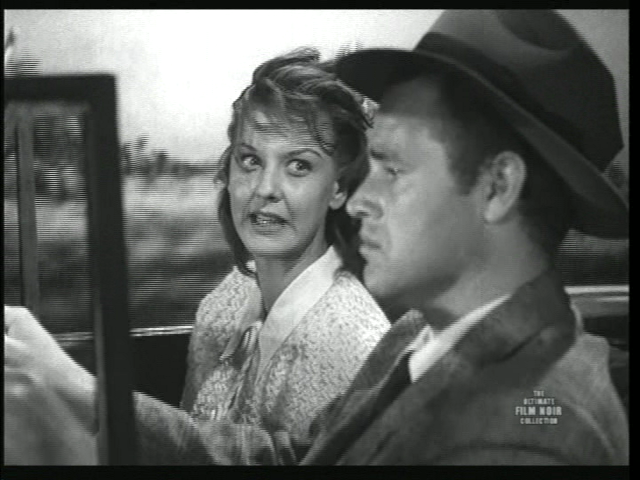
Vera the banshee begins her verbal whippings of Al the schmuck early on.

Just as Al is about to sell the car and be rid of Vera's poisonous suspicion and greed, Vera discovers the dead Haskell's final secret - he was heading to California to milk his rich and terminally ill father for tons of money. Vera tries to force Al to pose as Haskell, in the hopes of squeezing money out of the old man. Al sees this as risky beyond all reason and refuses to do it.

The argument continues back in their motel room, with both Al and Vera threatening to turn one another in to try and get what they want: Vera the money and Al his freedom. The argument heats up, and ends with Al accidentally choking Vera to death with a telephone cord. Al is now connected to two deaths. He sees fleeing as his only choice, so he hits the road.

In the end, we see Al wandering along a dusty road, slowly heading back east. That is, until a police car pulls up and tugs him into it, apparently on suspicion of the two murders. We can presume that Al Roberts' next stop is likely to be death row.

Take 1: My Gut Reaction (done after this most recent viewing, before any research):

Sometimes, going cut-rate ain't so bad.

You know what I mean. It's when you have a hankering for something, but can't be bothered to put forth a full emotional or financial commitment. You go to Taco Bell instead of an actual Mexican restaurant. You read a Dan Brown novel instead of picking up some Alexander Dumas. Sometimes, these lesser substitutes leave you satisfied (Taco Bell), and sometimes they leave you hollow and guilty (Dan Brown). Detour offers that former type of cheap satisfaction.

This movie is like a passable local dive bar. Sure, it's beat up and worn out, the people are a tad shady, and everything could use a refinish or another layer of duct tape. Still, the beer is cheap and there's an indefinable air of comfort. If Double Indemnity is the sleek speakeasy of film noir, Detour is the scuzzy, back-alley joint with dried blood on the floor.

In short, it's a pretty fun watch. I'm not altogether sure why it's proclaimed a classic. Everything about it screams D.I.Y. The acting, while not awful, is far from stellar. The visuals are a touch overdone at times, like when they went a little crazy with a fog machine to give the setting the standard murky quality of noir flicks. The dialogue comes off as a lame imitation of the masters like Raymond Chandler and James M. Cain.

And yet, it gets the big things right. The narrative is classic noir flashback, with Al Roberts drifting into a diner, agitation and anger radiating off of him. It's a perfect hook to draw you into his lurid tale of horrible luck. He may not be the brightest or most engaging character, but the story is interesting enough to follow through. How does this weary piano player get into such shape? The noir answer is always the same: a woman. Or, in this case, two women.

Al initially sets out from New York to L.A. to marry the girl he loves, a vapid lounge singer. Once he's on his way and he gets the fateful ride from Haskell, it's as if he's already standing on the gallows and just doesn't know it yet. Once Haskell has his heart attack and Al makes the fatal mistake of swapping identities with him, the wheel are set in motion and can't take him anywhere but the end.

Which brings up Vera. The woman is obviously the femme fatale, but not like any other that I've seen. Rather than the coy, subtle panthers like Phyllis Dietrichson in Double Indemnity, or even Kathie Moffat in Out of the Past, Vera is a spitting viper. There's nothing subtle about her in the least. She's a 24-going-on-50 road gal. A tattered, leaky bottle of cyanide. She's not in the film for two minutes before I came to hate her. Ann Savage plays her like she was seriously ready to rip out Tom Neal's eyes at any moment. It borders on overacting, but stays just on the right side of it to keep it from laughable.

Here's the scene when Al first picks up Vera. Start at 3:00 in and watch the rest to get the immediate "Do not touch" vibes that crush Al from the get-go:


Yeesh. Maybe he should have just plowed her over at that gas station when he had the chance.

Oddly, I lost my sympathy for Al early on. Once he makes the boneheaded mistake of ditching Haskell's body, I figured he was too stupid to make it through the whole thing. Still, he's such a sad sack that it's painful to watch Vera tear into him and use him as so much cannon fodder.

The story, while not nearly as complex, polished, or thought-provoking as noir classics, is also a case study in restraint. It never tries to do too much. The film is a mere 67 minutes and hustles along. Al's situation goes from sad to shocking, to desperate, to even more desperate, to fatal at breakneck speed. Once again, the film toes the line of moving too quickly, but manages to rein it in just when necessary by having relatively slower moments of argument/discourse between Al and Vera.

The final reminder of how fictional the world of noir is comes with the death of Vera. Yet again, it's almost humorous when Al accidentally strangles her with a telephone wire. I didn't really laugh, but if I had, it would have been laughter in self-defense rather than humor. By this point, the tragedy has reached its highest pitch, and I couldn't help but empathize with Al's desperation and fatalism. The man's goose was thoroughly cooked, and it was visible in every down-turned line of his haggard face. All that remained was the handcuffs.

Detour is a good little film that any fan of old-school noir, either film or literature, would like to some degree. Once more, I'll have to research just why it's held in high regard by critics these days, as I don't see anything particularly special about it. Then again, that's why I'm doing this little project of mine, eh?

Take 2: Why Film Geeks Love this Movie (done after some further research):

Interesting to note that I couldn't find any original reviews, which speaks to the fact that back in '45, Detour didn't make much of a splash. It has only been after decades of people returning to it that it has emerged as a standard.

Roger Ebert has an interesting analysis of Detour, in which he readily points out that the technical shoddiness is a moot point. It all comes down to Al and Vera, particularly Al. Ebert points to the notion of Andrew Britton that the film's narration may actually represent the desperate attempt of a born loser to gain some kind of sympathy from the audience. This means we can see Al as an unreliable narrator who tries to paint himself as far less pathetic, masochistic and culpable than he may truly be. Interesting.

Richard Schickel's quick capsule take at TIME is rather sparse. He does, however, compare Vera and Al locked in a room to Jean-Paul Sartre's No Exit Hell. In thinking back on the film, I can see his point.

A final notable discovery about the ending. In those days, films were not allowed to show criminals "getting away with it." This is why, rather than the film ending with Al simply drifting along the road into a fade-out, the cops come along in the last seconds and stuff him into their paddy wagon. Notable because, as I watched the movie, it struck me that a better ending may have been the mystery of Al's true fate. Here's the end of it all. Go to 5:00 to see just how censorship changed it, ever-so (?) slightly:


BONUS!! For anyone interested in taking a gander at the film, go no further than this link. The thing is public domain, so you can watch the whole thing. As mentioned, it's a short one, and you may find yourself intrigued enough to stay with it. I did. Twice. I won't be surprised if I get hooked into it again.

That's a wrap. 28 shows down, 77 to go.

Coming Soon: Notorious (1946):


Nice! Hitchcock makes his first appearance on the list. To boot, I get to see Cary Grant in something other than a screwball comedy, and the ever-stunning Ingrid Bergman.

Please be sure to pick up all empties on the way out.


Friday, May 21, 2010

Film #27: Les enfants du paradis (1945)


Title I Can Understand: Children of Paradise

Director: Marcel Carne

Initial Release Country: France

Times Previously Seen: Once, about a dozen years ago. Quite frankly, I remembered virtually nothing about it.

20-Words-or-Fewer Summary (no spoilers)

Various characters, including circus performers, fall for the same woman. Love abounds and confounds.

Full Blow-by-Blow (A complete summary, with spoilers)

In 19th century (?) France, two young actors, the mime Baptiste (Jean-Louis Barrault) and the bombastic stage actor Frederick LeMaitre (Pierre Brasseur) are just starting to make their marks on the Paris stages in the lowlier quarters of the city. Simultaneously, they both fall in love with Garance, a mildly jaded though clever and loving woman who makes a living posing for nude paintings or being the object of desire in a circus side show. Added to this list of lovers for Garance is the misanthropic, cunning criminal Pierre-Francois Lacenaire, and later, the wealthy Count of Montray, Edouard.


The playful, charismatic Frederick makes one of his countless advances upon Garance.


While the ultra-sensitive Baptiste falls most deeply for Garance, his shyness and romantic propriety preclude him from simply giving himself to her. Thus, Garance takes up with the incredibly pretentious, though affable, Frederick for a time. Shortly after, the Count shows up and offers Garance a life of luxury, if only she commits to him. She refuses, but the love-stricken Baptiste finds out about it and erupts with emotion over his plight of unrequited love.

A short time after, Garance is arrested due to her casual associations with the nefarious criminal Pierre-Francois. Instead of allowing herself to be prosecuted, she calls in the favor of Count Edouard, thus abandoning her life in Paris and leaving the country.

Fast forward roughly six years. Baptiste and Frederick are the toasts of the Parisian stage, Baptiste due to his miming artistry and Frederick his unparalleled acting skills. Frederick is more rakish than ever, but Baptiste has married and had a son with Nathalie, a young fellow stage actor who has always proclaimed deep and true love for him. All seems relatively well.

Then Garance returns, throwing things into chaos again. Fredrick makes advances that are rebuffed, and Pierre-Francois is no longer interested in her affections but is plotting careful destruction of the love that he is incapable of feeling. Baptiste is hit the hardest upon learning of his true love's return, abandoning his wife and son, and Garance's sugar daddy, Edouard, challenges Frederick to a duel for having insulted his honor. (Dizzying, I know)

In the end, the assassin Pierre-Francois kills Edouard, thus saving Frederick. Nathalie discovers Baptiste and Garance together and demands an honest answer from her husband as to whether or not he ever loved her. Rather than answer, Baptiste instead leaves his wife standing in a room so that he might pursue Garance, who has fled the scene and jumped into a coach. She rides off, leaving Baptiste standing in the middle of a Carnival festival, love-stricken and emotionally alone.

Close curtain.

Take 1: My Gut Reaction (done after this most recent viewing & before any research):

A general summary doesn't do this film justice. It's great.

The movie is a monster epic - it's over 3 hours long and divided into 2 parts. And yet, it never felt tedious. Right from the get-go, we start in the middle of throngs of circus performers on the street, captivating the hordes of onlookers. Before you know it - you're one of the onlookers, hypnotized by the show. This has to be what would inspire the likes of Federico Fellini in films like La Strada and 8 1/2, as well as Terry Gilliam's fascination with the same, as evidenced in his recent The Imaginarium of Dr. Parnassus. The liveliness and lust for spectacle keeps these creators' films humming with energy, and Children of Paradise caught onto this early.

Not long after the opening, the actors start to show their chops, which are considerable. The playful, overwhelming arrogance of Frederick makes him more charming than annoying. Pierre-Francois is an Iago-like misanthrope who is almost soulless in his pursuit to make a mockery of the rest of humanity. Played by Marcel Herrand (who oddly looks like a shifty, French Charles Bronson), he is certainly the darkest, and maybe the most fascinating character in the whole tale. The final of the three "suitors" is Baptiste the mime, who may have been the most arresting to me.

Now, you may be saying, "A mime? Seriously, dude?" To which I say, yes. While the Baptiste character is rather pityable and childish in his hopelessly romantic love for Garance, his stage performances are incredible. I know, I know - the goofy, standard mime gear of the black skull cap, super baggy costume, and mascara may be laughable. Still, Jean-Louis Barrault's athleticism and body control are amazing. With agility and grace that may surpass the amazing Buster Keaton, Barrault conveys an immense array of powerful emotions. Even if this is too "touchy-feely" for you, I would challenge anyone who has ever attempted any athletic endeavor not to be impressed by the sheer skill of Barrault's movements.

Here's a perfect sample. Start it at about 2:00 and watch the full play, for the full effect. Keep in mind that this little play analogizes the dynamics between Frederick, Baptiste and Garance, who are all three in the play together. Even though there are no subtitles, you shouldn't have any trouble figuring out who each person is, or how they feel about each other:


The story may seem sappy on the surface, being a romance. Don't let it fool you, though. There is an incredible amount of depth here.

Garance is worth looking at first, though the character is an interesting enigma. She is obviously the source of all of the tension in the film - the object of the various men's desires. But she is almost a fleeting mirage. When pressed, she admits to no tangible past, and never truly commits to any one man. I suppose one could read into these things that she symbolizes the quixotic nature of love itself; ever inspiring action, but rarely satisfying the actor. This ambiguity is one of the things that I truly like about the story.

Each of the four men who desire Garance represent a certain philosophy of love, and each one lives and articulates it in different ways. Any person who has pondered the nature of love for another human will find something to chew over in this film's expositions; whether it's Frederick's devil-may-care hedonism, Pierre-Francois' selfish nihilism, Baptiste's starry-eyed dreamy romanticism, or even Count Edouard's cultured notions of honorable love, any viewer will likely find one or more of them empathetic, at the very least. Writer Jacque Prevert created an excellent script, weaving in appropriate literary references and creating many a memorable line about the nature of art and human relationships. They were so memorable, in fact, that I found myself wishing that I spoke French, as certain nuances are nearly always lost in translation.

Before one thinks that the entire film is merely a 190-minute jaunt through the tender fields of love, I need to point out that there is suspense and intrigue, supplied mostly by the criminal Pierre-Francoise. His nefarious nature results in more than a few robberies, fist-fights, duels and murder, though none of them seemed gratuitous to me. Just thought I'd add that, for those who like a little action.

The look of the film is also outstanding. While color film was gradually becoming more common, most films were still in black and white, and Children of Paradise was no exception. Despite the limitations of the two-tone technique, this movie doesn't lose much of anything by it. The framing, set and costume designs are so good that one can't help but come away with a very vivid impression of the tale's setting and characters. Each place and character has a particular look and feel, which is a testament to the work of the creative forces of the film.

While the movie is a commitment, in terms of time, I would suggest it to nearly anyone who doesn't mind reading subtitles and who has even a shred of the romantic in them.

Take 2: Why Film Geeks Love this Movie (done after some further research)

Apparently, the time that this movie was made is of significance. Filmed over three years, mostly during Nazi occupation, it has been posited that much of the film's narrative can be seen as allegory for the occupation with Garance as France and the suitors each representing some aspect of French ethos. Some analysts would say that this may be reading a bit too much into the script, but all agree that if it was meant as allegory, it was an absolutely masterful job of subtlety.

Of greater interest to me are the revelations about the historical sources for some of the characters, which Brian Stonehill explains in this essay, and Peter Cowie looks at as well. Baptiste was the preeminent mime of his day, and Frederick LeMaitre was a stage actor of such prominence that Alexandre Dumas and Victor Hugo themselves wrote plays just for him. Not exactly light-weights. As if those references weren't enough, the anarchist character Pierre-Francois Lacenaire was also a real figure; one who would meet the gallows and eventually be the inspiration for Dostoevsky's Raskolnikov character in Crime and Punishment. Apparently, 1830s Paris produced its share of memorable figures.

Don't let this guy's "pampered dandy" get-up fool you - he's stone cold enough to chill Dostoevsky.

The original TIME review is an interesting one that points to a certain lack of patience on the part of the reviewer. The review shows a quality of frustration with what they see as a lack of a coherent theme to tie everything together. I disagree with this, as I think many reviewers in the subsequent decades have. Funny to note that that original review uses the superlative "Frenchest" to describe the movie. True, that.

Nifty historical stuff aside, this film is, by most accounts, a national treasure of the French people. It has been described as "the French Gone With the Wind," for being constantly shown on big screens and consistently ranked within France as the greatest film of all time. While I personally think that the Gone With the Wind comparison does a disservice to Children of Paradise, I can easily see what makes this film a titan of French film.

That's a wrap. 27 shows down, 78 to go.

Coming Soon: Detour (1945):

A return to film noir. Awesome! As much as a liked the sublime theme of Eros in Children of Paradise, it'll be good to wallow in the gutter of lust and murder for a bit. Come on back and see how this little knuckle duster stacks up.

Please be sure to pick up all empties on the way out.

Wednesday, May 5, 2010

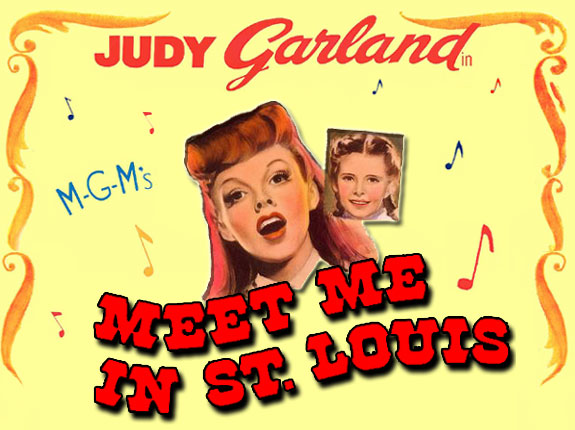
Film #26: Meet Me in St. Louis (1944)

Director: Vincente Minelli

Initial Release Country: United States

Times Previously Seen: none

20-Words-or-Fewer Summary (no spoilers, not that it matters):

Well-to-do, cheery family sings their way through a potential move from St. Louis to New York in 1903.

Blow-by-Blow Summary (detailed plot outline, with spoilers):

It's 1903 and the World's Fair is coming to Saint Louis, Missouri. The four sisters in the Smith family, a wealthy, happy tribe, have concerns. The two eldest daughters, Esther (Judy Garland) and Rose (Lucille Bremer), are pining to marry eligible bachelors. Esther has her sights set on the new dashing neighbor, John Truett (Tom Drake), while Rose awaits the proposal of another strapping young fellow. Their two much younger sisters are chuckling through the formative years of their innocent childhood.

Their father drops a bit of a bombshell when he arrives home one day and announces that the family will be moving to New York, so that he can take a new position. The family is greatly upset at the things that they will have to abandon in St. Louis: potential husbands, friends, and the fast-approaching World's Fair.

Here's Esther, regaling the riveted riders with her "Clang...the Trolley" tune.

The entire family sings their way through all of their joys and fears, with Mr. Smith finally making the decision not to move, in order to preserve his family's happiness and roots in their beloved city. His decision is rewarded in the end, when his daughters both become engaged and they all drink in the majesty of the World's Fair of 1904.

Take 1: My Gut Reaction (done after one viewing, before any research on the film):

This movie can kiss my ass.

Up to this point, I would say The Awful Truth had been the most taxing on my patience. Now, there is a new, undisputed champion of insufferability: Meet Me in St. Louis.

It's going to take some research for me to figure out why this movie made TIME magazines list of 100 important films. I have my theories, which I'll expound upon below, but I don't need to ponder my feelings about watching this movie - I couldn't stand it.

I've made clear my feelings on musicals before. The only shot a musical has in entertaining me is if: (1) the story has enough substance to hold my interest, and (2) the music is well-woven into the fabric of the film. This is why a musical like Swing Time or Cabaret is enjoyable for me. Meet Me in Saint Louis contains everything that steers me away from the genre. It's pure fluff and a textbook case of style over substance.

The story is as edgy as a down pillow. I honestly couldn't have cared less about the privileged Smith clan and their "problems" of finding love and dealing with a possible move to New York. After watching Citizen Kane, Casablanca, and Double Indemnity, three movies with a great amount of creative artistry and psychological sophistication and maturity, Meet Me in St. Louis was like watching an episode of The Wiggles. Actually, the Wiggles think the Smiths are a bunch of pansies.

Shocking factoid: Double Indemnity and Meet Me in St. Louis were released mere months apart, both to great success. This blows my mind and speaks to some kind of multiple personality disorder that U.S. culture was beginning to undergo.

The songs are bubble-gum fare of the highest order. The best-known cuts are "Clang Goes the Trolley" and "Have Yourself a Merry Little Christmas," the latter of which is actually a classic and a legitimately great song. Aside from that, however, the only thing I can say about the music is that it's infectious. That's not a complement - I mean infectious in the same way that Mad Cow disease is infectious. You can't shake it and it will melt your brain.

You may (or may not) ask, "How on earth did you make it through nearly two hours of a film that you so obviously hated?" Good question. The answer is that my girlfriend and I took the opportunity to persistently add our own snarky commentary and voice-overs, a la Mystery Science Theater 3000. Two scenes in particular gave us some good ammunition. One was when a confused and enraged Judy Garland believes that her little sister has been roughed up by the neighbor, John. She promptly goes over and pummels the shit out of him. The second was when little "Tootie" Smith, after hearing her older sister attempt to sooth her sadness by singing "Have Yourself a Merry Little Christmas," runs outside, grabs a massive stick, and commences to decapitate, eviscerate and disembowel the placid snowpeople in their front lawn. I'll save you the trouble and offer this latter little gem here (it is actually the one scene from the movie that I'd listen to and watch again):


That little chick's got a mean backswing.

Obviously, sarcasm was my only chance to survive through this piece of work. So, why is this movie touted so highly? My guess is that it was the first of its kind: a shockingly vibrant, well-shot formulaic musical. I'm not sure if there was a predecessor to it: Gone With the Wind type visuals, absolutely nothing controversial, and a string of snappy tunes, however sappy I think they may be. It's either that or simply the endurance of the Christmas song, which has become part of the American pop culture and holiday landscape.

I believe I've made myself clear. I do realize that many people love this type of film: The Sound of Music, West Side Story, Grease, and others could be put into the same category. I will say this though: even though I don't like any of these three films, either, at least they have a shade more edge to them. Meet Me in St. Louis is, to me, an absolutely G-Rated exercise in forgettable excess.

To paraphrase Leo from Miller's Crossing: if I never see it again, it'll be soon enough.

Take 2: Why Film Geeks Love this Movie (done after some further research):

Surprisingly, there's really not much out there to explain exactly what sets Meet Me in St. Louis apart from the others. Based on Richard Schickel's quick-shot review, I glean that this movie has a place in history for being the first film that offered the musical format using more down-to-earth characters (rather than high-minded, pure aristocrats, I assume).

The original review is an interesting little read, if only for two things. One is the line, "even the deaf should love this film." Oh, political correctness, where were you in 1944? While amusing, this little gag does point out that the visuals were impressive. The second thing the reviewer mentioned comes at the end - that the whole story and look of the film are too beautiful and attractive to be mistaken for the truth. These things, and the popularity of the songs, are seemingly what have dubbed this film a "classic."

And this, as stated before, is probably the bone that sticks in my craw. I don't mind heavy doses of complete fiction (I'm too big a fantasy and sci-fi nerd to try and argue that), but I can't take the froo-froo veneer of a film like Meet Me in St. Louis. Sorry.

That's a wrap. 26 shows down, 79 to go.

Coming Soon: Les Enfants du Paradis ("Children of Paradise"; 1945):


A 3-hour French drama set in a circus and revolving around a love triangle involving a mime. On the surface, it seems like a death sentence. Come on back and see if and how I survive this one.

Please be sure to pick up all empties on the way out.

Saturday, May 1, 2010

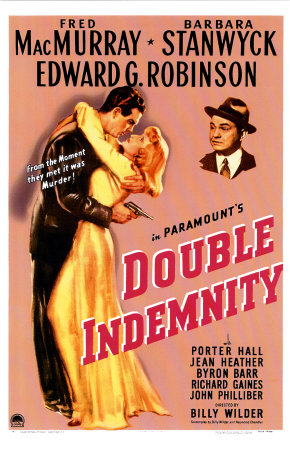
Film #25: Double Indemnity (1944)

Director: Billy Wilder

Initial Release Country: United States

Times Previously Seen: 3 (most recently about 2 years ago)

20-Words-or-Fewer Summary (no spoilers)

Insurance salesman and black widow gold digger plot murder of husband; hope to get rich off insurance policy.

The Full Treatment (A complete summary, spoilers included. Fair warning):

In 1940s Los Angeles, clever insurance salesman Walter Neff (Fred MacMurray) stops by the opulent home of rich client Mr. Dietrichson to get some signatures on an auto insurance policy. Instead, he meets Dietrichson's sultry younger wife, Phyllis (Barbara Stanwyck). After some flirtatious fast-talk, Phyllis slyly inquires about getting a life insurance policy for her husband, but without his knowing it. The quick-witted Neff immediately smells something fishy and clears out, warning Phyllis that any plot she may have to off her husband and collect insurance money is bound to fail.

And yet, after leaving, Neff can't get Phyllis or her scheme out of his mind. Sure enough, she shows at his apartment later, and they fall into each other's arms. Then and there, Walter agrees to help Phyllis with her nefarious plot. He's sure that, with his knowledge of botched murders through the insurance claims business, they can commit the crime, avoid leaving any evidence, and spend the rest of their lives together off of a $100,000 "double indemnity" insurance policy.


Walter & Phyllis: future lovers and accomplices.

Neff carefully plots the murder and coaches Phyllis in assisting him. With calculated precision, the two get Mr. Dietrichson's unwitting signature on the life insurance policy, then lure him to his own murder, making it seem like an accidental fall from the observation car of a moving train.

At first, it seems as if they will get off scott free. Then, one person starts to smell a rat. Barton Keyes, the eagle-eyed, obsessive claims manager at Neff's office, senses something amiss. Following his instincts, which he refers to as his "little man," the long-time insurance man starts to become ever surer that Dietrichson's death was not accidental. Even more, he feels that Phyllis is the culprit. The only thing he doesn't see is Neff's involvement in the whole thing, but Neff senses Keyes getting closer to the truth.

As the pressure ratchets up, Neff discovers several unsavory things about his co-conspirator, Phyllis. She was, according to Dietrichson's daughter Lola, responsible for the death of the first Mrs. Dietrichson. On top of this, Phyllis has been secretly seeing Lola's boyfriend, Nino, at night for unknown reasons. Neff realizes that he's been played for a sucker.

When Walter goes to Phyllis's house to confront her with his revelations, he throws her deceptions in her face and explains how he plans to see that she will get locked up for the murder of Dietrichson. As a kicker, he plans to absolve himself by killing Nino, who Walter will claim was her accomplice. Phyllis, cornered, pulls a gun and shoots Neff in the arm. Neff clutches her tightly and shoots her dead, the two sharing one final, warped moment of attraction for each other. Nino shows up shortly after, but Neff abandons his plan to frame and kill him, rather telling him to leave and find Lola.

The wounded Neff manages to stagger back to Keyes's office and begins to record his own confession. Just as he reaches the end, Keyes shows up and looks on with sadness and disappointment as his former employee, and perhaps friend, lies bleeding on the floor. As they await the police, Keyes does Walter one final favor - he assists his now one-armed, former friend to light one last cigarette. Sure to be his last.

Take 1: My Gut Reaction (done after the most recent viewing, before any research):

Now we get down an dirty.

After watching several artful cinematic master works and wading through the sophomoric humor of the screwball comedies on this list, I was ready for the downright nastiness of Double Indemnity. This film is a standard just as much as Citizen Kane or Casablanca, but for completely different reasons.

There are no heroes. You have to face this fact - the two main characters are murderers, one merely cold-blooded; the other ice-blooded. Rather than love being the force that attracts one to the other and gives the audience some semblance of a human connection, it's base lust. Walter is entranced by Phyllis' looks and attitude. It's almost like he refuses to realize that he's drawn to her based on the thing that makes her most dangerous - her viper-like magnetism and the promise of sensual delights, even if they're followed by his own destruction. It's this fatalism that's a hallmark characteristic of nearly all film noir protagonists (most notably in the classic Out of the Past - film #31 on the TIME list.)


"She didn't fool me this time." Oh, but she had you all along, Walt. She had you all along...

And yet, at one point, I was hoping that the killer Neff would succeed. This is not because his victim was an evil, or even a bad person. In fact, we don't know much about Dietrichson at all. He's just a pawn with a fat bank account as far as Neff, Phyllis and we viewers are concerned. I think it speaks to the movie writers' skill that there was a moment when, after the murder occurs, I actually wanted Neff to get away with it. How the hell did I become a cheerleader for a murderer?!

I chalk it up to a certain aspect of human nature, one that A-Team leader Hannibal put well: "I love it when a plan comes together." Whatever the plan is, we love to see if someone can pull it off. How else do you explain the appeal of crime movies? Well, Double Indemnity went all the way with it. Instead of giving you something slightly more palatable like bank robbers or a prison escape, you get two people who are going to kill someone for nothing more than greed and lust. Still, Walter's plan is so well-conceived and precise that you can't wait to see if it works, regardless of the motives. There was actually a moment when, as a monkey wrench is thrown into the plan and the risk of discovery increases, I felt nervous for Walter. I was actually sympathizing with a killer!

But more than this is that there is actually some form of redemption in the end. While his veins pump with 33-degree water throughout most of the movie, Walter's senses do return by the end, if only just barely. He sees Phyllis for the black widow that she is and even frees Nino from the frame job that was in place for the oblivious young man. This is what makes Neff more than just an unconscious killer.

Any viewer of this movie is getting treated to pure, unadulterated film noir. The rapid dialogue, the touch of '30s slang, the dark themes, and the deadly femme fatale are all in place. Someone who hasn't seen films in this genre may find them a bit ridiculous at first glance: no one really talks like that. No one could or would really pull these things off. No one place could have so many dynamic characters. All of these things are true. None of these things could or would exist, except for one place - the world of fiction. Whether it was books or film, the realm of noir fiction was a cohesive world all its own. This is why it was such a powerful force in American storytelling for at least two decades. Those broads, booze, and bullets tales had such a great appeal and impact that even as recently as Sin City, noir yet lives, albeit in a small corner of the cinema world.

To pull off such a twisted tale of deceit, you need good performances, and Double Indemnity has them. Fred MacMurray becomes a seminal noir man with his intense, slick talking dead pan. The amazing thing is that he's able to modulate his stoicism by the slightest of degrees, so that you can actually tell when his nerves are eating away at him, as opposed to when he's confident and relaxed. Billy Bob Thornton did this exceptionally well in the outlandish Coen brothers noir film The Man Who Wasn't There, and I suspect he may have studied MacMurray's turn as Neff in Double Indemnity.

I've made my feeling about Barbara Stanwyck pretty clear before. Her role as Phyllis Dietrichson is maybe her best-known role, but I actually prefer her roles in Baby Face and The Lady Eve. I suppose it's that, in Double Indemnity, her character is truly an irredeemable asp whose sex appeal thinly veils the venom stored in her fangs. I think I prefer when she played roles that have a heart, however tiny it might have been.

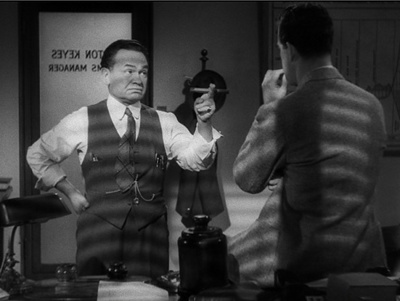
Edward G. Robinson is also incredible as the claims manager, Barton Keyes. He injects such passion into the character that you almost want to get into the insurance business, as laughable as that is; his enthusiasm is that intense.

Robinson injects so much pinched, focused energy in his role as Keyes that he nearly steals every scene in which he appears. The cantankerous, walking actuarial table does his best to keep Walt in line throughout the tale. Alas, it is to no avail.

All of these ingredients: a pitch-black plot (though a thoroughly entertaining one), engaging characters, and fantastic performances, create perhaps the first classic noir film. It helps to know what you're in for, but if you're ready for it, you'll most likely love Double Indemnity.

Take 2: Why Film Geeks Love this Movie (done after further research):

"With Double Indemnity, Billy Wilder took that idea of Americans being a bunch of fast-buck motherfuckers and turned it into art." - Elmore Leonard

And with this statement, I think Leonard sums up a lot. Like Citizen Kane and Casablanca, Double Indemnity has been food for film critic analysis for almost 70 years now. The reason being that this was the first film that artfully told a completely sordid tale that cut right to a very palpable element of the American condition: underneath the attractive exterior lurks a murderous demon.

Perhaps not surprisingly, it took a foreigner to put this idea to film, skillfully. Billy Wilder, a German immigrant who had fled during the early days of the rise of the Reich, was a student of American culture. Apparently, he was riveted by the notion that, in the States, even the most seemingly pleasant and innocuous of people had a murderer slumbering deep inside. All it took was the right trigger to wake it up. In the case of Double Indemnity, the insurance salesman Walter Neff's trigger is the trashy seductiveness of Phyllis Dietrichson.

Hollywood was terrified of this film. The salaciousness. The lack of a hero. These things seemed like poison to major studios, despite the massive popularity of dark themes in the written stories of James M. Cain and Dashiel Hammett. Once Wilder convinced the studio to make it, it was hell to cast. Too many actors and actresses saw it as career suicide. It wasn't until Wilder essentially dared Barbara Stanwyck (with the line, "Are you an actress or a mouse?!"), verbally massaged former nice-guy actor Fred MacMurray, and soothed the pride of usual-top-billed Edward G. Robinson that he had the players he needed.

Once released, Double Indemnity was not dismissed as trash, as one may suspect. Quite the contrary - it was nominated for 7 Academy Awards, winning 1, and is today considered the movie that gave birth to film noir. Never before had such a sinister tale been told with such strong acting, stylishly dark cinematography (in a time when color was growing ever-more common), and with such indelible dialogue. This movie was the parent of many later classics: Out of the Past, The Killers, Wilder's own Sunset Boulevard, and a host of others, both American and foreign.

An interesting note about the writing: the film was co-written by Billy Wilder and Raymond Chandler, based on a novella by James M. Cain. Chandler adapting a Cain novella?! That's pulp fiction madness! The really curious thing is that Chandler, Cain, and fellow pulp master Dashiell Hammett all apparently thought the others' works were garbage. I guess there's more than one plumber to dig into the dark pipes of the human psyche, and those different plumbers do not like the looks of each other.

So, why did this film resonate with Americans at this point in time? Some theorize that the time of release, with the U.S. then being familiar to the darkness of man thanks to three years at war, was more receptive to a midnight-black, adult-themed movie. No longer did every movie have to be family friendly, a hero didn't always have to win, you didn't need a song or dance number, and there didn't need to be an overt moral. Double Indemnity was created at the right time and by the right people, released in the right place, and viewed by the right audience.

The descendants of Double Indemnity are many, a few of which were previously mentioned. Along with a host of others, ones of note would be the '80s remake, Body Heat, and of course, Chinatown, which echoes the tone and even some of the exact settings in Double Indemnity. There have been more recent filmmakers who have redone noir films, but not many have the brass to make the attempt, as there is virtually no chance for blockbuster commercial success. A shame, really, as film noir is another example of the kind of world that could only exist on the silver screen. When done right, as with Double Indemnity, it's as good as anything that's ever been put on celluloid.

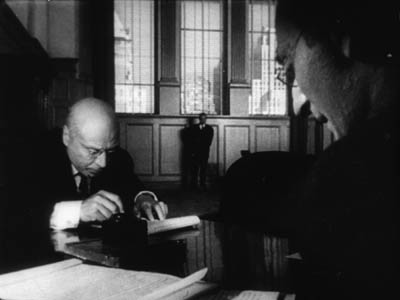
In parting, it must be pointed out that the Coen brothers, in addition to the more direct homage to noir, The Man Who Wasn't There, based the ultimate cult film, The Big Lebowski on the entire pulp fiction & film noir genres. If you, like I, are a devoted Little Lebowski Urban Achiever, and have ever wondered why exactly the Coens made bowling such an integral part of the film, allow me to illuminate. Here's a still from a really brief scene in which Neff mulls over the possibility of killing for money:

F***ing Neff...that creep can roll, man.

That's a wrap. 25 shows down, 80 to go.

Coming Soon: Meet Me In St. Louis (1944):


I'm really not much of a musical guy. So much so that I'm calling in reinforcements for this one - my lady friend is going to be my copilot during this viewing, making it the first film that I won't be watching alone, like some film-obsessed hermit. We'll see if she can help me confront Judy Garland and...color!!!

Please be sure to pick up all empties on the way out.

Wednesday, April 28, 2010

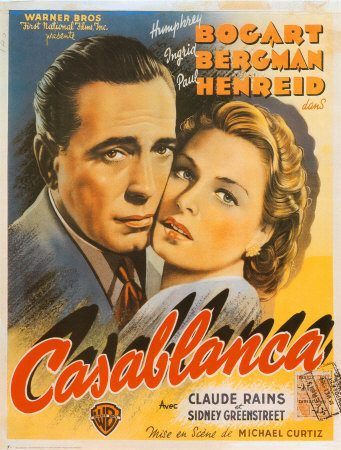
Film #24: Casablanca (1942)


Director: Michael Curtiz

Initial Release Country: United States

Times Previously Seen: 4 or 5 (last seen about 6 months ago)

20-Words-or-Fewer Summary (no spoilers):

Jaded club owner/ex-mercenary is reunited with past love, wife of underground Nazi resistance movement leader. Romance and adventure ensue.

Full Blow-by-Blow (a detailed summary, with spoilers. Fair warning):

World War II has completely erupted and the Axis is steadily marching through Europe. In the Moroccan city of Casablanca in northeast Africa, hordes of refugees are scrambling for freedom and desperately searching for ways and means to escape from the carnage. Casablanca is now a city filled with expatriates, rich and poor, and scoundrels looking to take full advantage of their desperation.

One semi-safe haven is the swinging night club Rick's Cafe Americain, run by American expatriate and former soldier-of-fortune, Rick Blaine (Humphrey Bogart). Rick is a world-weary man who seeks nothing more than to operate a viable club, clearly stating that he won't "stick his neck out for nobody." Despite this callous decree, Rick is a man who has a hidden soft spot for those he sees as decent people, and who privately despises the Nazis and their fascist ideals.
The four main players, left to right: Rick, Renault, Lazlo and Ilsa

One night, local scumbag Ugarte (Peter Lorre) shows up in Rick's, asking him to stash two exit visas, exceptionally valuable commodities in Casablanca, that Ugarte has stolen from a pair of Nazi couriers whom he has killed. Rick agrees, but Ugarte is promptly seized and killed trying to escape. Overseeing the action is the local corrupt police chief, French Captain Renault (Claude Raines) and newly-arrived Nazi Major Strasse. Strasse has arrived to find and contain escaped resistance leader Victor Lazlo, a Czechoslovakian who has suffered in a concentration camp, escaped, and continued to fight for freedom from Nazi rule.

Lo and behold, Lazlo appears, and he's not alone. With him is his beautiful wife, Ilsa Lind (Ingrid Bergman). When the pair show up at Rick's, the normally stoic Rick sees Ilsa and slips into a deep, depressive reverie. After being cordial to Victor and Ilsa, we learn that, prior to arriving in Casablanca, Rick had fallen in love with Ilsa in Paris just before the Nazis rolled in and took over. Rick had planned to flee Paris with Ilsa, but was left standing at the train station with his piano-playing comrade, Sam, and an extra train ticket. Devastated, Rick flees, not knowing what became of his love.

In modern Casablanca, Rick's heart has become hard. When Ilsa and Victor ask for his help in acquiring exit visas, he refuses, despite having the visas stolen by Ugarte. Ilsa eventually reveals that, when she and Rick were together in Paris, she was still married to Victor, though she had then thought him dead. Shortly before Rick's flight from Paris, she had learned that her husband still yet lived, and she abandoned Rick to return to her husband. Even this revelation seemingly fails to move Rick.

As Major Strasse tightens the noose around Victor, he and his wife become more desperate. Rick cooks up a scheme by which he plans to use the two exit visas for himself and the now exhausted and complicit Ilsa, apparently to leave Lazlo to the mercies of the Nazis. However, when all of the different forces converge on an airstrip, Rick offers a final surprise: he gives the visas to Ilsa and Victor and gets them on a plane, granting them their freedom. To boot, he guns down Major Strasse, a terribly severe crime that is overlooked by Captain Renault, who re-embraces his own past convictions. Victor and Ilsa fly away into the night, and Rick and Renault saunter off to who-knows-where, to fight for the Allied cause in even more distant lands.

Love and ideals conquer all.

Take 1: My Gut Reaction (done after this most recent viewing of the film, before any research):

Citizen Kane may be the most innovative and artistic work in the history of major American films, but Casablanca is the absolute pinnacle of what mainstream Hollywood can ever achieve in terms of storytelling. I can't think of a movie that has a tighter script, more memorable classic lines, and as solid a cast as this all-timer.

At the very start, things are a touch droll. During the initial scan through the city, we are treated to various scenes that convey the sense of wonder that is the thrumming populace. For the first five minutes or so, we see people getting robbed, suspected refugees shot, and even a young woman looking up at a departing plane and, dreamy-eyed, declaring, "Do you think we'll be on that plane one day?" Such a cheese-tastic line almost had me wondering just why I like this film so much.

Then, a reverse of my The Lady Eve experience occurs.

That film had an amazingly strong beginning, then faded significantly as it went along. Casablanca just gets better and better as the story unfolds. Every major and minor character is memorable, right down to the bartender in Rick's. Every scene and line of dialogue advances the story or reveals something essential about a character. And yet, despite the film being an economical hour and forty-two minutes long, it at no time seems rushed. There are quiet, ponderous moments, just as there are moments of high intrigue and suspense. The cocktail is mixed so perfectly that you don't even realize that you're being intoxicated until you've got that stupid grin on your face.

The lines. Those who haven't seen this film may not realize just how many classic lines come from this movie. When I first watched it back when I was about 21 years old, my initial thought was, "Man, that line was another cliche." Shortly after that first notion, I realized that this movie was the source for all of the cliches:

"Play it, Sam." (there is no "again," as some may have you believe)

"Of all the gin joints, in all the towns, in all the world, she walks into mine."

"Here's looking at you, kid."

"Round up the usual suspects."

"Louis, I think this is the beginning of a beautiful friendship."

There are plenty more, including this favorite gem of mine (sorry there's no clip, just the link):

"I was misinformed." Just count how many great lines are in this 2:30 bit of the film.

In between all of these more renowned lines are tons of others. Throughout nearly the entire film, I was smirking at the clever digs and cynical observations of everyone involved. The true stars of the show, though, are Humphrey Bogart and Claude Raines, who get the best lines and deliver them masterfully.

More needs to be said of Bogart and Raines. The other actors are excellent, including Bergman, Henried, Lorre and the others. However, when Bogie shows up as Rick, he becomes the stuff of legend. His weary hangdog face, subtle gestures, one-of-a-kind voice, and effortless delivery are cinematic platinum. His sarcasm is authentic and timelessly funny, his anger is intense, his depression is heart-rending, and his compassion, though sparing, is wholly redeeming. I can't possibly imagine any person playing the role as well, and no actor has filled the slot left in Hollywood once Bogart left.

Raines is the sleeper of this one. Though not as prominent as Rick, he's the character whose scenes you're waiting for. While he's mostly comic relief, like most of the characters aside from Ilsa, Victor, and Major Strasse, Raines is far superior to them all. His officious posture and self awareness as a playfully corrupt official are as entertaining and unique as they come. He's slimy, to a degree, but one whom you know has a good heart buried under all of that manicured vice. He and Rick pairing up at the airfield and heading out to unknown horizons on the war front is arguably the greatest ending a Hollywood film has ever had.

Here's one of Renault's greatest lines:


Of course, in addition to all of this is the time when the film was released. The U.S. had just seriously committed to engagement in WWII, so the collective emotions of the nation were focused on the goings on in Europe and northern Africa. If you keep in mind the uncertainty of things in those years, the film's story of love and hope becomes far more potent. As great as it is today, I can only imagine how much better it would have been to see it back in 1942.

There it is. With Casablanca, you arguably get: the greatest tale told in film, some of the greatest characters in film, the greatest lines in film, and the greatest ending in film. These things are the reasons that people have been trying for nearly 70 years to match Casablanca in terms of smoothness, tone, characterization, dialogue, and storytelling. Long before Steven Soderberg went at it, many have tried and come close, but none have matched it, in my view.

If you haven't seen this film yet, you only have two choices: watch it immediately or renounce any claim as a movie lover.

Take 2: Why Film Geeks Love This Movie (done after some further research):

As with Citizen Kane and other mammoths of film history, Casablanca has been studied and critiqued endlessly, if not for exactly the same reasons. It's a fascinating film since, while it can be called "sophisticated hokum," as one of the original script readers put it, there's a timeless charm that is exceptionally rare, though not elusive.

While the casting went through many iterations, one stood out to me. The Rick Blaine character was originally to be given to...are you ready? Ronald Reagan. Oof. I really can't get my mind around that one. I know Reagan had some clout back then, but anyone who's seen this movie can see why my eyes go wide when I consider this.

Another fairly interesting fact is that World War II itself indirectly (as well as directly) contributed to the greatness of Casablanca. Many of the supporting actors were themselves real refugees who had been prominent actors in their home countries, such as Germany, Bulgaria, Czechoslovakia, and others. This goes a long way to explaining why even the bit parts are so well played. I was a bit surprised at how dismissive the original TIME review was in regards to Raines' Captain Renault character. Bush-league?

In learning about the story and script I picked up that, in the film (it was adapted from an unproduced play called Everybody Comes to Rick's), Rick's background is left intentionally vague. In the play, it is revealed that in America, he was a lawyer with a wife and children. By omitting this, and only filling in the occasional detail about Rick's past fighting against fascist regimes, we're left with a more mysterious figure. To me, this is a fantastic example of skillful story editing.

Director Michael Curtiz was hailed as one of the great directors of his day. The surprising thing is that, apparently, he was not much of a "story" man. So much so that one writer explained that Curtiz didn't get along with writers and couldn't talk to them because, "He didn't know what the hell we were talking about." Rather, Curtiz was a master of scenes and working with actors. He may not have been able to create or adapt and tale, but once you gave it to him, he knew exactly how to translate it to film.

Something that I totally overlooked in my first take was the music. I think that this is because it's such a part of the fabric of the movie that I didn't give it much thought. It is excellent, and of course the song "As Time Goes By" is just as memorable as any of the classic lines of dialogue. Intriguing is the fact that the original music director didn't like the song, but wasn't able to find an alternative in time for the film's rushed release. I guess he had to eat a little crow on that one.

All of this is the slenderest tip of the iceberg of study that can be done on this movie. As opined above, Casablanca is not a masterpiece of high art or the culmination of genius. This film is not the ceiling of the Sistine Chapel. Rather, it's more like the most superbly crafted wooden chair. All of the pieces have been carefully carved and fit together just the way that they need to. You can sit down, lean back, run your hands over the supply curved arms, relax and marvel at how such a seemingly simple thing can be so rare and enjoyable. While it's perfection may invite overanalysis, there's no real need - just enjoy it.

Greatest ending ever? If not, it's in the discussion:


That's a wrap. 24 shows down. 81 to go.

Number 3 in the 1-2-3 combo of some of my favorite films is this film noir classic. Barbara Stanwyck makes her third appearance of TIME's list, this time as a true femme fatale. I'm all geared up for another viewing of this back-stabbing, double-dealing yarn of lust and betrayal. Good, clean fun.

Please be sure to pick up all empties on the way out.

Sunday, April 18, 2010

FIlm #23; Citizen Kane (1941)

Director: Orson Welles

Initial Release Country: United States

Times Previously Seen: 2 (last seen about a year ago)

20-Words-or-Fewer Summary (no spoilers):

The life story of a fictional (?) massive American newspaper magnate.

The Full Story (a complete summary, with spoilers. Fair warning):

In a sprawling palace in Florida, aged American newspaper magnate Charles Foster Kane dies in bed, uttering the cryptic word, "Rosebud." The enigma of this single word sets off a search by hungry reporters to find its hidden meaning.

In a series of time jumps and near-Rashomon like tale-telling, we gradually get an ever-clearer portrait of the larger-than-life tycoon Kane. As a child in the snowy winter landscape of Colorado, his mother unexpectedly comes into a massive fortune in the form of Colorado gold mines. Not wanting her son to grow up in their family's meager conditions, she signs over care of her only boy to the money-centric banker Jerry Thompson.

Over the succeeding years, young Kane is sent to, and kicked out of, a variety of Ivy League schools. Upon turning 25, he decides to take on the duties of one of his smaller properties - a tiny New York newspaper which he sees as a chance to exercise his idealism upon the public. With tireless energy, inexhaustible financial resources, and a flare for sensationalism, he turns the paper into a massive success. From this, he builds a media empire that he uses to build up or tear down whatever causes he sees fit. Kane becomes one of the most powerful men in the country, if not the world.


However, as his financial and political strength grow, so does his isolation. His friends begin to realize that they may not truly know Charles Kane, as his opinions and yellow journalism seem to change on a dime, with little regard for who he may or may not harm. As he slowly becomes estranged from his wife, Emily, he finds some relief in the form of a poor young musician, Susan. He begins to spend occasional evenings at Susan's, initially innocently, but eventually keeping her as a mistress.

Kane eventually runs for political office and appears to be headed for a landslide victory over incumbent but corrupt "Boss" Jim Gettys. That is, until Gettys obtains proof of Kane's evenings with Susan and reveals them to the press. His first marriage and political aspirations are destroyed. His wife and 10-year-old son die in a car accident a few years later.

Kane marries Susan and attempts to repair his damaged reputation and psyche. Despite her obejctions, Susan is forced to undergo training as an opera singer at Kane's behest. He funds a stringent regimen of music lessons, builds an opera house to showcase his wife's "talent", and uses his newspapers' might to publish glowing reviews. Regardless, Susan's lack of talent cannot be overlooked. She bombs horribly, eventually attempting suicide to escape from the pressure of her domineering husband. Kane relents and they retire to his newly-constructed Xanadu, a pleasure palace of mythical proportions.

On high, Susan makes the realization that her husband has no true feeling for her. She sees that he wants her to love him, but he is unwilling to reciprocate beyond showering her with material wealth. She leaves him, and he is devastated. He goes on a wild destructive rampage in Susan's room, then takes ill. As death approaches, Kane clutches a snow globe. He utters the haunting word, "Rosebud," and releases the globe, which crashes to the floor.

In the end, during a final look at the countless works of art that Kane had amassed during his life, we see a small, simple child's snow sled, the name of which is "Rosebud." The mystery is now solved: the final wish of the immensely powerful icon was a return to his childhood, before the massive forces of the world took control of his life.

Jeez, that's a lot for just under 2 hours, eh?

Take 1: My Gut Reaction (done after this most recent viewing):

This movie completely lives up to the word "masterpiece" in my mind. Not that there aren't a few things that I could do without, but it's still a film unlike anything that I've ever seen. Every time I've watched it, the time flies as I drink in the narrative structure and the various elements at work in the film.

The organization of the tale is incredible. The set-up is a single word: Rosebud. After that, the story is told in an inverted pyramid structure: going from a broad, sweeping scope to ever more focused glances at various seminal moments in the title character's life. Kane's death at the beginning is told through newsreels that give a "public" summary of his life and accomplishments. This gives us viewers some scope to work with, not unlike the outline of a jigsaw puzzle (an image that comes into play much later in the film).

From the massive scope of the newsreels, we start to get interviews from Kane's past associates. Each one adds his or her own brush stroke to the incomplete portrait of the man's life, with no single one completely able to reveal the sum total of the titan. As the story moves on, the exuberance and sensational expositions become ever quieter and more intense, culminating in the grand finale of an elderly Kane being shunned by his last chance at love, Susan, and going on an almost tragically comical rampage in her now-empty room.

Here's a taste of the playful feelings the earlier parts of the film, in which the young and idealistic Charles Kane has his whole life ahead of him:


If only the cock-sure young fellow knew what was coming.

One thing that people may not be crazy about is the occasional overblown theatrics of the acting, and this is fair, to a point. There is a certain amount of melodramatic simplification and hokum in terms of the characterization, dialogue and sometimes the humor. Many of the characters could be dismissed as being a bit 2-dimensional, especially minor characters like the first newspaper editor, Mr. Carter or the banker Thomson. However, the more important supporting characters like Jedediah Leland and Susan are extremely well-rounded, and their multi-faceted personalities help to reveal various aspects of the enigmatic Kane.

Yet the ostentatious posturing in the early parts of the film are another element that morphs as the tale unfolds. It almost seems natural that the arrogant young playboy is a cardboard cutout, as that's what most idealists are. His grand gestures at being a "man of the people" manifest themselves in an earnest manifesto in which he makes a public promise in his newspaper to be "honest and fair," for the cause of mankind's betterment.

However, as age and hubris set in, the vibrant charisma wears off. People begin to realize that Kane has built a fortress of self-righteousness around himself, without ever truly reflecting on his own motivations. It is only at the end, with that now-iconic dying word, "Rosebud", that we glimpse what Charles Foster Kane was perhaps truly after: the simple joy he felt in childhood, just before the crushing world became his foster parent. By this point in the movie, true gravity has taken over, and the near-silly playfulness mixed into the first half of the film is nowhere to be seen. This speaks to the complexity of the movie's structure. Welles crafted something that few storyteller have ever been able to do: telling a familiar story - the dark side of the American dream - in an engaging way that could only have been done in the cinematic medium.

Speaking of the cinematic aspects, Citizen Kane has few, if any, peers. The sets, costumes, and the camerawork are so well-coordinated that we viewers are treated to one iconic image after another. Once you see this film, the number of unforgettable scenes is almost countless: The reporters in the smoky newsreel room. A young Kane framed in by a shoddy window. The 30-year-old Kane throwing a massive celebration with dancing girls. A weary Kane slouched in a tattered chair in Susan's apartment. An emotionally drained Susan poring over a jigsaw puzzle at Xanadu. One could go on and on. If you see this movie a single time, you could turn it on at any moment and, despite the incredibly non-linear narrative, know exactly where in the story you are.

One of the more famous scenes in which the young Kane's (in the far background) entire future is being framed, both figuratively and literally:


Many serious studies have been made of this film, so one could (and many have) obviously write volumes on it. Alas, I will reduce my basic reactions and thoughts to one that is far from controversial: this film needs to be seen by everyone at least once. If nothing else, it will give you some nourishing food for thought on life and the grand art of storytelling.

Take 2: Why (a whole lot of) Film Geeks Love This Movie (done after some further research):

As stated above, there is no shortage of opinion and analysis on this movie. I'll try to pick out some of the highlights here.

One who hasn't seen the film may wonder why it gets so much modern attention, despite not being a household name, like Casablanca, Gone With the Wind, or a handful of other iconic films. Well, therein lies part of the fascinating story of the film itself and its creator.

Orson Welles was, by all accounts, a true genius of the arts. By the time he was 23, he had already become a force of nature in the theater and on the radio (his version of War of the Worlds had listeners fleeing town, thinking that a real alien invasion was occurring). Based on this success, he was granted something unprecedented in Hollywood: a contract guaranteeing total creative control to make his first film. Right from the jump, this fomented jealousy and bitterness in other filmmakers.

For this first project, Welles started right in on Citizen Kane, demanding to use only performers who had never before appeared in film. Personally, I love this idea, as it works to create verisimilitude through unfamiliarity with the actors. Critics agreed that the performers, all radio and theater actors from RKO, did marvelously. In addition to this freedom, Welles used the lack of parameters to try anything that came to mind, in terms of narrative and cinematography. The result was a tremendously novel movie that should have been a smash hit that would be recognized for its genius from the day it premiered.

It was a commercial flop.

The reason could be summed up in one name: William Randolph Hearst. Hearst, the near-omnipotent newspaper magnate heard about the film during its production and saw in it a searing parody of his own life. While this was not totally unfounded, Welles never meant it to be such. In constructing the character of Charles Foster Kane, Welles took elements from the lives of several larger-than-life American millionaires, Hearst included. I liken this to working with highly volatile materials in a chemistry lab - if one of the sensitive chemicals reacts badly, the lab can blow up. Hearst reacted badly, and the immediate success of Citizen Kane blew up.

Hearst blacklisted the film from any mention in all of his many newspapers across the country; he also threatened to blacklist any theater that dared to show the film. He also bought up as many of the film prints as he could, seeking to have them destroyed. The result was that Citizen Kane, despite glowing reviews from nearly every independent critic, went largely unnoticed (TIME magazine was actually powerful enough to give its own, highly positive review, back in 1941). It wasn't until the 1950s and '60s that its greatness and influence were re-discovered.

Upon re-watching the film with an audio commentary track by filmmaker and personal friend of Orson Welles, Peter Bogdanovich, several things were pointed out: most notably the breaking of filming conventions. Welles and cinematographer Gregg Toland used harsh lights, odd angles, and multiple perspectives to create a moving tapestry that apparently blew viewers minds. They also set up the conventions that would essentially be usurped by the entire film noir genre of film making.

Here's a still that shows the darkness, light and shadows that would be seen in films like Double Indemnity, Out of the Past, and others:

To me, one great thing is how this film illustrates how true genius can often not be described in words. There's a well-known scene in the film that is shot from an angle that is so low that Welles had a hole dug into the floor to get the camera low enough.

This is one still from the well-known "low angle" scene. It was one of the earliest uses of such technique to convey the deeper themes of narrative. After his election loss, Kane becomes even more megalomaniacal and isolated.

Analysts have subsequently imbued the ultra low-angle's purpose to give Kane a domineering appearance, highlight the framing of the background, or a number of other speculations. However, when Welles himself was asked about it, he replied simply, "I don't know. It just looked better from down there." He was absolutely right, and I love how this speaks to how often true masters may not be able to articulate their reasoning for doing things.

"God, how they'll love me when I'm dead." - Orson Welles

This line was all too prescient. Welles was hailed as a true master of the arts before Citizen Kane. His film career never totally recovered from the movie's commercial failure. The remainder of his life was spent scrambling for money to fund his own projects, some of which were excellent (see Touch of Evil or F for Fake, for example). The man who, at the age of 24, had already conquered radio and theater, and was poised to be a driving force of American film, ended his career voicing Unicron in Transformers: The Movie. Now, there is little debate as to his real contributions to the medium of film. Citizen Kane stands as testament to that.

That's a wrap. 23 shows down. 82 to go.

Coming (very) Soon: Casablanca (1941):


Another strong contender for the title of "Greatest American Movie of All Time" and one that I enjoy every time I watch it.

Please be sure to pick up all empties on the way out.


Monday, April 12, 2010

Film #22: The Lady Eve (1941)


Director: Preston Sturges

Initial Release Country: United States

Times Previously Seen: once (about a year ago)

20-Words-or-Fewer Plot Summary (no spoilers):

Wealthy ale heir is conned by lovely young grifter, who falls in love with him.

The Full Story (a complete summary, spoilers and all. Fair warning):

Charles Pike (Henry Fonda) a young ophiologist (that's snake scientist to we lay people) and heir to the vast fortunes of the Pike Ale company boards a cruise ship returning to the U.S. after a year-long research expedition in the Amazon. He is spotted and marked by Jean Harrington (Barbra Stanwyck) and her father, a pair of slick con artists. The savvy Jean uses her cunning and wiles to seduce Pike with the intention of suckering him out of some serious dough. In the process, however, she falls in love with him. She promises her father and herself to give up grifting and marry Charles, but before she can do so, Pike discovers their identities, dumps Jean and crushes her earnest desire to be with him.

The slick Harringtons on the left, with the mark, Pike, on the right.

Some months later, Jean, still seething from the rejection, sees a chance to get even with Pike. She poses as a young English aristocrat, Lady Eve Sidwich, and turns up at the Pike family mansion, once again conning Pike into believing that she's a different, though still infinitely charming, woman. Pike falls for her again and marries her. On the wedding night, just before the consummation, Jean tortures Pike with fictional tales of a wildly loose past with countless men. This time, it's Charles' turn to be crushed. He stops the train, mid-trip, and jumps off, swearing to never see his bride again.

Only after achieving her harsh revenge does Jean realize that she still loves Charles, and she seeks to make amends, still under the auspices of her assumed identity as Lady Eve. She is severely rebuffed by a still-disconsolate Charles, who then leaves for a new research journey into the jungles. On the ship, however, Jean tracks him down again, this time as herself. Charles sees her and, without realizing her past ruse as Lady Eve, instantly falls in love with her again. All is apparently forgiven and they fall into each other's arms.

Eve has truly captured her Adam, the one for whom she was made.

Take 1: My Gut Reaction (done after 1 viewing, before any research):

When I first watched this film a year ago, my lingering impression was of a decent, though not great, film. Upon this second viewing, I was conflicted for the first half. For 45 minutes, the film is so damn good that I almost wondered why I came away with such a lukewarm impression the first time. The characters are fantastic, Fonda and Stanwyck are absolutely perfect in their roles, the intrigue of the con game is totally engaging, and the script is razor sharp. Stanwyck renews my opinion that she may have been the sexiest woman in American film, which is only augmented by Fonda's stern, semi-naive portrayal of the bookish Pike. Everything that unfolds in the first episode of the film is flawless.

In this scene, Stanwyck does nothing more than run her fingers through Fonda's hair and whisper to him. She was so sensual, though, that this is one of the most alluring scenes I've ever seen in film.

Then, the second half.

After Pike leaves Jean emotionally high and dry, things got really tedious really quickly, and I can sum up every problem with one hyphenated word: Screw-fucking-ball.

Once the action goes to the Pike mansion, it all got to be way too much like the corniest bits of The Awful Truth, The Philadelphia Story, and their ilk. Virtually gone is the sophisticated plot and thoughtful dialogue, only to be replaced by a torrent of sophomoric sight gags. Within about 15 minutes, you get to watch the high-brow (read that with oozing sarcasm, please) jokes of: a couch tripped over by Pike, curtains ripped down by Pike, a roast beef platter spilled on Pike, coffee spilled on Pike, Pike fall over in a train, and Pike slip in the mud. If it had been a Three Stooges film, I would have been into it. Based on the first half of The Lady Eve, though, I felt like I had been demoted from a trigonometry to a finger painting class.

On top of that, the ending is a touch implausible. After Pike has dumped "Lady Eve" and sees Jean on the second cruise ship, his instantly re-kindled love is a bit confounding. He had initially dumped her as a deceptive gold-digger, and there's really nothing that's changed from this standpoint. Yet he gives himself right back to her, giving us all a happy ending that seems almost slapped together.

While the latter half left me unsatisfied, I still have to say that the first half is so strong that I'm willing to forgive the lamer follow-up. In fact, I was even able to deal with the weaker portions due to the performances of Fonda and Stanwyck. I cannot express enough how much I like Barbra Stanwyck. Before starting this blog, I only knew her from Double Indemnity (soon to be reviewed as film #25), and grew to appreciate her far more in Baby Face (film #9). I'm willing to admit that there were probably more stunningly beautiful actresses of the day, but I'm yet to see one who had the natural wits, power, and smoky sensuality that she portrayed with seeming effortlessness.

Check out this symbolic still of when she's seducing Pike under the guide of "The Lady Eve", especially how close her mouth is to Pike's:
Along with this, Stanwyck constantly draws attention to her mouth, whether it be with her words or movements. There's a scene on the ship deck in which she uses a rose to gently and playfully caress her own lips. It's entracing.

Fonda is a slightly different story. I've seen a handful of his better-known movies and I think he's great, though limited. Whether he was playing the quiet hero Tom Joad in The Grapes of Wrath or the cold-blooded murderer Frank in Once Upon a Time in the West, he had the strength one would ascribe to a gnarled oak tree. It's rigid and tough as hell, but in the end it's wooden. His character in The Lady Eve doesn't dispel this image that I have of him, but it's perfectly acceptable for the character. Charles Pike is meant to be a stiff bookworm who's uncomfortable around women, and Fonda was the perfect man to play him. The juxtaposition of Pike and Harrington was amazingly effective.

This is a film that, for me, represents a movie-watching experience that all movie-watchers experience at some point - the disappointment of a great extended first act followed by inferior second and third acts. I'd gladly re-watch the first half , but couldn't make any promises about sitting through the rest.

Take 2: Why Film Geeks Love This Movie (done after some further research):

No fantastic shocks in doing the research. Of note is that the original TIME magazine review, obviously impressed, indicates that neither critics nor fans were yet tired of the slapstick gags littering screwball films. I guess I just have to suppose that, had I been born in 1920, I would be far less bored by these elements.

One thing that I'm almost ashamed to have overlooked was the figurative nature of all of the physical humor. All of the the spills that Fonda takes throughout the story are meant to represent the mythical "fall" of Adam. This may add a certain amount of depth to the fumbling, but it doesn't make it any less tiresome to me.

Also of note is that director Preston Sturgess is a major footnote in film history. Most casual fans of classic films know at least a few old directors: D.W. Griffith, John Ford, and so on. Sturgess, though, is far less known, in the grand scheme. This apparently is because he was something of a comet - he banged out 9 extremely successful films within four years, most notably The Lady Eve and Sullivan's Travels. Nearly all of these screwball tales were darlings of moviegoers and critics alike, a feat that not many directors accomplish. I can only assume that his relative lack of enduring fame is due to the screwball genre having faded so much once films evolved in certain ways.

That's a wrap. 22 shows down. 83 to go.

Coming Soon: Citizen Kane (1941):


This is it! The one that many argue is the greatest American film of all time, and the film that kicks off what may very well be the best 1-2-3 sequence of the list: Citizen Kane, Casablanca, and Double Indemnity. Damn. On top of this, I absolutely love this movie and am greatly looking forward to watching it again, with my critic's hat on. Y'all come back now, y'hear?

Please be sure to pick up all empties on the way out.