Sunday, April 29, 2018

New Release! Avengers: Infinity War (2018) [Spoiler-Free 1st Section]

Spoiler-Free Section - Have No Fear!

Directors: Joe and Anthony Russo

Fans of the Marvel Cinematic Universe (MCU) will almost definitely love, or at least highly enjoy, Infinity War. Those who are apathetic or even averse to the ever-sprawling juggernaut of superhero films will hardly be won over. In fact, the latter group may very well despise this movie.

Tying together many tiny threads that have been laced throughout the previous 18 MCU films, Infinity War follows Thanos, the "Mad Titan" from the so-named moon, whose grand ambition is to gather all six of the immensely powerful Infinity Stones, gems that allow dominion over aspects of existence such as mind, space, time, and others. Most of the stones have been intermittently introduced in previous MCU films: the Space Stone back in Captain America: The First Avenger; the Mind Stone in The Avengers, and so on. Thanos is an incredibly powerful alien who has long waged a campaign to basically "thin the herd" of populations which have grown too unwieldy to manage themselves. When he determines that a planet has reached such a point, he brings in his armies to kill half the population, at random, leaving the remaining half more than enough resources to flourish. Thanos's ultimate scheme now is to gather and control the six Infinity Stones, granting him the power to eliminate half of the population of the entire universe with no more than the snap of his fingers. To stop him, the many heroic characters from the previous films must use every resource at their disposal.

Right off, I'll admit that Infinity War isn't the best MCU movie. The scale is so epic, and the number of balls needing to be juggled is so large, that there was no way that a single film could provide satisfaction on every possible cinematic and storytelling level. In this movie's case, what gets sacrificed is real emotional depth and notable character development. The movie does actually provide a bit of depth to the imposing Thanos, a character who has only been shown in brief glimpses a handful of times in the previous six years. And there is a sense of loss concerning a couple of key characters. Also, for those who have followed and enjoyed any of the individual characters from previous MCU film series, the third act is bound to have some impact for you. On the whole, though, this is as purely plot-driven a film as the MCU has offered us to date. Anyone who has preferred the smaller-scale MCU flicks like Ant-Man or Spider-Man: Homecoming, thanks to those films' greater focus on a few people and their relationships, may find the flashy, rip-roaring pace of Infinity War too dizzying and shallow.

Yep - that is indeed Spider-Man and Iron Man grouped up
with a few members of Guardians of the Galaxy. Such cross-
over teamings are part of the fun of
Infinity War.
For my part, I greatly enjoyed the movie. The directing duo Russo brothers had a lot of moving parts to rein into a single narrative, and they actually did an admirable job of it. This movie is bringing together no less than twenty different characters from well over a half dozen different movie "franchises," and having them band together to try and save quite literally half the universe. The main appeal of such an enterprise boils down to two things: what will the dynamics be when different characters interact, and how exactly will they stop an immensely powerful and determined force like Thanos? Well, the tale does an excellent job of entertaining us through these aspects of the film. Within the first few scenes, we get Spider-Man and Iron Man meeting up with Doctor Strange, and before long Quill and the Guardians of the Galaxy run into a very familiar Asgardian. As the disparate characters begin to coalesce into various teams and fill each other in on exactly who Thanos is and what he wants, the tale comes together in a rather satisfying way. As the heroes attempt to rebuff the initial attacks by Thanos's underlings, their powers, creativity, and mettle are tested in ways that make for some fun viewing.

The ending of this film is already causing some mixed reactions among movie-goers. Though one can assume that certain developments will be undone (the Infinity Stones are virtual game-breakers), there were certainly a few heroes who seem to have truly met their ultimate end. This was bound to upset fans of those particular characters. And while I was expecting a slightly more self-contained movie, I found the ending fine for what it is. The MCU overlords have always billed this movie as the first of what is basically a two-part story, with the second, still-unnamed, chapter set for release in May of 2019. It will feel like a rather long wait for the follow-up, but I believe that it is set up to actually be the stronger of the two films. Much of Infinity War had to be given over to set-up and Thanos's blitzkrieg attack, and when it is all said and done, it will likely feel more like acts one and two of the greater whole.

Infinity War is a success, for what it is. It's what DC films like Man of Steel and Batman v. Superman were trying to be in many ways but mostly failed to be. Short of making a TV-style, five or six-hour mini-series, this movie was never going to have enough time to please everyone across the movie-viewing spectrum. I think the Russo's trimmed away what they needed in order to create a cohesive movie. It's far from the most heart-felt or ponderous MCU flick, but it's strong popcorn entertainment for those looking for fantasy action/adventure of the superhero variety.

Fun fact - this exact scene never actually happens in the film,
but scenes very similar to it do unfold. Good to see Okoye get
a few good moments and one-liners in there, too.
Spoiler Section!! Beware!!!

Here is where I get into a few of the details that I enjoyed or didn't, and nearly all of them could potentially ruin some of the fun for you, if you haven't seen the movie yet.

As covered generally above, the greatest weakness of this movie is simply that there just isn't enough time for any character, or even group of characters, to particularly shine. One thing I've loved about my favorite among the MCU movies is that several of the characters have developed clear personalities, which themselves can carry a movie. Tony Stark and Steve Rogers are the two most obvious, but even less prominent characters like Doctor Strange or Bucky Barnes/The Winter Soldier have compelling enough backgrounds to make them engaging. Due to the reality of time constraints, however, no character is given much more than fifteen minutes of total screen time, and much of that is action. Amazingly, the writers did work in several solid dialogue exchanges that included some solid humor, but the scope of the film and its plot demands were such that one was bound to be disappointed by how little exposure their favorite characters would get. Ant-Man and Hawkeye aren't even in the film at all, despite the former having one film on the shelf and a sequel coming in a mere two months.

Another unfortunate result of the massive scale of the movie is that the losses don't have the emotional impact that one would hope for. Part of this is because of the limited dedication to emotional depth. Again, if one has fallen in love with certain characters, then the impact will be there, but that will have to have come from your previous viewing(s) of those characters' own movies. The deepest emotional tale in the movie involved Gamora and Thanos, but Gamora's death will only have resonance if one has enjoyed the two Guardians of the Galaxy movies (and for my part, I never found the connection between her and Quill terribly organic). And the demise of a character like Loki, one of the cornerstone villains of the MCU, lacks the power that it could have had in another stand-alone "Thor" movie. This is all to say nothing of the fact that the mere existence of the Infinity Stones tells us that whatever happens can be changed or undone, which is what I fully expect will happen in next year's follow-up film, though not everyone will be resurrected.

Oh, and we never get to see the Hulk really "smash," which is something I've greatly enjoyed in the previous two Avengers movies and Ragnarok. It is pretty cool that Thanos's raw physical strength is made clear by his almost dismissive thrashing of the jade giant early in the picture, but it would have been nice to see him leaping around and pounding a few platoons of alien invaders into Wakandan rhino meat. I have to assume that this is all a setup for Banner's Hulk persona to make a big splash in the sequel.

Those are my "superhero fanboy" gripes, and they are what keeps Infinity War from being among my absolute favorite MCU movies. When I set aside my fandom and just look at it as an objective cinephile, the movie fares worse, for reasons I mostly cover in the first section of this review. But I am a massive fan of these films, so it is in this vein that I describe what I enjoyed.
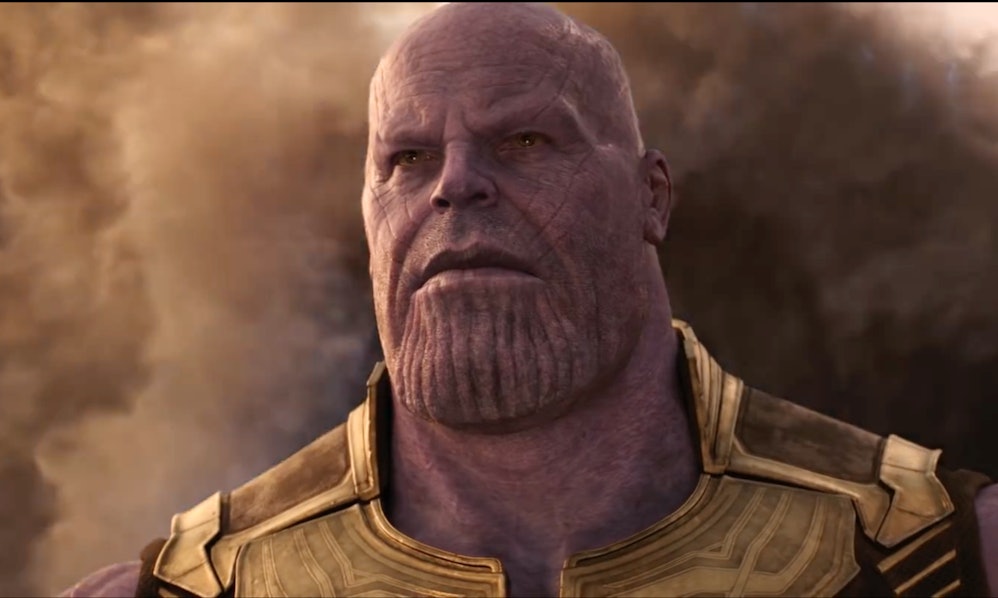
The movie does a decent job of elevating Thanos above being
a mere mindless, power-mad force of destruction. This has
been a severe weakness in many of the MCU films.
As stated, I think the actual plot is extremely well-managed. While Thanos's motivation is rather simplistic, I can justify that when I consider that most massive-scale zealots become that way by oversimplifying complex dilemmas. Rather than try to use creativity or imagination to solve large-scale population problems, Thanos falls back on brutal genocide and justifies it by telling himself that he is doing an honorable and difficult task which only he has the strength and will to carry out. I'm glad that the writers did find a way to add a couple of extra layers to the giant purple killing machine in the way of his backstory and his connection to Gamora. They weren't exactly high emotional drama, but they worked well enough.

And the many heroes' planet-jumping dash to find and stop the Mad Titan is spun very well. Especially if one has followed the various characters in the previous films, there is a very logical progression as to how they seek each other out and ultimately muster for their grand defense in Wakanda. Speaking of, I actually rather enjoyed the movie's use of the fictional African country as the staging ground for much of the ultimate battle. Even though I had just rewatched Black Panther the weekend before seeing Infinity War, I was far from tired of the setting.

With where things stand in the MCU currently - with literally half of the population obliterated, including half of our beloved heroes - this should be a great moment for the MCU to "clean things up," so to speak. I think if Infinity War shows us anything, it's that there is a breaking point for just how many "superhero" characters one put in a a movie and still have that movie provide depth as well as rousing action. Captain America: Civil War was just barely on the right side of that line, while I think Infinity War crossed over to the wrong side of it a bit, watering down what is in many ways a fun flick. Now, however, if MCU president Kevin Feige and his creative team play their cards right, they can pare things back a bit. Once Thanos is dealt with and much of his damage undone (I presume the Time Stone will play a fairly big part in this), the universe can probably be reworked a bit, allowing the future films' creators to go in directions different from what we've yet seen. I'm still well on board, even these ten years later.

Re-Watch Report (Still Spoilers...)

I enjoyed the movie enough to go take it in, IMAX 3-D style, ten days after the first viewing. I'm pleased to say that I enjoyed it even a little more upon a second viewing, even if it doesn't change a few of the purely, objective "story" weaknesses that it will never escape. To whit, full enjoyment of this film simply requires that the viewer has seen at least eight of the previous 18 MCU films. Without that familiarity with the characters' backstories, most or all of the emotional weight is simply not there.

For one like me, on the other hand, who is a big enough fan to have watched every single previous MCU film multiple times, this movie does hold up exceptionally well. As with most movies, the first viewing was all about seeing the plot unfold. With that out of the way, I was able to focus more on the pacing, visuals, intricacies of the narrative, and even the action choreography. Somewhat surprisingly, all of these aspects hold up extemely well under closer scrutiny.

As far as the action, thanks to seeing it on an IMAX screen, I was once again reminded of just how good the Russo brothers are at fight scene design and pacing. I'm generally not a particular fan of action films, but I do greatly appreciate very well-done action sequences that are neither too fast (I'm looking at you Paul Greengrass and the Bourne movies) nor addicted to slow-motion (looking even harder at you, Michael Bay). As they did with their two previous Captain America films, the Russos do brilliantly with Infinity War, which is on a much larger, literally interplanetary scale. It would have been really easy for them to lean too heavily on the CGI and simply send a bunch of digital garbage flying across the screen at all moments. Instead, they actually offer more than a few wide shots, use negative space, and give certain sequences enough room to breath a bit. This all greatly enhances the scope and scale of the larger moments, both those involving action and those which are more meditative.

The other strength that emerges is the larger theme of sacrifice and its connection to one's soul. The running question through Infinity War is: is a single life worth sacrificing, if it is likely to guarantee the safety of many, perhaps millions or more, other lives? From the opening sequences right through to the end, this question is faced by several different characters, with different choices being made. Heimdall decides that his own life is worth losing to give the universe a chance to fend of Thanos. Loki makes as if he's willing to give up Thor's life to save his own, only to turn the tables and lose his own life. Quill faces the choice of having to kill Gamora, at her behest, in order to prevent Thanos from being able to use her. And on it goes. It's not shocking that Thanos is willing to sacrifice the daughter he loves to his greater cause. Much more curiously, though, is that not every "hero" makes the choice to value the single life of a loved one over the many other lives at stake. Quill actually pulls the trigger on Gamora, and Wanda makes the move to destroy the Mind Stone, in effect killing her beloved Vision. The ultimate emotional fallout from these decisions will hopefully be explored in next year's Avengers film, but it all serves as a clear running theme that draws a fairly clear line between Thanos and those who seek to stop his mad scheme.

For anyone still considering it, I would suggest seeing the movie in IMAX. Much of the movie was actually filmed with IMAX cameras, so it fits the screens perfectly, and it really brings out the epic scale of everything. The 3-D is also well-done, so it's worth it, if that's your thing. More importantly is that the movie really is a great one for MCU fans. Few things prove that more than when one enjoys it even more upon a second viewing, as I did. 

Thursday, April 19, 2018

Retro Trio: Talladega Nights (2006); The Conjuring 2 (2016); The Ninth Gate (1999)

Talladega Nights: The Ballad of Ricky Bobby (2006)

Director: Adam McKay

My second viewing of this Will Ferrell farce, the first one being shortly after its release 12 years ago. Still consistently funny, though a movie that relies on its cast more than any especially clever script.

To quickly recap, Will Ferrell plays Ricky Bobby, a NASCAR driver born with a desire to "drive fast" and eventually gets his shot on the big stage. He quickly rises to the top of the sport, but almost as quickly becomes immensely arrogant, seeing his success on the racetrack as validating his and his family's boorish behavior. Ricky's world is turned upside-down when he is first defeated at the hands of the gay, French Formula One driver Jean Girard (Sacha Baron Cohen), and the subsequent defeat sees his family and best friend abandon him. Ricky then must rediscover his shattered confidence and put his life back together with the help of his loving mother (Jane Lynch) and his estranged and ever-irresponsible father (Gary Cole).

What can one say about Talladega Nights other than it's certainly a "Will Ferrell" movie. Ferrell has always been a guy who can make me laugh with consistency, even if he's never been an intellectual or overly clever comedian. Virtually every memorable role and character has been the same for him - the obliviously over-confident boor. Thing is, he is so freakishly good at playing this buffoonish role in spot-on deadpan, that he's bound to make nearly anyone laugh at least a few times in every movie. Talladega Nights is no different.

What helps this movie rise above lesser Ferrell fare like Get Hard or Daddy's Home is the comedic talent of the supporting cast. Time-tested comedy pros like John C. Reilly, Jane Lynch, and Sacha Baron Cohen unsurprisingly hit their marks well. But even lesser-known comedic quantities like trophy-wife-playing Leslie Bibb do nice work here. But arguably the stand-out minor character is legendary comedic character-actor Gary Cole, who plays Ricky's transient, rebel-without-a-clue father, Reese Bobby. Many will recognize him as the droning boss Lumbergh from the classic Mike Judge movie Office Space, or more recently as the hilariously dry political analyst Kent Davidson on the HBO series Veep. But here, Cole gets to show off a more dynamic aspect of his comedy game, playing the brash, loud-mouthed father who sparks his son's love of driving as well as his supreme arrogance.

It helped that I watched this movie with my wife, who hadn't seen it. Seeing a goofy comedy like this is always more enjoyable with others, even if it's hardly what I would call an essential classic. Within the Will Ferrell comedy canon, though, I have it up with Blades of Glory as one of his two or three best.


The Conjuring 2 (2016)

Director: James Wan

A step down from the original, though a high-quality version of a mostly by-the-numbers horror flick.

The Conjuring told the based-on-true-events story of a haunting which called on Ed and Lorraine Warren to assist a family with a truly haunted house. After recovering from that harrowing experience, the couple is now asked to help a poor family in London England with strange phenomena in their run-down flat. There, a single mother's children are experiencing moving objects and terrifying visions. Most notably, the youngest girl Madison is seeing and perhaps sometimes being controlled by the spirit of the old man who previously lived in the home.

This sequel was not nearly as satisfying to me as the original. It sticks to the same formula in most ways - use tried-and-true classic haunted house tropes: creaky doors, things jumping out of shadows, eerie sounds and whispers in the night, and so on, and do them well. Director James Wan (who also oversaw the original) is an undisputed expert in this realm, to be sure. The problem is that they lose their effect when one has seen the original movie not long before (I saw it about two years ago). Yes, the jump scares are very effective, but I've always found such a tactic as being ultimately shallow. Fortunately, there are some visual sequences that are more original and nerve-tingling, even before the inevitable jump-scare, such as Lorraine Warren's daydream at home involving "The Nun" (I won't ruin it for those who haven't seen it) and a few others.

I think what stood out to me as being particularly inferior to the original were the non-horror elements. The dialogue was notably bad at times, either from being overly sappy or simply overwrought. While the original movie didn't have stand-out dialogue, it at least wasn't distracting in any way. The sequel, unfortunately, made some missteps by trying to get sentimental or explore more human emotional territory. When highly reliable actors like Vera Farmiga and Patrick Wilson are having trouble selling the lines, then you know the writing is a bit dubious.

So I obviously did not like The Conjuring 2 as much as the original. Still, it was loads better than the next movie I watched...


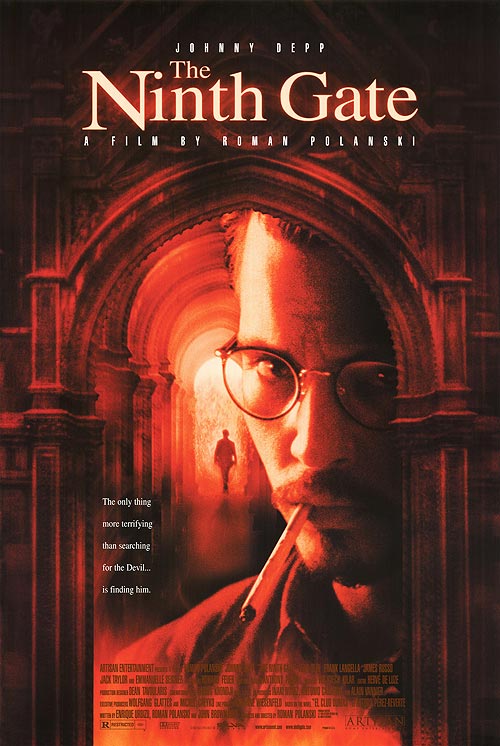
The Ninth Gate (1999)

Director: Roman Polanski

Disappointing, even though I pretty much knew to keep my expectations tempered.

All I knew about this movie was that it was about a rare book dealer who is sent to track down an ultra-rare volume reputed to be of particularly demonic nature. As a guy who loves books, used to work in book stores and collect books, and enjoys a good Biblical demon story, I thought there would be enough here to really enjoy. Not quite.

The story follows Dean Corso (Johnny Depp), a book dealer of highly dubious morals who is hired to track down a pair of books supposedly written by Satan himself. The man who hires him, Boris Balkan (Frank Lingella), has one copy of the volume and he wants it authenticated along with the other two. Corso infers that Balkan has been attempting to use the books to literally raise the devil and acquire unspeakable power in the process. Corso goes to Europe, where the other two copies are held. As he gets closer to the books and their owners, however, Corso becomes a person of interest for a few mysterious individuals. When people start to die around Corso and the books, things grow ever-more sinister. Everything culminates when Balkan ends up with the relevant information from the three texts and enacts a Satanic ritual, only to fail horribly and burn himself alive. Corso, who witnesses this first-hand, is then granted his own chance to pass through the titular "ninth gate," and into who knows what sort of demonic powers.

The movie has some solid ideas going for it. Unfortunately, I'm not sure what accomplished director Roman Polanski was thinking as he made this movie. I don't know if there was studio interference here, or if it was just a bad misfire in terms of vision (it happens to the best of them), but the movie never seems to get anything completely right. There are several plot turns which at first are intriguing but then fall flat due to either being unimaginative or simply lacking enough detail to be compelling. Characters act in illogical or wildly inconsistent ways. I often had the feeling that Polanski was trying to be too subtle, leaving the audience to figure something out but not giving us nearly enough clues to do so. What we are left with is a mess of overly vague suggestions that never coalesce into a satisfying narrative.

The acting is just as spotty as the narrative. The veterans like Depp, Langella, and even Lena Olin are fine. They do their typically-solid jobs here. But more than a few secondary characters were downright awful, most obviously "The Girl," played by Emmanuelle Seigner. I don't know any of Seigner's other work, but it looks like she has a solid resume in film and TV. That said, it was simply hard to watch her in this movie. I can only guess at the possible reasons; whatever it was, though, it resulted in line deliveries that were alternately stiff and oddly-stressed. There were also a few other bizarrely wooden actors in lesser parts, which rang of Polanski hiring them for their stunning good looks rather than any trace of acting ability.

This movie is a shame, really. It had the makings of something much scarier and memorable, rather than the frustrating mess that it was. 

Wednesday, March 21, 2018

New Release! Tomb Raider (2018)

Director: Roar Uthaug

A completely average reboot that wastes some legitimate resources and acting talent.

Like plenty of men now in their early-forties, I played the original 1996 Tomb Raider game on the Playstation back when it was released. It was a fun little adventure/action/puzzle game, if not one that totally grabbed me. I didn't bother with any of the many sequels for a long while. I also didn't bother seeing the two feature films starring Angelina Jolie back in 2001 and 2003, as they looked rather campy and silly. I did, however, play the more 2015 reboot of the video game series, which was actually very well done and quite entertaining. This last interaction with the series, along with my brother-in-law's desire to see the film, is what brought me to the theater to see a movie I otherwise wouldn't have bothered with.

The film tells the story of Lara Croft, an heiress to a billion-dollar business empire who has little desire to claim her vast fortunes. We meet Lara as she tries to scrape out a meager living in downtown London. She is eventually confronted with the unavoidable task of signing documents which will declare her father, who went missing seven years prior, legally deceased, also making her responsible for the family's vast fortune. Lara quickly discovers some cryptic clues as to her father's mysterious disappearance, however, and she jets off to follow his cold trail and learn more. She initially traces her father's path to Hong Kong, and then to a tiny, remote, barely-known island off the southern coast of Japan. There, she discovers an entire crew of captive men being forced to search for some sort of treasure alluded to in little-known legends about a Japanese empress's tomb. Lara becomes embroiled in a game of survival and a race to prevent the potential thieves, led by the cold-blooded Mathias Vogel (Walton Goggins), from accomplishing their goal.

Tomb Raider is ultimately a pretty forgettable attempt to blend the most recent versions of the video game series with a few dashes from the Indiana Jones movies which have always inspired the character. There are a few culprits, but the two obvious ones are a lack of a sharp script and a misguided choice in tone.

Expect a mud-caked, battered Lara to hang from many
cliffs and grit many teeth. Actress Alicia Vikander certainly
looked and acted the part. If only the script had risen to her
dedication and acting levels.
The dialogue and character interactions never rise above mildly interesting, and often they are flat-out dull. This has nothing to do with most of the acting. Alicia Vikander and Walton Goggins do as much as they can with the lame dialogue they were given to work with (Dominic West, who plays Lara's father goes overboard, though). The film also misses out on chances to add a bit more depth to a few characters, such as Lu Ren, the young boat captain who accompanies Lara to the island. The basic idea of the character was fine, and actor Daniel Wu does well in the role; alas, nothing much was done with him to inspire interest in his plight.

The weakness in the script can also be connected to the general tone and approach to the film. About 20 minutes into the film, virtually the entire movie is pure survival adventure, with one cliff-hanger after another bombarding you. Some of the early sequences and set-pieces are actually decent. But when there are laughable coincidences and lame devices connecting one thrill-scene after another, for over an hour straight, it gets old pretty quickly. Some decent levity and comedy might have helped here, but the movie has a fairly humorless tone much of the time. And the occasional attempts at comedy always fall very flat, again due to mediocre writing more than any problems with the performances.

This iteration of Tomb Raider is one of those movies that you'd probably feel fine about watching if you're just looking for a decent, two-hour distraction while channel surfing at home, late at night. But I wouldn't suggest anyone go out of their way for it. 

Wednesday, March 7, 2018

Before I Die #620: Earth (1930)

This was the 620th film I've now seen out of the 1,199 films on the "Before You Die" list which I'm gradually working my way through.

Original Russian Title: Zemlya

Director: Aleksandr Dovzhenko

A curious old silent Russian movie that was intermittently hypnotizing and baffling, the latter only slightly due to poor subtitles.

This tidy little, 76-minute movie tells the story of a group of Russian peasant farmers who obtain a mechanized tiller/thresher, a highly advanced piece of machinery for the day. One group uses the thresher to till the fields of the wealthy land-owning kulaks, in a bid to take control over the land on which the peasants do most of the work. The young man most responsible for the tilling is killed that night, while drunkenly wandering home. This death leads to his young wife's death through grief, and his father swearing revenge. This leads to a greater uprising in which the kulaks are brought down, thus heralding a new age in which peasants have control over their own lives.

Earth is a quick watch, which I found to be fortunate. Although I can appreciate the film artistry and clear passion that went into this pre-Stalin era Russian movie, it was quite obviously meant for a particular audience. Namely, the common Russian peasant of the 1920s, '30s, and even '40s. Like many of the great Russian movies in and around the time of the Bolshevik Revolution, this one wears its propagandic nature right on its sleeve: the kulaks are evil, and the common peasants are the downtrodden heroes. As simple as that premise is, this movie is actually rather confusing for someone who doesn't understand exactly how Russian agrarian society was organized, along with its built-in tensions. I honestly had to pause the movie and do a bit of research on the Internet so that I didn't get lost. For me, one mark of any great piece of art is that is doesn't rely as much on context and can stand on its own feet. In this regard, Earth doesn't hold up well. A Russian citizen or Russian scholar would probably follow the grander themes without trouble, but the rest of us are bound to be at least a little confused.

There are plenty of wonderful outside shots in the film,
including Vassily's funeral march. The implication is also
rather clear - nature itself, in the form of the sunflowers'
down-turned heads, mourn the loss of one of their own.
Though the narrative elements are not terribly accessible, director Dovzhenko's skills as a filmmaker are quite clear. He uses a variety of then-deft film techniques to tell the story in evocative, poetic ways that can be quite engaging. He will superimpose shots of nature with the age-lined faces of the peasants. He will allow the camera to linger on farm machinery as it churns away, not unlike the brilliant Russian film Man with a Movie Camera from the prior year. Such fascinating camerawork and editing made me wish I had been watching a better copy of the film, as opposed to the online streaming version I found, which was passable but hardly of Criterion Collection quality.

Put this one in the same category as movies like Battleship Potemkin and October - silent Russian Revolution propaganda movies by excellent filmmakers in their day, but movies which now are mostly for academics and pure students of the visual aspects of film.

That's 620 movies down. Only 579 to go before I can die. 

Monday, February 26, 2018

Retro-Trio: Two Days, One Night (2014); Kong: Skull Island (2017); In Her Shoes (2005)

Two Days, One Night (2014)

Directors: Jean-Pierre Dardenne, Luc Dardenne

Very well-done, human drama that relies on genuine distress to remain engaging.

The story is that of Sandra (Marion Cotillard), a woman in Belgium has just gotten over the hump of a horrible depressive episode. However, she just learns that she has lost her job due to a vote held behind her back. Her coworkers were forced to choose to either keep Sandra on the staff or to accept their sizable annual bonuses. She and a friend quickly appeal to the manager to hold a re-vote the following Monday, a mere two days away. Sanda much now frantically track down as many coworkers as possible and convince them to forego their bonuses so that she can return to her job - a job that she desperately needs.

This movie is certainly not an "upper" by any means. While there is just enough humor and levity to prevent things from getting overly grim, there is a very real sense of panic as Sandra rushes about on her desperate mission. This is, of course, what makes the film strong. As she speaks with each of her coworkers, we become invested in how they will respond. Some are sympathetic and offer to vote in Sandra's favor. Others try to be understanding but admit that they need their bonus money. Still others grow angry at Sandra for even asking them to give up their bonus for her sake. It is a very human drama where the stakes feel all too real, and the excellent acting sells its reality.

My wife, who tends to enjoy this kind of movie a bit more than me, even admitted that Sandra could get a bit much at times. Her husband, a rather kindly fellow who stays by her side through the particularly rough patches, becomes a quietly sympathetic character in the movie, as he offers no end of support. By film's end, one may grow a bit tired of the emotional ups and downs. Still, the ride is pretty well worth it, as it offers genuinely touching moments of the sort that can be tough to find in movies these days.

A few nights after watching this one, I felt the urge to go for nearly the completely opposite genre...


Kong: Skull Island (2017)

Director: Jordan Vogt-Roberts

Somewhat to my surprise, I enjoyed this movie, even though I'm not particularly a fan of monster movies.

The second in the newly-created "Monsterverse" franchise (the first being 2014's Godzilla), Kong:Skull Island takes place in the 1970s, as the U.S. begins to pull out of Vietnam. A tiny government agency (two guys, really) convinces a congressman to fund an expedition to a mysterious island in the South Pacific. The official Bill Randa (John Goodman) and the geologist Houston Brooks (Corey Brooks) believe that the unexplored island may contain bizarre lifeforms which the U.S. would do well to obtain before any of their Cold War enemies do. With funding, they round up a team including a tracker, several scientists and observers, and an Army platoon who has just been decommissioned from the Vietnam War. But when the crew arrive on the island, known as Skull Island, they very soon come across a massive, 100-foot ape which attacks them and wipes out several of their helicopters and soldiers. Now scattered, the team must try to regroup and find their way off of the treacherous Skull Island. As they wander, they discover more dangers and wonders about the home of Kong.

This movie is solid fun. Yes, it does attempt to get a tad serious in a few spots, but it never overdoes it. Mostly, it's a well-done action romp. The cast is great, with a ton of screen veterans like the aforementioned Goodman, and also Samuel L. Jackson as the warmonger platoon captain, Tom Hiddleston as the capable tracker, and slightly lesser characters played by vets like Brie Larsen and John C. Reilly. They don't always have super sharp dialogue to work with, but they almost always sell it well.

The action is mostly great. I'm not a particular fan of monster movies, but this one did a really nice job of keeping some surprises up its sleeve as the story went along. Mostly, the fun came when a seemingly serene part of Skull Island would suddenly turn into some sort of lethal monster. There is an entertainment in realizing that literally anything in the lush landscape could come to life and start killing the humans who have encroached here. Helping keep the vibe up-tempo and heart rates racing, this movie has one of the more kick-ass soundtracks I've heard in a while, with heavy metal and rock 'n roll greats from the early '70s like Black Sabbath, The Stooges, and Credence. Pretty hard to miss with such titans of great rock music enhancing the on-screen action.

So as of now, I'm on board with the Monsterverse. It's two-for-two in my book, which was much more than I could say for the big-budget DC Extended Universe after its first two movies, Man of Steel and Batman v. Superman. I may even go check out Godzilla: King of Monsters when it comes out in 2019, if I'm in the mood for a fun popcorn flick.

And then Valentine's Day came along, which swings me back in the complete opposite direction again with...


In Her Shoes (2005)

Director: Curtis Hanson

An enjoyable chick flick, even for a dude like me.

This is one of my wife's favorite movies, and Valentine's Day seemed like an appropriate time to watch it with her. It tells the story of two sisters, Maggie (Cameron Diaz) and Rose (Toni Collette), living in Manhattan. Maggie is a consummately irresponsible "party girl" and almost pathological liar, while here sister Rose is a highly responsible though rather uptight lawyer of no small means. The sisters have an established routine of Maggie getting herself into trouble, often through her drinking and/or lying, and running to seek shelter with Rose. This mildly codependent bond is shredded when Maggie is caught sleeping with Rose's current boyfriend and boss. Kicked out of Rose's apartment and with no other idea of where to go, Maggie hops a train down to Florida to find her and Rose's estranged grandmother, Ella (Shirley MacLaine). There, Maggie begins to learn more about their hidden family issues, while back up in Philadelphia, her sister deals with the fallout of her boyfriend having cheated on her.

It's easy to see why this movie is considered a pinnacle of "chick flick"-dom. It focuses on female characters, and it hits virtually every emotional mark that the genre is known for hitting; namely, relationships of several types. Relationships with one's sister. Relationships with potential boyfriends and husbands. Relationships with one's grandmother. Relationships with the family members who've gone missing. These are all handled very well in this movie, with a solid balance of humor and gravity that even a less sensitive fellow like myself can appreciate. The dynamics between the primary characters all feel quite genuine, and the parts are written and acted very well by the stars.

I also appreciate the tone of the movie. Many films in this genre are a bit too "light and fluffy" for me. I remember watching a chunk of My Best Friend's Wedding years ago, and being unable to stomach the contrivances and so-obviously cutesy nature of much of the story and gags. In Her Shoes keeps the stakes just high enough that there is some weight to the characters' thoughts and actions, while never getting too bogged down into any sort of darkness. This was not easy, as the movie does deal with learning disorder, mental instability in a parent, the need for Maggie to change her self-absorption, and similarly deeper topics. Screenwriter Susannah Grant did a really nice job adapting Jennifer Weiner's successful novel of the same name.

So I have to give this movie the highest compliment I possibly can for this type of movie: not only did I enjoy watching it, but I wouldn't mind watching it again should the wife suggest it. It's made the shortlist!

Friday, February 23, 2018

Retro-Trio: Hellraiser (1987); Semi-Pro (2008); Flesh + Blood (1985)

Hellraiser (1987)

Director: Clive Barker

Sometimes you feel the urge to go back and watch a highly influential movie you hadn't seen in decades, even if you're fairly sure that it won't hold up well. Such was the case when, a few nights back, I noticed that Hellraiser was available on one of my streaming services. It was late, and I was in the mood for something twisted and dark, so I went for it.

Watching this movie now, 31 years after its original release and probably a good 25 years after I'd last seen it, the strengths and weaknesses are exactly what lay in my memory, even though most of the details had been lost in the interim.

For those who don't know the tale, it is a wildly horrific tale of Julia and the family into which she married. The rather cold, reserved Julia moves into the old, previously abandoned family house of her husband, Larry, and her step-daughter Kirsty. When first seeing the place, they realize that Larry's mysterious loner brother, Frank, had been squatting in the home not long before their arrival, though Frank is nowhere to be found at the time. Seeing his belongings sparks Julia's memories of having an extended, passionate affair with the darkly hedonistic Frank, and Julia even begins to dream about being with Frank again. A few days later, Larry cuts his hand in the home, and the blood trickles into the floorboards of the dank, upper-most room in the house. Slowly, the blood is absorbed and revives some sort of horrific, flayed human, whom Julia discovers to her horror. This creature quickly explains to Julia that he is, indeed, Frank, and that he had transported himself, via a strange black and gold magic box, into a realm of dark sadomasochism ruled by terrifying, demoniac creatures called Cenobites. Frank convinces Julia to lure more victims into his upper floor lair, where she should kill him and allow their blood to revitalize Frank into human form before the Cenobites discover him missing and pull him back into their twisted, torturous realm.

In its day, Hellraiser was one of the most creative, disturbing, and truly horrifying films made in quite some time. Sure, there had been more graphic horror movies. And there had been eerier tales told on film. But Clive Barker's feature film debut was its own stunning blend of modern gothic horror and graphic bloodletting, wrapped in a supernatural tale that hinted at its own almost Lovecraftian-level mythos. The mere conception and look of the Cenobites, tortured and disfigured creatures cloaked in black leather and adorned with various sharp, cutting instruments, was enough to give most of us nightmares. When this was added to the quality special effects that brought the nightmares to life, you had something that made a major impression, grotesque it is may have been. In watching it now, 30 years after its release, I can say that most of the visual effects, especially the costumes and basic set designs, hold up. And the pure horror elements of the story are just as disturbing now as they were then.

The effects in the movie are great, most notably on the
slowly-regenerating Frank. It calls to mind of the stellar
makeup work from Cronenberg's
The Fly.
Unfortunately, like most of even the best horror films, the non-horror aspects of the movie are fairly weak. The backstory of Frank and Julia's affair is quite shallow, with Frank being a one-dimensional "bad boy" who literally shows up in a leather jacket on Julia's doorstep, dripping with rain, and giving her the bedroom eyes right from the jump. There is zero subtlety in their lust-filled affairs, and it seems a bit odd that Julia becomes so wildly obsessed with him that she is quite literally prepared to become a serial killer just to revive him - a man who long since abandoned her to go chasing other women and satisfaction of his own carnal lusts through any means he could find. I suppose one could argue that such can be the power of lust, especially lust repressed under a cold veneer such as the one that Julia usually exudes, but this is a bit of a stretch.

The acting is rather inconsistent, too, with a few screen veterans like Andrew Robinson and Clare Higgins doing just fine, but most other cast members appear rather amateurish. It doesn't do any of them any favors that the dialogue is uncomfortably bad, aside from the few memorable catchphrases that Barker puts in the mouths of the Cenobites - "We have such sights to show you," and "We'll tear you soul apart!" delivered in actor Doug Bradley's powerful, domineering voice still resonate as some of the most memorable lines in the history of horror films. But when it comes to the more casual dialogue between the horror scenes, the attempts at humor fall completely flat and any attempt to build any compassion for the characters never materializes.

I recall having seen the immediate sequel, 1988's Hellbound: Hellraiser II, but I've never bothered with any of the seven feature-length follow-ups (several of which were straight-to-video). I can appreciate dark horror, and the more imaginative concepts which Clive Barker created those decades ago are still somewhat compelling, but there was never enough for me to go beyond those first two movies. Real horror aficionados have likely already seen these films, probably multiple times, so it is hard to recommend it to any new viewers. Only if you are a horror fan who is a bit young and never gone back to see this one would I suggest you give it a go - despite its clear flaws, it really is one of the most influential horror movies of all time, with its fingerprints still being seen in horror movies made today.


Semi-Pro (2008)

Director: Kent Alterman

It's a Will Ferrell comedy, alright.

I like Will Ferrell. He's always been good for pretty solid, consistent laughs. I have not, however, ever become a full devotee of the comedian with seemingly boundless energy. As funny as he can be, he rather quickly became a one-note comic act in my view. This is why I've never run out to catch him movies in theaters, often waiting years after their release to watch them; sometimes never bothering to watch them at all. Watching the now decade-old Semi-Pro did nothing to change my feeling about Ferrell, either positively or negatively.

The story takes for its setting the rather low-hanging comedic fruit of the disco era in 1976. Ferrell plays Jackie Moon, a one-hit music wonder who used his lone hit song's earnings to purchase the Flint Tropics - a professional basketball team in the struggling American Basketball Association (ABA). The Tropics are the worst team in the floundering ABA, only keeping their nose above water thanks to Moon's over-the-top promotional antics, including sensational halftime shows and performances. When word comes down that the ABA is going to be contracted and absorbed into the far larger and more successful NBA, the desperate Moon makes a deal to see that his team is one of the four who will make the jump into the big league. The deal requires him to get his squad to climb out of the cellar and attain 4th place in the ABA standings by season's end, no mean feat for the disogranized and talent-bereft Tropics. Hope does emerge when aging former NBA player Ed Monix (Woody Harrelson) is able to lend his veteran knowledge and help coach up talented but selfish young NBA-hopeful Clarence (Andre Benjamin).

While Ferrell's Jackie Moon character isn't exactly like Ron Burgundy in Anchorman or Ricky Bobby in Talladega Nights, Moon does bear the hallmark idiocy, self-absorption, and overconfidence of virtually every character Ferrell has ever played on TV or the big screen. Of course, there is a reason for the typecast - Ferrell is exceptionally good at the role. Despite myself, I can't help but laugh at his line deliveries, facial expressions, and overall body language when playing such over-the-top buffoons. Since Ferrell's shtick alone can become a bit tiresome at times, it helps that there's ample comedy talent around him. Will Arnett is a standout, as the whiskey-swilling, chain-smoking color commentator for Tropics' broadcasts, but there are several others who round out the proceedings well. Woody Harrelson's comedic gifts are mostly underutilized, as he plays the mature role in the film, but he does have a few moments.

As with every other Ferrell-starring film, not every gag hits, and there are probably ten to fifteen minutes of ad-libbed nattering that should have been edited out, but the movie provides frequent enough laughs to justify its purpose. It's a dumb comedy meant to provide some gut laughs. It does that just fine.


Flesh + Blood (1985)

Director: Paul Verhoeven

A rather good, gritty medieval flick with a B-movie attitude by a director who knows how to do entertaining sex and violence.

I picked this one up after seeing it pop up on more than one "underrated film" list. Despite being a true 1980s kid, I had never even heard of it. Now that I've seen it, I understand why. The movie follows a renegade band of mercenaries led by Martin (Rutger Hauer), a highly skilled and dangerously cunning fighter. Martin and his band are first used and then cheated by a regional lord in order to get his castle back from invaders. As revenge, Martin's unruly band stages an attack on a group of the lord's closest associates, including his son Steven (Tom Burlison) and Steven's bride-to-be, Agnes (Jennifer Jason Leigh). Martin's band of marauders steal the goods, only to later discover that Agnes has been hidden away in one of the wagons. She is promptly raped by Martin, although in a way whereby Agnes either does, or at least acts like she does, enjoy being violated by the strapping bandit leader. From this point, Agnes's action become rather difficult to decipher for everyone involved. She is taken with the band to a small nearby castle, where Martin's crew kills the defenders and takes over. Agnes seems to become Martin's willing woman, although when Steven and the regional lord's soldiers lay siege to the castle, Agnes continues to change her allegiances back and forth between Steven and Martin. By tale's end, Martin narrowly escapes his entire band's being wiped out by the plague, and Agnes leaves with Steven. Agnes actually sees Martin escaping, but remains silent rather than alerting Steven's men to the dangerous bandit's survival.

This is a 1980s medieval sword-swinger unlike any other I've ever seen, especially from that era. I always enjoyed the setting and characters in those romantic "Arthurian" type tales, and even plenty of the fantasy tales that were inspired by that sort of setting. Excalibur is still great, and movies like Ladyhawke and Willow always had an appeal for me. Those movies were, though, relatively PG-rated. Flesh + Blood, on the other hand, gets its hands really dirty. The murder and sex are right in your face, and Martin's rape of Agnes is downright disturbing on an original Straw Dogs level. This movie is very much about depicting a band of depraved and bloodthirsty cutthroats in all their viciousness, and it works quite well. They truly are despicable characters.

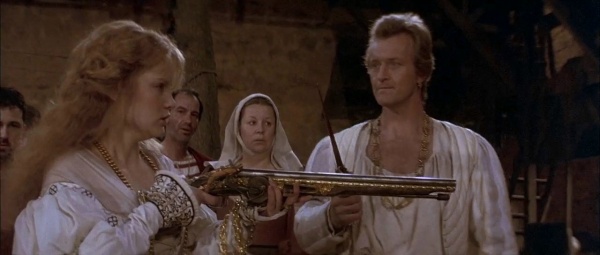
Martin is more than ready to let Agnes handle his, uh, rifle.
The previously-sheltered Agnes takes to the sex and violence
with disturbing alacrity.
The story of Agnes is also a strangely novel one. There is a bold ambiguity to her motivations, as she plays Martin and Steven off of one another, almost like a cat playing with two mice. Of course, this cat is posing as a harmless kitten, but there is a strange empowerment to her character at times. And the way that the theme of violence is handled puts me in mind of the David Cronenberg masterpiece A History of Violence, in which violence is depicted both as a repugnant aspect of human nature as well as a source of animal magnetism to others. Rutger Hauer's swaggering, bare-chested alpha male Martin is the polar opposite of the learned and thoughtful but also bold and clever Steven. The basic tale of a woman torn between "brawn" and "brains" was not a new one by a long shot, but this movie tackled the subject in a grittier way than any other I know of.

I doubt I'll ever need to see this movie again, but I was glad to have finally gone back and given it a shot. It's not for everyone, as it is a hard-R-rated movie, without a doubt. But it more than held my attention for its manageable running time, and it shed even more light on what an exciting, if uneven, resume Paul Verhoeven has put together over the decades.

Wednesday, February 21, 2018

New Release! Three Billboards outside Ebbing, Missouri (2018)

Director: Martin McDonagh

A brilliantly biting, strikingly dark comedy that is noted director Martin McDonagh's best to date.

Taking place in the titular small town in roughly modern times, local woman Mildred Hayes (Frances McDormand) rents out three billboards lined up in a row along a little-used road near her home. On the billboards, she places three connected phrases, the ultimate message of which is to question the local sheriff, William Willoughby (Woody Harrelson), as to why he has yet to find the person(s) responsible for the rape and murder of her teenage daughter, a horrific act which happened a year prior. The billboards set off a range of emotions in several of the townspeople, and they expose more than a few sentiments that have lingered slightly beneath the surface for many. Most of these sentiments are connected to deep anger, and the only person who might be angrier than Mildred herself is the none-too-bright deputy Dixon (Sam Rockwell), a racist and homophobic thug who more often than he wishes finds himself in the middle of the firestorm that Mildred sets off with her billboards.

Anyone who has seen Martin McDonagh's other films In Bruges or Seven Psychopaths knows that he loves his humor pitch-dark, and Three Billboards is right in line with his previous movies. But while In Bruges was more overtly comic, and Seven Psychopaths had a much more bizarre, overall gonzo feel to it, Three Billboards includes more genuine, and genuinely moving, emotional turns. Yes, the plot turns and even sometimes the characters are quite obviously works of fiction, given the sometimes-extreme nature of what occurs and the main players' reactions. But it all has a mostly cohesive feel, and one that is helped along by plenty of downright hilarious (but again, dark) comedy. McDonagh seems to have found his best balance of his sly storytelling abilities and a certain poignancy with which he has only flirted in the past. The running theme he works with here is that of anger in several forms, and how people handle it in sometimes highly destructive ways, even when that anger is justified. This seems like a topic especially relevant to our current times.

Frances McDormand is an immense force in this movie,
utterly unafraid to face down anyone she sees as coming
between her and her desired justice. This includes head-
strong bully cops, like Sam Rockwell's Officer Dixon.
This movie has, along with grabbing a nomination for Oscar Best Picture, has also been nominated for a couple of acting Academy Awards. I can't argue, with Frances McDormand once again turning in a brilliant performance as the ever-salty, tough- and mad-as-hell Mildred. And Sam Rockwell is excellent as the mostly repugnant Officer Dixon, though I actually think that he has had a few performances even more worthy of recognition than this one, most notably in Moon. Though not nominated for any grand awards, Woody Harrelson also turns in a typically fine performance, and all of the bit players are great.

I will say that not everything in the movie fits perfectly into place. There are a few over-the-top or simply oddball scenes which feel too much at odds with the overall tone at times. And the change that Officer Dixon undergoes is a bit inexplicable in a few ways. Still, the movie's strengths do more than enough to outweigh such questionable elements.

At this point, I have seen eight of the nine nominees for Oscar Best Picture, and Three Billboards is among my favorites. Though it might not be as tight or quite as narratively polished as several of the other nominees, it is, along with Get Out, the gutsiest and most unique of them all. I give it a semi-outside chance at winning, but I'll be surprised if it wins the big award.