Showing posts sorted by relevance for query europa report. Sort by date Show all posts

Thursday, July 24, 2014

Europa Report (2013)


Director: Sebastian Cordero

This movie is incredible. And it's not for everyone.

Europa Report is probably the most sober, carefully-researched film tales about space exploration that I've ever seen. In other words, it truly puts the "science" in "science fiction." For people who like verisimilitude in their movies, this is more than welcome.

This tight, 90-minute movie follows the fictional tale of a privately-funded mission to explore Jupiter's moon, Europa, where signs of water have been found. This evidence opens the possibility that life may be found, as well, which leads to a half dozen astronauts being sent on the epic 22-month flight to reach it and attempt to add to mankind's knowledge of the solar system.

Of course, things do not go as planned. However, unlike 99% of space exploration science fiction out there, the perils depicted in Europa Report are all very realistic. Never mind the numbing boredom that must ensue when one is stuck for 22 months straight with five other people in a spacecraft the size of a modest apartment. In space, when a very real problem occurs, there is no margin for error. If an error is made, chances are that someone is going to die. Such threats are a very real part of Europa Report, as they are with space journeys in our own real history. And with only six members in the crew, each life feels that much more precious and vital to the mission.

One of the most realistically conceived and presented science
 fiction crews ever assembled. Though fictional, what they
represent commands the respect and admiration of us
viewers throughout the film.
The characters are great. The writers avoided the pitfall of trying to make everyone "a character," and instead gave us six very natural people who do nothing to create any of the drama themselves. Each of the six is incredibly smart, capable, and dedicated to the mission of learning in the face of extreme risk. Yes, a few of the crew are a little more amiable than others, but there are no "villains" here. There is nothing to root against in this movie. Rather than seeking heartstrings to pull on, the writers and director wrap us in the intensity of dealing with high-stress situations in order to save comrades and contribute to mankind's greater good. It's a far more noble theme than what is presented by the vast majority of science fiction movies.

The final thirty minutes of the film are astounding. Once the craft and crew reach Europa, accidents and wonders converge to create the suspense, awe and terror that the great explorers of human history must have felt. Vespucci sighting the North American coastlines. Magellan discovering the massive native peoples of Patagonia. The first hunters to set sights on a blue whale. The power of these immense discoveries is echoed in the climax of Europa Report, and its something to be treasured.

Some people might watch the movie through to the end and clamor for a sequel. Though the film certainly sets up in a way that a sequel would seem logical, this would be misguided. The point of this film was not to set up some kind of sci-fi movie franchise series. The point was to remind viewers of just what may be lying out there in the farther reaches of our own planetary system.

If you're expecting Alien, Aliens, or Star Wars, you'll be bitterly disappointed. If you truly love science and the scientific process of adventure and discovery, then you will definitely want to check out Europa Report. 

Thursday, November 26, 2015

New Releases! The Martian (2015); Spotlight (2015)

The Martian (2015)

Director: Ridley Scott

A strong, sober take on outer space adventure, but one that takes no true risks.

Set in an undetermined but not-too-distant future, The Martian is the tale of Doctor Mark Watney (Matt Damon), an astrobotanist who is accidentally abandoned by his crew on Mars during an exploratory mission on the red planet. Once he awakens after being knocked unconscious, Watney must attempt to survive on a planet with almost no water, very limited food, and no immediate way to contact Earth to send a rescue team.

The strength of the film is in seeing just how a top-notch scientist uses all of his knowledge to fend off impending death at multiple turns. Watching Watney diagnose and solve problem after problem offers plenty of fascination for those who wonder exactly how someone might survive in the worst environmental circumstances.

Buoying the compelling plot is the performance of ever-reliable Matt Damon. Damon does excellent work in conveying the affable doctor's fear, frustration, elation, bemusement, and excitement at various turns in the film. He humanizes Watney in a way that stokes our hopes that he somehow safely return to Earth.

Watney takes a little break during one of his lower moments.
Not surprisingly, director Ridley Scott oversaw some
incredible visual effects within which Matt Damon could
bring Watney to life. 
These immense strengths make the movie well worth watching. However, I couldn't help but see some places where other, similar movies have outdone The Martian. The 1995 drama Apollo 13 tells a similar, albeit historically true, tale in which the NASA engineers and astronauts are less romanticized or glamorized while still being granted extreme respect for their intelligence and abilities. The 2013 film Europa Report is far more similar to The Martian, being a futuristic tale of speculative fiction about space exploration. However, this earlier film avoids Hollywood tropes such as the sometimes-misplaced playful humor and occasional caricatures which we see in The Martian (just note the socially awkward, uber-nerdy astrophysicist Rich Purnell). 

The main reason that I think more highly of a movie like Europa Report is that it takes the risk of actual peril with its characters. I never for one moment watching The Martian doubt that Watney would be saved. The movie sets a tone early on that tells us viewers that we shouldn't worry too much about the lovable doctor. What I respect so much about Europa Report is that strong, dignified characters must literally die for a higher purpose - in this case broadening humanity's collective scientific knowledge. It may not be the most crowd-pleasing element, but it is one that I hold in high regard. The Martian misses out on some of this, in the name of finding a broader appeal.


Spotlight (2015)

Director: Tom McCarthy

Quite simply one of the best movies I've seen in years.

Spotlight depicts the lamentably true story of how a handful of dedicated journalists working for the Boston Globe exposed nearly 90 Catholic priests in the Boston area who had molested young children, only to have church authorities and other local institutions cover up and bury the story for decades.

The Boston priest scandal was a bombshell when it broke in 2002. The story of the victims and the protection of their abusers is one that required the utmost respect, diligence, and skill of a filmmaker. Fortunately, director Tom McCarthy and his team were clearly up to the task. Spotlight conveys just how hard it can be, even for the most skilled and dedicated journalists, to construct and publish an immensely impactful story in the proper way and at the right time. This movie truly is the All the President's Men of our time.

When watching a film based on true events, I am always wary of directors' attempts to romanticize or glamorize the real characters or actions. I found none of this in Spotlight. What we get is a group of always committed, sometimes conflicted professionals who are chasing down a social disease. The facts of the story provide all of the drama, without need for anything extra. In fact, I cannot think of a single scene or character in the movie which was superfluous to the primary story. There are no romance stories or relationship dramas thrown in for inattentive viewers, and every character feels completely fleshed out.

Liev Schreiber as editor Marty Baron. He may look and talk
like a human tranquilizer, but underneath lies the steady hand
that urged and supported the revelation that was the Boston
Catholic priest abuse scandal.
The acting, with one exception, is above reproach. My only little gripe is that I found Mark Ruffalo trying a bit too hard to display righteous indignation in an overt, twitchy way that I felt oversold the emotion. I did grow accustomed to it as the movie progressed, though. All of the other actors, major stars and lesser-knows as well, are outstanding. In particular, I found Liev Schreiber's understated yet extremely powerful turn as new editor-in-chief Marty Baron to be quietly amazing. The depiction of his character is the very portrait of a restrained yet unwavering sense of what is right and how to do it correctly. He and all of the other actors seemed well aware that this movie was far less about them or their performances, but rather it was about the horrible story that they were dramatizing. They clearly went to great lengths to get it right, just as their source people did in their jobs as journalists.

I can very easily see this film becoming an inspiration for young people who see it. Just as All the President's Men stoked the fires of meaningful journalism in the 1970's, Spotlight could very well do the same these forty year later. I certainly hope so.

Sunday, January 17, 2016

Retro Trio: Sunshine (2007); The Big Lebowski (1998); Shall We Dance? (2004)

Sunshine (2007)

Director: Danny Boyle

Smart, intriguing sci-fi that goes a bit off the rails in the third act.

Sunshine is set in a future where our sun is slowly dying, leading to a gradual cooling of Earth and the impending, subsequent death of all living things on it. To prevent such a complete devastation, a crew of astronauts is piloting a ship, the Icarus II, towards the sun in order to deliver a nuclear payload to the star's center. This will trigger a rebirth of the sun's energy and allow life to continue on our planet. A similar mission had been sent a few years prior, on the original Icarus craft, but it failed with no word from the crew, who have been presumed dead.

Of course, the Icarus II's trip does not go as planned. Once they get close enough to the sun, they receive some form of message from the original Icarus. The crew make the risky decision to investigate. Technical problems start to emerge after the detour is taken, and lives are lost. Matters go from bad to worse when one of the original Icarus's crew members, Pinbacker, is discovered to be alive and completely insane. Pinbacker sneaks aboard the Icarus II and, convinced that humanity deserves to die, does everything he can to sabotage their mission to deliver the payload.

Sunshine boasts a great many strengths as a film. Written by Alex Garland (28 Days Later, Dredd, Ex Machina), the story is wonderfully smart science fiction. Beyond the mere adventure of the Icarus II's mission, there is plenty of character conflict and psychological probing. The crew must repeatedly make extremely difficult decisions, similar to what is seen in the predecessor film Alien, and also later space travel movies like Europa Report and Interstellar. Such films are all the stronger due to the stakes on every level.

The acting is also top-notch. There are many actors who either were already well-established, like Michelle Yeoh, or have since become so, such as Cillian Murphy, Chris Evans, Rose Byre, and others. Every one of them displays their characters' stengths and weaknesses phenomenally well, which is essential for such science fiction movies to ascend beyond a mere genre piece.

My only real issue with the movie comes from its third act. When the tension is at its absolute peak, the visuals and editing become extemely trippy and herky-jerky, which is a technique that director Danny Boyle has put to good use several times in his career. For Sunshine, however, I found it unnecessary and disorienting. Simply, I lost my sense of spatial orientation bewteen characters and actions. I realize that this might have been Boyle's intent, but this knowledge didn't make it any easier to watch.

This aesthetic gripe aside, I thought that Sunshine was a great piece of science fiction cinema. Along with other Alex Garland-written movies like Dredd and Ex Machina, I've found that rare, reliable sci-fi writer whom I plan to follow faithfully for at least the next several years.


The Big Lebowski (1998)

Directors: Joel and Ethan Coen

Like many fans of this film, I could probably write a doctoral thesis on what I love about it. For the purposes of this blog, I'll keep it relatively short and sweet. I think this movie is an absolute classic, and I can't imagine it ever getting old.

The entire concept has "Coen Brothers" written all over it. What if we tell an LA noir crime story, a la Dashiell Hammett or Raymond Chandler, only instead of a weary but capable PI in the middle of it all, we thrust a burnt-out stoner into the role of protagonist? It's a great starting concept, though it was one which required a lot more spice to make a memorable movie. The Coen brothers were up to the challenge.

If you read a bare-bones, general plot synopsis of the tale, it would bear a striking similarity to film noir - an unsuspecting citizen is mistaken for a wealthy local by a shady and powerful figure. The young wife of this shady and powerful figure is soon after kidnapped, at which point, the protagonist is soon thrown into the machinations of various parties who are interested in the million-dollar ransom put up for her release. The path to resolution is a winding one, along which the protagonist meets many strange characters, each with his or her own motivations.

That blueprint could just as easily have been some lesser-known Hammett or Chandler novel. Instead of Sam Spade trying to navigate the troubled waters of the tale, though, we get "The Dude," a loveable but interminably lazy stoner whose sensibilities never escaped the hippie movement of the 1960s. The powerful figures he meets include the self-aggrandizing Jeoffrey Lebowski, porn producer Jackie Treehorn, and the son of Arthur Digby Sellers ("you ever hear of a little show called 'Branded,' Dude?!"), among many others. Each and every appearance is hilariously memorable, all done in a style that only the Coen brothers would even attempt to pull off.

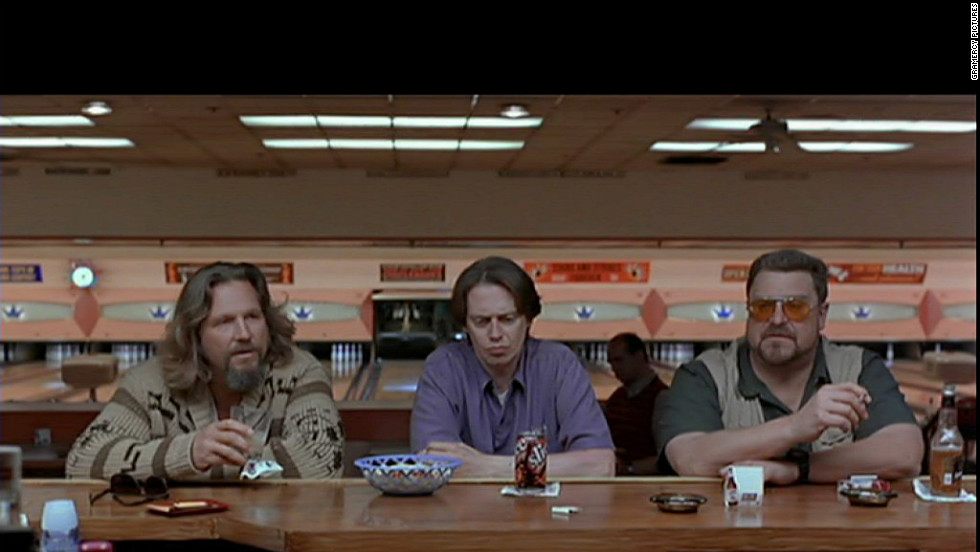
One of the countless moments of hilarious banter between
oddballs in the movie. This one involves nihilists, marmots,
and the Dude possibly getting castrated. Where else
would you possibly find such a thing?
While the Coen brothers have made snappy, memorable dialogue a regular feature in their movies, none is as highly quotable as The Big Lebowski (Raising Arizona is a contender, but it falls short). Thanks to sharp and quirky comedic writing and brilliant comic acting on the parts of over a dozen actors, nearly every line humorously expresses something about the oddball character who delivers it. From "It really tied the room together," to "The bums will always lose," to "Nobody fucks with the Jesus," and endless others, fans of this movie can send themselves into a tantric frenzy when they get into a room and start firing off line after memorable line.

It is arguable that The Big Lebowski is not "great cinema," and that it is not the Coen Brothers' best movie. However, it is certainly their most beloved. Being such a strange fusion of their unusual, and ususually effective, comic sensibilties and their passion for classic noir cinema, this movie is such a singular work that its cult classic status is more than well-deserved.


Shall We Dance? (2004)

Director: Peter Chelsom

Certainly not my cup of tea, but it's easy to see the appeal for many.

Shall We Dance is the story of John Clark (Richard Gere), a family man in New York City who seems a bit discontent with his normal, though very enviable, life. On his normal bus ride home, he spies a beautiful young woman staring forelornly out of a window to a dance school. He eventually and reluctantly enrolls in dance classes there, albeit without telling his wife, Beverly (Susan Sarandon). He even gets a bit of instruction from the sad muse from the window, Paulina (Jennifer Lopez), an exceptional dancer and teacher.

The movie is almost pure fluff. There is very little that is dangerous or challenging. A few of the characters do experience a tribulation or two here and there, but none of them is so great that it can't be overcome with some laughter and a touch of attitude. The main comic relief comes from the characters Bobbie and Link (Lisa Anne Walter and Stanley Tucci), two oddballs with great passion for dancing. Along with the mere presence of these two, there is plenty of light humor sprinkled regularly through the film, in the form of slapstick on the dance floor or airy dialogue.

The movie accomplishes its goals, thanks mostly to its incredibly talented cast. Supporting members like the aforementioned Walter and Tucci, along with Bobby Cannavale, often sell some rather tepid gags through sheer force of acting talent. Also, having Richard Jenkins give a great deadpan performance in a small role is a welcome element. These things were just enough to hold my attention. They help buoy the primary husband/wife/hot dance instructor relationship drama that takes very few risks and I found only slightly interesting.

Shall We Dance is probably not a movie that I'll need to watch again. It was certainly a good enough movie for those in a rom-com kind of mood.

Sunday, January 26, 2020

New(ish) Releases from 2019: Ad Astra and El Camino

No Spoilers for either show. Read away!!

Ad Astra (2019)

Director: James Gray

A decent enough sci-fi flick with enough to keep a person tuned it, but not inventive enough to stand out very much.

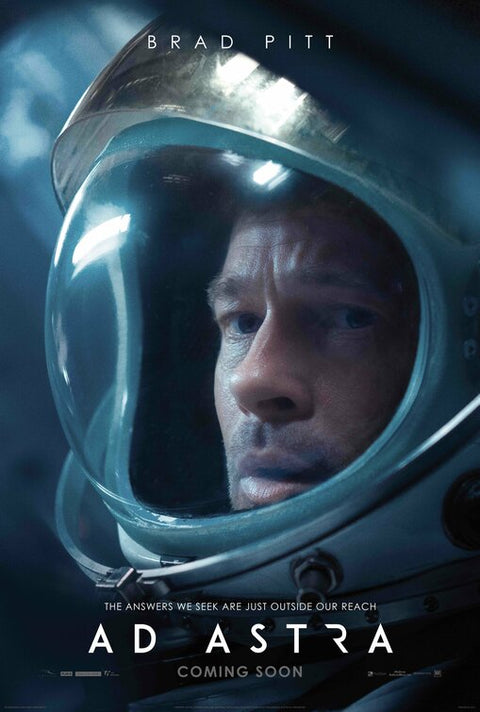
In a not-too distant future, Brad Pitt plays Roy McBride, an astronaut called upon by the government to embark on a mysterious mission to the far reaches of the Solar System. Some sort of strange energy is emanating from a location there, and it threatens to destroy the entire system. As if that weren't enough, the government believes that the person behind the imminent catastrophe is the last astronaut sent to the area, none other than McBride's own father, H. Clifford (Tommy Lee Jones), long hailed as a national hero and icon.

The movie is a solid, space-faring sci-fi flick that does the sci-fi elements better than the emotional ones. Like the very best mission-to-space flicks - I'm thinking 2001, Interstellar, and Europa Report, among others - Ad Astra maintains a cool, meditative tone throughout, especially once the story brings Roy outside of the Earth's atmosphere. The vision of director and co-writer James Gray is an engaging one that seems grounded in a very believable possible future. There is a thrilling pursuit on the Moon, and a rather striking and eerie vision of what Mars might become, which offer some nice food for thought on how humans may be interacting with the nearest celestial bodies long before the century is over. Anyone who enjoys such topics and themes is bound to appreciate these aspects of the movie. And there is the greater mystery of what, exactly, is the threat in deep space to pull one along through Roy's journey farther from home.

The more personal story about Roy and his father? Not nearly as engaging. While Pitt and Jones play their roles perfectly well, the entire relationship never feels like it is offering anything that is novel or surprising. Right from the jump, it's clear that Roy's mission is as much about finding closure with his father, long-presumed dead. I suppose one could read a certain amount of symbolism into the narrative about an absent father's ability to mysteriously have the ability to annihilate one's world, but that's a bit of a stretch. Because Roy is a rather repressed individual (not uncommon for astronauts, who need the ability to subdue and overcome their own nerves), there is a certain detachment which runs through the film. Had there been a few more moments of vulnerability sprinkled in here or there, the film may have had a bit more emotional impact. As it was, though, there was only so much pathos to be found.

If you're like me, and enjoy good space-faring movies for their ability to inspire awe at the cosmos, then Ad Astra can give you that. If you're looking for the more human drama elements, though, this one may leave you wanting.


El Camino (2019)

Director: Vince Gilligan

Compelling, entertaining, and satisfying sequel movie to the brilliant Breaking Bad TV show, which ended its outstanding run in 2013.

The sixty-odd episode run of Breaking Bad represented one of the very best TV shows of all time, created and run by Vince Gilligan. It saw the rise and eventual fall of high school chemistry teacher-turned-drug kingpin, Walter White, who used his genius for chemistry to concoct the most potent formula for crystal meth ever known. White, who had been diagnosed with terminal cancer, took this bizarre career shift in an effort to quickly earn enough money to support his family after his impending death. The problem was that, once White got a taste for the money and nefarious reputation which his recipe brought him, he found that he liked it. So much, in fact, that it sent him spiraling down darker and darker paths in order to maintain and grow his place in the drug-peddling world. By the end of the show's run, White had destroyed or alienated everything which he had once held dear; and although he found some measure of penance and rectification, he still died a tragic and lonely death.

White's partner through nearly his entire journey was Jesse Pinkman, a confused former student of his who had been dabbling lightly in the drug trade during his few years removed from high school. Pinkman, played brilliantly by Aaron Paul, while likable and funny in many ways, was always a lost soul, never knowing exactly who he was or what he wanted from life. As such, he was ripe to be pulled into the dark gravity of Walter White's drive and obsession. As White's decisions grew grimmer and more self-serving as the show progressed, Jesse felt more and more tied to him, despite his pangs of conscience and general reluctance to get so deeply involved in such dastardly deeds. In the show's finale, the last image we see of Jesse is him driving away from a white supremacist compound, where he had been brutally imprisoned and forced to cook meth for them for six straight months.

This is where El Camino picks up the story. In the hours immediately after the fiery end of Walter White, in which he freed Jesse, gunned down and killed all of his tormentors, and then died himself, Jesse has to elude the police as they look to put the pieces together of the entire bloodbath at the compound. A beaten and traumatized Jesse must seek out any friendly faces and places of sanctuary that he can, in an effort to not only escape capture and certain imprisonment, but also to truly decide who he is and what he wants to do with the rest of his life, should he even have one.

The movie is every bit as good as Breaking Bad was, even if it doesn't have the power of some of that show's most memorable moments (think Walter's showdown with Tuco or Gus Fring's death). El Camino certainly has a few great thriller sequences, with some fun twists of their own, but a two-hour movie is never going to be able to have the build-up necessary for the explosive moments that a longer-form TV show can offer. This movie does, however, make the most of its time, balancing Jesse's soul-searching and recovery from a horrific situation with the more cat-and-mouse elements that come from his scrambling away from his pursuers and towards an uncertain future.

Jesse, after cleaning himself up a bit, during one of several
moments of desperation. Viewers of Breaking Bad may
recognize the blurred outlines in the back of Skinny Pete and
Badger, two of several familiar faces who appear in the film.
The show is split roughly in half, with the tale alternating between the roughly 48-hours immediately after Jesse's escape and a series of flashbacks, some going way back into Breaking Bad's first season, when he and Walter White were just getting into the meth-cooking business together. We get to see scenes and moments never revealed during the original show, and they all make maximum use of the many open areas in the story, adding extra shading to certain familiar characters, some friendly and others downright evil. It all makes a great follow-up and addendum to the entire story.

I can't say enough about Aaron Paul as Jesse Pinkman. This film requires nearly every bit of the immense acting chops and range that he showed during Breaking Bad, and he seemed able to get right back into the character's head, despite having been away from it for a good six years. He exhibits, by turns, all of the terror, misplaced swagger, soul, and humor that he did at various points during the original story. Though Breaking Bad was mostly the story of Walter White, Jesse Pinkman was the soul and often the tragedy of the tale. Aaron Paul's ability to play the character with just the right type of vulnerability at just the right times is what elevated the show well above other drama/suspense/thriller fare.

Obviously, I can't recommend this movie highly enough for fans of Breaking Bad. If you haven't seen the show, then the movie won't make much sense to you. In fact, you should stay well away if you haven't watched the original show. It will mostly baffle. But feel free to use this as yet another endorsement from me to go ahead and start watching Breaking Bad. I've watched the entire series twice now, with a likely third time coming at some point in the future. It's brilliant, and El Camino only further enhanced the entire amazing show. Now, we just have to wait for the next season of Better Call Saul for more stories from this incredible tale that Vince Gilligan has created. 

Saturday, August 16, 2014

Idiot Boxing: American Horror Story Season 2 & Dexter Season 1

Yes, I do actually watch some TV in between the movies...

Yes, this show is every bit as disturbing
as this poster would suggest...
American Horror Story: Asylum (2012)

This show is about as dark and twisted as you could possibly find on network TV. And it's phenomenally well done.

I enjoyed the first season, known as "Murder House," well enough, even if I didn't think it was exactly a masterpiece. Though some aspects of the 12-episode tale didn't completely draw me in, I couldn't help but admire the construction and execution of the complex plot, as well as the outstanding performances by the cast.

This intense demon exorcism was one of the tamest scenes
during the
Asylum storyline.
Season 2, "Asylum," resulted in a similar feeling. I must admit, though, that the direction and acting grew even stronger with this season. It's an interesting series in that it brings back many of the same actors from the first season, but has them all playing completely different characters, in a different time, place, and story. While all are marvelous, the standouts are Angela Lange and

Like Season 1, Asylum is not for those who blanch at dark horror. Asylum places these actors in a horribly gothic asylum in Massachusetts in the 1960s, where various twisted administrators abuse and torture the committed patients. There are rapes, brutal murders, and ghastly experiments enough to go around. As if that weren't enough, the supernatural elements include demonic possessions and alien abductions. So there's plenty of the stuff of horror films to satisfy nearly any fan.

All of these elements might have led to a massive mess of a tale. Admittedly, things do get a tad convoluted in places. Still, the narrative is handled well, and it remains mysterious and compelling enough right to the end.

Some are likely to be disappointed or confounded by the resolutions of some characters' stories. I must admit that not all of them were satisfying to me. The show was still well done, though, and I'll likely watch Season 3 - Coven.


Dexter, Season 1 (2006)

This was a re-watch for me. I watched Seasons 1, 2, and 3 back when they were released between '06 and '08, and I liked the show well enough. But I didn't keep up with it after that, and never really felt any great sense of loss. All the same, when a key character from the first season showed up in Europa Report, I felt the urge to go back to the initial run.

It's still a pretty good season, though I was also reminded of why the show never completely won me over. The main draw is, as you would expect, the title character. Dexter is a serial killer who has mastered the art of "blending in" as well as possible. He's a blood spatter analyst for the Miami Police Department, and he uses his background in criminology to track down, stalk, and ritually kill other serial killers. This method allows him to feed his ever-present urge to kill while not arousing suspicions.

This season did very well with introducing the character and using pitch dark humor to get into the mind of a homicidal sociopath, and even make him amusing and a little charming. As the season unfolds, we learn about the making of this very unusual murderer, and how his adopted father - a police officer - recognizes what Dexter is and helps him avoid detection. Sure, it's far-fetched, but the show makes it just plausible enough, and it is a morbidly fascinating tale.

And on the right, Deb, likely on the verge of one of her
countless mental meltdowns. I rate Deb as possibly
the most
annoying character in a TV series I've ever seen.
Unfortunately, Dexter is far and away the strongest character. Aside from Doakes - a tough and highly suspicious cop who works with Dexter - all of the other characters are nuisances who, to me, simply waste screen time. The greatest offender happens to be Dexter's adopted sister, Deb. Deb is one of the worst-conceived and most annoyingly-portrayed characters I've ever seen. She's an insecure, emotional basket-case who is exceedingly sensitive and constantly on the verge of crying or breaking down in some way. And what's her job? A cop!! There is no way such an unstable personality would have passed the psych profiles to become a police officer, and yet there she is. I always found her character horribly forced. She is supposed to be some counterpoint to Dexter's unfeeling sociopath. That's fine, but to make her a cop is ridiculous. On top of that, as if to somehow justify this irrational decision in storytelling, they try to make her "tough" by having her constantly spew profanity. It's all very contrived, and she's a large enough part of the show that her presence would test my patience far too often.

I have no idea how the more recent seasons of Dexter have shaped up (it's in its ninth season, currently), but this first one was entertaining enough. I feel no great need to re-watch the second season any time soon, though the building confrontation between Doakes and Dexter was certainly intriguing. 

Tuesday, December 2, 2014

New Release: Interstellar (2014)

Have no fear - there are no spoilers in this review.

Director: Christopher Nolan

It's certainly not a bad movie, but it's one that leaves a few things to be desired.

Christopher Nolan has always loved multi-tiered stories. Whether he's layering experience with memory as in Memento, layering illusion and showmanship with personal desires as in The Prestige, layering heroism and villainy with their own social constructs as in the Dark Knight trilogy, or any of his other movies, his films always operate on a few levels. Interstellar in no different. Unlike his best films, though, this one tries to add at least one stratum too many.

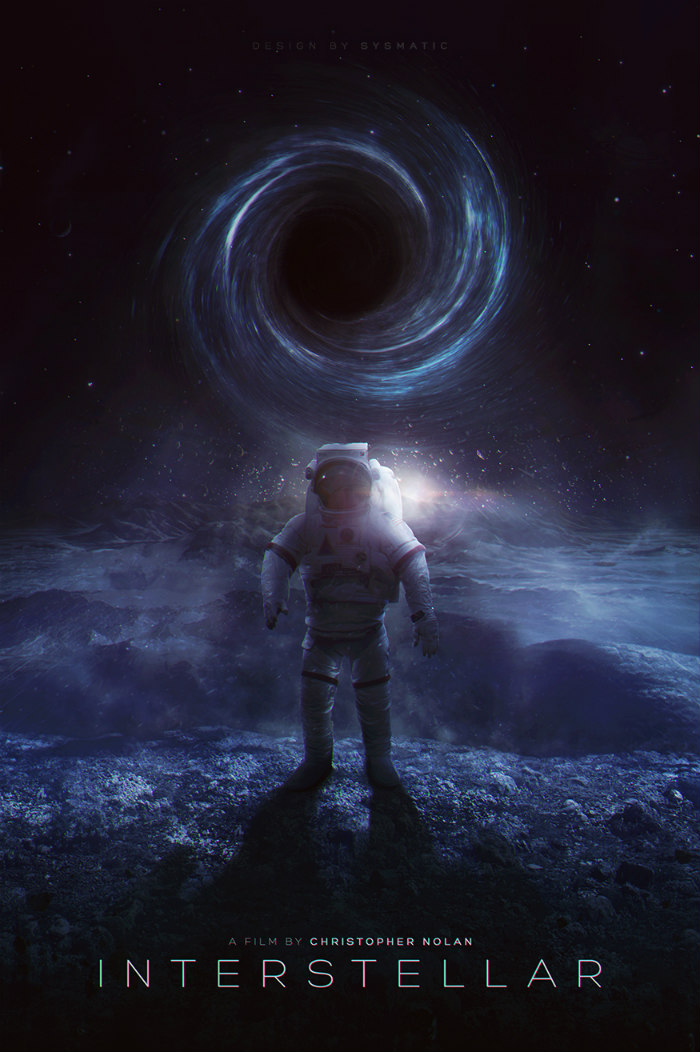
The story is mostly that of Cooper (Matthew McConaughey), a former test pilot and engineer who is living on a future earth that is slowly dying of a massive and growing blight, a la the Dust Bowl of the 1930s Midwest U.S. This one, though, is on a global scale. In a last-ditch effort to escape the seeming fate of humanity slowly choking to death on its home planet, Cooper is enlisted for a mission through a wormhole next to Saturn, beyond which he hopes to find a habitable alternative planet. Once through the hole, though, things do not go exactly as planned, forcing Cooper and his fellow astronauts to make several extremely difficult decisions that weigh their own beliefs and hopes with those of all humanity.

Many of the themes in the movie are worthy of speculation and make for some solid food for thought. The place of exploration in our society, especially when balanced against far more immediate problems, is one that people have always struggled with. In Interstellar, this makes for a legitimate source of conflict, especially as the success of Cooper's mission is far from guaranteed. Then of course, are the tremendous sacrifices that the boldest explorers must make, and not just to life and limb. When Cooper and his crew near a planet where time is distorted by gravity, they must also consider how their aging will be slowed immensely, leaving everything and everyone they know to age far more quickly while they explore. The film does a very nice job of making these theoretical consequences of space exploration more tangible and impacting on the characters.

I'm no astrophysicist, but much of the science behind the film seems solid; at least, as far as the physical rigors and obstacles which need to be overcome are concerned. These days, there have been so many excellent documentary series done on such topics that we laypeople can have a pretty good idea of what things are like for astronauts, and Nolan seems to have done all of his homework. It helps that the visuals are extremely well done, and several scenes and sequences do an excellent job of capturing the vastness and majesty of the cosmos.

The relationship between Murph and her father is actually
endearing for the first part of the film, but grows a bit stale
as things progress. It eventually comprises what I found to
be one of the biggest weaknesses of the tale.
Where the movie goes astray is with the "human" layer of the tale. Filmmakers like Stanley Kubrick and Andrei Tarkovsky made thoughtful, insightful, artistic statements about humanity's probable destiny in space and the collective psyche of our species. Without giving away anything, I can say that I felt Nolan's attempt to weave human emotion into the story was a tad forced, with extremely shaky support. This thin tether is meant to be the link between Cooper deep in space and his daughter, Murph, back on Earth. The connection works at certain points in the movie, but is often either baffling or lacking the desired emotional effect.

Another problem I have with the film is the casting and acting. While Matthew McConaughey has proven himself to be a legitimately excellent actor in recent years, I was annoyed by the constantly hushed drone that he chose to speak in through nearly the whole movie. A tad more baffling was Nolan's choice to cast Anne Hathaway as the fellow astronaut/astrophysicist Brand. She's not terrible, but I found her lacking some of the grit, confidence, and stoicism that I associate with such professionals. I wonder if we're not starting to see Nolan fall in love with some of his own casting choices; what else would make him recast "Catwoman" in such a way? There are a few other casting choices that made me scratch my head, but I don't want to give away too much.

So the movie is a decent one, but I would have to put it towards the bottom of the Christopher Nolan catalog, especially when weighed against its huge ambition and massive budget. Nolan has never, in my view, made a "bad" movie. He has, however, made a few that smack of a bit of pretension and fall a bit short of his lofty goals. Interstellar is one of these. I would recommend that nearly anyone watch it once, but I would caution against expecting a masterpiece. Ultimately, the film just made me want to re-watch Europa Report at the earliest possible chance.