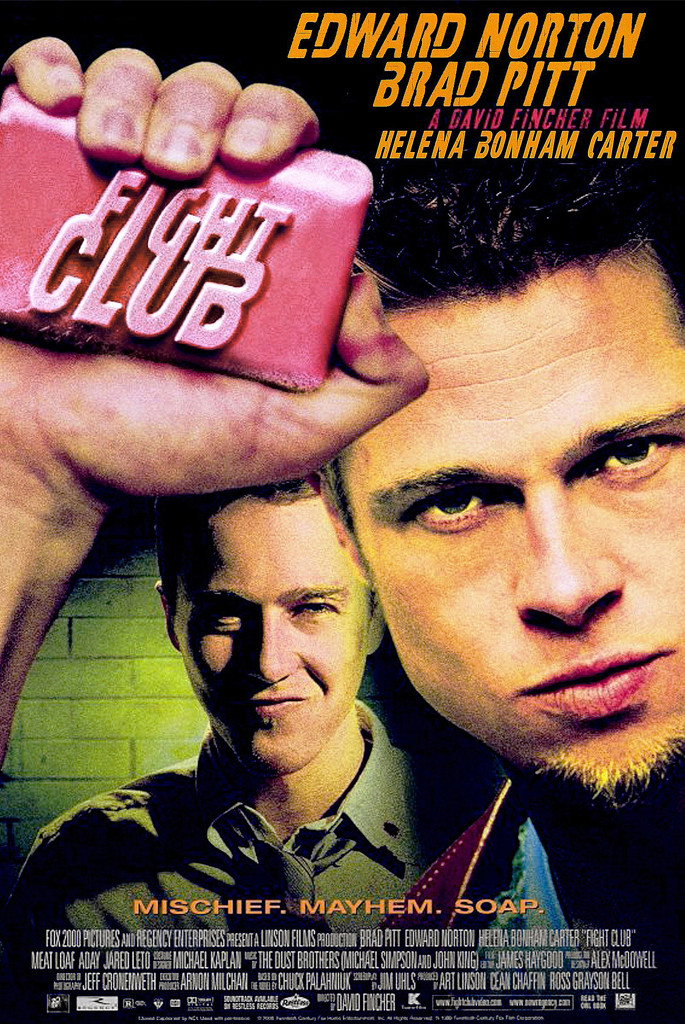
Still a great, wild ride of a movie that showcases so many of director David Fincher's many strengths as a filmmaker.
The movie, based on the novel of the same name by Chuck Palahniuk, follows an unnamed protagonist (Ed Norton) whose life has become such a drone that he is a virtual zombie. To paraphrase him, he is never fully awake but can never fully sleep. This continues until a chance meeting with Tyler Durden (Brad Pitt), a whip-smart renegade with the ultimate punk rock sensibility. Durden squats in an abandoned house, refuses to live by any of society's rules, and eventually convinces our protagonist to begin an underground fight club for men like themselves - disenfranchised and feeling like they've been sold a bill of goods by capitalist, consumer culture. Eventually, Durden molds this ostensible underground MMA group into something much more potent and frightening, with our anonymous main character being pulled along in ways that he can't even begin to imagine.
I can't recall just how many times I've seen this movie, but it's easily in the double digits. I saw it a couple of time in theaters upon its release back in 1999, and would routinely go back to it for many years after. I'd gone quite a few years since a full rewatch, until reading Brian Raftery's recent book Best. Movie. Year. Ever., which catalogs the insane number of great films that came out in 1999. My enthusiasm fully stoked, I snapped up a cheap blu-ray copy of Fight Club and took it all in again. My thoughts about the film have evolved over two decades, but I still find it to be a satisfying, subversive, funny, and extremely well-crafted middle finger to large segments of the film industry.
In those first years after the movie came out, like a lot of guys in the early and mid-twenties, I saw the Tyler Durden character as an icon of cool. He was a take-no-bullshit badass who just got things done, and seemed to be on the side of righteousness. To slightly paraphrase Durden himself, he looks like you want to look, f***s like you want to f***. He is smart, capable, and most importantly, free in all the ways that you are not. It's a great sales pitch to young men who are in desperate need of leadership, wherever that leadership takes them. Durden's appeal to "enlightened" macho violence is one that is still fully relevant today, with the immense popularity of "smart" MMA bros like Joe Rogan and similar "intelligent" Alpha males who have millions of devoted fans and followers. Chuck Pahlaniuk was onto something when he wrote the novel, and David Fincher was clearly aware of it.
What has changed, though, is the realization that being punk rock isn't really the hard part. And looking and sounding cool while doing isn't even the hard part. As calculating and slick as Tyler Durden is, his plan doesn't go beyond "blow stuff up." It's really a punk rock sensibility, which has a very strong appeal in the hands of such a charismatic character. When I watch Fight Club now, I can't help but wonder just how likely it is that Durden's master plan actually works, after the credits roll. Or whether he ends up being happy with Marla. Yes, Project Mayhem's bombs go off, destroying the headquarters of major credit card companies, essentially annihilating debt and giving everyone a fresh start. But will that actually work? And yes, Durden's fractured mind reunifies, and he seems to reconcile with Marla. But they're both clearly still very damaged people. Such grounded thoughts, though, are not what Fincher had in mind. He was looking to tell a raucous tale of a modern anarchist, and he gave us just that.
If the themes are what elevate the story well above just being a sweaty trek through underground fight clubs, then the film technique is what makes the whole show so wildly entertaining. You have three actors in Norton, Pitt, and Carter, who are as good as they've ever been. And the sharp writing is still absolutely hilarious. The look of the movie, along with the editing and cool-as-hell Dust Brother soundtrack bring it all together to give us a movie that's simply a blast to watch.
It's both fascinating and unsurprising that this movie fell on its face when it was released back in 1999. Up until then, there really hadn't been anything quite like it - an in-your-face, crotch-grabbing "screw you" to capitalism lightly disguised by a "pretty boy" actor in Pitt and "up and coming" fresh face in Norton. There were obviously people like me, who saw it in the theaters and loved the dark humor and the deeper themes and ideas, but most people were either baffled, disgusted, or just stayed well away from it. However, you might view Fight Club now - a worthy, dark satire; flawed attempt at profundity; or something else - I think most would agree that there's more than a little solid film technique happening, and that the movie had a serious impact on movies for years to come.
 |
| If you need to illustrate the idea of self-destructive anarchy having sex appeal, then Brad Pitt is a pretty good choice as your spokesmodel. |
If the themes are what elevate the story well above just being a sweaty trek through underground fight clubs, then the film technique is what makes the whole show so wildly entertaining. You have three actors in Norton, Pitt, and Carter, who are as good as they've ever been. And the sharp writing is still absolutely hilarious. The look of the movie, along with the editing and cool-as-hell Dust Brother soundtrack bring it all together to give us a movie that's simply a blast to watch.
It's both fascinating and unsurprising that this movie fell on its face when it was released back in 1999. Up until then, there really hadn't been anything quite like it - an in-your-face, crotch-grabbing "screw you" to capitalism lightly disguised by a "pretty boy" actor in Pitt and "up and coming" fresh face in Norton. There were obviously people like me, who saw it in the theaters and loved the dark humor and the deeper themes and ideas, but most people were either baffled, disgusted, or just stayed well away from it. However, you might view Fight Club now - a worthy, dark satire; flawed attempt at profundity; or something else - I think most would agree that there's more than a little solid film technique happening, and that the movie had a serious impact on movies for years to come.