Tuesday, November 1, 2011

Film #65: Bonnie and Clyde (1967)


Director: Arthur Penn

Initial Release Country: United States

Times Previously Seen: once (about 10 years ago)

Teaser Summary (No spoilers)

Restless Texas redneck lovers go on a bank-robbing spree during the Great Depression. “Laws”, emotional highs and lows dog their heels.

Extended Summary (More complete plot synopsis, including spoilers. Fair warning.)

Rural Texas, 1931. The 21-year old Bonnie Parker (Faye Dunaway) is agitated by her dead-end life as a waitress living with her mother in a small town. She spies a handsome, dapper young man outside of her house, casing her mother's car, seemingly to rob it. After running out to stop him, the two strike up a conversation during which the man, Clyde Barrow (Warren Beatty), readily admits that he has recently been released from prison for an attempted robbery. Bonnie is skeptical to the point of egging Clyde into robbing a nearby grocery store. When Clyde does just that, Bonnie, rather than flee the armed robber, readily hops into a stolen car with him and drives out of town.

When the pair stop just outside of town, Bonnie is so overcome with excitement that she throws herself at Clyde. Surprisingly, Clyde roughly rebuffs her, claiming that he “ain't no loverboy”. Despite this odd reaction to the beautiful and willing Bonnie's advances, the two see that they have a unique connection with each other. Both are seeking to make names for themselves by breaking away from societies' rules. Clyde plans to rob his way to fortune and fame, and Bonnie is all too happy to join him.
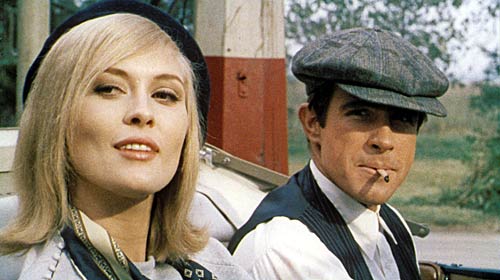

The pair of fugitives size up the next member of their little gang.

The two make a failed attempt to rob a bank that has recently gone out of business, but they soon start to find more success. After picking up a strange and disenfranchised young gas station attendant, C.W. Moss, as their getaway driver, they manage a successful bank robbery. However, Clyde shoots and kills a man during their semi-bungled escape.

Once in a safe hotel room, Clyde offers Bonnie a chance for escape. Realizing that he will now be wanted for murder, he urges Bonnie to return home and avoid any potential capital punishment. Bonnie refuses to leave Clyde, thus reaffirming their bond to one another. The two attempt to consummate their love, but Clyde's impotence prevents it yet again.

The trio of fugitives soon meets up with Clyde's older brother, Buck (Gene Hackman), a fellow ex-con, and Buck's wife, the reserved and rather dim-witted Blanche. The fun-loving and simpler Buck readily joins his younger brother's crime spree, Blanche in tow. Clyde welcomes the company of his brother, but Bonnie soon becomes highly agitated at Buck and Blanche's utter lack of sophistication. While Bonnie has some spark of creativity, even writing poetry, Buck, Blanche and C.W. seem to find the game of checkers the height of mental gymnastics. The tensions begin early and grow steadily.

The gang of 5 continue robbing banks throughout Texas, Kansas, Oklahoma, and other nearby states, hopping borders in order to avoid capture. They avoid some early attempts at capture as they perfect their thievery. They efficiently loot multiple banks, but never take any money from the more humble farmers and locals. Their legend and fame grows rapidly, as newspapers regularly report the deeds, as well as falsely attributing several robberies to the gang.

The gang grows more confident and skilled in their robberies.

Eventually, the law begins to close in. After C.W. Allows himself to be seen in a little town, the police raid the gang's hotel room. After a furious and bloody shootout, the gang escapes, but not without serious injuries. Buck sustains a horrible head wound, Blanche suffers eye damage, and Clyde is shot in the arm. After camping outside to recover slightly, the gang is once again tracked down and attacked. Bonnie, Clyde, and C.W. Manage to get away, though Bonnie is also wounded in the arm. Buck and Blanche are not so lucky. Buck is shot again and soon dies. Blanche, now completely blind, is taken away by the police.

The injured Bonnie and Clyde are driven to safety by C.W., receiving a little support along the way from impoverished Dust Bowlers who are awestruck by the celebrity thieves. C.W. takes the pair to his father's tiny farm, and the man seems to welcome them. This ostensible kindness is merely a front, though. As Bonnie and Clyde recuperate, C.W.'s father privately berates his son for a fool and eventually informs the Texas Rangers about the two fugitives.

In a simple set-up while Bonnie and Clyde return from buying groceries in town, C.W.'s father pretends at having car trouble. The pair pull over to assist, but do not sense the trap. Before either Bonnie or Clyde can react, let alone surrender, a score of Rangers and lawmen open fire upon them from behind the nearby bushes, riddling the couple and their car with dozens of bullets. The mutilated corpses of Bonnie Parker and Clyde Barrow fall limp onto the ground, ending their renowned spree.

Take 1: My Gut Reaction (Done after this most recent viewing, before any research on the movie.)

Really good movie that holds up exceptionally well.

Bonnie and Clyde may not seem so special to modern, first-time viewer, but with a little awareness of the context, it's not hard to see why it is considered so very influential. Based on my film-watching experience, it created a unique blend of tried-and-true standard film-making conventions with a dash of the novel, leading to entire shifts in the way that crime stories have been told in film.

The story itself is intriguing enough, being based in reality. I personally don't know much about the real Bonnie and Clyde, but I'm eager to do the research for the Part 2. I have to assume that the screenwriters took certain liberties with the dialogue, and even some of the action. What little I do know, however, tells me that the singular personalities and passion of the titular pair of thieves is not a mere fantasy. The bizarre quirks of the two – Bonnie's predilections towards intellectualism and Clyde's sexual impotence, to name the most obvious – give the story a very compelling eccentricity that is lacking in most crime films.

Of course, such unique characters can only be given life by solid acting, and Faye Dunaway and Warren Beatty do phenomenally well. While Beatty's Texas accent is a bit inconsistent at times (maybe I can say that only because it's my home state), this is a minor gripe. In all other things, the two actors nail the charm, passion, foolishness, pretentiousness, and rebelliousness that make for intriguing and rounded characters. Being able to pull off such a range of traits can't be easy, but Dunaway and Beatty do just that.

The supporting cast is also quite solid. A young Gene Hackman stands out wonderfully as the loud-mouthed yokel, Buck, and his wife is played to pitch-perfect annoyance by Estelle Parsons. It doesn't take long to see why the more reflective Bonnie takes an instant dislike to the shrieking, mulish Blanche. Even the minor roles by Michael J. Pollard and Gene Wilder (!) make great accents to the film.

The performances and story are certainly strong, but no stronger than quite a few other good crime movies. What sets this one above the rest, I feel, is the direction. Bonnie and Clyde is one of those rare films that wastes nary a second. Every scene, every word, every glance between characters means something and adds to the tale. From the opening shots of a bored Bonnie Parker, pining away in her room, to the final shots of hers and Clyde's lifeless bodies on the ground, this movie is about as tight as they come. There are certainly quiet moments, as well, but even they invite the viewer to pay close attention, as body language and eye movements are telling stories that words aren't. One needs only see a few of Bonnie's eye rolls to see my point.

The quarters get tighter, and Bonnie's patience with her goober gang-mates runs thinner.

Even beyond all of this is the overall story arc and the tone. Bonnie and Clyde might have been the first movie to tell the tale of two criminals in a way that endears them to the audience, and then shoves their bloodied corpses right in your face. The first half of the movie is far heavier on comedy, a lot of which holds up really well, 45 years later. It feels like you're on a fun little escapade with a few young renegades. However, there are allusions of what is to come. After one bank robbery, a farmer whose money Clyde purposefully did not steal, says to a reporter, “That Clyde Barrow done alright by me. I'll be bringin' the Missus to their funeral.” This and other signs remind the viewer of just how this will all end.

Once the “laws”, as Clyde and Buck call them, begin to close in, the humor begins to fade and deadly seriousness takes over. There's a sequence in the film when, at Bonnie's behest, they go out to see her mother and family in a remote rock quarry. The scenes are shot in a washed-out, sepia tone that lends a hazy heaviness to this part of the story. This is totally appropriate, as Bonnie mother senses her daughter's imminent demise and detaches herself with a final, matter-of-fact goodbye.

When the end finally comes, director Arthur Penn puts his ultimate stamp on violent film-making. With a death scene that would be emulated within a scant few years in films such as The Godfather and others, Bonnie and Clyde are mowed down in quick, brutal fashion. In such scenes in earlier films, I can't recall them ever being so shockingly realistic. The likable duo are machine-gunned to death with a scant few seconds. There is no slow-motion or music score to add any semblance of romance or glory to it. There are no death throes or final words from either of the two lovers. One moment they are smiling and alive; the next they are simply no more.

This single frame gives a good sense of just how brutal the finale is. It's lightning-quick and ultimate.

It is the elements in this final scene that set a standard for film violence that many directors misunderstand and misuse today. Someone like Michael Bay seems to think that the violence itself is the artistry and the draw of such things. However, he glamorizes and ultimately anesthetizes people to it through cinematic slight-of-hand. David Cronenberg, on the other hand, follows the Arthur Penn model, in his way. If you watch the death scenes in his recent films A History of Violence or Eastern Promises, you see that these scenes, while few in number, are brutally graphic and shockingly quick. I heard him explain in an interview that this is because he wants the audience to know that violence is not to be polished up for easier consumption, even in a tale of fiction. I think Arthur Penn had this figured out long before his imitators.

Bonnie and Clyde is a revolutionary film, though probably not so obviously a one as other films. It wasn't until I watched it, slept on it, and thought about it for a day that I realize this. I would recommend it virtually anyone who is not completely turned off by rather graphic violence, as the latter half of the film features plenty of it. This aside, it has something for nearly any attentive film-watcher.

Take 2; Or, Why Film Geeks Love This Movie (Done after further research on the film.)

There's almost no end of material that one can lose oneself into when it comes to the Bonnie and Clyde film. Let's start with the real history:

Volumes have been written, so in the interest of time, I went to that oh-so-reliable reference source, wikipedia (hey, I'm running a blog for fun here, not writing a dissertation!). It becomes quite clear that Arthur Penn's movie, as is usually the case with movies, plays extremely fast and loose with the facts. Sure, some of the locales and people's names are correct, and even a few of the general actions are true to fact. Still, a large portion of the true story was molded, shaved, and fashioned into something very different. And this, of course, was the only way that it would work.

The reality of Bonnie Parker and Clyde Barrow is, of course, far less sexy and far more tragic than a Hollywood movie can convey. While true that the two were renegades and had no small affection for each other, the film conveniently leaves out just how many civilians they murdered. Or about Barrow's very troubled younger days, being raped in prison at age 16, essentially channeling his rage to become the personification of the philosophy “Get rich or die trying.” If you read a brief description of Bonnie and Clyde's exploits throughout the Dust Bowl, you become less sympathetic than you probably would be for Beatty's and Dunaway's more affable duo.

The real deal Bonnie and Clyde, goofing around with a shotgun. Unlike the film, in which the duo are unarmed when killed, the originals were loaded for bear and had already taken the lives of multiple civilians and lawmen, alike.

Of course, Arthur Penn's film makes no claims at being a documentary, and so we can view it in a very different way.

Apparently, the going was very rough for the production of the film. A few very talented people were interested, but Warren Beatty landed the production rights. After the film was made, the studio and test audiences apparently hated it, so much so that the studio was planning to only release it in Texas drive-ins. The story goes that Beatty literally begged the studio, on hands and knees, to give it a real chance. They did, to initially lukewarm and even poor reviews. When it was released, the original TIME reviewer called it “sheer, tasteless aimlessness”.

After several months hovering in obscurity, people eventually came around. Once again, Roger Ebert, having only been at the professional film critic gig for less than 6 months, was ahead of the curve. In this more modern 1998 review, he outlines the story of the film with far more detail. He also points out some of the more interesting tones and themes in it, some of which I mentioned in my own “Take 1” above.

In short, the novelty of the movie has resonated right through the succeeding decades, into out very own. For those of us who have grown up with Thelma & Louis or Natural Born Killers as part of the mainstream movie landscape, Bonnie and Clyde may seem rather tame. One only has to realize, however, that this movie was the granddaddy of them. As with Citizen Kane, in inspiring so many imitators in terms of techniques and styles, it's almost hard to see Bonnie and Clyde for just how embedded its innovations are in so many movies that have followed.

I suppose what brought some of it home to me was reading about how many of the early 1967 audiences were shocked, bordering on disgusted. Bonnie and Clyde was seen by many as more violent and sexual than any movie had a right to be.

And you know what? The kids loved it.

Even now, in 2011, some of the scenes have a somewhat uncomfortable promiscuity to them, but maybe that's just that 1960's, grainy look that the film has. Whatever the characters are doing, it always seems to be more illicit when it was filmed in the 1960s and 1970s. Whatever the case, younger viewers were right on board with the maverick tones of sex and violence flying right in the face of the moral majority.

All of this just scratches the surface of the myth-versus-reality angle, the story of the film angle, and any of a number of others. All I really need to do is reiterate that, if you haven't seen this movie, you really should give it a shot. If you do, and you really watch what's being said and done, it's easy to see it for the a truly revolutionary work.

That's a wrap! 65 shows down. 40 to go.

Coming Soon: Once Upon a Time in the West (1968)


As much as I love Sergio Leone and his movies, I was surprised that they put a second Western of his on the list, already giving The Good, The Bad, and The Ugly a slot. Whatever the reason, I certainly don't mind setting aside about three hours to watch more long shots, extended close-ups, and bizzaro sound effects, as scuzzy buckaroos try to out-shoot and out-stare each other.

Please be sure to pick up all empties on the way out.

Monday, October 24, 2011

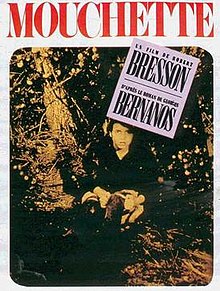
Film #64: Mouchette (1967)


Director: Robert Bresson

Initial Release Country: France

Times Previously Seen: none

Teaser Summary (No spoilers)

Sad young teen girl, in sad family situation, in a sad town, gets even sadder due to uncontrollable forces.

Extended Summary (More complete plot synopsis, including spoilers. Fair warning):

Mouchette (Nadine Nortier) is a 14-year old girl in a small town in France in the 1960s. She has virtually nothing going for her. She lives in poverty with a slowly dying invalid mother, a drunken thief of a father, and a helpless infant brother. Whether at school, at work, or removed from either, the only person who seems to value Mouchette at all is her mother, who is confined to her bed and is barely conscious most times. Otherwise, Mouchette is humiliated by teachers and classmates, abused and extorted by her father, and generally given little more than a passing glance by anyone else. Any brief moments of pleasure that she can steal for herself seems to be promptly quashed by some larger, oppressive force in her life.

At a local fair, Mouchette follows a young man she takes a fancy to. Soon after, she is slapped and derided by her domineering, scumbag father.

While sulking through all of this drudgery, Mouchette's life suddenly becomes more frightening and exciting. While hiding in the woods nearby her school to escape a heavy rain one evening, she is near a scuffle between the school's gamekeeper and a local poacher, Arsene (Jean-Claude Guilbert). The two men have romantic designs on the same woman in town, and the gamekeeper confronts Arsene. They tussle a bit and seem to settle their differences by sharing a few shots of liquor.

Some time shortly after, a drunken Arsene wanders through the woods and comes across Mouchette, still huddled under a tree. Arsene, thinking Mouchette may have seen something, brings her out of the woods and to a nearby shelter. Mouchette is aware that Arsene had fought with the gamekeeper, but neither she nor Arsene is sure of the exact outcome, which may have been a murder; Mouchette because she was not there and Arsene because he is too drunk to recall. To be safe, Arsene gives Mouchette an alibi that she can use for Arsene, in the event that the poacher has killed the gamekeeper. Mouchette seems to go along with it, out of either fear or some strange attraction to the nefarious rogue.

Arsene brings Mouchette to a safe-house in the town, where he plans to burn tons of firewood in order to corroborate his concocted alibi of being there all night. As he continues to grill Mouchette on their story, he goes into an epileptic fit. Mouchette comforts him briefly. When Arsene recovers, however, he becomes suspicious and will not let Mouchette leave. After a brief chase around the room, he captures her and forces himself upon her. She resists at first, but then relents to his sexual advance.

Mouchette is bullied by yet another force - the poacher Arsene.

Early the next morning, Mouchette returns home to find her mother in dire condition. After a brief exchange with her, her mother dies quietly, leaving Mouchette with only her father and infant brother.

The next day, as her father sits in mourning over his wife, Mouchette leaves the house on an errand for milk. On her way, she stops at a bakery, where the proprietress is kind at first, but turns insulting when a shaken Mouchette begins to act strangely. Mouchette then goes to the gamekeeper's house, where she unexpectedly finds the man alive and well. She is pulled inside and grilled for a bit by the man and a housemaid, the latter being more sympathetic. The two get the story out of Mouchette of what, exactly, happened with Arsene, with Mouchette embellishing slightly by calling Arsene her “lover”. Mouchette then leaves on her way back home. Along the way, she makes one last stop at an elderly townswoman's house. The woman rambles a bit, but tries to speak to Mouchette about her own life. She even gives the sullen young girl a dress with which to cover her deceased mother at the funeral. Mouchette merely hurls an insult at the old woman and runs out.

Instead of returning home, the thoroughly dejected Mouchette goes to the side of stream and looks out over the water. After some time pondering, she attempts to roll herself down the hill and into the water, only to be prevented by a collection of rushes on the bank. Once more, the girl goes back up the hill. Rolling down with more force of will, she send her body through the rushes and into the water, drowning herself.

Take 1: My Gut Reaction (Done after this first viewing, before any research):

Boy, these realist films don't play around.

Before watching Mouchette, I did the same thing almost anyone would do – I read the little summary on the DVD sleeve. Within that tight little sub-100 word reading, all of the following words and terms can be found: “...haunting...bleak, hopeless life...alcoholic father and terminally ill mother...grim surroundings...harsh...tragic tale...”

So yeah. I knew what I was in for.

With this foreknowledge, I was spared any nasty surprises, and I probably enjoyed the movie a little more than I would have. Still, it truly is a downer of a movie after which I can't help but ask “What's the point?”

Mouchette's visuals right up there with the best of the naturalist black and white films of Ingmar Bergman and others. While the director, Robert Bresson, used a few more cameras than Bergman, thus creating slightly more kinetic motion, he also used dialogue much more sparingly. Instead, he used wonderful visual storytelling a la the older silent filmmakers and contemporaries like Sergio Leone (though Leone told tales of a completely different ilk).


One of Mouchette's few pleasure. For several minutes, you can see every ounce of joy and attraction on her face as she rides the bumper cars around.

It's also not hard to see how different this film is compared to what was mainstream in the day. Yes, realism had already been around for a few decades, and had even achieved international recognition through films like the Apu Trilogy, Umberto D., Tokyo Story, and plenty of others. Of all of them, though, only the Apu Trilogy comes close to this sad tale of a lonely little girl who has nothing truly going for her, in terms of the weeping factor. And Mouchette goes even further down the road of depression, as the title character is left in the end with absolutely no hope, unlike the young Apu. Hence Mouchette's ultimate decision to end her own life.


Along the way, Mouchette's tale is told with heart-rending realism and subtlety. Often through mere facial expressions and body language, we can see every ounce of humiliation, anger, and even, short-live though it may be, joy that the girl goes through. One can realize that, while poverty is doubtlessly crushing for anyone, it might be even more so for a young person just reaching the age at which she is most emotional, quixotic, and malleable. The only moment of contact she has is a virtual rape. While it is understandable to see this scene with anger at the “she was asking for it” implication as Mouchette rapidly goes from resisting to embracing Arsene, I think it is incorrect. I took it to mean that Mouchette sees this horrific violation of herself as the only connection she can have with anyone. So much so that she even convinces herself that she is now Arsene's lover. Such is the result of utter poverty: physical, emotional, and spiritual.


The end is the icing on the cake, so to speak. I can't pretend to understand suicidal tendencies, but it's not hard to see how the title character's environment would lead to such a mental state. I suspect, though, that most viewers would, like I did, merely want to shake the girl and tell her to snap out of it. When she finally does herself in, I wasn't even sure what to feel. I would have to describe my mental state as the emotional equivalent of a shoulder shrug: “Oh, well. Saw that coming.”


Mouchette's first, failed, attempt at suicide. She gets it right on the next go-round.

As depressing as it all is, it wasn't as much of a chore to watch as I had feared. Mouchette's tale is told with the backdrop of a sexier story involving a jealousy between the gamekeeper and the rakish Arsene. With these more dynamic characters' confrontations adding a spice of energy to things, the movie avoids being an hour-and-twenty-minute drag.

If it isn't obvious from this review, I do not plan to watch this film again. As strong as the technical merits are, and as bold as it is for telling a harrowingly realistic tale, I can't see getting anything more out of repeated viewings. I would only recommend it to those who enjoy such melancholy fare, or are hard-core fans of very sound filmmaking.

Take 2: Why Film Geeks Love this Movie (Done after some further research.)

There's actually not much to be found on this movie, at least not in my basic searches. However, watching 2 of the documentaries offered on the Criterion Collection DVD that I had offered a little more.

The most interesting tidbit is why director Robert Bresson chose to tell the sad tale of the adolescent Mouchette, something he had done several times in previous films. Apparently, Bresson was fascinated with the malleability and unpredictability of adolescence. I can see his point – in this film, Mouchette succumbs to the abuse and neglect she faces. She attempts to get past it, but ultimately cannot. If this had been a Hollywood film, the title character would almost certainly have triumphed over the negative elements in some way. It may be far more cliche, but it doesn't make it any less probable. One never knows how a young person with react to adversity. Mouchette looked at the darkest side of it.

“[Mouchette] can't be summarized. If it could, it'd be awful.” - Robert Bresson.

After writing my own summary for this movie, I was glad to hear Bresson say this. The story of Mouchette (which is based on a French novel) is exceedingly simple. And yet, no summary can convey the tragedy and the reality of the tale. The truth is, you never quite know how Mouchette will react to the different forces acting on her, and therein lies the little bit of intrigue that can pull a viewer through the movie. It worked for me, even if the film isn't terribly exciting.

On a final note, I have to say that it was nice to watch a few “behind-the-scenes” documentaries about Mouchette. If nothing else, seeing Nadine Nortier smiling and laughing helped to wash the taste of the melancholic fatalism out of my mouth.

That's a wrap. 64 shows down. 41 to go.

Coming Soon: Bonnie and Clyde (1967):


Whew! After the Thorazine pill that was Mouchette, a rootin', tootin' Hollywood shoot-'em-up is just what I need. I haven't watched this one in many a year, so I'm looking forward to it.

Please be sure to pick up all empties on the way out.

Saturday, September 17, 2011

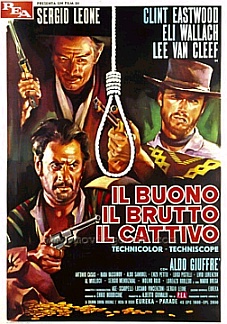
Film #63: Il buono, il brutto, il cattivo (1966)


Title for us English-speaking types: The Good, the Bad, and the Ugly

Director: Sergio Leone

Initial Release Country: Italy

Times Previously Seen: approximately 7 or 8

Teaser Summary (No spoilers)

Three tough hombres seek out a hidden fortune in the Wild West. During the search, they try to avoid becoming casualties of the Civil War and each other.

Extended Summary (A more complete plot synopsis, spoilers included. Fair warning)

The American West. Early 1860s and the States are far from United. The Civil War is in full swing, though in the deserts and plains of the West, it is only a peripheral presence. In a remote town, three gunmen storm into a barber shop, only to be rapidly gunned down by a rough-looking character named Tuco. Tuco jumps on a nearby horse and flees the town.

Elsewhere, a man in black drifts into a small hacienda. The man has been paid by another to find the current alias about another missing man, one called Jackson. The owner of the hacienda fearfully tells the man in black that Jackson now goes by the name Bill Carson, and also mentions a stolen cash box filled with $200,000 that Carson has in his possession. The frightened man assumes that the man in black has been paid to kill him, and he offers him double his fee to desist. The man in black responds to the offer by killing the man and his son and taking the money anyway. He returns to the man who hired him. He learns that Bill Carson was part of a small group of Confederate renegades who stole the gold from a Union convoy. Upon learning this, the man in black, who goes by the name “Angel Eyes” kills his original patron in cold blood.

Angel Eyes, "The Bad", begins his blood-soaked path towards the treasure.

Back on the plains, Tuco is riding along on his stolen horse, but the horse is shot out from underneath him. He is surrounded by three bounty hunters who seem intent on taking him in the for the $2,000 reward being offered for the capture of this inveterate criminal. Just as the three hunters close in on Tuco, a quiet stranger emerges and tells the three bounty hunters to back off and allow him to take Tuco. The three men try to shoot the brazen newcomer, but the man kills all three of them with lightning quickness. Tuco, believing the man to be his savior, tries to thank him and be on his way, but the stranger merely straps him onto the back of his horse, brings him into the nearest town, and collects the reward for himself.

Shortly after he spews and endless litany of insults at the lone bounty hunter, whom he calls “Blondie” for his light-colored hair, Tuco is placed into a noose, with only a horse between him, the ground, and oblivion. When sentence is passed and Tuco is about to he hanged, Blondie, who is hidden in a nearby barn hayloft, shoots the rope apart, freeing Tuco. He also shoots the hats off of several citizens, to ward off any chance of pursuit. It turns out that Blondie has struck a deal with Tuco – Tuco gets turned in, Blondie takes the reward and then saves Tuco. Tuco's bounty goes up, and they repeat the process, splitting all the reward money. Tuco complains about wanting more than a 50-50 share, but Blondie suggests that his “aim might be affected” if his share drops. Tuco drops his complaint, but assures Blondie that double crossing him would be a grave mistake.

In a new town, Tuco sits atop another horse, his neck in another noose. On the edge of the town, Blondie, already with the reward money for Tuco, waits to free him with another rifle blast. Casually looking over the scene is Angel Eyes, who happens to be in town to follow the lead of Bill Carson. He learns of a prostitute who Carson frequents in another town. Angel Eyes makes note of Blondie and Tuco, but leaves town in pursuit of the prostitute. Just as before, when Tuco is about to be hanged, Blondie fires his shot, but slightly misses. Tuco dangles from the neck for a few seconds from the half-cut rope. Blondie fires another shot that cuts the rope completely and frees Tuco again. The two hop onto Blondie's horse and head out of town.

Blondie and Tuco, the "Good" and "Ugly", respectively, discuss their business deal.

Once they are many miles from the town, Tuco rails at Blondie for nearly missing the rope. Blondie quietly lowers Tuco onto the ground and explains that he thinks they have milked their little scam for all its worth. Leaving Tuco stranded and tied in the middle of nowhere, Blondie rides off with all of their ill-gotten gains.

On a subsequent evening in yet another town, Angel Eyes tracks down the prostitute who knows Bill Carson. After a mild beating at Angel Eyes' hands, the girl tells him which regiment Bill Carson is in. Angel Eyes is getting closer to the money.

On a following day, Tuco staggers into a tiny village. He has somehow survived the miles-long exodus that Blondie forced upon him, and he now has two things on his mind – getting water and getting revenge. He makes a good start of it by pilfering some water from a well and then robbing the shop owner of his best revolver and all of his cash. He even tracks down Blondie to a hotel and almost exacts his revenge then and there. At gunpoint, he forces Blondie onto a stool and gets a rope around his neck. Just as TucoTuco through the floor and allowing Blondie to escape.

After several days of tracking him across the plains, Tuco finds that Blondie is in the middle of the same old scam. He lays behind the cover of a low hill, his rifle cross-hairs on another hanging rope around the neck of another criminal. However, just before he is meant to fire his life-saving shot, Tuco sneaks up behind him and takes him prisoner. Blondie's new “partner” is left to die and Blondie is now the captive of the last man in the world he would want to be captive of.

Echoing their last parting, Tuco leads Blondie to desert. As Tuco rides atop a horse, he forces Blondie to try and keep up with him along a 100-mile trek across the scorching hot sands. With the comforting shade of a parasol and ample water, Tuco delights in the slow death of Blondie, even teasing and taunting him along the way. Blondie remains stoic, but eventually his endurance is baked away by the relentlessly brutal desert sun. After walking for many hours without water or shade, he finally collapses. Tuco, having appeased his desire for retribution, slowly moves in for the kill.

Tuco now has his man, Blondie, right where he wants him.

Just as Tuco cocks his gun, though, a riderless wagon comes barreling out of the desert. The distracted Tuco leaves the nearly-dead Blondie and heads off the wagon. In it, he finds several dead Confederate soldiers. One soldier, however, still clings to a small shred of life. It is Bill Carson, and he explains that his group was attacked out in the desert. He promises Tuco that he will reveal the location of his stolen gold coins if only he can get some life-saving water. Tuco tries to pry the information from him, and manages to get the name of the cemetery, but not the specific name on the grave where the gold is hidden. Carson loses consciousness, and Tuco scrambles to find some water in order to revive him. When he returns with the water, though, Tuco sees that Blondie has dragged himself to Carson. Carson has died, but not before he whispered the name of the grave to Blondie. Tuco, who moments before was joyfully going to kill him, now has 200,000 golden reasons to ensure Blondie's safety.

Tuco brings Blondie to a mission where the monks start to nurse him back to health. Tuco tries to weasel the location of the grave out of Blondie early on, but to no avail. Once Blondie's health is returned, the two men prepare to set out after the gold. Before leaving, Tuco seeks out his brother, who is the head Brother at the mission. Tuco and his brother, Pablo, recount their very different paths through life, each one casting aspersions and disgust at the other. The two part, regretting that they cannot reconcile, but they part all the same.

Out on the plains again, in their found wagon and Confederate uniforms, Blondie and Tuco make toward the gold. Tuco knows the general location, and Blondie the specific grave, so neither can find the treasure without the other. It isn't long before they are found and captured by a traveling Union army. They are presumed to be rebels, thanks to their uniforms, and are sent to a P.O.W. camp.

At the camp, Blondie and Tuco are surprised to see Angel Eyes there, somehow in the position of a Union sergeant. Angel Eyes has positioned himself here in order to best come across any word of Bill Carson. During the prisoner role call, when Bill Carson's name is sounded, Blondie convinces Tuco to assume the role. Angel Eyes promptly has Tuco brought into his office and brutally tortured in order to find out what he knows about the real Bill Carson and his stash of gold. Tuco parts with his half of the information and is sent off on a prison train with a massive and violent man as an escort. Angel Eyes next brings Blondie into his office. Realizing that torture will not work with Blondie, Angel Eyes forms a partnership with him instead, now that Angel Eyes has the name of the cemetery. Blondie cautiously accepts, for he has no other choice.

Angel Eyes, posing as a Union officer, as he prepares to squeeze information about the gold out of Tuco.

On a cargo train with his ogre-like guard, Tuco makes his move. Feigning the call of nature, Tuco hurls himself and the guard to whom he is handcuffed off of the moving train. He promptly kills the guard, and soon after manages to get the handcuffs off by laying them (and his guard) across the railroad tracks. Another train comes along, severs the chain, and frees Tuco.

A little time after, a little farther along, and a little closer to the cemetery, in a town decimated by the War, Blondie takes a breather with Angel Eyes and the five mercenaries who Angel Eyes has brought along. Tuco has also found his way into the town, but he has been spotted by one of the men he shot in the barber shop at the beginning of the story. Tuco shoots the man in self defense. A short way off, Blondie recognizes the report of Tuco's gun, and strolls away from his companions. Angel Eyes gestures for one of the guns for hire to tail Blondie.

A few buildings away, Blondie rounds on the mercenary and kills him. He then finds Tuco and reinstates his deal with him, assuring the never-say-die bandit that Angel Eyes still does not know the name on the grave where the treasure is hidden. Tuco and Blondie then kill their way towards Angel Eyes, gunning down all of the remaining four hired guns in Angel Eyes' employ. When they get to his hiding place, though, they find Angel Eyes himself gone. Blondie and Tuco strike out again.

Eventually, the two men come to a bridge that will lead them to the cemetery. The only problem is that it is the setting of a current stalemate between two large forces – one Union Army and one Confederate. The two sides are locked in war of attrition, with neither side willing to give up on the bridge. Tuco and Blondie remedy this problem by sneaking out to the bridge and using dynamite to blow it to pieces. Just before they do, however, Tuco and Blondie agree to swap their pieces of the information – the cemetery is named Sand Hill and the grave is that of Arch Stanton. Once the bridge is removed, Tuco and Blondie cross the river.

Across the river, Tuco breaks away from Blondie and dashes towards the cemetery. He gets to Sand Hill and races through the hundreds of gravestones until he finds that of Arch Stanton. He starts to dig when Blondie arrives with a shovel for him to use. Just as they are about to open the grave, Angel Eyes sneaks in and holds the two men at gunpoint. Just as he thinks he has the upper hand, however, Blondie surprises both other men by kicking open Arch Stanton's grave to reveal nothing but a pile of bones. He explains that he never told Tuco the right grave, not trusting him with it.

To settle it all, Blondie proposes to write the name of the real grave on the bottom of a stone, which he will place in the middle of all three men and they will simply have a three-way showdown for it. The name is written, the rock is placed face-down, and the three men slowly back away from each other. After several minutes of carefully measuring each other, the men make their moves. Angel Eyes draws first, aiming for Blondie, but Blondie is quicker and kills him. Tuco, meanwhile, has been firing his weapon in Angel Eyes' direction, but to no effect. He apparently has no bullets in his gun.

The middle of Sand Hill Cemetery - scene of the grande finale, three-way standoff.

After the tension has eased, Blondie explains that he had unloaded Tuco's gun the night before, as they were waiting out the aftermath of their sabotage of the bridge, and Tuco was asleep. He also shows Tuco the “name” rock, which has no writing on it, whatsoever. It turns out that Bill Carson had told Blondie that the gold was stashed in the grave marked “unknown” next to Arch Stanton's. This is where Blondie urges Tuco to dig, and where they do indeed find the sacks heavy with the gold.

Blondie plays one final trick on Tuco. At gunpoint, Tuco is forced to stand atop a wooden grave marker and place his head in a noose hung from a tree. Blondie leaves Tuco's half of the money on the ground and rides away. Just as Tuco is about to slip and hang, however, Blondie emerges from behind a distant tree and, recalling their early scams together, shoots the rope. Tuco is freed to take his money, but not before he screams a few parting insults at his “business partner”.

Take 1: My Gut Reaction (Done after this most recent viewing, before any further research.)

A movie like this may never be made again. I've seen it many times now and I still love it. Yet, despite my undying enjoyment at watching The Good, the Bad, and the Ugly, it is a film that I would hesitate to recommend to everyone.

I recall a conversation I had with one of my anthropology professors around 1999. I had learned that he enjoyed Western movies, so we got to talking about them one day, touching on the John Wayne/John Ford Monument Valley films and others. When I brought up Sergio Leone and his “Man With No Name” series, I was crestfallen to hear this professor poo-poo them as “silly.” I was a bit thrown.

And yet, when I watch any of the Leone westerns now, I can see why he said it. Compared to a typical American western, there is something quirky and blatantly stylish about a movie like The Good, the Bad, and the Ugly. Still, it's these offbeat elements that are part of their indelible magic.

Tuco Ramirez. Never has such an entertaining bag of scum been filmed so skillfully.

Before getting into the more peculiar aspects of the Leone westerns, one needs to look at the more traditional standards. The clearest of them all is the visual element. The Good, the Bad, and the Ugly can easily be placed right next to any of the titans of western movies in terms of visuals. The composition and framing of every shot, be it the vast sweep of the plains or the extreme close-ups of the gnarled and lined faces of the characters, is the height of film aesthetic. Even when compared to Leone's previous “Man With No Name” films, this one excels.

Closely related to this is one of my favorite aspects – the visual storytelling. As I've mentioned in my reviews of several silent films like The Last Command and others, visual storytelling is, oddly, a nearly lost skill in films. It's odd since it is arguably one of the very few things that can set film apart from any other storytelling medium. Far too many films rely on excessive dialogue or exposition. Sergio Leone was quite the opposite – he seemed to relish the chances to tell a tale without a character saying a single word, and his movies are replete with examples. One of my favorites in this movie is when Tuco emerges from his death-defying escape from the desert. As he bursts into the shop, silently disassembles and reassembles various revolvers, and robs the shopkeeper, the man's entire character is laid bare: He's driven. He's skilled. He's ruthless. He's even oddly funny. This is all clear in a roughly five-minute sequence in which barely ten words are spoken. So few directors have the imagination or technique to do such a sequence, and Leone made a habit of it.

One of the nearly countless clever shots of Leone's. When the camera pans up to this perspective, you get several seconds to dwell on what it means for Tuco.

Speaking of Tuco, the character has a special place in my heart. Thanks to good writing and a phenomenal acting job by Eli Wallach, Tuco Ramirez is one of my all-time favorites. It's hard to even think of another character like him in movies. He's clearly scum of the lowest order, but I can't help but like and almost admire him. His exploits in the movie make it all clear – while he possesses some of the basest of human qualities (greed, selfishness and violence), he also possesses several admirable, if somewhat twisted, qualities. He's as tough as they come (how else does one survive hangings, being marooned in a desert, severe beatings, and countless shootouts?) and he absolutely never backs down. Most importantly, he's as capable as anyone in the movie, and this is my favorite bit. While Tuco already serves the most humorous role in the film, Leone could have written him to be a total clown, yet didn't. As lethal as Blondie and Angel Eyes are, Tuco is just as deadly. The former two may be more intelligent and collected, but Tuco is easily as dangerous. By not relegating Tuco to the role of some goofball bandit, the story is granted much greater balance.

In addition to my fondness for Tuco, a few things need be pointed out about the other title roles. Of the three, Lee Van Cleef as “The Bad” is clearly the most two-dimensional. He's simply a cold-blooded killer out for himself. No more. Blondie and Tuco, though, are different cases. In some ways, they embody abstract, mythological archetypes of the western tale: the calm, cool, unflappable drifter with impossibly perfect aim; and the dirt-encrusted, blood-drenched bandit. Yet, there are scenes in the movie in which they are made more endearing. With Tuco, it is through his touching interactions with his missionary brother. With Blondie, his quiet observations and kindnesses to the downtrodden and dying he comes across. These scenes show the two men to possess a humanity that their harsh exteriors belie. It's this unusual blending of mythical and humane that set Leone's films apart from their cruder ilk.

I can't let a review of this movie pass without mentioning the music. Even if you've never seen these movies, you know some of the tunes. Scored by the absolute master, Ennio Morricone, Leone's spaghetti westerns all had a sound of their own, and The Good, the Bad, and the Ugly was the best of them. The driving bass drums, human grunts, Jew's harp, discordant piano notes, and lonely guitar picks all add to the tone of the movie. The music echoes the odd blend of funny, cool, serious, and tense, and does it like no other soundtrack ever has or perhaps will.

So back to my former professor's judgment of Leone's movies as “silly”. I think he was put off by the lack of authenticity when it came to the action elements of the movie. There is certainly some contrivance in the name of style. Leone had a knack for coming up with cool and clever visual tricks. Blondie's serape and ever-present cigars. Tuco's over-the-shoulder gun sling. The wacko music. Lee Van Cleef's cartoonishly evil sneering and laughing. Sure, these are not things that were part of “the Real Wild West”. But that's not what Leone's movies were about. They were about telling a tale of adventure, featuring interesting characters in a setting only somewhat based on history. That dusty, wide-open setting is the perfect crucible in which to crush three hard cases, forming a flashy and volatile compound.

The tragi-comic, drunken Union colonel. One of the many elements of the movie that has just enough reality to avoid being dismissed as mere camp.

If you haven't seen this movie, you may ask, “Should I watch it?” As alluded to earlier, this is hard to say. Leone's films are for lovers of epic adventure movies, sure, but they also require a true love of cinema. I've read plenty of reviews on Netflix and other places in which viewers trash his movies for being way too slow. I know they refer to the extended close-up shots and the long periods without dialogue. Personally, I love these moments. They force you to pay attention and always provide a payoff – either a tale is told or tension is built. If you're OK with westerns and want to see a classic like none other, give this one your time. A good approach is to watch Leone's first, A Fistful of Dollars. Not only is it a solid remake of the Kurosawa samurai great, Yojimbo, but it's a much more accessible  90 minutes.

NOTE: I watched, for the first time, the 40th Anniversary Special Edition of this movie. It includes an extra 15-or-so minutes that were cut out of the original. Word of warning – get the original, theatrical release. The added scenes are not only superfluous and a bit choppy, but they are voiced over by 70-year old Clint Eastwood and Eli Wallach, who had to go back and re-dubbed the sound. All of the added material detracts from the flow of Leone's original cut.

Take 2: Why Film Geeks Love This Movie (Done after some further research on the film)

There are plenty of interesting, puzzling, and downright hilarious factoids to dig up about this movie.

There are a few short, strong documentaries on the film, including plenty of modern interviews with Eastwood and Wallach. They recount just how “cheap” spaghetti westerns were, in almost every respect. The film they made with Leone was not much of an exception, as they had to act through complete language barriers and loosey-goosey attitudes towards the filming process. Eastwood having been a Hollywood reject, he began working with Leone because he didn't have too many options. He and Wallach tell many a tale about how they narrowly avoided serious maiming and death on the sets several times. Funny in hindsight, I guess.

Going through some other commentary, such as the film doc “The Leone Style” with Richard Schickel or Roger Ebert's revisiting of the movie, it's interesting to see how the recognition of Leone's true mastery of the form took time to coalesce. This original TIME magazine review was apparently a rather typical mixed bag, and clearly has no use for Eastwood's acting, calling his to-date film works “consistently awful”. But even such a lukewarm critic was not blind to the visual genius of the movie.

Arguably one of the most iconic western movie shots of all time. Eastwood may not have had much acting range, but he damn sure knew how to strike a stoic pose.

It was curious to find that, to my surprise, the historical Civil War events portrayed in The Good, the Bad, and the Ugly were rooted far more deeply in fact that I had suspected. While I, and I suppose many other people, assume that there was little to no large-scale fighting in the Southwest, apparently there was. As referenced in the movie, there really was a General Sibley, who really did make a desperate gambit to storm through Union forces, up the Rio Grande and into Colorado, in an effort to take charge of that state's silver and gold supplies. He failed rather miserably, but not before several thousand of his men were killed along the way. This is not so different from the backdrop of the wild quest of Angel Eyes, Tuco and Blondie.

I also discovered something about the “added” scenes that I disliked so much. These extra 16 minutes were actually part of Leone's original cut, released in Rome. He unwillingly cut them out at the behest of United Artists, who claimed American audiences would find his original 177-minute version too taxing. Regardless, I still found most of these edited scenes unnecessary. Maybe it's just because I had always seen the 161-minute version, and any change to it feels unnatural. Whatever the case, I'll go back to the shorter version for future viewings.

Whether the editing helped or not, the reception was fairly clear. When released in 1967, the movie was a hit. American audiences were enamored of the odd little tweaks to the all-too familiar western genre. They had already been able to adapt to them with Leone's first two westerns featuring the stone-faced Eastwood, A Fistful of Dollars and For A Few Dollars More. The Good, the Bad, and the Ugly kept all of the idiosyncratic flourishes of style and polished the aesthetics to a high finish.

Looking slightly ahead on my list, I see the later Leone western, Once Upon A Time in the West. I have seen this one a few times before, and it is good. However, I'm left to wonder exactly why it is considered a separately “great” film. I suppose I'll find out in another few weeks.

That's a wrap. 63 shows down. 42 to go.

Coming Soon: Mouchette (1967)


This one looks like a serious change of pace. I'm going from a raucous shoot-em-up to a dreary-looking French film about a teenage girl's suffering an misery. I may have to whack back a fifth of Scotch to get into the right mindset for this one. Come on back and see if I can stay lucid enough to figure out what make Mouchette “great”.

Please be sure to pick up all empties on the way out.
Sunday, September 11, 2011

Film #62: Ostre sledovane vlaky (1966)


Title for us English-speaking Types: Closely Watched Trains

Director: Jiri Menzel

Initial Release Country: Czechoslovakia

Times Previously Seen: none

Teaser Summary (No spoilers)

Young, newly-minted train station operator passes boring hours by obsessing about losing his virginity. Backs into involvement in a World War.

Extended Summary (A more complete plot synopsis, serious spoilers included. Fair warning.)

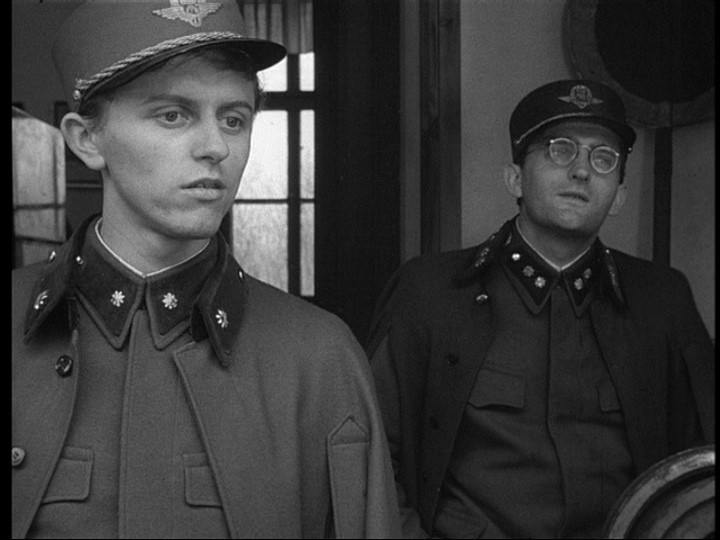
Towards the final months of World War II, in the middle of Nazi-occupied Czechoslovakia, the young Milos Hrma is taking a major step in life – he is preparing for his first job. While his mother helps him don the fresh uniform of a train station dispatcher, Milos mulls over his family history, which is not exactly glowing. Milos seems to come from a long line of duty-shirkers, layabouts, delusionals, and generally disagreeable loafers.

Milos Hrma. Not exactly the sharpest tool in Czechoslovakia's shed.

On his first day on the job, the skinny and shy Milos absorbs his new workplace and workmates. The station is in shoddy repair, being connected to the station master's home and farm. The master himself spends as much time tending chickens as doing his job. Milos' immediate superior is the calm, affable, and randy Hubicka. Hubicka uses the many quiet hours on the job to seduce any attractive woman within sight.

Hubicka readily takes the wide-eyed Milos under his wing and starts to show him the ropes. The actual job is laughably simple and dull, which leaves plenty of time for Hubicka to start asking after Milos' love life. Milos has a girlfriend of sorts – a young, pretty train assistant named Masa – though they are yet to consummate anything. Milos is made all-too aware of this as he sees the savvy Hubicka bed several women while on duty, which inflames Milos' libido even more.

Opportunity comes when Masa invites Milos to stay at her uncle's house/photo shop. Masa makes strong advances on Milos, but Milos sullenly and strangely turns away. Not understanding the rebuff, Masa returns to her own bed. Early the next morning, a bomb attack blows down the house Milos is in. No one is hurt, but the house is destroyed.

Later that day, Milos checks into a hotel and attempts suicide. He is found and saved by a hotel worker, and sent to a hospital. While there, he explains himself to the doctor. It turned out that he had suffered impotence or premature ejaculation, which was why he did not have sex with Masa when he had the chance. He thought that this equaled a lack of manhood – something that he could not live with. The doctor assures him that this is normal, and Milos returns to work.

The devastated Milos prepares to do himself in after his "failure" with Masa.

Back at the station, things have been stirring. Hubicka and a handful of other locals have been conspiring to blow up a German military transport train. This is all being planned under the noses of politicians subservient to the conquering Nazi forces. Milos returns in the midst of this, and Hubicka welcomes him back to work. Once he hears the story of Milos' hospitalization, Hubicka soothes the young man and suggests that he find an older woman with whom he can relax and enjoy his first sexual foray. Hubicka also lets Milos in on the plan to blow up the Nazi train, and the two plan the sabotage together.

The eve of the sabotage arrives. A beautiful woman arrives at the station late in the evening, offers a password, and gives Hubicka a package with the explosives in it. The woman stays in the station, and Hubicka urges Milos into her arms. With the older woman, Milos finally enjoys his first night of sexual pleasure.

Milos looks out over the tracks, his slacking mentor Hubicka looking over his shoulder.

The next morning, the day of the planned attack, the train station begins buzzing. A few government officials show to follow up a complaint about Hubicka, who had previously bedded the young woman who works at the station with him. In the middle of his interrogation at the hands of the bureaucrats and the young woman's grandmother, Milos brazenly takes the explosives, shimmies out onto a structure hanging over the tracks, and waits. When the Nazi cargo train passes underneath, he deftly drops the explosives onto a middle car. However, just as he begins to soak in his success, a soldier on the train spots him and shoots him dead.

The train makes it about a mile farther down the track when it blows up in a massive explosion. The remaining workers at the train station rush out to see the tell-tale smoke clouds rising in the distance. Hubicka, oblivious to the death of his young co-worker and countryman, lets out a satisfied laugh over the victory.

Take 1: My Gut Reaction (Done after this one viewing, before any further research)

Closely Watched Trains is a very uniquely hilarious movie.

Right from the opening minutes, I was laughing. As the sheepish, gawky little Milos is being dressed by his mother, his dry summary of his male forebears is great. His even-toned description of each man's laziness, oddity, and ultimate fate is accompanied by great still shots. It does a great job in setting the tone for the rest of the film.

The entire telling of Milos' pursuit to vanquish his own virginity is funny enough, but Milos himself is so hilarious in his innocence and naivete that it amplifies the comedy immeasurably. It starts with the aforementioned role call of his own lineage of laze, but it gets even better after his sexual failure with Masa. His attempted suicide is morbidly realistic, but his subsequent actions and behavior are so funny that they make you forget the darkness of it. So socially oblivious is he, that he seeks advice from any person available, openly proclaiming his problem of “premature ejaculation.”

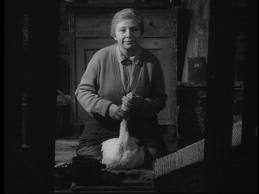
This and his pubescent notions about manhood can't help but make you laugh, if only because everyone around him takes it in such easy stride. At one point, in his quest for a “mature woman” to help relieve him of the burden of virginity, he approaches the train station chief's 60-something year old mother as she stuffs a massive goose. While Milos awkwardly explains his plight, the woman calmly takes in the confession/plea while massaging foods down the goose's massive, phallic-shaped neck. Perhaps not very subtle, but the actors play it so straight that it's comedy gold.

The station master's mother placidly takes in Milos' tale of impotence, holding a suggestively fashioned goose.

While Milos more or less quietly steals the show, as he should, the supporting cast can't be overlooked. The libidinous Hubicka is a fantastically lovable loafer and ladies man. He basically has everything that the unimaginative Milos hopes to – a thoroughly undemanding job and a seemingly endless procession of young women to sleep with. What makes the otherwise selfish Hubicka so likable is that he is more than willing to help the hapless Milos achieve his dream. Sure, it's hardly a master/apprentice relationship on the scale of Socrates and Plato, but it's heartwarming in a much earthier way.

The entire mini-saga of Milos is funny enough, but what puts Closely Watched Trains in that rarer category of great movies is the setting. Being set in Nazi-occupied Czechoslovakia adds a strange element to the character study. In the movie, the Nazi presence is tangential to the main plot, and the Germans are almost never seen. We mostly hear about them through the Czech bureaucrats, who obey them more out of fear rather than any loyalty. This reduction of the enemy presence emphasizes how an inexperienced teenage boy would prioritize such things: Number One = Sleep with a woman. Number Two = Find the easiest job possible. Number Whatever = Anything and everything else, including World War II. This totally bears out in the story, as it is only with his job secured and his virginity firmly stamped out that Milos is able to play a small part in the rebel cause.

The train station staff, caught in the blow back of the train explosion - Milos' lone confident and heroic act.

The movie does end on a somewhat weird vibe, as poor little Milos is shot and killed a few seconds after his crowing achievement as “A Man.” However, as I think back on it, it's not as sad as it seems. Had Milos lived, he almost certainly would have gone down as just another slacker in a long line of slackers in the Hrma family. His role in the attack on the Nazis probably would have faded, and he would have probably ended up just like his father – prematurely retired at age 50, lounging on a couch and being ridiculed by his working neighbors. As it was, he got to die a “hero's death” of sorts.

The characters, story and tone of the movie are clearly the outstanding elements of this movie, but a few other aspects shouldn't be overlooked. The filming is fantastic. It's in black and white, but the sets and framing show skill that goes beyond the norm. Some of the compositions and juxtapositions of characters and props enhance the physical comedy greatly, and usually is very sly ways. Whether its Hubicka playfully stamping his young co-workers legs and buttocks in the station or the uncomfortable stand-off between Milos and the goose-stuffing station master's mother, the visuals do nothing but enhance everything about the story.

As I write this, it had been four days since I watched Closely Watched Trains, and with every passing day I realize more and more just how much I liked the movie. As I think about the different levels that it was working on, and just how solid a film it was in all regards, I can see it as a film that I would watch and enjoy again. Anyone who enjoys somewhat dark, tongue-in-cheek humor would do well to track down this movie and give it a shot.

Take 2: Why Film Geeks Love this Movie (Done after some further research)

Some of the writing on Closely Watched Trains has sent me into philosophical crisis. I don't know whether to be hopelessly frustrated at human stupidity or grudgingly thankful to it for providing the fuel for artistic genius.

A little bit of research has informed me a little more of the political climate, and the geographical and historical context that allowed the birth of a film such as Closely Watched Trains. The best of what I read is this essay by Richard Schickel, in which he gives a thumbnail account of Czechoslovakia's unique place in European political affairs. He describes how its odd and interminable position as an occupied country led to a culture of “impish rebellion” that could be seen in its arts. It's a really interesting read, and one that makes the Czechs a very endearing group to me, a person who has never been there and only known a handful of the country's people (they were great, and boy, did they know their beers).

Milos' first of many near-kisses with Masa. This is just one of the much lighter comic moments sprinkled throughout this very sly film.

One other thing that stuck out a bit to me was that, in this original review in 1967, the TIME magazine reviewer didn't seem to view the character Hubicka as genial as I did. At best, he is written about with indifference. I felt that I agreed much more with Schickel's take (in the same essay as above) about Hubicka's more well-rounded character. Schickel even points out how Hubicka quite possibly represented the entire Czech nation, with his humorous self-absorption not completely drowning out his penchant for causing headaches to boorish and idiotic superiors and conquerors. I guess its no surprise how characters and filmmakers like that would appeal to viewers not only in the U.S., but throughout the Western world.

That's a wrap. 62 shows down. 43 to go.

Coming Soon: The Good, the Bad, and the Ugly (1966)


I'm giddy with glee that this one is next on the list. I've probably seen it 10 times, and I can't wait to watch it again. Come on back to read me gush about one of my absolute favorite films of all time. Maybe I can convince a few uninitiated to give it a shot.

Please be sure to pick up all empties on the way out.

Tuesday, September 6, 2011

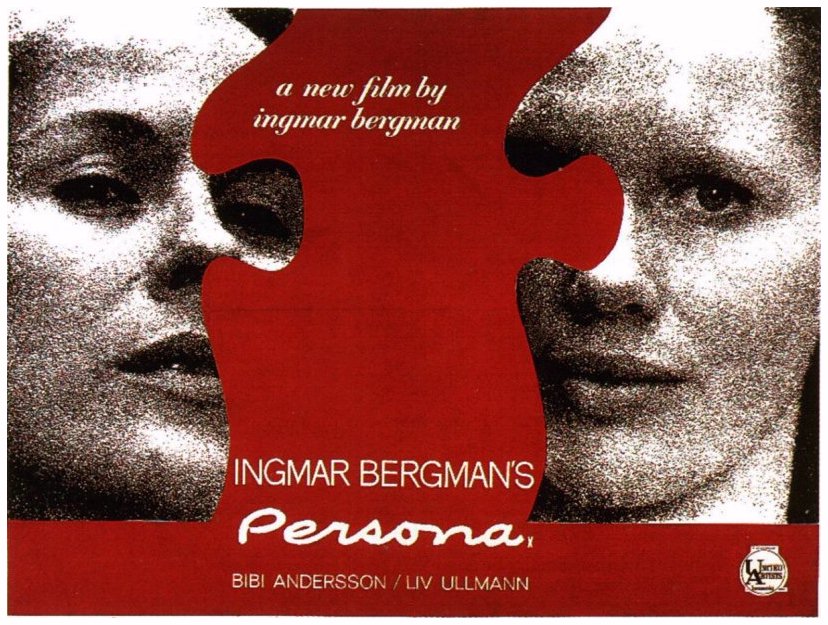
Film #61: Persona (1966)

Director: Ingmar Bergman

Initial Release Country: Sweden

Times Previously Seen: once (about 6 years ago)

Teaser Summary (no spoilers)

Young nurse & mute patient engage in intense psychological back-and-forths.

Extended Summary (More complete plot synopsis, including spoilers. Fair warning.)

Middle-aged and prominent Swedish actress, Elisabet Vogler (Liv Ullman), is inexplicably stricken dumb in the middle of her performance as the title role in the play, Electra. She is sent to a psychiatric institution, where she maintains her utter silence and unresponsiveness.

She is placed under the care of the beautiful, 25-year old nurse, Sister Alma (Bibi Andersen). Nurse Alma's gentle and dutiful ministrations elicit some positive, if mild, responses from Elisabet, but the actress remains completely mute. The head psychiatrist decides that the best thing is for Sister Alma to accompany Elisabet to a seaside retreat, where the two women can advance Elisabet's treatment. Alma expresses her concerns that the clearly willful Elisabet may be more than she can handle, but her worries are quickly swept aside by the doctor and her own naivete.

Sister Alma, a kindly nurse who has no idea of the mental trial ahead.

At the picturesque seaside house, the pairing makes a promising enough start. While Elisabet refuses to speak, she seems an eager listener as Alma fills the silence with expositions about her own life. Alma talks of her life, educational background, her fiance, and other more casual topics for several days. All the while, Elisabet lends her ears and absorbs it all.

Eventually, Alma begins to reveal much more personal thoughts and feelings. One evening, with both women rather deep in their cups, Alma shares a rather scandalous episode in her life. While on vacation with her fiance, she and another woman engage in some naked sunbathing, away from their significant others. A few young boys approach them and, following the lead of her new-found companion, Alma has sex with both boys. In an attempt to cover up this unforeseen foray into hedonism, she later has sex with her unknowing fiance. She becomes pregnant and soon has an abortion, actions that Alma is deeply conflicted over – she clearly feels guilty about it all, while simultaneously acknowledging the pure, if temporary, delight of the amorous escapade. As always, Elisabet seems to take in the entire tale without judgment, and she offers Alma the comfort of a warm embrace.

An ever-silent Elisabet calmly absorbs Alma's most personal revelations.

The next day, as Alma drives to the nearest town for supplies, she glances at a letter that Elisabet has written to a friend. In the letter, Elisabet has written a rather detailed account of the sordid tale that Alma told her in confidence the previous evening. Feeling utterly betrayed, Alma begins enacting forms of revenge back at the house. At first, she leaves a broken shard of glass on the ground for Elisabet to step on. Alma also begins verbal attacks, accusing Elisabet of being a sort of dramatic parasite and using Alma's confessions as potential acting fodder. The most violent attack is when she nearly hurls a pot of boiling water at her charge, only pulling up at the last minute when Elisabet screams her first words: “No, don't!” Alma desists, and after slinging a few more sharp accusations at her, feels remorse and asks for Elisabet's forgiveness.

Over the next several days, the bonds between the two women deepen in disturbing ways. Alma imagines that Elisabet is speaking to her and quietly visiting her in the night, even when Elisabet denies it. At another point, in what may be a dream or reality, Elisabet's estranged husband, an older blind man, shows up at the house. When Elisabet still refuses to talk, Alma takes her place as a proxy, going so far as to make love to the man, who mistakes Alma for his wife. All of this is done as a passive Elisabet looks on, doing nothing to prevent it.

Towards the end of their time together, the lines between Elisabet and Alma grow even more blurred. As the two sit across a table from one another one afternoon, Alma begins to narrate a personal event from Elisabet's life – that of the birth and life of her son, whom Elisabet has also retreated from. Alma tells a story of Elisabet, the actress, only becoming pregnant in order to become more “motherly” in the eyes of her fans and critics. However, through and after the pregnancy, none of the outward motherly emotions were real. Elisabet has always been thoroughly detached from her child, despite his unconditional love of her. It seems at this point that Alma has achieved a complete psychic transference with the woman behind the shroud of silence – so much so that she can speak of Elisabet's innermost despairs with first-hand authority.

Their strange personality shifts having run their course, the two women are undeniably, in indefinably, changed. There is, however, nothing more for them to say or do to one another. Instead, they simply pack their belongings, clean up the vacation house, and leave.

Near the end of their stay together, Alma is able to see deep into, and essentially become, Elisabet.

Take 1: My Gut Reaction (My impression of the movie, based on this viewing & before any research)

Persona is another film that I have to say is an excellent artistic work, and one that was a very interesting intellectual exercise, but a film that I may never watch again. Seeing its opening shots, a viewer is inclined to feel that they are watching some bizarre, incoherent art house work. There are spliced film cells, brief images of cartoons, silent films, and animals being butchered. The montage ends with a shot of a young boy laying on a cold slab. He wakes, looks around, reads a book for a moment, and then notices a massive, blurry image of a woman who seems to be looking over him. If you're wondering what any of this has to do with the main plot or two women who develop a co-dependence on each other, you know exactly how I felt. Immediately after this odd, 2- or 3-minute overture, the story proper begins, and we are given a traditional narrative to follow.

The story of Sister Alma and Elisabet Vogler is highly intriguing for anyone interested in psychology and its probings into the darker recesses of human personality. The Elisabet character is rather unique – one who speaks only three words and whose silence turns her into a blank slate of sorts onto whom the young Alma projects her own feelings and desires. This element aside, one is left to puzzle out exactly what shocked Elisabet into her self-imposed muteness. The film gives hints and suggestions, but with a vagueness that allows the viewer to fill in the blanks. Some may find this frustrating, but I found it engaging.

One of the iconic images of the bizarre opening montage of Persona.

The tone seems perfect. By making the setting a quiet, peaceful beach side house, an eerie tension is built between the two women. It's not hard to see how the cheery Sister Alma goes from seeing Elisabet as trusted Mother Confessor to betrayer to emotional vampire. The final phase, in which Alma seems to virtually become Elisabet in a way, seems somehow organic. This is even more amazing when you realize that the film is a mere hour and 20-odd minutes.

The ever-morphing feelings of the two women are communicated even more clearly thanks to the camerawork. With a starkness that I last saw in the German film The White Ribbon (Das Weisse Band), the many black-and-white still shots are incredibly effective. The isolation of Alma and Elisabet is palpable. When Alma reveals her past moment of unbridled sexual abandon, the dark shadows in the house, the quiet of the scene, and the authenticity of the performance are remarkable. It reminded me of a similar scene in Stanley Kubrick's Eyes Wide Shut, when Nicole Kidman's character does something similar, sending her husband into the mental anguish that propels the rest of the story. Bergman built up the same kind of power, without color and three decades before in
Persona.

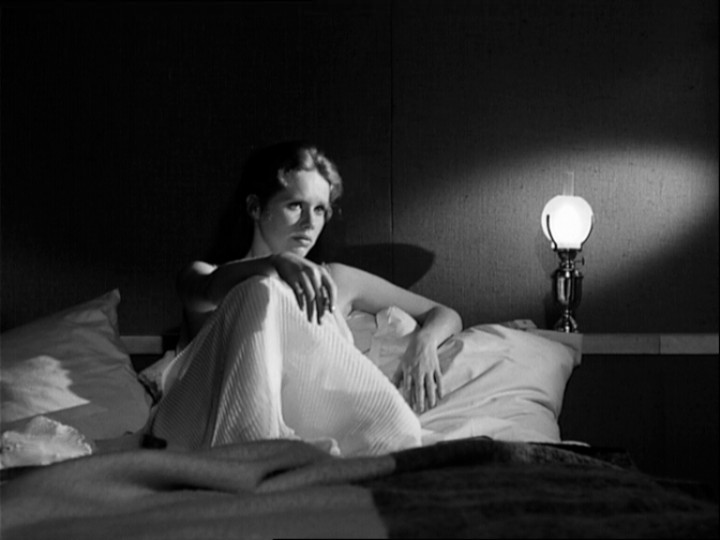
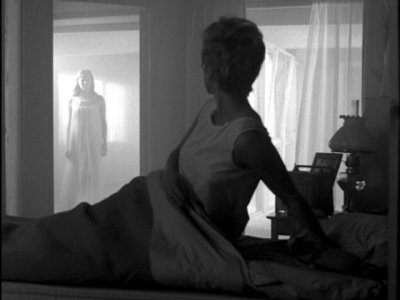
One of the many haunting and quiet images that blur the line between reality and dream between the two women.

So it should be clear that I found plenty of intellectual food for thought and that I think that the film is executed brilliantly. So why do I say that I would probably not watch this movie again? Because it's rather painful in its rawness. This was something that Bergman seemed to veer towards in the latter parts of his long career. Years later, he would go much further with the horrifyingly emotional Cries and Whispers. Persona is not nearly the trial of this later movie, but the discomfort is still there. And when Bergman approached such subjects, there was nary a second of comedic relief. He went at you hard, and didn't dilute the tale with anything that didn't fit the overall sensations he meant to draw out.

The closing scenes of Persona echo the first ones – the young boy, the roughly edited footage, and a film reel burning to its end. However, by the end of the movie, it seemed to make much more sense to me. I may be way off (my further research will probably tell), but it seemed that the fractured images are meant to reflect the mind of Elisabet Vogler. She, as an actress, can be seen as a paid, professional liar who has forsaken any real, human connection for her own success and fame. When this realization strikes her, it sets off the events of the film and results in the fallout for Sister Alma. This is just one theory of mine, however, and the film offers many avenues for more. This is what makes it fascinating, if not exactly pleasurable.

Take 2: Why Film Geeks Love This Movie (Done after some further research)

It always feels good to know that you weren't completely missing the point, eh?

In reading several essays and writings on Persona, I found that I did, for the most part, “get it”. However, this may not be something that the average viewer could or would want to do. It would seem that a fair amount of familiarity with Ingmar Bergman's pre-existing body of work goes a long way. This original review in TIME magazine shows how that reviewer, knowing of Bergman's iconic film images, was able to see the underlying structure of the film right from the strange, fractured, opening shots. Well, that's great if you're an aficionado or just know Bergman's films, but what if you aren't privy to these things? Confusion galore. That's what.

It seems that Persona was very much a major turning point for Bergman himself. He had apparently gotten very ill shortly before making it, and his experience in the hospital served as the inspiration for the story. He even said in a later interview that he had been suffering so much emotional distress that, if he hadn't made Persona in order to release his anxieties, he probably would have fallen apart. When one watches the film, it's not hard to see the existential angst that pervades all of the film's basic conflicts.

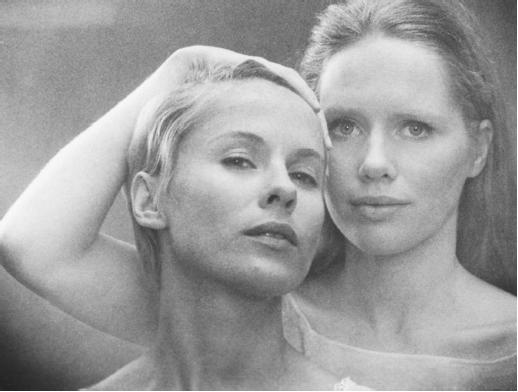
Another of the best-known shots from the film. Within context, it can be one of the eeriest, most sensual, and thought-provoking scenes you can see. And not a word is spoken.

One other tidbit that I found interesting, if only for the fact that it didn't strike me while I was watching the movie. For 1966, this film was incredibly daring. In particular, the scene during which Alma is recounting her sexual escapade on the beach. Bibi Andersen, Ingmar Bergman, and numerous critics have pointed how people will often recount this part of the movie as if it were actually shown on the screen, and not just relayed through Sister Alma's recounting. Such is the power of the scene. When I think about how forthright and honest the description is, it's not surprising to find out that several edited versions of the film were cut up for American audiences (we're always the prude ones).

Whenever I come across such an editing incident, it reminds me of just how Puritan our culture is, at root. Bibi Andersen's telling of the story as Alma is so authentic, and the story so incredibly believable, that most people would find it uncomfortable. Yet, most countries didn't feel the need to cut it out. Why? Because that's reality, folks. Sometimes the sweet, naïve, pretty nurse decides to throw caution to the wind and have some unprotected sex on the beach with some strange boys. Alma made a decision to dive into the unbridled sensual life for an afternoon, and Persona shows her reliving it through the retelling, with more circumspection and introspection than actual remorse. That's what Persona gives you – plenty of complex actions and emotions for mature, meditative humans to think about.

That's a wrap. 61 shows down. 44 to go.

Coming Soon: Closely Watched Trains (1966)


I'd never heard of this movie, but here's the summary on the DVD, verbatim: “Surrounded by but seemingly removed from the violence of Word War II, a naïve railroad apprentice working at train station in Nazi occupied Czechoslovakia carves some excitement by exploring his own sexuality.”

Now I ask you – how could I top that, and how can I not watch this film?! Come on back to see how this little “adventure” goes.

Please be sure to pick up all empties on the way out.