Thursday, July 9, 2020

The Grand Budapest Hotel (2014)

Director: Wes Anderson

A solid Wes Anderson movie that's mostly carried by a brilliant comic performance by Ralph Fiennes.

As the final leg of our unplanned, incomplete return to Wes Anderson's movie catalog, my wife and I rewatched Grand Budapest Hotel for the first time since seeing it in the theater back in 2014. Before this, we had returned to The Darjeeling Limited, Rushmore, The Royal Tennenbaums, and The Life Aquatic with Steve Zissou. Now, the itch has been fully scratched.

Grand Budapest is a chronologically layered tale, beginning in the 1980s and quickly jumping two levels backward into the past, ultimately landing in the 1930s for the majority of the film. There (and then), we follow M. Gustave, the famed concierge of the luxurious Grand Budapest Hotel, through a wild adventure involving an invaluable painting and the viciously greedy family that covets it, all set to the backdrop of a rising, Nazi-esque fascist movement throughout this fictitious segment of Europe. Helping Gustave much of the way is the hotel's eager bellhop and concierge-in-training, Zero (Tony Revolori).

This movie is arguably Anderson's most sweeping, romantic picture. At least, romantic in Wes Anderson's unique way. More than any other of his live-action pictures, Anderson constructed an entire world. Yes, it's based on familiar elements of pre-World War II Europe, but the setting feels more exotic and romantic than anything we've seen from him. On top of that, this is the only Anderson film that doesn't hinge on the dynamics of a dysfunctional family unit. Instead, we focus on a uniquely charismatic, if not exactly honorable, figure in Gustave. He is an extremely polished, charmingly eloquent, and amusingly immoral character whose great tragedy is only that his era is slowly slipping away. Bittersweetness is always a part of Wes Anderson's movies, but never before had he examined the bittersweetness of feeling oneself slowly and inexorably becoming an anachronism. And it is a hilarious and touching study.

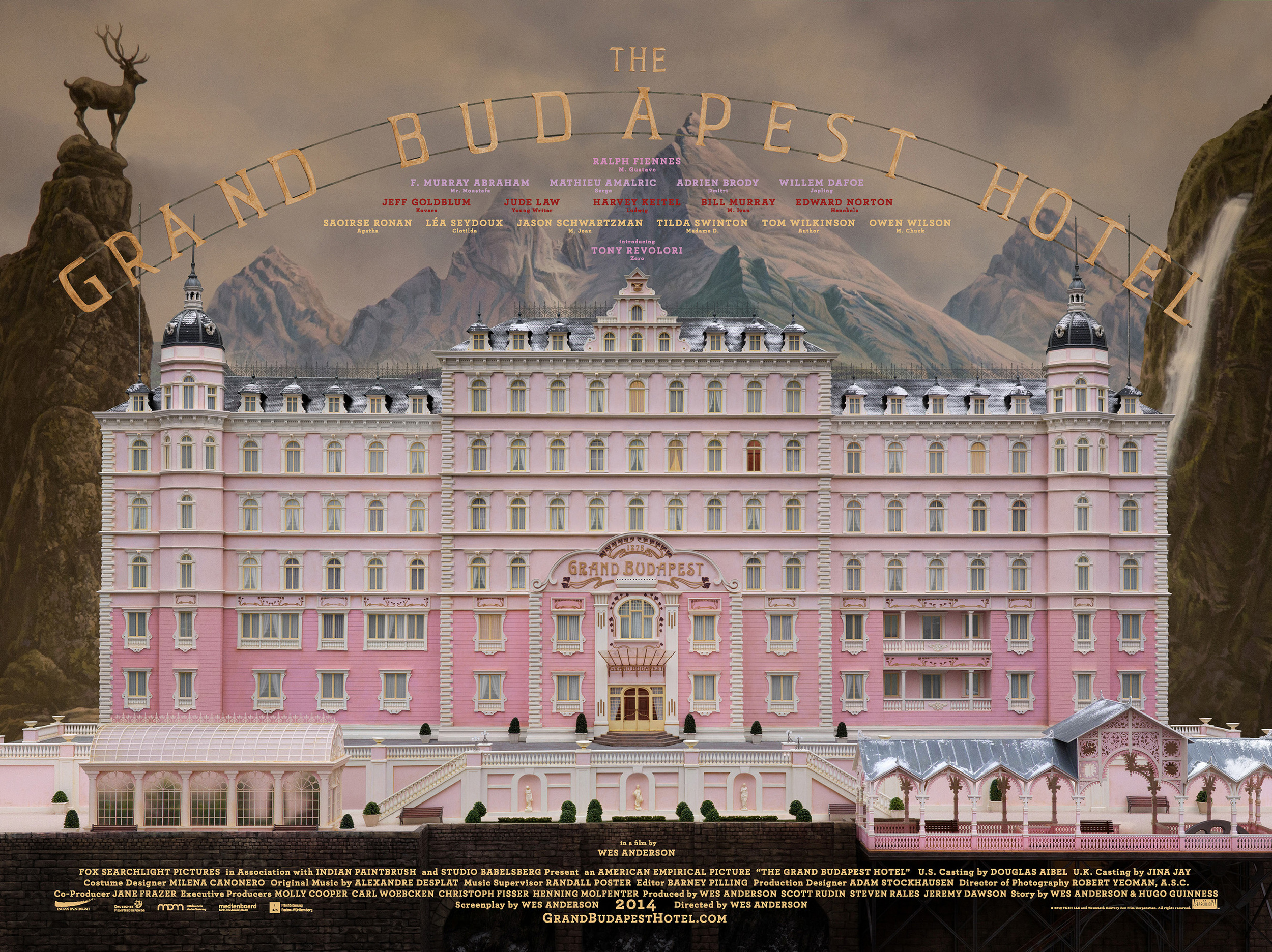
M. Gustave in the foreground. Ralph Fiennes's performance
here ranks among his very best, which is no mean feat for
such an accomplished actor. Ronan and Revolori do
excellent work here, as well. 
As one might expect, all of Wes Anderson's gifts as a visual filmmaker are on display, perhaps more than any other movie. By the time Grand Budapest - his seventh full-length live-action movie - arrived, we knew to expect the meticulous and vibrant sets and costumes, and carefully considered cinematography. What really jumps out, though, is Ralph Fiennes's performance as Gustave. Anderson's movies have often featured memorable turns as his quirky and flawed characters: Gene Hackman as Royal Tennenbaum. Jason Schwartzman as Max Fisher. But Fiennes turns in what I think is the best main performance of any Wes Anderson movie. It can't be easy to make an immoral hedonist like Gustave so amiable, but Fiennes pulls it off. Part of this is the great script, but even more of it is Fiennes's ability to shift registers and emotional tones with incredible agility. One moment, he's using wonderfully flowery and elevated language to wax poetic and profound, and in a blink he gives up and drops a completely resigned, "fuck it." And you feel that sad "fuck it" right along with him. It's brilliant, touching, and hilarious, and it happens several times throughout the movie.

As much as any Wes Anderson movie, this one features countless great actors filling in major and minor roles, alike. There are plenty of Anderson film mainstays like Willem Dafoe, Jeff Goldblum, and Harvey Keitel. But we also get an early and memorable performance by a then-less-known Saoirse Ronan (BrooklynLadybird) and a nice turn by Tony Revolori as Zero the diminutive bellboy, whose character is revealed to be made of far sterner and deeper stuff than we might initially believe.

This second viewing reminded me of how much I enjoyed this one when I first saw it. While it doesn't quite rise to the level of Rushmore or The Royal Tenenbaums among Wes Anderson's canon, in my mind, it's in that close second-tier along with The Darjeeling Limited. This is one that I would happily recommend to someone who has seen and enjoyed one or two of Anderson's other films, and I'm sure to return to it in the future. 

Wednesday, July 8, 2020

The Life Aquatic with Steve Zissou (2004)

Director: Wes Anderson

A fun Wes Anderson flick, though one that still feels more bloated than his others.

As part of our little, incomplete return to the films of Wes Anderson, my wife and I decided to give The Life Aquatic our first watch in well over a decade. It follows the title character, Steve Zissou (Bill Murray), who has hit a fairly nasty late-in-life rut. Zissou is a Jacque Cousteau-like marine biologist/adventurer who was once highly renowned and respected. In recent years, though, his star has fallen in the eyes of the public. His vices and arrogance have caught up with him, and nearly every personal bridge has been burned, leaving Steve in a haze of self-pity and existential crisis. A sense of purpose is sparked, however, when Steve's longtime partner is killed by what he claims is an exotic, previously-unknown species of shark. This sets Steve on an Ahab-like quest to find and kill the beast. Joining him and his normal crew is newcomer Ned Plimpton (Owen Wilson), a straightforward, earnest, Midwestern pilot who believes Steve to be his illegitimate father.

The Life Aquatic was fun to watch again, though the weaknesses that I observed when it came out are mostly still evident. There are plenty of hilarious moments, often little gags in the dialog or facial expressions, as one would expect from a movie featuring Bill Murray and other great actors like Cate Blanchett, Jeff Goldblum, Willem Dafoe, and Angelica Huston, among others. Having Murray play a weary, arrogant, dry narcissist on the high seas was bound to be funny, one way or another, and it is. Casting the greater tale within the notion of being a funny, quirky take on Moby Dick with a dysfunctional ship crew sets up a good deal of humor, too.

So what isn't it quite as memorable or funny as Anderson's other films? My feeling is that it simply tried to introduce a few too many character clashes and dynamics. There's the mystery of Steve's relationship with Ned. And Steve trying to maintain or repair his relationship with his wife. And Steve trying to impress and seduce a journalist who has joined his voyage. And Steve's rivalry with fellow celebrity marine biologist Alistair Hennessey. Then Steve has an entire side foray to save an "insurance bond stooge." And there's even a few other personal dramas thrown in here and there with members of his ship crew. It all just adds up to too much, resulting in a movie that feels too long, despite the film being a little under two hours. There were at least two moments in the third act that felt like good places to wrap up the movie, but it somehow kept going, resulting in a film that probably could have been a good 15 minutes shorter.

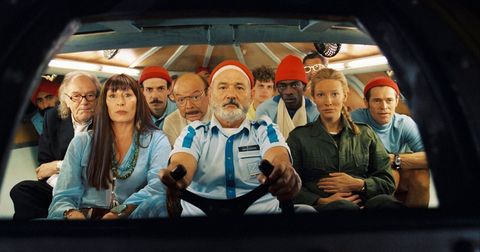
I think this image - widely used the promotional materials for the film - is a
perfect illustration of its main weakness. Too many characters stuffed into
a small space. Even with so much great acting talent, the movie would
have been better off leaving some of them back onshore.

A curious observation I made on this viewing was how this movie hinted at Anderson's interest in using stop-motion animation, which he playfully sprinkled into The Life Aquatic, usually in the underwater sequences. It's an early tease of his control of the form, which he would bring fully to bear in his later full-length animated films The Fantastic Mr. Fox and Isle of Dogs.

The Life Aquatic is still a funny movie, and my wife and I did enjoy it. But I still consider it Anderson's weakest movie, mostly because it was overstuffed with too great a variety of interpersonal tensions. This is an error in judgment that Anderson seemed to correct with his next film, the shorter, more focused The Darjeeling Limited, and all subsequent live-action films, none of which has been more than 99 minutes long. Still, it says something when the worst of a director's seven full-length, live-action films is still a pretty good one. 

Tuesday, July 7, 2020

Fight Club (1999)

Director: David Fincher

Still a great, wild ride of a movie that showcases so many of director David Fincher's many strengths as a filmmaker. 

The movie, based on the novel of the same name by Chuck Palahniuk, follows an unnamed protagonist (Ed Norton) whose life has become such a drone that he is a virtual zombie. To paraphrase him, he is never fully awake but can never fully sleep. This continues until a chance meeting with Tyler Durden (Brad Pitt), a whip-smart renegade with the ultimate punk rock sensibility. Durden squats in an abandoned house, refuses to live by any of society's rules, and eventually convinces our protagonist to begin an underground fight club for men like themselves - disenfranchised and feeling like they've been sold a bill of goods by capitalist, consumer culture. Eventually, Durden molds this ostensible underground MMA group into something much more potent and frightening, with our anonymous main character being pulled along in ways that he can't even begin to imagine. 

I can't recall just how many times I've seen this movie, but it's easily in the double digits. I saw it a couple of time in theaters upon its release back in 1999, and would routinely go back to it for many years after. I'd gone quite a few years since a full rewatch, until reading Brian Raftery's recent book Best. Movie. Year. Ever., which catalogs the insane number of great films that came out in 1999. My enthusiasm fully stoked, I snapped up a cheap blu-ray copy of Fight Club and took it all in again. My thoughts about the film have evolved over two decades, but I still find it to be a satisfying, subversive, funny, and extremely well-crafted middle finger to large segments of the film industry. 

In those first years after the movie came out, like a lot of guys in the early and mid-twenties, I saw the Tyler Durden character as an icon of cool. He was a take-no-bullshit badass who just got things done, and seemed to be on the side of righteousness. To slightly paraphrase Durden himself, he looks like you want to look, f***s like you want to f***. He is smart, capable, and most importantly, free in all the ways that you are not. It's a great sales pitch to young men who are in desperate need of leadership, wherever that leadership takes them. Durden's appeal to "enlightened" macho violence is one that is still fully relevant today, with the immense popularity of "smart" MMA bros like Joe Rogan and similar "intelligent" Alpha males who have millions of devoted fans and followers. Chuck Pahlaniuk was onto something when he wrote the novel, and David Fincher was clearly aware of it.

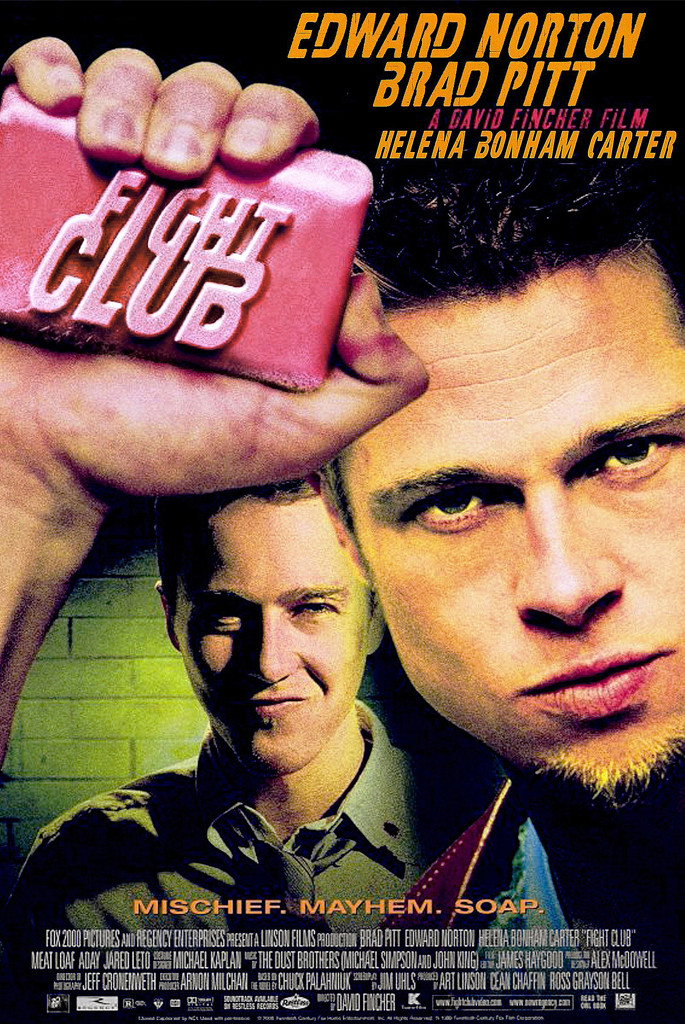
If you need to illustrate the idea of self-destructive anarchy
having sex appeal, then Brad Pitt is a pretty good choice
as your spokesmodel.
What has changed, though, is the realization that being punk rock isn't really the hard part. And looking and sounding cool while doing isn't even the hard part. As calculating and slick as Tyler Durden is, his plan doesn't go beyond "blow stuff up." It's really a punk rock sensibility, which has a very strong appeal in the hands of such a charismatic character. When I watch Fight Club now, I can't help but wonder just how likely it is that Durden's master plan actually works, after the credits roll. Or whether he ends up being happy with Marla. Yes, Project Mayhem's bombs go off, destroying the headquarters of major credit card companies, essentially annihilating debt and giving everyone a fresh start. But will that actually work? And yes, Durden's fractured mind reunifies, and he seems to reconcile with Marla. But they're both clearly still very damaged people. Such grounded thoughts, though, are not what Fincher had in mind. He was looking to tell a raucous tale of a modern anarchist, and he gave us just that.

If the themes are what elevate the story well above just being a sweaty trek through underground fight clubs, then the film technique is what makes the whole show so wildly entertaining. You have three actors in Norton, Pitt, and Carter, who are as good as they've ever been. And the sharp writing is still absolutely hilarious. The look of the movie, along with the editing and cool-as-hell Dust Brother soundtrack bring it all together to give us a movie that's simply a blast to watch.

It's both fascinating and unsurprising that this movie fell on its face when it was released back in 1999. Up until then, there really hadn't been anything quite like it - an in-your-face, crotch-grabbing "screw you" to capitalism lightly disguised by a "pretty boy" actor in Pitt and "up and coming" fresh face in Norton. There were obviously people like me, who saw it in the theaters and loved the dark humor and the deeper themes and ideas, but most people were either baffled, disgusted, or just stayed well away from it. However, you might view Fight Club now - a worthy, dark satire; flawed attempt at profundity; or something else - I think most would agree that there's more than a little solid film technique happening, and that the movie had a serious impact on movies for years to come. 

Monday, July 6, 2020

Idiot Boxing: Never Have I Ever, season 1 (2020)

Pretty fun coming-of-age series from a somewhat novel perspective, and told with a few entertaining flourishes.

Created and co-written by Mindy Kaling, the show chronicles a tumultuous school year in the life of Devi, and Indian-American teen living in California and dealing with the semi-recent death of her beloved father, on top of the typical angst and stresses that come along with being a sophomore in high school. Devi is an academic overachiever, but she is itching to expand her experiences into the romantic realm, which until this point have been non-existent due in no small part to her drive for academic success. This starts to change when she develops some small connections with the "It" guy at school - star swimmer and noted ladies man Paxton Hall-Yoshida. This creates more than a little drama in Devi's life, on top of her shifting relationships with her two closest friends. But at the center of most of Devi's troubles are her as-yet unresolved feelings around the sudden loss of her father the year before, which had actually left Devi mysteriously paralyzed from the waist down, due to some sort of shock. She has since mostly avoided confronting the emotional fallout of the tragedy, but it resurfaces in several dramatic and unexpected ways for her.

Never Have I Ever follows many of the patterns and tropes of a typical high school dramedy. Friendships are tested. Romance is often at the forefront. The immediate impulses of teenagers lead to some comical and damaging decisions and consequences. These, of course, lead to revelations about the main characters to us, other characters, and themselves. The broad strokes of the high school narratives are certainly familiar. What gives this show a unique flavor is firstly that Devi's experience as an Indian-American child of immigrants is one really explored in TV before. Mindy Kaling and the other writers obviously knew what they were about here, and the pressures of Devi's mother's native country and culture become a major aspect of the story, rather than just a source of "immigrants think and act funny" line of cheap gags. And then there's the reckoning with Devi's father's death that she and her mother deal with. I have to admit that I found the depiction of her father as being a "perfect Dad" to be a bit uninspired, but this is something that could potentially be explored and expanded in future seasons. And while the story doesn't suggest any mind-blowing novelties around coping with death, it still provides some genuinely touching moments by season's end.

The show is, for the most part, a comedy, and it delivers pretty consistently. The star, Maitreyi Ramakrishnan, does a great job as the driven and sometimes overconfident Devi, and Poorna Jagannathan is excellent as Devi's strict, dermatologist mother. Most of the rest of the cast is solid, too, much of it consisting of late teens and early twenty-somethings playing 16- and 17-year olds. The one nuisance was Devi's friend Eleanor, an aspiring actress who never fails to remind us viewers that she's "dramatic," either directly or indirectly. It didn't help that Eleanor's absentee mother - also an aspiring actress - shows up for an episode, is infuriatingly irresponsible, and then leaves. All that aside, the writing and acting is solid. The use of tennis legend John McEnroe as the show's narrator is an obvious oddity at first, and it didn't completely work for me at the beginning, but it eventually makes some sense and becomes a reliable source of humor.

I probably enjoyed this about as much as a white dude, in his mid-forties, without any kids could enjoy a high school teen dramedy. I'll certainly check out a second season, which I assume will happen. 

Sunday, July 5, 2020

Idiot Boxing: Twin Peaks, original two seasons (1990-1991) and Fire Walk With Me (1992)


Agent Cooper (right), with several of the locals
of the town, all attending Laura Palmer's
funeral. Every character embodies some degree
of poor decision-making, oddity, or a combo.


The Original Series (1990-1991)


What a strange little slice of TV history to return to, a full thirty years after its initial airing and nearly twenty years after my original viewing of it.

Those of us in Generation X almost certainly remember the buzz surrounding Twin Peaks thirty years ago. Even if you never watched it during its original airing (I didn't), you heard about it. You knew it was about a murder mystery in a small town populated by weird characters. The question of, "Who killed Laura Palmer?" percolated into the mainstream, despite the show being so markedly odd.


I, being a fairly unadventurous 14- and 15-year old back when the show originally aired, had zero interest in the show. It wasn't until a good decade later, when I was working in a small town in the north of Japan that I was hunting some new viewing material and picked up the VHS tapes (that's right - VHS tapes) of the first two seasons. I plowed through them in a matter of about three weeks, only then seeing why the show had developed a cult-like following so quickly ten years prior. I also saw why, after such a meteoric rise to popularity, it ended after only its second season. But how does it all hold up now, thirty years after its release, and after creator David Lynch returned for a "Return" season on Showtime in 2017?

The answer is that is doesn't hold up too badly, though it's fairly clear why it was canceled.

For those unfamiliar with the show, it kicked off with the discovery in a small town in the Pacific Northwest of the dead body of Laura Palmer. We soon learn that Laura was the "dream girl" of the town - the beautiful, high school prom queen that was the object of many people's eye and many men's desires. The strange details around her murder attract the attention of the FBI, who sends agent Dale Cooper (Kyle McLachlan) to Twin Peaks to investigate. Cooper is a rather odd fellow, who is always extremely chipper and seems to have boundless fascination with the supernatural. He is also a Sherlock Holmes-caliber investigator with immense powers of observation and logic. He soon learns that he will need all of his skills to solve the case of Laura's murder, as Twin Peaks has more than a few strange and dark characters lurking within and around it, some of them weaving sinister plots that belie the otherwise sleepy town.

Nearly everything about Dale Cooper and the mysterious and creepy details around Laura and her murder were what made this show so compelling. And they still are, even if you recall how the tale played out. Kyle MacLachlan turns in an iconic performance as the peppy Agent Dale Cooper, and his become the scenes that you are always looking forward to. Yes, there are other amusing characters and some decent acting from a handful of the other cast members, but it's MacLachlan's Cooper who made this show what it was. The great novelty of this character was that, instead of merely being an amazing crime investigator, Cooper was more than willing to think outside the boundaries of classical Western logic, following hints and clues gleaned from altered-state visions or even outer space. These elements of Twin Peaks (still evident in the recent revival of the show) are what made it distinct, and I'm not sure that it would have worked without MacLachlan's fearlessly ebullient turn as Cooper.

Any scenes with Bob were chilling, especially since you often
didn't know when they were coming.
As with most David Lynch projects, Twin Peaks was a wild ride, even this original prime time network show, which would obviously restrict the famously surreal and disturbing Lynch. Following a running theme for Lynch, the show presents a veneer of classic, American tranquility that is merely a thin mask covering some absolutely nightmarish corruption and violent, primeval urges. And the show takes some seriously dark turns. Dark enough that my wife made a regular habit of turning away whenever one of the several very intense sequences would occur. I was even squirming more than a little at some of them, and I'd hardly call myself "squeamish" when it comes to movies and TV shows. But it's this balance of dark and light that makes the show unique and compelling. 

So why did the show get canceled after only two seasons? Some of it is a bit obvious, while some of it I had to research a little. The obvious is this: the show wasn't always very consistent, thanks in part to David Lynch's proclivity for casting people based more on looks and the "vibe" they exude than on acting skills. Some of this actually works, as there's often more than a little campiness to the show, which can often give it a very soap opera feel. Some people love camp, and while I can appreciate it at times, it's not my favorite style or mood in TV and movies. More than this, though, is that the murder of Laura Palmer was actually solved by the middle of season two, apparently against the wishes of David Lynch and co-creator Mark Frost. This left the second half of that season following secondary and tertiary characters through stories that were either uninteresting or just plain goofy. Another element was an upended airing schedule that got shuffled due to coverage of the Iraq Desert Storm invasion in 1991. According to what I read, these reasons together resulted in the show's rating dropping precipitously enough that the network gave it the ax. The shame is that, in the final few episodes, it seemed like the show had started to find its footing again, with the introduction of Cooper's nemesis Windom Earle and a solid cliff-hanger. Alas, we would have to wait nearly three decades to get the continuation of the tale, though we would get a prequel movie just over a year later...

As disturbing as the original show could be at times, the
prequel film goes well beyond it, thanks to a lack of network
restrictions. And the movie leans hard into that, going
completely dark in the second half. 

Twin Peaks: Fire Walk with Me (1992)

This prequel film, released a little more than a year after the final TV episode, covers events leading up to Laura Palmer's death. It begins roughly a year before the murder, following a different pair of FBI agents who are on the trail of a murder that has happened some way south of Twin Peaks, closer to the Pacific coast. The two agents start to piece together enough clues to realize that the victim was killed by the serial-murdering "Bob" character who later kills Laura Palmer, but the agents mysteriously disappear before they can learn more. The tale then fast-forwards to about a week before Laura's murder, where we get a close look at how troubled she is, and how much self-destructive behavior she engages in, in order to dull her inner turmoil. It takes the form of drug abuse and even highly risky sexual adventures. These habits bring her all-too close to the people who help pave the path towards her ultimate destruction - the murder that triggers the events of the original TV series. 

As any type of stand-alone film, Fire Walk with Me isn't very good. Anyone who hasn't seen the TV show would be completely lost and probably totally disconnected from and baffled by any of the events. Yes, there are some dazzling visuals, some decent acting here and there, and some great music. But the story and dynamics between characters are bound to leave an unversed viewer annoyed at best, and angered or bored to tears at worst. 

As a prequel to the TV show, though, it's an interesting enough chapter to the greater story. Without the restrictions of network TV, Lynch could get as dark and disturbing as he wanted to, which is saying something. It can be a bit odd to see more sexually graphic material and more colorful language in a world that previously was molded by prime time American sensibilities, but it fits the subject matter well enough. And the darker sequences with Laura and Donna in a hedonistic drug and sex den were strangely hypnotic, thanks mostly to the trippy, opium jazz buzz of the music score and the camera and lighting work. This scene, and a few others, made the film worth watching for me, even if there was more than a little narrative fat present.

Anyone interested in the full Twin Peaks story should check out the movie, but one shouldn't expect any grand "magic bullet" answers to the more bizarre elements and greater questions around the tale. That's not what David Lynch is about, and this film just serves as further proof. Keep your expectations in check, be aware of what Lynch does, and you'll find a few things to appreciate in this film. 

And with all that, my wife and I were ready to jump into "The Return" show, which I'll be reviewing in the next week or two. 

Friday, July 3, 2020

Idiot Boxing: Rick and Morty, season 4 (2019-2020)

The latest season features some familiar
faces, but plenty of new intergalactic and
interdimensional oddballs, too.
Boy oh boy, did this show come back with a vengeance. While it may not have been as consistently, accessibly funny as the first three seasons, the razor-sharp wit and irreverence are still at full-tilt for this already legendary animated series.

Unlike standard shows, there's no over-arching plot to summarize with Rick and Morty. While there's a certain continuity and recurring characters, each episode stands alone. The highs and lows for me of this ten-episode season were:

The Low (there's only one)

Episode 4: "Claw and Hoarder: Special Ricktim's Morty" - it wasn't a "bad" show, really. It was just obviously not as good as nearly any of the other 41 episodes of this incredibly consistent program. It involves Morty fulfilling his wish to have a dragon of his own, only to find out that it's not all it's cracked up to be. His dragon, Balthromar, is pretty crotchety, and we eventually learn that he and the greater society of dragons are just a bunch of depraved sexual deviants. There's certainly funny stuff here, but more gags than normal are rather broad and obvious.

The High

Episode 1: "Edge of Tomorty: Rick Die Repeat" - Morty gets his hands on and (of course) misuses some crystals that can show you a multitude of possible futures, depending on your decisions. This is one of those episodes, like season two's "A Rickle in Time," that feature hyper-fast, multi-layered storytelling and jokes that are as dazzling as they are funny. 

Episode 2: "The Old Man and the Seat" - Rick puts all of his limitless intelligence and abilities to preserving his most treasured possession: a toilet placed in a paradisical setting of his discovery. 

Episode 3 (I swear I'm not going to put every episode here. I swear): "One Crew Over the Crewcoo's Morty" - a lightning-paced spoof of the "heist crew" genre of movies. If you revere the "Ocean's" movies, this one is likely to upset you. 

A lasting image from "The Vat of Acid Episode." I always
find joy on the rare occasions that Morty gets to bust Rick's
chops for conceiving a poor plan.
 Episode 8: "The Vat of Acid Episode" - I found this one to be a nice return to the relatively slower-paced feel of many of the earlier episodes. Morty grows frustrated with one of Rick's less-than-genius escape plans.

Episode 10: "Star Mort: Rickturn of the Jerri" - This fourth season ended with a blast, as Birdperson returns as a deadly enemy in this galaxy-jumping adventure in which the entire family has a ton of fun and saves the universe. Well, except Jerry, of course. 

The remaining four episodes not mentioned above were all good, and this show continues to dazzle. My only fear at this point is that it will feel the need to keep ramping up the speed, pace, and insanity to levels that overpower the humor a little too much. It hasn't happened yet, but I feel as if I catch a glimmer of potential for it. 

One can only guess how long it will be until we see the next season, but like nearly every fan of this show, I'll be all too ready to see them. Until then, I'll have plenty of laughs going back and rewatching this most recent season, since I was laughing hard enough to miss more than a few gags or clever plot points during every episode.

Wednesday, June 24, 2020

Idiot Boxing: Party Down, the complete series (2009-2010)

A hilarious, R-rated sitcom that aired on the Starz network and about which I knew nothing until my wife's hairdresser recommended it to her. Great call, Molly.

The premise is simple: follow a Los Angeles-based catering company - the titular Party Down company - as they provide food and beverage service to the wide variety of oddball individuals and groups in and around the L.A. area. The catering crew is made up of an aspiring but dim actor, an aspiring but aloof sci-fi writer, a long-since washed-up actor, a recently washed-up actor, and an aspiring comedian. They're headed up by a semi-pathetic crew leader whose big dream is to manage his own all-you-can-eat soup and salad franchise restaurant.

This was a great little sit-com that had all the right ingredients. Hilarious writing and comic actors all around, and a conceit that allowed every episode to feature different situations and characters. One episode, the crew is serving at a community theater, and the next they're at an ill-conceived orgy. Or they're catering a sweet sixteen on a yacht for the daughter of a big movie producer, then the next episode sees them in a bar with Russian gangsters. The set up provided such a great variety of setting for comedy, and the writers took full advantage.

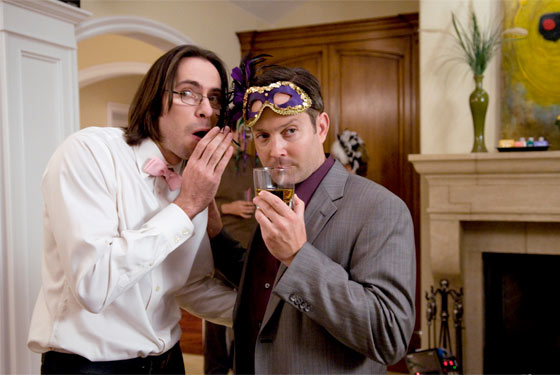
The know-it-all, aspiring sci-fi writer Roman (left) tries to
help a host get his orgy off the ground. Of course, Roman's
knowledge of sex and orgies is laughably limited, but it
doesn't stop him from dishing out advice.
Just as strong as the writing, though, is the comedic acting. There are all sorts of familiar faces playing the main parts. Adam Scott plays the most prominent role as Henry Pollard, an actor trying to rebound from irrelevance after a brief moment of fame stemming from a beer commercial. But Scott is only one of several comic actors who would later become far better known, with Jane Lynch and Martin Starr being the most obvious. But there were more than a few established comic actors, too, several of whom viewers may remember from the comedy troupe The State, who were on MTV for a few years in the early and mid-1990s. The primary one is Ken Marino, who's great as Ron Donald, the trying-to-make-it-work team leader, but several other members of The State show up in individual episodes, and each and every one of them nails their roles, whether it's as an aspiring orgy leader, a delusional community actor, or a high school buddy who's never matured beyond his senior year.

This show was consistently funny enough that I had to check and see why it didn't go beyond its two ten-episode seasons. Turns out that, being on Starz, it just didn't have a ton of exposure. It had also already lost Jane Lynch to the far bigger smash hit TV sit-com Glee after her first season on Party Down, which was a blow to the cast (the hilarious Megan Mullaly was brought in, but her character was a bit too straight-laced to fully allow Mullaly to flex her comic muscles). And apparently, the show was about to lose Adam Scott to soon-to-be new hit show Parks and Rec. So they pulled the plug, which I get.

Still, I recommend this one to anyone who likes some solid, R-rated humor and silliness. This is definitely a hidden gem that I was really glad to discover.