Thursday, April 21, 2011

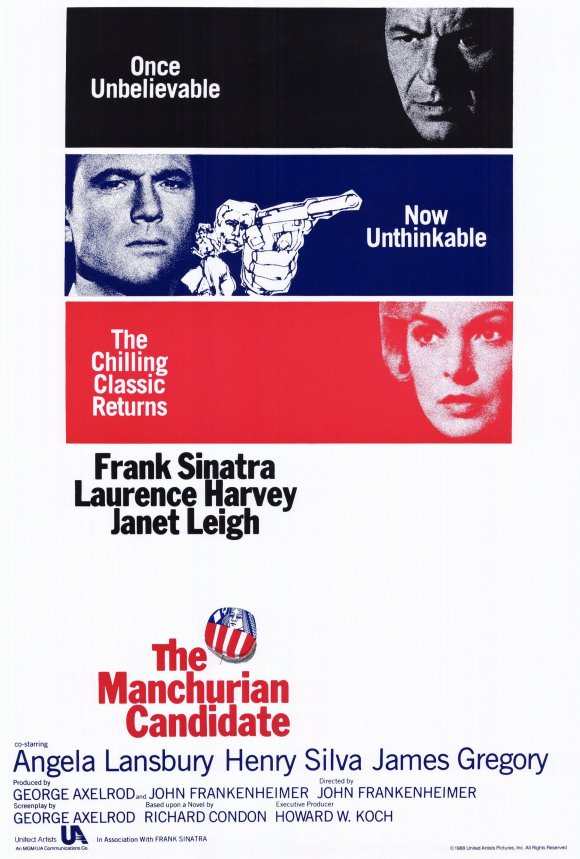
Film #54: The Manchurian Candidate (1962)


Director: John Frankenheimer

Initial Release Country: United States

Times Previously Seen: once (about ten years ago)

Teaser Summary (No spoilers)

U.S. Army officer has mind bent into an assassin during Korean War, comes home, experiences strangeness; Machiavellian mother.

Extended Summary (Complete summary of major story points, MAJOR spoilers included. Fair warning.)

In the thick of the Korean War, Raymond Shaw (Laurence Harvey) is the thoroughly uppity, humorless and utterly disliked Staff Sergeant of a small platoon. One night, thanks to their traitorous Chinese interpreter, the entire platoon is captured and dragged away by mysterious, black-clad figures.

Fast-forward several weeks. Raymond Shaw arrives home in the United States to much fanfare. We are told that he had escaped capture by fighting his way out of a POW camp, destroying enemy fortifications, and rescuing his entire platoon, save two men, in the process. For these acts, he has been awarded the prestigious Medal of Honor. His plane is met by marching bands and hordes of reporters, as well as his mother, Eleanor Shaw Iselin (Angela Lansbury) and step-father, Senator John Iselin. It soon becomes apparent to the young Shaw that the entire pageant has been set up as a platform for his step-father's political ambitions. Raymond is clearly disgusted and embarrassed by the entire show.

Elsewhere in the country, two of Raymond's fellow soldiers from Korea are having some bad experiences. Major Bennett Marco (Frank Sinatra) and Corporal Allen Melvin are having bizarre and terrifying dreams. In these dreams, they see themselves and their platoon sitting in a hotel lobby, listening to what starts as a lecture on hydrangeas. Eventually, however, it becomes an exposition by a Chinese hypnotherapist, Doctor Yen Lo, to high-ranking communist party leaders from places such as Russia. Lo is explaining to his comrades how he has brainwashed the platoon, but particularly Raymond Shaw. Shaw has become a weapon that, upon seeing or hearing the correct triggers, will follow whatever orders he is given. To demonstrate, he has Shaw kill two of his own squad members in front of the others. At this point in their dreams, Marco and Melvin always wake up.

Bennett and Shaw, brainwashed with the rest of the platoon.

In the waking world, a shaky Marco Bennett is assigned as a press relations attache to a federal congressman. On his first duty, at a small press hearing, he comes almost head-to-head with the blustering Senator Iselin, who shows up unannounced and loudly levels anti-Communist accusations towards many unnamed members of Congress. While the doltish Iselin holds the position of power and the attention of a communist-wary public, it is clearly his wife, the cold and calculating Eleanor, who is behind all of his fear-mongering.

Bennett's dreams continue to disturb him; so much so that he is temporarily relieved of duty. He seeks out Raymond Shaw to find some sort of answers, and finds him working for a left-leaning journalist in New York. In speaking with his ever-misanthropic former subordinate, he learns that he is not alone in his dreams, as Raymond had received a letter from Melvin shortly before. This, however, is all he can tell Bennett. Soon, Marco convinces his superiors of the validity of his suspicions, and he and Melvin are separately able to identify some of the communist leaders they have seen in their dreams. The army decides to let Bennett stay close to Shaw to keep tabs on him.

While being under Bennett's watch, Shaw reveals a seminal moment in his past: the one time that he has both truly loved and been loved. It was with the lovely Jocelyn Jordan, the daughter of Senator Thomas Jordan, the staunchest rival to Raymond's fanatical mother and her puppet Senator husband. Raymond and Jocelyn had a summer of happiness before Eleanor learned of it, and forced Raymond to break it off in brutal fashion. Raymond then enlisted in the army.

Shortly after this revelation of Raymond's past, Major Bennett witnesses a clue to the brainwashing technique through a bizarre accident with a deck of cards. During a random encounter in a bar, Bennett sees Raymond hear the suggestion, “Why don't you pass the time by playing a little solitaire?” Upon hearing this phrase, Raymond robotically follows the suggestion until he overturns the queen of diamonds. Whatever suggestion is made to Raymond after he sees this card will be seen through and completely forgotten by him, no matter how ridiculous or brutal.

Bennett works out the triggering mechanism for Raymond's fugue assassination states.

Raymond's mother decides to throw a costume party with two subversive purposes. She invites her arch-enemies, the Jordans, so that she might reunite Raymond and Jocelyn, thus getting Eleanor closer to her rivals. Also, she reveals to Senator Jordan her plans to spearhead her husband's nomination as Vice-President in the upcoming elections. Jordan informs her that he will seek to impeach Iselin if they do any such thing. In a side room, Jocelyn, costumed as the Queen of Diamonds, steals in upon a dazed Raymond, and inadvertently hypnotizes him into eloping with her.

While all of this is happening, Major Bennett has been back at headquarters, puzzling over Raymond's strange behavior. He eventually puzzles out all of the triggers, and he plans to find Raymond in order to try and de-program him. Whom he finds first, however, is Jocelyn Jordan, who pleads with Bennett to give them 48 hours together while on their honeymoon. She assures Bennett that hers and Raymond's love for each other will overcome any potential brainwashing. Bennett reluctantly accedes.

Back at the Iselin residence, Eleanor schemes. She knows of her son's elopement, and puts her darkest plan into motion: We now learn that she has been the communists' agent in America, and she uses Raymond's triggers to hypnotize him and send him to kill both Senator Jordan and Raymond's own new wife, Jocelyn. Raymond does so, in the same mechanical fashion as he had killed his fellow soldiers.

The slaying of Jocelyn and her father by her own husband. One of the most distrubing scenes I've ever watched.

We also learn that, in addition to eliminating Senator Jordan, Eleanor has even greater ambitions: she has orchestrated the assassination of the presidential candidate who her husband will be running with as Vice-Presidential candidate. Her overall plan is to use the killing, which will happen in mid-acceptance speech, to whip up such powerful anti-communist sentiment that her husband will become president (with her making all the decisions, as usual), enact martial law, and turn the country into a war machine that will crush the supposed “Red Menace”. During her exposition of this plan to her entranced son, she recalls how she had requested an assassin from the communists, not knowing that they would use her own son in an attempt to bind her to them. Alas, she is willing to sacrifice Raymond for her own ends.

Upon hearing of the deaths of the Jordans, Major Bennett is wracked with guilt and self-doubt. He realizes that he could have stopped it, but did not. He receives a call from Raymond and races to meet him in hotel across the street from the fast-approaching acceptance speech for Raymond's detested step-father. Bennett finds Raymond and uses his own deck of cards, all queens of diamonds, to send Raymond into a trance and attempts to “rip out the wiring” by telling him that its all over now, and that he is free of the psychological strings that the scientists attached to him in Korea.

Still, it would seem that Bennett's work has gone for naught. When the speech approaches, Raymond frees himself from Bennett and seems to fall back under his mother's control. He disguises himself as a priest and takes a rifle into a high point in the convention hall. Bennett and another officer get to the speech just as it starts and desperately search for Raymond. As the speech nears the point at which Raymond is to kill the presidential candidate, Bennett spies Raymond's position and runs up to him. Just as he reaches the door, Raymond turns his rifle sights away from the presidential candidate and rapidly shoots and kills both his step-father and his mother. He puts on his Medal of Honor, turns, looks at Bennett, and sadly explains that “nobody else could have stopped them”. Then, he puts the rifle in his own mouth and kills himself.

Take 1: My Gut Reaction (Done before any research)

I'm still trying to get my head around this one. It's not hard to see why so many of the original press releases and posters had things like, “You'll have to watch it again immediately!” Quite true. If I hadn't seen it once already, I would probably feel the same way. Even still, as you can see from the massive plot summary, it's hard to give a thumbnail synopsis of this movie. There are too many bizarre, novel, and absolutely necessary elements to explain.

But really, do they all amount to a movie that I liked? Overall, yes. While there are some clunky elements, I really enjoy the film and recommend it to nearly anyone with a stomach for very dark subject matter and stories that go for the slow reveal.

First, the bad, though perhaps “bad” is not quite the right word. As fascinating and unique as so many of the facets of The Manchurian Candidate are, there are some odd ones as well. Probably foremost are the several false leads that the movie throws at you. In a film that, from its very beginning, is all about not taking things at face value, there are many conversations and happenings that lead you down false paths. Marco Bennett's reading books of odd and varied topics is one of them. In a movie that so masterfully interlocks seemingly disparate and puzzling story elements, this is one that is never explained or connected to any other element. Or if it was, I'll be damned if I can figure it out.

Related to this are two things that are themselves connected. In the middle of the film, a very shaky Major Bennett is on a train and meets the gorgeous Eugenie Rose Cheney, played by the sultry Janet Leigh. The two have a conversation that is, in turns, flirtatious, awkward, and laden with bizarre questions and answers that lead we viewers to think that there is something much deeper going on. Is Rose romantically interested in Bennett or is she some kind of agent for one of the great Cold War powers? Well, it turns out that she merely fancies Bennett. No more, no less. Once this is clear, the strangeness of their initial conversation seems far out of place.

On top of these strange feints and hintings at things that are not there, it seems completely incoherent to have a romantic plot-line that does nothing to enhance the story. Hollywood has always been notorious for this, and rarely has it been more obvious than in The Manchurian Candidate. The characters of Rose Cheney and her wooing of Major Bennett have so little to do with anything else going on in the movie that they are mere distraction. It's utterly bizarre to me that a film that was, in all other respects, so carefully crafted and rich in story would have such a malformed component attached to it. I strongly suspect that this was something that the studio, not the original creative forces, demanded. I plan to find this in my research.

Aside from these clumsy add-ons, the film is a wonderful mind-bender. I can only imagine the impact that it had on audiences in 1962, in the middle of the Cold War, but I have to assume that it took real guts to pull this one off. You have double-dealing, backstabbing, and brainwashing thrown into a dizzying plot-line that rarely gives the viewers a moment to truly figure out whose side they're on. The political climate would have been just post-McCarthyism, who the buffoonish Senator Johnny Iselin is clearly based upon, but having him be the puppet of a communist-backed, double-dealing, viperous marionette in Angela Lansbury is just plain wicked, in all of the right ways. The layers of fear and betrayal going on in this movie are astounding, but never completely out of reach for us viewers. This is a testament to John Frankenheimer's directorial powers.

Raymond Shaw, the last guy you want to be seeing from this perspective.

I suppose that part of me feels that this movie is a sign of the times. Having been released in the middle of the Cold War, when the fear of spreading communism was all-too-palpable, The Manchurian Candidate must have been quite a shocker in that it demonizes both political extremes. The hard-core communists are portrayed as manipulating, soul-less monsters. However, their monstrosity is equally matched by Senator Johnny Iselin and his dictator wife. In the end, the movie is the ultimate condemnation of fanaticism, which gives it a life far beyond the political climate of the Cold War decades.

The acting is quite solid. Sinatra does fine (though he does add in some strange, “Brat Pack”, hipster lingo here and there.) The strongest performances, though, are from Laurence Harvey and Angela Lansbury. Who would have thought that the woman most of us know as a kindly, geriatric sleuth on Murder, She Wrote could so convincingly play an icy, calculating, she-demon? When you see her go to work on both her son and dunce of a husband, you're as scared of her as of the ostentatiously sinister communist hypnotherapist, Doctor Yen Lo.

The visuals are just right for the movie. Done in black-and-white, the stark tone is set and compliments the theme of dual extremes that is explored. There are many shadows and skewed angles that enhance the viewers' sense of unbalance and the warped nature of what certain characters are doing. A bonus for me is that I watched this movie on a cold, rainy day. It was perfect, and I recommend anyone else try the same.

Considering the ultimate fate of Staff Sergeant Raymond Shaw in The Manchurian Candidate, I'll go ahead and say that it is the darkest, most disturbing movie I've seen from the TIME list so far. So many films claim to go to dark places, and some of them even flirt with it, though very few actually plunge right into those shadowy recesses. The Manchurian Candidate doesn't balk at leading you into the abyss. Darkness and all, this movie is one-of-a-kind. So much so that I probably will never watch the recent re-make with Denzel Washington. I never have seen it, and I simply don't see how it can pack the same punch.

Take 2: Why Film Geeks Love This Movie (Done after some further research):

Ah-ha. After some digging, some interestings factoids emerge, and I feel less stupid about a few things.

The Manchurian Candidate was adapted from Richard Condon's novel of the same name, published in 1959. Most of the elements from the novel are kept for the movie. However, one notable change was made: In the novel, Eleanor Shaw not only uses her son as an assassin to further her nefarious political goals, but she also leads him into a hypnotized, incestuous relationship with herself. This, as we can all imagine, was not going to fly in a mainstream movie in 1962. The closest the film gets is a rather disturbing, lips-on-lips kiss that Eleanor delivers to her mesmerized son just before the movies' climax.

A curious side-note about the novel: it has since been cited for blatant plagiarism from the Robert Graves classic novel, I, Claudius.

My moment of vindication came when, after reading several critical reviews, including the cinematically erudite Roger Ebert's, it became clear that the conversation between Bennett and Rose Cheney that so befuddled me has been perplexing viewers for decades. Apparently, this was also taken almost word-for-word from the novel and is universally baffling. Ebert, in his review here, offers the interesting notion that we are meant to infer that, though never openly suggested, Rose may also be a communist agent of some type. If this is the case, then the movie is flirting with an ambiguity that may be just as upsetting as any of the other aspects of the story.

The altered "incest" scene, tamed for the masses.

The initial critical reviews were almost unanimously positive. Almost. TIME magazine's rather short review from 1962 does seem to criticize it, but more for lacking some of the literary punch of the novel.

One final interesting note: The Manchurian Candidate was pulled from release and basically never shown between 1963 and 1988. The reason? The Kennedy assassination, which happened a mere week after the movie's premier. Frank Sinatra, who had purchased the rights to the film, reportedly felt it in poor taste to allow a film about political assassination to reap profits for anyone, including himself. So, the movie remained in virtual hiding for 25 years. Good thing for us younger movie lovers, he opened up the cage.

That's a wrap. 54 shows down, 51 to go.

Coming Soon: Lawrence of Arabia (1962)

Law-RENCE! Law-RENCE! Law-RENCE!

Once I find the roughly four hours it takes to watch this behemoth, I'll let you know how it went.

Please be sure to pick up all empties on the way out.

Friday, April 8, 2011

Film #53: Yojimbo (1961)


Title for Us English-Speaking Types: “The Bodyguard”

Director: Akira Kurosawa

Initial Release Country: Japan

Times Previously Seen: once (about 8 years ago)

Teaser Summary (no spoilers)

Skilled, masterless samurai whittles away two rival gangs in a dusty Japanese village. Drinks plenty of sake.

Uncut Summary (A full plot synopsis, including spoilers. Fair warning)

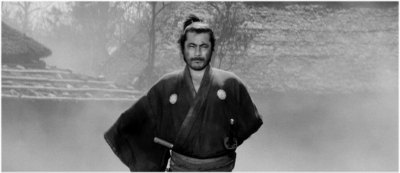
In 19th century feudal Japan, Sanjuro Kuwabakate (Toshiro Mifune), a drifter samurai with no retainer, wanders into a tiny village. He soon runs into a small horde of raggedy hoods who bar his path through the town. Not itching for a fight (yet), he casually retreats into the tiny nearby sake shop. While there, the owner, Gonji (Eijiro Tono), explains the ill-fated town's situation. The entire village is the setting of a current stalemate between two rival gang families, headed by Seibei on one side and Ushitora on the other. They are both competing for domination of the local silk and sake trade. The competition is so fierce that each boss has appointed his own mayor and essentially owns a complete half of the village. Sanjuro sees this as a money-making opportunity.

Sanjuro, getting the lowdown and considering his money-making options.

He first strolls over to the Ushitora gang, goads some of them into attacking him, and effortlessly slays three of them in full sight of the Seibei clan, who is watching from the far side of the village main street. He walks over to Seibei and extorts major cash from him to side with him. After the deal, though, Seibei's venomous wife pulls her husband aside and convinces him to kill Sanjuro after he helps them exterminate Ushitora and his minions. Sanjuro overhears this, but does nothing immediately.

Emboldened by his new-found sell-sword, Seibei calls out the Ushitora clan and calls for a showdown. Both sides square off, but just as they are about to begin their slow approach towards each other, Sanjuro throws Seibei's money into his and his wife's faces, loudly proclaiming how insulted he is that they were plotting to assassinate him. He then calmly scales the central bell-tower, overlooking everyone. Seibei, now in no position to back down, begins the slow march towards Ushitora's gang. From on high, Sanjuro gleefully watches what he hopes will be a bloodbath that eliminates both gangs at once, without much effort on his part.

Unfortunately, just as the two gangs are about to start fighting, an inspector rides into town. Sanjuro's plan is stymied. He returns to Gonji's shop to plot his next move. He learns of a nearby murder of a local magistrate (conducted by Ushitora's men), and decides to wait and see which clan outbids the other for his services. He doesn't have to wait long, as Ushitora's comes with a very generous offer. Sanjuro refuses, saying that he has many offers to consider. Later that night, Ushitora's youngest brother, the handsome but psychotic Unosuke arrives, brandishing a brand new pistol.

The night deepens, and Sanjuro approaches Ushitora, offering to spy on Seibei for him. Ushitora accepts and pays Sanjuro. Shortly after, Sanjuro runs across the two drunken thugs who Ushitora sent to kill the magistrate. Sanjuro quickly rounds them up and brings them to Seibei, who pays him handsomely for the chance to have proof of Ushitora's assassination order. Sanjuro then quickly returns to Ushitora and informs him that Seibei has captured his men (leaving out the fact that he's the one responsible). This leads to a quick deal for a hostage swap: Ushitora gets his men back, and he will return one of Seibei's prized stable girls, Nui, whom he had stolen and pimped out to his puppet mayor. After one failed attempt, the deal eventually goes down, much to the dismay of Nui's poor husband and young son. Sanjuro watches the exchange with these last two, and shows no sympathy for the quivering husband.

Sanjuro goes to work. Scum-thugs flee in terror.

Without much ado, the homicidal Unosuke kills the two returned assassins, and his elder brother Ushitora returns Nui to the lecherous mayor's home. Sanjuro learns of the latter and coyly suggests that he check on the house, despite the six armed guards that Ushitora has placed there. Sanjuro goes with Ushitora's middle brother, the dull-witted thug Inusuke. Just before they arrive at the mayor's house, Sanjuro distracts Inusuke, pretends to have inspected the mayor's house, and then tells Inusuke that the six guards have all been killed. Inusuke, without bothering to check Sanjuro's story, runs back to his brother's house to rouse the troops. Sanjuro then storms the mayor's house, easily slaughters the six guards, and grabs Nui, whom he returns to her husband and son, who have been hovering just outside. They try to stay and offer their profound thanks, but Sanjuro disgustedly ushers them on their way.

Ushitora's men soon arrive at the mayor's house, which Sanjuro has just demolished in order to lend credence to his lie that the place had been stormed by a group of Seibei's men. Ushitora buys it, and they all return to his place in anger.

A few days later, Sanjuro is relaxing in Gonji's sake shop when he receives a letter from Nui and her husband, thanking him again for saving their lives. Sanjuro repeats his distaste for such “weak people”, though Gonji openly admires Sanjuro's heroism. Then, the cold-blooded Unosuke arrives with Inusuke. He has had his doubts about Sanjuro's tale about the mayor's house. In addition, he has heard through the grapevine that Nui and her husband have been seen in a nearby village, claiming to have been saved by a single skilled samurai. Sanjuro plays it cool and tries to dismiss the accusations and inconspicuously dispatch the note from Nui, but Unosuke sees and snatches it first. Sanjuro is finally caught in his deception. His sword is taken from him, leaving him all but defenseless.

Back at the Ushitora compound, Sanjuro is locked in a side room and beaten mercilessly for a full day. Eventually, he is left alone and he takes his chance. He crawls inside a chest and waits. When his two thug guards return and don't immediately see him, they believe he has escaped, panic and run out of the room, leaving the door open. Sanjuro painstakingly crawls out the door and, with agonizing slowness and a little luck, manages to evade Ushitora's brothers and gang.

He makes it to Gonji's and asks the sake maker to smuggle him out of town. Gonji and the local casket maker load Sanjuro into a casket and begin to carry him to the local cemetery. Just as they begin their trek, though, they see that Ushitora has launched an all-out assault on Ushitora's compound. Ushitora believes that Seibei is responsible for Sanjuro's escape, and he sets fire to his rival's house, with all of those fleeing the inferno being either cut down by a gang member or gunned down by Unosuke. Sanjuro watches from afar, the fact that half of the town's cancerous crime is dead bringing his battered body some small relief. He is then carried to a safe house on the outside of the village.

Sanjuro spends several days quietly recuperating and practicing hitting a moving leaf with a throwing dagger. He has also heard that Ushitora has fired most of his thugs, now that Seibei's entire crime family is dead. Both Gonji and the casket maker have been smuggling him food and water during this time, but a serious problem emerges. The casket maker informs Sanjuro that Gonji has been discovered and captured, and that Ushitora has him strung up in the middle of town. Sanjuro's decides to cut his recovery shorter than expected.

The final stand-off commences.

In the middle of town, Gonji hangs from a low gibbet, tied around his body and awaiting his fate. Less than a dozen gang members are left to support Ushitora and his two deadly brothers. Sanjuro walks into the center of town, only to be met by these last, most powerful criminals. A few words are exchanged, and then the fighting breaks out. Unosuke, predictably, pulls his revolver first, but Sanjuro is faster and hurls his throwing dagger, striking Unosuke directly in his shooting forearm. With this primary threat neutralized, Sanjuro routinely mows down everyone left with his sword.

With all of the criminals now dead, Sanjuro pronounces the town clean of its human filth and walks out, leaving it to Gonji, the casket-maker, and the scant few others remaining to rebuild anew.

Take 1: My Gut Reaction (Done after this most recent viewing, before any research.)

To use one of Quentin Tarantino's favorite phrases, this movie is bad-ass. Or, perhaps more accurately, Sanjuro Kuwabakate is bad-ass. So, what accounts for its bad-assitude? I thought you'd never ask...

Before really looking at the greatest strength of this movie, I have to give credit to several other impressive aspects. First is the story. The notion of having a seeming mercenary drift into a lawless town, wreck shop, save the remaining innocents, and coolly walk away from it is legendary. I'll have to do some digging to see if this idea has been used before (I'm reasonably sure it has), but Kurosawa molded it into one hell of a fun film to watch. Waiting to see just how Sanjuro would play one side against the other and take advantage of their own insecurities and paranoia is as entertaining as can be.

Here's a great scene. Sanjuro uses hits wits to con the doltish Inusuke, then his unmatched swordsmanship to dispatch basically everyone else who gets in his way:


The setting itself is worthy of mention. While this tale could easily be told in a large, thriving city, and in a more modern time, doing it in a tiny 19th century village lends a perfect sense of unity to everything that's happening. With such a limited cast of main characters and individual places, one can really sense how connected everything is and just how imminent the dangers are.

Of course, these two previous components are only enhanced by the flawless direction of Akira Kurosawa. By this point, Kurosawa was fully established as a brilliant filmmaker. While I know that he had some critics, I don't think that anyone can see a film such as Yojimbo and deny just how great he was at visual storytelling, pacing, and overall directing. Just one of the many great examples might be early in the movie, when Gonji is giving Sanjuro the low-down on all of the dirty dealings in the village. Both men are inside Gonji's weathered, wooden store, with Gonji excitedly throwing up the various windows as he points out the different factions and ne'er-do-wells. This short scene is filled with so much energy that you almost can't help but get caught up in it.

The crowning element of the whole thing, though, is Toshiro Mifune's turn as Sanjuro himself. Anyone who has seen both The Seven Samurai and Yojimbo has to marvel at the man's range. Sure, both roles were feudal-era Japan swordsmen, but they could not have contrasted more. Six years prior, he played an uncontrollable wildman. In Yojimbo, he portrayed a character as psychologically poised as a bamboo reed and cool as the snowy slopes of Nagano.

However, it would be hasty just to lump him into the standard “calm, calculating maverick hero” department. With Kurosawa envisioning Sanjuro as a generally amoral, eminently scruffy, and only occasionally fallable rogue, he created something new. Mifune brought the master director's vision to full life with his lazy gaze, shifting shoulders, and unhurried manner. Mifune did in 1961 what great character actors like Johnny Depp and Brad Pitt made careers of decades later.

Upon dissection, my guess is that most, if not all, of the components of Yojimbo have their inspiration in other direct sources. Still, I found it to be a fantastically unique and entertaining film. As long as one realizes that the scenarios and characters are rather ridiculous, it's easy to see this movie for the masterpiece that it is.

Take 2: Why Film Geeks Love This Movie (Done after some further research)

As suspected, Yojimbo was not created in a vacuum. Akira Kurosawa, a junky of the western noir and western film genres, apparently took the story and Sanjuro character ideas from one or two Dashiell Hammett novels, namely The Glass Key and Red Harvest. The visual style was adapted from classic John Ford westerns, most notably the now-standard scene of the hero in foreground, enemies in the distance, and dust blowing through the streets. In fact, this last element is almost comically overdone (intentionally?) in Yojimbo.

A great shot of Sanjuro, hopinng to watch the two gangs weed each other out, thanks to his own skillful machinations.

When it was released, Yojimbo was a massive hit. Kurosawa's name had already been well-established throughout the cinema world, both popular and critical, but Yojimbo offered something new. While it was still clearly a samurai movie, the character of Sanjuro provided a rather new creature: a true mercenary with only the odd pangs of morality. Essayist Alexander Sesonske gives a really interesting analysis of it here.

Popular audiences loved the sword-swinging action and the steady dose of sarcasm throughout the movie, and this is no surprise. What was a tad surprising to me is how universal the critical praise was for such a “western style” action film. This original TIME piece, in addition to raving about Yojimbo, offers a really insightful look at Kurosawa himself and his place in Japanese film history (it was already clearly staked out, even back in 1961).

Yojimbo may have borrowed certain elements from other, earlier, sources, but its mark has been so indelible as to have spawned several direct remakes, set in different places. The first, and probably the greatest, is the Sergio Leone spaghetti western, A Fistful of Dollars (1964). Other less notables include the science fiction version, The Warrior and the Sorceress (1984), and the return to black-and-white noir, Last Man Standing (1996). Love the first one. Never seen the latter two.

My final word? Steam up some rice, warm up some sake, and fire Yojimbo into the DVD player!

Coming Soon: The Manchurian Candidate (1962)


Chinese communists! Brainwashing!! Assassination plots!!! Angela Lansbury!!!! Frank Sinatra!!!!! How can one film have literally EVERYTHING??!!! Come on back later and find out!

Please be sure to pick up all empties on the way out.

Sunday, March 13, 2011

INTERMISSION AWARDS!

Awards presented by myself, a humble cinephile, based on the first half of TIME magazine's 2007 list of “All TIME 100 Films”.

So here it is. I have now made it virtually halfway through the mildly monumental task of watching 100 “shows” (actually 105 since several of them are separate films that constitute a “whole” one). In honor of this middle point, I offer a little intermission in the form of my own awards. There is, of course, no Art Deco statuette, cash prize, or any other reward of any practical use. Merely my respect, admiration, and even derision in one case.

Several of these awards will seem very familiar, as they are right in line with any standard film award show. A few others are of my own design based on other criteria that I and many others often apply to movies. The one thing they all have in common is that they are all thoroughly subjective and completely open to debate.

Without further ado, let's have a look at the “winners” and runners-up, starting with a best of the worst:

“Insufferable” Award - given for excellence in the field of making me wish I could have gotten back the hours of life I lost in watching this film. And the winner is...


I would have to be paid some SERIOUS cash to watch this schlock again. The shallow characters, the threadbare plot, the excruciatingly cheesy pop songs. It all added up to two hours that were only made bearable by my girlfriend and I cracking wise through the whole thing. Musicals are my least favorite genre, and Meet Me In Saint Louis only further strengthened its position as such.

Runner-Up: The Awful Truth (1937) – A bunch of fast-talking, condescending aristocrats goofing off. It was about as funny as rickets.

“That Dog Don't Hunt No More” Award- Given to the film that has lost the most luster over the succeeding years. Even the classics sometimes die. And the winner is...

The Crowd (1928)


It seems like the down-to-earth dialogue and several very creative camera shots stamped this movie in the minds of audiences and film aficionados for decades. Eighty-plus years later, this film is about as bland as raw tofu, and nearly all of the humor is unintentional. It still has a smidgen of charm, but overall is tiresome by nearly every modern standard.

Runner-Up: King Kong (1933) – Some people still love this original version, and I have to give it props for originality, ingenuity, and a spirit of adventure. Alas, 78 years of special effects and action movie evolution have seriously dimmed the great ape's former brilliance. Even the Eighth Wonder of the World gradually wears down, I guess.

And now, on to the more positive side of things...

“Fine Wine” Award- Given to the film that I believe will, in the year 2101, still hold a place among great films and be watched and discussed by some schmo like myself. And the winner is...

Ugetsu (1953)


This movie, along with only a few others from the first half, transcends merely powerful cinematic storytelling and brings us into the realm of more universal myth. It taps into centuries-old folktales, and is so well-crafted and faithful to the spirit of such myths that I can't help but think that it will possibly outlast every other movie on this list. And that's saying something.

Runners-Up (tie): The Olympiad (1936) and Man With a Movie Camera (1929). The former will appeal to sports historians for many decades to come, and the latter is perhaps the purest film, in terms of art, on the entire list. Neither one will be disappearing from the cinematic landscape any time soon.

“'I'm Not Talkin' Here!'” Award - Given to my favorite silent film from the list. Those movies in the days of yore when it all relied on either pure visual film technique, great sight gags, or some of both. And the winner is...


This one packed a serious punch. An epic story that is told in a tight 90 minutes, the brightest among this film's many bright elements is a fantastic leading performance by Emil Jannings, the very first Academy Award “Best Actor” winner for his role as a traumatized Czarist Russian general.

Runner-Up: Metropolis (1927). The original science-fiction masterpiece is still just that – a massive film that was so far ahead of its time that modern viewers can still find things to appreciate. The acting is necessarily way over the top, but the visuals are still well worth taking in.

“Subtitle Me!” Award - Given to my favorite film made by one of those non-English-speaking types. And the winner is...


This early, lighthearted number by oft-depressing Swedish master, Ingmar Bergman, was really fun. If one has to do a 19th-century aristocratic period piece, this is how to do it: sharp visuals, plenty of witty and dry humor, and consistently strong acting. I'll go back to this one sooner rather than later.

Runner-Up: Les enfants du paradis (Children of Paradise) [1945]. Grand in scope and in production, this French mammoth is worth the full 3 hours. It may drag in just a few places, but overall was well worth the time invested.

“Hidden Gem Award” - Given to the film that I previously knew absolutely nothing about, yet enjoyed immensely. And the winner is...


I had never so much as heard of this film, and I feel ashamed for it. It was so damned funny that I'm itching to watch it again already. It was hands-down the darkest comedy from the list so far, and may very well retain that title by the end. The British mastery of finding humor in normally dreadful and morbid doings is on full display in this one, wonderfully accented through Alec Guinness and his eight separate and hilarious roles.

Runners-Up (tie): Dodsworth (1936) and In A Lonely Place (1950). The former was wonderfully-executed tale of the American dream personified in the title character, who then grapples with unexpected personal obstacles. The latter was an incredibly tense character study of a deeply disturbed genius, played by Humphrey Bogart.

“'Just Because You Are a Character, Doesn't Mean That You Have Character' Award” - Given to the individual character that I liked the most. And the winner is...

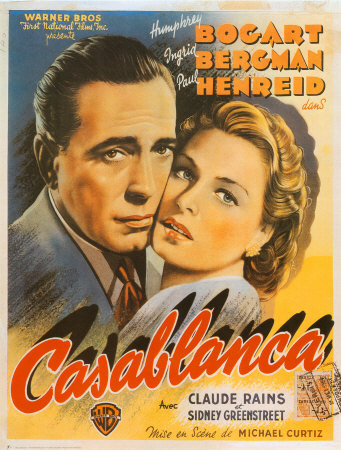
Rick Blaine, Casablanca (1942)


It may not be an original choice, but Rick is the friggin' man, man. He's tough, sensitive, witty, and above all, smooth. Anyone who watches Casablanca wishes Rick were real and, like all the other characters in the film, rightfully wants to be on Rick's good side. He'll buy you a stiff drink, give you a fair shake, and if he likes you, he'll absolutely go to the mat for you.

Runner-Up: Jeff Markham, Out of the Past (1947). I seem to have a type. Jeff Markham is the archetype noir protagonist: quietly tormented, capable of great nobility, though subject to a few serious demons. He out-thinks, out-smokes, and out-sarcasms every other dark soul in the picture. His Achilles heel, just as with all noir tough guys, is a pretty face masking an absolute Gorgon.

“'I'm A Movie Star, Not an Actor!!'” Award – Given to the man whose performance I dug the most. And the winner is...

James Cagney as Cody Jarrett in White Heat (1949)


The little New Yorker went all in when he played this violent, ruthless, fully psychotic criminal with major mommy issues. Cagney injects every scene he's in with energy that magnetized me to the point that I was watching his every gesture and facial expression. And that's not even getting into the great one-liners he delivers throughout.

Runner-Up: Anthony Perkins as Norman Bates in Psycho (1960). In the most recent movie I watched, I saw a mesmerizing performance by Perkins. He was so naturalistic with all of the divergent facets of Norman Bates that it is still astounding. He alone makes it worth watching the movie.

“I'm Ready for My Close-Up!” Award – Given to the woman whose performance I dug the most. And the winner is...

Barbara Stanwyck as Lily Powers in Baby Face (1933)


In this tale of a downtrodden woman empowering herself by sleeping her way up the corporate ladder, Stanwyck showed herself so far ahead of her time that it's scary. When Hollywood films were still firmly entrenched in more theatrical and dramatic (i.e. “exaggerated”) styles of acting, Stanwyck was one of the few who could seem so relaxed that she made everyone else on the screen look like amateurs.

Runner-Up: Ingrid Bergman as Alicia Huberman in Notorious (1946). I seem to have a type. My favorite female performances would appear to involve either sex or booze, or in Alicia Huberman's case, both. Not unlike Stanwyck's most memorable roles, the adorable Bergman shifted gears in Notorious and was surprisingly adept at playing a reluctant spy with very questionable habits in relation to alcohol and men. A brilliant showing by the classic Swedish beauty.

“Mmmm...This Is An Excellent Movie!” Award – Given to my absolute favorite film of the first half. And the winner is...

Casablanca (1942)


I sure won't get originality points for this, but I can't ignore how much I still enjoy this standard of American film. Casablanca may not be a life-changing film of immense learning or depth, but it contains all of the elements of the magic of movies. It created a fictional place that was equal parts alluring and frightening, characters who were intriguing, charming and strong in turns, and situated all of these elements within a compelling tale that, while very temporal and geographical, seems to transcend these clear boundaries. Add in one of the greatest scripts in film history, and this movie still has enough gas in the tank to be a standard for decades to come.

Other Nominees – These are the four other films that I had to seriously consider for this award, as they are ones that I will certainly return to and enjoy many more times in the future: Double Indemnity (1944), Out of the Past (1947), Kind Hearts and Coronets (1949), and The Sweet Smell of Success (1957).

Imagine now the orchestra in a crescendo, not-so-gently telling you that the show is over.

That's a wrap. Still 52 shows down, still 53 to go.

Coming Soon: Yojimbo (1961)
Sword-swinging samurai action from perhaps the greatest samurai film director/actor duo in history: Akira Kurosawa and Toshiro Mifune. This one should be fun!

Please be sure to pick up all empties on the way out.

Sunday, March 6, 2011

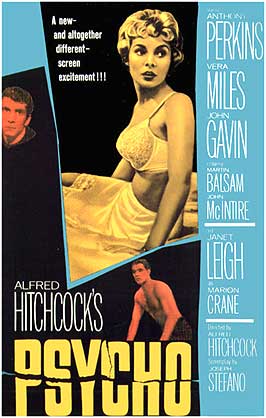
Film #52: Psycho (1960)


Director: Alfred Hitchcock

Initial Release Country: United States

Times Previously Seen: once (about 8 years ago)

Teaser Summary (No spoilers)

Restless secretary steals serious cash, then runs across a socially awkward creep at a motel.

Uncut Summary (A full plot synopsis, serious spoilers included. Fair warning. No seriously, if you have not watched this movie and have intention of doing so, do NOT read this summary!)

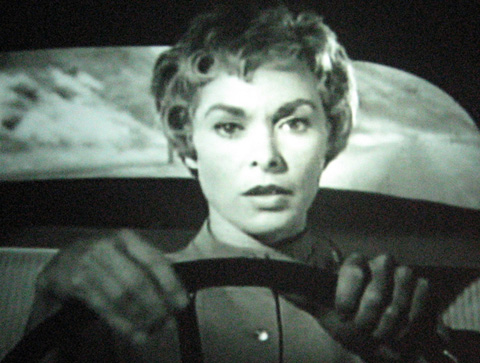
In Phoenix, Arizona, Marion Crane (Janet Leigh) is a secretary who has an itch to change her life. She's wrapped up with a lover, Sam (John Gavin) who must use much of the little money that he makes on alimony payments. She's been in the same static job for ten years. Her professional and romantic lives are in a complete rut.

And then, opportunity presents itself. Her boss has just completed a major deal with an out-of-town high-roller. The new client comes into the office, makes some overtly lecherous passes at Marion and drops $40,000 on her desk. The money is part of her boss's new deal with the man, and she is charged with putting the money in the bank. Instead of seeing the task through, though, she takes the money and hits the road. She clearly sees this as a chance to join Sam and use the money to live a better life.

Marion, driving away from Phoenix, considers her recent theft.

Once she hits the road, Marion gradually becomes a nervous wreck. She begins to imagine her boss, friends and relatives wondering where she is and just how the imminent pursuit will begin. She eventually pulls over and falls asleep on the side of the road, only to be awoken in the morning by a curious police officer. Rather shakily, she tries to brush the cop off, but only succeeds in arousing his suspicions. She does, however, manage to avoid any kind of arrest or more serious trouble for the time being.

The next night, with rain pouring down and her nerves worn thin, Marion decides to pull into a roadside lodge called the Bates Motel, a twelve-room inn that sits beneath the shadow of an imposing Victorian-era house. She sees the silhouette of an old woman in the window from the road, but it is a young man who comes dashing down to help her. The man, Norman Bates (Anthony Perkins), is friendly in his greeting and checks Marion in for the evening. Despite her fatigue, Norman convinces her to have some dinner and chat with him in the motel office.

In the course of their conversation, it becomes clear that Norman is a rather awkward fellow. He explains that the motel, which once was on the major highway, has seen very little business in recent years and that he is inextricably bound to his mother. This surprises Marion somewhat, as she had overheard the woman's voice berating and browbeating Norman in their home a short time earlier. In hearing about Norman's trapped existence, Marion becomes more ponderous and even rethinks her larcenous plan.

In the office of his motel, Norman describes his own lonely life to a receptive Marion.

After she retires to her room (into which Norman briefly peeks through a hidden hole in the wall) Marion seems determined to return to Phoenix, give back the money, and avoid trapping herself by becoming a bona fide felon. Having made this life-preserving decision, she hops into the shower, with horrendous results. A shadowy figure of a woman stalks into the bathroom with a massive knife, attacks and kills Marion, leaving her body on the floor.

Moments later, Norman comes running from the house and into Marion's room, where he finds the horrifying remains of Mother's attack. Once he recovers himself, he carefully gathers up the body, along with all of her personal affects (including the $40,000, which was hidden in a newspaper), loads everything into her car, and pushes it all into a nearby swamp.

Roughly a week later, Marion's sister Lila shows up in California, where Sam works. By now, people back in Phoenix assume that Marion stole the $40,000 and must be with Sam. Sam admits that he knows nothing about this and hasn't seen Marion since their last rendezvous before she stole the money. Also on the case is private investigator Arbogast, who has been hired by Marion's boss to recover the money. Arbogast decides that Marion must have been somewhere close, and he starts looking into all of the nearby motels.

After searching dozens of motels in the area, Arbogast eventually arrives at the Bates Motel. In questioning Norman Bates, Arbogast finds not only probable evidence of Marion's presence in the form of an alias in the motel registry, but also a suspiciously nervous Norman Bates. He doesn't get any direct admissions from Bates, but squeezes an admission from Bates that he saw Marion. Bates also accidentally implies that Marion had spoken with his mother. When Arbogast asks to speak with Norman's mother, however, Norman rebuffs him, explaining that his mother is an invalid and unable to take visitors. Arbogast reluctantly leaves.

After quickly checking in with Lila and Sam, Arbogast decides to return to the Bates motel and try to speak with Mrs. Bates. Once he returns, he quietly strolls directly to the Bates house and enters. As he ascends the stairs, however, the same be-dressed, knife-wielding figure who murdered Marion sets upon Arbogast. Before he can react, he is knocked down the stairs and stabbed to death.

The figure of Norman in front of his family home, where things become more mysterious and murderous.

Back in town, Sam and Lila grow nervous. Having not heard from Arbogast for hours past his stated meeting time, they call the local police. The sheriff is skeptical of what he hears, especially when Sam and Lila relate their notion that Mrs. Bates knows something about Marion's whereabouts. The sheriff explains his surprise by informing the two that Mrs. Bates died ten years before. This raises the question: exactly who is the “Mrs. Bates” back in the Bates house?

Sam and Lila decide to take matters in their own hands and head to the Bates Motel themselves. They have Norman Bates check them in as a phony married couple and hatch their investigation. Sam distracts and interrogates Norman while Lila slips away to the house. She searches through the house, but finds no evidence of “Mother”. Back at the motel, Norman grows very nervous under Sam's questioning, realizes the ploy, knocks Sam out and runs to the house.

In the Bates house, Lila sees Norman coming and scuttles down into the basement. In a far corner, she sees the back of an old, withered woman sitting in a rocking chair, presumably the enigmatic Mrs. Bates. When she turns the chair around, however, she is mortified to see that it is, instead, the semi-mummified and rotted remains of the deceased woman. Just as Lila shrieks in horror, she turns to see the door behind her burst open and Norman Bates, donning his mother's dress and a wig, hoisting a massive blade and ready to kill her. In the nick of time, Sam barrels in and subdues Norman before he can get to Lila.

Some time later, back at the police station and with Norman in custody, a psychologist explains everything. After intense interviewing of Norman, he explains that Norman has been a split personality. That he had, in fact, been so close to his domineering mother as a young boy and man that he felt them to be inseparable. Eventually, however, Norman's mother had taken a lover and began to shun her son. Norman apparently suffered a severe mental collapse and killed his mother and her lover. Unable to take the guilt, his mind fractured further and he began to live out both his own life as well as that of his dead mother. He took it so far that, if he would ever have any yearnings for any other woman, his “Mother” half would lash out and kill that woman. Hence the death of Marion and the subsequent killing of Arbogast.

In the end, Norman Bates was no more. After the final shock and capture, the only personality left was the “Mother” part of his persona. Left in a solitary room, he mutely awaits their judgment, lost in his own mind and delusional to the point that he believes that his current silence and timidity will save him. “They'll look at me and say,” thinks “Mother” while staring into space,”'She wouldn't hurt a fly.'”

A final look at Bates, lost in his own mind.

Take 1: My Gut Reaction (Done after this most recent viewing, before any research)

This is definitely one that has seriously lost some of its luster.

Don't get me wrong. This is not because of any flaws in the film; it is simply due to the passage of time and the fact that so many of the elements that were dazzlingly fresh and shocking in Psycho became old hat some time ago.

I realize that I may be smacking around a very sacred cow here, as Psycho is universally acclaimed by critics as a cornerstone of cinema. No argument there. It is obvious that with this film, Alfred Hitchcock took mainstream viewers to places they had never been before, and he changed both suspense and horror films forever. Still, a viewer who is coming into Psycho for the first time is bound to be underwhelmed a bit. I think it helps to look at each of the strongest and innovative elements of the movie and see how they have held up over the past fifty years:

One – The psychological darkness. As far as a I know, Psycho was the first popular movie (by an immensely accomplished and respected director) to take watchers into darker places than they had ever been. The disturbing nature of the brutal knife murders and the probing look at Norman Bates' mental schisms were certainly new ground for the 1960 viewer. Anyone with a shred of morbid curiosity would have been enthralled by the entire concept. Now, in 2011, however, we cannot be shocked by such things as split personalities or fairly graphic violence in movies. Our culture has grown highly aware of bizarre psychological maladies and has seen them used in fiction for decades now, from films like Sisters and Seven, to television shows like Dexter. Within a modern context, this element of Psycho is knocked down several weight classes.

Two – The “twist” at the end. When a crazed Norman comes crashing through the basement door, in drag and knife held high, I admit that it still gives me a bit of a jolt. I imagine that if I had seen it as a viewer in 1960, I probably would have soiled my pants. I can only imagine how many minds were blown by that famous scene and how it probably haunted people for years. Once again, though, a modern viewer cannot be so easily caught off guard. The notion of “the twist” has been done so many times that we are almost trained to anticipate it. The wilder the possibility, the more likely we are to expect it. This cat-and-mouse game between viewer and screenwriter has fueled the entire careers of people like M. Night Shyamalan. In the end, Psycho's finale is now severely watered down.

Three – The sex! From the very earliest movie posters to the first seconds of the movie, Hitchcock makes no bones about titillating you. The very first scene has Janet Leigh in a rocket bra, lounging in a post-coital afterglow in bed with her strapping lover, Sam. Add to this a few other scenes with a touch of skin and the shower scene, and you have a film that probably had the more Puritanical elements of our society up in arms. Once again, though, what was probably highly erotic in 1960 film does not pack quite the same punch these days. It's not that Janet Leigh isn't still sexy in the movie (she certainly is), but one need only scan a magazine rack these days to find no less than a dozen “FHM”-type publications which don covers that go well beyond Psycho in terms of skin and sultriness.

Here's that most famous of shower scenes:


Four – The camerawork. Psycho has, without a doubt, some of the most iconic shots and scenes in film history. It's nearly on par with Casablanca in terms of being so thoroughly entrenched in popular culture that even people who have never seen the film are familiar with several of the images. This strength of the film most certainly does hold up. The composition of some of the scenes is still stunning, and shots like the slow, backward-panning, spiraling shot of a dead Marion on the bathroom floor are just as powerful now as ever.

So, from this little list of mine, only one out of the four groundbreaking elements has anywhere near the same force that it had decades ago.

I should point that, in addition to the camerawork, there are several excellent verbal exchanges throughout the film, most notably between Norman and Marion and Norman and Arbogast. This is part in due to the writing and part due to outstanding acting, with Anthony Perkins turning in a phenomenal performance as the twitchy, intense, creepy and yet oddly vulnerable Norman Bates.

Despite the handful of lasting merits, I would suggest that anyone new to Psycho not get their hopes too high. It's still a good movie, and one worth watching at least once, but I think that any newcomer under the age of 40 will likely not feel it to be one of the greatest films that they've ever seen. For many, there may be a “seen that before” feeling to it all.

Take 2: Why Film Geeks Love This Movie (Done after some further research):

There are all sorts of great little tidbits about Psycho; some are well-known and some are pure urban myth.

The book Psycho, written by H.P Lovecraft understudy Robert Bloch, was based on a very real incident of a murderer in Wisconsin. The screenwriter, Joseph Stefano, along with Hitchcock, decided to alter many things in order to appeal to the audience. Foremost is that the Norman Bates character, who in the book is an overweight, boorish and wholly unsympathetic butcher, would become a handsome, mildly charming and very vulnerable person. It's quite a trick that would not have been possible had Anthony Perkins not given such convincing life to the role.

Speaking of Perkins, I learned that he was, in fact, a gay man who had struggled throughout his life under the pressures of homophobic society. Apparently, he was often rather uncomfortable around women, and for decades at odds with his own desires. While he would later be very open about his sexual orientation and find some semblance of comfort, one has to believe that these very strains were tapped into to create such an affecting performance in Psycho.

The shower scene, one of the most famous in all of cinema, is surrounded by all sorts of tales. From the difficulties of setting up and editing a nude scene to using chocolate syrup as blood to Janet Leigh having to lay stock still during the final pull-away shot, all of these were very true. They also amounted to this seemingly simple, 1-minute piece of finished film taking a whole week to shoot. One myth that I myself had shattered is that Hitchcock had ordered that, during the moment Bates pulls back the curtain, the shower water be turned ice cold in order to extract a more blood-curdling scream from Leigh. This, according to Leigh herself, was entirely untrue. Makes for an amusing story, though.

One of the scenes that will seem to drag to modern audiences is the psychiatrist's exposition near the very end. This scene was, in fact, one that Hitchcock initially felt unnecessary. The screenwriter Stefano, however, himself undergoing psychiatric treatment at the time, convinced him otherwise and it stayed. I think this is yet another element that was probably quite interesting to the 1960 viewer but will seem unduly long and all but redundant to us here in the 21st century.

The release of the movie created several trends, as well. The studio, under Hitchcock's adamant demands, ordered all theaters not to allow any late entrants into the shows. In addition, there were rather humorous signs posted outside of many theaters imploring people not to spoil the ending for others. In seeing footage of this, it became clear that Psycho was meant to be at least as exciting as it was disturbing. In fact, Joseph Stefano said he was pleasantly surprise at just how many people, on leaving the theater, would be simultaneously gasping and laughing. He likened it to how people feel when exiting a really good roller coaster. I have to feel that this is exactly as Hitchcock intended. He wasn't trying to create Silence of the Lambs, but rather an engaging thrill-ride of a movie.

The critics, unlike the audiences, were not as amused. Many of them gave it very tepid reviews, such as this original TIME magazine review, and some panned it altogether. Many of these professionals seemed to think it beneath the director of such sharp, colorful, and adventurous movies like North by Northwest, To Catch a Thief, and many others in the prior Hitchcock canon. Joseph Stefano offered another theory on the lukewarm critical reception: that the reviewers were annoyed that they were not allowed to watch previews of the movie, but had to wait until nationwide release like everyone else. Perhaps this is the case, but we'll never know for sure. Curiously enough, several critics who initially torched the film would later list it among the year's best.

I have to repeat that I think any fan of films needs to see this movie at least once. You may not find it to live up to its massive reputation, but it is one that you can have fun developing an opinion on.

This is the original, full-length trailer hosted by the incomparable Alfred Hitchcock himself. It is absolutely hilarious and reveals so much of the man's genius:


That's a wrap. 52 shows down, 53 to go.

Coming Soon: Half-Time Awards!!

In honor of my finishing essentially half of this list that I started a little over a year ago, I will look back over the first 52 shows that I've watched, develop some awards of my own, and dish out completely non-existant prizes. I may drop an F-bomb or two, and maybe I'll post myself in eight different outfits, a la Anne Hathaway. After that little intermission, it's back to the movies!

Please be sure to pick up all empties on the way out.

Thursday, March 3, 2011

Film #51: Les Quatre cents coups (1959)

Title for Us English-Speaking Types: The 400 Blows

Director: Francois Truffaut

Initial Release Country: France

Times Previously Seen: once (about 10 years ago)

Teaser Summary (No spoilers)

French adolescent eases down a slippery slope from bad student to petty thief.

Uncut Summary (Full plot synopsis, including spoilers. Fair warning)

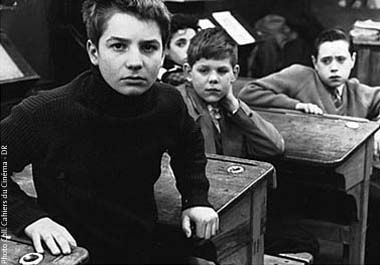
In 1950s Paris, fourteen-year-old Antoine Doinel is the proverbial bee in his teachers' bonnet. He shirks his studies and mocks the instructors whenever he gets the chance. One day, after mouthing off and defacing a classroom wall, Antoine is given an extra writing assignment for French class. None too pleased, he heads home.

Just one of several times Antoine gets into hot water at school.

At home, we see that Antoine lives in an apartment tiny enough that its narrow rear entry hall doubles as Antoine's “bedroom”. His parents, though not abusive, seem to treat Antoine as much a nuisance as their only child. His young, beautiful mother harps on his poor grades and behavior at school, and his father, while a pleasant office clerk, is as interested in his auto racing club as anything else in his life. Antoine's life seems to consist of little more than the criticisms of his teachers and the mundane bickering of his parents.

Having not done his punishment homework the night before, Antoine is afraid to return to school the next morning. His equally irascible buddy, Rene, convinces him to ditch class, swipe some cash from his parents, and roam the city. The two partake of the usual hooky activities of the 1950s – a movie, pinball, and junk food. While traipsing about, Antoine runs across his own mother, who happens to be with a man not her husband. After the brief glimpse of each other, Antoine and his mother swiftly head in opposite directions. That night, Antoine's mother tells her husband that she's working late, leaving Antoine and his father to have a semi-pleasant evening together.

The next morning, it's time to pay the fiddler. Antoine knows that he has to show up at school, despite not having a note from his parents. When firmly questioned by his teacher, Antoine claims that he was absent because his mother has died. While this shocks the teacher into penitence and sympathy for Antoine, the ruse only lasts for a few hours. Antoine's parents show up before long and go ballistic, along with his teachers.

Unable to deal with the constant hassling, Antoine decides to run away from home. He sleeps in a factory that Rene knows of for a night and ditches school the next day. After a day of panic, he is found and his mother finally shows some form of repentance. In a quiet moment, she offers Antoine a bit of a bribe if he will return to school and bring up his grades. Antoine makes the attempt, but is foiled when he attempts of plagiarize a short story from famed French author, Honore Balzac. The teacher easily detects the cheat and calls out Antoine once again.

On the lam with his cohort, Rene, Antoine indulges a bit.

This is, indeed the last straw for Antoine. Punished yet again, he takes the first opportunity to run away once more. This time, he and Rene raid Rene's wealthy and separated parents' petty cash and live it up for a time. When the money and food run out, Antoine steals a typewriter from his father's office. When they can't fence it, Antoine tries to return it to the office. He gets caught, though, and is dragged by his parents to a government office.

At the government office, Antoine's mother concedes that she is unwilling to deal with her son anymore. She turns him over to the state to be placed in a sort of correctional facility for troubled boys. At the camp, Antoine gives an interview to a psychologist in which we learn that he had already spent several of his younger years with his grandmother since his mother did not want the trouble of raising him. We also learn that, even when he tells the truth, no one believes him; therefore, he sees no reason to bother with it.

After a short time in the camp, during which Antoine undergoes the same cycle of scrutiny/slip-up/punishment that he has always known, he dashes out of the camp during a recreational soccer match. Antoine eludes his pursuers for a time and eventually makes it to the shore, where he stops and turns back. Thus ends the story of the boyhood of Antoine Doinel.


Take 1: My Gut Reaction (Done after this most recent viewing, before any research on the film):

I enjoyed this movie more than the first time I watched it, but that may not be saying much.

When I first saw The 400 Blows, I was about 25 years old and didn't have much knowledge of either more artistic or international films. I suspect that this was why, back then, I found this movie to be slow and lacking any clear punch. After a succeeding decade, during which I've learned to be more patient and enjoy slower stories with something deeper to impart, I can now appreciate such movies much more.

Still, I have to say that I was not blinded by the supposed brilliance of this movie.

Like many other films of its standing, I cannot deny the artistic merits of the movie. Director Francois Truffaut attained exactly what he sought with outstanding skill. On top of that, it's a different sort of crime story. Rather than follow the hackneyed path of sensationalism, Truffaut is far more subtle. Most tales that attempt to tell the “creation of a criminal” story will make the external forces clearly manipulative and overtly despicable. Whether it's Scorsese's Goodfellas or the great Brazilian film City of God, the environments that create the criminals are so obviously poisoned by poverty, gangsters or a host of other deleterious influences, that the viewer has no trouble following how a character becomes a hardened felon.

With The 400 Blows, however, Antoine is not pulled, but rather ever-so-gently nudged into his larcenous life as a reluctant rebel. The negative components are disturbingly commonplace: a teacher who is not tyrannical, but just short-tempered enough to prevent Antoine's academic growth; a mother who is not abusive, but just negligent enough to deprive Antoine of the unconditional love he seeks; a father who is not uncaring, but who is just self-involved enough to deprive Antoine of the fatherly guidance that he needs; and a society that is not toxic, but just apathetic enough to allow Antoine to slide, ever-so-gradually, through the cracks. It's the blending of these very authentic aspects and their affects on a troubled child that set this film apart from others, and is clearly it's greatest strength.

Here's a clip of highly dubious quality, but it shows one of the most engaging scenes in the movie - Antoine is in the government's compound for socially maladjusted youth. He's being interviewed by the center's psychiatrist:


On top of the plot's elemental alchemy, the filming itself cannot be overlooked. I'm far from well-versed in film technique, but I imagine that a person would have a difficult time in criticizing any of the technical points of The 400 Blows. The story flows very well, the dialogue and acting are pitch-perfect in conveying the necessary realism, and the directing and camerawork are outstanding. Many of the settings are stunning and quite memorable.

Still, I shall most likely never watch this film again. While all of the above points are wonderful merits that will assure this film's place in cinema history for many decades to come, in the end, I feel that this film is a piece of art more to be studied by film academics and students than to be enjoyed by the common viewer (clearly, I count myself in the latter group). It's tragedy of the slow-burn variety, and while it's not without some humor, it ends up being a rather depressing affair. In short, while it wasn't exactly a chore to watch, I feel that there's nothing else that subsequent viewings can offer me.

There it is. For my part, I don't know if I can recommend this movie to too many people. Perhaps if you are looking for a very well-crafted tale of a young, semi-likable French rascal's slow descent into delinquency, this will clearly be for you. Or, for those who are looking to delve deeper into film history and technique, The 400 Blows will surely offer a treasure trove of lessons. For the rest of you who like your movies a bit quicker, flashier, and perhaps more imaginative, you may want to steer clear.

Take 2: Why Film Geeks Love This Movie (Done after some further research):

There's one curious thing in digging through some essays on this movie. Every one of them makes key the fact that the movie is highly autobiographical. Apparently, Truffaut himself went through many of the things that Antoine Doinel did in his movie. I suppose that this goes no small way in producing the authenticity of the tale and the emotions portrayed.

And yet, this brings up a much larger issue in terms of art. Why should it matter to me, or any viewer, just how fictional or factual a story is? I could very well go on an extended rant on this, but I shall rein myself in. Suffice it to say that I was highly surprised to find that so many professional film analysts and critics seemed to focus on the mere fact that Truffaut was telling a story that was his own in many ways. To me, the focus should be the film itself, independent of any connection it may or may not have to any sources.

The end result is that, in my relatively limited searching, I found less critical analysis of the film and more lauding of Truffaut and his life as a young man. This did me little good. The analysis I did find did confirm my own feeling about the movie, though: that it was very well-acted and offered a tale very different from what had been shown to larger audiences before its arrival. It is, in fact, considered one of if not the first great “French New Wave” movies, a genre that would define much of 60's cinema.

The 400 Blows was an immediate success, wowing critics the world over and garnering several major awards. This is no mean feat, as it was Francois Truffaut's first feature film. He would go on to make a few more movies on Antoine Doinel, chronicling his later life. I have to say that, while I certainly have no overt problems with Doinel's story, I am unlikely to seek out the subsequent films in the series.

While it loses its emotional impact when watched on its own, here's the oft-discussed, iconic final few minutes of the film. If you want to see the most famous image, just watch the last 20 seconds:


That's a wrap. 51 shows down, 54 to go.

Coming Soon: Psycho (1960)


Oh, yes! The suspense movie that changed the genre forever! I've only seen it once, though I don't remember being exactly blown away. Maybe I'll be more impressed on this second go-round.

What's that? Yes, Mother, I'm coming...

Please be sure to pick up all empties on the way out.

Sunday, February 13, 2011

Film #50: Apur Sansor (1959)


Note: Apur Sansar is the final installment of the Apu Trilogy. Here are my reviews of the first two, Pather Panchali and Aparajito,

Title for Us English-Speaking Types: The World of Apu

Director: Satyajit Ray

Initial Release Country: Bangladesh

Times Previously Seen: none

Teaser Summary (No spoilers)

Young and artistic Bengali man faces myriad of emotional swings when reality clashes with his ideals.

Uncut Summary (A full plot synopsis, spoilers included. Fair warning)

When last we saw the young Apu Roy, he was leaving his ancestral home after his mother's tragic death. He was returning to Calcutta to proceed with his university education. It is now a few years down the road, and he has only been able to partially complete his education due to lack of money. With only an Intermediate diploma, he is hard-pressed to find work. He dreams of being a writer, and works diligently at it, but can only pay his bills through modest tutoring jobs.

Under the threat of eviction from his worn-down room, he seeks a more regular job. However, when he learns that the only jobs available are the most menial and mind-numbing of tasks, he decides to continue eking out his living through tutoring and writing. He does receive word that one of his short stories has been accepted for publication. This is perhaps a hint at potential future success.

A very poor but fairly contented Apu plays his pipe to while away time in his battered room.

Apu is eventually visited by his old college friend, Pulu. Pulu is initially disappointed that Apu has not been heard of since leaving college, and the two bicker over Apu's idealist notions compared to Pulu's more practical approach to life. The two do rekindle their friendship for one another, though.

On Pulu's invitation, Apu travels to his friend's impressive family home to witness his younger cousin, Apurna's, forthcoming wedding. Things go horribly wrong, though, when the groom-to-be shows up and appears to be stark mad. Pulu's family is distraught, as they believe that a cancellation of the wedding will curse Apurna for the rest of her life. Desperate, they ask Apu if he will marry Apurna so that their family will not be cursed and disgraced. Apu is at first appalled, and he angrily refuses. After some thought, though, he decides that it would be highly virtuous to accede to their request. As such, he becomes the unexpected groom.

On the wedding night, Apu comes clean to his new wife, who is quite beautiful, if rather young. Apu explains his reasons for marrying her and admits that his artistic aspirations likely preclude any possibility of riches. He has accepted a life of poverty and asks if she is willing to do the same. Despite being from a family of significant means, Apurna accepts the situation and agrees to go with her new husband back to Calcutta.

Apu and his new wife, complete strangers, make awkward attempts to get to know each other.

On first arriving, Apurna has a few moments of quiet sadness as, in Apu's dilapidated apartment, the realization of her new life hits her. And yet, she soon comes to love her husband's kind nature. She even rebuffs his proposal to find more work so that they may be a little more comfortable, preferring instead to simply spend the time with him. She has realized that any material wealth is as nothing compared to being with the man that she loves. Apu sees this and his love for his wife grows deep and profound.

Soon, Apurna becomes pregnant. She leaves Apu in Calcutta, in order to be with her family for the few months leading up to the birth. Then, tragedy. One of Apurna's brothers unexpectedly shows on Apu's door to inform him that Apurna has died in a premature birth. His child lives, but Apu has lost the one thing that he treasures above all else in the world – his loving wife.

With Apurna gone, Apu becomes a shell of the man he was. He turns his back on nearly everything, including his newborn son, Kajal. Leaving Kajal with Apurna's family, Apu becomes a wanderer who has lost faith in everything. He even takes his novel,his semi-autobiographical prized work, and jettisons the pages off of a cliff. Everything that was his has now been taken or thrown away.

Five years pass. All who once knew him now know almost nothing of Apu's whereabouts. His young son is now a very troubled child, causing no end of mischief for his de facto guardians, his great aunt and uncle. In the midst of Kajal's turmoil, Pulu shows up. Upon seeing Kajal's behavior, he decides to seek out his old friend, Apu.

After losing his beloved wife, Apu becomes an aimless drifter.

After a little searching, Pulu finds Apu drifting between coal mining and writing jobs, saving money in order to leave the country. At Pulu's insistence, Apu confesses that he feels nothing for his son. He explains that he cannot get past the fact that it was Kajal's life that caused Apurna's death. Apu, therefore, feels that he cannot act as the child's father. Nevertheless, Pulu convinces Apu to at least visit his son to see if he might have a change of heart.

On returning to his in-laws' home, where Kajal is living, Apu faces more difficulty. His in-laws are rightfully accusatory, and Kajal greets him with willful reluctance. Apu explains who he is to his son, and even tries to melt away some of the bitter iciness that Kajal has for him. Alas, it does not seem to be, and Apu decides to leave for good.

On walking along the road from his son and his keepers' house, however, Apu turns back to see Kajal following him. Kajal seems to be interested in Apu, even if he does not want to believe that he is his real father. Kajal asks if, should he agree to go with Apu, they could go to Calcutta to “find his father,” a pact that Apu is glad to make. Father and son continue along the road, one tiny stitch mended from the shredded fabric of their relationship.

Take 1: My Gut Reaction (Done after this first viewing, before any research)

The Apu Trilogy is an amazing piece of work, though one I may never feel the need to watch again.

After taking in the entire trilogy, it is clear that Satyajit Ray constructed a wonderfully unique set of films. The tale of Apu's growth into his late twenties blends universal sentiments that can move any viewer, yet the films have a distinctively regional feel. This masterful mixture is due to many components.

Here's a fantastic sequence from before and through the botched marriage. It actually makes for a great little mini-tale that can be taken completely on its own. Just start at the beginning and watch for a few minutes:


The story is one that has something for every fan of humanistic movies. Apu overcomes nearly-crushing poverty and personal tragedies through his intelligence and perseverance. Through the three movies, each successive death in his family takes a greater and greater toll on him. The first, his sister Durga's death, is one that the six-year old Apu moves past with an alacrity that only a young child can possess. In the second film, his father's passing is also overcome by the ten-year-old Apu's further bonding with his mother. When she too dies, he turns towards the beckoning word of academics for solace. When he is unable to see this through, his surprise marriage promises to give him the love that is missing. With the death of Apurna, however, Apu seems unable to cope any more. His devastation at this loss turns him into a rather unsympathetic character, though one can understand his plight in light of everything.

Running through the second half of the roughly five-and-a-half hour fully story is the conflict between Apu the artist and Apu the man. Any person who has attempted to carve out a livelihood in the creative arts can easily understand the friction that results when idealism meets the cold, hard realities of being a husband and father. The family tensions are always palpable, though not presented in the highly dramatic fashion of most popular drama.

How does director Ray communicate this to the viewer? Unlike most other directors, he uses very quiet moments of reflection during which you can see the calm anguish on certain characters' faces. With Ray often not relying on the dialogue to pass this along, we viewers have to adopt the same contemplative state that the characters show. It brings us closer to them by allowing us into their minds and spirits in a more authentic manner. A fine example is Apurna's arrival at Apu's run-down apartment in Calcutta. She arrives and Apu leaves the room for a moment. Apurna, still adorned in her wedding dress and make-up, sits down on his bed, looks out at the tattered neighborhood, and begins to cry softly. She never voices this initial disappointment, but I could feel it almost as if it were my own.

Here is a clip which includes that very scene. Start it at 6:20:


The backgrounds of India and Bangladesh, and Ray's integration of these areas, are a major part of what give the Apu Trilogy its distinctive look, sound and feel. With the eye of a cultural anthropologist, he includes the locales, music and customs of Bangladesh and India. We foreign viewers may not understand the reasons and feelings behind some of the traditions we see, but we can certainly grasp their significance for the characters in the tale. One of the many sequences that exemplifies this is the wedding. From Apurna being dressed up by her mother, aunts and sisters, to the actual ceremony itself, there is a wealth of visual wonders to take in. Ray set up these scenes and shot them so as to maximize our ability to slowly absorb them and dwell on what they mean to all characters involved.

I need to say more about Ray's general filming style. I still need to check on who the primary cinematographer was, but the final product is dazzling in its efficiency. An array of great work is done, from still to low-angle to wide-angle to panning shots, each technique is measured and executed perfectly. They draw the eye to exactly where it needs to be, while allowing one to take in the greater whole when necessary. Between the first and third films, I feel that Ray went from great to phenomenal in these respects. By even summoning certain sounds and images from the earlier films, such as windows, trains and beds, The World of Apu adds a satisfying sense of cohesion to the whole.

Here's a clip from near the end. You can pick any place and just watch for a little while. The work is so well-done that it's not hard to pick up the mood of the entire scene or figure out exactly what's going on:


The only complaint I can possibly imagine anyone leveling at these movies is that they are rather slow and mildly depressing. The truth is that I can't really argue against this. However, these are certainly cultural biases that would lead one to feel that the Apu Trilogy is not an “entertaining” set of films. Entertaining they may not be, but I feel that they transcend mere entertainment, and bring us something of greater depth and artistry. I may not ever be in the right frame of mind to sit through them again, but I have no doubt that these three movies will stay with me for the rest of my days.

Take 2: Why Film Geeks Love This Movie (Done after some further research)

No real shockers in the digging. Here's what the professionals say:

Right from the jump, The Apu Trilogy, including the final installment, was recognized as a phenomenal piece of work. Between the three films, it raked in heaps of awards at film shows all over the world, and it opened up entire new worlds for Indian/Bengali filmmakers. Apparently, virtually all films in the region had been basic swashbucklers or musical romances (which is ironic, since there is a scene in the third film in which Apu and Apurna enjoy taking in an Indian pirate flick of just such fare). Even the TIME magazine reviewer in 1960 gushed about it. Here's their review.

Even more recent critics seem unable to ignore this black and white story that was done for a pittance. Roger Ebert brings up many of the things that I couldn't help notice, but articulates them better than I can, and of course adds a few minor observations in his review here.

The only other note of interest was what I dug up on the photographer. He was a man named Subrata Mitra, and, like nearly everyone else on the cast and crew, had never done any film work before Pather Panchali. To this day, filmmakers and critics alike all seem to marvel at just how Mitra, along with everyone else, wrung so much from such meager finances (the entire trilogy was made for $3,000! Try that in today's market!). I suppose it's amazing what true talent can do.

That's a wrap. 50 shows down, 53 to go.

Coming Soon: The 400 Blows (1959)

Joy of joys – French cinema verite comes alive. (Be sure to read that last sentence with an extremely sarcastic tone.) I can't say I've enjoyed the verite films that I've seen, including this one, but I'll try to watch this one with fresh eyes. Wish me "bon chance!"

Please be sure to pick up all empties on the way out.