Saturday, September 17, 2011

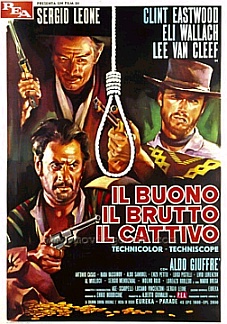
Film #63: Il buono, il brutto, il cattivo (1966)


Title for us English-speaking types: The Good, the Bad, and the Ugly

Director: Sergio Leone

Initial Release Country: Italy

Times Previously Seen: approximately 7 or 8

Teaser Summary (No spoilers)

Three tough hombres seek out a hidden fortune in the Wild West. During the search, they try to avoid becoming casualties of the Civil War and each other.

Extended Summary (A more complete plot synopsis, spoilers included. Fair warning)

The American West. Early 1860s and the States are far from United. The Civil War is in full swing, though in the deserts and plains of the West, it is only a peripheral presence. In a remote town, three gunmen storm into a barber shop, only to be rapidly gunned down by a rough-looking character named Tuco. Tuco jumps on a nearby horse and flees the town.

Elsewhere, a man in black drifts into a small hacienda. The man has been paid by another to find the current alias about another missing man, one called Jackson. The owner of the hacienda fearfully tells the man in black that Jackson now goes by the name Bill Carson, and also mentions a stolen cash box filled with $200,000 that Carson has in his possession. The frightened man assumes that the man in black has been paid to kill him, and he offers him double his fee to desist. The man in black responds to the offer by killing the man and his son and taking the money anyway. He returns to the man who hired him. He learns that Bill Carson was part of a small group of Confederate renegades who stole the gold from a Union convoy. Upon learning this, the man in black, who goes by the name “Angel Eyes” kills his original patron in cold blood.

Angel Eyes, "The Bad", begins his blood-soaked path towards the treasure.

Back on the plains, Tuco is riding along on his stolen horse, but the horse is shot out from underneath him. He is surrounded by three bounty hunters who seem intent on taking him in the for the $2,000 reward being offered for the capture of this inveterate criminal. Just as the three hunters close in on Tuco, a quiet stranger emerges and tells the three bounty hunters to back off and allow him to take Tuco. The three men try to shoot the brazen newcomer, but the man kills all three of them with lightning quickness. Tuco, believing the man to be his savior, tries to thank him and be on his way, but the stranger merely straps him onto the back of his horse, brings him into the nearest town, and collects the reward for himself.

Shortly after he spews and endless litany of insults at the lone bounty hunter, whom he calls “Blondie” for his light-colored hair, Tuco is placed into a noose, with only a horse between him, the ground, and oblivion. When sentence is passed and Tuco is about to he hanged, Blondie, who is hidden in a nearby barn hayloft, shoots the rope apart, freeing Tuco. He also shoots the hats off of several citizens, to ward off any chance of pursuit. It turns out that Blondie has struck a deal with Tuco – Tuco gets turned in, Blondie takes the reward and then saves Tuco. Tuco's bounty goes up, and they repeat the process, splitting all the reward money. Tuco complains about wanting more than a 50-50 share, but Blondie suggests that his “aim might be affected” if his share drops. Tuco drops his complaint, but assures Blondie that double crossing him would be a grave mistake.

In a new town, Tuco sits atop another horse, his neck in another noose. On the edge of the town, Blondie, already with the reward money for Tuco, waits to free him with another rifle blast. Casually looking over the scene is Angel Eyes, who happens to be in town to follow the lead of Bill Carson. He learns of a prostitute who Carson frequents in another town. Angel Eyes makes note of Blondie and Tuco, but leaves town in pursuit of the prostitute. Just as before, when Tuco is about to be hanged, Blondie fires his shot, but slightly misses. Tuco dangles from the neck for a few seconds from the half-cut rope. Blondie fires another shot that cuts the rope completely and frees Tuco again. The two hop onto Blondie's horse and head out of town.

Blondie and Tuco, the "Good" and "Ugly", respectively, discuss their business deal.

Once they are many miles from the town, Tuco rails at Blondie for nearly missing the rope. Blondie quietly lowers Tuco onto the ground and explains that he thinks they have milked their little scam for all its worth. Leaving Tuco stranded and tied in the middle of nowhere, Blondie rides off with all of their ill-gotten gains.

On a subsequent evening in yet another town, Angel Eyes tracks down the prostitute who knows Bill Carson. After a mild beating at Angel Eyes' hands, the girl tells him which regiment Bill Carson is in. Angel Eyes is getting closer to the money.

On a following day, Tuco staggers into a tiny village. He has somehow survived the miles-long exodus that Blondie forced upon him, and he now has two things on his mind – getting water and getting revenge. He makes a good start of it by pilfering some water from a well and then robbing the shop owner of his best revolver and all of his cash. He even tracks down Blondie to a hotel and almost exacts his revenge then and there. At gunpoint, he forces Blondie onto a stool and gets a rope around his neck. Just as TucoTuco through the floor and allowing Blondie to escape.

After several days of tracking him across the plains, Tuco finds that Blondie is in the middle of the same old scam. He lays behind the cover of a low hill, his rifle cross-hairs on another hanging rope around the neck of another criminal. However, just before he is meant to fire his life-saving shot, Tuco sneaks up behind him and takes him prisoner. Blondie's new “partner” is left to die and Blondie is now the captive of the last man in the world he would want to be captive of.

Echoing their last parting, Tuco leads Blondie to desert. As Tuco rides atop a horse, he forces Blondie to try and keep up with him along a 100-mile trek across the scorching hot sands. With the comforting shade of a parasol and ample water, Tuco delights in the slow death of Blondie, even teasing and taunting him along the way. Blondie remains stoic, but eventually his endurance is baked away by the relentlessly brutal desert sun. After walking for many hours without water or shade, he finally collapses. Tuco, having appeased his desire for retribution, slowly moves in for the kill.

Tuco now has his man, Blondie, right where he wants him.

Just as Tuco cocks his gun, though, a riderless wagon comes barreling out of the desert. The distracted Tuco leaves the nearly-dead Blondie and heads off the wagon. In it, he finds several dead Confederate soldiers. One soldier, however, still clings to a small shred of life. It is Bill Carson, and he explains that his group was attacked out in the desert. He promises Tuco that he will reveal the location of his stolen gold coins if only he can get some life-saving water. Tuco tries to pry the information from him, and manages to get the name of the cemetery, but not the specific name on the grave where the gold is hidden. Carson loses consciousness, and Tuco scrambles to find some water in order to revive him. When he returns with the water, though, Tuco sees that Blondie has dragged himself to Carson. Carson has died, but not before he whispered the name of the grave to Blondie. Tuco, who moments before was joyfully going to kill him, now has 200,000 golden reasons to ensure Blondie's safety.

Tuco brings Blondie to a mission where the monks start to nurse him back to health. Tuco tries to weasel the location of the grave out of Blondie early on, but to no avail. Once Blondie's health is returned, the two men prepare to set out after the gold. Before leaving, Tuco seeks out his brother, who is the head Brother at the mission. Tuco and his brother, Pablo, recount their very different paths through life, each one casting aspersions and disgust at the other. The two part, regretting that they cannot reconcile, but they part all the same.

Out on the plains again, in their found wagon and Confederate uniforms, Blondie and Tuco make toward the gold. Tuco knows the general location, and Blondie the specific grave, so neither can find the treasure without the other. It isn't long before they are found and captured by a traveling Union army. They are presumed to be rebels, thanks to their uniforms, and are sent to a P.O.W. camp.

At the camp, Blondie and Tuco are surprised to see Angel Eyes there, somehow in the position of a Union sergeant. Angel Eyes has positioned himself here in order to best come across any word of Bill Carson. During the prisoner role call, when Bill Carson's name is sounded, Blondie convinces Tuco to assume the role. Angel Eyes promptly has Tuco brought into his office and brutally tortured in order to find out what he knows about the real Bill Carson and his stash of gold. Tuco parts with his half of the information and is sent off on a prison train with a massive and violent man as an escort. Angel Eyes next brings Blondie into his office. Realizing that torture will not work with Blondie, Angel Eyes forms a partnership with him instead, now that Angel Eyes has the name of the cemetery. Blondie cautiously accepts, for he has no other choice.

Angel Eyes, posing as a Union officer, as he prepares to squeeze information about the gold out of Tuco.

On a cargo train with his ogre-like guard, Tuco makes his move. Feigning the call of nature, Tuco hurls himself and the guard to whom he is handcuffed off of the moving train. He promptly kills the guard, and soon after manages to get the handcuffs off by laying them (and his guard) across the railroad tracks. Another train comes along, severs the chain, and frees Tuco.

A little time after, a little farther along, and a little closer to the cemetery, in a town decimated by the War, Blondie takes a breather with Angel Eyes and the five mercenaries who Angel Eyes has brought along. Tuco has also found his way into the town, but he has been spotted by one of the men he shot in the barber shop at the beginning of the story. Tuco shoots the man in self defense. A short way off, Blondie recognizes the report of Tuco's gun, and strolls away from his companions. Angel Eyes gestures for one of the guns for hire to tail Blondie.

A few buildings away, Blondie rounds on the mercenary and kills him. He then finds Tuco and reinstates his deal with him, assuring the never-say-die bandit that Angel Eyes still does not know the name on the grave where the treasure is hidden. Tuco and Blondie then kill their way towards Angel Eyes, gunning down all of the remaining four hired guns in Angel Eyes' employ. When they get to his hiding place, though, they find Angel Eyes himself gone. Blondie and Tuco strike out again.

Eventually, the two men come to a bridge that will lead them to the cemetery. The only problem is that it is the setting of a current stalemate between two large forces – one Union Army and one Confederate. The two sides are locked in war of attrition, with neither side willing to give up on the bridge. Tuco and Blondie remedy this problem by sneaking out to the bridge and using dynamite to blow it to pieces. Just before they do, however, Tuco and Blondie agree to swap their pieces of the information – the cemetery is named Sand Hill and the grave is that of Arch Stanton. Once the bridge is removed, Tuco and Blondie cross the river.

Across the river, Tuco breaks away from Blondie and dashes towards the cemetery. He gets to Sand Hill and races through the hundreds of gravestones until he finds that of Arch Stanton. He starts to dig when Blondie arrives with a shovel for him to use. Just as they are about to open the grave, Angel Eyes sneaks in and holds the two men at gunpoint. Just as he thinks he has the upper hand, however, Blondie surprises both other men by kicking open Arch Stanton's grave to reveal nothing but a pile of bones. He explains that he never told Tuco the right grave, not trusting him with it.

To settle it all, Blondie proposes to write the name of the real grave on the bottom of a stone, which he will place in the middle of all three men and they will simply have a three-way showdown for it. The name is written, the rock is placed face-down, and the three men slowly back away from each other. After several minutes of carefully measuring each other, the men make their moves. Angel Eyes draws first, aiming for Blondie, but Blondie is quicker and kills him. Tuco, meanwhile, has been firing his weapon in Angel Eyes' direction, but to no effect. He apparently has no bullets in his gun.

The middle of Sand Hill Cemetery - scene of the grande finale, three-way standoff.

After the tension has eased, Blondie explains that he had unloaded Tuco's gun the night before, as they were waiting out the aftermath of their sabotage of the bridge, and Tuco was asleep. He also shows Tuco the “name” rock, which has no writing on it, whatsoever. It turns out that Bill Carson had told Blondie that the gold was stashed in the grave marked “unknown” next to Arch Stanton's. This is where Blondie urges Tuco to dig, and where they do indeed find the sacks heavy with the gold.

Blondie plays one final trick on Tuco. At gunpoint, Tuco is forced to stand atop a wooden grave marker and place his head in a noose hung from a tree. Blondie leaves Tuco's half of the money on the ground and rides away. Just as Tuco is about to slip and hang, however, Blondie emerges from behind a distant tree and, recalling their early scams together, shoots the rope. Tuco is freed to take his money, but not before he screams a few parting insults at his “business partner”.

Take 1: My Gut Reaction (Done after this most recent viewing, before any further research.)

A movie like this may never be made again. I've seen it many times now and I still love it. Yet, despite my undying enjoyment at watching The Good, the Bad, and the Ugly, it is a film that I would hesitate to recommend to everyone.

I recall a conversation I had with one of my anthropology professors around 1999. I had learned that he enjoyed Western movies, so we got to talking about them one day, touching on the John Wayne/John Ford Monument Valley films and others. When I brought up Sergio Leone and his “Man With No Name” series, I was crestfallen to hear this professor poo-poo them as “silly.” I was a bit thrown.

And yet, when I watch any of the Leone westerns now, I can see why he said it. Compared to a typical American western, there is something quirky and blatantly stylish about a movie like The Good, the Bad, and the Ugly. Still, it's these offbeat elements that are part of their indelible magic.

Tuco Ramirez. Never has such an entertaining bag of scum been filmed so skillfully.

Before getting into the more peculiar aspects of the Leone westerns, one needs to look at the more traditional standards. The clearest of them all is the visual element. The Good, the Bad, and the Ugly can easily be placed right next to any of the titans of western movies in terms of visuals. The composition and framing of every shot, be it the vast sweep of the plains or the extreme close-ups of the gnarled and lined faces of the characters, is the height of film aesthetic. Even when compared to Leone's previous “Man With No Name” films, this one excels.

Closely related to this is one of my favorite aspects – the visual storytelling. As I've mentioned in my reviews of several silent films like The Last Command and others, visual storytelling is, oddly, a nearly lost skill in films. It's odd since it is arguably one of the very few things that can set film apart from any other storytelling medium. Far too many films rely on excessive dialogue or exposition. Sergio Leone was quite the opposite – he seemed to relish the chances to tell a tale without a character saying a single word, and his movies are replete with examples. One of my favorites in this movie is when Tuco emerges from his death-defying escape from the desert. As he bursts into the shop, silently disassembles and reassembles various revolvers, and robs the shopkeeper, the man's entire character is laid bare: He's driven. He's skilled. He's ruthless. He's even oddly funny. This is all clear in a roughly five-minute sequence in which barely ten words are spoken. So few directors have the imagination or technique to do such a sequence, and Leone made a habit of it.

One of the nearly countless clever shots of Leone's. When the camera pans up to this perspective, you get several seconds to dwell on what it means for Tuco.

Speaking of Tuco, the character has a special place in my heart. Thanks to good writing and a phenomenal acting job by Eli Wallach, Tuco Ramirez is one of my all-time favorites. It's hard to even think of another character like him in movies. He's clearly scum of the lowest order, but I can't help but like and almost admire him. His exploits in the movie make it all clear – while he possesses some of the basest of human qualities (greed, selfishness and violence), he also possesses several admirable, if somewhat twisted, qualities. He's as tough as they come (how else does one survive hangings, being marooned in a desert, severe beatings, and countless shootouts?) and he absolutely never backs down. Most importantly, he's as capable as anyone in the movie, and this is my favorite bit. While Tuco already serves the most humorous role in the film, Leone could have written him to be a total clown, yet didn't. As lethal as Blondie and Angel Eyes are, Tuco is just as deadly. The former two may be more intelligent and collected, but Tuco is easily as dangerous. By not relegating Tuco to the role of some goofball bandit, the story is granted much greater balance.

In addition to my fondness for Tuco, a few things need be pointed out about the other title roles. Of the three, Lee Van Cleef as “The Bad” is clearly the most two-dimensional. He's simply a cold-blooded killer out for himself. No more. Blondie and Tuco, though, are different cases. In some ways, they embody abstract, mythological archetypes of the western tale: the calm, cool, unflappable drifter with impossibly perfect aim; and the dirt-encrusted, blood-drenched bandit. Yet, there are scenes in the movie in which they are made more endearing. With Tuco, it is through his touching interactions with his missionary brother. With Blondie, his quiet observations and kindnesses to the downtrodden and dying he comes across. These scenes show the two men to possess a humanity that their harsh exteriors belie. It's this unusual blending of mythical and humane that set Leone's films apart from their cruder ilk.

I can't let a review of this movie pass without mentioning the music. Even if you've never seen these movies, you know some of the tunes. Scored by the absolute master, Ennio Morricone, Leone's spaghetti westerns all had a sound of their own, and The Good, the Bad, and the Ugly was the best of them. The driving bass drums, human grunts, Jew's harp, discordant piano notes, and lonely guitar picks all add to the tone of the movie. The music echoes the odd blend of funny, cool, serious, and tense, and does it like no other soundtrack ever has or perhaps will.

So back to my former professor's judgment of Leone's movies as “silly”. I think he was put off by the lack of authenticity when it came to the action elements of the movie. There is certainly some contrivance in the name of style. Leone had a knack for coming up with cool and clever visual tricks. Blondie's serape and ever-present cigars. Tuco's over-the-shoulder gun sling. The wacko music. Lee Van Cleef's cartoonishly evil sneering and laughing. Sure, these are not things that were part of “the Real Wild West”. But that's not what Leone's movies were about. They were about telling a tale of adventure, featuring interesting characters in a setting only somewhat based on history. That dusty, wide-open setting is the perfect crucible in which to crush three hard cases, forming a flashy and volatile compound.

The tragi-comic, drunken Union colonel. One of the many elements of the movie that has just enough reality to avoid being dismissed as mere camp.

If you haven't seen this movie, you may ask, “Should I watch it?” As alluded to earlier, this is hard to say. Leone's films are for lovers of epic adventure movies, sure, but they also require a true love of cinema. I've read plenty of reviews on Netflix and other places in which viewers trash his movies for being way too slow. I know they refer to the extended close-up shots and the long periods without dialogue. Personally, I love these moments. They force you to pay attention and always provide a payoff – either a tale is told or tension is built. If you're OK with westerns and want to see a classic like none other, give this one your time. A good approach is to watch Leone's first, A Fistful of Dollars. Not only is it a solid remake of the Kurosawa samurai great, Yojimbo, but it's a much more accessible  90 minutes.

NOTE: I watched, for the first time, the 40th Anniversary Special Edition of this movie. It includes an extra 15-or-so minutes that were cut out of the original. Word of warning – get the original, theatrical release. The added scenes are not only superfluous and a bit choppy, but they are voiced over by 70-year old Clint Eastwood and Eli Wallach, who had to go back and re-dubbed the sound. All of the added material detracts from the flow of Leone's original cut.

Take 2: Why Film Geeks Love This Movie (Done after some further research on the film)

There are plenty of interesting, puzzling, and downright hilarious factoids to dig up about this movie.

There are a few short, strong documentaries on the film, including plenty of modern interviews with Eastwood and Wallach. They recount just how “cheap” spaghetti westerns were, in almost every respect. The film they made with Leone was not much of an exception, as they had to act through complete language barriers and loosey-goosey attitudes towards the filming process. Eastwood having been a Hollywood reject, he began working with Leone because he didn't have too many options. He and Wallach tell many a tale about how they narrowly avoided serious maiming and death on the sets several times. Funny in hindsight, I guess.

Going through some other commentary, such as the film doc “The Leone Style” with Richard Schickel or Roger Ebert's revisiting of the movie, it's interesting to see how the recognition of Leone's true mastery of the form took time to coalesce. This original TIME magazine review was apparently a rather typical mixed bag, and clearly has no use for Eastwood's acting, calling his to-date film works “consistently awful”. But even such a lukewarm critic was not blind to the visual genius of the movie.

Arguably one of the most iconic western movie shots of all time. Eastwood may not have had much acting range, but he damn sure knew how to strike a stoic pose.

It was curious to find that, to my surprise, the historical Civil War events portrayed in The Good, the Bad, and the Ugly were rooted far more deeply in fact that I had suspected. While I, and I suppose many other people, assume that there was little to no large-scale fighting in the Southwest, apparently there was. As referenced in the movie, there really was a General Sibley, who really did make a desperate gambit to storm through Union forces, up the Rio Grande and into Colorado, in an effort to take charge of that state's silver and gold supplies. He failed rather miserably, but not before several thousand of his men were killed along the way. This is not so different from the backdrop of the wild quest of Angel Eyes, Tuco and Blondie.

I also discovered something about the “added” scenes that I disliked so much. These extra 16 minutes were actually part of Leone's original cut, released in Rome. He unwillingly cut them out at the behest of United Artists, who claimed American audiences would find his original 177-minute version too taxing. Regardless, I still found most of these edited scenes unnecessary. Maybe it's just because I had always seen the 161-minute version, and any change to it feels unnatural. Whatever the case, I'll go back to the shorter version for future viewings.

Whether the editing helped or not, the reception was fairly clear. When released in 1967, the movie was a hit. American audiences were enamored of the odd little tweaks to the all-too familiar western genre. They had already been able to adapt to them with Leone's first two westerns featuring the stone-faced Eastwood, A Fistful of Dollars and For A Few Dollars More. The Good, the Bad, and the Ugly kept all of the idiosyncratic flourishes of style and polished the aesthetics to a high finish.

Looking slightly ahead on my list, I see the later Leone western, Once Upon A Time in the West. I have seen this one a few times before, and it is good. However, I'm left to wonder exactly why it is considered a separately “great” film. I suppose I'll find out in another few weeks.

That's a wrap. 63 shows down. 42 to go.

Coming Soon: Mouchette (1967)


This one looks like a serious change of pace. I'm going from a raucous shoot-em-up to a dreary-looking French film about a teenage girl's suffering an misery. I may have to whack back a fifth of Scotch to get into the right mindset for this one. Come on back and see if I can stay lucid enough to figure out what make Mouchette “great”.

Please be sure to pick up all empties on the way out.

Sunday, September 11, 2011

Film #62: Ostre sledovane vlaky (1966)


Title for us English-speaking Types: Closely Watched Trains

Director: Jiri Menzel

Initial Release Country: Czechoslovakia

Times Previously Seen: none

Teaser Summary (No spoilers)

Young, newly-minted train station operator passes boring hours by obsessing about losing his virginity. Backs into involvement in a World War.

Extended Summary (A more complete plot synopsis, serious spoilers included. Fair warning.)

Towards the final months of World War II, in the middle of Nazi-occupied Czechoslovakia, the young Milos Hrma is taking a major step in life – he is preparing for his first job. While his mother helps him don the fresh uniform of a train station dispatcher, Milos mulls over his family history, which is not exactly glowing. Milos seems to come from a long line of duty-shirkers, layabouts, delusionals, and generally disagreeable loafers.

Milos Hrma. Not exactly the sharpest tool in Czechoslovakia's shed.

On his first day on the job, the skinny and shy Milos absorbs his new workplace and workmates. The station is in shoddy repair, being connected to the station master's home and farm. The master himself spends as much time tending chickens as doing his job. Milos' immediate superior is the calm, affable, and randy Hubicka. Hubicka uses the many quiet hours on the job to seduce any attractive woman within sight.

Hubicka readily takes the wide-eyed Milos under his wing and starts to show him the ropes. The actual job is laughably simple and dull, which leaves plenty of time for Hubicka to start asking after Milos' love life. Milos has a girlfriend of sorts – a young, pretty train assistant named Masa – though they are yet to consummate anything. Milos is made all-too aware of this as he sees the savvy Hubicka bed several women while on duty, which inflames Milos' libido even more.

Opportunity comes when Masa invites Milos to stay at her uncle's house/photo shop. Masa makes strong advances on Milos, but Milos sullenly and strangely turns away. Not understanding the rebuff, Masa returns to her own bed. Early the next morning, a bomb attack blows down the house Milos is in. No one is hurt, but the house is destroyed.

Later that day, Milos checks into a hotel and attempts suicide. He is found and saved by a hotel worker, and sent to a hospital. While there, he explains himself to the doctor. It turned out that he had suffered impotence or premature ejaculation, which was why he did not have sex with Masa when he had the chance. He thought that this equaled a lack of manhood – something that he could not live with. The doctor assures him that this is normal, and Milos returns to work.

The devastated Milos prepares to do himself in after his "failure" with Masa.

Back at the station, things have been stirring. Hubicka and a handful of other locals have been conspiring to blow up a German military transport train. This is all being planned under the noses of politicians subservient to the conquering Nazi forces. Milos returns in the midst of this, and Hubicka welcomes him back to work. Once he hears the story of Milos' hospitalization, Hubicka soothes the young man and suggests that he find an older woman with whom he can relax and enjoy his first sexual foray. Hubicka also lets Milos in on the plan to blow up the Nazi train, and the two plan the sabotage together.

The eve of the sabotage arrives. A beautiful woman arrives at the station late in the evening, offers a password, and gives Hubicka a package with the explosives in it. The woman stays in the station, and Hubicka urges Milos into her arms. With the older woman, Milos finally enjoys his first night of sexual pleasure.

Milos looks out over the tracks, his slacking mentor Hubicka looking over his shoulder.

The next morning, the day of the planned attack, the train station begins buzzing. A few government officials show to follow up a complaint about Hubicka, who had previously bedded the young woman who works at the station with him. In the middle of his interrogation at the hands of the bureaucrats and the young woman's grandmother, Milos brazenly takes the explosives, shimmies out onto a structure hanging over the tracks, and waits. When the Nazi cargo train passes underneath, he deftly drops the explosives onto a middle car. However, just as he begins to soak in his success, a soldier on the train spots him and shoots him dead.

The train makes it about a mile farther down the track when it blows up in a massive explosion. The remaining workers at the train station rush out to see the tell-tale smoke clouds rising in the distance. Hubicka, oblivious to the death of his young co-worker and countryman, lets out a satisfied laugh over the victory.

Take 1: My Gut Reaction (Done after this one viewing, before any further research)

Closely Watched Trains is a very uniquely hilarious movie.

Right from the opening minutes, I was laughing. As the sheepish, gawky little Milos is being dressed by his mother, his dry summary of his male forebears is great. His even-toned description of each man's laziness, oddity, and ultimate fate is accompanied by great still shots. It does a great job in setting the tone for the rest of the film.

The entire telling of Milos' pursuit to vanquish his own virginity is funny enough, but Milos himself is so hilarious in his innocence and naivete that it amplifies the comedy immeasurably. It starts with the aforementioned role call of his own lineage of laze, but it gets even better after his sexual failure with Masa. His attempted suicide is morbidly realistic, but his subsequent actions and behavior are so funny that they make you forget the darkness of it. So socially oblivious is he, that he seeks advice from any person available, openly proclaiming his problem of “premature ejaculation.”

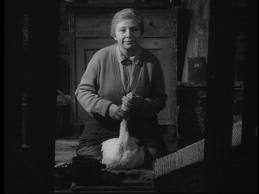
This and his pubescent notions about manhood can't help but make you laugh, if only because everyone around him takes it in such easy stride. At one point, in his quest for a “mature woman” to help relieve him of the burden of virginity, he approaches the train station chief's 60-something year old mother as she stuffs a massive goose. While Milos awkwardly explains his plight, the woman calmly takes in the confession/plea while massaging foods down the goose's massive, phallic-shaped neck. Perhaps not very subtle, but the actors play it so straight that it's comedy gold.

The station master's mother placidly takes in Milos' tale of impotence, holding a suggestively fashioned goose.

While Milos more or less quietly steals the show, as he should, the supporting cast can't be overlooked. The libidinous Hubicka is a fantastically lovable loafer and ladies man. He basically has everything that the unimaginative Milos hopes to – a thoroughly undemanding job and a seemingly endless procession of young women to sleep with. What makes the otherwise selfish Hubicka so likable is that he is more than willing to help the hapless Milos achieve his dream. Sure, it's hardly a master/apprentice relationship on the scale of Socrates and Plato, but it's heartwarming in a much earthier way.

The entire mini-saga of Milos is funny enough, but what puts Closely Watched Trains in that rarer category of great movies is the setting. Being set in Nazi-occupied Czechoslovakia adds a strange element to the character study. In the movie, the Nazi presence is tangential to the main plot, and the Germans are almost never seen. We mostly hear about them through the Czech bureaucrats, who obey them more out of fear rather than any loyalty. This reduction of the enemy presence emphasizes how an inexperienced teenage boy would prioritize such things: Number One = Sleep with a woman. Number Two = Find the easiest job possible. Number Whatever = Anything and everything else, including World War II. This totally bears out in the story, as it is only with his job secured and his virginity firmly stamped out that Milos is able to play a small part in the rebel cause.

The train station staff, caught in the blow back of the train explosion - Milos' lone confident and heroic act.

The movie does end on a somewhat weird vibe, as poor little Milos is shot and killed a few seconds after his crowing achievement as “A Man.” However, as I think back on it, it's not as sad as it seems. Had Milos lived, he almost certainly would have gone down as just another slacker in a long line of slackers in the Hrma family. His role in the attack on the Nazis probably would have faded, and he would have probably ended up just like his father – prematurely retired at age 50, lounging on a couch and being ridiculed by his working neighbors. As it was, he got to die a “hero's death” of sorts.

The characters, story and tone of the movie are clearly the outstanding elements of this movie, but a few other aspects shouldn't be overlooked. The filming is fantastic. It's in black and white, but the sets and framing show skill that goes beyond the norm. Some of the compositions and juxtapositions of characters and props enhance the physical comedy greatly, and usually is very sly ways. Whether its Hubicka playfully stamping his young co-workers legs and buttocks in the station or the uncomfortable stand-off between Milos and the goose-stuffing station master's mother, the visuals do nothing but enhance everything about the story.

As I write this, it had been four days since I watched Closely Watched Trains, and with every passing day I realize more and more just how much I liked the movie. As I think about the different levels that it was working on, and just how solid a film it was in all regards, I can see it as a film that I would watch and enjoy again. Anyone who enjoys somewhat dark, tongue-in-cheek humor would do well to track down this movie and give it a shot.

Take 2: Why Film Geeks Love this Movie (Done after some further research)

Some of the writing on Closely Watched Trains has sent me into philosophical crisis. I don't know whether to be hopelessly frustrated at human stupidity or grudgingly thankful to it for providing the fuel for artistic genius.

A little bit of research has informed me a little more of the political climate, and the geographical and historical context that allowed the birth of a film such as Closely Watched Trains. The best of what I read is this essay by Richard Schickel, in which he gives a thumbnail account of Czechoslovakia's unique place in European political affairs. He describes how its odd and interminable position as an occupied country led to a culture of “impish rebellion” that could be seen in its arts. It's a really interesting read, and one that makes the Czechs a very endearing group to me, a person who has never been there and only known a handful of the country's people (they were great, and boy, did they know their beers).

Milos' first of many near-kisses with Masa. This is just one of the much lighter comic moments sprinkled throughout this very sly film.

One other thing that stuck out a bit to me was that, in this original review in 1967, the TIME magazine reviewer didn't seem to view the character Hubicka as genial as I did. At best, he is written about with indifference. I felt that I agreed much more with Schickel's take (in the same essay as above) about Hubicka's more well-rounded character. Schickel even points out how Hubicka quite possibly represented the entire Czech nation, with his humorous self-absorption not completely drowning out his penchant for causing headaches to boorish and idiotic superiors and conquerors. I guess its no surprise how characters and filmmakers like that would appeal to viewers not only in the U.S., but throughout the Western world.

That's a wrap. 62 shows down. 43 to go.

Coming Soon: The Good, the Bad, and the Ugly (1966)


I'm giddy with glee that this one is next on the list. I've probably seen it 10 times, and I can't wait to watch it again. Come on back to read me gush about one of my absolute favorite films of all time. Maybe I can convince a few uninitiated to give it a shot.

Please be sure to pick up all empties on the way out.

Tuesday, September 6, 2011

Film #61: Persona (1966)

Director: Ingmar Bergman

Initial Release Country: Sweden

Times Previously Seen: once (about 6 years ago)

Teaser Summary (no spoilers)

Young nurse & mute patient engage in intense psychological back-and-forths.

Extended Summary (More complete plot synopsis, including spoilers. Fair warning.)

Middle-aged and prominent Swedish actress, Elisabet Vogler (Liv Ullman), is inexplicably stricken dumb in the middle of her performance as the title role in the play, Electra. She is sent to a psychiatric institution, where she maintains her utter silence and unresponsiveness.

She is placed under the care of the beautiful, 25-year old nurse, Sister Alma (Bibi Andersen). Nurse Alma's gentle and dutiful ministrations elicit some positive, if mild, responses from Elisabet, but the actress remains completely mute. The head psychiatrist decides that the best thing is for Sister Alma to accompany Elisabet to a seaside retreat, where the two women can advance Elisabet's treatment. Alma expresses her concerns that the clearly willful Elisabet may be more than she can handle, but her worries are quickly swept aside by the doctor and her own naivete.

Sister Alma, a kindly nurse who has no idea of the mental trial ahead.

At the picturesque seaside house, the pairing makes a promising enough start. While Elisabet refuses to speak, she seems an eager listener as Alma fills the silence with expositions about her own life. Alma talks of her life, educational background, her fiance, and other more casual topics for several days. All the while, Elisabet lends her ears and absorbs it all.

Eventually, Alma begins to reveal much more personal thoughts and feelings. One evening, with both women rather deep in their cups, Alma shares a rather scandalous episode in her life. While on vacation with her fiance, she and another woman engage in some naked sunbathing, away from their significant others. A few young boys approach them and, following the lead of her new-found companion, Alma has sex with both boys. In an attempt to cover up this unforeseen foray into hedonism, she later has sex with her unknowing fiance. She becomes pregnant and soon has an abortion, actions that Alma is deeply conflicted over – she clearly feels guilty about it all, while simultaneously acknowledging the pure, if temporary, delight of the amorous escapade. As always, Elisabet seems to take in the entire tale without judgment, and she offers Alma the comfort of a warm embrace.

An ever-silent Elisabet calmly absorbs Alma's most personal revelations.

The next day, as Alma drives to the nearest town for supplies, she glances at a letter that Elisabet has written to a friend. In the letter, Elisabet has written a rather detailed account of the sordid tale that Alma told her in confidence the previous evening. Feeling utterly betrayed, Alma begins enacting forms of revenge back at the house. At first, she leaves a broken shard of glass on the ground for Elisabet to step on. Alma also begins verbal attacks, accusing Elisabet of being a sort of dramatic parasite and using Alma's confessions as potential acting fodder. The most violent attack is when she nearly hurls a pot of boiling water at her charge, only pulling up at the last minute when Elisabet screams her first words: “No, don't!” Alma desists, and after slinging a few more sharp accusations at her, feels remorse and asks for Elisabet's forgiveness.

Over the next several days, the bonds between the two women deepen in disturbing ways. Alma imagines that Elisabet is speaking to her and quietly visiting her in the night, even when Elisabet denies it. At another point, in what may be a dream or reality, Elisabet's estranged husband, an older blind man, shows up at the house. When Elisabet still refuses to talk, Alma takes her place as a proxy, going so far as to make love to the man, who mistakes Alma for his wife. All of this is done as a passive Elisabet looks on, doing nothing to prevent it.

Towards the end of their time together, the lines between Elisabet and Alma grow even more blurred. As the two sit across a table from one another one afternoon, Alma begins to narrate a personal event from Elisabet's life – that of the birth and life of her son, whom Elisabet has also retreated from. Alma tells a story of Elisabet, the actress, only becoming pregnant in order to become more “motherly” in the eyes of her fans and critics. However, through and after the pregnancy, none of the outward motherly emotions were real. Elisabet has always been thoroughly detached from her child, despite his unconditional love of her. It seems at this point that Alma has achieved a complete psychic transference with the woman behind the shroud of silence – so much so that she can speak of Elisabet's innermost despairs with first-hand authority.

Their strange personality shifts having run their course, the two women are undeniably, in indefinably, changed. There is, however, nothing more for them to say or do to one another. Instead, they simply pack their belongings, clean up the vacation house, and leave.

Near the end of their stay together, Alma is able to see deep into, and essentially become, Elisabet.

Take 1: My Gut Reaction (My impression of the movie, based on this viewing & before any research)

Persona is another film that I have to say is an excellent artistic work, and one that was a very interesting intellectual exercise, but a film that I may never watch again. Seeing its opening shots, a viewer is inclined to feel that they are watching some bizarre, incoherent art house work. There are spliced film cells, brief images of cartoons, silent films, and animals being butchered. The montage ends with a shot of a young boy laying on a cold slab. He wakes, looks around, reads a book for a moment, and then notices a massive, blurry image of a woman who seems to be looking over him. If you're wondering what any of this has to do with the main plot or two women who develop a co-dependence on each other, you know exactly how I felt. Immediately after this odd, 2- or 3-minute overture, the story proper begins, and we are given a traditional narrative to follow.

The story of Sister Alma and Elisabet Vogler is highly intriguing for anyone interested in psychology and its probings into the darker recesses of human personality. The Elisabet character is rather unique – one who speaks only three words and whose silence turns her into a blank slate of sorts onto whom the young Alma projects her own feelings and desires. This element aside, one is left to puzzle out exactly what shocked Elisabet into her self-imposed muteness. The film gives hints and suggestions, but with a vagueness that allows the viewer to fill in the blanks. Some may find this frustrating, but I found it engaging.

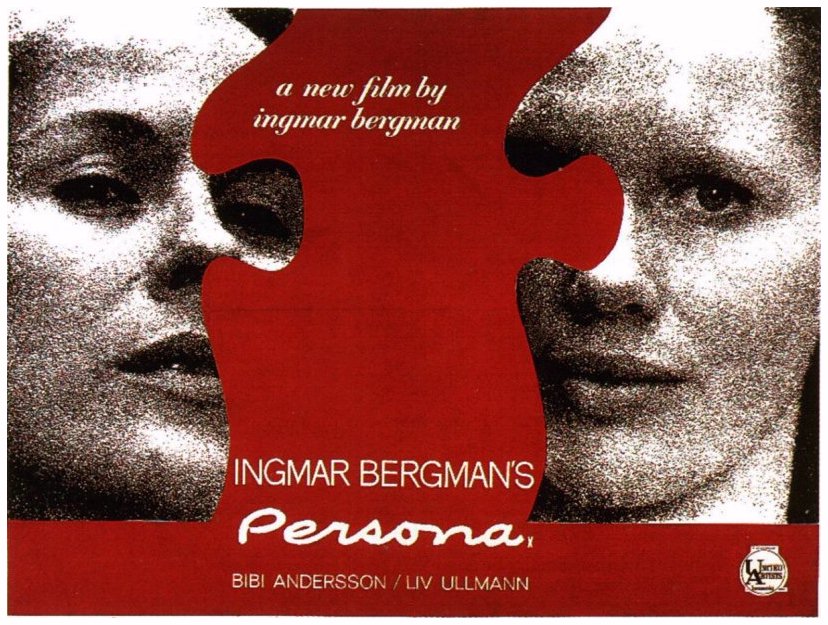
One of the iconic images of the bizarre opening montage of Persona.

The tone seems perfect. By making the setting a quiet, peaceful beach side house, an eerie tension is built between the two women. It's not hard to see how the cheery Sister Alma goes from seeing Elisabet as trusted Mother Confessor to betrayer to emotional vampire. The final phase, in which Alma seems to virtually become Elisabet in a way, seems somehow organic. This is even more amazing when you realize that the film is a mere hour and 20-odd minutes.

The ever-morphing feelings of the two women are communicated even more clearly thanks to the camerawork. With a starkness that I last saw in the German film The White Ribbon (Das Weisse Band), the many black-and-white still shots are incredibly effective. The isolation of Alma and Elisabet is palpable. When Alma reveals her past moment of unbridled sexual abandon, the dark shadows in the house, the quiet of the scene, and the authenticity of the performance are remarkable. It reminded me of a similar scene in Stanley Kubrick's Eyes Wide Shut, when Nicole Kidman's character does something similar, sending her husband into the mental anguish that propels the rest of the story. Bergman built up the same kind of power, without color and three decades before in
Persona.

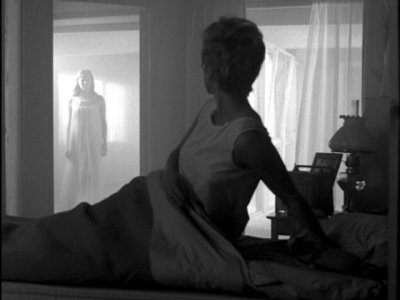
One of the many haunting and quiet images that blur the line between reality and dream between the two women.

So it should be clear that I found plenty of intellectual food for thought and that I think that the film is executed brilliantly. So why do I say that I would probably not watch this movie again? Because it's rather painful in its rawness. This was something that Bergman seemed to veer towards in the latter parts of his long career. Years later, he would go much further with the horrifyingly emotional Cries and Whispers. Persona is not nearly the trial of this later movie, but the discomfort is still there. And when Bergman approached such subjects, there was nary a second of comedic relief. He went at you hard, and didn't dilute the tale with anything that didn't fit the overall sensations he meant to draw out.

The closing scenes of Persona echo the first ones – the young boy, the roughly edited footage, and a film reel burning to its end. However, by the end of the movie, it seemed to make much more sense to me. I may be way off (my further research will probably tell), but it seemed that the fractured images are meant to reflect the mind of Elisabet Vogler. She, as an actress, can be seen as a paid, professional liar who has forsaken any real, human connection for her own success and fame. When this realization strikes her, it sets off the events of the film and results in the fallout for Sister Alma. This is just one theory of mine, however, and the film offers many avenues for more. This is what makes it fascinating, if not exactly pleasurable.

Take 2: Why Film Geeks Love This Movie (Done after some further research)

It always feels good to know that you weren't completely missing the point, eh?

In reading several essays and writings on Persona, I found that I did, for the most part, “get it”. However, this may not be something that the average viewer could or would want to do. It would seem that a fair amount of familiarity with Ingmar Bergman's pre-existing body of work goes a long way. This original review in TIME magazine shows how that reviewer, knowing of Bergman's iconic film images, was able to see the underlying structure of the film right from the strange, fractured, opening shots. Well, that's great if you're an aficionado or just know Bergman's films, but what if you aren't privy to these things? Confusion galore. That's what.

It seems that Persona was very much a major turning point for Bergman himself. He had apparently gotten very ill shortly before making it, and his experience in the hospital served as the inspiration for the story. He even said in a later interview that he had been suffering so much emotional distress that, if he hadn't made Persona in order to release his anxieties, he probably would have fallen apart. When one watches the film, it's not hard to see the existential angst that pervades all of the film's basic conflicts.

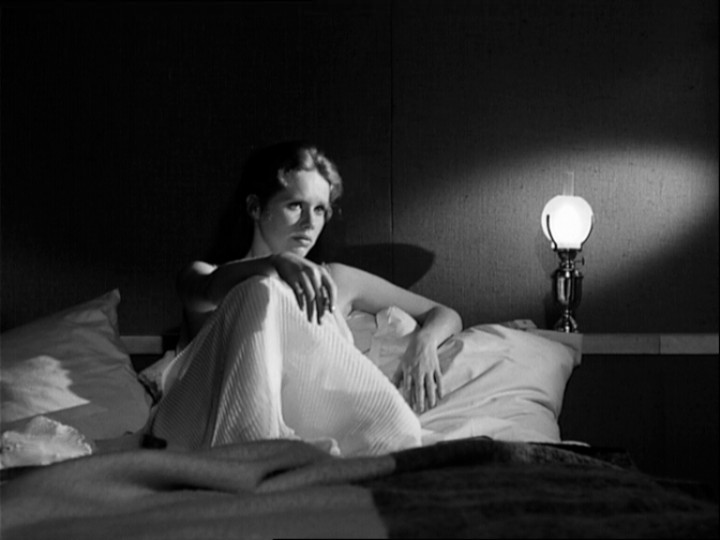
Another of the best-known shots from the film. Within context, it can be one of the eeriest, most sensual, and thought-provoking scenes you can see. And not a word is spoken.

One other tidbit that I found interesting, if only for the fact that it didn't strike me while I was watching the movie. For 1966, this film was incredibly daring. In particular, the scene during which Alma is recounting her sexual escapade on the beach. Bibi Andersen, Ingmar Bergman, and numerous critics have pointed how people will often recount this part of the movie as if it were actually shown on the screen, and not just relayed through Sister Alma's recounting. Such is the power of the scene. When I think about how forthright and honest the description is, it's not surprising to find out that several edited versions of the film were cut up for American audiences (we're always the prude ones).

Whenever I come across such an editing incident, it reminds me of just how Puritan our culture is, at root. Bibi Andersen's telling of the story as Alma is so authentic, and the story so incredibly believable, that most people would find it uncomfortable. Yet, most countries didn't feel the need to cut it out. Why? Because that's reality, folks. Sometimes the sweet, naïve, pretty nurse decides to throw caution to the wind and have some unprotected sex on the beach with some strange boys. Alma made a decision to dive into the unbridled sensual life for an afternoon, and Persona shows her reliving it through the retelling, with more circumspection and introspection than actual remorse. That's what Persona gives you – plenty of complex actions and emotions for mature, meditative humans to think about.

That's a wrap. 61 shows down. 44 to go.

Coming Soon: Closely Watched Trains (1966)


I'd never heard of this movie, but here's the summary on the DVD, verbatim: “Surrounded by but seemingly removed from the violence of Word War II, a naïve railroad apprentice working at train station in Nazi occupied Czechoslovakia carves some excitement by exploring his own sexuality.”

Now I ask you – how could I top that, and how can I not watch this film?! Come on back to see how this little “adventure” goes.

Please be sure to pick up all empties on the way out.

Saturday, August 27, 2011

Film #60: Bande a part (1966)


Title for us English-speaking Types: Band of Outsiders

Director: Jean-Luc Godard

Initial Release Country: France

Times Previously Seen: none

Teaser Summary (No spoilers)

Trio of young, restless Parisians attempt a heist, in their own silly, amateurish way.

Extended Summary (A more complete plot synopsis, spoilers included. Fair warning)

In 1960s Paris, buddies Arthur (Claude Brasseur) and Franz (Sami Frey) are in the midst of planning a burglary. The two men are complete novices at thievery, but they seem bored and mildly desperate, and opportunity presents itself. That opportunity has come through Odile (Anna Karina), a pretty young girl whom Franz has met at an English school. Odile lives with her aunt in an impressive home, where she says their current boarder has a stash of millions of francs which he has stolen from the government. Odile tells Arthur and Franz that the money is left in an unlocked cabinet in an unlocked room. The three decide to relieve him of the money and escape their dull lives in Paris.

Over the course of a few days, the three grapple with their impending crime and their own feelings for each other. All three seem friendly enough, in their own flighty ways, but they all face uncertainties. Franz is a bright, well-read man who has genuine feelings for Odile. Odile, the youngest, the most nervous and guilt-ridden of the three, falls for Arthur. Arthur has a quirky yet dark charm, but is somewhat cold and beholden to his heartless and greedy family.

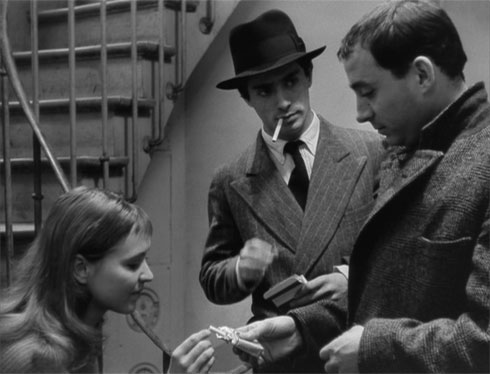
The triangle takes shape: Odile (left), accepts a cigarette from Arthur (right), after coldly refusing Franz (middle).

When the planned date of the robbery approaches, problems start to arise. Odile’s nervousness increases, but the fellows calm her enough to go in and allow them entry to the house. After they “break” in, they soon discover that the previously unlocked room is now firmly locked. They try the outside window, but this too is locked. Odile explains that her aunt and the boarder must have gotten suspicious, based on her own slight disheveling of the room on a previous search through it. Franz and Arthur, frustrated, abandon the job for the day, but pledge to return on the morrow.

The next day, the scene from the prior day repeats itself, to a degree. Odile lets the men in, and Arthur and Franz bully her aunt into giving them the room key, and then they bind her, gag her, and lock her in a massive cabinet. They get into the boarder’s room, but the cabinet is now empty of all but a few thousand francs. When they return to try and get the money’s location out of the aunt, she appears lifeless. They assume she is dead and they flee the house. Just as Arthur, Franz, and Odile are about to drive away, Arthur decides to double back and check to see if the aunt is indeed dead. He promises to meet Franz and Odile a short while later.

During the second robbery attempt, Arthur unleashes his nasty side, while Odile looks on.

Franz and Odile, driving away from the house, spot Arthur’s nefarious uncle, who has known of the planned caper all along, heading towards the house. Franz has a bad feeling about it all, makes a quick U-turn, and tries to catch up. When he and Odile approach the house, their fears are realized: they see Arthur emerge from the house, go into an attached doghouse, and fish the missing money out. As he is carrying the bundles of cash away, his own uncle steps out of the bushes and shoots him several times, the money spilling onto the lawn. Arthur does manage to shoot and kill his uncle in return, but then dies himself. Odile and Franz, watching from afar, then see Odile’s aunt, alive and well, come out of the house just as the boarder arrives on the scene. The two scoop up the money and scramble inside. Franz and Odile leave the bloody scene and drive away.

On the road away from the carnage, Franz and Odile share their feelings for each other and realize that they love one another, even through the attempted crime gone horribly wrong. They decide to board a ship and head to Brazil, where they hope to live happily together and explore a place far removed from their lives in Paris.

Take 1: My Gut Reaction (Done before any further research)

This was a peculiar little movie, but a rather enjoyable one.

Before watching Band of Outsiders, the only other Jean-Luc Godard film I had seen was the influential science fiction film, Alphaville. I found Alphaville interesting and imaginative, but also rather baffling. Band of Outsiders was also a bit baffling, but in different and more amusing ways.

While watching this movie, I couldn't help but think of one of my absolute favorite comedies, The Big Lebowski, that fantastic, bizarro take of the Coen brothers on the noir genre. The Coen's clearly took the premise of “What if a burnt-out stoner were thrown into a 1940s-style noir crime tale set in 1990's Los Angeles?” and ran with it. In Band of Outsiders, Godard seemed to do something similar, asking, “What if three semi-hapless youths tried to pull a heist, and the story were told in noir style?” The results are pretty entertaining and, I imagine, quite novel for 1964.

From the beginning, the film does a good job of establishing the tone. Franz and Arthur drive out and “case” the house they plan to rob, but they can't help lapsing into silly games of “Billy the Kid versus Pat Garrett,” romping and rolling around the street like a couple of 8-year-olds. Master criminals, these are not.

Arthur and Franz, clowning around in the middle of their first recon of the house.

When the young, pretty, uncertain and almost accidentally devious Odile appears, she adds another dimension. Like Franz and Arthur, she knows only that she doesn't like her current life in Paris. Throughout the film, the three flirt with each other and make attempts to reveal their feelings about and to one another, without much success. Franz has a deeper, more thoughtful attraction to Odile, who is infatuated with the more reckless, immature and mysterious Arthur, who lusts for Odile but is more interested in the loot. It's a half-baked love triangle that one would expect from aimless youth.

The style of the film is a comedic take on noir movies. The voice-over narration reveals the inner thoughts of the three main characters. In a standard noir, such as Out of the Past or Double Indemnity, this adds psychological depth, mood and tension through terse, poetic language. In Band of Outsiders, it provides an extra layer of humor by revealing that neither Franz, Arthur, nor Odile is possessed of so much as a fraction of the ability, weariness or resignation of legitimate noir protagonists. They are restless and scattered, and their preoccupations make them horribly suited for lives of crime. But, what else are they going to do?

The plot itself is nothing extraordinary. When I saw “French” and “crime” on the DVD summary, I was ready for something quite different. Having enjoyed several French crime/escape flicks, such as Le Trou and Rififi, I hoped for a similarly tight, fast-paced caper film. Band of Outsiders makes the object of the thieves' desires one that any crime film can utilize – bundles of dirty cash – but makes its obtainment (and failure of) so simple that it's laughable. The money just sits in a cabinet, and the thieves are first thwarted when the cabinet is locked, and later when the money is moved into a nearby doghouse. There's something oddly and hilariously more realistic about all of this.

The "bande" kill some time before the heist by racing through the Louvre. Just one of their sillier adventures.

The acting is all solid. The roles were not extremely demanding, but the three main characters needed to convey uncertainly and antsiness in just the right amounts, and all of them did so. As with any film in a language that one doesn't speak, I'm sure that I even missed some of the subtle humor that can be conveyed by phrasing and tone, but the subtitles seemed to do a good enough job to keep me laughing in appropriate moments.

If a have to knock my viewing experience at all, I would say that it was due to the disorienting nature of the movie. Perhaps this was due to my ignorance of the film going in, but it takes a while to get a full grip on what the movie is trying to do. There are moments of silliness, gravity, dancing, somber soul-searching, deaths by gunshots, and overblown death throes, among others. At times it borders on incoherent, but it never slipped over the edge to me.

Another thing that tried my patience a little was the dialogue. Like many French nouveau movies of the same era, the characters tend to speak in oddly existential epigrams at times. This may have been another element that Godard meant as a mild spoof, but it was hard to be sure. When someone like Odile, who, according to the narrator “wondered if the boys noticed her breasts moving beneath her sweater,” later observes that, "All that is new is, by that fact, automatically traditional." It's hard to tell whether this is supposed to imbue her with a more rounded character, or if we are simply supposed to laugh at her suddenly-found profundity and/or pretension (two things that many French films have in nauseating abundance). Hard for me to say.

Band of Outsiders was a fun, quirky little film to watch. It was far from taxing, length-wise (a mere 93 minutes), and never got mired too deeply in the few elements that I could have found annoying. Would I watch it again? Perhaps, but I wouldn't rush to do so.

Fin. Franz and Odile take a slow boat to Brazil - some place that's not France.

Take 2: Why Film Geeks Love This Movie (Done after some further research)

Not a ton of information out there on this movie, and nothing that surprised me or altered my view of it too much.

In general, it seems that this movie is revered for the blending of its lighthearted tone with its aping of previously-established styles. Several scenes and visuals in the film inspired several later homages in other movies. The one most often mentioned is the “Madison dance” scene. I didn't mention it, but it is a standout scene for its humorous strangeness. One of the more modern and well-known homages of the scene is the Vincent Vega/Mia Wallace dance number in Pulp Fiction.

The famous "Madison dance" scene. Strange? Yup.

A rather heady 2003 essay by Joshua Clover can be found here. Mr. Clover is clearly well-versed in film history, and he draws connections between many elements of Bande A Part, its American root elements, and the relationship to the French New Wave movement of the time. It's an interesting read, though dizzying at times.

That's a wrap. 60 shows down; 45 to go.

Coming Soon: Persona (1966)


Ingmar Bergman has gone all serious, psychological, and disturbing on us! Last time one of his films was in this list, it was the delightful Smiles of a Summer Night. I've seen Persona before, and I know not to expect the easygoing, sly comedy of that earlier film.

Please be sure to pick up all empties on the way out.

Saturday, August 20, 2011

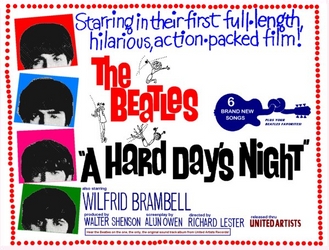
Film # 59: A Hard Day's Night (1964)


Director: Richard Lester

Initial Release Country: United Kingdom

Times Previously Seen: none

Teaser Summary (No spoilers)

The iconic pop quartet spend a day running from fans, being cheeky, and mixing in several smash hits.

Extended Summary (Spoilers included, not that it matters)

Pop music sensations The Beatles are busy young lads. On one “typical” day, they spend their time charming some fans with their playful puns, avoiding stodgy drags with impish impassivity, or simply driving the teenyboppers wild with their monstrously popular tunes. They bounce from trains to limos to concert halls to night clubs, bringing their playfully subversive charm with them.

Accompanied by Paul McCarthy's rakish granddad and the band's managers, the Fab Four break into song several times, be it in a train car, on the street or in its presumed proper place, a concert hall. After a series of misunderstandings nearly lose their drummer, Ringo Starr, to arrest by the local police, the four arrive at that evening's gig just in time play their set, sooth the panicked stage manager, and send the adolescent girls into absolute rapture.

Lennon & Harrison, dazzling adoring fans by their meer presence.

After all of the screaming, cheering and hoipaloi die down, John, Paul, George and Ringo run off with their managers to board a helicopter and fly away, presumably to the next day's gig and yet another bout of non-stop insanity and hijinx.

Take 1: My Gut Reaction (Done after this first viewing, before any research on the film)

I simply don't get it.

This isn't to imply that there's anything about the movie to “get”. What I mean by that opening line is that I don't get why it's placed on the TIME magazine “100 Great Films” list. A Hard Day's Night is ultimately harmless fun, featuring arguably the most popular band of all time. Still, it showed me nothing that would explain bestowing “great film” status on it.

I suppose full disclosure would be appropriate. I am not a huge Beatles fan. I have nothing against them. I certainly don't dislike them. In fact, I have several albums of their and actually quite like several of their songs. However, I've never felt drawn to them with the religious dedication seen in so many millions of other people. Not even close.

The rabid fandom gets going early and continues through the film and into the 21st century.

I can best describe myself as being a “post drugs” Beatles fan – a person who likes the music they made after they started dabbling in better living through chemistry. Hence, all of the songs I like are from 1965 and after (Revolver, Rubber Soul, and their successors). A Hard Day's Night predated these by a few years and was the apex of The Beatles early, teenybopper heyday (after seeing this film, I might dub The Beatles as the first ever “boy band”, though they grew out of that shortly after). The music was pure bubblegum – catchy, crisp, and lyrically shallow. The movie follows suit, for the most part.

Going into the movie, I didn't really know what to expect. I didn't know if it was a pure documentary or what. The answer was “or what”. A Hard Day's Night was a comical take on the hectic daily life of an incredibly popular “band on the run”. While the four band members play themselves, everything in the film is totally scripted, and it is quite clearly meant to be a lighthearted farce. The boys crack wise, ditch their uptight managers, and generally frustrate any person over the age of 30. The kids obviously loved it.

I, however, am not a starry-eyed 15-year-old British girl (so my girlfriend tells me). Whether my age had anything to do with it, I can't be sure, but I found the movie to be mostly a bore. There are a few one-liners that elicited a chuckle here and there, but the vast majority of the movie was plain dull. The jokes were mostly lame puns and the physical comedy was sadly sophomoric.

McCartney hides from fans by wearing a fake moustache. Just one of many silly jokes I can only guess were aimed at the vaudevillian/8-year old demographic.

One reason I assume people rate this movie highly is the music. The soundtrack is, essentially, the album of the same name. Without doubt, some of the band's most enduring and infectious hits are to be heard and seen performed. If you love that album, you'll no doubt love the movie, just for hearing the songs. As previously explained, though, these are not the Beatles tunes that draw me in. For me, these little musical interludes simply tried my patience.

I do have to say that the movie is shot well. It's in black and white, but the framing is solid and the acting is decent enough. Alas, it takes far more to make a great film. Sure, this one features a pop music group the likes of which may never be seen again, since our modern culture precludes the dominance of any one superstar band or group, but it's still very flat to me.

For people who love The Beatles in general, or just prefer their earlier G-rated vibe, this movie is probably one that you'd like. It wasn't my cup o' tea, sorry to say.

Take 2: Or, Why Film Geeks Love This Movie. (Done after some further research on the film)

A little research has shed a wee touch of light on the enduring praise of A Hard Day's Night.

While the earliest reviews, including this original one from TIME magazine, seem to find the movie far funnier than I did, several more modern reviewers bring up more salient points. As is often the case, Roger Ebert saw the greater picture in this 1996 review of his. Though he also found more humor in the movie than I did, he pays even more attention to the technical merits exhibited by director Richard Lester. Lester's unique blending of various filming styles apparently influenced movies, TV shows, and television commercials for decades to come. I certainly can't argue with this, as the cinematography was a clear standout aspect of the movie.

The other semi-novelty is that A Hard Day's Night was apparently an early stab at the "mockumentary". It certainly doesn't go all the way, as later films such as "The Ruttles" or "Spinal Tap", but one can see how the zaniness is there, though much tamer than those later entries to the genre.

I must that that, even in the more sober reviews, I couldn't help but think that the writer's couldn't shake off a certain amount of nostalgia. I'd probably do the same for any group that provided the primary soundtrack to roughly 15 of my formative years, if such a band existed. Despite this, I have to take the glowing reviews from the Baby Boomers with a tiny grain of salt.

That's a wrap. 59 shows down; 46 to go.

Coming Soon: Band of Outsiders (1964)


A French crime movie, oui? Actually, I've found many a pleasant surprise in watching French crime films, so I look forward to this one. Come back and check out my review, non?

Please be sure to pick up all empties on the way out.

Monday, August 15, 2011

Film # 58: Dr. Strangelove: Or, How I Learned to Stop Worrying and Love the Bomb (1964)


Director: Stanley Kubrick

Initial Release Country: United States

Times Previously Seen: Roughly 7 or 8 (Last time – about 5 years ago)

Teaser Summary (No spoilers)

Wingnut general unleashes nuclear bombers on Russia. Loads of bizarre and hilarious characters fumble their way through the insanity.

Extended Summary (More complete synopsis; spoilers included. Fair warning)

In the middle of the Cold War, at Burpelson Air Force Base, deranged, rogue brigadier general Jack D. Ripper (Sterling Hayden) sends out a “go” code to an entire fleet of bombers. His orders are for them to dump their nuclear payloads onto scores of targets inside the Soviet Union.


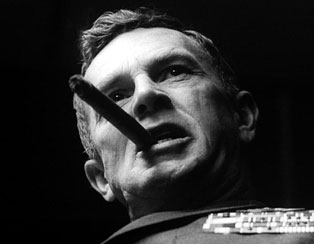
General Jack D. Ripper - the man who seeks to annihilate the entire Soviet populace based on a rather...unusual theory.

When word of this catastrophic attack command reaches the U.S. War Room, General Buck Turgidson (George C. Scott) is called to confer with the country's executive and military leaders. Turgidson is a buffoonish hawk, completely caught up in the Red Scare, and suggests that the U.S. simply allow the unauthorized attacks to take place, as this will give them the upper hand in a Third World War. President Merkin Muffley (Peter Sellers) scoffs at this and starts the process of contacting the U.S.S.R. In an attempt to warn the Soviets and seek a solution.

In the air and fast approaching Soviet air space in the crew of one of the B-52 bombers, this one being flown by Major “King” Kong (Slim Pickens). The crew is rather nervous about getting the attack codes, as it signifies the start of all-out nuclear war. Still, the crew is determined to carry out their mission.

Back in the War Room, it soon becomes very clear than recalling the bombers is an impossible task. General Turgidson explains to all present that recent and obscure legislation allows for a single general to enact an attack under his own authority under certain provisions. While these provisions were not met, the rogue General Ripper has ceased to care. The President grows more desperate.


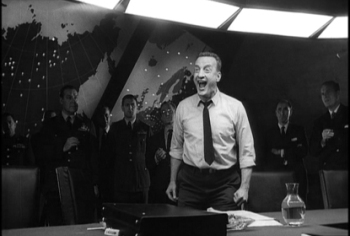
General Buck Turgidson continues his half-baked attempts in the War Room to bulldog the rest of his peers and superiors into pressing the attack on Russia.

Back at Burpelson, British group captain and executive officer Lionel Mandrake (Peter Sellers again) soon discovers that the supposed Russian attack is not true, and he confronts General Ripper. Ripper locks Mandrake into his office and explains his reason for launching the bomber attack: he believes that the communists are taking over American “bodily fluids” through fluoridation. At this point, it is clear than General Ripper is thoroughly insane. Mandrake demands the recall codes, but to no avail. He must await his psychotic superior's next move.

In the War Room, President Mandrake calls on the Soviet premier and calls in the Soviet diplomat in an attempt to resolve the crisis. In explaining the impending catastrophe, it is revealed that the Soviets have just created a “doomsday device” that will exterminate all life on the face of the earth, should any attack be made on the Soviet Union. The choices are now stark – the president enacts two assaults: one by the Americans on Burpelson Air Force Base, in order to wrest the recall codes from Ripper; and another, Soviet attack on the B-52 bombers that are rapidly approaching their targets inside the Soviet Union.

At Burpelson, the base has come under attack by the U.S. Army, and Ripper fights back. With Mandrake attempting to reason with him, Ripper keeps up his fight until the last moment. When it is clear than he can hold out no longer, Ripper commits suicide, seemingly taking the recall codes with him into the hereafter. However, Mandrake puzzles out the codes from some of Ripper's desk scribblings. After a bizarre hold-up at the hands of a dense and over-zealous army officer, Mandrake reaches the president.

In the War Room, the government's plan seems to have worked. The Soviets have shot down many of the American bombers, and the codes sent along by Mandrake have recalled all of the others. All, that is, except...

...the B-52 piloted by Major Kong. Their coding equipment having been shot up, they have not received the recall code from base. In addition, they have eluded all attempts to shoot them down. With gumption that is almost admirable, they make it to one of the targets and attempt to drop their payload. However, the bomb doors are jammed. In a final act of wherewithal, Major Kong straddles the bomb, fixes the bomb door wiring just above it, and rides the bomb down to its target. Nuclear winter has begun.


Major Kong succeeds in bringing his payload. Personally.

Back in the War Room, the mood is understandably somber. That is until the floor is taken by the wheelchair-ridden Doctor Strangelove (Peter Sellers, yet again), an ex-Nazi-turned American adviser. He seems oddly chipper about the entire scenario. He explains that the world's leaders can survive within caves beneath the earth. In his scenario, he suggests that the military and political leaders will take precedence and that they will have ample provisions to survive. In addition, in order to repopulate the earth after the fallout clears, they will need a high ratio of women to men. The cherry on top is that these women will need to be exceptionally attractive, so as better to allow the men to function in their role as procreators. With all of this to ease their worries, all of the men in the War Room seem to have already moved far beyond the nuclear apocalypse taking place above their very heads, to the point that they are already plotting how to get a leg up on post-Apocalyptic competitions with the Russians.

Did I Like It?

If you noticed how many times I've seen this film before, the answer is obvious. This most recent viewing did nothing to change my mind – this movie is one of the greatest comedy films of all time.

Now sure, there are probably other movies that I've laughed at more, and there are probably some comedies that have been wittier. But for balancing sheer inventiveness, zaniness, and canny social commentary, Dr. Strangelove is all but untouched.

While the theme of lampooning the Cold War era political philosophies of fear-mongering and arms racing may seem dated, it surely is not. The entire notion of the pre-emptive strike will never go away, and Dr. Strangelove takes the idea to its Swiftian extreme. Considering how the specter of nuclear holocaust continued to haunt the world for decades after the book and movie's release, Dr. Strangelove has serious staying power. By pushing the era's prevailing martial ideologies a little (I stress “a little”) further, it's easy to see how laughably insane they were. (We can laugh now, anyway.)

Beyond the brilliance of the story line and its execution is the real strength of the movie – the actors. Dr. Strangelove is mostly populated by caricatures goofy enough to laugh at, but also frighteningly real for what they represent. Such a strange balancing act can only be pulled off by just the right cast, and this film got it perfectly. Sterling Hayden as the chillingly calm, thoroughly insane General Ripper is as horrifying as he is hilarious. (His interactions with Mandrake are some of my favorite scenes in any movie). I can't imagine gung-ho pilot Major King Kong being played by anyone other than uber-hick, Slim Pickens. Even the bit role of Sergeant “Bat” Guano is done to pitch perfection by Keenan Wynn and his fantastically mispronounced catchphrase, “pre-versions”. As excellent as all of these, and other, actors are in the film, they are far surpassed by one of the all-time greats.

Peter Sellers, who had some of the most memorable comic performances of all time throughout his career, pulled off his greatest feat in Dr. Strangelove. In playing the amusingly sober Commander Mandrake, the oddly pliant President Muffley, and the hilariously twisted title character, he utilized every one of his considerable acting skills. It's been said of Sellers that few people (if any) actually knew the real man, for he would so completely lose himself in the characters that he was playing. In watching Dr. Strangelove, it's not hard to believe this. If you didn't know better, you may not even guess that the same actor is playing all 3 vastly different roles, as each of the three is busting your gut in vastly different ways. Just seeing him is more than worth the price of admission.


Officer Mandrake does his best to weather the storm of deranged General Ripper's apocalyptic dementia. Seller's role as Strangelove may be more iconic, but his turn as Mandrake is far funnier to me.

One interesting mental note I made as I watched the movie this most recent time – I had a moment of emotional guilt, not unlike when I was watching Double Indemnity earlier in the list. At the moment when the B-52 crew is trying to desperately make their bomb run, I felt myself pulling for them. Major Kong, the all-guts patriot/pilot redneck, shows no end of moxy by shrugging of missile attacks, broken fuel lines, and other malfunctions to get to his target and drop his payload. As I watched him almost single-handedly overcome each obstacle, I admired the simple yet brave soldier. Then I realized, “Wait a minute...this guy's about to trigger the ultimate nuclear winter!!!” There's something about watching a truly determined character use sheer willpower to smash through barriers that's gratifying, often regardless of their ultimate goal.

So yeah – I love this movie. I'll certainly watch it many more times in the years to come, and I can't recommend it highly enough. There may be a few moments where things seem a little slow (particularly in the B-52 scenes), but this film is a masterpiece the likes of which may never be duplicated.

That's a wrap. 58 films down, 48 to go.


Coming (Very) Soon: A Hard Day's Night (1964)


The Fab Four in one of their early feature films. I certainly respect, if not exactly love, the Beatles. Let's see how they did on the silver screen.

Please be sure to pick up all empties on the way out.
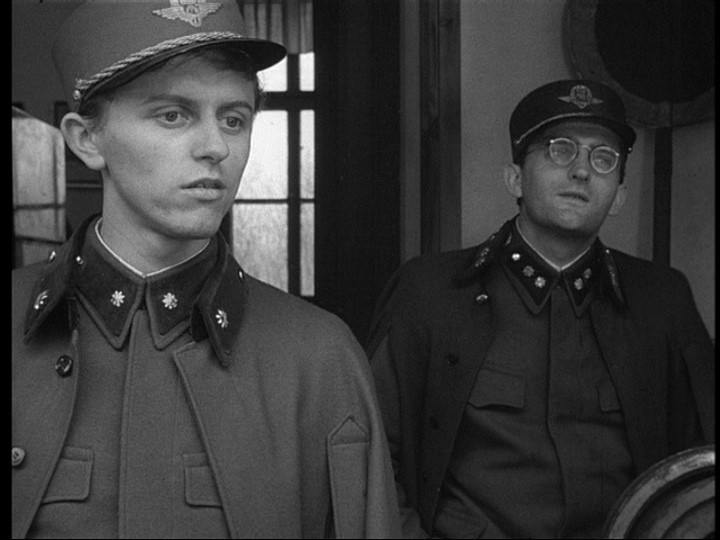
Thursday, June 2, 2011

Film #57: Charade (1963)


Director: Stanley Dolan

Initial Release Country: United States

Times Previously Seen: once (about 2 years ago)

Teaser Summary (No spoilers)

Newly widowed, ever-chic waif is hounded by mean strangers over a mysterious fortune left by her enigmatic dead husband. Wears fantastic hats.

Extended Summary (Lengthier synopsis, including major spoilers. Fair warning)

Somewhere in France, a body is found beside a railroad track. The corpse was Charles Lampert, whose widow, Regina (Audrey Hepburn) at first knows nothing of her husband's death. Instead, she has been whiling away her time on a ski slope, complaining to a friend about how she knows virtually nothing of her husband, and will soon be asking for a divorce. While at the ski lodge, she has a brief flirtatious encounter with Peter Joshua (Cary Grant), a suave American seemingly on holiday as well.

Upon her return to Paris, Regina discovers that she and her husband's 5-star hotel suite has been completely gutted of all belongings. At police headquarters, she is informed that her husband has been found dead, but not before he had sold off he and his wife's belongings and attempted to flee the country for some unknown reason. The questions about Regina's deceased husband increase.

Regina Lampert, sporting the only sunglasses that could possibly be larger than her Japanese animated character eyes.

Back at her hotel room, Regina is soon met by Peter Joshua, who has looked her up and found her deep in thought. After hearing her story, he offers to help her in any way that he can. At Charles Lampert's funeral the next day, Regina witnesses more oddity: three distinctive men, known as Panthollow (James Coburn), Scobie (George Kennedy) and Gideon, one-by-one, approach the open coffin of the dead man and carefully check to see that he is dead. Regina merely watches in stunned amazement.

After the funeral, Regina is contacted by U.S. Treasury official Hamilton Bartholomew (Walter Matthau), who clarifies a few things, while adding new mysteries. He explains that Charles Lampert's real name was Charles Voss, and that he was part of a small U.S. military group that stole $250,000 that was meant for the French resistance during World War II. Voss/Lampert was part of the five-man conspiracy, which included the three strange men from Lampert's funeral, as well as a fifth man named Dyle. Voss/Lampert, after many years of waiting, snuck in and stole the money and was running off with it when he was killed. With Voss/Lampert dead for a certainty, the surviving conspirators are all after the money that they are sure he spirited away from them. The problem is that no one knows where the money is, but everyone thinks that Regina does. The only clues that Charles Voss/Lampert left behind are in a travel bag which seems to contain nothing out of the ordinary.

As if this winding tale weren't confounding enough, the confusion grows as Peter Joshua becomes more involved. At first, he is the helpful compatriot, Peter Joshua. However, he then seems to be in cahoots with the other three thieves, as they refer to him as Dyle. He later explains that he is not the original Dyle, who is presumed dead, but Dyle's brother, and he is seeking revenge on the other three treasure seekers. This, too, is another fabrication, as “Dyle” admits to a third identity – that of an international thief named Adam Canfield. All of these shifts and covers are slowly revealed to Regina through their interactions. Frustrating as it all is to her, she finds herself falling in love with this mystery man, as he repeatedly saves her from the other three fortune hunters.

The mystery man shows off his true professionalism by not laughing at that ridiculous excuse for a hat that Regina Lampert is wearing.

The serious problems start when more deaths occur. First is the massive Scobie, who is found drowned in The Mystery Man's tub. Shortly after, Gideon is discovered with his throat slashed in the same hotel's elevator. It would seem that the only suspects are the still-living Tex Panthollow or Regina's identity-shifting protector/rogue, The Mystery Man.

Just as all of this is transpiring, The Mystery Man presses Regina for any information that will still lead him to the $250,000 and save her from any further threats by Panthollow. She does recall a meeting place and time, which is in a nearby public park. When The Mystery Man arrives, he notices that Panthollow is already there. At first, neither of them understands the significance of the park. That is, until they both notice the massive swap meet of stamp collectors. Panthollow recalls that one of the items in Charles Voss/Lampert's travel bag was a letter affixed with three stamps. He also correctly assumes that these stamps must be the hiding place of the quarter million dollars. He races back to Regina's hotel room to get the stamps. The Mystery Man puts together the same pieces, finds Panthollow back in the room, but discovers that, while the letter and envelope are still there, the stamps have been torn off.

Back in the park, Regina sees the results of her own little maneuver. She had realized the value of the stamps and sent them to a friend for safe-keeping. Following a nearly disastrous sell-off of the stamps, she recovers them. We then learn that the three stamps are, indeed, worth an amazing $250,000.

Regina returns to her hotel room and is horrified to find Tex Panthollow's dead body in her room. His dead fingers have sketched out the name “Dyle” on the carpet. As Regina flees, The Mystery Man himself arrives and begins to give chase. Regina runs and manages to contact the Treasury Agent Bartholomew for help. All three people converge between the massive marble pillars of an outdoor plaza. Both Bartholomew and The Mystery Man are armed and ready to kill each other. It is only now that The Mystery Man realizes and explains to Regina that Bartholomew is actually the original Dyle; that he was never killed in the War, and that he has been posing as a Treasury agent and killing the other thieves in order to get at the money through Regina. While he denies it at first, Bartholomew eventually admits to the truth. He threatens Regina in an attempt to wrest the valuable stamps from her, but The Mystery Man gets to the real Dyle first, shooting him dead.

Hamlton Bartholomew, one of several characters who are not quite what they seem.

The following day, The Mystery Man and Regina go to the American Embassy to return the $250,000 that was originally theirs. The Mystery Man decides to remain in the hallway, claiming that, being a professional thief, it would hurt him too much to see so much money simply given away. This, however, is his final ruse. When Regina strolls into the office of Treasury Director Crookshanks, she discovers that he is, in fact, the man who has been so rapidly swapping names. This final identity is, however, genuine, and the two fall into each others' arms.

The Verdict

Charade is a decent enough movie, and it held my attention, but this was despite some really serious problems I have with it.

The good? One thing is the overall plot. As far as playful suspense movies go, the story in Charade clicks along really well. Like many of Alfred Hitchcock's stronger suspense movies, the viewer is intrigued enough to try and piece together the strange scenarios. However, every time you think you have a handle on it, one of the variables changes. This is typified by the nominal chameleon, Agent Crookshanks. Even though I wasn't completely in love with this movie, the time flew by pleasantly enough as I scrambled to keep to up with the plot.

Helping out the telling of the tale are some humorously 2-dimensional characters brought to life by some solid acting. While I have serious problems with some of the acting (I'll get to that in a moment), James Coburn and George Kennedy are enjoyable. Even better, I felt like Walter Matthau steals all of his scenes. His effortlessly dry humor is perfection.

Another undoubted strength is the visuals. As might be expected from a director who was behind such technicolor musical standards as Singin' In the Rain and many others, Charade's vibrancy is rather appealing. The shots are framed perfectly, and all actors and props are right in their places. Such compositions make the film exceptionally easy on the eyes.

One of the many shots in the film that could make a pretty decent postcard. Note the artful arrangement of colors.

All of these positives just barely outweighed the nuisances to me. First among these bugaboos is that there is a serious lack of cohesion in the speech and actions of the main characters. Both Regina Lampert and Crookshanks make odd swings between being silly and playful to being highly emotional. This leads to some rather strange scenes and annoying interactions. Most obvious to me is a rather weird scene in which Crookshanks, to bring a smile to Regina's face after a near-death experience, jumps into a shower fully clothed and pretends to wash. I think it was meant to be charmingly goofy, but it comes off as just bizarre.

The greater problem to me is a major bias of mine: Audrey Hepburn. I am simply not a fan of hers. Granted, the fact that the character she plays is a confusing hodge-podge of attitudes and emotions, and perhaps no actress could have pulled it off. Still, there has always been something about Hepburn's giant-eyed posing and aristocratic air that irks me. I realize that she was the “it” girl in her day and is still seen as a fashion icon, and I guess I understand why. All the same, the only movie in which I've been able to stomach her is My Fair Lady, and that only because she is verbally abused relentlessly by Rex Harrison. Her role in Charade managed only to annoy me with her odd shifts from comically apathetic widower to hopelessly fawning romantic or from clever, cool customer to skitish, hapless victim.

One of many scenes in which Audrey Hepburn over(re)acts. Seriously - it's just a friggin' match, lady.

Will I watch this movie again? Probably not. The riveting aspect of this movie was the suspense of the unknown. Even having watched the movie a few years ago, I had forgotten nearly all of the plot details. Now knowing them all, further viewings would only highlight the things that I don't like about the movie. I would still recommend that nearly anyone who enjoys films give it at least one go. Anyone who really likes Audrey Hepburn and/or Cary Grant will surely not be disappointed, as the former is at her most “adorably” elfish, and the latter is...well, he's Cary Grant.

That's a wrap. 57 shows down. 48 to go.

Coming Soon: Dr. Strangelove: Or, How I Learned to Stop Worrying and Love the Bomb (1964)


One of my favorite comedies of all time, by the otherwise dead serious directing great, Stanley Kubrick. If any film on this list has a chance to unseat Kind Hearts and Coronets as “darkest comedy”, this is the one...

Please be sure to pick up all empties on the way out.